954
Models of Moderation-based Instructions in Teaching ENGLISH at Islamic Senior High Schools in Makassar
Hanafie Pelu1, Murni Mahmud2, Sahril Nur3, Kisman Salija4 Balai Diklat Keagamaan Provinsi Sulsel1
Universitas Negeri Makassar2,3,4 Email: [email protected]
Abstract. Moderation is an important aspect in education since it can contribute to democratic education. The educational system in Indonesia needs to consider implementing the concept of moderation, especially in Islamic Schools. For this purpose, this research aims at exploring the models of moderation in Islamic Schools in Makassar. This research focuses on exploring moderation-based instruction models in teaching English at Islamic Senior High School in Makassar. The subject of the study is an English teacher and the students of one Islamic Senior High School in Makassar. This study employed an ethnographic research design. The researchers applied observation, interview, note-taking, and documentation of English teachers in exploring the implementation of moderation-based instruction in teaching English. Findings from this study show that PELA Model stands for Preparing material, Establishing and adopting the local wisdom, Learning to apply in ourselves before teaching others, and Applying moderation based instruction in English teaching. This model is only a suggested model that should be followed up by further research to examine and measure the effectiveness. This study will contribute to the professional knowledge of how to implement moderation in teaching English in Islamic Schools in Indonesia and provide insights for policy-making and improving the quality of primary-school level English language teaching in general.
Keywords: Moderation; instruction; moderation-based instruction; English Language Teaching
INTRODUCTION
English language instruction is not only a matter of imparting a specific set of abilities to students. Rather than that, the occupation of ELT is strongly permeated with values, which are complex and fraught with dilemmas and conflict (Johnston, 2003). Learning the English language assists in developing intercultural understanding. It is a means of improved communication and promotes global understanding and respect for cultural diversity. When students inculcate morals and values through English language learning, it also enhances their language acquisition skills. Integrating values in the teaching and learning process is in line with the goal of national education. Indonesian national education system law number 20 the year
955
2003, chapter 3 states that the goal of national education is to develop educated people with life skills and good character building. So, all levels of our education should integrate character values into the curriculum, syllabus, lesson plan, and teaching-learning materials (Abdullah et al., 2021). Indonesian minister of education develops a grand design for implementing character values in all levels of education.
Through character-based education, students will have the opportunity to maximize their potential.
English, as a school subject, also contains character values that should be fostered through its educational activities (Patak et al., 2020). These character traits have been developed to aid in the success of language learning. Because when studying a language, the learners learn how to master the language skills and learn how to use them politely and properly. Individuals typically learn and utilize language solely to convey their ideas, beliefs, and thoughts, or as an intellectual exercise.
Language is more than those purposes. It is also used to express norms, values, and even emotions. It is strengthened in the new curriculum 2013 that the learning outcomes cover cognitive aspects and skills and attitudes. The 2013 standard of competence encompassed attitude and behavior, ability and knowledge. As a result, the standard competencies are subdivided into core competencies. In core competence 1 is about religious competence or how the students respect and apply their religion theory. Core competency is about establishing appropriate behaviors (honesty, discipline, responsibility, care, well-behaved, environmental awareness, mutual aid, politeness, and self-confidence) for effective engagement with society and the world. Religious competence and human behavior were explained explicitly in core competence 1 and core competence. Indeed, religious competence and social competence are primary competencies in English teaching and learning (Kemendikbud, 2013).
English is taught in our country's schools and madrasah (Islamic school).
Madrasah is a traditional Islamic school education system that first incorporated elements of the Dutch school system. It was introduced in the early 1900s (Azra, 1999). The madrasah curriculum is given 30 percent religious subjects and 70 percent general subjects by the government. Madrasah is divided into three levels: Madrasah Ibtidaiyah (Islamic elementary school), Madrasah Tsanawiyah (Islamic Senior High School) and Madrasah Aliyah (Islamic high school). Madrasah education is expected to be National Plus, a sound general education based on the national curriculum, as well as a religious education aimed at instilling a strong sense of religious and moral values based on Islamic beliefs. This idea recalls the argument over whether Madrasahs should prioritize religious education over general education or enhance general education at the expense of religious education. This should be rectified by returning madrasahs to the fundamental educational idea upon which they were founded, namely that Islamic education is more complete than conventional general education. Additionally, teachers, students, and madrasah principals require English resources that incorporate Islamic teaching (Rohman, 2017). Under these
956
circumstances, English instruction, particularly at madrasah, should be given with an emphasis on Islamic teaching, a concept known as moderation.
Instilling Islamic moderation values must be done not only through religious subjects but also general subjects like Math, Biology, English, and so forth because students, as the next generation is in charge of the survival of this nation, should be early supplied with Islamic moderation values. Irveanty (2013) stated that with the existence of Islamic character values integrated into every subject in school, especially in English lessons, students could apply the values of Islamic character in daily life. Integrating the Islamic moderation value in the teaching and learning process is not hard work. The teacher can choose the teaching methods which cover the classroom activity involving collaborative activity.
English as a Foreign Language (TEFL) instruction is more relevant when teachers incorporate the culture of the society in which the students live and indigenous wisdom, such as the ideals of the students' religion. For instance, teachers might increase students' motivation by providing an example from a real-world issue and including information about the students' social and cultural backgrounds. As a result, the teacher can integrate the teaching and learning process with the Islamic values of the students‘ background. English teachers teaching at the school should be able to teach and learn English integrated with Islamic values. Therefore, they incorporate an approach of learning, i.e., teachers moderate in the teaching and learning process.
According to the observation by the researchers, teachers of Madrasah Aliyah Negeri 2 Makassar always explain a moral value or advice to the students besides teaching the main material. The teacher tried to take responsibility for shaping the student's attitudes to make the students have noble character. Students at junior high school are still the young characters in the phase of life. They still have their childish attitudes, so some do not know how they should behave. Here is where the teacher should guide students. From the interview with some English teachers of Madrasah Aliyah Negeri 2 Makassar, the researcher found that incorporating Islamic values and English materials in moderation in teaching and learning English. The teachers not only implemented moderation in teaching English but also incorporated Islamic values in the learning process.
The researchers firstly found the concept and the implementation of integrating Islamic values from teaching practice experience at Madrasah Aliyah Negeri 2 Makassar. During that time period, the English teacher taught the topic by inserting verses from the Al-Qur'an and hadith into each chapter that were relevant to the course focus. However, learning English like this brings such a new academic model in education world practice.
Teacher of Madrasah Aliyah Negeri 2 Makassar applied a method that required the teacher to teach the students about moral values besides the main material. Internalization of Islamic values is instilling the student‘s values of Islam.
Every teacher in Madrasah Aliyah Negeri 2 Makassar is required to teach students
957
about the value of Islam, so the English teachers teach about English and the value of Islam. The English teacher would directly give the Islamic value when the teacher or the students discuss a text that contains a moral value. The teacher also gives an example by telling a story of Prophet Muhammad SAW. The value given by the teacher was expected to be practiced by students in their daily life. However, some teachers still face internalization problems because they have to deliver the Islamic value while teaching English. Islamic value is intended to master the Islamic contents and build good student‘s character (Omar & Noh, 2015).
From the background of the studies above, the researchers are interested in investigating the implementation of moderation-based instructions in teaching English at Madrasah Aliyah Negeri 2 Makassar. Two principle aspects made the research different from other researchers. First, the teaching and learning process will be conducted in an integrated manner. The 2013 Curriculum recommends the integration of language skills in teaching and learning. Additionally, integrating the four language skills is believed to increase the emphasis on actual conversation, which is critical for students' English competency development. Second, the implementation of moderation-based instruction in teaching English will pay attention to the school context. Integrating teaching and learning with Islamic values includes how English teachers design the lesson plan, how the English teachers select the instructional materials and media, how the English teachers integrate the instructional activities, and how the English teachers assess the student‘s assessment.
This article examines the models used by teachers at the school to implement moderation-based instruction. This study is expected to contribute to the theory of moderation in English classroom instruction. It is hoped that this study will contribute to professional knowledge about how to implement moderation in English language instruction in Islamic schools in Indonesia, as well as provide insights for policymakers and those responsible for improving the quality of English language instruction at the primary school level in general.
RELATED LITERATURE What is Moderation?
Reconstruction of the theory of moderation in learning is a new thing. In the context of this research, reconstruction theory is drawn from the moderation theory that has been used more on political and social segments. However, the moderate theory is more likely to relate to individual or group attitude statements against two choices. This theory is also born due to a collision between two ideas that have someone to build a stance on the idea. In the study of this research, the moderation theory was used as a value element that must be possessed by the principal, educators, and educational professionals in making decisions in the planning, implementation, and evaluation of learning.
To define moderation, Muslim scholars firstly explore the lexical meanings of its Arabic equivalent, ―wasatiyyah‖. Generally, the word wasatiyyah in Arabic lexicons
958
refers to several shades of meaning such as justice or balance (al-‗adl), merit or excellence (al-faḍl), better (al-khairiyyah), median (albainiyyah) (Sallabi, 1999).
According to Schwedler and Schwedler (2006), moderation is a process rather than a category that comprises development along a continuum from radical to moderate.
Moderation is inextricably linked (and at times explicitly) to liberal concepts of individual rights and democratic concepts of tolerance, plurality, and cooperation.
The study implies that in order to become more moderate, actors must be more sensitive to the possibility that different opinions are valid, if not equally so. But mere participation in elections or democratic processes behavior that might appear to indicate the embrace of liberal and democratic norms of governance is alone in sufficient as an indicator of moderation; participation is a form of political behavior that a group might adopt for purely strategic purposes while continuing to harbor a more radical political agenda. Thus, scholarly models propose a variety of criteria for determining when moderation has occurred and for identifying the mechanisms underlying that change. He reserves the term moderation to refer to attitudes changing positively toward democracy and adopts the term de-radicalization instead as the process of abandoning militancy.‖
Moderation based learning
Moderation is the process by which teachers share, discuss, and agree on their understanding of the expected levels of student achievement and growth across the curriculum. Moderation is critical for maintaining the integrity of assessment tasks.
This method, particularly at the assessment design and point of assessment stages, identifies and improves assessment validity and reliability difficulties. In other words, moderation is the process through which teachers or students share and grow their understanding of what learning looks like through the examination of samples of various types and levels of student work and their comparison to formal criteria.
Understanding the moderation process and how it might be implemented in classrooms is critical for enhancing student learning results. Moderation enables teachers to develop and apply a consistent and precise language of assessment that teachers, students, and families can use to describe and discuss student learning (Ontario Ministry of Education, 2007). Moderation is the process through which teachers or students share and enhance their understanding of what constitutes learning by analyzing samples of various sorts and qualities of students' work and comparing them to established standards and success criteria (Bini, 2019; Victorian Curriculum and Assessment Authority, 2002). The technique provides teachers and students with the structure and processes for attentively examining evidence (student work samples) in order to determine what should be learnt, how learning should proceed, and what should be learned next. Moderation enables discussion about interpreting the Victorian Curriculum F-10 Achievement Standards (Bini, 2019;
Victorian Curriculum and Assessment Authority, 2002), what students need to learn to meet the standards, and what success looks like?
959
Moderation is a form of evaluation, but it is also a technique that bolsters other forms of assessment. It establishes a framework and method for teaching teams, teachers, classes, and individual students to acquire a common and comprehensive knowledge of learning intents, success criteria, and the curriculum standards upon which assessment is based. Teacher moderation is a procedure in which teachers, typically with varying levels of experience and from a variety of year levels, gather to assess student work samples that are aligned with the Victorian Curriculum's F-10 Achievement Standards (Bini, 2019; Victorian Curriculum and Assessment Authority, 2002).
Student moderation is a method that entails embedding learning aims and empowering students to define success for themselves. This may be accomplished by the evaluation of (anonymized) student work samples, the use of rubrics for self- or peer-assessment, or the joint creation of learning objectives. Moderation can be used in conjunction with data walls, as both approaches facilitate robust discussion of evidence of student learning. Both moderation and data walls contribute to the development of effective learning and classroom practices. Moderation also helps build collective efficacy–that is, teachers‘ collective power to improve learning outcomes for students (Heineke & McTighe, 2018).
The objective of moderation is to ensure that decisions are consistent, valid, and evidence-based. Within an improvement cycle, moderation can be applied. Prior to the assessment, establish consensus on the standards to be met and organize the teaching and learning program. As a means of determining student comprehension, monitoring progress, and adjusting a learning program. After an assessment to support consistency of teacher judgment and alignment with curriculum standards
Moderation enables schools to connect their curriculum, pedagogy, assessment, and reporting with the Victorian Curriculum F-10 Achievement Standards (Bini, 2019; Victorian Curriculum and Assessment Authority, 2002). For example, moderation can be used as one step in the design of summative assessment tasks as follows:
1. Developing marking guides for a learning area or subject that use student work samples to show how student achievement can be linked to the Victorian Curriculum F-10 Achievement Standards;
2. Determining learning intentions and describing a learning continuum using the Victorian Curriculum F-10;
3. Identifying phases along a learning continuum and establishing a rubric that breaks difficult learning down into manageable, progressively complex portions that facilitate the collecting of evidence of student learning and assessment practice consistency.
When moderation is integrated into the entire school planning process, it enables consistent teacher judgments, accurate reporting of results, and effective evidence of student learning. Moderation can also be incorporated into diagnostic evaluations. Additionally, a rubric generated during the moderation process can be
960
utilized to elicit information regarding student comprehension prior to the commencement of a unit of work. A teacher can collect evidence of students' present achievement levels as part of a moderation conversation within a teaching team and compare them to the rubric. The teaching team can then evaluate what students are prepared to learn and collaborate on how to establish learning objectives, select an instructional focus, and select successful tactics for each learning area. Moderation enables pupils to acquire critical self-regulation and metacognitive abilities, such as self-reflection, self-questioning, and critical inquiry. Students may use moderation to establish personal and group goals. For instance, teachers could urge students to use self-questioning to reflect on class success criteria, self-evaluate, and set their own goals. Then, teachers lead a group discussion in which students are invited to investigate the thinking of others, develop critical listening skills, and reach consensus on what they wish to study in greater detail to ensure comprehension. For instance, a teacher could encourage students to examine the evaluation criteria and standards associated with a unit of work and then use anonymous work examples from another class to discuss and grade the samples. Additionally, to track their improvement. For instance, a teacher might distribute a copy of a formative assessment rubric to students that includes examples of phases on a learning continuum and invites them to match these phases to their own learning objectives.
Even very young children can employ a variety of metacognitive processes to establish goals and assess their comprehension. Twelve students with strong self- regulation skills can reflect on their knowledge, set goals, and plan for increasingly complex learning tasks, habits that enable them to recognize and lead their learning and teach others (Frey et al., 2018).
Indicators of Moderation
As we know, moderation is the middle way of two things or more, one group or more, and how to balance one thing and more. Moderation is a value that helps us to make the most appropriate or balanced moral and behavioral judgments. If there are two excellent things, moderation prefers the better of the two; if there are two terrible things, moderation prefers the less wicked of the two; and if there are two choices—bad or good—moderation prefers the good (Sallabi, 1999). Based on the explanation above about indicators of moderation, the researchers distribute indicators of moderation in three (3) parts, as follows:
Tolerance
Tolerance is one thing of the moderation indicators. Thus, in the teaching- learning process, teachers must understand students‘ abilities. Numerous educators avoid discussing race and racism. It is uncomfortable, may cause conflict, and involves the development of abilities that few of us possess. Often, this avoidance stems from a fear of speaking incorrectly, sounding racist, or inadvertently offending others. Social responsibility and cooperation, tolerance, and understanding
961
differences are some of the liberal educational aims found in Finnish curricular documents, and they form an important part of the rhetoric concerning schools‘
responsibilities in education for citizenship.
Education is a national project aiming for the promotion of future citizens. In schools, a process of normalization occurs, based on accepted definitions of proper adulthood and citizens' legal and social rights and responsibilities. Historically, schools have been expected to confirm, reproduce, and challenge social divisions (Gordon et al., 2014). Schools, then, have a dual task. They should regulate and maintain hierarchical social relations, as well as serve as places of social change and emancipation. These tasks have met new challenges in the globalized world in which neoliberal restructuring of education emphasizes accountability, choices, and markets, with decreasing consideration of equality and social justice (Aapola et al., 2003; Arnot & Gordon, 1996).
Finnish educational documents make these contradictory goals more or less explicit. The following is an excerpt from the current comprehensive school curriculum framework. ―The task of the comprehensive school is to promote all- round development of its students‘ personalities, to support the achieving of those skills which are important for further studies and in choosing one‘s career, and to prepare the way for positive social growth and cooperation in the light of the students‘ differences (Ministry of National Education of the Republic of Indonesia, 2002).
The curriculum document regards the student as an active agent capable of reflecting on her or his own opinions and feelings – although it is possible to read other emphases in it. While the statement acknowledges the possibility for collaboration, individuality remains important to the value system (Aapola et al., 2003; Norris et al., 1996; Simola, 1998). Students are supposed to learn to ‗‗accept the fact that people are different‘‘ (Ministry of National Education of the Republic of Indonesia, 2002) and develop ‗‗tolerance and openness towards different cultural backgrounds, viewpoints, and languages as well as interest in them‘‘ (Ministry of National Education of the Republic of Indonesia, 2002).
Justice
Justice is one thing of moderation indicators. Thus, in the teaching-learning process, teachers must be understanding of students‘ abilities. Numerous teachers contended that such themes are considered when issues conducive to this type of debate arise during lessons. Many of them, however, emphasized the lack of time.
One teacher felt bad because ‗‗we are always in a hurry to cover the syllabus and get on.‘‘ She or he regrets that even when there are interesting themes to discuss, she or he feels that she or he does not have enough time. Distributive justice refers to the principles that 'ought' to govern the distribution of societal resources ('good' and 'bad') to persons or organizations operating in various social realms (like the economy, health, education). These principles stem from civilizations' moral
962
infrastructure, which establishes standards of 'good' and 'wrong' behavior and instructs citizens to follow them.
Education – a socially constructed and highly valued public resource is a distinct ‗sphere of justice‘ (United Nations Administrative Committee on Coordination, 2000; Walzer, 1984; Walzer, 1995) whereby specific, but different, justice principles guide the distribution of instrumental, relational, and symbolic goods (or punishments). Teachers are constantly distributing these goods: they test students and grade their performance; they praise or scold them for learning efforts, homework, and class behavior; accordingly, they place them in classes, ability groups, and tracks; and they grant them attention, respect, affection, etc. Students, on their part, evaluate the ‗fairness‘ of these distributions and, as a result, feel that they were just – or unjustly – rewarded. Thus, justice (or, in students' parlance, 'fairness') is a critical component of the educational experience of students, with far-reaching ramifications for their actual educational chances, motivation, attitudes, affection, and actual behavior. Yet, empirical investigations are relatively scarce about the distribution of different educational resources and the possible impact of ‗just‘ and
‗unjust‘ distribution on students‘ motivation and behavior.
At the school level, however, teachers, principals, and counselors are endowed with the responsibility and authority to allocate certain educational resources that are critical to students' educational experiences. The question of who will receive what kind of educational resources, based on which principles, is crucial to a wide range of factors that affect the socio-economic welfare of citizens virtually across the life cycle (United Nations Administrative Committee on Coordination, 2000). This point is all the more critical given that the educational literature often frames distributional difficulties in terms of effectiveness rather than justice, such as didactic fit, pace adjustment, and academic accomplishment. Moreover, educational practices depend on resources – public and private – allocated based on policy decisions (national, local, etc.) regarding who ought to get what and according to which principles.
Balancing
Balancing is one thing of moderation indicators. Thus, in the teaching-learning process, teachers must be understanding of students‘ abilities. Not only that but also, in teaching-learning as teachers must be mastering the material and understand the students' needs based on curriculum and break them down to syllabi. Despite the fact that teachers make the majority of learning decisions for students and control the majority of features of the learning environment, students still get to make the most important decision. They, and they alone, determine whether they will learn or not. Teachers cannot learn on behalf of pupils or compel them to learn. In actuality, the power balance in the classroom is skewed in favor of students. They can render teaching pointless by not learning (Weimer, 2008).
Teaching is one of the most difficult and stressful occupations, and teacher stress adds to disease and is a risk factor for mental health disorders. According to a
963
survey conducted in Warwickshire, 25% of headteachers had an alcohol issue. That is startling and generates much anxiety about the mental health of teachers. In the classroom, it is the instructor who inspires, cultivates, and motivates students to learn. A healthy work-life balance is critical for a teacher's productivity and performance. Work-life balance for teaching professionals has become one of the greatest challenges in today‘s world. Apart from maintaining student records and responding to numerous institution-related functional requirements, teachers' workload requires their time in the institution and extends to their home to prepare for the following day. Teachers must spend additional hours each day to be effective and productive in their career in order to advance to higher levels and deal with the demanding environment. When someone begins a new career vs when they approach retirement, their work-life balance shifts. A concept was developed to explore the quality of work-life balance among teachers in order to emphasize the critical nature of work-life balance among teachers in various educational institutions.
That is the pinnacle of research, when individuals should get familiar with the term work-life balance in order to develop a productive and balanced attitude toward all aspects of their lives. Considering the status of work-life balance and finding out comparisons among teachers from select educational institutions in Haryana, the present study was carried out to elucidate different factors affecting the quality of work-life balance among teachers (Lakshmi & Kumar, 2011).
Numerous studies on teachers' work-life balance have been undertaken, as it has been established that teaching is a stressful job (Rosser, 2004). Another critical reason for examining teachers' work-life balance is that this profession is overwhelmingly female, more so than any other (Acker, 1995). Clark (2006) concluded that It is the teaching profession that has a variety of dimensions such as work pattern, authority, identification, and career, among others, and the most important thing is that each of these dimensions varies between institutes and subjects, which is why this field is the most preferred for work-family conflict.
Sorcinelli and Near (1989) studied how feasible work and life away from work are connected among university faculty members. This study identifies differences based on rank and gender and suggests the implication of family-friendly policies for higher education institutions. Jacobs and Winslow (2004) discovered a link between teacher workload and discontent. The authors discover evidence of how many teachers are dissatisfied with their workload. Additionally, discontent increases among people who work the most hours. Additionally, the statistics indicate that working longer hours contributes to research efficiency. Thus, the extended hours required of faculty jobs provide a dilemma for parents (professors) who wish to spend quality time with their families and children.
RESEARCH METHOD
This study employed an ethnographic research design. Ethnography is the study of people' cultural patterns and views in their natural environment.
964
Ethnographic designs are qualitative research methods for describing, analyzing, and understanding the shared patterns of behavior, beliefs, and language that evolve through time within a culture-sharing group. Therefore, the researchers can describe, analyze, and interpret the culture of a group in terms of the group‘s shared beliefs, behaviors, and language at the end (Mills & Gay, 2018). According to Dourish (2014), ethnography means the picture of a human being. Ethnography is the written information of a special culture, customs, beliefs, and attitude lied on issues collected by using the field note.
This research was conducted at one Islamic Senior High School in Makassar.
The respondents of this research are English teachers who teach in Madrasah Aliyah Negeri 2 Makassar and the students and the headmaster of Madrasah, the Vice of Madrasah curriculum. To collect data, the researchers will employ observation, interview, take notes, and documentation.
The primary instrument in ethnographic research was the researcher himself.
According to Mulyana (2006), the researcher‘s position is very important and complex because the researcher is a planner, organizer, data collector, analyzer, interpreter, and at the end will be the reporter of his/her research. The secondary instruments were the use of the camera to observe the direct communication taking place between students and teachers, the documentation of the interview protocol, and field notes which became very important instruments in ethnography. Here is the explanation of each instrument:
After selecting and determining the research respondents, the first step of collecting the data was an interview. In this step, the teachers and the students, the headmaster of Madrasah, the Vice of Madrasah curriculum of Madrasah Aliyah Negeri 2 Makassar were interviewed to gain the data. After gaining the data about the implementation of moderation-based instructional in teaching English to English teachers and students, the next step was observing. In the observation phase, the researchers recorded the situation or the direct communication; English teachers implement moderation-based instructional in teaching using a camera. Since the researcher also became a passive observer, the process of video recording was assisted by several co-researchers. In this process, the researchers acted as passive participant-observers. As Spradley (2016) suggests, passive participant-observers attended in the classroom but did not interact with students and teachers.
The observation using video recording was applied several times to gain the relevant data of the research. During the observation, the researchers took notes to help the researcher understand the situation being observed. It also enabled the researchers to craft a narrative of what was going on eventually. The data of mediated communication as one of the variables were obtained through the document of text. All the conversations between English teachers and students were collected to provide the relevant data. The documentation data were taken based on the English teachers‘ and students‘ agreement.
965
Discourse Analysis was used to analyze the data in this study (DA). Discourse analysis is an effective method for examining the political implications of written and spoken information (Barron & Schneider, 2014). Ten steps could help to conduct a systematic and professional discourse analysis are as follows:
1. Establishing the context;
2. Exploring the production process;
3. Preparing the material for analysis;
4. Coding the material;
5. Examining the structure of the text;
6. Collecting and examining discursive statements;
7. Identifying cultural references;
8. Identifying linguistic and rhetorical mechanisms;
9. Interpreting the data;
10. Presenting the findings FINDINGS
Based on the data obtained from the results of observations on learning English at MAN 2 Makassar, it can be seen that the moderation-based Instruction Model applied by the teacher is a model of adapting and adopting and adjusting material according to the context and experiences of students then implementing it properly and fairly without partiality to other parties and evaluate the learning objectively.
The interview results with informant R stated that:
“Model pembelajaran yang digunakan dalam pembelajaran bergantung pada jenis materinya yang akan diajarkan oleh guru; Bisa menggunakan projek, pemecahan masalah dan penemuan yang disesuaikan dengan ruang lingkup materi yang akan disampaikan seperti yang telah dituangkan dalam RPP”
(The learning model used in learning depends on the type of material to be taught by the teacher; it can use projects, problem solving and findings that are tailored to the scope of the material to be conveyed as outlined in the RPP).
It indicated that moderation-based instruction applied by English teachers in MAN 2 by adjusting the curriculum, syllabus, and learning material to the national curriculum and then inserting moral values from the students‘ habits, culture, and religion. After that, the teacher exemplifies it in the learning process and the environment for students as a role model to impress them to be applied in everyday life.
966
Meanwhile, the results of interviews with respondent D said that:
“Guru menggunakan model pembelajaran berdasarkan materi dan kemampuan siswa” (The teacher uses a learning model based on the material and students' abilities)
It indicated that the model used in English learning-based instruction is the need-based model, in which teachers must observe and identify the students‘ ability and students‘ background before planning the material so the teachers can be fair and tolerant with students‘ diversity.
This is also in line with the results of an interview with respondent W which strengthens the answer of respondent D as follows:
“Model yang digunakan sesuai dengan materi yang akan diajarkan; sehingga model pembelajaran sangat variasi sesuai dengan kemampuan dan latar belakang siswa”. (The model used is following the material to be taught; so that the learning model varies greatly according to the abilities and backgrounds of students)
Respondent W's answer indicates that the teacher should first observe and identify students‘ abilities and the conditions and backgrounds of students of different religions, ethnicities, races, and cultures. So, the material prepared, and the learning and evaluation process can accommodate students' diversity, which will impact learning success.
Besides that, the researchers interviewed some students to get more information, not only about the model are used by the teachers but methods and something else that teachers used to explore the materials of English subjects, namely:
Nurul Isnaeni Jumaide
Apakah guru menggunakan metode pembelajaran dalam Bahasa Inggeris?
Answer: Iya, guru disekolah/Madrasah saya menggunakan metode pembelajaran dalam bahasa Inggeris untuk memotivasi kami dalam belajar Model pembelajaran apa yang di gunakan oleh guru dalam menyampaikan materi pembelajaran Bahasa Inggeris?
Answer: Selama pembelajaran online, guru disekolah saya menyampaikan materi melalui audio whatsapp, hasil foto materi dari buku, materi dari google, dan mengirimkan video link youtube untuk ditonton agar lebih mudah dipahami
How do you respond about learning English either in class or zoom?
Answer: My response about learning English in class or zoom is easy to understand if you pay attention to the explanation because in everyday life English is also widely used, such as in playing games and when using cellphones
967
Does the teacher use learning methods in English? Answer: Yes, the teachers at my school/madrasah use English learning methods to motivate us to study What learning model is used by the teacher in delivering English learning materials? Answer: During online learning, the teacher at my school conveys material via WhatsApp audio, photos of material from books, material from google, and sends YouTube video links to watch so that it is easier to understand
Another response of students, as follows:
Fitrahtullah
Respond saya mengenai pembelajaran bahasa Inggeris di kelas lebih efektif karena berinteraksi langsung dengan guru dan teman-teman lainnya, terus ada feedback dari guru dan teman lainnya lebih mudah untuk memahami meteri yang di sampaikan, sedangkan melalui zoom transfer of knowledge lebih susah di karenakan tidak berinteraksi langsung dengan guru dan teman-teman lainnya sehinggah susah mengetahui secara langsung.
Guru menggunakan metode daring karena lebih aman untuk masa pandemik sekarang ini untuk mencegah penyebaran covid 19 dan guru juga mengirimkan tugas untuk dikerjakan.
Model pembelajaran yang diterapkan oleh guru di kelas dengan meggunakan model pembelajaran projek based learning untuk memudahkan kami untuk belajara dan di arahkan untuk berfikir kritis, kreatif, dan kami bisa bekerjasama berdasarkan instruksi dari guru.
My response about learning English in class is more effective because I interact directly with the teacher and other friends, there is always feedback from the teacher and other friends, it is easier to understand the material being conveyed, while through zoom the transfer of knowledge is more difficult because do not interact directly with teachers and other friends so it is difficult to know directly.
The teacher uses the online method because it is safer for the current pandemic period to prevent the spread-out of covid-19 and the teacher also sends assignments to work on.
The learning model applied by the teacher in the classroom by using a project-based learning model to make it easier for us to learn and be directed to think critically, creatively, and we can work together based on the instructions from the teacher
Different idea from other students, as follows: Hernawati
Menurut pendapat saya belajar didalam kelas jauh lebih menyenangkan dibanding belajar melalui zoom, karena belajar didalam kelas kita lebih berinteraksi dengan satu sama lain secara baik. Dan juga belajar dikelas itu lebih siswa dan guru lebih interaktif.
968
Guru menggunakan metode dalam mengajar bahasa Inggeris karena tanpa metode mengajar maka pembelajaran akan monoton dan tidak memiliki tujuan. Metode pembelajaran sangat memiliki peran penting dalam proses belajar mengajar.
Setiap guru memiliki metode apabila mereka mau mengajar. Terkadang guru menggunakan metode ceramah, diskusi dan demonstrasi.
In my opinion, learning in class is much more fun than learning through zoom because learning in class, we interact with each other better. And also, learning in the classroom is more interactive for students and teachers.
Teachers use methods in teaching English because learning will be monotonous and have no purpose without teaching methods. Learning methods have an important role in the teaching and learning process.
Every teacher has a method if they want to teach. Sometimes teachers use lecture, discussion, and demonstration methods.
Based on students‘ responses above, below are other responses from another student, namely;
Sukmawati
Bagaimana respon anda tentang pembelajaran Bahasa Inggris di kelas atau zoom?
Jawab: Sangat antusias
Apakah guru menggunakan metode pembelajaran dalam kelas?
Jawab: Iya, karna menggunakan salah satu metode pembelajaran membantu mengembangkan kemampuan secara individu para peserta didik agar mampu menyelesaikan setiap masalah dalam ruangan kelas
Metode pembelajaran apa yang digunakan oleh guru dalam menyampaikan materi pembelajaran Bahasa Inggris?
Metode pembelajaran, demonstrasi, ceramah, dan Resitasi How do you feel about learning English in class or zoom?
Answer: Very enthusiastic
Do teachers use learning methods in the classroom?
Answer: Yes, because using one of the learning methods helps develop the individual abilities of students to be able to solve every problem in the classroom
What learning do teachers use methods in delivering English learning materials?
Learning methods, demonstrations, lectures, and recitations
From the findings of this study, the researchers conclude that the moderation- based instruction model in learning English at MAN 2 Makassar City uses the material preparation model based on student backgrounds, adjusting the material with existing material but inserting material that contains existing local wisdom
969
values. Teachers are role models for students so that it gives an impression on changes the students‘ knowledge, attitudes, and behavior.
DISCUSSION
The moderation-based instruction model in learning English at MAN 2 Makassar City was practiced using the material preparation model based on student backgrounds, adjusting the material with existing material but inserting material that contains existing local wisdom values. Teachers performed their example as the role model for students to impress on changes the students' knowledge, attitudes, and behavior. Anderson et al.(2001) demonstrated that the school learning model is predicated on the premise that there are fast and slow learners. According to Carroll (1963), when the appropriate time and learning opportunities are provided, all students are capable of achieving their learning objectives. The ratio of elapsed time in active learning to the time required for learning determines the learning level.
When it comes to explaining the "School learning" concept, time is the most critical variable. The model also includes the following components: ability, ability to benefit from teaching, patience/diligence, opportunity, and teaching quality. Furthermore, Carroll (1963) stated that Two independent variables have an effect on the level of learning achieved by pupils, or on their learning outcomes. The first of these two factors is the student characteristics at the beginning of the teaching-learning process; the second is the instructional quality. If these two variables are correctly managed, planned, and implemented during the educational activities, "mastery learning" can be reached among pupils. As stated previously, social factors such as family and school contexts play a significant influence in the acquisition of individual differences.
Numerous elements influence school learning. Some of these aspects, such as IQ (general ability), the teacher's personal characteristics, and the socioeconomic condition of the family, cannot be changed directly through the teaching-learning process. On the other hand, during the teaching-learning process, variables such as students' prior knowledge, interests, attitudes, belief in achievement, and the quality of instruction can be altered. The primary goal of schools is to promote the institution, to compensate for students' lack of learning, to focus their attention on certain themes, to raise their belief in their ability to succeed, and to improve the quality of instruction. If schools can effect positive changes in the variables that affect students' learning processes and the teaching-learning environment, they can aid in students' self-realization.
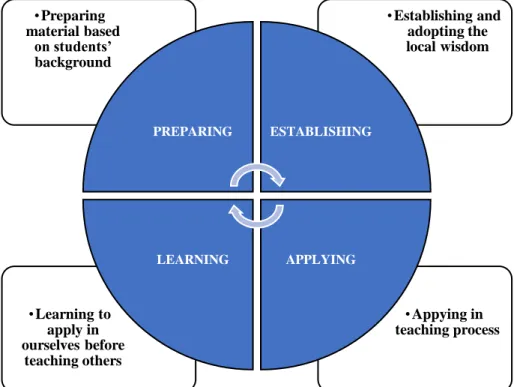
This model is very close to the values of local wisdom in Maluku, namely PELA-GANDONG, which teaches kinship between people so that this model researchers call the PELA Model, which stands for Preparing material, Establishing and adopting the local wisdom, Learning to apply in ourselves before teaching others and Applying it in the teaching process.
970
The moderation-based instruction model in English teaching at MAN 2 Model Makassar city can be described in Figure 1 as follows:
Figure 1. PELA Model of Moderation Based Instruction
Figure 1 shows the PELA Model, which stands for Preparing material based on students' background of prior knowledge, experience, habit, culture, and religion.
Then, Establishing the material by adopting and adapting the local wisdom and habit into the material made students have many ideas to share and deliver in the classroom. It is followed by Learning the material to apply in teacher self before teaching others as a role model and Applying the material in the teaching process.
Preparing material based on students‘ background, in line with Omabe (2006) asserts that instructional materials are central in the teaching and learning of the English language because they complement the efficiency of a teacher and effectiveness in lesson delivery.
Esu et al. (2004) confirmed that instructional materials aid in the acquisition of abstract concepts by assisting in the concretization of ideas and stimulating learners' imaginations. Additionally, instructional resources promote active engagement in the learning process while conserving instructors' energy and minimizing teacher- centered instruction. The use of instructional resources enhances the effectiveness of teaching by allowing learners to take an active role in classroom instruction. All of these perspectives imply that the usage of instructional resources can help students perform better. The effectiveness of meeting their objectives in an instructional scenario is contingent upon the applicability, sufficiency, and effective utilization of instructional materials (Olaitan & Aguisiobo, 1994). It is obvious that instructional
•Appying in teaching process
•Learning to apply in ourselves before
teaching others
•Establishing and adopting the local wisdom
•Preparing material based
on students’
background
PREPARING ESTABLISHING
APPLYING LEARNING
971
materials improve students' academic performance in teaching and learning. It gives learners with critical sensory experiences necessary for effective and meaningful behavioral change. Instructional resources are intended to enhance the quality of education and facilitate students' academic achievement in school.. The students' performance on the intended learning outcomes provides the validation – loop on the success of the interaction and instruction.
It is in line with what Barfield and Uzarski (2009) stated who attempted to include indigenous cultures into English Language Teaching (ELT) for students from multilingual countries. Having spent nearly two decades living and working abroad, Barfield and Uzarski (2009) noted that the majority of EFL programs follow curricula developed in English-speaking nations such as the United Kingdom, the United States, and Australia. They created English teaching resources for elementary and advanced levels based on a collection of indigenous cultures from diverse regions, including Maori Tattoos (New Zealand), Bantu Storytelling (Mozambique), Beading and Mathematics (South Africa), and Star Quilts (North American Indians).
The same result reveled by Guthrie (2013) that concerned on ELT in high schools in Ontario, Canada as a means of acquiring local wisdom. The research findings indicate that certain parts of indigenous wisdom evolved during the English learning process. The instructor aimed to connect literary instruction and practice in class to the students' life experiences, emphasis on life themes, self-experience, self- reflective learning, and individual requirements. Kaltsum (2014) emphasized issues of globalization pertaining to national identity. Globalization has the potential to affect every element of life, including education. Integrating foreign culture into foreign language instruction (English) is unavoidable. Accordingly, English teachers must integrate local cultural (local wisdom) elements in foreign language teaching for young learners to maintain national identity.
It also suggested by Wulandari et al. (2020) that integrating aspects of local wisdom into ELT materials is required as it has the following benefits: (1) supporting the learning process, (2) helping the students understand the materials related to local cultures, and (3) enhancing the knowledge of local culture and character education as well as maintaining the exposure of local language (Javanese). It can be integrated aspects of local wisdom in ELT materials may have some benefits as follows: (1) enlivening the classroom atmosphere since the opening session is accompanied with the song (video), (2) the local wisdom would enrich the students‘
understanding about local cultures, and (3) the integration of local wisdom would help the students understand the English texts more easily.
The teachers‘ adaptation of materials should reflect the concern of the course‘s objectives, learning atmosphere, and student learning achievement. When teachers think that teaching materials do not completely serve the lesson's objectives or they may be a barrier to student learning instead of enhancing it, the teachers need to adapt the materials to get the best of the material use. Furthermore, adaptation allows students greater access to the information to be taught. More
972
importantly, teachers should bear in mind that the students‘ linguistic ability is beyond the normal coursebook assigned for the class. Therefore, material adaptation is needed to make the task more real, personal, and closer to the students‘ own experiences. Then the students can learn the most efficiently through the assumption (Krashen, 2009).
Teachers as educators have the role of supporting students‘ learning about teaching, but in so doing, through their teaching, model the role of the teacher. In this regard, teacher education is unique, as opposed to, for example, physicians who teach medicine. During their teaching, physicians do not serve as role models for the real practice of their profession, i.e., they do not treat their students with respect.
Teachers, as educators, conversely, whether intentionally or not, teach their students and teachers about teaching.
Perhaps this part of teacher education is sometimes neglected as a significant factor influencing teachers' views and practices. Wideen et al. (1998) are correct in concluding that teacher education methods may be more significant than the knowledge imparted to student teachers. Despite intrinsic disparities between university and school contexts, the way teacher educators model the promotion of particular ideas of learning may be a more influential influence in molding teacher behavior than the content of the messages they transmit.
Based on this explanation, the researchers concluded that PELA Model stands for Preparing material, Establishing and adopting the local wisdom, Learning to apply in ourselves before teaching others, and Applying moderation-based instruction in English teaching. This model is the only suggested model that should be followed up by further research to examine and measure the effectiveness.
CONCLUSION
Findings from this study show that PELA Model stands for Preparing material, Establishing and adopting the local wisdom, Learning to apply ourselves before teaching others, and Applying moderation-based instruction in English teaching. This model is the only suggested model that should be followed up by further research to examine and measure the effectiveness. This study will contribute to the professional knowledge of how to implement moderation in teaching English in Islamic Schools in Indonesia and provide insights for policy-making and improving the quality of primary-school level English language teaching in general.
REFERENCES
Aapola, S., Gordon, T., & Lahelma, E. (2003). Citizens in the Text? International Presentations of Citizenship in Textbooks. Teoksessa Torres, Carlos Alberto &
Antikainen, Ari (toim.), The international handbook on the sociology of education: An international assessment of new research and theory. Lanham, MD: Rowman & Littlefield Publishers.
Abdullah, Sunusi, S. L., & Bhat, B. A. (2021). Developing teaching material design of basic English Vocabulary based on interactive multimedia for Elementary
973
School. International Journal of Humanities and Innovation (IJHI), 4(3), 99–103.
Acker, S. (1995). Chapter 3: Gender and teachers‘ work. Review of Research in Education, 21(1), 99–162.
Anderson, L. W., Bloom, B. S., Krathwohl, D. R., Airasian, P., Cruikshank, K., Mayer, R., Pintrich, P., Raths, J., & Wittrock, M. (2001). A Taxonomy for Learning, Teaching, and Assessing: A Revision of Bloom’s Taxonomy of Educational Objectives.
Longman. https://books.google.co.id/books?id=bcQlAQAAIAAJ
Arnot, M., & Gordon, T. (1996). Gender, citizenship and marketisation: a dialogue between Madeleine Arnot and Tuula Gordon. Discourse: Studies in the Cultural Politics of Education, 17(3), 377–388.
Azra, A. (1999). Pendidikan Islam: tradisi dan modernisasi menuju milenium baru.
Logos Wacana Ilmu. https://books.google.co.id/books?id=MDYgAAAACAAJ Barfield, S. C., & Uzarski, J. (2009). Integrating Indigenous Cultures into English
Language Teaching. English Teaching Forum, 47(1), 2–9.
Barron, A., & Schneider, K. P. (2014). 1. Discourse pragmatics: signposting a vast field.
In Pragmatics of discourse (pp. 1–34). De Gruyter Mouton.
Bini, M. (2019). The Victorian Curriculum: F-10 capabilities. Synergy, 17(2).
Carroll, J. B. (1963). A Model of School Learning.
https://books.google.co.id/books?id=LOpRnQEACAAJ
Clark, J. A. (2006). The conditions of Islamist moderation: Unpacking cross-ideological cooperation in Jordan. International Journal of Middle East Studies, 38(4), 539–
560.
Dourish, P. (2014). Reading and Interpreting Ethnography. In Ways of Knowing in HCI (pp. 1–23). Springer New York. https://doi.org/10.1007/978-1-4939-0378-8_1 Esu, A. E. O., Enukoha, I. O., & Umoren, G. U. (2004). Current development in Nigeria
for colleges and universities. Owerri: Whyte and White Publishers.
Frey, N., Hattie, J., & Fisher, D. (2018). Developing assessment-capable visible learners, grades K-12: Maximizing skill, will, and thrill. Corwin Press.
Gordon, T., Holland, J., & Lahelma, E. (2014). From pupil to citizen: a gendered route.
In Challenging democracy (pp. 201–216). Routledge.
Guthrie, C. E. (2013). Teaching for wisdom in the English language arts: secondary school teachers’ beliefs about literature and life learning in the Classroom.
https://tspace.library.utoronto.ca/bitstream/1807/42621/1/Guthrie_Christine_E _201311_MA_thesis.pdf
Heineke, A. J., & McTighe, J. (2018). Using Understanding by Design in the Culturally
and Linguistically Diverse Classroom. ASCD.
https://books.google.co.id/books?id=VB9pDwAAQBAJ
Irveanty, M. (2013). Integrasi Nilai-Nilai Karakter Islami dalam Pembelajaran Bahasa Inggris di SMAN Banjarbaru. Pascasarjana.
Jacobs, J. A., & Winslow, S. E. (2004). Overworked faculty: Job stresses and family demands. The ANNALS of the American Academy of Political and Social Science, 596(1), 104–129.
974
Johnston, B. (2003). Values in English Language Teaching. Routledge.
https://doi.org/10.4324/9781410606983
Kaltsum, H. U. (2014). Integrating Local Wisdom in The English for Young Learners.
Proceeding of The 3rd UAD TEFL International Conference. Yogyakarta.
Kemendikbud. (2013). Kurikulum 2013: Kompetensi Dasar. Kementerian Pendidikan dan Kebudayaan.
Krashen, S. (2009). Anything but reading. Knowledge Quest, 37(5), 18.
Lakshmi, K. S., & Kumar, N. S. (2011). Work Life Balance of Women Employee-with reference to Teaching Faculty. E-Proceedings for 2011 International Research Conference and Colloquium, on Contemporary Research Issues and Challenges in Emerging Economies Held on October, 10–11.
Mills, G., & Gay, L. (2018). Educational Research: Competencies for Analysis and Applications. Pearson. https://books.google.co.id/books?id=4dCVswEACAAJ Ministry of National Education of the Republic of Indonesia. (2002). Keputusan
Menteri Pendidikan Nasional Republik Indonesia Nomor 044/u/2002 Tentang Dewan Pendidikan dan Komite Sekolah [Decree of the Minister of National Education of the Republic of Indonesia Number 044/u/2002 concerning the
Board of Education and the Sc.
https://simpuh.kemenag.go.id/regulasi/kepmendiknas_044_02.pdf
Mulyana, D. (2006). Metodologi penelitian kualitatif: paradigma baru ilmu komunikasi dan ilmu sosial lainnya. PT Remaja Rosdakarya.
https://books.google.co.id/books?id=ohGfAQAACAAJ
Norris, N., Aspland, R., MacDonald, B., Shostak, J., & Zamorski, B. (1996). An Independent Evaluation of Comprehensive Curriculum Reform in Finland.
National Board of Education.
https://books.google.co.id/books?id=ABknAQAACAAJ
Olaitan, S. O., & Aguisiobo, O. N. (1994). Teaching of clothing and Textile. New York John Wiley and Sons Publishers.
Omabe, C. C. (2006). Instructional materials for social studies education in Nigeria.
Abakaliki: Willy Rose and Apple Seed Publishers.
Omar, N., & Noh, M. A. C. (2015). Islamic Education Teaching Practice Based on the Cultural Diversity of Students. Academic Journal of Interdisciplinary Studies, 4(1 S1), 135.
Ontario Ministry of Education. (2007). Teacher moderation: Collaborative assessment of student work.
Patak, A. A., Wirawan, H., Abduh, A., Hidayat, R., Iskandar, I., & Dirawan, G. D. (2020).
Teaching English as a Foreign Language in Indonesia: University Lecturers‘
Views on Plagiarism. Journal of Academic Ethics.
https://doi.org/10.1007/s10805-020-09385-y
Rohman, A. (2017). Pesantren as a Basis for Internalization of Pluralistic Values for Preparing a Democratic Citizens in a Diverse Society. Walisongo: Jurnal Penelitian Sosial Keagamaan, 25(2), 419–442.
975
Rosser, V. J. (2004). Faculty Members‘ Intentions to Leave: A National Study on Their Worklife and Satisfaction. Research in Higher Education, 45(3), 285–309.
https://doi.org/10.1023/B:RIHE.0000019591.74425.f1
Sallabi, `Ali Muhammad Muhammad. (1999). al-Wasatiyah fi al-Quran al-Karim. Dar al-Nafais.
Schwedler, J., & Schwedler, J. M. (2006). Faith in moderation: Islamist parties in Jordan and Yemen. Cambridge University Press.
Simola, H. (1998). Constructing a school-free pedagogy: Decontextualization of Finnish state educational discourse. Journal of Curriculum Studies, 30(3), 339–
356. https://doi.org/10.1080/002202798183648
Sorcinelli, M. D., & Near, J. P. (1989). Relations between work and life away from work among university faculty. The Journal of Higher Education, 60(1), 59–81.
Spradley, J. P. (2016). Participant observation. Waveland Press.
United Nations Administrative Committee on Coordination. (2000). 4th Report-the world nutrition situation: Nutrition throughout the life cycle. Geneva: ACC/SCN
in Collaboration with IFPRI.
http://www.unsystem.org/scn/Publications/4RWNS/4rwns.pdf
Victorian Curriculum and Assessment Authority. (2002). Victorian Curriculum and Assessment Authority annual report [2001-02-2019-20].
Walzer, M. (1984). Spheres Of Justice: A Defense Of Pluralism And Equality. Basic Books. https://books.google.co.id/books?id=JWkbtAEACAAJ
Walzer, Michael. (1995). Education, Democratic Citizenship and Multiculturalism.
Journal of Philosophy of Education, 29(2), 181–189.
https://doi.org/10.1111/j.1467-9752.1995.tb00352.x
Weimer, M. (2008). Learner-Centered Teaching: Five Key Changes to Practice. Wiley.
https://books.google.co.id/books?id=X6IfawF1RNwC
Wideen, M., Mayer-Smith, J., & Moon, B. (1998). A critical analysis of the research on learning to teach: Making the case for an ecological perspective on inquiry.
Review of Educational Research, 68(2), 130–178.
Wulandari, D., Sundari, W., & Ellysafny, C. A. P. (2020). Integrating Local Wisdom into ELT Materials for Secondary School Students in Semarang. PAROLE: Journal of Linguistics and Education, 10(1), 14–21.