61■Month 1: Create the Plan and Get Started
4
Month 1: Create the Plan and Get Started
Now that we’ve gone through all the basic back- ground information you need, it’s time to get started on a project. Getting your colleagues com- fortable with social media and all it entails—the good and the bad—is a key factor for organiza- tional buy-in and ultimately success. Remember, these projects involve a lot of trial and error. Your company and your management team have to be comfortable with that dynamic if you are going to have the flexibility you need to find a suc- cessful social media marketing strategy for your organization.
Chapter Contents Week 1: Lay the Groundwork Week 2: Draft and Present the Plan Week 3: Establish a Presence with the
Facebook Profile and Friends Week 4: Use Basic Facebook Features to
Promote Yourself
62
chapter 4:Month 1: Create the Plan and Get Started■
Week 1: Lay the Groundwork
early in any project, you really should be in fact-finding mode more than anything else. You should research what other people have done and look for examples of com- panies that execute well. read everything you can about successful and failed cam- paigns. remember that there are a lot of examples of both out there. You can find them by just searching to see what popular brands and your competitors are doing. the best and worst cases tend to get covered in the blogosphere. Week 1 is all about doing due diligence without even getting into the details of what Facebook or other social media services can do for you. Find out what your colleagues think and what people in the industry are saying about customer engagement via social media.
Monday: Set Project Goals
at the highest level, what are you trying to achieve with the project? We talked about a few of these opportunities earlier in the book—additional sales, increased revenue, lower marketing/customer engagement costs, improved customer service, collecting feedback quicker, and so on. Most of the time, you and your management team will want all of them, but you’ll really need one or two. It’s better to be selective about your goals and nail them than it is try to solve every problem for every constituent in your business. table 4.1 presents some of the types of things you can do with a social media campaign, how you would measure it, and examples.
PTable 4.1 Examples of Opportunities in Social Media
Goal Metrics Example
Increased sales Incremental revenue Social media campaign launched specifically to sell/market products; URLs set up to iden- tify social media as channel that found the customer
Improved customer service
Increased number of service queries handled, faster response time
Facebook fan page and Twitter account estab- lished for customers to ask questions of your business
Save money on market- ing or advertising
Lower $/touch vs. other mar- keting options
Facebook advertising campaign run to com- pare costs with traditional marketing efforts Earn more blogger,
journalist, or analyst attention
Number of blog posts mention- ing the organization or product Number of articles written Number of analyst mentions
Informal engagement 1:1 with people active in social media (Facebook, Twitter, and so on) to inform them of a new product, service, or event
then there is always the concept of buzz, which is the amorphous term used to broadly describe a palpable increase in the positive responses to a product or company in social media. You know that you’re getting good buzz when you find that people are saying a lot about you and you haven’t really done anything to force it. We find
63■Week 1: laY the GroundWork
that people use the term when they like what they see but don’t quite understand why there is a positive response from customers or pundits in the marketplace. this isn’t a criticism—you may conduct a campaign that doesn’t immediately result in significant increases in your metrics only to find that, for whatever reason, there is considerably more buzz several weeks or months after the fact. Social media is a handy and rela- tively inexpensive way to introduce a concept to people well in advance of a product launch or a major marketing push. Buzz is the indirect benefit of those efforts.
overall, if your company has been active on Facebook and social media, your company is probably more sophisticated at setting goals and measuring success. the bar to achieve success may be pretty high. If it’s your first project, the goal may just be as simple as learning what to do and what to expect in the future. learning is a per- fectly reasonable goal, especially if you keep your costs low and your tolerance high.
When working with clients, we often ask them to visualize the 15-minute pre- sentation they are giving to superiors to update them on the status of the project. how will that meeting go? What numbers will support your success? What specific results will help them understand that the project has been a success based on your strategy, your recommendations, and your effort? You know your management chain better than anyone else—it’s best to think through their expectations at the beginning of a project so you can guide it to success.
Tuesday: Analyze Stakeholder Needs
Ideally, you’d take a full day here to interview key stakeholders to understand their perspectives. But if you’re short on time, you may be able to learn just as much by put- ting together a questionnaire that your colleagues can answer easily via e-mail. Make a list of all the people who may be impacted even peripherally by your work on Facebook and social media. I’d be as inclusive as you can when compiling your list: people in your management chain, colleagues who work on different products, people in organi- zations that support the marketing or sales effort, and so on. the last thing you need is to be blindsided by influential colleagues who think they were not adequately con- sulted. these can be your harshest critics.
Start by putting a list of questions together. You want to understand how they view you, your project, your organization, your product, and the nature of the work.
Some relevant questions to ask include the following:
W
• hat does the person think of social media?
I
• s the person an active Facebook or twitter user?
W
• hat are some of the company’s best campaigns for dealing directly with customers?
W
• hat opportunities does the company have to improve its customer engagement?
W
• hat should your company be doing on social networks?
W
• hat would social media success mean to them?
Week 1: Lay the Groundwork
early in any project, you really should be in fact-finding mode more than anything else. You should research what other people have done and look for examples of com- panies that execute well. read everything you can about successful and failed cam- paigns. remember that there are a lot of examples of both out there. You can find them by just searching to see what popular brands and your competitors are doing. the best and worst cases tend to get covered in the blogosphere. Week 1 is all about doing due diligence without even getting into the details of what Facebook or other social media services can do for you. Find out what your colleagues think and what people in the industry are saying about customer engagement via social media.
Monday: Set Project Goals
at the highest level, what are you trying to achieve with the project? We talked about a few of these opportunities earlier in the book—additional sales, increased revenue, lower marketing/customer engagement costs, improved customer service, collecting feedback quicker, and so on. Most of the time, you and your management team will want all of them, but you’ll really need one or two. It’s better to be selective about your goals and nail them than it is try to solve every problem for every constituent in your business. table 4.1 presents some of the types of things you can do with a social media campaign, how you would measure it, and examples.
PTable 4.1 Examples of Opportunities in Social Media
Goal Metrics Example
Increased sales Incremental revenue Social media campaign launched specifically to sell/market products; URLs set up to iden- tify social media as channel that found the customer
Improved customer service
Increased number of service queries handled, faster response time
Facebook fan page and Twitter account estab- lished for customers to ask questions of your business
Save money on market- ing or advertising
Lower $/touch vs. other mar- keting options
Facebook advertising campaign run to com- pare costs with traditional marketing efforts Earn more blogger,
journalist, or analyst attention
Number of blog posts mention- ing the organization or product Number of articles written Number of analyst mentions
Informal engagement 1:1 with people active in social media (Facebook, Twitter, and so on) to inform them of a new product, service, or event
then there is always the concept of buzz, which is the amorphous term used to broadly describe a palpable increase in the positive responses to a product or company in social media. You know that you’re getting good buzz when you find that people are saying a lot about you and you haven’t really done anything to force it. We find
64
chapter 4:Month 1: Create the Plan and Get Started■
and sometimes there are good reasons to conduct such things. But this probably isn’t one of those places. as we’ve mentioned in this book, the Web is the land of experi- mentation. users will vote with their presence, and you’ll see the results in the number of fans or followers you have, page views, unique users, comments, and so on. Your strategy should be to act on imperfect or incomplete data early in the project and be more reliant on mountains of data as the project matures.
When you get access to your subjects, you’re going to have to ask them a lot of questions:
W
• hat do they do on social networks?
h
• ow much time do they spend on Facebook? how often do they log into Facebook? and what do they do once they get there?
W
• hat annoys them about Facebook?
a
• re they a Facebook fan or twitter follower of companies? If so, which ones?
h
• ave friends shared recommendations on social media? If so, which ones stand out and why?
W
• hat types of content, information, and so on, from the company would you be willing to share with your friends?
there are many more that are applicable to your specific situation. Before sitting down, come up with another three to five questions that can help validate ideas from you or your colleagues. try not to let your own perceptions of the project or of feed- back you’ve received get in the way of your learning. Be humble, and listen as best you can. also leave some time for free-form feedback or suggestions. oftentimes, some of the best ideas don’t originate with your company but rather with your customers.
We should mention one other cautionary note here. It’s really easy to take cus- tomer feedback and run with it full speed. after all, when we hear something from a customer, it’s valid and “straight from the horse’s mouth,” right? although that is true for the most part, you can’t always trust that verbatim feedback to represent what cus- tomers really want. You have to map feedback to promises you can keep, both profit- ably and sustainably.
It’s dangerous to listen too closely to what customers say they want. Remember the old Henry Ford quote: “If I’d asked my customers what they wanted, they’d have said ‘a faster horse.’” Customers may not be aware of how tech- nology can help them in new and innovative ways. It’s your role to translate their feedback into new and interesting offerings that they’ll love.
Thursday: Determine Work Roles
By now you’ve set your goals, and you’ve gotten feedback from internal stakeholders and customers. It’s time to think through the operational mechanics that will make your Facebook marketing project sing. regardless of the size of your business, there then there are questions you probably don’t want to ask directly but can impact
the landscape of your project:
I
• f the person is an influencer on marketing decisions, does the person think that it is a waste of time?
h
• ow will this project increase their workload? If so, are they aware of it, and are they prepared to deal with it?
d
• oes the person truly want to see the project succeed? Will the person be diffi- cult when you need help advancing your project?
W
• ill you get the benefit of the doubt from this person in executive or manage- ment reviews?
You’re doing a few things with the stakeholder analysis. First, you are compar- ing your assumptions on project goals/priorities to the perception of your colleagues.
You may find that the goals you have set for the project are significantly different from the goals that other people have for the project. this is your opportunity to confront the differences and make a course correction if necessary. Second, you want to learn who your friends are within your company. let’s face it—all companies are in some ways political. Some people have authority; others either want it or think they deserve it. It’s the nature of business today. You’re probably aware of the political minefield in which you work, but it’s better to extend the olive branch to as many people as you can as early as you can. You don’t want to find out that certain people in your com- pany have a political aversion to your work at the time when your success or failure is being judged. We generally advise middle managers to do what they can at this stage to build consensus around the project. It’s a great way to give yourself enough time to learn as you go and get the benefit of the doubt should anything go sideways.
Wednesday: Analyze Customer Needs
Your work earlier this week to determine project goals and the motivations driving or influencing the project inside your company should begin to give you some ideas about campaigns. now it’s time to take all of that to the very people you rely upon to turn your idea into a marketing success. Granted, as a marketer, you should always be engaging with your customers to learn about their needs. But translating that to social media success can be a bit tricky. You’ll need direct feedback from relatively disinter- ested customers in your target demographics to further understand the opportunities and limitations.
the best way to do this doesn’t generally involve a lot of money. do things that are relatively simple and almost immediately actionable. Find people you already know in your target demographics, and give them a cup of coffee or ice cream in exchange for a 30-minute chat. It’s essentially your own focus group. If you’d rather have a larger set of opinions, create a survey on SurveyMonkey or a similar service. It’s easy to get paralyzed by not having resources to conduct a professional, statistically valid study,
65■Week 1: laY the GroundWork
and sometimes there are good reasons to conduct such things. But this probably isn’t one of those places. as we’ve mentioned in this book, the Web is the land of experi- mentation. users will vote with their presence, and you’ll see the results in the number of fans or followers you have, page views, unique users, comments, and so on. Your strategy should be to act on imperfect or incomplete data early in the project and be more reliant on mountains of data as the project matures.
When you get access to your subjects, you’re going to have to ask them a lot of questions:
W
• hat do they do on social networks?
h
• ow much time do they spend on Facebook? how often do they log into Facebook? and what do they do once they get there?
W
• hat annoys them about Facebook?
a
• re they a Facebook fan or twitter follower of companies? If so, which ones?
h
• ave friends shared recommendations on social media? If so, which ones stand out and why?
W
• hat types of content, information, and so on, from the company would you be willing to share with your friends?
there are many more that are applicable to your specific situation. Before sitting down, come up with another three to five questions that can help validate ideas from you or your colleagues. try not to let your own perceptions of the project or of feed- back you’ve received get in the way of your learning. Be humble, and listen as best you can. also leave some time for free-form feedback or suggestions. oftentimes, some of the best ideas don’t originate with your company but rather with your customers.
We should mention one other cautionary note here. It’s really easy to take cus- tomer feedback and run with it full speed. after all, when we hear something from a customer, it’s valid and “straight from the horse’s mouth,” right? although that is true for the most part, you can’t always trust that verbatim feedback to represent what cus- tomers really want. You have to map feedback to promises you can keep, both profit- ably and sustainably.
It’s dangerous to listen too closely to what customers say they want. Remember the old Henry Ford quote: “If I’d asked my customers what they wanted, they’d have said ‘a faster horse.’” Customers may not be aware of how tech- nology can help them in new and innovative ways. It’s your role to translate their feedback into new and interesting offerings that they’ll love.
Thursday: Determine Work Roles
By now you’ve set your goals, and you’ve gotten feedback from internal stakeholders and customers. It’s time to think through the operational mechanics that will make your Facebook marketing project sing. regardless of the size of your business, there
66
chapter 4:Month 1: Create the Plan and Get Started■
are a wide range of roles and responsibilities associated with any project. Branding, messaging, design/creative, e-commerce, product management, website management, It, and others all may have some role in the success or failure of your project. In small businesses, these roles may be filled by one or two people. But in corporations, you can have entire teams that work on one element of what you need. like it or not, these people won’t necessarily have the same priorities you have. So, you have to get them on your side.
the chart in the following sidebar illustrates how the role of social media cham- pion is really suited for people who are well regarded inside their company. You’ll regu- larly need to get the cooperation of your colleagues to do things they aren’t necessarily resourced or equipped to do, often times on short notice. the job is one part visionary, one part marketer, one part politician. do what you can to give people as much time as you can to help you. You have probably heard the quote “Failure to plan on your part does not constitute an emergency on my part.” If you limit your emergencies to times when it’s truly warranted, you’ll gain the respect of your colleagues, and you’ll prob- ably get what you need more regularly.
Featured Case: Necessary Skill Sets
The size of your company will probably dictate the extent to which you have to court colleagues in other functional areas of your business. Social media projects are by definition cross-functional.
To do things the right way, you’re going to have to become the conductor who keeps the orches- tra playing a harmonious tune.
What functions map to different parts of your organization? Here’s an example from a recent client engagement. We dealt primarily with the manager of the social media project, but she had to deal with a variety of colleagues across her company:
Branding: Use of logos and brand assets Design: Creation of new/modified image assets
Product management: Sign-off on the way the product was used
E-commerce: Coordination of the project with other online campaigns, e-mail marketing promotions, and so on
Website management: Campaigns on the Web that pointed to Facebook, and vice versa
For each of the roles mentioned above, do what you can to have a point person available to take requests, feedback, and so on. You really don’t want the responsibili- ties to be ambiguous either—talk through the requirements, what people will need to do, and what the deadlines will likely be. You have to know who will do what, when,
67■Week 1: laY the GroundWork
and what the rules of engagement will be. If you are in a larger corporation, your work will likely be handed to a junior member of the team. But don’t let that fool you: you’ll have to keep that person and their manager happy to get their undying cooperation and love. earlier in this book, we mentioned that you’re truly building a social media prod- uct when you create a Facebook campaign. You’re the product manager here, so you’ll have to manage relationships as much as you’ll have to manage the end product.
Friday: Set or Review Social Media Policy
as you navigate the political waters of your organization, you’ll undoubtedly face ques- tions about the organization’s official policies regarding the execution of social media products. We’re talking as much about who does what as who can edit Facebook on behalf of the company, who can comment on success or failure, who can access statis- tics and summary reports, and who is in the room for executive reviews.
If you are in a large corporation, odds are that you may already have some loose guidelines for blogging set forth by public relations people. this can be a good start—because such guidelines tend to reflect a company’s treatment of risk, customer advocacy, and interaction. Put another way, some companies simply put more trust in their employees to make judgment calls that may ultimately reflect on the business.
others prefer a more centralized communications structure that closely manages com- pany positioning. Smaller companies tend to have less complex rules about customer engagement for a few reasons. they tend to be scrappier and more action-oriented. In our experience, this has a lot to do with the fact that larger companies are generally more risk-averse because they are “under the microscope” more than their smaller brethren.
What you really want to do here is make sure your team is on the same page across blogs and social media. although we’re not huge fans of “makework,” (that is, unproductive work done primarily for the sake of satisfying process) an e-mail or docu- ment that summarizes the basics can be very helpful to keep you from having argu- ments or misunderstandings as your campaign evolves. here are a few questions to consider when putting together your company’s policy on social media:
W
• hat are the official social media accounts for the company?
W
• ho manages them?
h
• ow often will you post updates from the different accounts?
W
• hat types of content will be shared from the different social media destinations?
W
• ill the social media account engage in conversation with users?
W
• hen posting news and updates, which accounts have priority?
W
• hat are the loose rules for how the Web, blogs, and social media interact?
are a wide range of roles and responsibilities associated with any project. Branding, messaging, design/creative, e-commerce, product management, website management, It, and others all may have some role in the success or failure of your project. In small businesses, these roles may be filled by one or two people. But in corporations, you can have entire teams that work on one element of what you need. like it or not, these people won’t necessarily have the same priorities you have. So, you have to get them on your side.
the chart in the following sidebar illustrates how the role of social media cham- pion is really suited for people who are well regarded inside their company. You’ll regu- larly need to get the cooperation of your colleagues to do things they aren’t necessarily resourced or equipped to do, often times on short notice. the job is one part visionary, one part marketer, one part politician. do what you can to give people as much time as you can to help you. You have probably heard the quote “Failure to plan on your part does not constitute an emergency on my part.” If you limit your emergencies to times when it’s truly warranted, you’ll gain the respect of your colleagues, and you’ll prob- ably get what you need more regularly.
Featured Case: Necessary Skill Sets
The size of your company will probably dictate the extent to which you have to court colleagues in other functional areas of your business. Social media projects are by definition cross-functional.
To do things the right way, you’re going to have to become the conductor who keeps the orches- tra playing a harmonious tune.
What functions map to different parts of your organization? Here’s an example from a recent client engagement. We dealt primarily with the manager of the social media project, but she had to deal with a variety of colleagues across her company:
Branding: Use of logos and brand assets Design: Creation of new/modified image assets
Product management: Sign-off on the way the product was used
E-commerce: Coordination of the project with other online campaigns, e-mail marketing promotions, and so on
Website management: Campaigns on the Web that pointed to Facebook, and vice versa
For each of the roles mentioned above, do what you can to have a point person available to take requests, feedback, and so on. You really don’t want the responsibili- ties to be ambiguous either—talk through the requirements, what people will need to do, and what the deadlines will likely be. You have to know who will do what, when,
68
chapter 4:Month 1: Create the Plan and Get Started■
Featured Case: Bad Reactions to Social Media Policy from the Sports World
Sometimes, the reaction to an organization’s social media policy can take on a life of its own.Take, for example, the case of ESPN in August 2009. ESPN released a social media policy that is by all accounts pretty fair. ESPN reporters are, in fact, as much representatives of the network as they are individuals—and their social media policy was set accordingly. But one commentator, NBA analyst Ric Bucher, sent a message via Twitter that said ESPN had “prohibited [employees and commentators from] Tweeting unless it serves ESPN.” The result was a PR nightmare for the
“total sports network,” and it sent its PR team into quick action the same day. Nonetheless, the blogosphere lit up with a number of critical posts suggesting that the network doesn’t care about fans and wants to control the sports industry. Check out http://mashable.com/2009/08/
04/espn-social-media for the full text of the policy along with ESPN’s official response.
Also in the sports world, the Southeastern Conference of college athletics in the United States released a similarly restrictive social media policy later in August 2009. According to the policy, ticketed fans can’t “produce or disseminate (or aid in producing or disseminating) any material or information about the Event, including, but not limited to, any account, description, picture, video, audio, reproduction or other information concerning the Event.”
Uproar against this policy ultimately led to its revision 11 days after the policy was released.
What is the reason for all the wrangling over social media in the sports world? Two words: money and control. The only problem is that attendees and consumers today are the same people who insist on sharing their experiences with friends through social media. The consumer is an active participant in social media culture. Keep that in mind as you craft your own social media policy for your employees and your customers moving forward.
Monday: Research Best Practices and Success Stories
although Facebook is relatively young as a platform, in 2010 and beyond you have the advantage of hindsight. a lot of companies have gone before you to create a Facebook presence. Some have failed; others have enjoyed wild success. Some companies have done very well by letting their communities manage themselves. Before you put pen to paper, you’ll want to know more about what has been done in the past. You have to know as much as you can, because these stories oftentimes reach the newsstands, the popular business periodicals, and the blogosphere. You’ll get a lot more credibility in your company if you are the expert and not a colleague who just keeps up with busi- ness news.
now, you know your organization a lot better than we do. Some companies manage their brand and outbound communications very closely, while others have a more decentralized approach. think Proctor & Gamble on one hand and Southwest airlines on the other. It really comes down to philosophy for a lot of businesses. Where your company or organization stands will drive a lot of other factors:
W
• hether you will need a stated policy for information shared via social media W
• hether you will communicate with customers directly via social media W
• hether the Facebook presence is managed in-house, by a trusted vendor or consultant, or by a combination of both
t
• he degree to which updates to the Facebook presence must be approved in advance due to fear of offending parts of the customer base—either accidentally or on purpose
W
• hether you should promote your product, your brand, or your company We have worked with organizations that first spend a lot of time on an “official social media policy” that drives what they can and can’t do. and we’ve worked with others that simply shoot from the hip and worry about problems as they come along.
If you don’t have such a policy, spend your hour today to create a basic framework that establishes some rules. think of a few difficult situations you may encounter—a difficult customer, a question you don’t want to answer, verbal abuse, and so on—and think about the most appropriate response that fits your company’s culture. Make your Facebook marketing project fit the cultural norms of your organization, lest your mis- understanding cost you professionally.
Week 2: Draft and Present the Plan
You’ve spent the last week gathering information from your colleagues, customers, and management. By now you should know your limitations for the project, and you should begin to see some specific opportunities. You must put your thoughts into a coherent package that can help you start the project.
We’ve alluded to this several times in the book, but we can’t overstate that success relies on your ability to set up a structure by which you can experiment. no two projects are alike—what works for your brand may not work for someone else’s, and vice versa. the problem is that you won’t know going into your project if your approach will be naturally viral, if it will require demand generation via advertising, if your lighthearted approach works with consumers, or if you need to deliver “just the facts.” You may have a hunch of how things will work, but you need freedom to learn and react to customer feedback.
69■Week 2: draFt and PreSent the Plan
Featured Case: Bad Reactions to Social Media Policy from the Sports World
Sometimes, the reaction to an organization’s social media policy can take on a life of its own.Take, for example, the case of ESPN in August 2009. ESPN released a social media policy that is by all accounts pretty fair. ESPN reporters are, in fact, as much representatives of the network as they are individuals—and their social media policy was set accordingly. But one commentator, NBA analyst Ric Bucher, sent a message via Twitter that said ESPN had “prohibited [employees and commentators from] Tweeting unless it serves ESPN.” The result was a PR nightmare for the
“total sports network,” and it sent its PR team into quick action the same day. Nonetheless, the blogosphere lit up with a number of critical posts suggesting that the network doesn’t care about fans and wants to control the sports industry. Check out http://mashable.com/2009/08/
04/espn-social-media for the full text of the policy along with ESPN’s official response.
Also in the sports world, the Southeastern Conference of college athletics in the United States released a similarly restrictive social media policy later in August 2009. According to the policy, ticketed fans can’t “produce or disseminate (or aid in producing or disseminating) any material or information about the Event, including, but not limited to, any account, description, picture, video, audio, reproduction or other information concerning the Event.”
Uproar against this policy ultimately led to its revision 11 days after the policy was released.
What is the reason for all the wrangling over social media in the sports world? Two words: money and control. The only problem is that attendees and consumers today are the same people who insist on sharing their experiences with friends through social media. The consumer is an active participant in social media culture. Keep that in mind as you craft your own social media policy for your employees and your customers moving forward.
Monday: Research Best Practices and Success Stories
although Facebook is relatively young as a platform, in 2010 and beyond you have the advantage of hindsight. a lot of companies have gone before you to create a Facebook presence. Some have failed; others have enjoyed wild success. Some companies have done very well by letting their communities manage themselves. Before you put pen to paper, you’ll want to know more about what has been done in the past. You have to know as much as you can, because these stories oftentimes reach the newsstands, the popular business periodicals, and the blogosphere. You’ll get a lot more credibility in your company if you are the expert and not a colleague who just keeps up with busi- ness news.
70
chapter 4:Month 1: Create the Plan and Get Started■
a variety of sources keep up with innovations in Facebook and social media marketing. Some of our favorites are listed here. You’ll want to look for sources that can keep you up-to-date on the latest creative uses of Facebook or social media. We cover some of these in this book and on our blog, but you’ll want to keep up with a few sources so you can bring the world’s best work to your specific situation.
Facebook Marketing: an hour a day: www.facebookmarketinganhouraday.com Mashable: www.mashable.com
allFacebook: www.allfacebook.com Inside Facebook: www.insidefacebook.com
Social Media examiner: http://socialmediaexaminer.com
Government 2.0: www.govloop.com, http://radar.oreilly.com/markd enterprise 2.0: www.web-strategist.com
It’s handy to read blogs from practitioners in your field. Ironically, Facebook isn’t the easiest way to get familiar with content from bloggers and other industry pun- dits who you did not know previously. Industry magazines, business magazines, trade shows, twitter, and search engines are good ways to help you discover some of these people. once you start digging, you’ll find that a lot of experts are grappling with the same issues you face every day. Most are relatively open with their experience and their advice—and they share it at low cost or free on the Internet and on their blogs. thank God for the Web!
Tuesday: Assess the Social Media Activity of Competitors
Before launching your own presence, you really should know exactly what your com- petitors are doing on Facebook and other social media sites. If you’re going to compre- hensively analyze your competitors’ activities, consider staying on top of the following:
Features keep track of all the elements of the competitors’ presence that appear to be run or officially sponsored by them. You need to know whether they are maintaining a profile, Facebook fan pages, twitter accounts, blogs, or other social media accounts.
Since social media sites typically rank high on search engines, you shouldn’t have any trouble finding these sites with a search engine.
Commitment Monitor the quantity and quality of social media updates. Is the competi- tor truly committed to social media for customer outreach, or does it appear to be more of an experiment? objectively speaking, would you consider their effort a competitive differentiator, or is it just the bare minimum necessary for a company these days?
Popularity keep track of the number of customers who appear to be communicating with your competitor. this can be a simple metric such as the number of fans/fol- lowers/friends/participants they’ve attracted, or you can dig deeper to see how much
71■Week 2: draFt and PreSent the Plan
“conversation” they have with their customers via social media. this is good to give yourself a benchmark for performance—either as a stated goal or as a personal goal.
PR/coverage analyze how much your competitor’s social media work is discussed through articles, in popular periodicals, by bloggers, and so on. It’s been said that there is no such thing as bad publicity. We guess that depends on your risk tolerance.
a good campaign or strategy can get a lot of people saying good things about a com- pany. When looking for this, be sure to discern between a competitor’s own employees talking about the social media effort and seemingly disinterested third parties doing so. It’s far too easy to appear anonymous on the Web—sophisticated competitors will plant moles around the Web to say good things about themselves to make it all more impactful.
a chart that summarizes all this data is a helpful and important resource that you can use to both benchmark yourself and monitor the playing field in the future.
If you’ve effectively gathered the data, you’ve built the scorecard as it relates to your competitors. now, your management may not hold you to that high a standard or your competitors may not be executing well, so the numbers are largely irrelevant. But as long as you know where your competitors are, you’ll be much more informed when set- ting goals and positioning your progress. Spend a little time to put this chart together with as many hard metrics as you can find. leave the subjectivity to perhaps only your assessment of Pr. You’ll need a snapshot at the beginning of your project and the com- mitment to update it regularly. add your performance to the chart to be honest about how you stack up.
Wednesday: Assign Metrics
as you’re finalizing your proposal, you need to spend some time thinking about score- keeping. how will your superiors know with confidence that you are successful? this comes down to a few things—what numbers you’ll share with them, how often you’ll share updates, and how you’ll manage expectations.
It always starts with the sophistication of the people ultimately responsible for the effort and what they expect to see. Ideally you spent time last week talking with them in detail. Getting everyone on the same page is important—so it’s probably a good idea to go back to the most influential stakeholders to get feedback on your plan.
Give them an opportunity to own part of the project through suggestion or advice, and they’ll be easier on you when times are tough.
Choosing metrics for your scorecard is one part art, one part science. You cer- tainly want to fill it with numbers that you know you can affect, but your management chain will likely want to tie the scorecard to meaningful business metrics: return on investment, low customer acquisition cost, number of fans/subscribers, how you do relative to your competitors, and so on. a good scorecard will have elements of both that will easily demonstrate a few things: maintenance, capturing opportunity, efficient
72
chapter 4:Month 1: Create the Plan and Get Started■
advertising spend, competitive environment, and customer interaction. Figure 4.1 shows a range of popular metrics and how easy or difficult they are to affect today.
Easier to Control Does Presence
Exist? Total Number of
Subscribers/Fans # of Positive
Customer References Cost per
Lead Total $ Amount of New E-commerce
# Updates
Day Ad Spend
per Day # of Customer
Interactions Cost per
Interaction Cost per
Fan/Follower Direct Return on Investment Harder to Control
Figure 4.1 The continuum of social metrics
table 4.2 shows an effective scorecard for a simple Facebook marketing cam- paign that utilizes Facebook fan pages and Facebook advertising. the first two metrics are entirely based on effort and measure simply whether the project manager did their job. the third metric, number of fans added, is a measure of the overall effectiveness of the effort as measured by incremental fans. advertising spend tells you whether the manager stayed within budget. the number of customer interactions per week is a measure of how engaging the effort is and whether there is sufficient follow-up with customers. advertising cost per fan is a customer acquisition cost metric that deter- mines whether the ad spend is effective. this is an admittedly simplistic measure—
we’ll talk in Chapter 6 about isolating the exact impact of advertising dollars. Finally, the ratio of total number of fans to a competitor’s total number of fans tells you how you compare to other companies in your market.
PTable 4.2 Example of a Basic Facebook Marketing Scorecard
Metric Last Week Goal This Week Goal
Daily updates of scorecard/metrics Yes Yes Yes Yes
Number of updates or posts/day 0.7 1.0 1.1 1.0
Number of Facebook fans added 77 80 106 90
Advertising spend $37.28 $40.00 $39.15 $40.00
Number of customer interactions per week 13 25 19 30
Advertising cost per fan $0.484 $0.50 $0.369 $0.44
Ratio of our total number of fans to competitor’s total number of fans
1.03:1 1:0:1 1.07:1 1.05:1
You should know two additional things about metrics and your scorecard. First, you and your management team should consider all of this to be somewhat fluid, espe- cially early in the process. as you work on the project, you may determine that some metrics matter more to you and others matter less. this is a learning experience for many people who take on such projects for the first time—it’s ok to make a mistake or course-correct as you learn.
73■Week 2: draFt and PreSent the Plan
Second, the spirit of the scorecard isn’t that you necessarily get locked in to doing things just because they’re on a scorecard but rather that you get in the habit of record- ing and analyzing relevant data about your efforts. these projects generate mountains of discrete pieces of data, and you can use this data to help drive decision making as long as you commit to recording it regularly. It can be tedious, but it’s very worthwhile.
Some data is available to you long-term, but Facebook discards other types of data such that you can’t go back to get it if you forget to record it. use spreadsheets to record progress and analyze data, and collect as much of that data as you can, even if you don’t think it will be immediately helpful. You never know what you’ll want to use later.
Thursday: Set Reporting Strategy
now you’ll turn your attention to the how and when of reporting metrics to your supe- riors. the funny thing about Internet marketing is that even in 2010 a lot of managers aren’t experienced enough to know the ins and outs of reportage. as a result, every statistic that you report could turn into a potential black hole of debate that may be totally unproductive. this may also make people question your work or how you are analyzing progress.
Getting out in front of these issues is key to managing perceptions, and educa- tion is the way to do it. take the time to educate people on what key metrics mean—it will go a long way to improving your internal credibility. It also shows people that you have nothing to hide, which will come in handy especially if you do have some metrics that you need more time to improve. at the end of the day, you want people to under- stand that you can measure your progress, you can be self-critical, and you know how to fix problems that emerge.
When establishing the reporting cadence, think through the ongoing report- ing need and the frequency of management reviews. You will probably need to share updates with some of your colleagues on an ongoing basis so they are always in the loop. this is most efficiently handled on a weekly basis, although we have seen cases where a small team gets daily updates on progress. Management reviews should be scheduled monthly at the most—otherwise, you won’t have time to see the outcome of inevitable changes or corrections to your strategy and tactics. the frequency and depth of your reporting will be driven by management requirements and how critical the project is in your company.
If you communicate proactively and openly, you’re doing everything you can to manage expectations and reactions to your work. We see people run into problems in their company all the time when they hoard information or don’t ensure that manage- ment understands the goals, the measurement, and the process of establishing a healthy social media campaign. deal with issues directly as they occur, and be open to feed- back. distrust is created when people don’t communicate—you have a leadership role to play as the manager of the social media project.
advertising spend, competitive environment, and customer interaction. Figure 4.1 shows a range of popular metrics and how easy or difficult they are to affect today.
Easier to Control Does Presence
Exist? Total Number of
Subscribers/Fans # of Positive
Customer References Cost per
Lead Total $ Amount of New E-commerce
# Updates
Day Ad Spend
per Day # of Customer
Interactions Cost per
Interaction Cost per
Fan/Follower Direct Return on Investment Harder to Control
Figure 4.1 The continuum of social metrics
table 4.2 shows an effective scorecard for a simple Facebook marketing cam- paign that utilizes Facebook fan pages and Facebook advertising. the first two metrics are entirely based on effort and measure simply whether the project manager did their job. the third metric, number of fans added, is a measure of the overall effectiveness of the effort as measured by incremental fans. advertising spend tells you whether the manager stayed within budget. the number of customer interactions per week is a measure of how engaging the effort is and whether there is sufficient follow-up with customers. advertising cost per fan is a customer acquisition cost metric that deter- mines whether the ad spend is effective. this is an admittedly simplistic measure—
we’ll talk in Chapter 6 about isolating the exact impact of advertising dollars. Finally, the ratio of total number of fans to a competitor’s total number of fans tells you how you compare to other companies in your market.
PTable 4.2 Example of a Basic Facebook Marketing Scorecard
Metric Last Week Goal This Week Goal
Daily updates of scorecard/metrics Yes Yes Yes Yes
Number of updates or posts/day 0.7 1.0 1.1 1.0
Number of Facebook fans added 77 80 106 90
Advertising spend $37.28 $40.00 $39.15 $40.00
Number of customer interactions per week 13 25 19 30
Advertising cost per fan $0.484 $0.50 $0.369 $0.44
Ratio of our total number of fans to competitor’s total number of fans
1.03:1 1:0:1 1.07:1 1.05:1
You should know two additional things about metrics and your scorecard. First, you and your management team should consider all of this to be somewhat fluid, espe- cially early in the process. as you work on the project, you may determine that some metrics matter more to you and others matter less. this is a learning experience for many people who take on such projects for the first time—it’s ok to make a mistake or course-correct as you learn.
74
chapter 4:Month 1: Create the Plan and Get Started■
Friday: Present the Plan
You’ve spent most of the last two weeks gathering information, negotiating with stake- holders, and preparing a plan to help your company take better advantage of Facebook and social media. now it’s time to sell it. We’ve talked at length about the value of metrics and the importance of communication to get cooperation from your colleagues.
here are a few other potential potholes that you should consider as you summarize your thoughts:
Management/mitigation of unintended consequences Good executives at major corporations are trained to mitigate risk wherever possible. You’ll need to show that you’ve thought through all the potential negative situations that may arise from your effort and that you have a plan for dealing with problems and unintended negative consequences.
Organizational fit are you the right person in the company to run the project? Would this cause a political problem in your company that will create problems for the manage- ment team? have you reached across organizational lines proactively to make the proj- ect run as smoothly as possible? Will the project be at odds with other major initiatives inside the company? You don’t want to compete with your colleagues unless there are good reasons to do so.
Fit with corporate culture/norms are the things you are proposing a fit for the way the com- pany communicates with customers, partners, and so on? If so, is that a good thing?
Management may have a different perspective on this than the rank and file. Be sure to understand how superiors see the opportunity in advance of your presentation.
Future commitment Will this project cause the company to take on a future financial or head count liability that it currently does not have? do you have a handle on the costs associated with the effort and how that may change over time? Could backing out of such a commitment cause customers significant consternation and create negative per- ceptions about the company or brand?
If they are balanced and fair, your superiors will likely ask you for a good bal- ance of metrics that you can control and stretch goals that will make you really work.
that’s ok. remember, you are trying to learn what will work and what has worked on Facebook. roI is certainly the toughest metric to guarantee today—more on that in Chapter 10, “organizational Considerations,” when we talk about what managers and executives should demand of employees who run social media projects.
One Final Point for the Day of Your Presentation
Be sure to keep your cool when you pitch your ideas. Not all of your ideas are going to necessarily work. That’s OK. React calmly and professionally to feedback. It’s the best way to make people confident that you can take feedback and you can do the job!
75■Week 3: eStaBlISh a PreSenCe WIth the FaCeBook ProFIle and FrIendS
Week 3: Establish a Presence with the Facebook Profile and Friends
Congratulations! now that you have a plan and you’ve taken feedback from the firing line of your management team, it’s time to execute! You’re probably already very familiar with the basics of Facebook, but you may never have looked at all the opportunities from a business perspective. We did a quick walk-through of the basics of the Facebook profile and friending in Chapter 2, “What Is Facebook?”—now we’ll talk about these features with an eye toward marketing opportunities. We’ll avoid feature walk-throughs as much as possible here, to focus on how different elements of Facebook help you create a campaign that your customers will appreciate.
Monday/Tuesday: Learn About Data in the Facebook Profile and Security Settings
as we’ve discussed previously, everything about your identity is summarized in the Facebook profile. there, you have the ability to say as much or as little as you want about yourself. table 4.3 summarizes the personal information users may expose about themselves. It is a ridiculously rich set of data, most of which is accessible to market- ers for better targeting through Facebook advertising, which we will cover in detail in Chapter 6, “Month 3: Creating a Following with Facebook ads.”
PTable 4.3 Facebook User Information
Category Data Listed
Basic Information Gender
Birth date Hometown Neighborhood Family Members Relationship Status
“Interested In”
“Looking For”
Political Views Religious Views
Personal Information Activities
Interests Favorite Music Favorite TV Shows Favorite Movies Favorite Books Favorite Quotations About Me Friday: Present the Plan
You’ve spent most of the last two weeks gathering information, negotiating with stake- holders, and preparing a plan to help your company take better advantage of Facebook and social media. now it’s time to sell it. We’ve talked at length about the value of metrics and the importance of communication to get cooperation from your colleagues.
here are a few other potential potholes that you should consider as you summarize your thoughts:
Management/mitigation of unintended consequences Good executives at major corporations are trained to mitigate risk wherever possible. You’ll need to show that you’ve thought through all the potential negative situations that may arise from your effort and that you have a plan for dealing with problems and unintended negative consequences.
Organizational fit are you the right person in the company to run the project? Would this cause a political problem in your company that will create problems for the manage- ment team? have you reached across organizational lines proactively to make the proj- ect run as smoothly as possible? Will the project be at odds with other major initiatives inside the company? You don’t want to compete with your colleagues unless there are good reasons to do so.
Fit with corporate culture/norms are the things you are proposing a fit for the way the com- pany communicates with customers, partners, and so on? If so, is that a good thing?
Management may have a different perspective on this than the rank and file. Be sure to understand how superiors see the opportunity in advance of your presentation.
Future commitment Will this project cause the company to take on a future financial or head count liability that it currently does not have? do you have a handle on the costs associated with the effort and how that may change over time? Could backing out of such a commitment cause customers significant consternation and create negative per- ceptions about the company or brand?
If they are balanced and fair, your superiors will likely ask you for a good bal- ance of metrics that you can control and stretch goals that will make you really work.
that’s ok. remember, you are trying to learn what will work and what has worked on Facebook. roI is certainly the toughest metric to guarantee today—more on that in Chapter 10, “organizational Considerations,” when we talk about what managers and executives should demand of employees who run social media projects.
One Final Point for the Day of Your Presentation
Be sure to keep your cool when you pitch your ideas. Not all of your ideas are going to necessarily work. That’s OK. React calmly and professionally to feedback. It’s the best way to make people confident that you can take feedback and you can do the job!
Continues
76
chapter 4:Month 1: Create the Plan and Get Started■
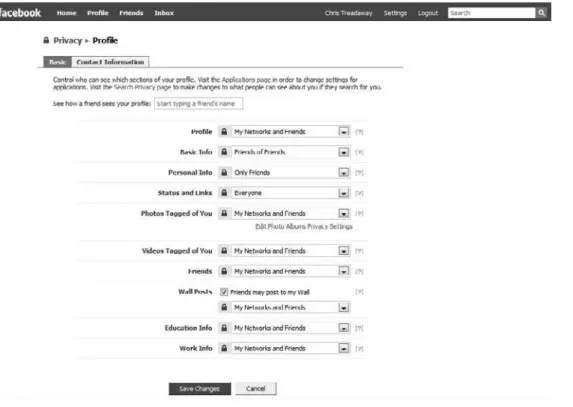
Figure 4.2 Facebook privacy settings
all of it means a few things for marketers:
Y
• ou simply won’t be able to access some people who are more careful with the data they share on Facebook.
h
• owever, most Facebook users, by virtue of adding self-identifying data to their profiles, are by default exposing themselves to marketing offers.
F
• acebook has an unbelievably rich set of demographic and behavioral data on its users, and that data will likely play a major role in the future of Facebook adver- tising and marketing on the platform.
In the sense that Facebook can gather accurate and up-to-date demographic tar- geting data from users, Facebook has only a few rivals (Google, Yahoo, twitter, maybe Microsoft, and a few others).
Wednesday: Decide How You’ll Use Your Facebook Profile
If you already have a Facebook profile, you’ll need to decide whether you want that profile to do “double duty” as your own personal profile and the profile that serves as the administrator account for the corporate presence (a fan page, group, and so on). If
Category Data Listed
Contact Information E-mail
Instant Messenger Screen Names Mobile Phone Number Land Phone Address City/Town Neighborhood Zip
Website
Education and Work College/University
Graduation Year Concentration/Major Degree Attained High School Employer Position Job Description City/Town Dates Worked
Groups Facebook groups to which the user belongs
Pages Facebook pages for which the user is a fan
the downside to collecting all this information is that it may make a user ner- vous. think about it—if the Facebook profile is totally filled out, it contains quite a bit of personal information that is often used in sensitive situations such as when you’ve forgotten your password for a credit card or when old friends you haven’t seen in years want to reconnect. It’s perfect for criminals who may want to steal someone’s iden- tity or use profile data to impersonate that person or act maliciously on behalf of that person.
Facebook established a rich set of data privacy controls with privacy settings for limiting exposure of certain types of information to certain people on Facebook—
friends, friends of friends, people in certain networks, nobody at all, and so on. all of this was done to make users more comfortable when adding life’s personal details into the social network. Figure 4.2 shows the available privacy options. users can also cus- tomize the privacy they want on a user-by-user basis if they are particularly concerned about certain individuals. Facebook truly has done a remarkable job of simplifying a user’s management of their own personal data.
PTable 4.3 Facebook User Information (Continued)
77■Week 3: eStaBlISh a PreSenCe WIth the FaCeBook ProFIle and FrIendS
Figure 4.2 Facebook privacy settings
all of it means a few things for marketers:
Y
• ou simply won’t be able to access some people who are more careful with the data they share on Facebook.
h
• owever, most Facebook users, by virtue of adding self-identifying data to their profiles, are by default exposing themselves to marketing offers.
F
• acebook has an unbelievably rich set of demographic and behavioral data on its users, and that data will likely play a major role in the future of Facebook adver- tising and marketing on the platform.
In the sense that Facebook can gather accurate and up-to-date demographic tar- geting data from users, Facebook has only a few rivals (Google, Yahoo, twitter, maybe Microsoft, and a few others).
Wednesday: Decide How You’ll Use Your Facebook Profile
If you already have a Facebook profile, you’ll need to decide whether you want that profile to do “double duty” as your own personal profile and the profile that serves as the administrator account for the corporate presence (a fan page, group, and so on). If
Category Data Listed
Contact Information E-mail
Instant Messenger Screen Names Mobile Phone Number Land Phone Address City/Town Neighborhood Zip
Website
Education and Work College/University
Graduation Year Concentration/Major Degree Attained High School Employer Position Job Description City/Town Dates Worked
Groups Facebook groups to which the user belongs
Pages Facebook pages for which the user is a fan
the downside to collecting all this information is that it may make a user ner- vous. think about it—if the Facebook profile is totally filled out, it contains quite a bit of personal information that is often used in sensitive situations such as when you’ve forgotten your password for a credit card or when old friends you haven’t seen in years want to reconnect. It’s perfect for criminals who may want to steal someone’s iden- tity or use profile data to impersonate that person or act maliciously on behalf of that person.
Facebook established a rich set of data privacy controls with privacy settings for limiting exposure of certain types of information to certain people on Facebook—
friends, friends of friends, people in certain networks, nobody at all, and so on. all of this was done to make users more comfortable when adding life’s personal details into the social network. Figure 4.2 shows the available privacy options. users can also cus- tomize the privacy they want on a user-by-user basis if they are particularly concerned about certain individuals. Facebook truly has done a remarkable job of simplifying a user’s management of their own personal data.