THE RAFFLES BULLETIN OF ZOOLOGY 2009 Supplement No. 20: 159–231
Date of Publication: 31 Jul.2009
© National University of Singapore
A NEW CLASSIFICATION FOR THE PYLOCHELIDAE (DECAPODA: ANOMURA: PAGUROIDEA)
AND DESCRIPTIONS OF NEW TAXA
Patsy A. McLaughlin
Shannon Point Marine Center, Western Washington University, 1900 Shannon Point Road, Anacortes, Washington, 98221-4042, USA
Email: hermit@fi dalgo.net
Rafael Lemaitre
Smithsonian Institution, National Museum of Natural History, Department of Invertebrate Zoology, P.O. Box 37012, Washington, D.C. 20013-7012, USA
Email: [email protected]
ABSTRACT. – A new classifi cation is presented based on the results of the recently completed cladistic analysis of the Pylochelidae. The subfamilies Pylochelinae and Pomatochelinae are retained, the latter with the genera Pylocheles and Cheiroplatea; however, the subgenera Xylocheles and Bathycheles are elevated to generic rank together with the nominal subgenus Pylocheles. In addition, one new species, B. phenax, is described in Bathycheles and B. profundus is shown to be conspecifi c with B. integer. The subfamilies Parapylochelinae, Cancellochelinae, Trizochelinae, and Mixtopagurinae are reduced to ranks of tribes and included in the subfamily Trizochelinae. A new genus Forestocheles is proposed in the tribe Trizochelini.
Within the genus Trizocheles, subspecifi c rank for T. spinosus bathamae is deemed unjustifi ed and this taxon is placed in synonymy with the nominal subspecies T. spinosus spinosus. The correct identity of Trizocheles balssi is established and the species mistakenly thought to represent that taxon is described as T. hoensonae, new species. Trizocheles gracilis is found to be conspecifi c with T. boasi and an additional new species, T.
mendanai, is added to the genus. The superfamilial ranks of Cheiroplateoidea, Pomatocheloidea, Pylocheloidea, and Cancellocheloidea proposed by Watabe (2007) are rejected, as is Birgusoidea.
KEY WORDS. – Decapoda, Anomura, Paguroidea, Pylochelidae, new classification, Pylochelinae, Pomatochelinae Trizochelinae, tribes, new genus, new species.
INTRODUCTION
Although the first pylochelid genera and species were described in the late nineteenth century, because of the cryptic habitats of these unusual paguroids they were rarely collected and consequently known from very few specimens.
Prior to the monographic review of Forest (1987a) only 19 species in fi ve genera had been described. In contrast to the total of 60 specimens reported in all the previous literature accounts, Forest was able to examine more than 400 individuals collected from approximately 200 sites around the world. Despite his revisionary efforts, which included the establishment of six subfamilies, Forest recognized the heterogeneity that still existed within the Pylochelidae Bate, 1888, and suggested that future study might show that each subfamily should be afforded familial rank.
It has only been recently that the substantial amount of supplemental material gathered during subsequent
exploratory cruises undertaken by the Muséum national d’Histoire naturelle (MNHN) and the Offi ce de la Recherche Scientifi que et Technique Outre-Mer (ORSTOM), now the Institut de Recherche pour le Developpement (IRD) has been examined. This increased abundance of study material, together with recent advances in cladistic methodology and computer generated phylogenetic analyses, made it possible for Lemaitre et al. (2009) to evaluate the interspecifi c and intergeneric relationships within the Pylochelidae. From those results and from detailed morphological investigations, we are able to propose a new classifi cation, amplify some of the existing descriptions and describe new taxa.
Additionally, fossilized carapaces thought to be paguroids recently have been recovered from the reefal and yellow algal limestones, respectively, of the Felsenkalke Formation, which date back to the Jurassic Period (van Bakel et al., 2008). Of these, two are believed to represent new pylochelid genera, one each assigned to the tribes Trizochelini Forest, 1987a
and Mixtopagurini Bouvier, 1895 (as subfamilies). This is the fi rst report of fossil pylochelids and the earliest evidence of paguroids in the fossil record, which lends support to the proposition that symmetry rather than the hypothesized asymmetry is the ancestral state of the Paguroidea.
MATERIALS AND METHODS
Specimens utilized in this reappraisal have come principally from the exceptionally large collections of the Muséum national d’Histoire naturelle, Paris, France, but these have been supplemented by specimens from the National Museum of Natural History, Smithsonian Institution, Washington, D.C., USA (USNM), the National Taiwan Ocean University, Keelung, Taiwan, Republic of China (NTOU), the Raffl es Museum of Biodiversity Research, National University of Singapore, Republic of Singapore (ZRC), and the National Institute of Water and Atmospheric Research, Ltd. (NIWA) [formerly New Zealand Oceanographic Institute (NZOI)], Wellington, New Zealand. Type specimens housed in the Instituto de Oceanología de la Academia de Ciencias de Cuba, Havana, Cuba (IOACC), the Kitakyushu Museum of Natural History and Human History, Kitakyushu, Japan (ZLKU), the Museum of Comparative Zoology, Harvard University, Cambridge, Massachusetts, USA (MCZ), the National Institute of Water and Atmospheric Research;
the Natural History Museum, London, United Kingdom (NHM), the South African Museum, Cape Town, South Africa (SAM), and the Zoological Museum University Copenhagen, Denmark (ZMUC), have been examined as well as those in the Muséum national d’Histoire naturelle and National Museum of Natural History. Additional identifying institutional abbreviations used in the text are IM, Indian Museum, Calcutta, India; NMCR, National Museum of the Philippines, Manila, Philippine Islands; NMNZ, National Museum of New Zealand (now Museum of New Zealand Te Papa Tongarewa), Wellington, New Zealand; ZSI, Zoological Survey of India. MUSORSTOM is the acronym for the joint expeditions of the MNHN and ORSTOM; EBISCO is the acronym for Exploration de la Biodiversité et ISolement en Mer du Corail; Panglao is the Philippine island around which certain expeditions surveyed. Specific collection gear used precedes the station number; gear abbreviations are: CC, otter trawl (shrimp); CP, beam trawl; DC, Charcot dredge; DW, Warén dredge; BS, benthic sample. Latitudes and longitudes are given only for the start of each gear deployment. Additional abbreviations used in the text are Stn.
for station, R.V. for research vessel, coll. for collector, and ovig. for ovigerous. Data for the Royal Indian Marine Survey vessel INVESTIGATOR has been taken from Anonymous (1914). One measurement, shield length, measured from the midpoint of the rostrum, rostral lobe, or anterior margin of the carapace to the midpoint of the posterior margin of the shield or cervical groove provides an indication of animal size and is given in parentheses following the specimen sex.
Ocular peduncle length has been measured on the lateral surface of the left peduncle from the distal margin of the cornea to the proximal margin of the ultimate peduncular segment; corneal diameter represents the maximum diameter
of the cornea measured across the dorsal surface. A number of morphological characters used by Lemaitre et al. (2009) in their cladistic matrix, but not considered by Forest (1987a) in his monograph, have been added to the generic diagnoses. In addition to the new classifi cation and keys, abbreviated redescriptions are presented for previously well known species and more detailed redescriptions for those taxa where additional information is now available. When possible the species accounts are accompanied by photographs of living specimens. Complete descriptions and detailed illustrations are presented for the new species. Terminology for the descriptions follows that of McLaughlin (2003) and McLaughlin et al. (2007a). The arrangement in the text of subfamilies, tribes, genera and species follows the keys and is not meant to imply phylogenetic relationships.
CLASSIFICATION AND JUSTIFICATION At the time of Forest’s (1987a) review of the Pylochelidae, the family was still considered part of the superfamily Coenobitoidea, a subdivision of Forest’s Section Paguridea.
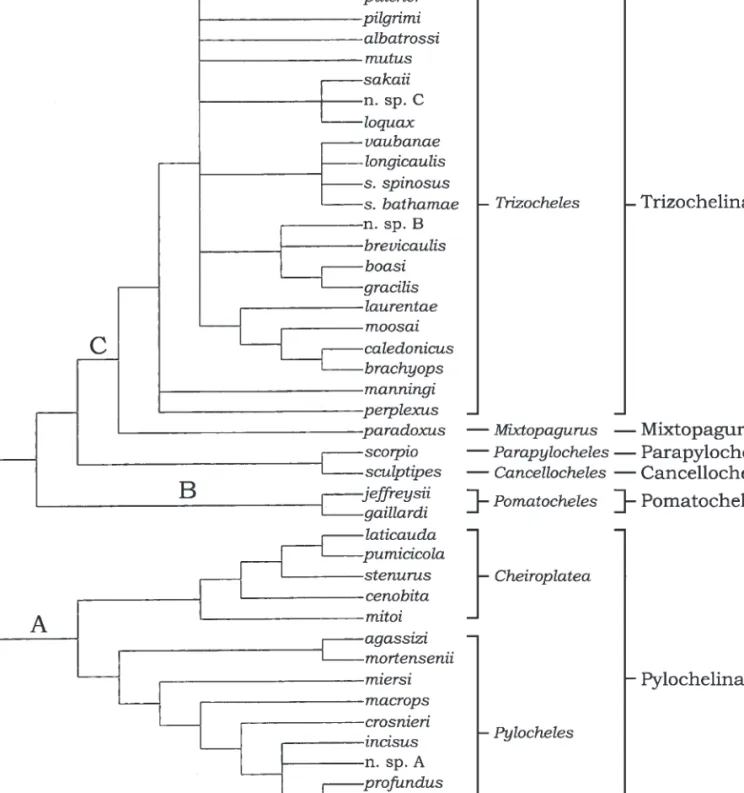
Martin & Davis (2001) rejected Forest’s classification, accepting instead an earlier proposition (McLaughlin, 1983b) that paguroids formed a monophyletic taxon, thus they abandoned Coenobitoidea and combined all existing families in the superfamily Paguroidea. McLaughlin et al. (2007b) confi rmed the monophyly of the Paguroidea but found, as had Richter & Scholtz (1994), that the Pylochelidae was paraphyletic according to the defi nition of paraphyly given by Hennig (1966), i.e., defi ned only by plesiomorphies. As may be seen from Lemaitre et al.’s (2009) strict consensus cladogram of relationships among the genera of the Pylochelidae, weighted against homoplasy, (Fig. 1), three distinct evolutionary branches are clearly distinguished, one representing the subfamily Pylochelinae Bate, 1888 (branch A), the second the subfamily Pomatochelinae Stebbing, 1914 (branch B), and the third including the remaining four other subfamilies (branch C), three of which are represented by single species. In Lemaitre et al.’s unweighted analysis (cladogram not shown), the Pylochelinae and Pomatochelinae received strong Bremer support, eight and 16, respectively, whereas the interfamilial relationships of the other subfamilies were only weakly supported, if at all. In the weighted analysis, fi ve synapomorphies attest to the monophyly of the Pylochelinae: 1) reduction or loss of the rostrum; 2) the loss of the epipod from the second maxilliped; 3, 4) the cheliform terminations of the second and third maxillipeds;
and 5) the prominent elevation of the dorsodistal facet of the carpus of each cheliped. Continuity of the linea transversalis is the only synapomorphy uniting the remaining major taxa. The Pomatochelinae are defi ned by the apomorphy, spinose second antennal segments, and share with the genera Pylocheles A. Milne-Edwards, 1880 and Cheiroplatea Bate, 1888 the synapomorphy of operculate chelae.
Although the data at present are very limited, McLaughlin &
Lemaitre (2008) and Lemaitre et al. (2009) called attention to the distinctly different larval patterns of development seen in Pylocheles mortensenii Boas, 1926, Pomatocheles jeffreysii
Miers, 1879, and two species of Trizocheles Forest, 1987a.
Their fi ndings lend additional support to subfamilial status for the Pylochelinae, Pomatochelinae and Trizochelinae Forest, 1987a. Thus, while the Parapylochelinae Forest, 1987a, and Cancellochelinae Forest, 1987a, are clearly sister taxa and they in turn sister to the Mixtopagurinae, subfamilial rank for each does not, at this time, seem justifi able. The Trizochelinae, currently represented only by the genus Trizocheles, is obviously not monophyletic. Of the 18 assigned species, four distinct clades are apparent and the relationships of four other species are unresolved, whereas
two species, T. manningi Forest, 1987a, and T. perplexus Forest, 1987a, are excluded from the genus. Although species were the terminal taxa in Lemaitre et al.’s (2009) analysis, the characters selected by the authors refl ected major morphological attributes distributed throughout the family. Differentiation of taxa of Trizocheles at the specifi c level was not as comprehensive, which explains why two of the four clades may not be accurate representations of intrageneric relationships. This may also be the reason that T. manningi was excluded from the genus. The suggested relative closeness of this species with T. perplexus is not
Fig. 1. Strict consensus cladogram of pylochelid inter- and intrageneric relationships (adapted from Lemaitre et al., 2009). [Thalassina anomala (Thalassinidae) and Munida quadrispina (Galatheidae), are the outgroup. Abbreviations used: n. sp. A, Bathycheles phenax, new species; n. sp. B, Trizocheles hoensonae, new species; n. sp C, T. mendanai, new species.
supported by their morphologies. The only character shared by the two species is the plesiomorphic absence of stridulatory rods and ridges on the carpi of the chelipeds and propodi and carpi of the second pereopods, and this is an absence also shared by T. mutus Forest, 1987a, as well. Development of these rods and ridges is a phenomenon that is not well understood, but appears to be, at least in part, correlated with growth. Pomatocheles stridulans Forest, 1987a, for example, is defi ned by the presence of these structures, while in the allied species P. jeffreysii, presumed stridulatory structures are present in small specimens, but disappear in larger individuals. A reversed situation has been observed in Trizocheles caledonicus Forest, 1987a, in which stridulatory rods and/or ridges are present in large specimens but absent in very small individuals.
In contrast, the exclusion T. perplexus from Trizocheles is completely justifi ed. The species was described by Forest (1987a), based on a single badly damaged specimen.
Despite the distinctly different structure of the telson of the holotype, the taxon was assigned to Trizocheles because of the similarities in the armatures of the remaining cheliped and pereopods with other members of that genus. Although supplementally collected material provided Forest &
McLaughlin (2000) with suffi cient information to present a more complete specifi c description, they apparently did not examine the mouthparts of any of their specimens. The present reexamination of that material has shown that this species differs in buccal character states, although primarily plesiomorphically, so markedly from species of Trizocheles that distinct generic reassignment is necessary. Specifi cally, species of Trizocheles, like Mixtopagurus A. Milne-Edwards, 1880, Cancellocheles Forest, 1987a, and Cheiroplatea all have one or more exceptionally long setae on the proximal margin of the posterior lobe of the maxillary scaphognathite. These setae are absent in Pylocheles, Pomatocheles Miers, 1879, Parapylocheles Alcock, 1901, and T. perplexus. However, the fi rst maxilliped lacks a fl agellum only in T. perplexus and Cancellocheles sculptipes (Miyake, 1978). In species of Pylocheles, Cheiroplatea, Pomatocheles, Parapylocheles and some Trizocheles, a one-segmented fl agellum is present, whereas in other Trizocheles species and in Mixtopagurus, the fl agellum is multiarticulated. The produced inner margin of the exopod of the second maxilliped seen in T. perplexus, also is found only in Pomatocheles species, and represented by a spine in Cancellocheles. One or more accessory teeth are present on the crista dentata of the third maxilliped in species of Parapylocheles, Cancellocheles, Trizocheles and Mixtopagurus, but absent in Pylocheles, Cheiroplatea, Pomatocheles and T. perplexus. The telson of T. perplexus is unlike those of any other pylochelid species, although in lacking subdivision into anterior and posterior portions, it approaches the condition seen in C. sculptipes.
Further phylogenetic assessment of relationships within Trizocheles is not possible at the present time, because five species are still only known from their holotypes.
We have already observed that even the addition of one or two supplemental specimens can signifi cantly alter the interpretation of a particular taxon. Consequently, although
the subfamily Pylochelinae still contains the two genera, Pylocheles and Cheiroplatea, and the Pomatochelinae three species in a single genus, Forest’s (1987a) monotypic subfamilies Parapylochelinae, Cancellochelinae, and Mixtopagurinae rather than being elevated to familial rankings, as suggested by Forest, are herein reduced to ranks of tribes and included in the subfamily Trizochelinae with the tribe Trizochelini containing the genera Trizocheles and Forestocheles new genus.
Watabe (2007), in his construction of an axiomatic system for the classifi cation of the Decapoda, proposed superfamilial ranks for some genera and families of the Paguroidea, but not all, thus creating a completely unacceptable hierarchy.
We fi nd his proposed Cheiroplateoidea, Pomatocheloidea, Pylocheloidea, Cancellocheloidea and Birgusoidea entirely without merit.
Pylochelidae Bate, 1888
“Paguriens” A. Milne-Edwards, 1880: 37 (in part).
Pylochelidae Bate, 1888: 10; Ortmann, 1898: 1144; Alcock, 1901:
209; Alcock, 1905: 13; Calman, 1909: 259; Calman, 1911: 94;
Balss, 1912: 90; Balss, 1913: 34; Terao, 1913: 390; Yokoya, 1933: 70; Makarov, 1938:119; Balss, 1940: 41, 96; Walton, 1950: 188 (in part); Forest, 1954: 167; Makarov, 1962: 114;
Dechancé, 1963: 495; Pilgrim, 1965: 549; Schembri & McLay, 1983: 28; Forest, 1987a: 25; Forest & McLaughlin, 2000: 31;
McLaughlin, 2003: 113 (key); McLaughlin et al., 2007c: 19 (key); Lemaitre et al., 2009: 1.
Parapaguridae – Henderson, 1888: 85 (in part); Ortmann, 1892:
274 (in part).
“Paguriens” ou “Pagurides” – A. Milne-Edwards & Bouvier, 1893:
17 (in part).
Pomatochelidae Stebbing, 1914: 2; Balss, 1924: 753; Balss, 1927:
1012; Barnard, 1950: 413; Miyake, 1978: 3; McLaughlin, 1983a:
431; McLaughlin, 1983b: 609; Baba, 1986: 184.
Type genus. – Pylocheles A. Milne-Edwards, 1880.
Diagnosis. – Carapace usually well calcified, at least anteriorly; incompletely or completely divided into shield and posterior carapace by linea transversalis; cervical groove contiguous or not with linea transversalis. Rostrum present or absent. Ocular peduncles well developed or reduced;
corneas well developed, reduced or absent. Antennular and antennal peduncles well developed. Usually 14 pairs of quadriserial phyllobranchiate gills, paired arthrobranchs on third maxillipeds and pereopods 1–4, unpaired pleurobranchs above pereopods 2–5; arthropods occasionally reduced on third maxillipeds.
Maxillule with or without external endopodal lobe developed.
Maxilla with or without 1 or more exceptionally long setae on posterior margin of proximal lobe of scaphognathite.
First maxilliped with epipod well developed; exopod with or without fl agellum. Second maxilliped with or with epipod;
exopod with or without spines. Third maxilliped with or without epipod; endopod with crista dentata developed on ischium, with or without 1 or more accessory teeth;
maxillipeds basally approximate.
Chelipeds equal or not, usually symmetrical, together forming operculum or not. Ambulatory legs pediform. Fourth pereopods sub- or semichelate. Fifth pereopods subchelate or chelate. Propodal rasps each consisting of 1 to several rows of corneous scales.
Pleon with tergal plates moderately to well calcified, articulated; pleura moderately well developed or reduced;
uropods usually symmetrical. Males with fi rst and second pleopods paired and modifi ed as gonopods; paired pleopods 3–5 unequally biramous or uniramous. Females with paired fi rst pleopods modifi ed; pleopods 2–5 paired, unequally biramous.
Remarks. – When he established the family Pylochelidae, Bate (1888) included the genera Pomatocheles, Pylocheles and his own Cheiroplatea. Although Bate did not specifi cally state that the type genus was Pylocheles, he implied as much by stating “The name is derived from that given to a genus by A. Milne-Edwards, and includes all those paguriform Anomura that are trichobranchiate.”
As may be seen from the synonymy, only limited supplemental information regarding the family in its entirety has been published since Forest’s (1987a) monograph. Although Forest provided etymologies for his new genera, he did not specify genders. Forest & McLaughlin (2000) cited the genders of both Pylocheles and Trizocheles incorrectly as masculine. The Greek noun (chele) is feminine (Bailly, 1928).
Key to the subfamilies and tribes of the Pylochelidae Bate, 1888
1. Linea transversalis interrupted, shield incompletely separated from posterior carapace; telson divided into anterior and posterior articulating plates ... Pylochelinae – Linea transversalis continuous; shield completely separated
from posterior carapace; telson not divided into anterior and posterior articulating plates ... 2 2. Epipod of second maxilliped absent; chelipeds alone forming
operculum ... Pomatochelinae – Epipod of second maxilliped present; chelipeds alone not
forming operculum ... 3 Trizochelinae 3. Posterior carapace distinctly longer than anterior carapace;
ocular peduncles spinose ... Parapylochelini – Posterior carapace equal to or shorter than anterior carapace;
ocular peduncles not spinose ... 4 4. Rostrum with subrostral spine; terminal margin of telson
entire ... Cancellochelini – Rostrum without subrostral spine; terminal margin of telson
with median concavity or cleft ... 5 5. Pleon symmetrical; telson with posterior lobes usually
symmetrical ... Trizochelini – Pleon asymmetrical; telson with posterior lobes usually
asymmetrical ... Mixtopagurini
Pylochelinae Bate, 1888 Type genus. – Pylocheles A. Milne-Edwards, 1880.
Diagnosis. – Shield incompletely separated from posterior carapace; linea transversalis not continuous medianly.
Rostrum absent or developed as small median spinule or rounded lobe; antennular lobes present. Ocular peduncles well developed or reduced, corneas well developed or reduced, pigmented or not; ocular acicles plate-like or not readily apparent. Maxillule with external endopodal lobe obsolete. First maxilliped with well developed epipod.
Second maxilliped without epipod. Third maxilliped without accessory tooth on crista dentata; terminally chelate or subchelate. Chelipeds equal, symmetrical, forming operculum or not. Telson divided into anterior and posterior portions by distinct transverse suture.
Remarks. – In the Pylochelinae, Lemaitre et al. (2009) recognized two clades representing the genera Cheiroplatea and Pylocheles, respectively. They are united by the distinctive synapomorphy of chelate or subchelate third maxillipeds. Within Pylocheles, the subgenus Pylocheles is sister to the remaining taxa. Several apomorphies set that subgenus apart, most notably the operculate and spinose chelae. Two synapomorphies attributable to the subgenus Xylocheles Forest, 1987a are the well developed lateral projections and the distinct presence of ocular acicles, which are shared with Pylocheles. In contrast, species of Bathycheles Forest, 1987a are set apart by their reduced ocular peduncles and corneas. The complete loss of the epipod on the third maxilliped is a synapomorphy that Bathycheles and Xylocheles share, but one that also occurs convergently in the Parapylochelini, Trizochelini and virtually all other non-pylochelid paguroids. The compelling distinctiveness of Pylocheles makes it impossible to classify Xylocheles and Bathycheles as subgenera of it. Therefore, although neither exhibits the apomorphies of Pylocheles, we believe there is ample morphological justifi cation to elevate all three subgenera to full generic rank.
Forest (1987a, b) also considered habitat and depth distributions in his characterization of the three subgenera.
While additional sampling has confi rmed the xylocolous and petricolous habitats of Bathycheles, Xylocheles and Pylocheles, sponge occupancy also has been documented for P. mortensenii. Bathymetric distributions are no longer easily categorized. Species of Pylocheles have been collected from depths of 100 to 600 m, possibly 700 m. Xylocheles species have been encountered from 148 to 760 m, whereas species of Bathycheles have been found as shallowly as 283 m and as deep as 2,149 m, possibly even to 2,217 m.
Key to the genera of the subfamily Pylochelinae Bate, 1888
1. Shield approximately as broad as long; anterior margin of shield with median concavity, with or without median spinule; corneas variable in size but always hemispherical ... 2 – Shield distinctly broader than long; anterior margin of shield
with well developed, rounded rostral lobe; corneas reduced, conical ... Cheiroplatea 2. Chelipeds together forming circular or subcircular operculum;
without cluster of tubercles on dorsomesial face of carpus ȤƾȜȒ
distally; posterior portion of telson distinctly divided into 2 lobes ... Pylocheles – Chelipeds not forming operculum; with cluster of tubercles on dorsomesial face of carpus distally; posterior portion of telson not distinctly divided into 2 lobes ... 3 3. Ocular peduncles moderately long, considerably more than half
shield length; corneas large, distinctly pigmented ...
... Xylocheles – Ocular peduncles short, not more than half shield length; corneas
reduced, not distinctly pigmented ... Bathycheles
Cheiroplatea Bate, 1888
Cheiroplatea Bate, 1888: 11; A. Milne-Edwards & Bouvier, 1893:
18; Stebbing, 1893: 170; Ortmann, 1898: 1144; Forest, 1987a:
87; Forest & McLaughlin, 2000: 35.
Chiroplatea – Ortmann, 1892: 274; Alcock, 1905: 17; Balss, 1940: 144; Balss, 1956: 1387; Balss, 1957: 1584, 1745 (misspelling).
Cheiroplataea – MacGilchrist, 1905: 243; Stebbing, 1914: 2; Boas, 1926: 42 (misspelling).
Type species. – By monotypy, Cheiroplatea cenobita Bate, 1888;
gender feminine.
Diagnosis. – Anterior margin with broad, weakly to well developed rostral lobe; lateral projections also moderately or well developed. Ocular peduncles reduced, corneas defi ned or not, non-pigmented if present; ocular acicles not clearly delineated, apparently fused with ultimate peduncular segments. Antennular and antennal peduncles considerably overreaching ocular peduncles, antennular peduncles appreciably longer than antennal peduncles. Antennal peduncles with supernumerary segmentation.
Mandible with calcifi ed cutting edge; second segment of mandibular palp with produced, denticulate lobe. Maxillule with external lobe of endopod obsolete. First maxilliped with epipod; fl agellum one-segmented. Second maxilliped without epipod; terminally semichelate. Third maxilliped with or without epipodal remnant; exopod unarmed; endopod with well developed crista dentata; no accessory tooth; merus with 2 or 3 ventral spines; terminally weakly chelate.
Chelipeds equal, symmetrical; carpi each with elevated anterodorsal facet overhanging posterior margin of chela;
chelae together forming operculum.
Sixth pleonal tergite subrectangular to subquadrate. Telson divided into anterior and posterior portions by transverse suture; posterior portion undivided.
Male first pleopod with long, moderately slender basal segment and shorter subovate distal segment. Second pleopod with moderately long basal segment; distal segment with semi-articulated distal portion much shorter than proximal portion; exopod rudimentary or absent. Pleopods 3–5 with well developed exopods, endopods rudimentary or absent.
Female fi rst pleopods slender, one or incompletely two- segmented. Pleopods 2–5 with long, one-segmented exopods and quite short one-segmented endopods.
Remarks. – The ocular acicles were described by Forest (1987a) as being very reduced and little if at all visible. From one of the specimens of C. laticauda Boas, 1926 available for reexamination, another interpretation is possible. This specimen (USNM 1024162) is a molt which makes sutures somewhat easier to discern. The ocular peduncles of this species have been described (Forest 1987a: 92) as being weakly concave on the mesial side proximally, which is quite true; however, the ocular peduncles of this species, like all the others in the genus, are actually broadened on the mesial surface basally. The ocular peduncles of the molt show clear suture lines on these mesial surfaces suggestive of ocular acicles that have incompletely or completely fused with the basal portions of the ultimate peduncular segments.
Key to the species of Cheiroplatea Bate, 1888 1. Lateral projections of shield reduced; epistome with 1 or 2
small spines ... C. laticauda (Pacifi c) – Lateral projections of shield prominently produced; epistome
unarmed ... 2 2. Dorsal surfaces of propodi of second pereopods each with row
of small spines ... 4 – Dorsal surfaces of propodi of second pereopods unarmed or
with few tiny spinules ... 3 3. Meri of chelipeds with ventromesial margins unarmed,
ventrolateral margins each with spinule at distal angle ...
... C. cenobita (Pacifi c) – Meri of chelipeds each with ventromesial and ventrolateral
marginal row of small spines increasing in size distally ...
... C. mitoi (Pacifi c) 4. Carpi of third pereopods with dorsal surfaces unarmed ...
... C. stenurus (Indian Ocean) – Carpi of third pereopods each with row of small spines on dorsal
surface ... 5 5. Ventral margins of meri of second pereopods each with few
spines or spinules; dorsal surfaces unarmed ...
... C. pumicicola (Pacifi c) – Ventral margins of meri of second pereopods unarmed; dorsal
margins each with 2 spinules ... C. scutata (Atlantic)
Pylocheles A. Milne-Edwards, 1880 restricted Pylocheles A. Milne-Edwards, 1880: 38; Bate, 1888: 11; Agassiz,
1888: 40; Ortmann, 1892: 274; Ortmann, 1898: 1144; A. Milne- Edwards & Bouvier, 1893: 17; Stebbing, 1893: 169; Alcock, 1901: 210 (in part); Benedict, 1901: 771; Alcock, 1905: 14 (in part); Boas 1926: 34 (in part); Forest, 1954: 167; Miyake, 1978:
10; Ortiz & Gómez, 1986: 31 (in part) (key); Forest, 1987a: 41 (in part); Forest & McLaughlin, 2000: 32 (in part); McLaughlin et al., 2007c: 19 (in part).
Mixtopagurus – Yokoya, 1933: 70 (in part).
Pylocheles (Pylocheles) – Forest, 1987a: 48; Forest, 1987b: 316;
Forest & McLaughlin, 2000: 33; McLaughlin et al., 2007c: 19 (key); Lemaitre et al., 2009: 9.
Type species. – By monotypy, Pylocheles agassizii A. Milne- Edwards, 1880; gender feminine.
Diagnosis. – Shield with subrostral groove; anterior margin with antennular lobes separated by shallow straight or weakly concave sinus from faintly rounded rostral projection, with
or without median spinule; lateral projections prominent.
Ocular peduncles well developed, appreciably shorter than antennular peduncles; corneas slightly dilated, pigmented;
ocular acicles developed as flattened plates. Antennal peduncles with supernumerary segmentation.
Mandible with calcifi ed cutting edge; second segment of mandibular palp with produced, marginally denticulate lobe. Maxillule with external lobe of endopod obsolete.
Scaphognathite of maxilla without very long setae on posterior lobe. First maxilliped with epipod; fl agellum one- segmented. Second maxilliped without epipod; terminally chelate. Exopod of third maxillipeds unarmed; endopod with well developed crista dentata; no accessory tooth; merus with 2 or 3 ventral spines; terminally chelate.
Chelipeds equal, symmetrical; carpi each with elevated dorsodistal facet overhanging posterior margin of chela;
chelae together forming operculum.
Sixth pleonal tergite subrectangular. Telson divided into anterior and posterior portions by transverse suture; posterior portion divided into distinct symmetrical lobes.
Male fi rst pleopods short, two-segmented, distal segment somewhat spatulate; second pleopods also two-segmented but much longer than fi rst, distal segment with cleft distally resulting in two very unequal lobes; pleopods 3–5 with endopods appreciably reduced. Females with fi rst pleopods also modified, uniramous, two-segmented; pleopods 2–5 unequally biramous, with exopods elongate, endopods shorter.
Key to the species of Pylocheles A. Milne-Edwards, 1880
1. Dorsal margins of carpi of second pereopods each with only dorsodistal spine ... P. agassizii (Atlantic) – Dorsal margins of carpi of second pereopods each with 5 or 6
spines ... P. mortensenii (Indo-Pacifi c)
Xylocheles Forest, 1987a
Pylocheles – Alcock, 1899: 111 (in part); Alcock & Anderson, 1899a: 14 (in part); Boas, 1926: 34 (in part); Pérez, 1934:
25.
Pylocheles (Xylocheles) Forest, 1987a: 57; Forest, 1987b: 316;
Lemaitre et al., 2009: 1.
Type species. – By original designation, Pylocheles (Xylocheles) macrops Forest, 1987a; gender feminine.
Diagnosis. – Shield without subrostral groove; rostrum absent; anterior margin with weakly developed antennular lobes separated by shallow straight or weakly concave sinus, without median spinule; lateral projections obsolete or absent.
Ocular peduncles well developed, appreciably shorter than antennular peduncles; corneas slightly to prominently dilated,
pigmented; ocular acicles developed as fl attened plates.
Antennal peduncles with supernumerary segmentation.
Mandible with calcifi ed cutting edge; second segment of mandibular palp with produced, marginally denticulate lobe. Maxillule with external lobe of endopod obsolete.
Scaphognathite of maxilla without very long setae on proximal lobe. First maxilliped with epipod; fl agellum one- segmented. Second maxilliped without epipod; terminally chelate. Third maxilliped without epipod; exopod unarmed;
endopod with well developed crista dentata; no accessory tooth; merus with 1 ventral spine or spinule; terminally chelate.
Chelipeds equal, symmetrical; carpi each with elevated dorsodistal facet overhanging posterior margin of chela;
chelae not forming operculum.
Sixth pleonal tergite subquadrate. Telson divided into anterior and posterior portions by transverse suture; posterior portion weakly divided into symmetrical lobes.
Male first pleopod with long, moderately slender basal segment and much shorter subovate distal segment. Second pleopod with moderately long basal segment; distal segment with semi-articulated, somewhat foliaceous terminal portion shorter than proximal portion; exopod rudimentary. Pleopods 3–5 with well developed exopods, endopods rudimentary or absent. Female fi rst pleopods slender, incompletely two- segmented. Pleopods 2–5 with long, one-segmented exopods and shorter one-segmented endopods.
Key to species of Xylocheles Forest, 1987a 1. Ocular peduncles moderately short, corneas prominently dilated;
terminal margin of sixth pleonal tergite with 2 median incisions separated by irregular concave marginal portion ...
... X. miersi (Pacifi c) 2. Ocular peduncles moderately long, corneas only slightly dilated;
terminal margin of sixth pleonal tergite with 2 median incisions separated by prominently produced marginal portion ...
... X. macrops (Indo-Pacifi c)
Bathycheles Forest, 1987a
Pylocheles (Bathycheles) Forest, 1987a: 66; Forest, 1987b: 316;
Lemaitre et al., 2009: 1.
Type species. – By original designation, Pylocheles (Bathycheles) incisus Forest, 1987a; gender feminine.
Diagnosis. – Anterior margin lacking rostrum; with moderate to well developed antennular lobes separated by shallow to deep, unarmed median concavity; lateral projections moderately well developed, usually rounded. Ocular peduncles reduced, greatly overreached by antennular peduncles;
corneas small, usually non-pigmented; ocular acicles reduced, often fused to penultimate peduncular segments. Antennal peduncles with supernumerary segmentation.
Mandible with calcifi ed cutting edge; second segment of mandibular palp with produced, marginally denticulate lobe. Maxillule with external lobe of endopod obsolete.
Scaphognathite of maxilla without 1 or more very long setae on proximal lobe. First maxilliped with epipod; fl agellum one-segmented. Second maxilliped without epipod; terminally chelate. Third maxilliped without epipod; exopod unarmed;
endopod with well developed crista dentata; no accessory tooth; merus unarmed; terminally chelate. Epistome with or without spine.
Chelipeds equal, symmetrical; carpi each with elevated dorsodistal facet overhanging posterior margin of chela.
Chelae not forming operculum.
Sixth pleonal tergite subrectangular. Telson divided into anterior and posterior portions by transverse suture; posterior portion undivided.
Male first pleopod with long, moderately slender basal segment and much shorter subovate distal segment. Second pleopod with moderately short basal segment; distal segment with semi-articulated distal portion foliaceous and shorter than proximal portion; exopod rudimentary. Pleopods 3–5 with well developed exopods, endopods rudimentary or absent.
Female fi rst pleopods slender, uniramous or incompletely two-segmented. Pleopods 2–5 with long, one-segmented or incompletely two-segmented non egg-bearing exopods and shorter one-segmented egg-bearing endopods.
Remarks. – In addition to a new species that is described in Bathycheles, B. profundus Forest, 1987a has been found to be conspecifi c with B. integer Forest, 1987a.
Key to species of Bathycheles Forest, 1987a 1. Terminal margin of sixth pleonal tergite with moderate to deep,
broad median subquadrate to subrectangular concavity ... 2 – Terminal margin of sixth pleonal tergite without moderate to
deep, broad median subquadrate to subrectangular concavity ... 4 2. Anterior region of telson with ovate area of decalcifi cation at
each posterolateral angle ... B. cubensis (Atlantic) – Anterior area of telson without ovate area of decalcifi cation at
each posterolateral angle ... 3 3. Dorsal surfaces of palms of chelipeds each with marginal and
median rows of simple and modifi ed (thick, club-like) setae ... B. incisus (Pacifi c) – Dorsal surfaces of palms of chelipeds each without marginal
and median rows of modifi ed (thick, club-like) setae ...
... B. phenax, new species (Pacifi c) 4. Dorsal surfaces of palms of chelipeds each with median and
lateral depressions separated by slightly sinuous longitudinal granular ridge ... B. macgilchristi (Indian Ocean) – Dorsal surfaces of palms of chelipeds each without slightly
sinuous longitudinal granular ridge ... 5 5. Terminal margin of sixth pleonal tergite straight or slightly
concave, with or without 1–3 very small incisions ...
... B. integer (Indo-Pacifi c) – Terminal margin of sixth pleonal tergite with median portion
produced ... B. crosnieri (Indian Ocean)
Pomatochelinae Stebbing, 1914 Pomatochelinae – Forest, 1987a: 113.
Type genus. – By monotypy, Pomatocheles Miers, 1879.
Diagnosis. – Shield separated from posterior carapace by continuous linea transversalis; cervical groove weakly delineated and contiguous with linea transversalis only medianly. Rostrum broadly rounded or absent. Arthrobranchs of third maxilliped reduced. Epipod of second maxilliped absent. Epipod of third maxilliped rudimentary. Maxilla without 1 or more long setae on posterior margin of scaphognathite. Chelipeds symmetrical, forming operculum.
Dactyls of ambulatory legs without ventral corneous spines.
Telson longer than broad.
Remarks. – The phylogenetic analysis of Lemaitre et al.
(2009) clearly delineated three evolutionary lineages in the family Pylochelidae; members of the subfamily Pylochelinae were the more basal of the three clades. Although the considerable diversity that exists among members of the latter clades requires hierarchical recognition, all are united by the synapomorphy, a continuous linea transversalis.
However, the Bremer support received by the Pomatochelinae in the unweighted analysis has convinced us that retention of subfamilial rank for the clade is justifi ed. The family is represented by only the type genus.
Pomatocheles Miers, 1879
Pomatocheles Miers, 1879: 49; Bate, 1888: 10; Henderson, 1888:
101; Alcock, 1899: 111; Alcock, 1905: 14; Stebbing, 1914: 3 (in part); Boas, 1926: 46; Balss, 1927: 1012; Balss, 1957:1584 (in part); Miyake, 1978: 4 (in part); Baba, 1986: 29; Forest, 1987a: 112.
Mixtopagurus – Balss, 1913: 34 (in part); Yokoya, 1933: 70 (in part).
Diagnosis. – Anterior margin with rostral lobe usually produced, broadly rounded. Lateral projections also usually well developed. Ocular peduncles moderately short and stout;
corneas well developed; ocular acicles plate-like. Antennular peduncles overreaching distal corneal margins. Antennal peduncles with supernumerary segmentation.
Mandibular palp with very prominent subrectangular, terminally spinulose, dorsomesial projection from second segment. Maxillule with external lobe of endopod elongate, articulated and recurved. First maxilliped with one-segmented flagellum. Second maxilliped with exopod unarmed or occasionally with small spine; endopod pseudo-semichelate.
Exopod of third maxilliped with 1 or 2 spines on inner surface;
endopod with well developed crista dentata on ischium and 1 very prominent ventral spine not equivalent to accessory tooth; merus with 1 prominent ventral spine; termination simple. Epistome unarmed.
Chelipeds each with dorsodistal facet of carpus prominently elevated or not. Ambulatory legs similar. Fourth pereopod
semichelate; propodal rasp consisting of 1–4 rows of corneous scales. Fifth pereopod weakly chelate; propodal rasp well developed.
Pleon with tergites calcifi ed; tergite of pleomere 6 roundly subquadrate, with deep lateral incisions; terminal margin with or without spines. Uropods symmetrical; protopods produced posteriorly, terminally armed with corneous tubercle. Telson with prominent lateral indentations; posterior lobes separated by shallow median cleft, terminal margins rounded, unarmed.
Remarks. – Forest (1987a) added two additional taxa to this formerly monotypic genus, P. gaillardi Forest, 1987a, and P.
stridulans Forest, 1987a. Both species are known from very few specimens, all of which are very small and smaller than the smallest specimens of P. jeffreysii personally examined.
Forest (1987a) differentiated P. gaillardi from P. jeffreysii primarily on proportional differences and the absence of spines on the terminal margin of the sixth pleonal tergite of the former species. Although ratios of ocular peduncular length to shield length and corneal diameter are known to be infl uenced by animal size as are antennular peduncular lengths, the lack of tergal spination in P. gaillardi does appear to support its distinctiveness. Because the posterior portion of the pleon was missing in the only adult specimen of P.
stridulans known, Forest cited the lack of rostral development and the presence of tubercles reminiscent of a stridulating mechanism on the mesial face of each chela as diagnostic for this taxon. Whereas small specimens of P. jeffreysii lacking a rostral lobe have not been observed, the Taiwan and non-type Japanese specimens from Tosa Bay, cited in the material examined for that species, each has a row of similar tubercles and arc as described for P. stridulans. A possible series of stridulatory tubercles was also observed in the paratype of P. gaillardi. Additionally, reexamination of the specimens of P. jeffreysii in the MNHN has shown that smaller specimens also have these tubercles developed but that they tend to become obscure with increasing animal size.
While it is quite possible that the lack of rostral development in the holotype of P. stridulans is abnormal and this taxon is conspecifi c with P. jeffreysii, we refrain from putting it into synonymy, pending knowledge of the morphology of the sixth pleonal tergite, uropods and telson.
Key to the species of Pomatocheles Miers, 1879 1. Rostral lobe obsolete ... P. stridulans (Indian Ocean) – Rostral lobe produced, broadly rounded ... 2 2. Rostrum without marginal spinules; fi rst segment of antennal
peduncle with few small spines on ventrolateral margin ...
... P. jeffreysii (Pacifi c) – Rostrum with 3 or 4 marginal spinules; fi rst segment of antennal
peduncles with long hooked spine on ventrolateral margin ....
... P. gaillardi (Indo-Pacifi c)
Trizochelinae Forest, 1987a Parapylochelinae Forest, 1987a: 135.
Cancellochelinae Forest, 1987a: 145.
Mixtopagurinae Bouvier, 1895: 208 (in part).
Trizochelinae Forest, 1987a: 155.
Type genus. – By original designation Trizocheles Forest, 1987a.
Diagnosis. – Rostrum triangular, moderately to prominently produced. Second maxilliped with epipod. Chelipeds symmetrical or not; chelae alone not forming operculum;
carpi lacking elevated dorsodistal facets. Fourth pereopods with propodal rasps each consisting of numerous rows of corneous scales.
Parapylochelini Forest, 1987a Parapylochelinae Forest, 1987a: 135.
Type genus. – By monotypy, Parapylocheles Alcock, 1901.
Diagnosis. – Posterior carapace considerably longer than shield. Rostrum moderately well developed, triangular.
Ocular peduncles basally swollen and approximate, distinctly separated distally; corneas reduced; ocular acicles plate-like, calcifi ed or not, sometimes fused. Arthrobranchs of third maxilliped reduced.
Sternites of fourth and fi fth pereopods each with median spiniform protuberance. Male and female pleopods 3–5 each with endopod well developed; exopod reduced.
Remarks. – Because Forest (1987a) could fi nd no characters that suggested affi nities with other genera of the Pylochelidae, he believed subfamilial rank was appropriate for the monotypic Parapylocheles. Despite its several unique apomorphies, the phylogenetic analyses of Lemaitre et al. (2009) consistently ranked Parapylocheles sister to Cancellocheles. We consider the distinctive attributes of both genera justifi cation for tribal rank, but not subfamilial.
Parapylocheles Alcock, 1901
Parapylocheles Alcock, 1901: 213; Alcock, 1905: 19; Balss, 1912:
90; Boas, 1926: 47; Balss, 1927: 1012; Balss, 1940: 96; Balss, 1956: 1386; Balss, 1957: 1585, 1744; Forest 1987a: 135.
Not Parapylocheles – Walton, 1950: 188 (= megalopa of Dardanus).
Type species. – By monotypy, Parapylocheles scorpio (Alcock, 1894); gender feminine; monotypic.
Diagnosis. – Anterior margin with rostrum triangular; lateral projections broadly triangular. Posterior carapace elongate.
Antennular peduncles overreaching distal corneal margins.
Antennal peduncles with supernumerary segmentation.
Mandible with broad corneous cutting edge; palp with dorsal portion of second segment broadened. Maxillule with external lobe of endopod obsolete. Maxilla with no long setae on proximal portion of posterior scaphognathal lobe.
First maxilliped with large, triangular epipod; fl agellum one-segmented. Second maxilliped with small epipod. Third maxilliped with 1 or more accessory teeth on crista dentata;
1 dorsal and 1 ventral spine on merus and on carpus; no epipod. Epistome with 2 spines.
Chelipeds subequal, right slightly larger; dorsodistal facets of carpi not elevated. Ambulatory legs similar; dactyls with ventral corneous spines. Fourth pereopods semichelate;
sternite with small median tubercle. Fifth pereopods dimorphic; sternite with prominent median projection directed anteriorly.
Sixth pleonal tergite subquadrate. Telson unequally divided by faint indentations.
Male first pleopods short, simple, 2-segmented. Male second pleopods elongate, 2-segmented; terminal segment representing endopod broadened distally but not spatulate;
exopod very reduced. Pleopods 3–5 each with 2-segmented endopod and short, reduced exopod. Female fi rst pleopod 1-segmented, short, simple. Pleopods 2–5 with 2-segmented endopods, reduced exopods, similar to males but slightly larger.
Cancellochelini Forest, 1987a Cancelochelinae Forest, 1987a: 145.
Type genus. – By monotypy, Cancellocheles Forest, 1987a.
Diagnosis. – Shield considerably broader than long; anterior margin with prominent triangular rostrum and subrostral spine. Corneas reduced; ocular acicles plate-like Chelipeds equal and symmetrical, with second pereopods, forming operculum. Tergite of pleonal segment 1 broad. Telson without lateral incisions or sutures.
Cancellocheles Forest, 1987a Pomatocheles – Miyake 1978: 9 (in part).
Cancellocheles Forest, 1987a: 145; Forest, 1987b: 313, Fig. 2.
Type species. – By monotypy, Pomatocheles sculptipes Miyake, 1978; gender feminine; monotypic.
Diagnosis. – Lateral projections not well developed. Ocular peduncles short, broadened basally. Antennular peduncles considerably overreaching distal corneal margins. Antennal peduncles with supernumerary segmentation.
Mandible with corneous cutting edge; palp with the second segment somewhat expanded, rounded, but unarmed.
Maxillule with external lobe of endopod short, articulated but not recurved. Maxilla with several long setae posteriorly on proximal lobe of scaphognathite. First maxilliped without exopodal flagellum. Exopod of second maxilliped with multispinose expansion of mesial face. Third maxilliped with 1 or 2 spines on inner surface of exopod; endopod with well developed crista dentata and 3 accessory teeth; merus with 1 prominent ventral spine and 2 tiny spinules; termination simple. Epistome with spine.
Second and third pereopods dissimilar. Fourth pereopods semichelate; propodal rasps consisting of many rows of corneous scales. Fifth pereopods dimorphic; propodal rasps well developed.
Sixth pleonal tergite subcircular. Uropods with protopods not produced posteriorly. Telson entire.
Male fi rst pleopods 2-segmented; distal segments ovate, with concave inner surfaces. Second pleopods with elongate 2-segmented endopods; proximal segment with distal half foliaceous, terminal segment slender, both with marginal fi ne setae; exopod rudimentary. Pleopods 3–5 biramous, exopod longer than 2-segmented endopod. Female first pleopods short, indistinctly 2-segmented. Pleopods 2–5 unequally biramous, exopods approximately twice lengths of endopods.
Trizochelini Forest, 1987a Trizochelinae Forest, 1987a: 155.
Type genus. – By original designation, Trizocheles Forest, 1987a.
Diagnosis. – Shield usually longer than broad. Rostrum triangular, usually acute. Ocular acicles well developed, distally spinose. Chelipeds non-operculate, equal, subequal or unequal, usually similarly armed. Ambulatory legs similar or dissimilar. Fourth pereopods usually semichelate, with propodal rasps composed of several rows of corneous scales.
Female pleopods 2–5 with exopods inserted laterally at bases of protopods. Telson usually longer than broad, terminal margin with median cleft.
Remarks. – In the strict consensus cladogram produced by Lemaitre et al. (2009: Fig. 3), Trizochelini was composed the genus Trizocheles, consisting of four clades and an additional four species, T. pulcher Forest, 1987a, T. pilgrimi Forest &
McLaughlin, 2000, T. albatrossi Forest, 1987a and T. mutus Forest, 1987a, the relationships of which were unresolved. As indicated previously, two taxa, T. perplexus and T. manningi were excluded from the genus, but retained in the tribe.
However, T. manningi’s suggested sister relationship with T.
perplexus is disavowed by several signifi cant morphological characters. As discussed earlier, so distinct is T. perplexus that the new genus, Forestocheles is proposed for it.
Key to the genera of Trizochelini Forest, 1987a 1. First maxilliped without exopodal fl agellum; crista dentata
without accessory tooth; telson not divided into anterior and posterior portions by lateral indentations ...
... Forestocheles new genus – First maxilliped with exopodal fl agellum; crista dentata with
accessory tooth; telson divided into anterior and posterior portions by lateral indentations ... Trizocheles
Forestocheles, new genus
Trizocheles Forest, 1987a: 155 (in part); Forest, 1987b: 315 (in part); Forest & McLaughlin, 2000: 40 (in part); Lemaitre et al., 2009: 10 (in part).
Type species. – By original designation, Trizocheles perplexus Forest, 1987a; gender feminine; monotypic.
Etymology. – Dedicated to Jacques Forest in recognition of his extensive work with and knowledge of the Pylochelidae.
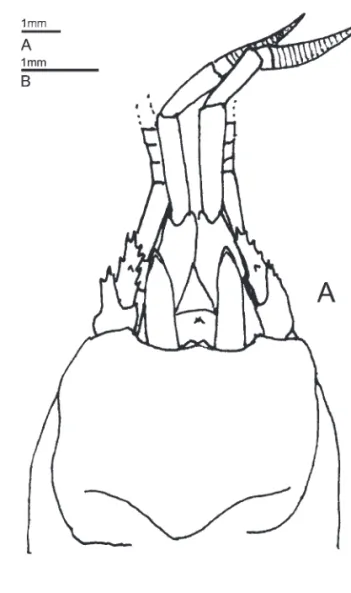
Fig. 2. Mouthparts of Forestocheles [F. perplexus (Forest, 1987a), male (3.0 mm) (MNHN-Pg 5835), NZOI Stn. K830], left, A–E, external view; F, internal view. A, mandible; B, maxillule; C, maxilla; D, fi rst maxilliped; E, second maxilliped; F, third maxilliped.
Diagnosis. – Shield as long as or longer than broad and longer than posterior carapace; no postrostral transverse groove.
Cervical groove and linea transversalis confl uent medianly.
Rostrum broadly triangular. Lateral projections moderately well developed. Ocular acicles each with acute projection.
Mandibular palp (Fig. 2A) with prominent lobe-like dorsomesial projection from the second segment. Maxillule (Fig. 2B) with external lobe of endopod obsolete. Maxilla (Fig. 2C) with posterior lobe of scaphognathite lacking 1 or more exceptionally long setae. First maxilliped (Fig. 2D) without exopodal flagellum; epipod present. Exopod of second maxilliped (Fig. 2E) with pronounced protuberant inner margin at midlength; epipod present. Exopod of third maxilliped (Fig. 2F) unarmed; endopod with well developed crista dentata on ischium, without accessory tooth; termination simple; epipod present. Epistome unarmed.
Chelipeds subequal or unequal but armament symmetrical, not forming operculum. Ambulatory legs similar; dactyls each with few ventral corneous spines. Fourth pereopods
semichelate; propodal rasps consisting of several rows of corneous scales. Fifth pereopods weakly chelate; propodal rasps well developed.
Pleon with tergites calcified, pleura weakly delineated, but covering acetabulae of pleopods; tergite of pleomere 6 subcircular, with deep lateral incisions; terminal margin entire, unarmed. Uropods symmetrical; protopods usually not produced posteriorly. Telson broader than long, without lateral indentations; terminal margin with small median cleft.
Male fi rst pleopods with moderately elongate, slightly arched, subcylindrical basal segment and approximately equally long foliaceous, rolled distal segment. Second pleopods each with long basal segment; terminal segment broadening in distal half into depressed and rolled lobe with strongly convex mesial margin, posterior surface with thickening extending about as far as distal 0.8 and set apart from lobe by suture; short conical, exopod with terminal setae. Pleopods 3–5 with basal segment articulating with long exopod and shorter endopod.
Female fi rst pleopods set very close together, small, slender.
Following pleopods much better developed, consisting of proximally enlarged basal seg ment, with long arched exopod and distally inserted, 2-segmented endopod.
Trizocheles Forest, 1987a Pylocheles Henderson, 1888: 100 (in part).
Mixtopagurus – A. Milne-Edwards & Bouvier, 1893: 23 (in part);
Balss, 1913: 34; Boas, 1926: 34 (in part); Balss, 1941: 174;
Forest, 1954: 167 (in part); Balss, 1957: 1585 (in part).
Pomatocheles – Stebbing, 1914: 3 (in part); Barnard, 1950: 423 (in part); Balss, 1957: 1548 (in part); Miyake, 1978: 4 (in part).
Trizocheles Forest, 1987a: 155 (in part); Forest & McLaughlin, 2000: 40 (in part); Lemaitre et al., 2009: 10 (in part).
Type species. – By original designation, Pylocheles spinosus Henderson, 1888; gender feminine.
Diagnosis. – Shield long as or longer than broad and longer than posterior carapace. Rostrum moderately well developed, triangular. Lateral projections also usually well developed.
Ocular peduncles moderately long to moderately short;
corneas well developed; ocular acicles each with spinose projection. Antennular peduncles overreaching distal corneal margins or not. Antennal peduncles with supernumerary segmentation.
Mandible with cutting edge calcifi ed; palp with dorsomesial projection produced from the second segment. Endopod of maxillule with external lobe reduced or obsolete. Maxilla with 1 or more long setae posteriorly on proximal lobe.
Flagellum of fi rst maxilliped with one or more articles.
Second maxilliped with epipod; exopod unarmed; endopod terminally simple. Exopod of third maxilliped unarmed;
epipod absent; endopodal ischium with 1 or more accessory teeth on well developed crista dentata, prominent dorsodistal spine; merus with 1 or 2 spines on dorsodistal margin and 0–3 spines on ventral margin; termination simple. Epistome unarmed.
Chelipeds equal, subequal or unequal, usually symmetrical;
carpi usually with stridulatory ridges or tubercles on lateral faces. Mesial faces of propodi and carpi of second pereopods usually with stridulatory ridges or tubercles; second and third otherwise similar or dissimilar. Fourth pereopods usually semichelate; propodal rasps each with several rows of scales.
Fifth pereopod usually chelate; rasps well developed.
Sixth pleonal tergite usually roundly subquadrate. Telson longer than broad, with division into equal or unequal anterior and posterior portions indicated by slight indentations;
terminal margin with distinct median cleft.
Male with paired fi rst pleopods moderately short, uniramous, terminal segments each subovate, with row of fi ne setae on inner margin. Second pleopods elongate; exopods rudimentary, endopods subtriangular, somewhat spatulate, with fi ne setae on inner margins. Pleopods 3–5 each with exopod long, slender, with marginal fringe of fi ne setae;
endopods rudimentary. Females with paired fi rst pleopods uniramous, slender; pleopods 2–5 unequally biramous, all egg bearing. Eggs moderately large, 0.7–0.8 non-eyed, few in number.
Remarks. – Within Trizocheles, subspecific rank for T.
spinosus bathamae Forest & de Saint Laurent, 1987, is deemed unjustifi ed and this taxon is placed in synonymy with the nominal subspecies T. spinosus spinosus. The correct identity of Trizocheles balssi Stebbing, 1914, is established and the species mistakenly thought to represent that taxon is described as T. hoensonae, new species. Supplemental material from the Philippine and Solomon Islands has shown that Trizocheles gracilis Forest, 1987a, is conspecifi c with T.
boasi Forest, 1987a, and an additional new species is added to the genus.
Only a few species of Trizocheles are known from numerous specimens, but from those we are aware that variations in key characters can occur, particularly in those correlated with animal size, such as stridulatory rods and tubercles and appendage spination. Therefore, while a key to the species is presented, it should not be relied upon exclusively for specifi c identifi cations. The species’ descriptions should be consulted for accurate taxon determinations.
Key to the species of Trizocheles Forest, 1987a 1. Chelipeds with stridulating rods or tubercles developed on
lateral face of each carpus ... 2 – Chelipeds without stridulating rods or tubercles developed on
lateral face of each carpus ... 18 2. Propodi of second pereopods each with row of spines or tubercles
on lateral face near dorsal margin ...
... T. mendanai, new species (Pacifi c) – Propodi of second pereopods each without row of spines or
tubercles on lateral face near dorsal margin ... 3 3. Propodi of second pereopods each with dorsal row(s) of
spines ... 4 – Propodi of second pereopods each without dorsal row(s) of
spines ... 9