Instructors are encouraged to view and download the Supplemental Instructor's Manual for the Handbook on Human Resource Management in Government. Library of Congress Cataloging-in-Publication Data Handbook of Human Resource Management in Government/Stephen E.
PART FIVE: MOTIVATING, ASSESSING, AND COMPENSATING EMPLOYEES 465
PART SIX: TOOLS FOR INTEGRATING HUMAN RESOURCES INTO THE ORGANIZATIONAL MISSION 619
Respondents who reported at least one incident within the past year 424 21.1 Three sets of motivating needs 480.
PREFACE
AUDIENCE
OVERVIEW OF THE CONTENTS
The fourth part, "The Legal Environment of Human Resource Management", provides the reader with an assessment of the legal context in which human resource management is practiced in public organizations. Individual chapters provide empirically based guidance for benchmarking and evaluating the productivity of organizations; conducting strategic planning and analysis; conducting human resource management research; evaluating, hiring and managing human resources consultants; and performing essential budgetary functions.
ACKNOWLEDGMENTS
The part begins with an overview of the most important statutes affecting the practice of public human resource management. Part Five, "Employee Motivation, Assessment, and Compensation," begins with an overview of the various theories and methodologies for rewarding and motivating public employees.
THE EDITOR
THE CONTRIBUTORS
Brudney is a professor of public administration and adjunct professor of social work at the University of Georgia. A wheelchair user, he was past president of the Society for Disability Studies and past editor of the society's journal, Disability Studies Quarterly. He was also editor of the Review of Disability Studies: An International Journal.
INTRODUCTION
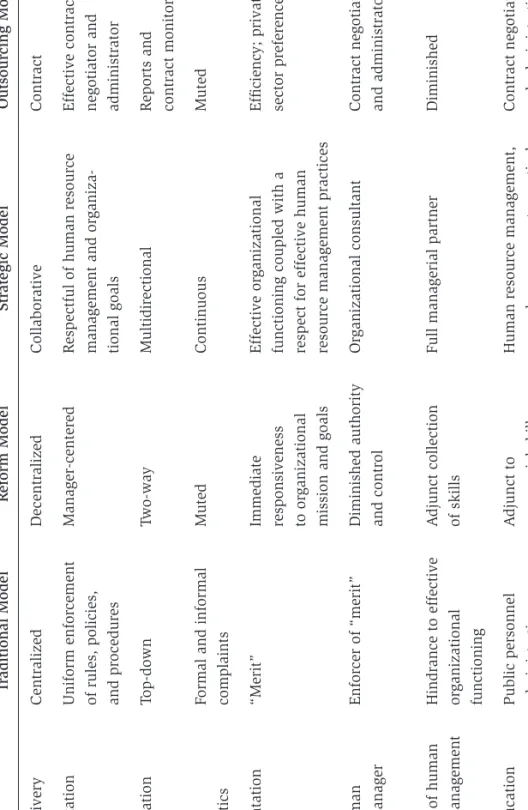
The strategic human resource management model discussed combines positive features of traditional and reforming human resource management models. A fourth emerging model focuses on privatization and outsourcing and reflects the reality of current human resource management in the public sector.
CHANGING PUBLIC HUMAN RESOURCE MANAGEMENT
HOW WE GOT WHERE WE ARE TODAY
Although time has proven the federal government's merit pay experiment to be a failure, merit pay and, more importantly, a view of the private sector as a model for public sector human resource management spread and continue to spread in many states, cities and counties. government organizations. This combination of privatization of traditional government functions, coupled with a growing tendency to outsource human resource management functions, has put a strain on the traditional role of 4 HANDBOOK OF HUMAN RESOURCE MANAGEMENT IN GOVERNMENT.
PERSONNEL ADMINISTRATION AND THE CALL FOR REFORM
He states that "one of the ideas associated with strategic human resource management is that the human resource management style is consistent with the organization's strategy and that line managers and employees adapt, adopt and use human resource practices as part of their daily work" (p 59–60). He explains that the strategic provision of human resources services helps to reduce the gap between the competing needs of line managers and human resources managers, because the central focus is on the optimal functioning of the organization, not on two different sets of values or. priorities.
DELIVERY OF HUMAN RESOURCE MANAGEMENT SERVICES: FOUR MODELS
In the strategic model, the personnel function is shared between personnel authorities and the line departments that use HR services. Here the HR manager is an organizational advisor, a valued member of the management team and not an obstacle to be avoided.
COMPARING THE MODELS
In the privatization or outsourcing model, the human resources manager focuses on effective contract negotiation and administration. Similarly, the perception of the human resource management profession varies widely as seen through the lens of the four models.
CONCLUSION
PART ONE
HUMAN RESOURCE MANAGEMENT IN A
The Politics of the Emergent Paradigms," describes the historical development of public human resource management in the United States and its relationship to the competing values of responsiveness, efficiency, employee rights, and social equity. Originally created to professionalize the public workforce and isolate public employees from the influence of exchange politics, civil service systems have recently been vilified as examples of much that is wrong with public human resource management in the United States.
CHAPTER ONE
Traditional civil service systems were complex and highly formalized, emphasizing uniformity rather than flexibility. Also traditionally a centralized body such as the Civil Service Commission or, at the federal level, the US.
WHAT IS THE PROBLEM?
In the public sector, traditionally, individual agencies have had little freedom to design their personnel systems; they must operate within civil service laws. The Office of Personnel Management not only set the rules, but actually administered the system, developing and administering civil service examinations for hiring and promotion and setting salary policy, among other functions.
NEGATIVE IMAGES OF THE PERSONNEL OFFICE
At the heart of the problem was a deep-seated role conflict between staff members and line managers. Staff members saw themselves as the "keepers of the flame," charged with preserving merit in the merit system—a likely accurate reflection of congressional intent.
THREE MODELS OF REFORM
- Customer Service
- Change Strategies
- Organization Development and Consulting
- Strategic Human Resource Management
- Change Strategies
Rather, the HR organization becomes an important player—an integral part of the strategic planning process (Office of Personnel Management, 1999). In the federal government, strategic planning has been driven by the requirements of the Government Performance and Results Act of 1993 (Office of Personnel Management, 1999).
KEY FACTORS DRIVING CHANGE
Also, this reform is expected to take half the time it [previously] took to hire an applicant (partly due to the removal of documentation requirements showing why competing candidates were not selected). From Compliance to Consultation: The Changing Role of the Public Personnel Manager.” Review of government personnel administration.
CHAPTER TWO
This change is driven by the same ideological and financial considerations as privatization in other fields: a desire to maintain military capability while showing a reduction in the size of the military. For whatever reason, the number of contract employees hired by the Pentagon and the CIA is increasing as the number of enlisted military personnel is decreasing (Waller, 2003).
A HISTORICAL PERSPECTIVE
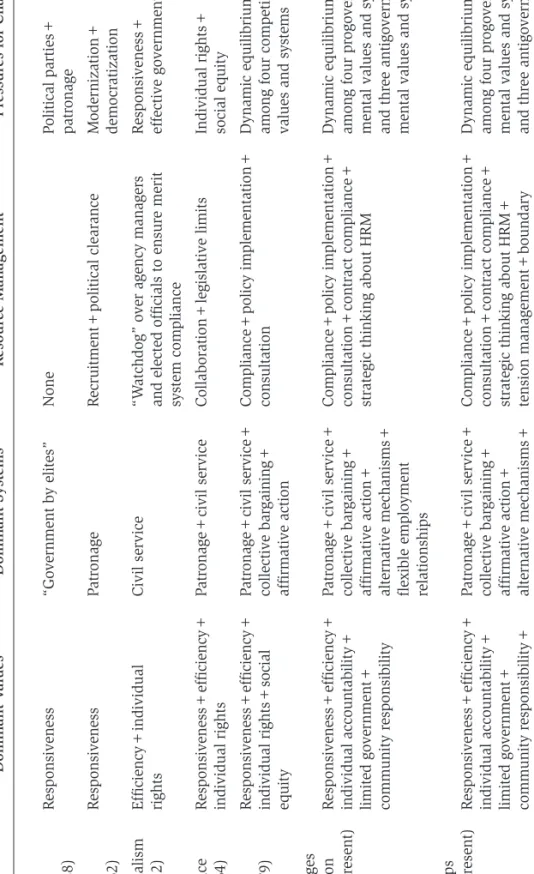
Fourth, public human resource management is the embodiment of human resource systems—the laws, rules, organizations, and procedures used to accomplish personnel functions in ways that express abstract values. With the passing of this generation—marked by the symbolic accidental deaths of John Adams and Thomas Jefferson on July 4, 1826, the fiftieth anniversary of the Declaration of Independence—the emergence of political parties ushered in an era of patronage in which public jobs were given to them. according to political allegiance or party affiliation.
PRIVATIZATION AND PARTNERSHIP
The unprecedented demands of a global depression and World War II led to the emergence of a hybrid performance model that combined the political leadership of patronage systems and the merit principles of civil service systems, because even pure merit systems must respond to political leadership if government is to be effective ( Fischer, 1945; Sayre, 1948). Subsequently, social upheavals foretold the rise of the Age of the People in which collective bargaining emerged to represent workers' collective rights (the fair treatment of members by management through negotiated labor rules for wages, benefits, and working conditions) and affirmative action emerged to promote social justice to represent. (through voluntary or court-ordered recruitment and selection practices to help improve the underrepresentation of minorities and women in the workforce).
THE EMERGENT PARADIGMS
In 1993, Vice President Al Gore issued the National Performance Review report, which aimed to create a government that "works better and costs less." The changes initiated by this report required (1) fundamental changes in organizational structure and accountability, captured by the phrase reinventing government or new public management (Osborne and Gaebler decentralization of most HR functions to operating agencies and a corresponding reduction in the functions and authority of the Office of Personnel Management, and (3) a reduction in federal civilian employment, particularly staff positions (staff, budget, auditing, procurement and middle management) with no direct relationship to increased productivity. Third, the values of limited and decentralized government and personal accountability is complemented by the value of community responsibility for social services. The most important consequence of the emergence of this value, at least as far as public human resource management is concerned, was the creation of this alternative to the traditional idea that the government must finance and deliver social services.
THINKING STRATEGICALLY
Conversely, where commitment and advanced skills are needed on a temporary basis, employers may seek to save money or maintain flexibility by placing contract or leased employees in positions exempt from civil service protections. Managerial and technical staff hired under these types of contracts typically receive higher salaries and benefits than can be offered to even highly qualified civil service employees, and increase managerial flexibility to quickly reduce staff costs if necessary without resorting to to the bureaucratic chaos caused by the performance of public service.
IMPACT OF THE EMERGENT PARADIGM
Although contracts can be routinely renewed with employee and employer approval, employees can also be dismissed at will in the event of a personality conflict, a change in management objectives, or a budget shortfall. The employee is given the option to retire early without associated penalties or an improved pension calculation factor, and the employer is allowed to fill the vacant position with an entry-level employee at a much lower salary.
ON TRADITIONAL VALUES AND PROGRAM OUTCOMES
The employee gets the option of early retirement without associated penalties or an increased retirement calculation factor, and the employer can fill the vacancy with an entry-level employee at a much lower salary. the balance of HR functions, HR systems and employee behavior) is at the heart of the discussion. The new paradigm places much less importance on the role of the national government (especially on domestic issues, those unrelated to defense or international affairs), because the first value of the new paradigm is personal responsibility, in general, reducing the role of government in societies.
THE CHANGING STRUCTURE AND ROLE OF PUBLIC HUMAN RESOURCE MANAGEMENT
The evolution of public personnel management in the United States adds to emergency systems without replacing their predecessors. In the United States on a national scale, this process was represented by the passage of the Pendleton Act in 1883 and the creation of the U.S.
CHAPTER THREE
Is the expertise of the administrative class just another example of functionalism, or is it different in nature from the functionalism that characterizes the civil service as a whole? But often the prescriptions offered have come with such certainty and certainty, and with such a lack of full consideration of the scope of their implications, that Waldo might well have described them as mere additions to an ever-growing collection of "superficial and false answers” (1948, p. 102).
THE CONSTANTS OF CIVIL SERVICE REFORM
This diagnosis is then combined with a set of prescriptions for public administration reform that are consistent. The political interests involved in civil service reform are clearly illustrated by the recent clash between George W.
RECENT REFORM INITIATIVES
Florida's reform removes all state supervisory personnel (about 16,000 out of a total of about 120,000 workers) from the civilian or secret service and places them in select exempt service. Final decisions on the nature of the new system were made and proposed regulations were published in the Federal Register in February 2004 ("Department", 2004).
CHAPTER FOUR
The literature on specific areas of government human resource management is extensive, but it is difficult to obtain information on general trends in government systems in the states. Today, state policymakers and researchers are asking: What are states doing with their civil service systems in the current era of austerity and cutbacks?
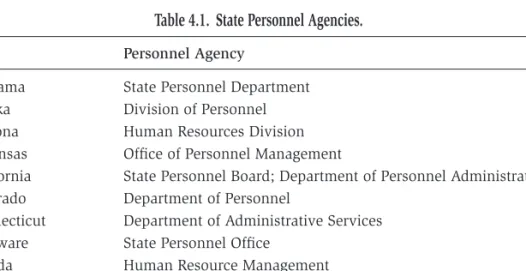
CIVIL SERVICE COMMISSIONS AND PERSONNEL AGENCIES
Alabama State Department of Personnel Alaska Department of Personnel Arizona Department of Personnel Arkansas Office of Personnel Management. Oklahoma Office of Personnel Management Division Oregon Human Resource Services Division Pennsylvania Office of Human Resources Office of Personnel Administration Rhode Island South Carolina Office of Human Resources South Dakota Bureau of Personnel Tennessee Department of Personnel.
CIVIL SERVICE REFORM
A snapshot of state civil service reform efforts can be taken by highlighting a few states with reform measures. Washington's state legislature passed the Personnel System Reform Act of 2002, calling for sweeping changes to the state's civil service system.
POSITION CLASSIFICATION
Two other factors affecting the number of job classes are organizational structure and the need for new occupations, especially information technology. The new system was created to better meet "the challenges of increasing demand for government services with continued technological advances, and the need to continually improve organizational effectiveness to better serve its citizens" (Henderson, 2002).

PRIVATIZATION AND CIVIL SERVICE REFORM
Done properly, contracting has proven to be a valuable tool for state government to deliver more cost-effective and efficient services to the public.” In fact, employees in several states filed lawsuits against their governments to oppose privatization.
WORKFORCE PLANNING
Trends in Public Service Systems: Staffing Agencies, Reform Efforts, Classifications, and Workforce Planning.” In The Book of the States, 2003–04. News release on "State Public Service Issues Performance Report." Albany, N.Y.: New York State Civil Service Commission, 1 October 1998.
PART TWO
THE PUBLIC SECTOR WORKFORCE
Newman outlines the history and likely future of involving women, minorities, persons with disabilities, and Generation X and Y employees in the workplace. He debunks myths associated with older workers and outlines management strategies to successfully integrate these workers into today's public sector work environment.
CHAPTER FIVE
Part of the problem can be traced back to the changing composition of the labor pool. A significant part of the discussion focuses on the changes now taking place in response to the crisis just mentioned.
THE MERITLESS SYSTEM: PAST AS PROLOGUE
The second feature, the civil service commission, was originally created to ensure fair and impartial administration of the testing program. Serving as "policemen" of the civil service systems, the commissions showed a special interest in promoting the objective of political neutrality.
THE STAFFING PROCESS: A PRIMER
As far as possible, the line managers have a greater influence on the recruitment and selection efforts. Under the most centralized format, the role of line managers in recruitment and selection is severely limited.
THE RECRUITMENT PROCESS
We therefore now turn to the use of IT for recruitment and selection, particularly by public authorities, to explore the prevalence of new information technologies and some of the potential challenges that may arise when using these new tools. If adequate training is not provided, coupled with efforts to convince staff of the benefits of IT in these crucial HRM functions, the use of these technologies can complicate rather than improve the recruitment and selection process.
SELECTION DILEMMAS AND STRATEGIES
In addition to certain basic rules (“Let the applicant do most of the talking”; “Set aside a quiet time and space to conduct the job interview”; “Be well prepared for the job interview by reviewing the job description and the applicant's qualifications in advance. take”), the main advice concerns the use of a patterned interview technique. Another requirement should be (but often is not) the verification of the information provided by the applicant.
CHAPTER SIX
Finally, private sector employers tend to use temporary workers much more than public sector employers. It is clear that the use of non-standard working arrangements to meet public sector staffing needs is not a one-off tactic or a passing fad.
NONSTANDARD WORK ARRANGEMENTS
Although the Social Security Administration and others have been strategic in rehiring annuitants to address resource shortfalls, NSWAs are sometimes hired on an ad hoc basis to meet immediate staffing needs or to reduce costs. Human resources managers have relied on NSWA to address short-term staffing needs without adequate forethought about how these workers fit into the agency's mission or how they fit into the government's role as a model employer.
DEFINITIONS IN USE
On-call shifts: "workers who are called to work only as needed, although they may be scheduled to work several days or weeks at a time". Temporary workers: "workers who were paid by a temporary agency, regardless of whether their work was temporary or not".
HISTORICAL TRENDS IN
Long-term data are available for two of the NSWA categories: part-time workers5 and temporary workers. Questions about part-time work are part of the regular CPS and are therefore available as far back as 1968.

WHY DO EMPLOYERS USE
While the majority of FTEs (86 to 90 percent) are full-time permanent employees, there are interesting trends among other types of work schedules. While the share of the executive branch workforce in full-time permanent positions remained high, there was a slight decline between 1997 and 2000, from 90.10 percent to 86.65 percent.
NONSTANDARD WORK ARRANGEMENTS?
Additional reasons for the use of NSWAs in the private sector include as a means of screening individuals for full-time employment, to access workers with particular skills, and to accommodate workers' requests for more flexible working hours (Houseman, 2001). The government has made the same benefits available to part-time employees as are available to full-time employees, proportionate to the number of hours worked.

WHY DO EMPLOYEES PARTICIPATE IN NONSTANDARD WORK ARRANGEMENTS?
BENEFITS AND COSTS OF
Workers' rights advocates are concerned that the secondary labor market is growing and that secondary market participants disproportionately come from disadvantaged segments of the population, including minorities and women. Further contributing to the legal muddle are the differences in the criteria included in major laws designed to protect workers.
THEORETICAL ISSUES
In support of the contention that there is an erosion of the traditional social contract between employee and employer, analysts point to an increase in downsizing, outsourcing and greater use of non-standard work arrangements. In fact, an analysis of total work years at executive agencies (excluding the U.S. Postal Service) shows a slight decline in the use of part-time, temporary, and “intermittent” work.
MANAGEMENT ISSUES
Data generated by Bernhardt and Marcotte (2000) also indicate a long-term decline in job stability, a reduction in benefits coverage, and an increase in externally driven wage structures in the US labor market. Although the federal government is in many ways the archetypal internal labor market, there is no evidence that fundamental changes in the central features of the employment relationship are underway at that level.
CONCLUSIONS
Public human resource managers must be aware of the potential for abuse, as well as the use of these arrangements to support the fulfillment of duties. Although they are technically part of the private sector, to the extent that they work for public sector entities, they become part of the public sector workforce.
CHAPTER SEVEN
WHAT IS DIVERSITY?
That is the important notion of representative government, and it is the law of the land. Taking advantage of the opportunity America's diversity offers, however, requires moving beyond erroneous assumptions, stereotypes, and prejudices.
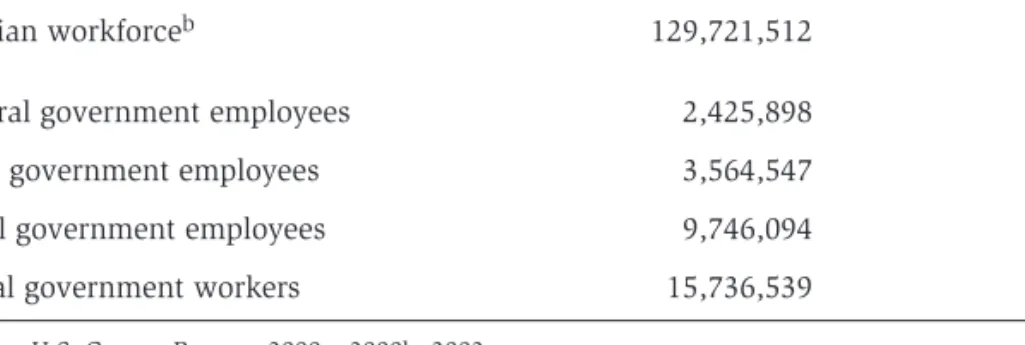
HOW DIVERSE IS THE PUBLIC WORKFORCE?
Since 1980, participation rates in the civilian labor force have increased 150 HANDBOOK OF HUMAN RESOURCE MANAGEMENT IN GOVERNMENT. The fact is that the percentage of disabled workers who are in the labor force is about the same now as it was before the ADA was passed (Hotchkiss, 2003).
HUMAN CAPITAL CHALLENGES
In terms of gender, for example, the 1963 Equal Pay Act made it illegal to label jobs as “men's jobs” or “women's jobs.” However, ideas about who can best perform certain tasks live on in the minds of both hiring authorities and applicants. Classification and compensation schemes based strictly on labor market data reward traditional men's jobs with higher wages, more autonomy, and more discretion, while traditional women's jobs receive lower wages, less autonomy, and less discretion.
WHAT IS THE IMPACT OF DIVERSITY?
Diversity diminishes the privileges that have been taken for granted by those in the traditionally privileged group. Doors of opportunity close while those in the majority adapt to changing faces.