
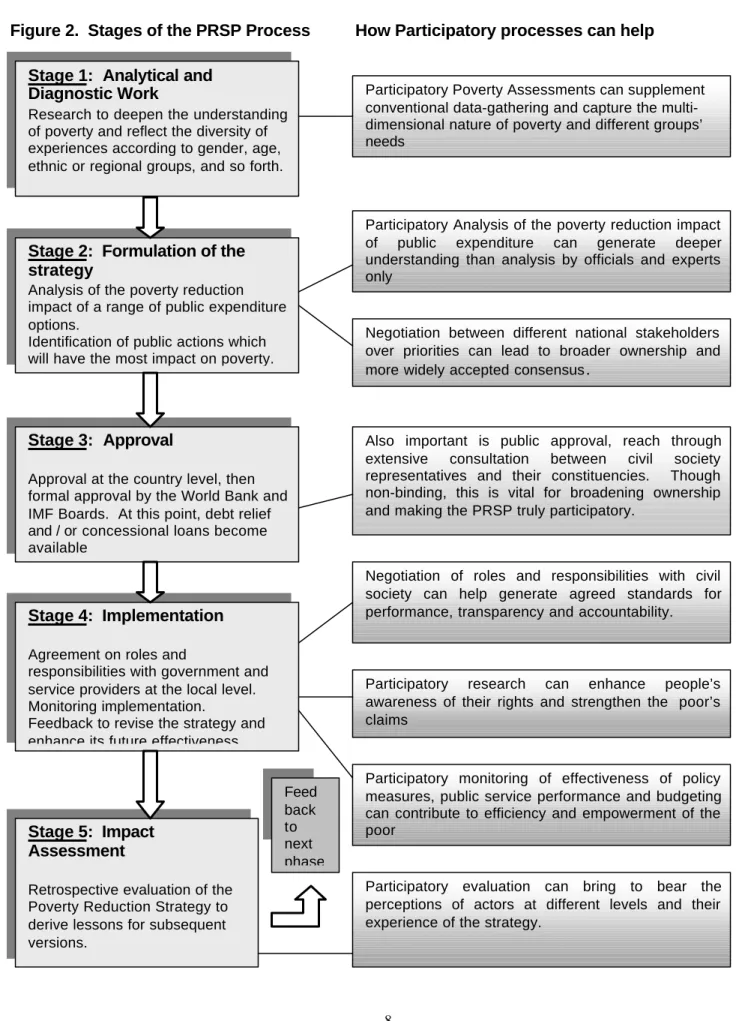
The third section helps designers of participatory processes link participation to the content of poverty reduction strategies by providing an overview of the building blocks of a macro-level participatory process. In this step, participatory processes are carried out, strategy is formulated, programs are implemented and the impact of the PRSP process on poverty reduction is assessed.
Initial negotiations among key stakeholders for participatory processes at the macro level
It is essential for the PRSP process to identify the short and long term goals for the strategy. Long-term goals provide a framework for poverty reduction, while short-term outcomes provide milestones for measuring progress and allowing for course corrections during the PRSP cycle.
Creating an enabling environment for participation: Information sharing
The Chief Minister visited the country extensively and explained the economic reforms to the people. Through a strategy of sharing information and fostering dialogue, Andhra Pradesh was able to achieve strong public support for the country's development vision, adopt poverty-oriented public action decisions, and reallocate resources to social sectors.
Participation among key stakeholder groups
- Intra-governmental Participation
- Civic engagement at the national level
- Civic engagement at the local level, particularly excluded groups
- Overview of Building Blocks for Participation: Managing the macro- level process
Government members of the PWG attended PPA feedback sessions at the local level, where the findings were discussed and debated. The following example from the Bolivian PRSP process (see Table 2) illustrates that the process at the national level could trigger processes at the local level.
Poverty Diagnostics
Macroeconomic Policy Formulation and Reform
Budgeting and Public Expenditure Management
Overview of Building Blocks for Collaboration: Process Management at the Process Level at the Macro Level. i) Budget formulation and analysis: Citizens participate in the allocation of budgets according to priorities identified in participatory poverty diagnostics, design alternative budgets or evaluate proposed allocations against government policy commitments and expressed equity concerns. ii) Expenditure monitoring and tracking: Citizens monitor whether public spending is consistent with budget allocations and track the flow of funds to agencies responsible for providing basic goods and social services. iii) Monitoring the delivery of public services: Citizens monitor the quality of goods and services that are supposed to affect their lives, especially the poor. This monitoring is measured by the amount of resources spent on such programs.
Monitoring and Evaluating Poverty Reduction
Preparing the Interim PRSP and Participation action Plan A. What is a Participation Action Plan?
Key options in designing a PAP
Given this structure, it is very important to obtain a broad range of support in government to allow continuity in the process of PRS. Ghana has developed a long-term, comprehensive vision for the development of the Ghanaian economy, Vision 2020. This process also provides a building block for strengthening the poverty focus of the national development strategy.
Because the government agreed to an NGO-led process, the credibility of the process increased. And therefore broad ownership of both the process and the content of the national vision was made possible. This outline plan of the participatory process for the development of the full PRSP should be based on knowledge of the current status of participation in the country.

Risks and limitations of participation
For example, in the Albania PRSP, UNICEF is providing funds and technical assistance to the government for its public information strategy and UNDP footed the bill for the launch workshop. PRSPs are time-limited due to the urgency countries face for debt relief, so they must be planned very carefully to maximize participation in the 12 to 18 months usually available. This case example illustrates a situation in which the major stakeholders in the complex natural resource management Planafloro project in the Amazon basin of Brazil were able to move from a conflict situation to a constructive dialogue, which eventually led to institutionalized participation and project success.
Establishment of a Demand-Driven Community Project Fund (PAIC): This fund is jointly managed by the government and a coalition of civil society organizations, coordinated by the NGO and the Social Movement Forum. Proposals for community projects in the region covered by the Planafloro project are submitted for funding. Based on this positive momentum, a comprehensive strategic planning exercise called Umidas was formulated in a participatory manner, aimed at defining a sustainable development plan for the State of Rondônia, based on the positive relationships created in Planafloro.
The role of Bank and IMF Staff in the PRSP
Participation in Formulating the Full Poverty Reduction Strategy A. Participatory Processes in Poverty Diagnostics
This can take the form of an open discussion, a semi-structured interview or carrying out an analysis of their livelihood. These barriers are mostly related to the relatively small sample size of the SWS omnibus survey (n = 1200). The poverty diagnostics phase of the I-PRSP is designed to establish a common understanding of poverty and its causes in the country.
A preliminary step would be a review of available poverty data and data sources in the country, including existing household surveys, censuses, rapid monitoring and satisfaction surveys, and poverty-related program and project documents, especially qualitative or participatory poverty assessments. Lack of access of poor households to information on legal rights and “knowledge of the poor” included by the government as an issue to be addressed in the poverty reduction strategy. Research into fees and voluntary contributions included in the Public Expenditure Review and discussed with the Ministry of Finance.

Participation in Macroeconomic Policy-making and Reform
Donors can also provide technical support in designing a public information strategy to disseminate poverty data so that stakeholders are aware of the types of issues emerging and the extent. The six main lessons of macroeconomic policy participation have major implications for the design, development and effectiveness of the PRSP process. In this way, the narrow economic mandates of the previous agreements were significantly expanded for the fourth and fifth agreements.
It has also been said that the 'shadow of the future' - the fact that the parties know they will meet again - has created an environment of patience and trust which, as has been argued by Robert Putnam and others, "nurturing reciprocity , facilitates communication, improves the flow of credible information, and increases the cost of defection.” This means that consensus and shared understanding of problems end up being the result of the process, not prerequisites.6 There are some merits to the theoretical arguments advanced by opponents of process, but the broad political support for the Partnership Agreements in Ireland suggests that as long as the process continues to deliver results at a very practical level, patience with theoretical disagreements will be short-lived.
Participation in Budgeting and Public Expenditure Management
- Setting the context: Public Expenditure Management in the Bank’s Work
- Budget formulation and analysis
- Expenditure Monitoring and Tracking
- Monitoring delivery of public services
Establishing ownership of budget analysis and advocacy will necessarily involve “democratizing” the ability to understand the budget. Three questions are addressed, i) whether the budget mentions specific pro-poor policies, ii) whether these are aligned with relevant funding commitments and iii) whether they relate to the socio-economic reality of Gujarat's poor – tribals, dalits, women and agricultural labourers. Two institutions at the mayor's office - the Planning Office (GAPLAN) and the Community Relations Coordination (CRC) - lead budget discussions with the city's residents.
User perceptions of the quality, efficiency and relevance of various services were aggregated to create a 'report card' that assessed the performance of all major service providers in the city. The city was divided into six regions, and a random sample of households that had interacted with at least one of the service providers in the past six months was selected from each region. These were then aggregated to calculate averages for overall perceptions of service quality.
Participation in Monitoring and Evaluating Poverty Reduction
Participatory management of public expenditures in the PRSP is a key building block for greater transparency and accountability in management. It can do this by providing a substantive entry point for participatory processes into the overall poverty reduction strategy process. They can then be used over time to measure changes in the government's respect for policy decisions, service delivery, and overall efforts to reduce poverty.
Link the budget directly to the poverty reduction priorities and outcomes identified at the outset of the participatory processes, such as increasing the capacity of civil society to involve public expenditure management processes and promoting public debates on budget and public service issues. A well-designed participatory monitoring and evaluation (PM&E) system builds on stakeholder analyzes to determine who can be involved in the PM&E process and what role they can play. Through a well-designed PM&E process, it is possible to build skills in society that enable independent monitoring of indicators, promote cooperation among civil society groups to improve their bargaining power, build trust among different stakeholder groups, create space for community engagement, enhance policymaking and institutionalize feedback mechanisms that enable efforts to reduce poverty to become iterative.
Decide who Participates
Establish Goals
Through a well-planned PM&R process, it is possible to build competences in society, which allows for independent monitoring of.
Develop Indicators
Results Gather Information
CycleTake
Action
Therefore, in order to develop a monitoring system that can provide both types of information and that creates indicators that are practical to collect and analyze, it is desirable to have a participatory process for selecting indicators and mechanisms for the monitoring system and for actually tracking the indicators. The choice of monitoring indicators and information collection methods depends on the circumstances of the country and is based on poverty diagnostics and technical analysis. The following is a set of options in which monitoring system designers can incorporate participatory processes.
Building institutional capacity for participatory monitoring and evaluation through various mechanisms that donors can support, such as training of facilitators, establishment of a coordinating government monitoring unit, workshops for local stakeholders, including government, NGOs and community organizations, and so on. Once indicators and data collection methods are chosen, the question becomes how to analyze this rich data and then incorporate it into policy making and program implementation. Participatory analysis of PM and V data provides a useful mechanism for negotiation between stakeholders on differences in interpretation and conclusions reached, and provides another way to build ownership of the process.