Introducing the Contemporary Business World
I n the opening cases in Chapters 1 to 5, you will read about five interesting situatiollS:
(1) opportunities and challe nges in the mobile p ho ne marke t, (2) inflation and deflation, (3) the unethjc al be haviour of business managers at Livent, (4) fumjly business stories, an d (5) Tim Hortons' international strategy. All of these situa- tions, and many mo re that are described in this text, have a common t hread: they all demonstrate the key elements of business, as weU as the excite- me nt a nd complexity of b usiness activity. Each case te lls a part of the story of our contemporary business world.
Part Summary
Part 1, Introducing the Contemporary Business World, provides a general overview of business today, Including Its economic roots, the environment in which It operates, the ethical prob- lems and opportunities facing business firms, the importance of entrepreneurship and the various forms of ownership available to business firms, and the globalization of business.
• We begin in Chapter 1, The Canadian Business System, by examining the role of business in the economy of Canada and other market economies. '.Ve al90 present a brief history of buslness in Canada.
• Then, in Chapter 2, The Environment of Business, we examine the external environ- ments that influence business activity. These include the economic, technological, socio- cultural, legal-political, and general business environments.
• Next, in Chapter 3, Conducting Business Ethically and Responsibly, we look at ind- vidual ethics and corporate social responsibil-
ity,
and how these affect the firm's customers, employees, and investors.• In Chapter 4, Entrepreneurship, Small Business, and New Venture Creation, we examine the important concepts of entre- preneurship, small business, and the various forms of business ownership that have evolved to facilitate business activity.
• Finally, in Chapter 5, The Global Context of Business, we look at why countries engage in international trade, how companies organize to operate intcmotionolly, tho development of free trade agreements, and factors that help or hindef- international trade.
Understanding the Canadian Business System
After reading this chapter, you should be able to:
1!•11
Define the nature of Canadianbusiness and Identify Its main goals.
l!•fM
Describedifferent types of global economic systems according to the means by which they control the factors of pro- duction
throughinput and output markets.
l!•d
Show howdemand and supply affect resource distri- bution in Canada.
1!•11 Identify the elements of private enterprise and explain the various degrees of competition In the Canadian economic system.
i!•IW
Trace thehistory of business in Canada.
ScanlifeTM Barcode: At the beginning and end of each chapter in the book, you will find a unique 20 barcode like the one above. Please go to http:!/
web.scanlife.com/us_enfdownloodapplicotion to
see
how you can download the ScanUfe app to your smartphone for free. Once the app is installad, your phone will scan the code and link to a web- site containing Pearson Canada's Study on the Go content, including the popular study tools Glos- sary Flashcards, Audio Summaries, and Quizzes,which can
beaccessed anytime.
Opportunities and Challenges in the Mobile Phone Market
D uring the last decade,a Canadian company called Research In Motion (RlM) has emerged as a high-tech star in the mobile phone industry . The company was started in 1984 by
t\VOe ngineering students- Mike Lazaridis at the University of\Vaterloo and Douglas Fregin at the University of\Vindsor . Its first wire- less handheld device-called the Jnter®ctive Pager-was introduced in l996.1l1e now-famous BlackBerry hit the market in l998.1l1e BlackBerry 850, which
combined email, a wireless data network, and a tiny QWERTY keyboard , was introduced in 1999. Other products have been developed since then, including the BlackBerry Pearl (2006), the Bla c kBerry 8300 (2008), the BlackBerry Storm 2 (2009), a 3G versi o n of its Pearl flip phone (2010), and OS 6.0 (2010).
Tite latter product is a touch-screen smart phone that is designed to browse the web faster than pre- vious models. ln the fi rst quarter of 2010, RIM was one of the top five mobile phone companies in the world, and at the 2010 Wireless Enterprise ¥ffipo- sium trade show, Lazaridis announced RIM's plans to dominate the global smart phone market.
Rll\1 raised $30 million from venrure capital firms in the years before its initial public offering (IPO) in 1998 that raised $115 million. RIM was
How Will This Help Me?
All businesses are subject to the influences of
economic forces. But these same economic
forces also provide astute managers and
entrepreneurs with opportunities for profits
and growth. The ideas presented in this
chapter will help you to better understand
(1) how managers deal with the challenges and
opportunities resulting from economic forces,
and (2) how consumers deal with the chal-
lenges and opportunities of price fluctuations.
listed on NASDAQ in 1999 and raised another $250 million.ln 2000, it raised another $950 million. As of mid-2009, RIM had 12,000 employees worldwide. In 2009,Fortune magazine named RIM as the fastest- growing company in the world. There are over 40 million corporate and consumer BlackBerry users, and RIM's goal is to have 100 million customers.
RIM is a remarkable Canadian success story , but industry analysts see potential challenges on the hori- zon for companies in the smart phone market.The market potential is huge, but competition is intense and new product introductions are occurring at a dizzying pace. For example, Nokia has introduced a smart phone-the Booklet 3G-that is designed to bridge the gap between a PC and a cellphone. The device (described as a mini-laptop) gives consumers the computing power of a PC with the mobility of a cellphone.Another new product is Motorola's Droid phone, which was launched byVerizon, the largest
U.S. wireless carrier (and RIM's biggest customer). A third entry comes from Google, which has devel-
oped a touch-screen mobile phone that uses Google 's own Android operating system (tllis product may also cause problems for Apple's iPhone).A fourth new product is Apple's iPhone, which will be a strong competitor to the Bl ackBerry as RIM shifts its emphasis from corporate clients to consumers.
There are also two industry trends that make it difficult to predict the future for any of the competitors in the smart phone industry . The first is the so-called "bring your own device" trend, which means tl1at companies are shifting the responsibility for having a phone onto employees.TI1e second trend is "sand- boxing,• which means separating work functions from the rest of the smart phone for security reasons, and allowing employees to use the phone at work without losing access to other applications like games or social networking. Both tl1ese trends may hurt RIM in tl1e corporate market because employees may decide to buy something other tl1an a BlackBerry. Some analysts are now fairly pessimistic about RIM's future; they think the company may continue to grow , but that shareholder returns will decline.
Another major area of concern is patent infringement lawsuits. During the past decade, RIM and other firms have sued and been sued for patent infringement. In 2006, RIM agreed to pay Virginia-based NTP
$612.5 million for infringing on NTP's patent. RIM also sued Samsung after Samsung introduced a smart phone called the Blacl"ack. In 2009, Klausner Technologies filed suit against RIM for infringing one of its visual voicemail patents. These lawsuits have created great uncertainty in the smart phone industry.
Yet another problem is the negative publicity RIM received regarding stock options. In 2007, the com- pany announced a $250 million restatement of earnings after it was learned that hundreds of stock options had been backdated (timed to a low share price to make tl1em more lucrative for managers who received them). In 2009, Canadian regulators were seeking $80 million in penalties from co-CEOs Mike Lazaridis and Jim Balsillie, and several other executives agreed to pay penalties for backdating stock options.
All of these things have had a negative effect on RIM's stock price. In 2007, stock market analysts began saying that RIM's stock was overvalued (it was then selling for $84 per share). By August 2008, the stock had defied predictions and had increased to $123 per share, but by early 2010 it had dropped to $61 per share. RIM spent $1.2 billion to buy back some of its shares, wllich should have increased the share price because fewer shares were on the market, but RIM still has to demonstrate that it can compete with other companies that are bringing out new models of smart phones. In April 2010, RIM announced a series of initiatives to increase investor confidence in the company, but analysts were skep- tical, and by the end of]une 2010, the price of RIM's stock had declined to $54 per share.
RIM has taken several strategic actions in an attempt to improve its future prospects. Historically, RIM's international footprint has not been large (about 80 percent of RIM's revenue comes from the U.S., Canada, and the U.K.). But in 2009, RIM signed a deal with Digital China to distribute BlackBerrys in Cllina.The potential market in China is obviously large, but consumers in China may not be willing to pay the high price of a BlackBerry. As well, the production of unauthorized copycat phones (knock- offs) is a problem in China. For example, the"BlockBerry" is one of the competing phones sold in Cllina.
RIM is also responding to competitive threats by positioning the BlackBerry as a general purpose smart phone for the average consumer, not just business users. More stylish models are being pro- duced and are aimed at students, "soccer moms," and consumers in general. RIM also developed a new advertising campaign, sponsored a high. profile tour of Irish rock group U2, and provided better web browsers and applications for internet shopping. RIM's security standards mean it is safe for custom- ers to do things like shop online from their smart phone.
According to the research firm IDC, there were 450 million mobile internet users in 2009, but that number should increase to 1 billion by 2013. Over 80 percent of RIM's new subscribers are individuals,
4 Part I: Introducing the Contempornry Business World
not businesses. One positive trend for RIM is increasing consumer interest in smart phones. About 40 percent of the mobile phones purchased in 20 LO were smart phones, and that proportion will inc rease over the next few years.
BUSINESS An organization that aeeke to earn profi1B by pro.rKing goods and services.
I lei I The Idea of Business
and Profit
The
opening case
Illustrates the dynamicand
rapidly changing nature of modern businessactivity, and
theopportunities and challenges that are evident. It also shows
hem business managers must pay attention to many dif- ferent things, Including the actions of competitors, rapidtechnological change, new product development, corpo-
rate strategy, risk management, stock prices, and a host ofother variables that you will read about in this book.
Let's begin by asking what you think of when you hear the word business. Do you think of large corporations
like Shoppers Drug Mart and Walmart,or smaller com-
panies like your local supermarket or favourite restau- rant? Do you think about successful companies likeCN and Research In Motion, or less successful com-
panies like GM Canada? Actually, eachof these firms is a business-an organization that produces or sells goods or services In an effort to make a profit.
Profitis what remains after a business's expenses have been subtracted from its revenues.
Profits reward the ownersof businesses for taking the risks involved in invest-
ing their timeand money.
In2008,
the most profitableCanadian companies were Encana Corp. ($6.3 billion),
the Canadian Wheat Board ($5.7 billion), and Canadian Natural Resources Ltd. ($4.9 billion).1The prospect of earning profits is what encourages people
to start and expand
businesses.Today, busi-
nesses produce most of the goods and services that weconsume, and they employ
many of the working people inCanada. Profits from these businesses are paid to thou- sands upon thousands of owners and shareholders, and
business taxes help support governments at all levels. Inaddition, businesses help support charitable causes and provide community leadership. A 2010 study by KPMG of the G7
Industrialized countries revealed that Canada ranked as the most cost-effective place to do buslness.2 In addition to for-profit business firms, there are also many not-for-profitorganizations
inCanada.
Not-for- profit organizations do not try to make a profit; rather,they use the funds they generate (from government grants or the sale of goods or services) to provide services to the public. Charities, educational institutions, hospitals, labour unions, and government agencies are examples of not-for-profit organizations. Business principles are helpful to these not-for-profit organizations as they try to achieve their service goals.
i!·f* Economic
Systems Around the World
A Canadian business
Is dif- ferentin many ways from one in China, and both are differ- ent from
businesses In Japan,France, or Peru. A major deter- minant of how organizations operate is
the kind of eco- nomic system thatcharacter-
izes the country in which they do business. An economic systemallocates a nation's
resources among its citizens.Economic systems differ In
terms of who owns and con- trols these resources, known
as the "factors of production"(see Figure 1.1).
Factors of Production
The key difference between
economic systems Is the way In which they manage the fac-
tors of production-the basicPROFIT What remaina
~ anythng) Biter a business's expenses are BUbtracted from ~8
sales revenuee.
NOT -FOR· PROFIT ORGANIZATION An organization that provides goocl8 and services to customere, but does not eeek to make a profit wHie dong so.
ECONOMIC SYSTEM The way in 'htlich a nation allocate&~~
IBIIOU'OOS among ~8 citizens.
FACTORS OF PRODUCTION The resouroee used to prcduce goods Er1d 8er11icas: labolr, capital, entrepreneu11, and natural reeouroes.
LABOUR The mental and physical tranng and !alerts of people;
sometimes called human reSOU'cae.
CAPITAL The lunda needed to operate an enterprise.
resources that a country's businesses use to produce
goods and services.
Traditionally,economists have focused on four factors of production: labour, capital,
entreprenours, and natural rosources. Newer perspec-tives tend to broaden
the idea of "natural resources" toinclude all physical resources.
In addition, information resources are often Included now.3Labour The people who work for a company represent the first factor of production-labour. Sometimes called human resources, labour
Is the mental and
physicalcapabilities of people. Carrying out the business of a
huge company such as Imperial Oil requires a labourforce with a wide variety of skills ranging from manag- ers to geologists to truck drivers.
Capital Capital refers to the
funds that are needed to start a business and to keep it operating
and growing.Chapter 1: Understanding the Canadian Business System 5
ENTREPRENEUR
An incilliduaJ who organiz.ee and men- ages lal:xxr, capital, and nalu'al resOU"Ces to pr<Xi.Joe goods and eervicee to earn 8 profit, but who also runs the risk of failtre.NATURAL RESOURCES
lteme ueed in the production of goods and services
n
their nalu'alstate, including land, water, mineral deposita, and trees.
INFORMA TION RESOURCES
Information such as market forecasts, economic data, end speciaized knowledge of employees the! is ueeful to 8 buei,._. and that helps it achieve its goals.
Capital Figure 1.1
For example, Imperial Oil needs capital to pay for its annual drill- ing costs, which run into the millions of dollars each year.
Major sources of capital for busi- nesses are personal investment by owners, the sale of stock to investors, profits from the sale of products and services, and funds borrowed from banks and other lending institutions.
Entrepreneurs Entrepre- neurs are people who accept the opportunities and risks involved in creating and operat- ing businesses. Mike Lazaridis (Research In Motion), Sergie Brin and
Larry
Page (Google), Michael Dell (Dell Computer), and Mark Zuckerberg (Facebook) are well- known entrepreneurs.Factors of productiDn
Natural Resources Natural resources include all physical resources such as land, water, mineral deposits, and trees. Imperial Oil makes use of a wide variety of natural resources. It obviously has vast quantities of crude oil to process each year. But Imperial Oil also needs the land where the oil is located, as well as land for its refineries and pipelines.
Information Resources Information resources include the specialized knowledge and expertise of people who work in businesses, as well as information that is found in market forecasts and various other forms of economic data. Much of what businesses do results in either the creation of new information or the repackaging of exist- ing information for new users and different audiences.
The boxed insert entitled "A Shrine to Wine" gives you an opportunity to think about the Importance of the factors of production in a specific business.
Types of Economic Systems
Different types of economic systems manage the fac- tors of production in different ways. In some systems,
Entrepreneurs
Factors of production are the basic resources a business uses to create goods and services. The four factors are natural resources, labour, capital, and entrepreneurs.
6 Part 1: Introducing tbe Contempornry Business World
ownership is private; in others, the factors of production are owned by the government. Economic systems also differ in the
Wa:>JSdecisions are made about production and allocation. A command economy, for example, relies on a centralized government to control all or most factors of production and to make all or most produc- tion and allocation decisions. In
market economies,individuals-producers and consumers-control pro- duction and allocation decisions through supply and demand.
Command Economies
The two most basic forms of command economies are
communismand socialism.
As
originally proposed by nineteenth-century German
economist Karl Marx, commu-
nismis a system in which the government owns and operates all sources of production. Marx envisioned a society in which individuals would ultimately contribute according to their abil- ities and receive economic ben- efits according to their needs. He also expected government own- ership of production factors to be only temporary. Once society had matured, government would
"wither away" and the workers would gain direct ownership.
COMMAND ECONOMY An economic system in which gowmnent controls all or most factors of production and make& ell or most production decisions.
MARKET ECONOMY M economic system i1 wt'ich indillidJals control all or moat factors of production and make all or most production decisions.
COMMUNISM A type of command economy in 'Mlich the QOIIemmenl ONOS and operates all indJstries.
ENTREPRENEURSHIP AND NEW VENTURES
A Shrine to Wine
Wine connoisseurs, also known as oenophiles, have a love of and devotion to wine, and they take just as much care in the procurement and storage of their vi no as they do in the tasting. Robb Denomme and Lance Kingma own Winnipeg-based Genuwine Cellars, which sells custom-designed wine cellars, some of which have six-figure price tags. The company was started somewhat by accident in 1995 when some- one asked Kingma if he thought he could build a wine cellar. He took on the challenge, and the first order led to another, and he eventually partnered with Denomme, who was just 17 at the time. As the saying goes, the rest is history. Today, the business is a multimillion-dollar operation selling to clients around the world, with the majority of sales being to the U.S.
Genuwine's international success probably wouldn't have happened, or at least not as easily, without the help of the Department of Foreign Affairs and International Trade (DFAIT). According to Robb, 'Working with the TCS [Trade Commissioner Service]
you get results, you get where you want to go. Trade commissioners are there to help and always get back to you with the answers you need." The TCS is a divi- sion of Foreign Affairs and its goal is to help companies succeed globally. Not only did TCS help Genuwine Cellars get connected with a business consultant, it also helped with financing. Other governmental agencies, including the Prairie Centre for Business Intelligence and the National Research Council, have also provided business support.
In addition to market development strate- gies, Genuwine Cellars is credited with some other good moves.
"Genuwine is doing all the right thingsa growing company should do-lean manufactur- ing, continual investments in technology, importing contract manufactured goods from Asia, setting up a design office in Latin America to take advantage of a lower cost structure and access to skilled profession- als, the list goes on," sa:ts Joanne MacKean, senior manager, Business Development Canada. Further, Genuwine Cellars is one of the largest wine cellar man- ufacturers in North America and the only company with a manufacturing facility in Canada. Very little competi- tion, niche market, upscale consumer-so just what's
"in store" for this business?
According to Denomme, the recent recession had some effect, but the company is still experienc- ing growth. Denomme's enthusiasm and drive are not quashed, however. He says, "You've got to keep a positive attitude." Sounds like this entrepreneur looks upon his wine glass as being half full rather than half empty.
Critical Thinking Questions
1. Discuss the factors of production as they apply to Genuwine Cellars.
2. What do you think about the company's decision to move some of its operations to Latin America because of a lower cost structure?
Otapter I: Understanding the Canadian Business System 7
SOCIALISM A kind of command economy in which the government owns and operates the main industries, while individuals own and operate less crucial induetriee.
MARKET An exchange process between buyers and seller& of a particular good or eervice.
INPUT MARKET Firms buy resoc.rces that they need in the production of good&
and eeMoe8.
OUTPUT MARKET Rrms atpply goode and
&e<Vicee in response to demand on the part of consumers.
CAPITALISM An economic eystem in which markets decide what, when, and for whom to produce.
But Marx's predictions were faulty. During the last 20 years, most countries have aban- doned communism in favour of a more market-based economy.
Even countries that still claim to be communist {for example, China, Vietnam, and Cuba) now
containelements of a market- based economy. Whether com- munism can be maintained alongside a market-based economy remains to be seen.
In a less extensive com- mand economic system called socialism, the government owns and operates only selected major industries. Smaller busi- nesses such as clothing stores and restaurants may be privately owned. Although workers in socialist countries are usually allowed to choose their occu- pations or professions, a large proportion generally work for the government. Many government- operated enterprises are inef- ficient, since management positions are frequently filled based on political considerations rather than ability.
Extensive public welfare systems have also resulted in very high taxes. Because of these factors, socialism is generally declining in popularity.4
Market Economies
A market
is a mechanism for ex-change between the buyers and seners of a particular good or service. For example, the internet is a technologically sophisticated market that brings buyers and sellers together through a-commerce. People usually think of a-commerce as being business-to-consumer {B2C) transactions, such as buying books over the internet for personal use. But business-to-business (B2B) transactions are also a very important market. B2B involves businesses joining together to create a-commerce companies that make them more efficient when they purchase the goods and services they need. B2B transactions actually far exceed B2C transac-
tions in dollar value.In a market economy, B2C and B2B exchanges take
place without much government involvement. To under- stand how a
market economyworks, consider what happens when a customer goes to a fruit stand to buy apples. Assume that one vendor is selling apples for
$1 per kilogram, and another is charging $1.50. Both
8 Part 1: Introducing the Contempomry Business World
vendors are free to charge what they want, and custom- ers are free to buy what they choose. If both vendors' apples are of the same quality, the customer will likely buy the cheaper ones. But if the $1.50 apples are fresher, the customer may buy them instead. Both buyers and sellers enjoy freedom of choice (but they also are sub- ject to risks, as the financial meltdown of 2008 demon- strated).
A GlobeScan poll of over 20 000 people in 20 coun- tries asked people whether they agreed with the follow- ing statement: "The free market economy is the best system." Where do you think the highest support for the free market economy was found? Not in Canada, the United States, Germany, or Japan, but in China, where 74 percent of people polled agreed with the statements This is a surprising
finding,given the Chinese gov- ernment's strong support of the communist economic ideology. It seems hard to believe now, but before 1979, people who sold watches on street comers in China were sentenced to years of hard labour. After China's consti- tution was amended to legitimate private enterprise, the private sector has become incredibly productive. It is esti- mated that China produces 60 percent of all the toys in the world.e China's reputation for being a low-cost producer of goods is legendary. It is also a vast and rapidly grow- ing market for many of the products that Canadian firms produce-chemicals, ores, cereals, and wood products.
Input and Output Markets A useful model for under- standing how the factors of production work in a pure market economy is shown in Figure
1.2.7 In the input market, firms buy resources from households, which then supply those resources. In the output
market, firms supply goods and services in response to demand on the part of the households. The activities of these two markets create a circular flow. Ford Motor Co., for example, buys labour directly from households, which may also supply capital from accumulated savings in the form of stock purchases. Consumer buying patterns provide information that helps Ford decide which models to produce and which to discontinue. In turn, Ford uses these inputs in various ways and becomes a supplier to households when it designs and produces various kinds of automobiles, trucks, and sport-utility vehicles and offers them for sale to consumers.
Individuals are free to work for Ford or an alternative
employer and to invest in Ford stock or alternative forms
of saving or consumption. Similarly, Ford can create
whatever vehicles it chooses and price them at what-
ever value it chooses. Consumers are free to buy their
next car from Ford, Toyota, BMW, or any other manufac-
turer. The political basis for the free market economy is
called
capitalism, which allows private ownershipof the
factors of production and encourages entrepreneurship by offering profits as an incentive. This process con- trasts markedly with that of a command economy, in which individuals may be told where they can and can- not work, companies may be told what they can and cannot manufacture, and consumers may have little or no choice as to what they purchase or how much they pay for items.
Mixed Market Economies
Command and market economies are two extremes, or opposites. In reality, most countries rely on some form of
mixed markete
con- omy that features characteristics of both command andmarket economies. One trend in mixed market econo- mies that began in the 1990s is privatization-<:onvert- ing government enterprises into privately o.vned compa- nies. In Canada, for example, the air traffic control system was privatized, and the federal government sold several other corporations, including Canadian National Railway and Air Canada. The Netherlands privatized its TNT Post Group N.V
.,and India privatized 18 industries, includ- Ing iron, steel, machinery, and telecommunicatlons.
8In 2010, the Organisation for Economic Co-operation and Development (OECD) said that Canada Post's monopoly should be ended and it should be privatized.
9However,
when a worldwide recession began in 2008, the trendslowed. Government bailouts of Chrysler and GM in both
OUTPUT MARKETS Goods Services
-
I I l n C D I I
FIRMS
• Supply products in output markets
• Demand resources in input markets
Canada and the U.S. meant that government was once again a part-owner of some business firms. A few countries are even pursuing a policy of
nat iona
lization-convertingprivate firms into government- owned firms. Venezuela, for example, nationalized its tele- communications industry
.D
eregula
tionmeans a reduction in the number of laws affecting business activity and in the powers of government enforcement agencies. This trend also developed during the 1990s, and deregulation occurred in many industries, including airlines, pipelines, banking, trucking, and communications. But this trend
MIXED MARKET ECONOMY An economic system wth elements of both a OOfTYTlard eoc:rar>f and a mMu!t eoc:rar>f; in jTQCtice, typic8 of most natiala' economies.
PRIVATIZATION The transfer of activities from the government to the private eector.
NATIONALIZATION The transfer of activities from private frm9 to the government
DEREGULATION A reduction in the num- ber of laws affecmg business actM!y.
has also slowed (and even reversed in some cases) due to the 2008 recession. For example, there have been calls for a dramatic tightening up of the laws regulating business activity, particularly in the financial sector. The British
Petroleum(BP) oil spill in the Gulf of Mexico in 2010 caused the U.S. government to put pressure on BP to reimburse
EEl [
HOUSEHOLDS
• Demand products in output markets
• Supply resources in input markets
INPUT MARKETS
~
~~; ~~
Entrepreneurs ~
Natural resourc.::es
I
Figure
1.2
Circular flow in a market economy.
Information resourJ
Otapter 1: Understanding the C2nadian Business System 9
CANADIAN RADIO-TELEVISION AND TELECOMMU- NICATIONS COM- MISSION (CRTC) RegUatea an:lll4l9'- ..,_ &II aepecte of the CBnadian broadca&ting ayatem.
Individuals
and businesses that were harmed by the spill.Incidents
like these have created a dilemma for
government policymakers;
a2009 study by the Conference Board of Canada showed
that deregulation{In tandem with privatization and increased competition) caused a sharp increase in productivity in sectors like freight and airlines.
1o
CANADIAN WHEATBOARD R~1111 the price fanners r.ceiYe for their wMat.
As a result of the recession of 2008, mixed market econo- mies are now characterized by
more government involvement thanwas
evident just a fewyears ago. Governments In mixed marl<et economies have
intervenedin the economic system in an attempt to sta- bilize it, but this has led to higher deficits {see Chapter 2) and more control of business activity.
Interactions between
Business and Government
In Canada's mixed market economy, there are many
important interactions between business and govern- ment.
The ways in which government influences busi-ness and the ways business Influences government are described below.
How Government Influences Business Government plays several key roles In the Canadian eco-
nomy, and each of theseroles influences business activity in some way. The roles government plays are as follows.
Government as a Customer
Government buys thou- sands of different
productsand services from busi-
ness firms,including office
supplies,office
buildings,computers, battleships, helicopters, highways,
watertreatment plants, and management and engineering con- sulting services. Many businesses depend on government purchasing, if not for their survival then at least for a cer- tain level of prosperity. Total government expenditures in 2009
were$234
blllion.11Government as a Competitor Government also com- petes with business through Crown corporations, which
are accountable to a minister of
parliament for their con- duct. Crowncorporations like
Hydro Quebec {revenuesof
$12.7
billion), Canada Post($7.4 billion), and the Canadian Wheat Board {$8.4 billion) account for a significant amount
10 Part 1: Introducing lbe Conrempor.uy Business World
Despite becoming a territory of the communist People's Republic of China in
1997,
Hong Kong remains one of the world's freest economies. In Hong Kong's Lan Kwal Fong district, for example, traditional Chinese businesses operate next door to well-known international chains.of economic
activityin Canada.
12Crown corporations exist at both the provincial and federal levels.
Government as Regulator
Federal, and
provincialgovernments in Canada regulate many aspects of busi-
nessactivity
throughadministrative
boards,tribunals,
andcommissions. Illustrative examples
includethe
Canadian Radio-television and Telecommunications Commission {CRTC) {which issues and renews broad-cast licences)
andthe
Canadian Wheat Board (Which regulatesthe
priceof
wheat).Provincial boards and
commissions alsoregu
late business activity, but differ-ent situations exist In different provinces.
For example, the provinces of Quebec and B.C. allowed mixed martialarts events such as the UFC, but Ontario didn't (Ontario
began allowing theseevents
in2011). 1
3 Reasons forregu- lating business activity include protecting competition,
protecting consumers, achieving socialgoals, and pro-
tecting the environment.Promoting Competit ion Competition is crucial to
a marketeconomy, so government regulates business
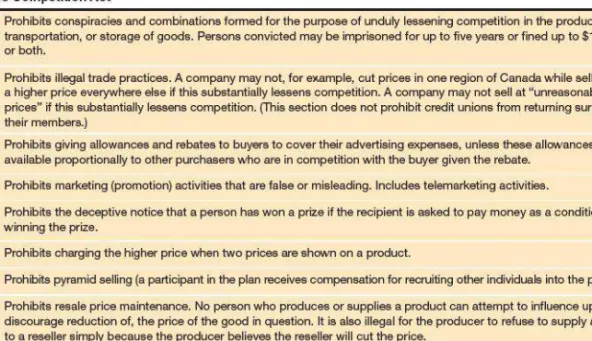
activity to ensure that healthy competition exists among business firms. Without these restrictions, a large com- pany with vast resources could cut its prices and drive smaller firms out of the market. The guidelines for Cana- da's competition policy are contained in the Competition Act, Which prohibits a variety of practices (see Table 1.1).
Section
61, for example, prohibits something called resale price maintenance.Labatt Brewing Co. recently pled guilty to resale price maintenance and was fined
$250 000after its sales representatives gave money to store opera- tors Who agreed to not lower prices on soma brands of beer
. This activity meantthat customers had to pay higher prices for beer.
14
The Act prohibits agreements among companies that are designed to reduce competition. Formerly, the govern- ment had to prove that such agreements actually reduced competition, but recent changes to the legislation mean that the mere existence of a conspiracy is assumed to be proof that competition has been reduced.1
5Another big change is the dramatically increased fines for misleading mar1<et- ing practices by corporations (formerly
$1 00 000for the first offence, but now
$10million).16
Businesses often complain that the Competition Bureau is too slow in approving or denying merger plans. For exam- ple, when Labatt Brewing wanted to take over Lakeport Brewing, it was told that the Competition Bureau would need up to six months to determine whether the takeCNer would lessen competition. Labatt therefore appealed to the Competition Tribunal to speed up the process. The Tribunal
Table
1.1
The Competition Actagreed with Labatt, and the merger went ahead sooner than it otherwise would have.17 There was, however, some interesting fallout later. The federal indus- try minister began an inves- tigation after a Federal Court judge accused the Competition Bureau of providing mislead- ing information in order to get a court order for Labatt's records during its review of the pro- posed margar.ts
Prot ecting Consumers The federal government has initi- ated many programs that pro- tect consumers. Consumer and Corporate Affairs Canada administers many of these.
Important
legislation indudes the
Hazardous Products ActHAZARDOUS
PRODUCTS ACT Regulatee b!rned prod- ucts Er"ld products that em be add but must be letlelled hazardous.
TOBACCO ACT Prohibits dgerette adwrtiairg on blboards and in retai stores, Er"ld assigns financial penal- ties to violators.
WEIGHTS AND MEASURES ACT Sets standards of accuracy for weighing and measuring devices.
TEXTILE LABELLING ACT Reg.Jiates the labelling, sale, importa- tion, and advertising of consuner textile articles.
(which requires poisonous, flammable, explosive, or cor- rosive products to be appropriately labelled), the Tobacco
Act (which prohibits cigarette advertising on billboards andin stores), the
Weightsand Measures Act (which sets stan- dards of accuracy for weighing and measuring devices), the
Textile Labelling Act(which regulates the labelling, sale, importation, and advertising of consumer textile articles),
Section45 Prohibits conspiracies and combinations formed tor the purpose of unduly lessening competition in the production, transportation, or storage of goode. Persona convicted may be ifr9riaoned for'-" to five yeare or fined up to $1 million or both.
Section 50
Section 51
Section 52 Section 53
Section 54 Section 55.1 Section61
Section 74
Prohibits illegal trade practices. A company may not, for example, cut prices in one region of Canada while selling at a higher price everywhere else if this substantially lessens competition. A company may not sell at "unreasonably low pricee" if this substantially lessens competition. (This section doee not prohibit credit unions from retuming surpluses to their members.)
Prohibita giving allowances and rebates to buyers to cover their advertising expenses, unleae these allowances are made available proportionally to other purchasers who are in competition with the buyer given the rebate.
Prohibita marketing (promotion) activ~iea that are false or misleading. Includes telemarketing activities.
Prohibita the deceptive notice that a person hae won a prize it the recipient ia asked to pay money aa e condition of wiming the prize.
Prohibits charging the higher price when two prices are shown on a product.
Prohibits pyramid selling (a participant in the plan receives compensation for reauiting other indviduals into the plan).
Prohibits resale price maintenance. No person who produces or supplies a product can attempt to rnluence upward, or discourage reduction of, the price of the good in question. It ia also illegal for the producer to refuse to supply a product to a reseller simply because the producer believes the reseller will cut the price.
Prohibits ba~-and-11witch selling. No person can advertise a product at a bargain price if there is no supply of the product available to the consOO"lE!I". (This tactic baits prospects into the store, where salespeople switch them to higher- priced goode.) This sec1ion also controls the uee of conteets to sell goode, and prohibits the sale of goods at a price higher than the advertised one.
<llapter I: Understanding the canadian Business System II
FOOD AND DRUG ACT Prohibita the l8le of bod Lnfit for hunan consumption and regu- lates food advertiling.
The Hazardous Products Act requires poisonous, flammable, explosive, or corrosive products to have
warning labels
to protect consumers who use them.CANADA WATER ACT Controls water quality in fr8lh and l1llnl9 WBIB111 of Careda
FISHERIES ACT Regtjates the <b- charge of twmfU llbltancee roto Mlter.
ENVIRONMENTAL CONTAMINANTS ACTEsta~
mgUations for ai'bome lllb!otancee tl-at we a danger to tunen health or to the em.;ronment.
REVENUE TAXES Taxa!l whose mai1 purpose is to hnd gowmment eervices and programe
PROGRESSIVE REVENUE TAXES
r -
levied at a higher ruteonhig,erinc:ome tm<payera and at a lower rate on lower- income laxpey8111.REGRESSIVE REVENUE TAXES Taxas that C8l.8l
poorer people to pay a l'qler peo081 taga of income tlwo ncher people pay.
RESTRICTIVE TAXES Taxas levied to OOf'Crol oartain adMties that leglslat0t'8 believe
!!I IUIJlcJ U.. oor lltUI!Kl.
and
the Food and Drug Act(which prohibits the sale of food that contains any poisonous or harmful substances). Consumers are also protected by municipal bylaws such as "no smoking"
bylaws.
Achieving Soc ial Goals Social goals, which promote the well-being of Canadian society, include things like uni- versal access to health care, safe wor1<places, employment
insurance, and decent
pen-
sions. All of these goals require the interaction of business firms and the Canadian government.
But the decisions of foreign governments-as they pursue their own social goals-can also affect Canadian businesses. For example, when
theU.S. government introduced legislation making it difficult for online gambling companies to operate In the U.S., the stock prices of Canadian firms like Cryptologic Inc. and Chartwell Technology dropped.1o
Protecting the Environm ent Government legislation designed to protect the environment includes the Canada
Water Act(which controls water quality in fresh and marine waters), the Fisheries
Act (which controls the discharge ofany harmful substance into water), and the Environmen-
tal Contaminants Act (which establishes regulations for 12 Part 1: lmrodudng t.be ConlempOr:lt)• Business Worldairborne substances that are a danger to human health or
the environment).Government as a Taxation Agent
Taxes are Imposed and collected
by the federal, provincial, and local govern-ments. Revenue taxes (e.g., income taxes) are levied by governments primarily to provide revenue to fund various services and programs. Progressive revenue taxes are levied at a higher rate on higher-income taxpayers and at a ICM'er rate on lower-income taxpayers. Regressive rev-
enue taxes (e.g.,sales
tax)are
leviedat the same rate regardless of
a person's income. Theycause poorer people to pay a higher percentage of their income for these taxes than rich people pay.
Restrictive taxes (e.g.,taxes on alcohol, tobacco, and gasoline) are levied partially for the revenue they provide, but also because legislative bodies believe that the products in question should be controlled.
Government as a Provider of Incentives and Financial Assistance
Federal, provincial
,and municipal govern- ments offer incentive programs that attempt to stimu- late economic
development. TheProvince of
Quebec, for example, hasattracted video game companies like Ubisoft by giving them multimillion-dollar subsidies If they
locate in the province.20 The Provincesof Ontario and B.C.
have given hundreds of millions of dollars in subsidies to
film connpanies to motivate them to make major films In those provinces.
Butthe government of Alberta (which spends about
$20mUIIon each year on subsidies to film- makers) has decided not to increase the amount of its sub- sidies.21
Governments also offer
incentives through themany services
they provide to business firms throughgovernment organizations. Examples include the Export Development Corporation (which assists Canadian export- ers by offering export insurance against non-payment by foreign buyers and long-term loans to foreign buyers of Canadian products), Natural Resources Canada (which provides geological maps of Canada's potential mineral- producing areas), and Statistics Canada (which provides data and analysis on almost every aspect of Canadian society). Industry Canada offers many different programs designed to help small businesses. The Canada Business program, for example, provides information on government programs, services, and regulations in order to improve the start-up and survival rates of small and medium-sized busi- nesses. It also encourages businesses to focus on sound business planning and the effective use of market research.
DFAIT helps Canadian companies doing business interna- tionally by promoting Canada as a good place to invest and to carry on business activities. It also assists in negotiating and administering trade agreements.
There are many other government incentive pro- grams, including municipal tax rebates for companies that locate in certain areas, design assistance programs, and remission of tariffs on certain advanced technology production equipment. Government incentive programs may or
may not have the desired effect ofstimulating the economy. They may also cause difficulties with our trad- ing partners, as we shall see in Chapter 5. Some critics also argue that business firms are too willing to accept government
assistanc~itherin the form of incentives or bailouts-and that managers should put more empha- sis on innovation and creativity so business firms can bet- ter cope with economic difficulties when they arise, as they did during the 2008--2009 recession.
Government as a Provider of Essential Services
The various levels of government facilitate business activ-
ity through the services they supply. The federalgovern- ment provides highways, the postal service, the minting of money, the armed forces, and statistical data on which to base business decisions. It also tries to maintain stability through fiscal and monetary policy (discussed in Chapter 2).
Provincial and municipal governments provide streets,
&m-age and sanitation systems, police and fire departments, utilities, hospitals, and education. All of these activities cre- ate the kind of stability that encourages business activity.
How Business Influences Government Businesses also try to influence the government through the use of lobbyists, trade associations, and advertising.
A
lobbyistis a person hired by a company or industry to represent that company's interests with government offi- cials. The Canadian Association of Consulting Engineers, for example, regularly lobbies the federal and provincial governments to make use of the skills possessed by
private-sector consulting engi- neers on projects like city water systems. Some business lob- byists have training in the par- ticular industry, public relations experience, or a legal back- ground. A few have served as legislators or government regu- lators.
The
federal Lobbying Act requires lobbyists to register with the Commissioner of Lobbying so it is clear which individuals are being paid for their lobby- ing activity. It also sets rules for accountability and transparency, and
requireslobbyists to report
LOBBYIST A pen!Oil hired by a company or an industry to represent
~s interasts with gov- errment officials.
TRADE ASSOCIATION An organization dedi- cated to promoting the nterests and assist-
ng
the members of a pertic:Uar industry.MARKET An exchange process between buyers End sellers of a particular good or service.
detailed information about their communications with what are known as Designated Public Office Holders (DPOHs).
22For many lobbying efforts, there are opposing points of view.
For example, the Canadian Cancer Society and the Tobacco Institute present very different points of view on cigarette smoking and cigarette advertising.
Employees and owners of small businesses that can- not afford lobbyists often join trade
associations, which may act as an industry lobby to influence legislation. Theyalso conduct training programs relevant to the particular industry, and they arrange trade shows at which mem- bers display their products or services to potential custo- mers. Most publish newsletters featuring articles on new products, new companies, changes in ownership, and changes in laws affecting the industry.
Corporations can influence legislation indirectly by influencing voters. A company can, for example, launch an advertising campaign designed to get people to write their MPs, MPPs, or ML.As demanding passage--<>r
rejectio~of a particular bill that is before parliament or the provincial legislature.
''·II The Canadian Market Economy
Understanding the complex nature of the Canadian eco- nomic system is essential to understanding Canadian business. In this section, we will examine the workings of our market economy, including markets, demand, sup- ply, private enterprise, and degrees of competition.
Demand and Supply in a Market Economy In economic terms, a market is not a specific place, like a supermarket, but an exchange process between buyers and sellers. Decisions about production in a market
01apter 1 : Understanding the Canadian Business System 13
DEMAND Thewilling- ness and ability of buyers to purchaae a product or setvioe.
SUPPLY The
wilng-
nesa and ability of pro- ducers to offer a good or service for safe.
LAW OF DEMAND The principle that buyers will purchaae (demand) more of a product aa price drops.
LAW OF SUPPLY The pmaple that producers wit offer(s~ more of a product as price rises.
DEMAND AND SUPPLY SCHEDULE Aseesement of the rela- tionships between dif- fernnt levels of demand En:! supply at dfferant price levels.
economy are the result of mil- lions of exchanges. How much of what product a company offers for sale and who buys it depends on the laws of demand and supply.
The Laws of Supply and Demand In a market economy,
decisions about what to buy and what to sell are deter- mined primarily by the forces of demand and supply.
Demandis the willingness and ability of buyers to purchase a product or service. Supply is the willing- ness and ability of producers to offer a good or service for sale.
The law of demand
states thatbuyers will purchase (demand}
more of a product as its price
drops. Conversely, the law of supply states that produc- ers will offer (supply) more for sale as the price rises.
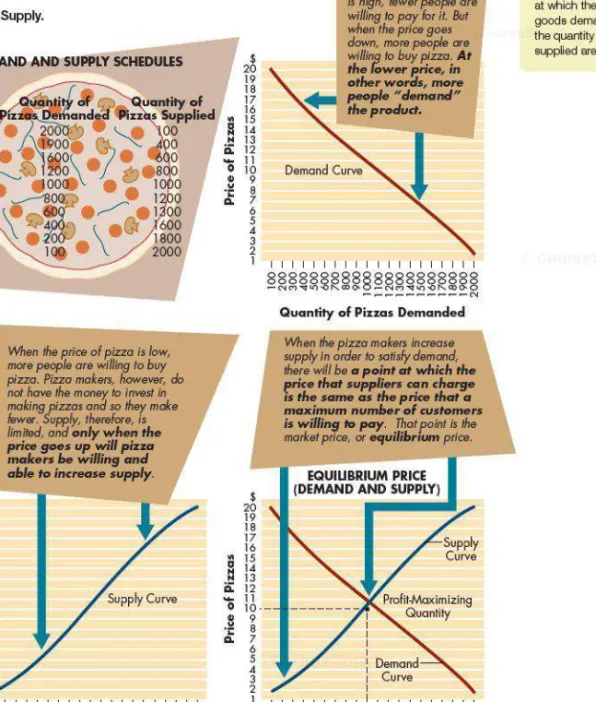
Demand and Supply Schedule
To appreciate these laws in action, consider the market for pizza in
yourtown. If everyone is willing to pay $25 for a pizza
(arelatively high price), the local pizzeria will produce a large supply. If, however, everyone is willing to pay only $5 (a relatively low price), the restaurant will make fewer pizzas. Through careful analysis, we can deter- mine how many pizzas will be sold at different prices.
These results, called a demand a
nd supply schedule, are obtained from marketing research and other sys-tematic studies of the market. Properly applied, they help managers understand the relationships among dif- ferent levels of demand and supply at different price levels.
Demand and Supply Curves
The demand and sup- ply schedule can be used to
constructdemand and
E-BUSINESS AND SOCIAL MEDIA SOLUTIONS
Virtual Goods: An Emerging E-Market
Not too long ago, people doubted the commercial sales potential of bottled water because a perfectly good sub- stitute was available for virtually no cost. At the time, many skeptics made comments like "What's next, are we going to sell air?" Today, consumers purchase approxi- mately 200 billion litres of bottled water worldwide each year
. The skeptics did not foresee an era dominated bythe internet, smart phones, and social media
M. least bottled water is a physical product. But
how much is an avatar worth? How much would you spend on a virtual good? If your answer is $0, you don't know what's going on in the virtual gaming world. Have you heard of Zynga? World of Warcraft? Mafia Wars?
FarmVille? H you answered "no" to all these questions, you may be shocked to learn that, in 2010, virtual goods sales were expected to reach $1.6 billion in the U.S.
alone, and are projected to grow to $3.6 billion by 2012.
As we've noted, a market is an exchange process
between buyers and sellers of a particular good or service. This definition fits the evolving virtual goods world as well. Whether you are buying a potato to make French fries (to eat), or a virtual potato to plant in your own FarmVille virtual garden (for entertainment), you are involved in a market of buyers and sellers.
14 Part 1: Introducing the Contempornry Business World
Hard-core virtual garners are willing to spend good money to ensure that they have the best gear available in games like World of Warcraft.
Facebook links people to the virtual wortd and has over 500 million users. The company is now trying to capitalize on its popularity by adding a new revenue stream. It plans to charge 30 percent on virtual game props (similar to Apple's approach to apps). It is also testing the extended use of its Facebook credits. If all goes as planned, Zynga (which has 120 million game users) may be forced to adopt this model. Facebook could collect as much as $500 million over the next three years from Zynga and other gaming companies, including Electronic Arts, CrowdStar, Slide, RockYou, and Digital Chocolate. One thing is certain, there is nothing virtual about the revenue potential.
Critical Thinking Questions
1. Have you ever purchased a virtual good? If so,
describe it. Were you satisfied? If not, what do you think of the prospects for
this growing market?2. What do you think of Facebook's new
revenue
stream model? Will it work?
supply curves for pizza A demand curve shows how many products-in this case, pizzas-will be demanded (bought) at different prices. A supply curve shows how many pizzas will be supplied (cooked)
at
different prices.Figure
1.3
shows the hypothetical demand and supply curves for pizzas in our illustration. As you can see, demand Increases as price decreases, and supply increases as price increases. When the demand and sup- ply curves are plotted on the same graph, the point at which they Intersect is the market price, or equilibriumFigure
1.3
Demand and Supply.DEMAND AHI)
SUPPlY SCHEDUUS 4
19 18 17 16 .. 15
8 l~
ii 12 -0 11 10
• 9
·i!!
8"' 7 6
price-the price at which the quantity of goods demanded and the quantity of goods sup- plied are equal. In Figure
1.3,
the equilibrium price for pizzas is$10.
At this point, the quan- tity of pizzas demanded and the quantity of pizzas supplied are thesame-1000
pizzas per week.s ..
3 2
I I I I I I I I I I I I I I I I I I I I I
20
s
19 18 17 .. 16 15
. 9 l~
"' 12
0 l6
-~ ~
"' 6 7 5
..
3 2
I I I I I I I I I I I I I I I I I I I I I
~~~~~§R2~8~~g~~§~~~8
... - ... ,....-NQuantity of Pizzas Supplied
. ; e
"'
0
-~ "'
~~~~~§~~~§~~~~~§~~~§
---N
Quantity of Pizzas Demanded
EQUIUBRIUM PRICE (DEMAND AND SUPPLY)
I I I I I
: Demond
1 Curve I
1 1 1 1 1 1 1 1 11 1 1 1 1 1 1 1 1 1 1
~~~~~§R2~~~~~~~~~~~~
Quantity of Pinos
DEMAND CURVE Graph allowirg how many lrits <X a product wil be dem!rded (bougll) at different prices.
SUPPLY CURVE Graph Mowing how many l.llits of a product win be
flt4lPiied
(offered for 881e) at different prioea.MARKET PRICE (EQUILIBRIUM PRICE)
Profit-m&lCirming price at v.hich the quent11y of goode denlMded and
the~ d gooclll at.ppied we equal.
Chapter 1: Understanding the Canadian Business System 15
Canada is the dominant supplier of maple syrup for the world market. But variable weather condi- tions can create conditions of either surplus or
shortage.MANAGING IN TURBULENT TIMES
Surpluses and Shortages
What would happen if theowner tried to increase profits by making more pizzas to
sell? Or,what if the owner wanted to reduce overhead,
cut back on store hours, and reduced the number of piz-zas offered for sale? In either case, the result would be an inefficient
use ofresources. For example,
if the restaurantsupplies 1200 pizzas and tries to sell them for $10 each, 200 pizzas will not be purchased. The demand schedule
clearly shows that only 1 000 pizzas will be demanded atthis
price.The pizza
makerwill
therefore havea surplus-a
situation in which the quantity supplied exceeds thequan- tity
demanded. The restaurant will thus lose the moneythat it spent making those extra 200 pizzas.
Conversely, if the pizzeria supplies only 800 pizzas,
a shortage will result because the quantity demanded will be greater than the quantity supplied. The pizze- ria will "lose" the extra money that it could have made by producing 200 more pizzas. Even though consum-
ers may pay more for pizzas because of the shortage,The High Price of High Prices
Economic theory tells us that when demand
fora com- modity increases, its price goes up, and people try to
findsubstitutes that are cheaper. For example, when the price of oil is high, companies use com to make
ethanol to add to gasoline,and palm oil is used to make diesel fuel (called biodiesel). But, as more pro-
ducers start using com or palm oil, the demand forthose commodities goes up and so does their price.
During 2006, for example, the price of palm oil rose
from less than US$400 per metric tonne to more thanUS$500 per metric tonne.
When prices of commodities rise rapidly, there are
usually some unanticipated outcomes. One of these is increased criminal activity. As the price of stainless steeland aluminum rose during the last few years, thieves began stealing items such as beer kegs, rail-
way baggage carts, railroad tracks, light poles, and highway guardrails.These
items were then soldto scrap yards for cash.
The impact of stealing is limited to lost revenue
(it'sonly
money),but sky-high prices for food can
actually threaten people's lives. Global food prices increased 83 percent between 2005 and 2008, andthat put a lot of stress on the world's poorest coun-
tries. In some countries, families are spending one-halftheir income just on food. One culprit, ironically, is the
16 Part 1: Introducing the Contemporary Business World
push to convert com
into biofuel. In countries like Haiti,Cameroon, Senegal, and Ethiopia, citizens have rioted over higher prices for important staple items such as beans and rice. In Pakistan and Thailand, army troops were deployed to prevent the theft of food from ware- houses. The World Bank has identified 33 countries that are at risk for serious social upheaval
becauseof high food prices. To cope with the problem, some countries are slashing import duties and imposing
export duties. This is justthe reverse of what countries normally do.
Critical Thinking Questions
1.
It is obvious that negative outcomes can occurwith high prices. Can high prices ever lead to posi- tive outcomes? Explain.
2.
Considerthe following
statement: "The high price ofcommodities like copper
is nota
concern because we do not need copper to survive, but the high price of food is a concern because it threat- ens people's lives. The central governments of the world should therefore coordinate their efforts and put in placerules
to ensure that food prices are kept low." Do you agree or disagree with the state-ment? Explain your reasoning.
the restaurant will still earn lower profits than it would have if it had made 1000 pizzas.
In addition, it may riskangering customers who cannot buy pizzas. To optimize profits, therefore, all businesses must constantly seek the right combination of price charged and quan- tity supplied. This "right combination" is found at the equilibrium point.
Maple syrup is a quintessential Canadian commodity (we produce 80 percent of the total world's supply), but its price fluctuates because weather Influences the sup- ply. Unfavourable weather reduced the supply In 2008, but good weather in 2009 caused yields to Increase by
85 percent over 2008.23 Price fluctuations in several othercommodities are described in the boxed insert entitled
"The High Price of High Prices."24
l!ejl Private Enterprise and Competition
Market economies rely on a private enterprise system- one that allows individuals to pursue their own interests with minimal government restriction. Private enterprise requires the presence of four elements: private property rights, freedom of choice, profits, and competition.
• Private property. Ownership of
the resources used to create wealth is in the hands of individuals.
25• Freedom of choice.
You can sell your labour to any employer you choose. You can also choose which products to buy, and producers can usually choose whom to hire and what to produce.
• Profits. The lure of profits (and freedom) leads some
people to abandon the security of working for some- one else and to assume the risks of entrepreneurship.
Anticipated profits also influence individuals' choices of which goods or services to produce.
• Competition.
Profits motivate individuals to start businesses, and competition motivates them to operate those businesses efficiently. Competition occurs when two or more businesses vie for the same resources or customers. To gain an advantage over competitors, a business must produce its goods or services efficiently and be able to sell at a
reason-able profit. Competition forces all businesses to make products better or cheaper.
Degrees of Competition
Economists have identified four basic degrees of compe- tition within a private enterprise system: perfect competi- tion, monopolistic competition, oligopoly, and monopoly.
Perfect Competition
For
perfect competitionto exist, firms must be small in size {but large in number), the products of each firm are almost identical, both buyers
and sellers know the price that others are paying and receiv- ing in the marketplace, firms find it easy to enter or leave the market, prices are set by the forces of supply and demand, and no firm is powerful enough individually to influence the price of its product in the mar- ketplace. Agriculture is usually considered to be a good exam- ple of pure competition in the Canadian economy. There are thousands of wheat farmers, the wheat produced on one farm is essentially the same as wheat produced on another farm, producers and buyers are well aware of prevailing market prices, and it is relatively easy to get started or to quit produc- ing wheat.
Monopolistic: Competition
In
monopolistic competition,there are fewer sellers than in pure competition, but there are still many buyers. Sellers try to make their products appear to be at least slightly different from those of their competitors by tactics such as using brand names (Tide and Cheer), design or styling (Ralph Lauren and lzod clothes), and advertising (like that done by Coca-Cola and PepsQ. Monopolistically competitive businesses may be large or small, because it is relatively easy for a firm to enter or leave the market. For example, many small clothing manufacturers compete suc- cessfully with large apparel makers. Product differentiation also gives sellers some con- trol over the price they charge.
Thus, Ralph Lauren polo shirts can be priced with little regard
SURPLUS Situation in •htlich quartity supplied exceeds quMtity demanded.
SHORTAGE Situation in •htlich quartity demanded exceeds quMtity 84lpied.
PRIVATE ENTERPRISE tv-. economic system characterized by private property rights, free- dom of choice, profits, and <XlfT"4>9Iition.
COMPETITION The \lying among buei- neeeee in a particul«
market or industry to best satisfy consumer demands and earn profits.
PERFECT COMPETITION A mEI'ket or industry characterized by a very large numl::e.-of small firms producing an identical product ao that none of the firma has MY ability to inftu- ence price.
MONOPOUSTIC COMPETITION A mEI'ket or industry characterized by a IEr"ge number of firms 94>plying products that are similar but distinctive enough from one another to r;jve firms eome ability to influence price.
OUGOPOLY A mEI'ket or industry characterized by a small numt::e.. of vety IEr"ge firms that have the power to influence the price of their prod- uct and/or resolrCes.
for the price of shirts sold at the Bay, even though the Bay's shirts may have very similar styling.
Oligopoly When an industry has only a handful of very
large sellers, an
oligopoly exists.Competition is fierce
<llapter I : Understanding the Canadlan Business System 17
MONOPOLY A market oc industry with orty one producer, who can set the price of ita product ard/or reeourcee.
NATURAL
MONOPOLY A market oc industry in which having only one prodU08<' is moat efficient because it em meet all of coneur1ers • demand foe the product.
because the actions of any one firm in an oligopolistic market can significantly affect the sales of all other firms.2 6 Most oligopolistic firms avoid price competition because it reduces profits. For example, the
fourmajor cereal makers (Kellogg, General Mills, Gen- eral Foods, and Quaker Oats) charge roughly the same price for their cereals. Rather than compete on price, they empha- size advertising, which claims that
their cereals are better tast-ing or more nutritious than the competition's. Entry into an oligopolistic market is diffi- cult because large capital investment is usually necessary.
Thus, oligopolistic
industries(such as
theautomobile, rubber, and steel industries) tend to stay oligopolistic. As
the trend toward globalization continues, it is likely thatmore global oligopolies will come into being.27
Monopoly When an industry or market has only one
producer, a
monopolyexists. Being the only supplier gives a firm complete control over the price of its pro-
duct. Its only constraint is how much consumer demandwill fall as its price rises. For centuries, wine bottles were sealed using natural cork made from tree bark. But a new
18 Part I: Introducing the Contemporary Business World
technology allows wine bottles to be sealed with plastic
corks that are cheaper and work just as well. The natural wine cork industry has lost its monopoly.
28 InCanada, laws such as the Competition Act forbid most monopo- lies.
Natural monopolies-such as provincial elec- tric utilities-are closely watched by provincial utilities boards, and the assumption that there is such a thing as a natural monopoly is increasingly being challenged. For example, the Royal
Mail Group's 350-year monopoly ofthe British postal service ended in 2006, and rival com- panies are now allowed to compete with Royal Maii.29
InIndia, private couriers like FedEx and United Parcel Ser- vice now provide more than half the delivery business in
that country after theywere allowed to compete with India Post, which had a monopoly on mail delivery for several hundred years.30
''·IW A Brief History of Business in Canada
In this section, we will
trace the broad outlines of the devel-opment of business activity in Canada Table 1.2 highlights some important dates in Canadian business history.31
The Early Years
Business activity and profit from commercial fishing
were the motivation for the first European involvement
in Canada. In the late 1400s, ships financed by English entrepreneurs came to the coast of Newfoundland to fish. By the late
1500s, the Newfoundland coast was
being visited by hundreds of fishing vessels each year.Beginning in the 1500s, French and British adven-