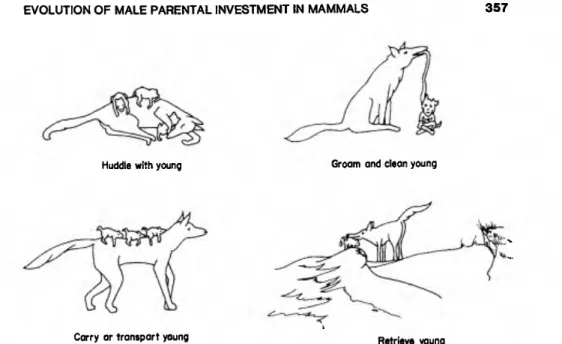
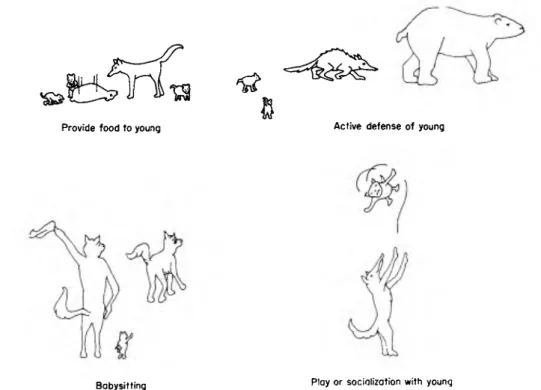
References to male parental investment in the literature usually involve direct investment (we will occasionally use the term male parental care when referring to direct male investment). Indirect male parental investment includes those actions that a male can perform in the absence of the young that increase the survival of the latter. Many forms of male parental investment that are indirect are also incidental to the species' breeding system, ecology, or social organization.
Most forms of indirect male parental investment are non-depreciable in that they benefit multiple young people without distinguishing between them. In the analysis of male parental investment in carnivores presented below, males were only recorded as helping females by securing resources if females also defended the same resources against conspecifics. The broad definition of male parental investment used here makes a comprehensive survey of the mammals impossible.
For our summary of male parental investment in primates, we relied heavily on reviews by Hrdy (1976), Mitchell and Brandt (1972), Mitchell (1969), and Redican (1976) and largely did not cite original sources. Many descriptions of male parental care are based on laboratory or zoo observations. Some sources refer to the existence of male parental investment without detailing specific behavioral patterns.
Authors also rarely describe changes in or refer to indirect forms of male parental investment. Since male and female mammals have the potential to be similar in parental investment patterns (regardless of gestation and lactation), a summary of male parental behavior will resemble a summary of female parental behavior. Of all indirect forms of male parental investment, only investment in the female does not contribute to both male and juvenile survival.
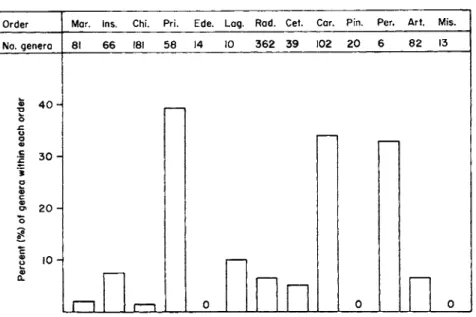
The percentage of genera within each mammalian order for which direct male parental care has been described is shown. The proportion of genera within each mammalian order in which direct male parental care has been recorded. Overall, approximately 9–10% of mammalian genera have been described as exhibiting direct male parental investment.
Nevertheless, the ability to demonstrate direct male parental investment appears to be common to a high percentage of primate genera. The presence and absence of recorded cases of male parental investment in all species of carnivores.

Discussion
Phylogenetic Considerations
Factors That May Predispose IMale Mammals to Care for Young
- Intrinsic Ability to Aid Offspring
- Sociality
- High Costs to Polygyny
- Paternity Certainty
In summary, high levels of direct male care appear to have evolved several times independently among mammals. Male primates are an exception, as male parental care has been described for several species, where male immigration at puberty reduces the probability that males are related to all infants and young. Species are divided into two different types; the diurnal, gregarious species such as Mungos mungos, Helogale párvula and Suricata suricatta, which exhibit extensive direct male care, including food provision, protection and male childcare (Rasa, 1977; Rood and a larger number of solitary, usually nocturnal forms, where male investment rarely goes beyond mere tolerance of the young (eg Rood and Waser, 1978).
Foraging in cooperative groups also appears important in the extreme case of communal breeding reported in the naked mole rat (Heterocephalus glaber) (Jarvis, 1978), and in the wolf (Cams lupus) and other pack-hunting canids. As Maynard Smith (1977) and Trivers (1972) have pointed out, the benefits to an offspring of male parental investment must be weighed by a male against his chances of mating again. Although in some cases a female would prefer a male that invests over one that deserts, there is also a point at which a female would prefer to mate with a successful polygyn who will give her effectively polygynous sons. . 34;Successful" and "effective" are probably ultimately related to the inheritance of traits leading to polygyny.).
Certain instances of direct male care in mammals may have evolved in situations where a male could not consistently mate with more than one female, even if he deserted, because females are so widely dispersed and so irregular in heat. In these species, his inherent ability to make a direct contribution to raising young seems limited. Indeed, maternal care is limited by the precocial nature of the newborns and the absent parental care system.
However, juveniles can obtain substantial indirect rewards by using resources in the territory and the escape system (Rathbun, 1979). So far, there have been a few reported cases of males investing in distantly related or genetically unrelated offspring. Additionally, there are species in which the male appears to be able to identify his offspring, such as species with male infanticide (Hrdy, 1977), but in which the male provides little or no care.
Paternity security may represent a necessary but not sufficient condition for the evolution of male investment, and it is not surprising that male parental care is common in species that are monogamous or live in one-male "closed" groups.
The Role of Male Parental Investment in Molding the Social Organization of Species
However, males other than the father certainly care for young, both in species with cooperative reproduction ("helpers at the nest") and in some social species with a multi-male group structure, for example baboons [Papio spp.) and capuchins (Cebus nigrivittatus) . ) (Robinson, personal communication). Similarly, in many 'solitary' species, such as mustelids and cats, female dispersal appears to be independent of male dispersal, although males may provide important indirect benefits by excluding other males. Even in some cases where a male focuses his care on the offspring of a single female, it appears that the male's investment may not play a significant role in dispersal, rearing strategy, or intrasexual selection in the female.
Rathbun (1979) reports that for one species of elephant shrew (E. rufescens), the male and female rarely interact and most territorial defense is directed against members of the same sex. It seems unlikely that female behavior would differ if the males' ranges overlapped those of multiple females, as is more usual in mammals in general. For the species mentioned above, mating systems appear to have evolved in response to factors in the ecology or natural history of the species, independent of the ability of males to invest in young.
Even in monogamous species, it is usually not the male's parental investment that appears to limit a male to mating with a single female. Male parental investments, such as guarding and antipredator behavior, and occasional play with young, which are seen especially in a number of gregarious species, are probably displayed by males only to the extent that they do not interfere with a polygynous mating system. . It is unlikely that a male in such species would ever give up an opportunity to marry or mate with a female in order to care for the young.
Important components of these species' social organization and mating systems can only be understood as consequences of the high levels of male parental care. These species, which include golden lion tamarins (Leontopithecus rosalia), African wild dogs, and wolves (Canis lupus), share a complex of behavioral characters that include more intense competition between females than males (Kleiman, 1979; Frame et ai, 1979 ), gender ratios tending towards men, disproportionate female emigration and often care provided by adults other than the father. Females in these species appear to compete for access to male investment, which in tamarins involves carrying the young and also providing food (Hoage and canids involve providing food and protection for an extended period of dependence.
The extent to which other obligately monogamous species exhibit the same characteristics may depend on the extent to which the contribution of the males to the young is depreciable.
Conclusions
The high levels of male tolerance and food sharing in captive small stock also suggest that it would be interesting to study, especially comparing a species with low and high population density where the ability to find mates may differ.
Cuneo, F., 1965, Observations on the breeding of the klipspringer antelope, Oreotragus oreotragus, and the behavior of their young in the Naples Zoo, Int. Geidel, B., and Gensch, W., 1976, Rearing of clouded leopards (Neojelis nebulosa) in the presence of the male. Gerling, S., and Yahr, P., 1979, The effect of the male parent on pup survival in Mongolian gerbils, Anim.
Gorman, M., 1979, Dispersal and foraging of the small Indian mongoose, Herpestes auropunctatus (Carnívora: Viverridae) in relation to the evolution of social viverrids. Hemmer, H., 1978, Were the leopard cat and sand cat among the ancestors of domestic cat breeds. J., 1977, Parental care in Leontopithecus rosalia rosalia: Sex and age differences in carrying behavior and the role of previous experience, in: The Biology and Conservation of the Callitrichidae (D. G. Kleiman, ed.), pp.
H., 1962, Ecology and social behavior of the coati (Nasua narica) on Barro Colorado Island, Panama, Univ. Lamprecht, J., 1979, Field observations on the behavior and social system of the broken fox, Otocyon megalotis Desmarest, Z. EVOLUTION OF MALE PARENTAL INVESTMENT IN MAMMALS 383 Laurie, A., and Seidensticker, J., 1977, Behavioral ecology of the sloth bear (Melursus . ursinus),;.
62, Zoological Institute of the USSR Academy of Sciences, Israel Program for Scientific Translation. Proctor, J., 1962, A contribution to the natural history of the spotted-necked otter (Lutra maculicollis Lichtenstein), in Tanganyika E. K., 1976, Adult male-infant interactions in nonhuman primates, in: The role of the father in child development ( M. E. Lamb, ed.), pp.
H., 1966, The evolutionary significance of certain behavioral, physiological and morphological adaptations of the ancient field mouse, Peromyscuspolionotus, Ph.D. W., 1977, Observations on the foraging behavior and bird prey of the Neotropical carnivorous bat, Vampyrum spectrum, J.