The transition to adulthood involves the adoption of new roles (eg, marriage and parenthood) that are shaped by gender. Additionally, gender ideology or notions of how men and women should perform their roles can cause a couple to experience conflict. In turn, carrying the burden of childcare can result in stress that leads to less than optimal parenting and a host of family tensions, including relationship conflict between spouses or partners (Dew and Wilcox 2011).
Furthermore, I investigate whether gender ideology is one mechanism through which parenting influences primary romantic relationships. Today's transition to adulthood may be especially important to study because current research shows it is dramatically different from just a generation ago. To the extent that gender ideology can determine the timing of role transitions such as parenthood, gender ideology and parenting can jointly determine role expectations.
Assessing outcomes over time allows me to look at how parenthood at the beginning of the study period as well as transitions to parenthood affect the level of dyadic argumentation by gender. Third, the data allow me to estimate models that adjust for other important roles and transitions (e.g., employment and marriage), as well as several other relevant factors (e.g., region of residence, urbanicity, household income) that may be important for to understand how parenting and gender ideology combine to influence relationship conflict.
Literature Review
Due to economic obligation and historical oppression, Collins (2000) shows how black families are typically more equal with women working more often. 2016) also shows how gender ideology intersects with many different identities, such as race and social class. With less advantaged men, including African Americans and white men without college degrees, gender ideology and labor market behavior are more fragmented (Glauber and Gozjolko 2011). Gender ideology is also fluid and changes over an individual's life course and exposure to new social settings with gendered expectations, such as parenthood and marriage (Vespa 2009).
Vespa (2009) notes that changes in gender ideology are often the result of new social situations and roles that are deeply embedded in gendered expectations. Therefore, one can expect that gender ideology and its impact on relationship conflict may differ by parenthood and gender. First, the birth of children more consistently aligns parents' gender ideology with long-standing normative expectations about gender roles, leading to less egalitarian ideologies.
Also, time demands of parenting conflict with the time available for other activities, pushing this shift towards traditional gender ideology (Fan and Marini 2000; Hochschild and Machung 1989), showing the flexibility of gender ideology during the transition to adult roles. Parenthood provides an arena for gender ideology to play out, often framing expectations of roles and responsibilities.
Summary and Hypotheses
Data and Methods
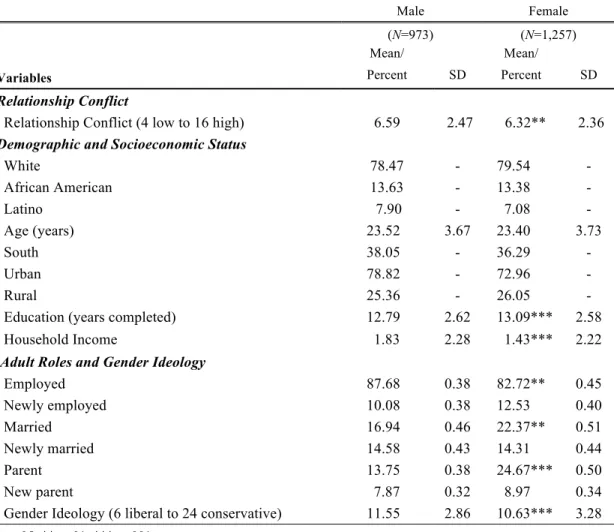
The NLSY-YA includes four gender ideology questions that pertain to those in committed relationships, either with a spouse/partner or boyfriend/girlfriend. These four items were scaled together to create a relationship conflict scale, ranging from 4 (lower relationship conflict) to 16 (higher relationship conflict). For those who became parents during the 2012 wave, I coded transition to parenthood as 1 and compared them to their peers who did not experience the birth or adoption of a new or another child during the study period.
Gender ideology is created from six questions that measure young adults' attitudes about appropriate roles for men and women with regard to family and work. Respondents were asked to strongly disagree, disagree, agree, or strongly disagree with the following statements: 1) "A woman's place is in the home, not the office or the store"; 2) "Wife, who takes full responsibility for the family, has no time for outside employment"; 3) "Employing wives leads to more juvenile delinquency";. 4) "It is much better if the man is the achiever outside the home and the woman takes care of the home and family"; 5) "Men should share housework with women"; and 6) "Women are much happier if they stay at home and take care of their children".
In ancillary analyses, not shown for brevity, I divided the scale into different sections (eg, tertiles, quartiles, quintiles) to conceptualize more traditional versus more egalitarian respondents. Thirds, which I operationalize as traditional, moderate, and egalitarian ideology (Perrone et al., 2009), best fit this data. For the sake of brevity, in the rest of this study I use traditional, moderate, and egalitarian as individual modifiers that refer to gender ideology.
I created dummy variables to distinguish race-ethnicity and compare African Americans and Hispanics to whites. Age is measured in years, and I compare those living in the southern region (1=yes) of the country with everyone else. I also have a permanent job for those who worked in 2010 and for those who transition to work during the study period.
Similarly, I account for individuals who reported marriage (1=yes) in the first wave and those who transitioned to marriage (1=yes) during the study period.
Analytic Strategy
Findings
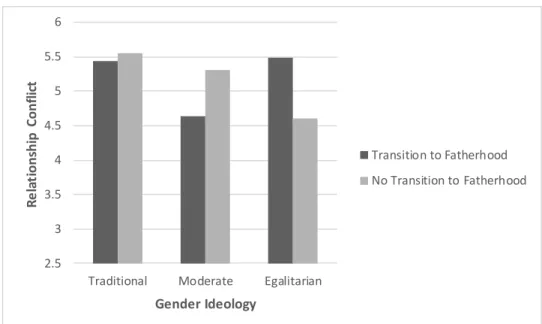
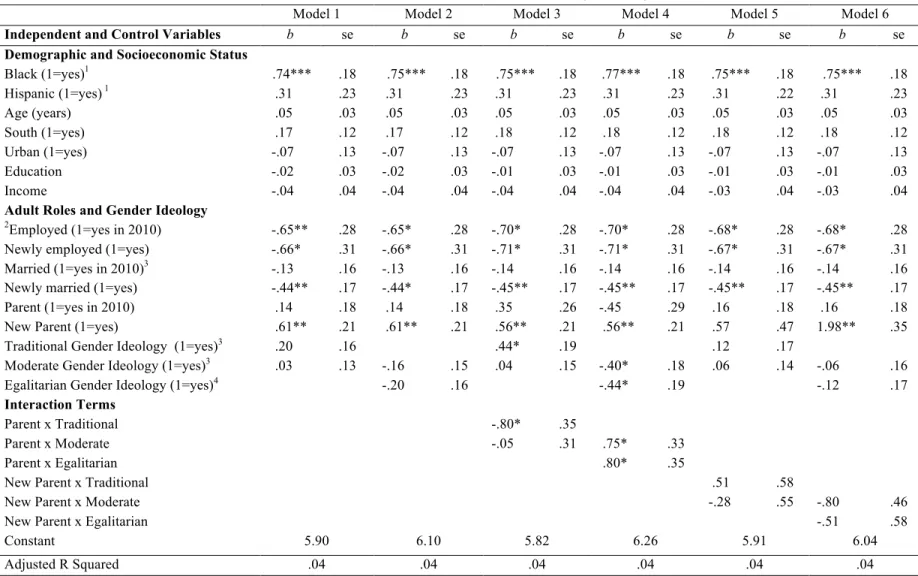
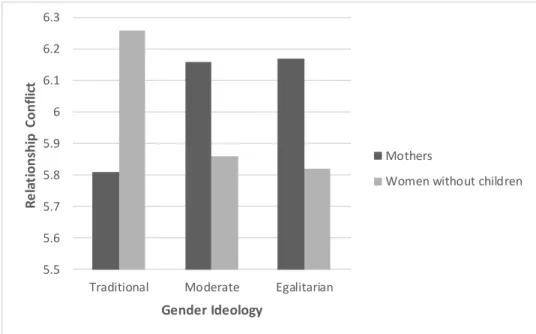
In addition, H2b predicted that traditional gender ideology is positively related to relationship conflict compared to egalitarian gender ideology. Both Models 1 and 2 show that gender ideology has no effect on women's relationship conflict. H3 predicted that parenting would moderate the influence and influence of gender ideology on Figure 1. "Interaction" between "parenting" and "gender ideology" for "women".
Table 2, Model 3 is significant and indicates that mothers with traditional gender ideology experience lower levels of relationship conflict, compared to mothers with egalitarian gender ideology (the omitted category). Among women in our sample who do not have children, those with traditional gender ideology have higher relationship conflict than those with egalitarian gender ideology. That is, traditional gender ideology leads to fewer arguments for mothers, but higher relationship conflict for women without children.
Table 2, Model 4 tests for H3b, which predicted that mothers with traditional gender ideologies would have lower relationship conflict than their counterparts with moderate gender ideologies. Again, model 4 shows that among women in the sample who do not have children, those with the traditional gender ideology intercept]) have higher relationship conflict than those with the moderate gender ideology intercept] - 0.40 [b for gender ideology moderate]) and gender egalitarian ideology intercept] - 0.44 [b for gender egalitarian ideology]). Therefore, model 5, which predicted that youth transitioning to parents with traditional gender ideologies would have lower conflict than egalitarian (H4a), was not supported.
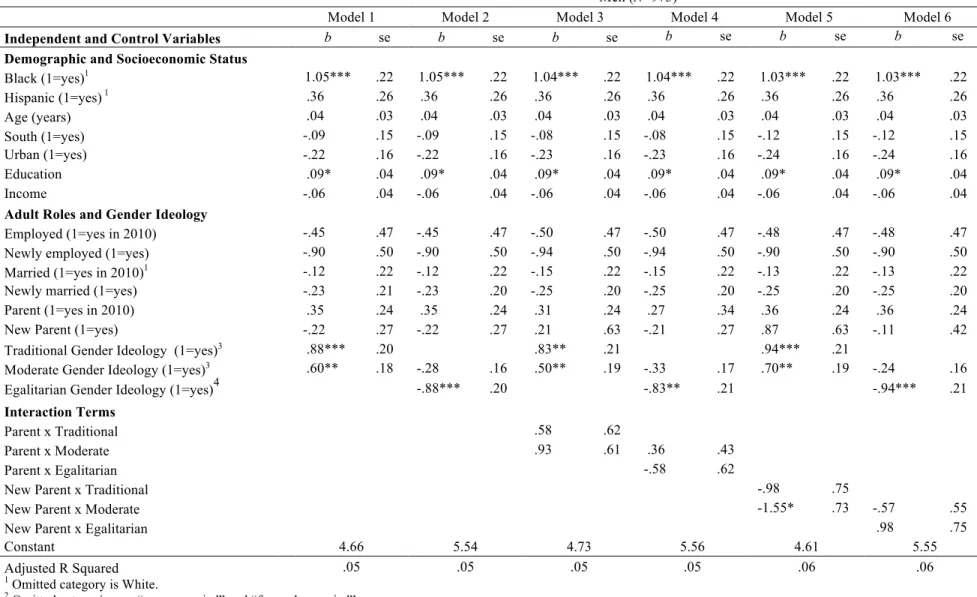
Model 6, which predicted that young adults' transition to parenthood with a traditional gender ideology would cause less conflict than those with a moderate gender ideology (H4b), was also not supported. However, Model 5 did find that men with a moderate gender ideology who transition to fatherhood during the study period experience less conflict than men with an egalitarian gender ideology who transition to fatherhood. Young men who transition to fatherhood with an egalitarian gender ideology experience similar levels as men with a traditional gender ideology, who both transition and do not transition to fatherhood.
Their levels of relationship conflict are similar to men with egalitarian gender ideology who do not transition to fatherhood. When evaluating young men in their transition to fatherhood, men with moderate gender ideologies experience the lowest levels of relationship conflict, with no significant differences between transitioning men with traditional and egalitarian gender ideologies. In all six models, gender ideology was a significant predictor of relationship conflict with egalitarian men arguing less than moderate and traditional men.
Discussion and Conclusion
I also find that mothers with traditional gender ideology argue less than moderate and egalitarian mothers, which can be understood in several ways. The same study found that this is not the case for traditional women; rather, traditionalism in gender ideology taught the influence of unequal spheres in the household. Traditional mothers are also more likely to be in relationships with traditional men, align ideologies, and learn relationship conflict.
For women, being employed, transitioning to marriage, and being moderate or egalitarian in gender ideology reduced relationship conflict. When looking at men, gender ideology predicts relationship conflict, with traditional and moderate men struggling more than egalitarian men. A surprising result was that new fathers with moderate gender ideology have less relationship conflict than fathers with egalitarian or traditional ideologies.
Therefore, moderate fathers may not have a concrete set of demands. expectations of parenthood or the gender ideology that provides them with guidance, allowing them to deal more gently with the transition to adult roles, such as parenthood. Not surprisingly, gender ideology is indicative of relationship conflict for men but a moderator for women. Much research has shown that parenting, relationship conflict, and gender ideology are shaped by race and are culturally determined (Arendell 2000;
As demonstrated with my study, gender ideology is still predictive of relationship conflict for men, but parenting is a strong predictor of relationship conflict for women. These findings are important in shaping mediation for intimate relationships and understanding how gender ideology and parenting influence young adults. The Effects of Traditional Family and Gender Ideology on Earnings: Race and Gender Differences.” Journal of Family and Economic Affairs 27:48-71.
Influences of Gender Ideology and Housework Allocation on Women's Employment across the Life Course." Social Science Research. Relationship between Young People's Gender Role Attitudes and Individual, Home, and School Characteristics: A Review." Sage Open 2016:1-19. Is this what motherhood is all about?' Weaving experiences and discourse through transition to first-time motherhood." Gender and Society.
Leisure and emotional well-being: Do dual-earner mothers and fathers differ? Gender and society. Nontraditional Gender Roles and the Work-Family Interface for Men and Women.” Journal of Career Development 36: 8–24.