Synopsis of the families and genera of the crustaceans (Crustacea: Decapoda) (Smithsonian Contributions to Zoology, No. 164). Key to the families and genera of the infraorder Astacidea Latrielle, 1803, exclusive of the superfamily Nephropoidea.
Superfamily ASTACOIDEA
Carapace and pleuron of second abdominal segment with large spines or tubercles; antero-lateral extension of branchiocardial groove almost continuous with cervical groove; tel- son with trace of transverse suture laterally; branchial formula 12 + epr + 5r Carapace and pleuron of second abdominal segment never with large spines or tubercles;. The anterolateral part of the branchial groove is subparallel to the cervical groove with relatively little space between them; branchial formula 20 + epr Sammitmcus Anterolateral part of branchiocardiac groove widely separated from, but converging throughout its length with, cervical groove; branch formula 21 + epr SO 30(29).
DIAGNOSIS.—Carapace lacking dorsomedian longi- tudinal suture or ridge in cardiac and posterior
Rostral lateral carina present; lateral process of sternum between fourth pereiopods not separated by median longitudinal carina; bronze formula 21 + e p Engmemm Missing lateral rostral carina; lateral processes of sternum between fourth pereiopods separated by median longitudinal carina; branched formula 18 + ep Temribrmmchhtnu 26(21). Confluence or approximation of the grooves of the cardiac and cervical branches located no further than the level of the caudolateral extremity of the postorbital ridge; bronchial formula 17 + epr Pmrmrtacotdet Junction or approximation of branchial and cervical grooves prominently located laterally at level of caudolateral extremity of postorbital ridge; bronze formula 20 + epr or 21 -I- epr 29 29 (28).
Family ASTACIDAE
Anterolateral lobe of branchiocardiac groove (disjoint with cervical groove; branch formula 20 + epr Fmrmstocut Anterolateral lobe of branchiocardiac groove widely separated from cervical groove;. Postorbital ridge* well developed; eyestalks of long palm; palms of lip; carpucde depressives Geochmrmx Postorbital ridges very weak or absent; eyestalks short and bulbous; chela-palm inserted; carpus of cheliped rounded distomesially 25 25 (24). Male genitalia large, longer than coxa; pleuron of second abdominal segment enlarged in female Grmnuutalia. small, much shorter than coxa, pleuron of second abdominal segment not.
DIAGNOSIS.—Male never showing cyclic dimorphism; first pleopod with distal portion rolled to form cylinder, and distal portion contracted to form tube or formed into 2 simple spoon-like lobes. NUMBER OF SPECIES.—Bott (1950) recognizes four species and four subspecies assigned to two subgenera, and two additional species of uncertain relationships. Karaman (1962) treated four species and six subspecies and "natio" assigned to two subgenera.
Genus Austropotamobius
Genus Pacifastacus
DIAGNOSIS.-Carapace usually with at least rudiments of anterior and posterior postorbital ridges; maxilliped third merus with row of spines along mesial margin; epistome without spine or ridge behind renal papilla; first pleopod of male with distal part contracted to form a narrow tube, without apical lobes; exopodite of second pleopod not reaching distal end of endopodite. DIAGNOSIS.-Male showing cyclic dimorphism (males of the first and second form); first pleopod either with shallow spermatic furrow mesially or distal part strongly folded with distal end of spermatic furrow opening into a (central projection) of 2–4 terminal elements. Male with hooks present on ischium of one or more second to fourth pereiopods.
Some articles of lateral ramus of antenna bearing either 1 or 2 clusters of asthetascs. DIAGNOSIS.—First pleopod in the male with the distal part tightly folded and the distal end of the spermathecae opening on a (central projection) of 2–4 terminal elements; hooks present on ischia of third, fourth or third and fourth pereiopods. Female with fixed or movable annulus ventralis, the latter rarely through an arc of as much as 40 degrees; with or without first pleopod.
Genus Barbicambanu
RANGE.—North America: Barren and Green river systems in Kentucky and Tennessee
Genus Cambarus
Gender: masculine.]
NUMBER 164 11 central projection, curved caudally much more. angle at right angles and truncate, partially horned mesial process bearing finger-like projection, reach- .. caudal button; cephalic process always absent), 2 prominent bent caudally or caudolaterally between 45 and 100 degrees or with a central projection forming an arc approaching 180 degrees; central projection blade-shaped or tapering from base, with or without subapical notch; mesial process subconical, bulbiform or conspicuously inflated at base, rarely horned, never appearing twisted or subpatulate distally and without eminence at cephalic (morphological) border; a caudal element is rarely present, but is occasionally represented by a humped projection on the caudolateral base of the central projection. Female with motionless annulus ventralis or with slightly movable caudal half; first pleopod present, rudimentary or absent. RANGE.—North America: From the coastal region of New Brunswick, Canada, south to Florida, west to Texas, and north to Minnesota and southern Ontario.
Mesial palmar margin of depressed chela with a row of less than 12 cusps; lateral edge of solid finger never with row of spines or tubercles; Opposable edge of dactyl, usually with prominent excision. First pleopods of the first form male symmetrical, basally contiguous and terminating in 2- or S-elements (mesial process, central projection and sometimes cephalic process) curved caudally or caudomesially at an angle greater than 95 degrees to the major axis or broadly formed arc of almost 180 degrees; central projection leaf-like or tapering, and usually without subapical notch; Mesial edge of palm of chela with or without greatly reduced tubercles; lateral edge of solid finger never with row of spines or tubercles; opposable edge of dactyl never with prominent excision.
The first pleopods of the first form are male symmetrical, basally contiguous and terminating in a long (central process) and a short (mesial process) element, the latter not more than half the length of the former; central projection of paired appendages that always overlap.

RANGE.—North America: Oklahoma and Texas east to Gadsden County, Florida, and Richland
Genus Hobbseus
First pleopod of first male form, symmetrical or slightly asymmetrical, deeply retracted between bases of pereopods and mostly hidden by dense setal bed extending from ventrolateral margin of sternum and terminating in two distinct parts (mesial process and projection central). almost straight, curved caudally up to 159 degrees, or forming a broad arch up to 180 degrees; central projection tapers at distal point and lacks subterminal level; mesial process never bulbiform, with thin distal part and lack of eminence at the cephalic border (morphological).
RANGE.—North America: Eastern Mississippi and western Alabama
Hobbs, 1969, 1972b
Genus Orconectes
ARGAM.—North America: Arizona and Alberta east to the Atlantic Ocean except on the east coast from South Carolina to Florida; also on the Rogue River in Oregon.
Genus Procambartu
Gender: masculine.]
Gender: masculine.]
Mesial edge of palm of chela with none to many tubercles; lateral edge of solid finger never bearing spiniform cusps; Opposable edge of dactyl, occasionally with prominent excision. The first pleopods of the first form are male, symmetrical or asymmetrical, sometimes deeply retracted between the bases of pereiopods and at least partially hidden by bristles extending from the ventrolateral margin of the sternum; subcontiguous, contiguous or basal partly overlapping, and terminating in 2 or more, usually 3 or 4 elements; presence of subterminal setae in many members of the unique genus; end elements highly variable in shape and character; if only two elements are present (mesial process and central projection), shoulder present on the distal third of the cephalic surface of the appendage, or central projection forming a distally projecting triangular plate, or central projection arising from the caudal margin of the enlarged terminal area; when more than two elements are present, the central projection is rarely leaf-shaped, if it is, directed laterodistally or without a subterminal notch, and the elements are never arcuate caudally at an angle as much as 90 degrees. Female with annulus ventralis freely movable, although sometimes partially covered ventrally by caudally projecting prominences from the sternal plate passing immediately to it; first pleopod usually present.
RANGE.—North America: Guatemala and Cuba to Minnesota and southern New England, except in mountains.
Genus Troglocambarus
Subfamily CAMBARELLINAE
Genus Cambarellus FicuftE 12
Genus Cambaroides
DIAGNOSIS.—Same as that of subfamily
RANGE.—Eastern Asia: Amur Basin, Korea, and Japan
Superfamily PARASTACOIDEA
DIAGNOSIS.—Carapace lacking dorsomedian, lon- gitudinal suture or ridge in cardiac and posterior
Podobranchiae of first three pereiopods not differ- entiated into branchial and epipoditic portions and
Family PARASTACIDAE DIAGNOSIS.—Same as that of superfamily
Genus Astacoides
DIAGNOSIS.—Carapace with conspicuous spines or tubercles, in addition to rostral, postorbital, bran-
Third maxilliped with ventral surface bearing scat- tered setiferous punctations; distolateral portion
RANGE.—Madagascar
Genus Astacopsis
DIAGNOSIS.—Carapace with spines or tubercles, other than rostral, postorbital, branchiostegal, and
RANGE.—Australia: Northwestern and central southern part of Tasmania
Genus Cherax
DIAGNOSIS.—Carapace smooth, punctate, or finely granulate, rarely with spines or tubercles other than
Abdomen rarely with spines or tubercles on pleura;
RANGE.—Australia and New Guinea: Eastern half and extreme southwestern part of Australia; New
Genus Engaeus
DIAGNOSIS.—Carapace generally smooth, rarely with granules or tubercles; anterolateral portion of
RANGE.—Australia: Victoria, New South Wales, and Tasmania
DIAGNOSIS.—Carapace smooth; anterolateral por-
RANGE.—Australia: Western Australia
Genus Euastacoides
DIAGNOSIS.—Carapace with dense setiferous punc- tations and very small tubercles; anterolateral ex-
RANGE.—Australia: Queensland
Genus Euastacus
DIAGNOSIS.—Carapace with spines or tubercles other than rostral, postorbital, branchiostegal, and
Third maxilliped with ventral surface of seat provided with one row of large setae bearing clusters of hard setae and located distolaterally in a sharp ridge; the exopodite is greatly reduced, but the flagellum often reaches the distal end of the ischium. Chela with ventrolateral margin bearing one row of spines and usually with an additional row or subparallel low carina; when the upper surface of the carpus of the cheliped is in a horizontal plane, the dactyl moves subhorizontally; carpus kelipata with 2-4 large spines raesially and 1 or 2 on or along ventrodistal margin. Male genitalia located on the ventral surface of the coxa, consisting of a short papilla bearing a calcified ring.
Genus Geocharax
DIAGNOSIS.-Carapace punctate; anterolateral portion of tachyocardial groove widely separated from, and parallel to, cervical groove almost to mid-height of carapace; viewed dorsally, cervical groove U-shaped; postorbital ridges well developed. Chela with ventrolateral margin without large tubercles; when the upper surface of carpus of cheliped is held in a horizontal plane, dactyl moving subhorizontally; carpus. DIAGNOSIS.-Carapace with spines or tubercles, other than rostral, postorbital, tachyostegal, and cervical; anterolateral portion of tachycardial groove widely separated from and parallel to cervical groove; postcervical groove prominent and merging with anterolateral arms of tachyocardials.
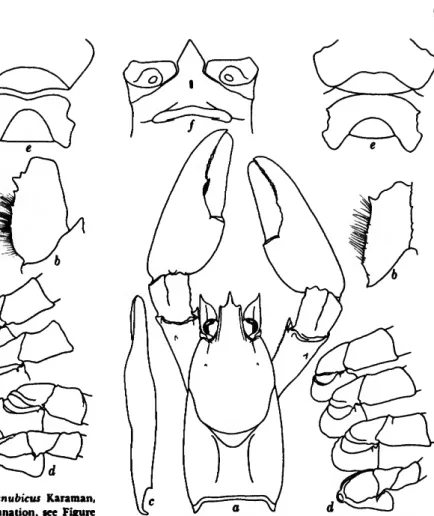
For explanation, see Figure 14; except d, basal podomere of fifth pereiopod illustrating male genitalia on mesial surface of coxa.).

RANGE.—New Zealand
Genus Parastacoides
Gender: masculine.]
DIAGNOSIS.—Carapace setose, punctate, or granu- late; anterolateral portion of branchiocardiac
RANGE.—Australia: Tasmania
Genus Parastacus
DIAGNOSIS.—Carapace punctate or tuberculate;
Abdomen without tubercles or spines; pleuron of first domain without tubercles or spines; pleuron of first abdominal segment distinct and partially overlapping that of second.
Third maxilliped with mesial half of ventral sur- face of ischium bearing setiferous punctations; ex-
Genus Sanuutacus
DIAGNOSIS.—Carapace punctate or smooth; an- terolateral portion of branchiocardiac groove ex-
Branchial formula 20 + epr + r; stem without winglike expansion
RANGE.—South America: Chile
Genus Tenuibranchhtnu FicinuE 27
DIAGNOSIS.—Carapace punctate to finely granu- late; anterolateral portion of branchiocardiac
Literature Cited Andre, Marc
Kegan Paul & Co
The interrelationships of the species of the genus Cambarus and their distribution across the United States. The cave fauna of North America with remarks on the anatomy of the brain and the origin of the blind species. Phytogeny of the Parastacidae (Crustacea: . Astacoidea) and description of a new genus of Australian freshwater crayfish.
Notices of new species of crustaceans from western North America; Being an abstract from a paper to be published in the Journal of the Society. Description of an Orthopterous Insect, and Two New Species of Crustacea, from New Zealand in the Collection of the British Museum. Six new crayfish of the genus Orconectes (Decapoda: Astacidac) from Arkansas, Missouri, and Oklahoma.
If the submission is invited, the following print format requirements will govern the preparation of the copy.