Introduction
Lifetime of a free neutron
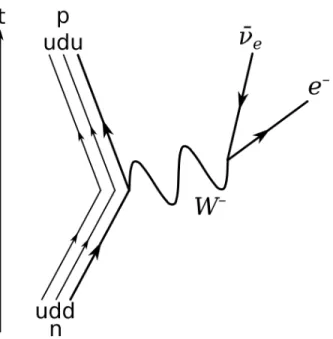
The amplitude of the tree-level process, shown in Figure 1.1, can be calculated using Feynman's rules for weak interactions. This differs from the current global average of free neutron lifetime measurements of 𝜏meas s [1] by '4%.
Unitarity of the Cabibbo–Kobayashi–Maskawa quark weak mixing
This difference is mostly due to ignoring higher order terms in the 𝛽-neutron decay process. The purpose of the UCN𝜏 experiment is to precisely measure the lifetime of a free neutron.
Big Bang nucleosynthesis and the neutron lifetime
Past measurements of the neutron lifetime
- Bottle lifetime experiments
- Beam lifetime experiments
- Differences between bottle and beam lifetime experiments . 8
However, the primary detector was only able to sample a fraction of the UCN in the trap at the height of Peak 2. Instability in UCN production during the filling process added uncertainty to the amount of UCN loaded into the trap.
UCN 𝜏 experimental design
Properties of ultra-cold neutrons (UCN)
The defining property of UCN is that they are neutrons that can be stored in material bottles. Given that the maximum energy of UCN is 335 neV, a magnetic field > 5.6 T can completely polarize UCN from their spin.
Overview
The gate valve and the opening in the bottom of the siphon close and the production of UCN stops. The primary detector is lowered to count any UCN remaining in the trap.
Production of UCN
This repeated cycle of source temperature causes frost layers to form on the surface of sD2. If most of the sD2 source is in a bad state, then a spontaneous excursion has only a small effect on UCN production.
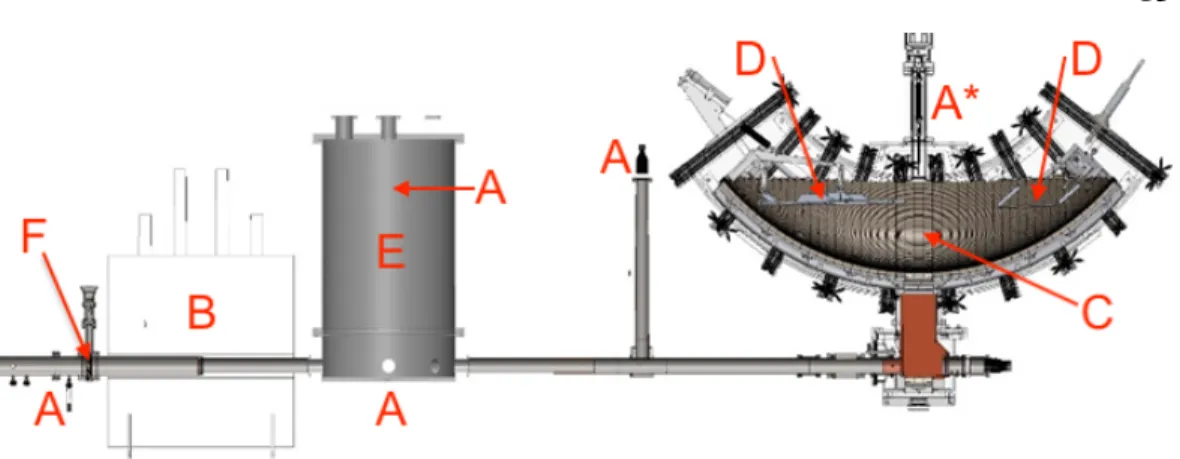
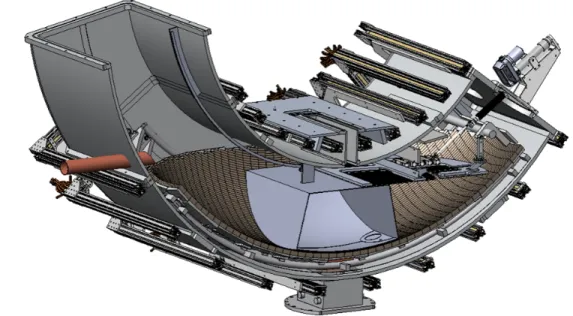
![Figure 2.2: A CAD drawing of the LANSCE UCN source [34]. Neutrons are produced by spallation from the W target that is caused by protons that come into the source from the right](https://thumb-ap.123doks.com/thumbv2/123dok/10402555.0/43.918.216.700.359.867/figure-drawing-lansce-source-neutrons-produced-spallation-protons.webp)
Transport of UCN
The first item in the above list is completely outside the control of the UCN𝜏 experiment. The fourth and fifth items in the list can be adjusted if the sD2 resource is reconditioned.
Polarization of UCN
These losses are small enough not to be a problem for the transport of UCN, but would have a significant impact on the service life measured using a material wall trap.
UCN trap
- Geometry
- Halbach array magnetic walls
- Holding field
- Putting UCN into the trap
The minimum magnitude of the magnetic field 2 mm above the surface of the trap is 0.81 T. The magnitude of the magnetic field produced by equation 2.5 decreases exponentially as the distance from the surface of the trap increases.
![Figure 2.4: A subset of a one-dimensional Halbach array constructed of nine PMs [37]. The direction of the remnant field in each PM is shown with arrows](https://thumb-ap.123doks.com/thumbv2/123dok/10402555.0/48.918.163.759.568.691/figure-subset-dimensional-halbach-constructed-direction-remnant-arrows.webp)
UCN detectors
- Primary detector
- Upstream monitors
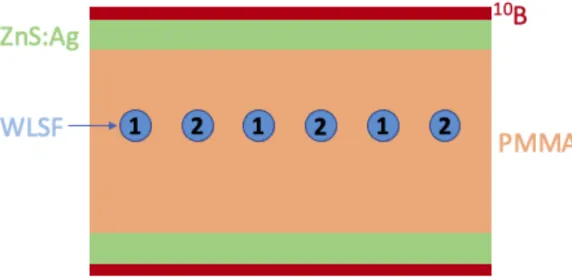
The main feature of the primary detector is the random detection of scintillation light in two PMTs. The primary detector rises above the entire usable volume of the trap while the UCN is stored in the trap.
Removing above-threshold UCN from the trap
Upstream monitors are installed at the bottom of the buffer volume and near the top of the buffer volume. The two detergents remain 43 cm above the bottom of the trap while the UCN is stored in the trap.

Upstream buffer volume
However, the buffer size also reduces the number of UCNs loaded into the trap by ~50%. The contributions to the statistical uncertainty of the extracted lifetime from the final number of UCN counted in the trap and the uncertainty of the number of UCN loaded into the trap will be quantified in Section 3.11.
Data acquisition
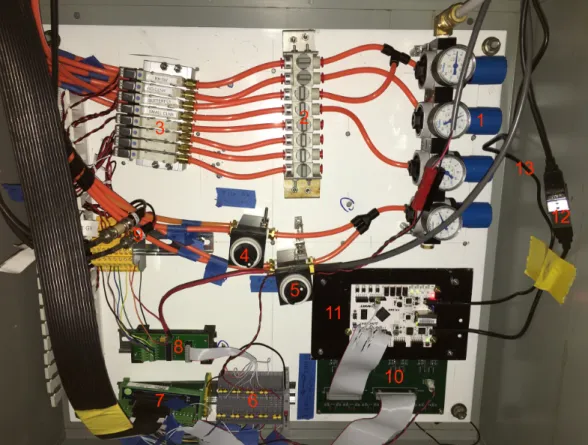
These marks are caused either by the movement of the components or by the voltage signals that control the components. The rate at which events of any type are recorded is & 300 Hz, so the tags are used to reconstruct component state histories with high accuracy.
Experimental control system
The number of expected CCs was a function of the estimated number of UCN loaded into the trap. The time evolution of the trajectories of UCN in the trap was studied with Monte Carlo simulations [43].
Extraction of the neutron lifetime
Introduction
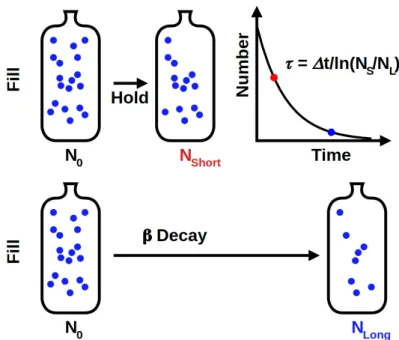
An unknown number of UCN is trapped, and the number of UCN in the trap was estimated as𝑁. Fluctuations in the production of UCN resulted in different runs loading different numbers of UCN into the trap at the beginning of each run.
Data structure
- Production runs
- Background runs
- Blinding the data
In the next 100 seconds, the primary detector captured 99.99% of the remaining UCNs in the trap. The primary detector spent 250 s at each of the four heights before the background run ended.
Run selection
- Introduction
- Fill quality
- Blinding bug
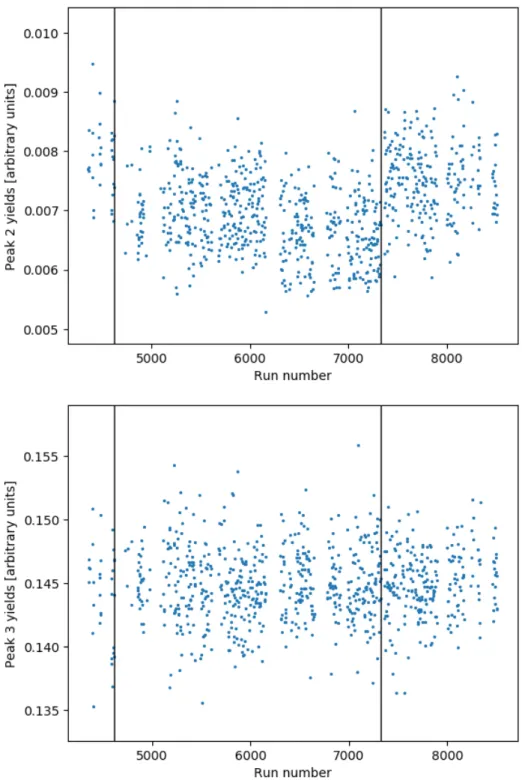
- Changes in the condition of the primary detector
- Conclusion
In the lower plot, both the lower and upper monitors were located inside the buffer volume. Occasionally, actions were taken that caused step changes in the behavior of the primary detector.

Identification of UCN events in the primary detector
- Introduction
- Modeling
- Simulating UCN events using Monte Carlo simulations
- Reconstructing UCN events from PEs
- Software dead time
- UCN-event-tail interactions
- Testing the software-dead-time and UCN-event-tail correc-
- Choice of the parameters of the reconstruction algorithm
- Conclusion
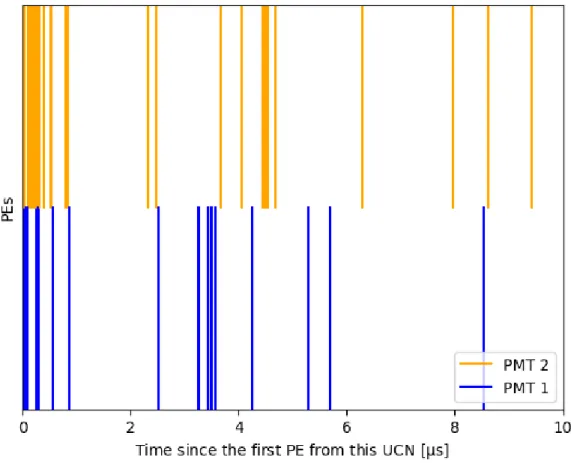
This algorithm estimated the number of PEs in the call window of the current CC that originated from previous UCN events. The potential bias of the extracted lifetime due to errors in the UCN-tail correction of the event will be investigated in Section 3.4.7.
Backgrounds
- Introduction
- Classification of background events
- Height-dependent background rates
- Time-dependent background rates
- Check of the estimation of the background CC rates
- Conclusion
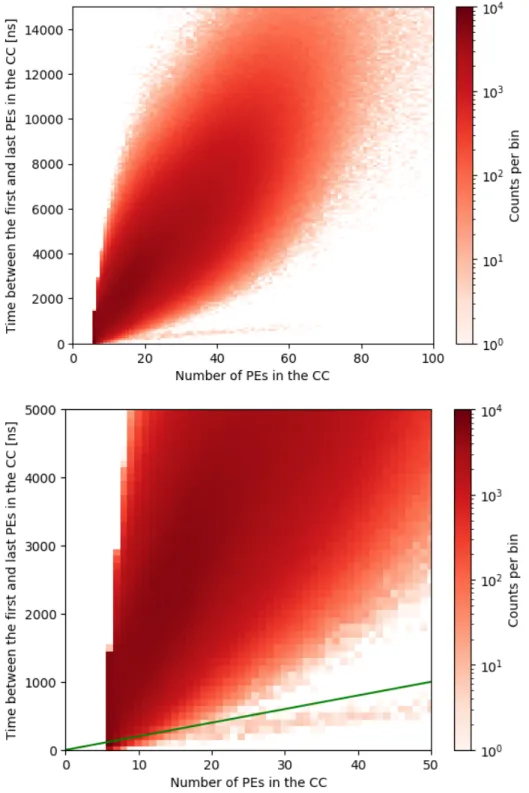
No increases in the background CC rates were observed as the primary detector moved between positions. Evidence of this was seen in the background PEs in both PMTs of the primary detector.
Normalization
- Introduction
- Normalization monitors
- Normalization model
- Changes in running conditions
- Conclusion
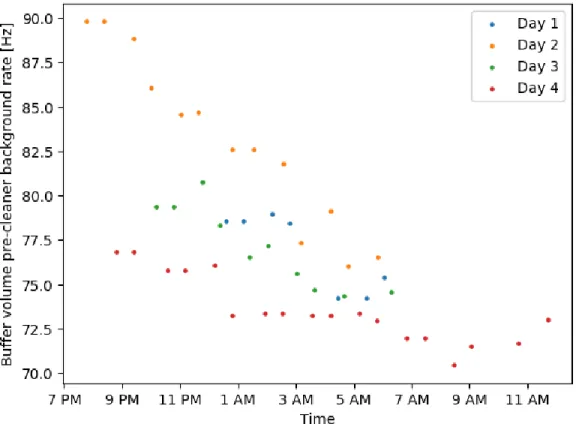
To complete the extraction of a lifetime, an estimate was needed for the number of UCN trapped at the start of the run. Both monitors provided a good measure of the overall number of UCN produced by the source.
Likelihood model
- Introduction
- Step 1: Loading UCN into the trap
- Step 2: Holding UCN in the trap
- Step 3: Detection efficiency of UCN in the trap
- Step 4: Software-dead-time and UCN-event-tail interactions 95
- Constructing a likelihood equation
- Checking the assumptions using Monte Carlo simulations
- Normalization optimization
- Conclusion
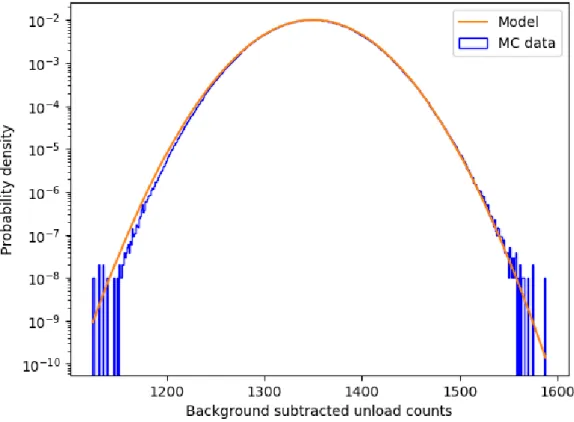
A Monte Carlo value for the number of UCN loaded into the trap is plotted as𝑛 ∼ Integer[Gaussian(𝑁 ,p . 𝑓 𝑁)]. A Monte Carlo value for the number of CCs recorded in the primary detector is plotted as𝑐 ∼Integer[Gauss(𝑠 𝑑 , 𝜎𝑠 . √ 𝑑)].
Holding length
- Fixed offsets in holding length
- Time evolution of UCN trajectories within the trap
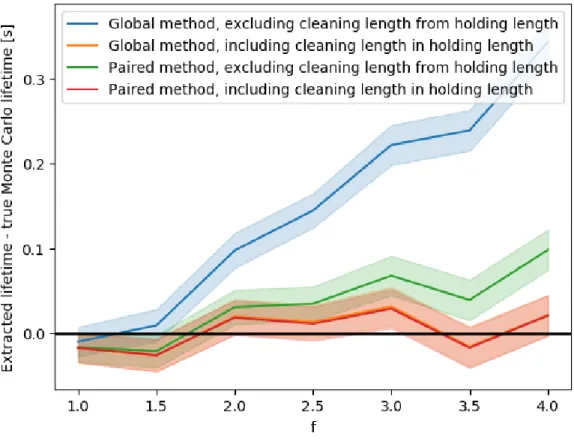
The relatively large number of UCN in Peak 3 outweighed the difference in the Peak 2 component of the arrival time distributions. When the average arrival times of each run are included in the calculation of the Δ𝑡s, the extracted lifetime s was smaller than the actual Monte Carlo lifetime.
Global analysis
- Introduction
- Extracting a global lifetime
- Statistical bias
- Results and conclusion
For a fixed value of 𝜏, the MLE of the normalization parameters was found using the method described in section 3.7.9. If no spectral correction was used in the normalization estimate (see equation 3.6), the global lifetime was 𝜏0.

Paired analysis
- Introduction
- Bias corrections
- Forming run pairs
- Extracting a paired lifetime
- Statistical bias
- Results
- Inefficiencies of the paired analysis
- Conclusion
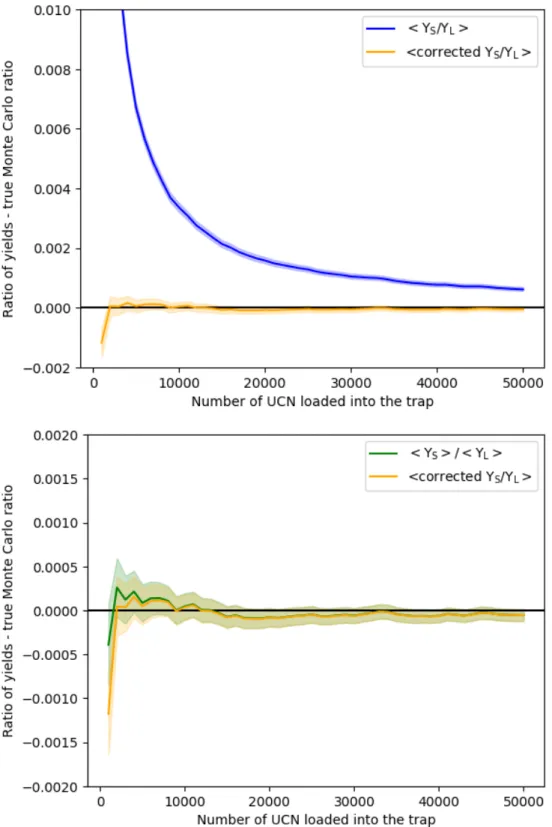
First, the paired lifetime extraction used less of the available data because not every run could reasonably fit into a short-long pair. Second, the associated lifetime extraction made less efficient use of the data it did use.
Conclusion
As discussed in section 5.2, an increase of approximately 10x in the number of UCN loaded into the trap could allow a measurement of neutron lifetimes with a total uncertainty of . Monte Carlo simulations of UCN trajectories in the trap [43] depend on models for the magnetic fields in the trap.
Systematic effects
Introduction
However, there were two cases where UCN in the UCN𝜏 trap interacted with other materials. The corrections that will be developed in Sections 4.2 and 4.3 will be applied on a run-to-run basis before a lifetime is extracted.
Aluminum block interactions
- Identifying when the aluminum block fell into the trap
- Estimating the effect of the aluminum block on trapped UCN 127
The aluminum block was found and the polyethylene block was placed 6.32 cm above the bottom of the trap. The lifetime of UCN in the trap that did not interact with the aluminum block was not affected.
Residual gas interactions
A simple scaling of the lifetime shift by a factor of 𝐴 led to an estimate that the aluminum block reduced the trapped UCN lifetime by between 𝐴×0.11 s=0.08 s and 𝐴×0.28 s=0.21 s. The corrections from Equation 4.4 were applied to batches where the aluminum block was assumed to be trapped.

Definition of a reconstructed UCN event in the primary detector
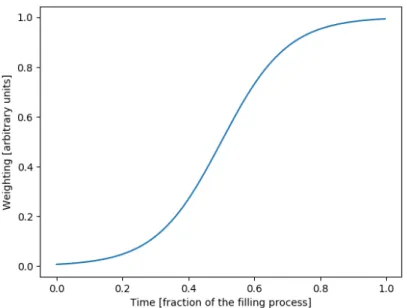
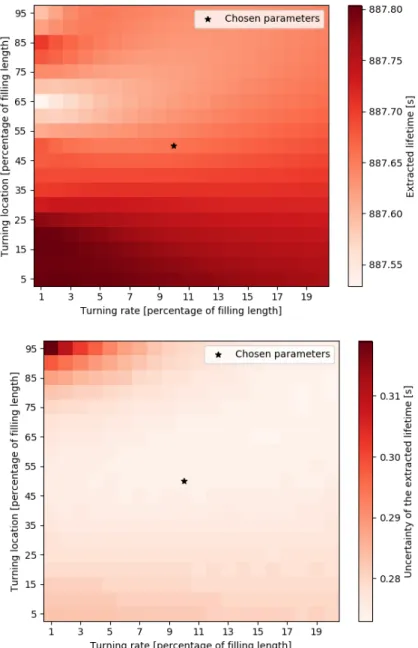
Choice of normalization weighting function
In both plots, the black star represents the spin location and spin rate used in the analyzes of Chapter 3. Earlier turning points gave more weight to the counts recorded earlier in the normalization monitors, even though these counts are mostly uncorrelated with the number of UCN in the trap at the end of the filling process.
Depolarization of trapped UCN
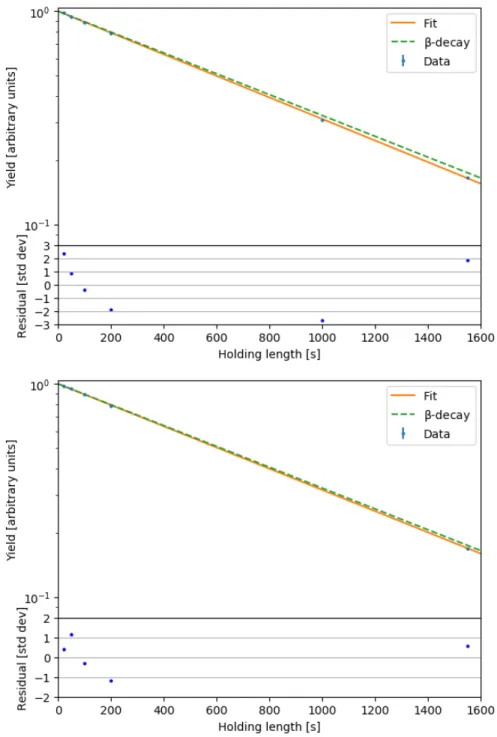
As explained at the beginning of this section, any correction to the extracted lifetime due to loss of depolarized UCN must be strictly nonnegative. The fit shown used the model from equation 4.6, but the fit parameters were extracted using only lifetimes measured with 𝐵 >0.5 mT.
![Figure 4.6: Measured lifetimes of UCN in the trap as a function of the magnetic holding field [26]](https://thumb-ap.123doks.com/thumbv2/123dok/10402555.0/167.918.194.719.268.979/figure-measured-lifetimes-ucn-function-magnetic-holding-field.webp)
Insufficient cleaning of quasi-bound UCN
The difference between 𝜅pure and 𝜏 was the estimate of the difference in lifetime extracted due to insufficiently purified nearly bound UCN escaping the trap. Therefore, the systematic uncertainty of the extracted lifetime due to insufficient purification of the quasi-bound UCN was reported as +0.10 s.
Vibrational heating of UCN
Vibrational heating did not cause any UCN to escape the trap during the holding process. As explained at the beginning of this section, any correction to the extracted lifetime due to vibrationally heated UCN escaping the trap must have been strictly non-negative.
Summary of systematic effects
A conservative estimate of 0.08±0.02 s of the correction to the extracted lifetime due to vibrational heating of the UCN was established by summing the two estimates. Therefore, the systematic uncertainty of the extracted lifetime due to vibrational heating of the UCN was reported to be +0.08 s.
Implications of this measurement
During a typical run from the 2020 run cycle, there was approximately 106UCN in the buffer volume at the end of the fill process. A new method has been realized to use this UCN to reduce the uncertainty of the estimates of the number of UCN loaded into the trap.
![Figure 4.8: History of measurements of the neutron lifetime [1, 5–27]. Inset: mod- mod-ern measurements of the neutron lifetime, as well as the current global averages for lifetimes measured using the beam and bottle methods](https://thumb-ap.123doks.com/thumbv2/123dok/10402555.0/178.918.168.751.282.680/history-measurements-lifetime-measurements-lifetime-averages-lifetimes-measured.webp)
The future of UCN 𝜏
Introduction
It is expected that after analyzing all data from the UCN𝜏 experiment, a combined lifetime with a total uncertainty of between 0.20 and 0.25 s will be extracted. The next generation version of the UCN𝜏 experiment must have significant upgrades to collect sufficient data to measure the lifetime with an uncertainty of ≤ 0.1 s in a reasonable time.
Increasing the production of UCN
One way to rapidly increase the size of the data set by 10× would be to increase the number of UCN produced by the UCN source. If this proposed next generation UCN source can be built and the 1000× increase in UCN production can be achieved, then measurement of the neutron lifetime to within a total uncertainty of 0.10 s will certainly be achieved.
![Figure 5.1: A model of the proposed next-generation UCN source [57]. Three extraction geometries were studied and the “horizontal near-foil” geometry was chosen in order to maximize the production of usable UCN while minimizing engineering constraints](https://thumb-ap.123doks.com/thumbv2/123dok/10402555.0/181.918.260.660.569.855/generation-extraction-geometries-horizontal-production-minimizing-engineering-constraints.webp)
Using the buffer volume as a normalization monitor
Using the UCN remaining in the buffer volume at the end of the priming process as a normalization monitor should significantly reduce the uncertainty of the normalization estimates. Neither of the two normalization monitors installed on the buffer volume during the 2018 run cycle could have counted all of the UCN in the buffer volume.
Improving transport of UCN from the buffer volume to the trap
A new method of transporting UCN from the buffer volume to the trap was proposed. The buffer volume would then be withdrawn from the trap and the cleanup process would begin.
Next-generation primary detector
The PE velocity in the primary detector with LYSO:Ce dropped to PE velocities close to the background PE velocity within 1𝜇s, which would significantly reduce the number of UCN-to-UCN interactions in the primary detector, even if the maximum rate at which UCN would have been counted increased significantly. Another feature that could be implemented in a next-generation version of the primary detector is pixelization of the active surface.
![Figure 5.4: Distributions for times that PEs are observed during a UCN event for primary detectors built with two different scintillating materials [59]](https://thumb-ap.123doks.com/thumbv2/123dok/10402555.0/187.918.169.747.97.493/figure-distributions-observed-primary-detectors-different-scintillating-materials.webp)
High-precision measurements of magnetic fields in the trap
Magnetic field models that more closely resemble the actual magnetic fields in the trap would improve the accuracy of simulations of UCN trajectories in the trap. Moreover, these magnetic field models can improve simulations that study the possibility that UCN can be depolarized in the trap.
Direct measurement of depolarized UCN
These improvements could further improve the understanding of UCN trajectories in the trap, and could also improve Monte Carlo estimates for the rates at which inadequately cleaned quasi-bonded UCN and vibrationally heated UCN escape from the trap . Instead, an optical camera was mounted above the trap to observe the scintillator at the bottom of the trap and look for flashes of light.
![Figure 5.6: A CAD drawing of how an optical camera could be mounted outside of the vacuum jacket [61]](https://thumb-ap.123doks.com/thumbv2/123dok/10402555.0/190.918.163.754.110.399/figure-drawing-optical-camera-mounted-outside-vacuum-jacket.webp)
Conclusion
All UCNs are counted exactly 70 seconds after the start of the unloading process, and UCN counting is completely efficient. Monte Carlo simulations are modeled after the simplified version of the UCN experiment described at the beginning of this appendix.
![Figure 1.4: History of measurements of the neutron lifetime [1, 5–27]. Inset: mod- mod-ern measurements of the neutron lifetime, as well as the current global averages for lifetimes measured using the beam and bottle methods](https://thumb-ap.123doks.com/thumbv2/123dok/10402555.0/37.918.168.752.110.522/history-measurements-lifetime-measurements-lifetime-averages-lifetimes-measured.webp)
![Figure 1.5: The relationship between the current global averages for measurements of 𝜏, 𝜆, and certain components of the CKM matrix [1]](https://thumb-ap.123doks.com/thumbv2/123dok/10402555.0/38.918.259.656.108.396/figure-relationship-current-global-averages-measurements-certain-components.webp)
![Figure 2.6: A CAD drawing of the coils that generate the magnetic holding field that surrounds the trap [37]](https://thumb-ap.123doks.com/thumbv2/123dok/10402555.0/51.918.166.756.108.430/figure-drawing-coils-generate-magnetic-holding-field-surrounds.webp)