Proposed to fulfill one of the requirements for the S1 degree in the English education program of the Department of Language and Arts Education, Faculty of Education and Training, University of Jember. Compiled to fulfill one of the requirements for obtaining the S1 diploma in the English education program of the Department of Language and Arts Education of the Faculty of No. The thesis was approved and accepted by the examination board of the Faculty of Education of the University of Jember.
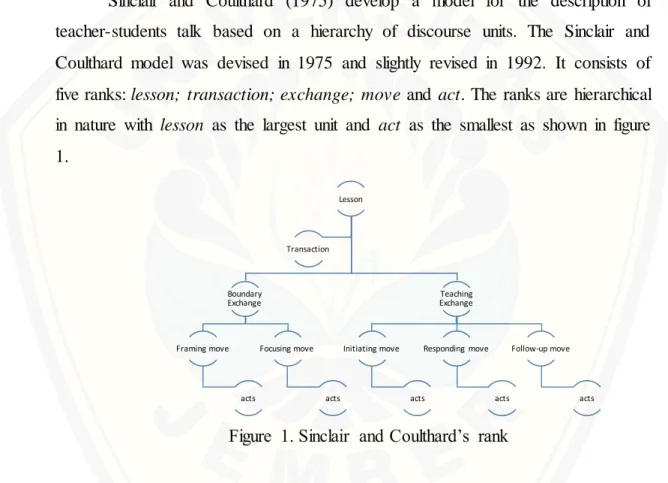
The teachers from the English education program who have taught and given me a lot of knowledge;. Discourse in the language classroom is a matter of oral use of language in classrooms. The purpose of the research was to identify the types of questions provided by the English teacher and describe the interaction patterns between teacher and students in the EFL class based on the descriptive framework proposed by Sinclair and Coulthard (1975).
The research area was SMAN 2 Lumajang which was purposefully selected by the researcher. The participant of this study was a teacher together with their students in EFL class in SMAN 2 Lumajang.
INTRODUCTION
The Problem of The Research
How patterns of teacher-student interactions take place in the EFL classroom based on the framework proposed by Sinclair and Coulthard (1975). To identify patterns of teacher-student interactions in an EFL classroom based on the descriptive framework proposed by Sinclair and Coulthard (1975)”. Wood (1988, in Myhill) wrote that "the aim of pedagogical questions is to motivate, sustain and direct the thought processes of the learner".
As we can see, the teacher begins the initiation part by addressing a closed known-answer question to Budi in a form of free exchange that evokes movement, to which Budi gives a short answer, “Jakarta” and with the sentence “Yes, that's right ", the teacher gives positive feedback to Budi's answer, followed by a related gesture to another student. Instead of responding with an evaluative sentence, the teacher repeats the student's answer, then asks the same question to another student and proceeds to a bound initiation “The capital of Indonesia. The analysis of the classroom discourse of the teacher's questions in the high school EFL class was the focus of the research.
I have a lot of money because I am rich and I always shop every day. the teacher delivering the material). Now look at the second task. the teacher just read the examples and continued on the next page).
The Objectives of The Research
Research Contribution
- Practical Contribution
- Empirical Contribution
According to the central discussion of teachers' questions in the EFL classroom, this research makes contributions in a number of areas, including practical and empirical contributions. The result of this research helps English teachers to examine classroom behavior in order to improve teaching and learning activities and make them more effective. Moreover, this research stimulates teachers to improve and explore their teaching behavior in general aspects of the provision of teaching and learning materials, but especially to give more variety in asking questions to their students.
This study is also expected to enrich the awareness of English teachers, especially in providing questions to their students. The result of this research is likely to attract future researchers, especially for those who are interested in conducting a classroom research. This study also provides information on types of teachers' questions in the EFL classroom and also provides information on the analysis of teacher-student interaction patterns in the classroom.
REVIEW OF RELATED LITERATURE
Conceptual Framework
- Discourse Analysis
- Spoken Discourse
- Classroom Discourse
- Types of Classroom Discourse
- Questioning
- Teacher Talk and Giving Feedback
- Benefits of Analyzing Classroom Discourse
- Sinclair and Coulthard’s (1975) IRF Model of Analysis
- Procedures of Analysis Using IRF Framework
Previous Research Review
The previous research was done by Ermawati (2012) studied about the analysis of classroom interaction, focusing on the analysis of the teacher's feedback on the students' descriptive text writing and the students' attitude towards the feedback given. The result showed that there was variation, sharing and use of a variety of discourse acts among the students, although the teacher was rather dominant in the classroom interaction. However, the study of interaction in the classroom during the analysis of the teacher's questions, which focuses on the IRF exchanges, has not been studied intensively.
Therefore, it is necessary to carry out this research which focuses on an analysis of the questions of an English language teacher in the classroom interaction in secondary school.
CONTEXT
Research Context
- Teacher’s Questions
- IRF Framework by Sinclair and Coulthard (1975)
- Acts
According to Ur, teacher questioning serves purposes such as allowing students to present their ideas, test their understanding, knowledge or skills, engage them actively in learning participation, stimulate their their thinking and make them review and practice previously learned material. In this research, the researcher interested in the series of questions, started from the types of questions submitted during the delivery of the materials, and the answers given by the students based on the teacher's questions, and ended with the teacher's follow-up on the students' answers. The framework starts from the way the teacher opens the exchange and marks a new phase of the activity with some discourse markers, for example "so".
Feedback often includes some type of evaluation such as good, right, okay (Sinclair & Coulthard 1975:36). For example, the function of the informative act was to provide information, the nominative act was to call or give permission to the learner to contribute to the discourse, the eliciting act required a linguistic response, while the directive act was to request a non-linguistic response. (Sinclair and Coulthard, 1992:9). The researcher observed all the actions related to the questioning interaction carried out by the teacher and the students in the classroom.
The interaction was recorded and then transcribed by arranging the transaction and giving certain notations of the actions.
Area Determination Method
Participant Determination Method
Data Collection Method
- Observation
- Interview
Data Analysis Method
Based on the research result of data analysis discussed and interpreted in Chapter 4, it can be concluded that the interaction patterns between teacher and students in the XI MIPA 4 were identified using 8 exchanges and 30 IRF frameworks developed by Sinclair and Coulthard was proposed (1975). It was shown that the English teacher had already given more opportunities to the students to participate in the classroom interaction by providing various types of questions. Paper presented at OECD/CERI International Conference: Learning in the 21st Century: Research, Innovation and Policy.
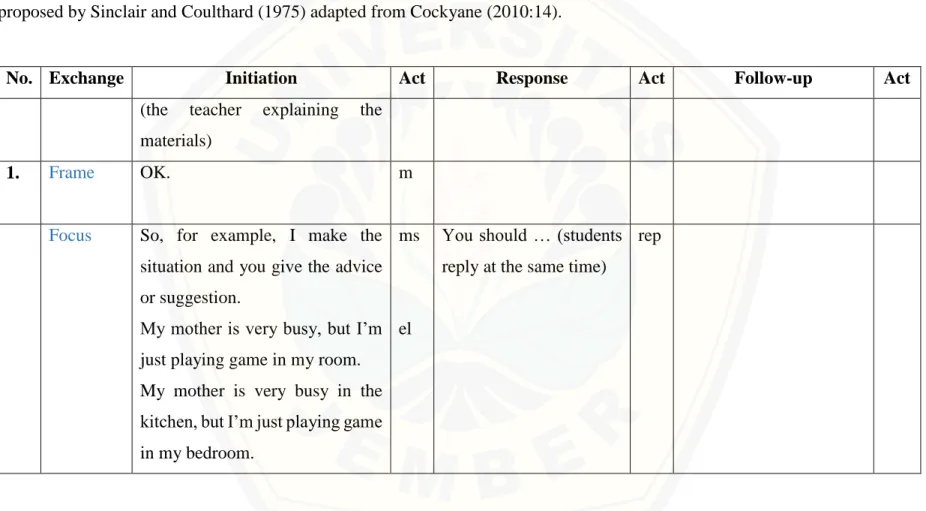
My mother is very busy in the kitchen, but I just play in my bedroom. students answer at the same time). How about giving some money to someone who is poor. p You better earn your money. Exchange Initiation Act Response Act Follow-up Act You had better use. your money to build the mosque. rep You'd better use your money to build a mosque.
Exchange Initiation Act Response Act Follow-up Act T elicit For picture one, the question, see. Exchange Implementation Act Reaction Act Follow-up Act What about sleeping. earlier in the night so you are not sleepy. The Exchange Initiation Act The Response Act The Follow-up Act T directly But before, read the dialogue first.
No. Exchange Initiation Act Reaction Act Follow-up Action Time - Classroom. discussion) T elicit You'd better choose one. If it's still morning, the students are still fresh, they can answer my questions quickly, and many of them raise their hands. But if it's the afternoon in the 8, 9, 100 periods, it will be harder for the students to understand what I mean.
My mother is very busy in the kitchen, but I am playing in my bedroom.
REFLECTION ON THE IMPLEMENTATION
The Result of Observation
The Result of Interview
Critical Evaluation of the Research Findings
Pedagogical Implication of Result
CONCLUSION
Types of Acts by Sinclair and Coulthard (1975)
Table Analysis of Questioning Exchange
The Result of Interview
Six Types of Questions based on Benjamin Bloom
The Analysis Result of Types of Questions
Documentation