Thesis by
Vanessa D. Jonsson
In Partial Fulfillment of the Requirements for the Degree of
Doctor of Philosophy
California Institute of Technology Pasadena, California
2016
(Defended July 10, 2015)
ii
c 2016 Vanessa D. Jonsson All Rights Reserved
For my mother, Ana Maria.
iv
Acknowledgments
I am humbled by the support of my main advisor Richard Murray, who was the principal reason for my success through the relatively daunting yet extraordinary experience of my graduate research. He provided an incredible amount of intellectual freedom and support to pursue my own ideas and research projects, despite their tangential association to his own objectives. His intellectual enthusiasm, integrity and ability to excel at the highest levels in multiple areas of engineering and science has been the inspiration to push the limits of my own knowledge while having strong personal principles as a researcher. I am indebted to my second advisor, David Baltimore, for giving me the immense opportunity to work in his lab five years ago, despite my lack of experience in experimental biology, and in particular with live HIV. His belief in my capabilities, support and enthusiasm for my research project catapulted my understanding of the power and limitations of engineering techniques in the application to biomedical problems. This total immersion among experts in virology and immunology was an incredibly unique and humbling experience. I would like thank Pamela Bjorkman, whose invaluable advice and support was critical to the success of several of my research projects. Her open-mindedness and willingness to support my research ideas was a constant source of encouragement and validation. I am indebted to her for providing such a welcoming environment. I also wish to thank John Doyle for his constant support throughout my graduate studies and beyond and for continually challenging and supporting me in the most difficult of times.
One of the professors that was most influential in the earlier years of my graduate research was Rob Phillips, who opened up a new world of physical biology for me.
This eventually led me to connect concepts from equilibrium thermodynamics to the
dynamics of evolution. I am grateful for his commitment to excellent teaching. I am also thankful to Christopher Snow and Justin Bois, who provided useful guidance in the areas of computational chemistry and equilibrium thermodynamics. I am indebted to my collaborators Anders Rantzer and Nikolai Matni, whose help was invaluable in the development of the control theoretic algorithms in this thesis. I would like to thank Anthony West who served as an informal advisor and whose knowledge of the structural biology of HIV antibodies was central in my progress and understanding.
I am thankful for all the support of my former colleagues in both the Baltimore and Bjorkman labs who provided immense technical support and mentoring. I appreciate the help of Alex Sigal who initially took me under his wing and showed me how to navigate HIV tissue culture. I am indebted to Collin Kieffer, who provided technical guidance and help with advanced HIV protocols and to Michael Bethune for his help and advice on experimental design and molecular biology protocols. I am thankful for the helpful discussions with Ron Diskin, Louise Scharf, Jennifer Keeffe, and the support from Geoffrey Lovely, Rachel Galimidi, Jocelyn Kim and Stella Ouyang. I am grateful for my colleagues in the Murray group who have provided useful insight and been supportive throughout the years. I thank Mark E. Davis at Caltech, for his supportive mentoring and encouragement to avidly pursue my research ideas.
Finally, this journey would not have been possible without the endless support of my wonderful family, my mother Ana Maria and father Russell, my stepmother Patricia and my brother Russell. Above all, I want to thank my partner and best friend Nikolai for his unwavering support – every moment of this journey was made better with you by my side.
vi
Contents
Acknowledgments iv
Abstract ix
1 Introduction 1
1.1 Background and Motivation . . . 1
1.2 Prior Work . . . 5
1.3 Thesis Contribution and Outline . . . 6
2 Evolutionary Dynamics on Computationally Derived Fitness Land- scapes 9 2.1 Introduction . . . 9
2.2 Results . . . 10
2.2.1 Statistical inference to uncover resistance phenotypes . . . 10
2.2.2 Gibbs Energy Landscapes Correlate With Known Escape Mu- tations . . . 14
2.2.3 Hill Functions Relate Gibbs Landscapes And Dynamical Sys- tems Parameters . . . 17
2.2.4 Evolutionary Dynamics on Quantifiable HIV-1 Fitness Land- scapes . . . 20
2.3 Discussion . . . 24
2.4 Materials and Methods . . . 25
2.4.1 Mathematical Models . . . 25
2.4.2 Model Implementation and Simulations . . . 28
2.4.3 Experimental Methods . . . 29
2.5 Appendix . . . 32
3 Robust Control of Evolutionary Dynamics 35 3.1 Introduction . . . 35
3.2 Problem Formulation . . . 37
3.2.1 Notation . . . 37
3.2.2 Evolutionary dynamics model . . . 38
3.2.3 The Hill equation . . . 39
3.2.4 State space representation . . . 40
3.2.5 Control of positive systems . . . 40
3.3 Static state feedback strategies for combination therapy usingH∞control 42 3.3.1 The bounded real lemma for internally positive systems . . . 42
3.3.2 Initializing stabilizing controller . . . 43
3.3.3 An H∞ combination therapy controller . . . 44
3.4 Static state feedback strategies for combination therapy for large-scale systems . . . 46
3.4.1 Controller synthesis by linear programming . . . 46
3.4.2 Regularization for structured controller synthesis . . . 48
3.4.3 A scalableL1 combination therapy controller . . . 48
3.5 Feedback strategies for combination therapy for large scale systems with nonlinear pharmacodynamics . . . 51
3.5.1 Pharmacodynamic models . . . 52
3.5.2 Piecewise linear mode approximations and mode reduction . . 54
3.5.3 A static state feedback combination therapy algorithm for non- linear pharmacodynamics . . . 58
4 Engineering Antibody Treatment Strategies to Control HIV 60 4.1 Introduction . . . 60
4.2 Mathematical Simulations . . . 61
4.2.1 Model parameters . . . 61
viii
4.2.2 Controller synthesis . . . 63
4.3 Preliminary Experimental Results . . . 69
4.3.1 Abstract . . . 69
4.3.2 Introduction . . . 69
4.3.3 Results . . . 70
4.3.4 Materials and Methods . . . 74
4.3.5 Appendix . . . 78
5 Summary and Future Directions 81
Bibliography 85
Abstract
The application of principles from evolutionary biology has long been used to gain new insights into the progression and clinical control of both infectious diseases and neo- plasms. This iterative evolutionary process consists of expansion, diversification and selection within an adaptive landscape — species are subject to random genetic or epi- genetic alterations that result in variations; genetic information is inherited through asexual reproduction and strong selective pressures such as therapeutic intervention can lead to the adaptation and expansion of resistant variants. These principles lie at the center of modern evolutionary synthesis and constitute the primary reasons for the development of resistance and therapeutic failure, but also provide a framework that allows for more effective control.
A model system for studying the evolution of resistance and control of therapeutic failure is the treatment of chronic HIV-1 infection by broadly neutralizing antibody (bNAb) therapy. A relatively recent discovery is that a minority of HIV-infected individuals can produce broadly neutralizing antibodies, that is, antibodies that in- hibit infection by many strains of HIV. Passive transfer of human antibodies for the prevention and treatment of HIV-1 infection is increasingly being considered as an alternative to a conventional vaccine. However, recent evolution studies have uncov- ered that antibody treatment can exert selective pressure on virus that results in the rapid evolution of resistance. In certain cases, complete resistance to an antibody is conferred with a single amino acid substitution on the viral envelope of HIV.
The challenges in uncovering resistance mechanisms and designing effective com- bination strategies to control evolutionary processes and prevent therapeutic failure apply more broadly. We are motivated by two questions:
x
• Can we predict the evolution to resistance by characterizing genetic alterations that contribute to modified phenotypic fitness?
• Given an evolutionary landscape and a set of candidate therapies, can we com- putationally synthesize treatment strategies that control evolution to resistance?
To address the first question, we propose a mathematical framework to reason about evolutionary dynamics of HIV from computationally derived Gibbs energy fitness landscapes — expanding the theoretical concept of an evolutionary landscape orig- inally conceived by Sewall Wright to a computable, quantifiable, multidimensional, structurally defined fitness surface upon which to study complex HIV evolutionary outcomes.
To design combination treatment strategies that control evolution to resistance, we propose a methodology that solves for optimal combinations and concentrations of candidate therapies, and allows for the ability to quantifiably explore tradeoffs in treatment design, such as limiting the number of candidate therapies in the combi- nation, dosage constraints and robustness to error. Our algorithm is based on the application of recent results in optimal control to an HIV evolutionary dynamics model and is constructed from experimentally derived antibody resistant phenotypes and their single antibody pharmacodynamics. This method represents a first step towards integrating principled engineering techniques with an experimentally based mathematical model in the rational design of combination treatment strategies and offers predictive understanding of the effects of combination therapies of evolutionary dynamics and resistance of HIV. Preliminary in vitro studies suggest that the com- bination antibody therapies predicted by our algorithm can neutralize heterogeneous viral populations despite containing resistant mutations.
Chapter 1 Introduction
“The power of Selection, whether exercised by man or brought into play under nature through the struggle for existence and the consequent survival of the fittest, absolutely depends on the variability of organic beings. Without variability, nothing can be ef- fected; slight individual differences, however, suffice for the work, and are probably the chief or sole means in the production of new species." - Charles Darwin, 1868.
1.1 Background and Motivation
The modern synthesis. The core of current evolutionary theory was forged seventy years after Charles Darwin’s On the Origin of Species [20], when statisticians and geneticists began laying the foundation for what is now called the ‘modern synthesis’.
This allowed the process of evolution to be described mathematically as the change in frequencies of genetic traits in a population over time, uniting Darwin’s concept of natural selection with a newly formed field of Mendelian genetics [30, 33, 103]. This theoretical foundation and its corresponding quantitative methods provided support to better understand the tenets of evolutionary theory — that variation arises through random genetic mutation, is inherited by offspring and these together with natural selection leads to adaptation and speciation.
Evolutionary biologists have since expanded upon the modern synthesis frame- work, drawing concepts and methods from other fields. The discovery of DNA as the material foundation for the encoding and the hereditary transmission of genetic
2
information, became the driving force of evolutionary theory. It transformed the no- tion that selection was associated with phenotypic trait variation to being a function of variations driven by genetic mutations. Since then, genetic mapping for numerous phenotypic adaptations across multiple organisms have been established — such as the evolution of influenza virus resistance to antivirals [80], the adaptation of wing shape in [74] and the genetic basis resistance of malaria in humans [34, 39].
Evolution and disease. More recently, the application of evolutionary concepts has been extended to the study of both infectious and neoplastic disease, giving new in- sights into their progression and clinical control [62, 71, 72]. The underlying processes are equivalent to other evolutionary models — cells or virus are subject to random genetic mutation that result in variations; genetic information is inherited through asexual reproduction and strong selective pressures such as therapeutic intervention can lead to the adaptation and expansion of resistant variants. Genetic instability of neoplasms drives single base sequence changes, chromosomal rearrangements and gene fusion, and these can confer a selective advantage when the resulting phenotype exhibits both a proliferative advantage and a defect in DNA repair [55]. Non-genetic adaptation and phenotypic plasticity can be induced via oncogene inhibition, enabling the survival in cancer cells during initial therapy and thereby promoting residual dis- ease. Recent studies in EGFR mutant lung adenocarcinoma reveal that NF-κB sig- naling is rapidly engaged upon initial EGFR inhibitor treatment to promote tumor cell survival [7].
The 1987 FDA approval of azidothymidine (AZT), a nucleoside analog reverse- transcriptase inhibitor (NRTI) for the treatment of chronic HIV infection, was one of the first signs of therapeutic promise in the treatment of chronic human immunod- eficiency virus type 1 (HIV-1) infection — this treatment significantly reduced viral replication in patients and led to clinical improvements [29]. However, the ability of HIV to rapidly evolve drug resistance was soon observed in patients treated with AZT— the genetic basis for their resistance was explained with the existence of three amino acid substitutions in the reverse transcription gene [50]. It was not until the 1995-1996, that that the subject of resistance was addressed with the development of
a new class of protease inhibitors (PIs) [61], that when combined with two NRTIs, introduced the concept of highly active antiretroviral therapy (HAART). The treat- ment of chronic HIV infection with HAART is considered one of the great successes of modern medicine in that it radically changed clinical outcomes successfully reducing both patient viral loads to virtually “undetectable" levels, transforming HIV from a fatal disease to one that is a manageable chronic illness [18].
The success of antiretroviral combination therapy in controlling evolution of HIV has provided insight into how the evolutionary processes of other disease models could be controlled for progression and management of therapeutic resistance [4, 94, 99].
With the recent introduction of targeted therapies for the treatment of certain cancers [36], new questions surrounding the effectiveness of tailoring treatments to an individ- ual patient’s tumor and its implications with respect to the emergence of driver mu- tations and resistant phenotypes are being raised. Specifically, these small molecule inhibitors and monoclonal antibodies exploit particular genetic addictions and vulner- abilities of cancer cells, establishing an environment in which the occurrence of mildly drug resistant cells can develop an evolutionary advantage over those for which the therapy is targeted [23, 27, 41, 97]. Clonal expansion of these evolutionary advan- tageous cells is exacerbated by the presence of considerable genetic intra-tumor het- erogeneity already present in treatment-naive patients, contributing to resistance and the need for principled approaches to the design of combination targeted treatment strategies.
Toward a Principled Design of Treatment Strategies. These disease models illustrate more generally the challenges in uncovering resistance mechanisms and de- signing effective combination strategies to control evolutionary processes that lead to resistance. Similar evolutionary processes are involved in the context of HIV-1 and selection of resistant mutants with respect to broadly neutralizing antibody (bNAb) therapy. In this thesis, we focus our attention to this particular application, but the mathematical techniques that we propose are relevant to other infectious and non-infectious diseases where growth, mutation and selection are central.
Recent evolution studies on HIV-1 have uncovered that bNAb monotherapy can
4
exert selective pressure on virus resulting in the rapid appearance and evolution of resistant mutant viral population [22, 47, 100]. In certain cases, complete resistance to a bNAb is conferred with a single amino acid substitution on the viral envelope (Env). To address HIV evolution in this context, combination bNAb therapy has been proposed and shown to effectively control infection and suppress viral loads below detection in murine models [22, 47, 100].
Advances in the identification and engineering of anti-HIV-1 antibodies have pro- duced a large set of detailed molecular structures and neutralization data generated against a broad panel of HIV-1 strains. Can we computationally predict evolution to resistance by characterizing genetic alterations that contribute to modified phe- notypic fitness? To address this question, we propose a computational model to reason about evolutionary dynamics of HIV from computationally derived fitness landscapes—linking the notion of genotype to phenotype in a quantifiable manner.
The second question we ask is, given a fitness landscape and a set of candidate therapies, can we computationally synthesize treatment strategies and control evo- lution? The rational design of combination antibody therapies for HIV treatment involves the exploration of a large mutational space in the context of an ever growing number of candidate antibodies — experimentally screening their combinations and concentrations to effectively control evolution to resistance becomes increasingly in- feasible. To address this, we require a scalable methodology that can take into account increasing amounts of HIV/bNAb resistance data, bNAb pharmacodynamic models and HIV mutational dynamics. To this end we propose a scalable and computation- ally tractable algorithm that solves for optimal combinations and concentrations of bNAbs to neutralize virus in light of viral evolution while simultaneously allowing the designer to tailor treatment strategies in light of viral composition, maximum achievable doses, number of bNAbs used and ability to support pharmacodynam- ics/pharmacokinetic fluctuations, modeling and experimental error.
We briefly discuss prior computational work in addressing this problem, and follow with the thesis outline and contributions.
1.2 Prior Work
Mathematical approaches. There have been numerous attempts to address evo- lution of resistance with respect to therapeutic intervention from a mathematical perspective within multiple disease contexts. Many computational results address evolution to resistance by employing analytic methods and/or simulations on small scale stochastic evolutionary dynamics models. The Michor lab [63] recently showed the effects of different erlotinib dosing strategies in the presence of pharmacokinetic fluctuations on the evolution of resistance of non small cell lung cancer through simu- lations of a stochastic evolutionary dynamics model. To address tumor heterogeneity by rational combination therapy design, Zhao et al. [105], propose a static multi- objective optimization formulation that is agnostic to evolutionary dynamics but that models the effectiveness of independently acting, additive drugs on different initial tumor populations. Proposed combination treatments were confirmed experimentally for different tumor initial conditions in a murine lymphoma model [106].
The first models describing evolutionary processes in the context of HIV, were inspired largely in part by Manfred Eigen’s original quasi species model [26] and have since been proposed to study evolution, antigenic drift [70, 71]. Recent results by Rosenbloom et al. [87], show that simulations of an evolutionary dynamics model of HIV infection subject to changes in antiretroviral dynamics due to adherence are consistent with clinical studies.
Control theoretic approaches. The challenge of designing treatment protocols that prevent escape is one that has been addressed by control theoretic methods. For cancer therapy, results in this spirit apply methods from optimal and receding horizon control [3, 16], as well as gain scheduling [2], to synthesize treatment protocols that are robust to parameter uncertainty, an inherent issue in all biological systems. In the context of HIV and antiretroviral therapy, Hernandez-Vargas et al. [25] propose a discrete time formulation that allows for the design of switching therapy strategies to delay the emergence of highly resistant mutant viruses. There have been several attempts as well to address nonlinear HIV infection dynamics using model predic-
6
tive control (MPC) to design optimal antiretroviral drug dosing strategies [56, 108].
Recent results in [84] and [8] consider a simplified bilinear model and the optimal control problem is shown to be convex over a finite horizon for a predefined set of initial states.
1.3 Thesis Contribution and Outline
In this thesis, we explore two questions in the evolutionary biology of disease: Can we predict the evolution to resistance by characterizing genetic alterations that contribute to modified phenotypic fitness? Given a fitness landscape and a set of candidate ther- apies, can we computationally synthesize treatment strategies and control evolution?
We focus our application to the antibody treatment of chronic HIV infection, but the mathematical techniques that we propose are relevant to other infectious and non- infectious diseases. Many of the contributions of the following chapters are based on a number of publications [42, 43, 44], indicated below.
Chapter 2: Evolutionary Dynamics on Computationally Derived Fitness Landscapes. We propose a computational model to reason about evolutionary dy- namics of HIV on computationally derived fitness landscapes. Our approach combines well-utilized HIV dynamical systems models, incorporates infection and antibody neu- tralization dynamics, a mutation process, and a method that uses energy minimization calculations on structural information to quantify fitness differences between sensitive and resistant strains. Specifically:
1. We propose and develop an extension of the least absolute shrinkage and selec- tion operator (LASSO) to identify mutational phenotypes and uncover potential escape mutants from neutralizing anti HIV antibodies.
2. We develop a biophysical model based on Gibbs free energy of binding derived from energy minimization calculations on structural information to quantify fitness differences between sensitive and resistant HIV strains.
3. We develop an HIV evolutionary dynamics model to include infection and neu- tralization reaction rates based on computed Gibbs energy fitness landscapes.
Chapter 3: Robust Control of Evolutionary Dynamics. Chapter 3 presents three algorithms for the principled design of targeted combination drug treatment strategies that explicitly account for the evolutionary dynamics of a generic disease model, where the drugs under consideration are non-interacting and exhibit inde- pendent additive effects. These algorithms allow the designer to quantifiably explore tradeoffs between number of therapies used (controller sparsity), therapy concentra- tions (magnitude of the gain) and ability to support pharmacokinetic fluctuations (robustness to perturbations). Our contribution specifically is itemized below.
1. Our first algorithm proposes a general iterative method that uses an H∞robust control approach to design targeted combination therapy concentrations and is effective in generating robustly stabilizing controllers.
2. Our second algorithm addresses large scale systems concerns lacking in the first algorithm, presenting a scalable solution to the combination therapy problem by reformulating it as a second order cone program (SOCP), with robustness guarantees addressed by minimization of the induced L1 norm.
3. Our third algorithm solves the combination therapy problem subject to the same design constraints (sparsity of the drug combination, maximum dosage and robustness constraints) formulated as an SOCP while addressing the nonlinear dynamics of individual drugs and of their combinations.
Chapter 4: Engineering Antibody Treatment Strategies to Control HIV.
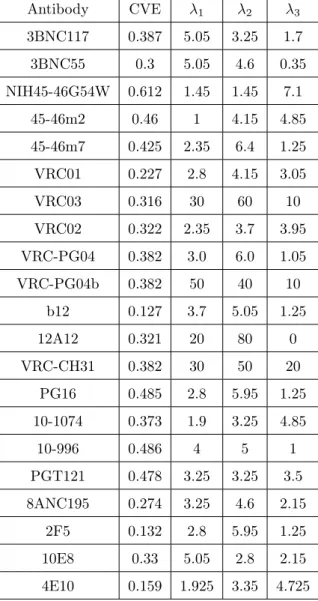
We demonstrate our ability to control the evolution to resistance of HIV in the pres- ence of antibody therapy, through the application of the combination therapy algo- rithms developed in Chapter 3 as applied to experimental data derived from recent published studies [14, 22, 47]. We also discuss a preliminary in vitro experimental methodology and results and show that the antibody treatment strategies synthesized with the nonlinear pharmacodynamics combination therapy algorithm described in
8
EXPERIMENTAL+BIOLOGY+
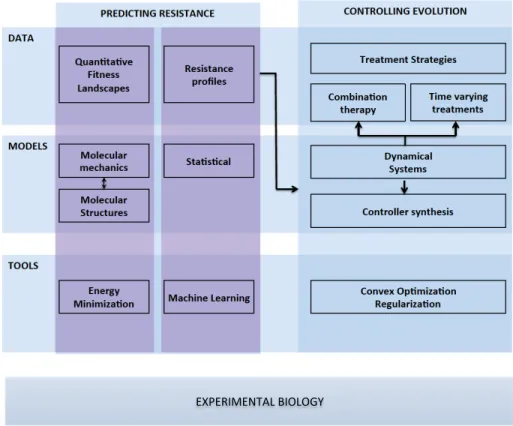
Figure 1.1: Overview of the data, mathematical models and tools used in this thesis.
Section 3.5.3 controls infection despite the presence of a mixed initial population of viruses, most of which are resistant to at least one antibody in the mix. Specifically:
1. We synthesize combination treatments and compare the respective H∞ and the L1 combination therapy algorithms with respect to their performance and robustness to biologically relevant uncertainty models and unmodeled dynamics.
2. We develop a high throughputin vitro experimental system to identify the repli- cation and neutralization properties of HIV mutants and populate parameters for our dynamical systems model, as well as test our predicted bNAb combina- tion therapies.
3. We demonstrate successful in vitro validation of our computationally predicted bNAb combinations on heterogeneous viral populations comprised of resistant mutants.
Chapter 2
Evolutionary Dynamics on
Computationally Derived Fitness Landscapes
2.1 Introduction
In evolutionary biology, the concept of fitness landscape serves to associate geno- type to some measure of fitness, or phenotype. With the growing number of detailed molecular structures and recent advances in modeling and computational approaches, genotype-phenotype relationships are now being quantified and generated in an au- tomated way. Thus, fitness landscapes are transitioning from a concept used for visualization of fitness distributions, to computable, quantifiable, multidimensional fitness surfaces upon which to study complex evolutionary outcomes.
Recent pre-clinical and clinical studies recently demonstrated that HIV can escape from antibody mono therapy, and in some cases, combination therapy [14, 37, 47, 95].
In this chapter, we develop a computational framework that explains these observa- tions and predicts the likelihood of certain resistant mutants in the presence of anti- body mono therapy. Our method uses energy minimization calculations on structural information and statistical inference on antibody neutralization data to quantify fit- ness differences between sensitive and resistant strains and incorporates this data into an HIV dynamical systems model of infection, mutation and antibody neutralization.
We show that our evolutionary dynamics simulations on computationally generated
10
HIV fitness landscapes have reasonable agreement with experimental findings. This represents a first step in modeling and predicting HIV escape from antibody therapy but has a broader application in evolutionary dynamics settings where a quantitative relationship between genotype and evolutionary fitness can be established.
The chapter is organized as follows: in Section 2.2.1, we propose a statistical in- ference method to uncover correlations between HIV-1 viral envelope (Env) sequence data and antibody neutralization data. In Section 2.2.2, we compute HIV-1 fitness landscapes using energy minimization techniques and argue that quantifying changes to both infection and neutralization due to mutations are equally important aspects in the study of HIV evolution to antibody resistance. In Sections 2.2.2 and 2.2.3, we derive generalized Hill equations to express bound gp160/CD4 and gp160/antibody as a function of the differences in Gibbs free energy of binding due to point mutations.
Section 2.2.4 connects preceding work by incorporating computed fitness landscapes into a stochastic HIV evolutionary dynamical systems model of infection, mutation and antibody neutralization and illustrates the applicability of these methods for the prediction of resistance dynamics in light of antibody monotherapy for HIV.
2.2 Results
2.2.1 Statistical inference to uncover resistance phenotypes
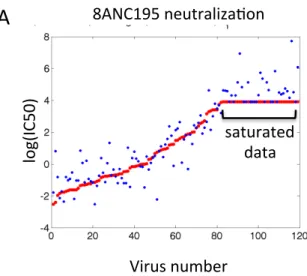
We developed a statistical model and used this to uncover correlations between HIV-1 envelope (Env) sequence data and antibody neutralization data. In order to obtain a model that could explain antibody neutralization data with a minimal set of residues while taking into account irregularity in the experimental data set corresponding to the limit of neutralization assays (Figure 2.1), we extended the well known least absolute shrinkage and selection operator (Lasso) [98]. Our model, the saturated Lasso (satlasso), returns a set of amino acid residues and their Env sequence loca- tion that explains antibody neutralization data by minimizing error between model and experimental data, penalizing large models, and appropriately weighing errors
corresponding to saturated experimental data. A mathematical description of the model can be found in Section 2.4.1. Model selection is performed with 5-fold cross validation [79].
saturated(
data(
8ANC195(neutraliza4on(
Virus(number(
A(
log(IC50)(
Figure 2.1: A. An example of the satlasso estimator as applied to 8ANC195 antibody neutralization data. Saturated data is due to the limit of the neutralization assay and is modeled in Equation (2.6). Red points correspond to experimental data, blue points correspond to the estimated model.
To assess the generalization of our satlasso model, we compare the first six largest magnitude regressors to experimentally derived data sets and find that many Env residues known to be critical to neutralization are identified (Figure 2.2). For the gp120-gp41 bridge antibody 8ANC195, changes in glycosylation at 276, 234 and 230 sites are found to induce large changes in neutralization [91]. Specifically, the intro- duction of a glycan at position 230 in a wild-type YU2 HIV strain, leads to a sixfold increase in IC50, whereas removal of 234 and 276 sites leads to a more substantial increase in IC50 [91, 101]. Our model identifies this epitope and captures the corre- sponding changes in IC50 through the magnitude of each regressor 276++ (-2.79), 234++ (-2.77) and 230++ (1.59) (Figure 2.2).
12
V3##MPER#gp120-gp41## bridge#V2#
CD4#bs#
Figure 2.2: The first six regressors with largest magnitude contributing to neutralization (blue) and resistance (red) for each of CD4 binding site, V2, V3, MPER and gp120-gp41 bridging antibodies in this study, solved with satlasso using 5-fold cross validation. Overlaid boxes correspond to amino acid changes that have been validated experimentally.
For all CD4 binding site antibodies in this study, we find that the existence of a Gly at position 459 is most important for neutralization, confirming previous evolution studies that mutations at position 459 confer resistance in 3BNC117 and NIH-4546- G54W [47, 22]. Our model uncovers that an Arg at position 456 is also significant for neutralization but less so than the site at position 459. Recently, Lynch et al. show that a Trp mutation at position 456 has a modest effect on neutralization by many CD4-bs antibodies with the exception of VRC-PG20 [57].
Functional studies on V3 loop binding antibodies 10-996 and 10-1074 reveal an essential dependence on the N332 associated glycan [66]. Our model identifies this
critical site and shows that the existence of a His or Tyr at position 330 is necessary for neutralization of 10-1074. There is some evidence that the H330Y substitution has no effect on neutralization of either PGT121 and 10-1074 when this mutation was tested on Simian-Human Immunodeficiency Virus, SHIVAD8 [89].
The highly conserved membrane proximal external region (MPER) of the gp41 transmembrane subunit on HIV-1 has recently been linked to epitopes of several broadly neutralizing antibodies 2F5, 10E8 and 4E10 [38, 88, 65]. Alanine scanning, structural and paratope analysis each indicate that 10E8 makes crucial contacts with highly conserved residues W672, F673, W676 and K/R683 [38]. Although our model does not recover these particular contact sites, it does identify a Thr substitution at 671 that is shown to raise IC80 values above 20 µg/ml in otherwise sensitive JR2 virus [38]. For 4E10, our model captures both one epitope site at 671 and a known resistant substitution at 674S [9]. The 2F5 epitope is defined by a linear segment of gp41 residues 662 - 668 with the key binding residues at N664, K665 and Y666 [6, 109]. Our model recovers the crucial binding site at position 665 and two sites on the epitope, E662 and A667 that each confer resistance at the IC90 level with Ala and Gly substitutions respectively [12, 109].
Our results demonstrate that satlasso recovers residues that are critical for neu- tralization and those that contribute to resistance for a large class of anti-HIV-1 antibodies. Despite the fact that substitutions in certain positions can mediate con- formational or other effects within Env that may be best represented by a nonlinear model, some changes in neutralization can nonetheless be captured by this linear regression model.
Recent studies in viral fitness costs associated with escape mutants from the class of CD4-bs antibodies show that viral replicative fitness may be diminished with cer- tain single mutations on the CD4 receptor binding site on gp120 [57], Chapter 4.
This suggests more broadly that evolution to resistance can be viewed as a function of both viral replicative and antibody neutralization fitness. We elaborate this idea in the following section and develop a method that quantifies both aspects of viral fitness and utilizes it to study the evolutionary dynamics of HIV in the presence of
14 antibody monotherapy.
2.2.2 Gibbs Energy Landscapes Correlate With Known Es- cape Mutations
We hypothesize that a virus’ capacity to infect and be neutralized by specific neu- tralizing antibodies (NAbs) can be approximated by differences in Gibbs free energy of binding associated to de novo point mutations on the envelope glycoprotein (Env) complexed with the CD4 receptor and antibody structure. To compute fitness land- scapes relating to viral replication and antibody neutralization, we apply an empirical force field, Fold X [93], to evaluate the effect of point mutations on the stability, fold- ing and dynamics on detailed Env/CD4 and Env/NAb molecular structures.
decreased'fitness'in'the'presence'of'an0body'
A"
C"
B"
increased''an0body'resistance' decreased''infec0vity'
Increased'viral'fitness'in'the'presence'of'an0body'
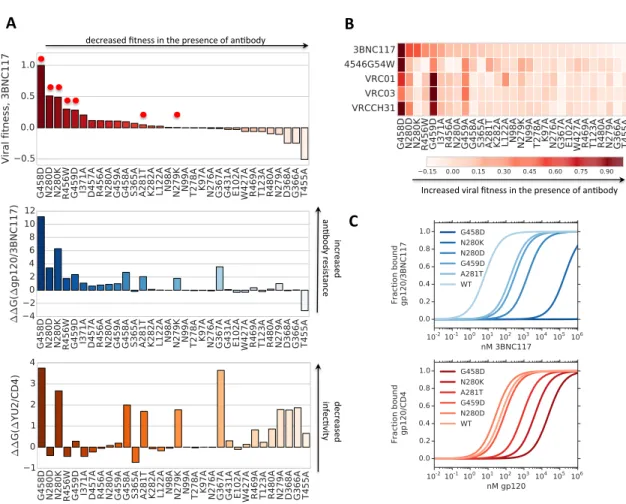
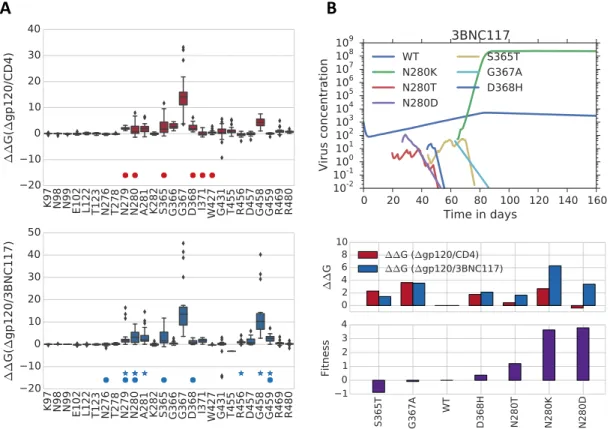
Figure 2.3: A. Gibbs binding energy differences computed between wild type and a subset of gp120 point mutations consisting of alanine substitutions on a subset of 3BCN117 antibody resistant mutations. Viral fitnessF∆gp/N Ab,is computed by Gibbs energy of binding differ- ences between neutralization and infection reactions and normalized with respect to largest value (Equation 2.3) (above). Gibbs energy differences for∆gp120/3BCN117 binding reac- tion (middle) and the ∆gp120/CD4 interaction (below). All mutations are numbered with respect to the HXBC2 reference genome. B. Viral fitness computed as inAfor CD4 binding site antibodies 3BNC117, 4546G54W, VRC01, VRC03, and VRCCH31. C.Fraction bound gp120/3BNC117 and CD4/gp120 as computed with Equations (2.5) using Gibbs energy landscapes for antibody and CD4 binding.
The resulting Gibbs free energy landscape provides an equilibrium thermody- namic representation of the fitness of each point mutant with respect to the following simplified binding reactions for infection and neutralization:
gp +cd4−→ gp·cd4, (2.1)
`+gp−→ `·gp, (2.2)
16
where the HIV membrane glycoprotein gp, binds to the CD4 receptor, denoted cd4, in reaction (2.1), and to antibody ` during neutralization in reaction (2.2).
We compute the difference in Gibbs free energy of binding between mutant and wild type viral glycoprotein gp160,
∆∆G= ∆Gmut−∆Gwt,
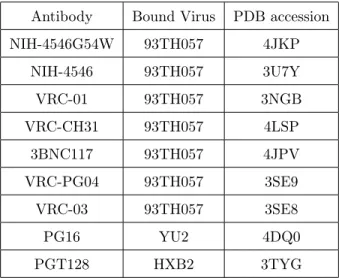
for all point mutations on the solved portions of gp160 in both CD4 and antibody complexes listed in Table 2.2, Section 2.5.
To quantify the effects of mutations on both infection and neutralization, we define viral fitnessF∆gp/N Ab as a function of the cost of the mutation (∆gp) with respect to antibody binding minus its cost with respect to CD4 binding
F∆gp/N Ab= ∆∆G(∆gp/NAb)−∆∆G(∆gp/CD4). (2.3)
To illustrate this measure of viral fitness, we compute binding energy landscapes for CD4 binding site (CD4bs) antibody 3BNC117 using gp120/3BNC117 (PDB ID:
4JPV) and gp120/CD4 (PDB ID: 1G9N) structures and find reasonable agreement between this measure and known resistant mutations in the presence of 3BNC117 [37, 57] (Figure 2.3, A). In particular, we note that the presence of either an Asp at position 458 or an Ala at position 367 decreases binding to both 3BNC117 and to CD4, simultaneously affecting the virus’ ability to infect and to be neutralized by antibody. Binding energy differences between mutations and the CD4 receptor are similar for both G367A and G458D (3.64 kcal/mol and 3.75 kcal/mol) whereas they differ significantly for 3BNC117 binding (3.55 kcal/mol (G367A) and 11.15 kcal/mol (G458D)), suggesting that both mutations could exhibit compromised viral replication but that due to the greater difference in 3BNC117 binding, the Asp mutation at location 458 is more likely to escape 3BNC117 neutralization. This is consistent with our viral fitness calculations and model simulations (Figure 2.5, B) as well as previous experimental validation showing that the Asp mutation at position 458 evolves in the presence of 3BNC117 in murine HIV infection models [37, 57].
To extend our analysis to other CD4bs antibodies, we compute Gibbs binding en- ergy landscapes for 3BNC117, 4546G54W, VRC01, VRC03 and VRCCH31. Our viral fitness calculations uncover that the most resistant substitutions across all CD4bs in the study consist of an Asp substitution at either locations 458, 280 and 459 (Figure 2.3, B). Previous studies show that both the Asp substitutions at location 458 and at location 280 evolve in 4546G54W and 3BNC117 monotherapy experiments [22, 37]
and abrogates neutralization by VRCCH31, and VRC01 [57]. The application of our statistical inference model from Section 2.2.1 and previous experimental validation [22, 37, 101] shows the importance of Gly at location 459 for effective neutralization by all CD4bs antibodies.
More subtle differences in viral fitness differences can be uncovered by computing Gibbs energy landscapes. We note that the Trp substitution at location 456 exhibits a more modest increase in viral fitness (0.15-0.45) than the Asp substitution at 458 (0.45-1.0) across the CD4bs antibodies in the study, confirming recent experimental studies that show that the Trp substitution at location 456 modestly decreases but does not completely abrogate neutralization in all CD4bs antibodies [57].
2.2.3 Hill Functions Relate Gibbs Landscapes And Dynamical Systems Parameters
Although analysis of detailed molecular structures may elicit molecular properties by which resistance occurs, the pharmacodynamics of associated drug resistance are less well understood. Therapeutic effect of resistant mutations is typically measured as a change in IC50 relative to wild type. In the case of antiretroviral therapy for HIV, Sampah et al. argue that inhibition can only be predicted if the shape of the dose-response curve is known [90]. This relationship takes the form of a Hill function, an equation extensively used in pharmacology to analyze nonlinear drug-receptor relationships.
We derive generalized Hill equations and express the fraction of bound Env/CD4 and Env/antibody complexes formed during infection and neutralization binding re-
18
MOLECULAR)BINDING)MODEL)
+"
INFECTED) T)CELL) VIRUS)
MUTATED) INFECTED) T)CELL) INFECTION)
RATE) UNINFECTED)
T)CELL) 0) 0)
0) NEUTRALIZED)
VIRUS)
+"
Y
"VIRUS) ANTIBODY)
NEUTRALIZATION) RATE)
0)
HIV)EVOLUTIONARY)DYNAMICS)MODEL) ANTIBODY)
GIBBS)BINDING) ENERGIES)
RECEPTOR)CD4) HIV)
Correla*on"gibbs"and"
inf"rate""
Correla*on"gibbs"and"
neut"rate""
NEUTRALIZATION+DYNAMICS+
INFECTION+DYNAMICS+
A) B)
C)
MOLECULAR)BINDING)MODEL)
+"
INFECTED) T)CELL) VIRUS)
MUTATED) INFECTED) T)CELL) INFECTION)
RATE) UNINFECTED)
T)CELL) 0) 0)
0) NEUTRALIZED)
VIRUS)
+"
Y
"VIRUS) ANTIBODY)
NEUTRALIZATION) RATE)
0)
HIV)EVOLUTIONARY)DYNAMICS)MODEL) ANTIBODY)
GIBBS)BINDING) ENERGIES)
CD4) RECEPTOR) HIV)
Correla*on"gibbs"and"
inf"rate""
Correla*on"gibbs"and"
neut"rate""
NEUTRALIZATION+DYNAMICS+
INFECTION+DYNAMICS+
A) B)
C)
MOLECULAR)BINDING)MODEL)
+"
INFECTED) T)CELL) VIRUS)
MUTATED) INFECTED) T)CELL) INFECTION)
RATE) UNINFECTED)
T)CELL) 0) 0)
0) NEUTRALIZED)
VIRUS)
+"
Y
"VIRUS) ANTIBODY)
NEUTRALIZATION) RATE)
0)
HIV)EVOLUTIONARY)DYNAMICS)MODEL) ANTIBODY)
GIBBS)BINDING) ENERGIES)
CD4) RECEPTOR) HIV)
Correla*on"gibbs"and"
inf"rate""
Correla*on"gibbs"and"
neut"rate""
NEUTRALIZATION+DYNAMICS+
INFECTION+DYNAMICS+
A) B)
C)
A
C#
D#
B#
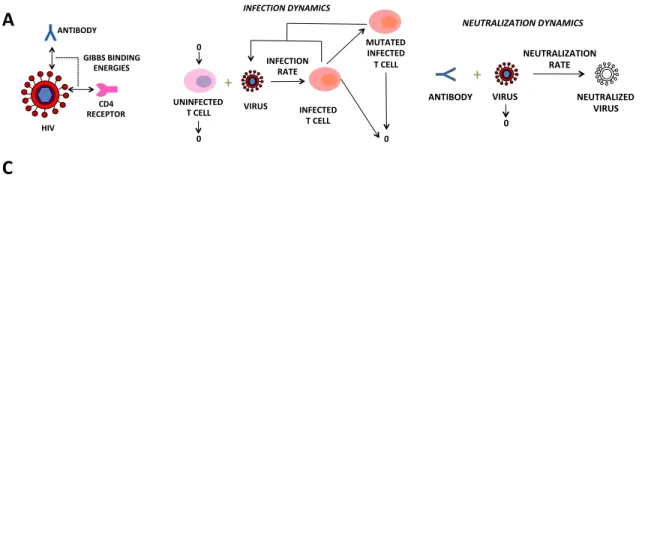
Figure 2.4: A.A depiction of the molecular binding model approximating the Gibbs binding energy between viral envelope glycoprotein and the neutralizing antibody and the CD4 re- ceptor, using simplified binding reactions (2.1) and (2.2). B.A depiction of the evolutionary dynamics model of HIV infection, mutation and neutralization in the presence of antibody therapy. C. (Left) Difference in Gibbs binding energy between wild type and mutations of the viral glycoprotein and the CD4 receptor, for a clade B virus YU2, (PDB ID: 1G9N) for a subset of point mutations. Percent infected cells on day three post secondary infection (dark red) and simulations of the molecular binding plus infection dynamics model using the calculated Gibbs free energy landscape (light red) for a subset of viral glycoprotein mutations. (Right) Three day infection simulations using the calculated Gibbs energies for selected point mutations. D.(Left) Difference in Gibbs binding energy between wild type and mutations of the viral glycoprotein and broadly neutralizing antibody 4546G54W, (PDB ID: 4JKP) for a subset of point mutations. Percent neutralized cells on day three in the presence of 10µg/ml 4546G54W (dark blue) and simulations of the molecular binding and infection and neutralization dynamics model using both Gibbs free energy landscapes in the presence of 10 µg/ml 4546G54W (light blue) for a subset of viral glycoprotein mutations.
(Right) Three day neutralization dynamics simulations using calculated Gibbs energies for selected point mutations for a range of 4546G54W antibody concentrations.
actions, as a function of the differences in Gibbs free energy due to point mutations.
We begin by noting that the dissociation constant Kd is an equilibrium value that can be expressed in terms of the free energy of binding, and define ∆Kdmut to be the ratio between mutant and wild type dissociation constants:
∆Kdmut = KKdmutwt d
= ∆∆G/RT , (2.4)
whereR is the ideal gas constant and T is temperature. The resulting Hill equations model the fraction bound complexes involved in both infection and neutralization reactions:
Rmut = [gp]m+(K[gp]infwtm∆Kinfmut)m
Nmut = [`]n+(Kneutwt[`]n∆Kmutneut)n ,
(2.5)
where the symbol [ ] indicates nanomolar concentration. ∆Kinfmut and ∆Kneutmut are the difference between the dissociation constants for CD4 and antibody binding reactions (2.1) and (2.2) between a mutationmutand the wild type viral glycoprotein as defined by Equation (2.4).
Remark 1. We assume that binding associated with the infection and neutralization process is noncooperative, and the corresponding Hill coefficientsmandnare approx- imately 1. Recent experimental studies characterizing antibody neutralization across a diverse virus panel, suggests that for CD4 binding site antibodies n ≈ 0.9−1.37 [92], for V2 antibodies n ≈0.7 and for V3 binding antibodiesn ≈1.5. [64].
Figure 2.3 C depicts the Hill equations (2.5) associated with infection and neu- tralization reactions for a subset of representative 3BNC117 resistant mutations and their computed Gibbs binding energy landscapes. For highly resistant mutations most likely to evolve in the presence of 3BNC117 like the Asp mutation at location 458, we expect a small fraction of bound gp120/3BNC117 regardless of antibody concentration and a moderate concentration of bound gp120/CD4, representing productive infec- tion. More moderately resistant mutations, such as the Thr mutation at 281, requires
20
two orders of magnitude increase in 3BNC117 concentration to achieve an equivalent fraction of gp120/antibody bound complexes and neutralization as wild type virus.
This suggests that at lower concentrations of antibody, viruses with similar fitness profiles as A281T may not be all neutralized by antibody, creating an environment in which this moderately resistant virus can become dominant or acquire additional mutations and achieve greater resistance [22, 37, 47, 57].
2.2.4 Evolutionary Dynamics on Quantifiable HIV-1 Fitness Landscapes
To reason about the dynamics of HIV evolution to resistance in the presence of an- tibody therapy, we combined computed Gibbs energy landscapes with a stochastic evolutionary dynamical system to model infection, mutation and antibody neutral- ization (Figure 2.4, A, B). A mathematical description of the virus dynamics and mutation model can be found in Section 2.4.1.
In order to validate of our model, we performed simulations of HIV infection and antibody neutralization and compared these results to replication and neutralization assays performed on gp120 mutations subcloned into a YU2-Env/NL4.3 infectious backbone (Materials and Methods, Section 2.4.3). Both our simulations and experi- ments were performed under the same conditions and were found to be in agreement, (Figure 2.4, C, D), suggesting that our proposed mathematical model of HIV infec- tion and neutralization based on Gibbs energy landscapes can be used to reasonably predict both infectivity and neutralization rate changes due to point mutations on Env. Simulations of our HIV infection model (Figure 2.4, C) confirm the well-known exponential growth dynamics of HIV infection for mutations with small changes in CD4 binding energies. For mutations with compromised CD4 binding such as the Lys mutation on 279 and the Tyr mutation at 280, our simulations and experiments show significantly decreased infection rates.
To illustrate how different neutralization profiles affect the evolution of resis- tance, we ran model simulations for a subset of Env point mutations and a range
of 4546G54W concentrations (Figure 2.4, D). We found that certain very resistant mutations are less likely to be affected by high doses of 4546G54W, such as the Lys mutation on 279 and the Tyr mutation at 280, whereas the degree of neutralization of moderately resistant mutations such as the Ser substitution at 279 is dependent on 4546G54W concentration (Figures 2.3, C and 2.4, D). High concentrations of 4546G54W are likely to shift the evolution of viral distributions towards highly re- sistant mutations by creating an environment in which mutations with moderate resistance are adequately neutralized, leaving the possibility of outgrowth of highly resistant mutants despite low infectivity. We observe this phenomenon in our evolu- tionary dynamics simulation in the presence of another CD4bs antibody, 3BNC117 (Figure 2.5,B). Specifically, the Lys substitution at location 280 is shown to outgrow all other mutations with lower viral fitness, despite its lower infectivity (Figures 2.4,C and 2.5,B).
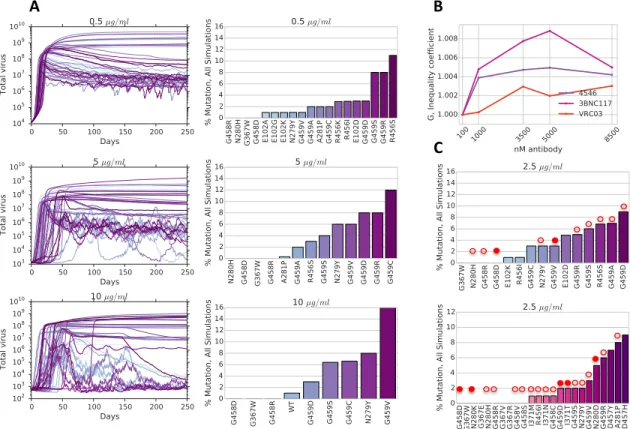
To further explore how antibody concentration could influence the composition of viral distributions at steady state, we ran fifty stochastic simulations of our HIV evo- lutionary dynamics model for different concentrations of 3BNC117 (Figure 2.6,A). We observe that the shape of the stationary distributions varies as a function of antibody concentration with broader peaks occurring at lower antibody concentrations and higher, narrower peaks at high antibody concentrations. We use the Gini coefficient (Materials and Methods, ss:gini) to describe the shape of the stationary viral distri- bution, and show that it increases as a function of different antibody concentration for multiple CD4bs antibodies (Figure 2.6,B).
To understand which mutants might evolve in the presence of CD4bs antibodies, we ran fifty evolutionary dynamics simulations using computed CD4 and antibody binding energy landscapes for 1664 different mutants of YU2, using constant concen- trations of either VRC01, VRC03, 3BNC117 or NIH4546. For a starting population of monoclonal wild type virus, we show that the evolved mutations have close agree- ment with previously studied escape mutations (Figure 2.5, C). Specifically, our HIV evolutionary dynamics simulations in the presence of NIH-4546 reveal the evolution of mutations at four out of five locations uncovered in recent evolutionary studies
22
on antibodies NIH-4546 and NIH-4546G54W [47, 22]. Moreover, recent experimen- tal results show that mutations N280D, N280K, A281T, G458D, G459D evolve from 3BNC117 monotherapy [37] - our simulations demonstrate the evolution of four out of these five specific point mutations.
A B#
Figure 2.5: A. Fitness landscapes representing the difference in Gibbs binding energy be- tween wild type and mutations on the viral glycoprotein (∆gp120) and the CD4 receptor (PDB ID: 1G9N) (above) and the neutralizing antibody 3BNC117 (PDB ID: 4JPV) (below) for all amino acid substitutions on a subset of residues. Closed circles indicate binding site locations, stars indicate residue locations for which resistant mutations have been found.
B. One simulation of the HIV evolutionary dynamics model (Equation 2.7, Materials and Methods) on computed Gibbs energy landscapes shown in A and for a concentration of 5 µg/ml 3BNC117. The simulation is run with an initial condition 105 uninfected cells/ml, 1000 virions/ml of of wild type YU2 clade B HIV. (Below) Fitness landscape and computed viral fitness for evolved mutations.
A" B"
C"
Figure 2.6: A. (Left) Fifty simulations of the HIV evolutionary dynamics model (Equation 2.7, Materials and Methods) on computed CD4 and antibody fitness landscapes for differ- ent NIH-4546 antibody concentrations. Simulations are run with an initial condition of 105 uninfected cells/ml, 1000 virions/ml of of wild type YU2 clade B HIV. (Right) Viral dis- tributions at day 250 for all corresponding simulations, representing the percent mutation present in the total population at steady state. B. Gini coefficient for antibodies NIH-4546, 3BNC117 and VRC03 as a function of antibody concentration, for steady state viral distri- butions in A. C. Viral distributions at day 250 for all 50 simulations of HIV evolutionary dynamics for (top) 2.5µg/ml of NIH-4546 and (bottom) 3BCN117. Filled circles represent particular mutations that are shown to evolve experimentally [22, 47] or to be resistant [57, 101]. Empty circles represent the residue locations at which mutations either evolve or have compromised neutralization by antibody.
24
2.3 Discussion
Recent advances in the identification and engineering of anti-HIV-1 antibodies have produced a large set of detailed molecular structures and neutralization data gen- erated against a broad panel of HIV-1 strains. Recent computational analysis of antibody neutralization data has been successful in categorizing antibodies with re- spect to their neutralization activity [32], extracting the identities of Env residues that are necessary for neutralization [101] and uncovering antibody epitopes [73]. Here, we report a computational methodology that utilizes antibody neutralization data and structural information to construct HIV fitness landscapes and reason about the dynamics of resistance. It consists of the interpretation of neutralization data us- ing statistical inference, the construction of fitness landscapes using computational chemistry and the development of biophysical and mathematical model to capture the dynamics of replication, mutation and selection.
Our statistical model is able to uncover critical Env residues involved in antibody neutralization and is consistent with recent studies in antibody resistance. It does not identify the entire structural epitope involved in the protein-protein contact. Rather, satlasso identifies an epitope that is involved in the function of the protein-protein interaction, in our case neutralization.
To address virus fitness in terms of its replication and neutralization capabilities, we computed Gibbs binding energy landscapes on gp120/CD4 and gp120/NAb struc- tures and found a good correspondence with our experimental studies. One of the drawbacks of using force fields to compute fitness landscapes, is that they rely on ex- perimental data and are therefore empirical. Furthermore, Xray structures are prone to errors due in part to the non-physiological conditions under which the structure is determined. Setting these concerns aside, tools like Fold X are geared specifically toward screening the effect of single nucleotide polymorphisms (SNPs) on protein sta- bility and are therefore well suited for our problem. For non-conservative mutations (those not involving Ala or Gly scanning), a reorganization of the protein backbone is often necessary, requiring an exploration of alternative conformations. However, for
large structure reconfigurations such as a deletion or creation of a glycan structure, we observe that Fold X is not always able to capture the corresponding effects on binding energy. In the case where glycosylation changes have a large effect on neutralization by antibody, satlasso is likely to recover these features, as illustrated by the accurate uncovering of the glycan dependence of 8ANC195. Therefore, the combination of data derived from satlasso and Gibbs energy landscapes offer complementary views on viral fitness.
We present an HIV evolutionary dynamics model that is the first to our knowl- edge to incorporate binding energy landscapes of replication and neutralization and that accurately predicts the evolution of point mutations in the presence of anti-HIV antibody monotherapy. Recent evolution studies uncovered the evolution of dou- ble mutations that conferred resistance to several antibodies [22, 47, 37]. A clear extension to our model is to incorporate double mutations in our Markov model of mutational dynamics however a clear limitation is the accuracy of an empirical energy minimization in the case of such double mutations.
2.4 Materials and Methods
2.4.1 Mathematical Models
satlasso. We define the saturated least absolute shrinkage and selection operator (satlasso) and formulate it as a convex optimization problem. We consider that the antibody neutralization data X = Xs+Xu is comprised of saturated data Xs, corresponding to IC50s of very resistant viruses, and of unsaturated data Xu (Figure 2.1). Observe n predictor response pairs (xi, yi) where xi ∈ Rp and y ∈R. Forming X ∈Rn×p, X =Xu+Xs with standardized columns, the saturated lasso, (satlasso) is an estimator defined by the following convex optimization problem:
26
minimize β∈Rp
λ1
1
m||yu−Xuβ||2
| {z }
Error unsaturated data
+λ2
1 m
n
X
i=1
wi|βi|
| {z }
Sparsity
+λ3 max(ys−Xsβ,0)
| {z }
Error saturated data
, (2.6)
where wi = ˆ1
βi and βˆi = 1ξPξ
j=1|βˆij| where βˆj is the solution to the ordinary least squares problem for subset j.
Model selection was performed by 5 fold-cross validation. Our results exclude mu- tations that are located in the signal peptide region, transmembrane and intracellular regions corresponding to HXBC2-numbered residues (1-30), (685-706) and (706-end) respectively. These locations on Env are not exposed to antibody binding and we assume that are not subject to selective pressure by antibody.
Viral dynamics. To simulate how HIV might evolve resistance, we extended the widely used HIV infection dynamics model [77] with a random mutation process and included our Gibbs energy formulation to capture the effects of genomic variation on the dynamics on infection and neutralization by antibody therapy. The stochastic discrete time differential equation model of HIV evolution under antibody selection is written as:
x[k+ 1] =λ+x[k]−(ηcPn
i Rix[k]−dxx[k])τ, yi[k+ 1] =yi[k] + (ηcRix[k] + Υi[k]−dyyi[k])τ,
vi[k+ 1] =vi[k] + ((1−Ni)kvyi[k]−Nivi[k]−dvv[k])τ,
(2.7)
where x ∈ R+ is the concentration of uninfected CD4+ T cells, yi ∈ R+ is the concentration of infected CD4+T cells that are actively producing mutant i,vi ∈R+
is the concentration of mutant virus i. Ri and Ni represent fraction bound ligand associated with infection and neutralization of mutants, respectively as described in Section 2.2.3. ηc = 104-105 is the number of CD4+ T cell receptors per uninfected cell [51, 81]. We note that the infection binding function
Ri = [gp]m
[gp]m+ (Kinfwt∆Kinfi )m (2.8)
depends on the concentration of HIV glycoprotein for mutanti, and that is dependent on virus statevi. The glycoprotein concentration for mutants iat timekis calculated by
[gpi] =vi[k]ηgp120N
A , (2.9)
where ηgp120 = 14 is the number of glycoprotein molecules per virion [17, 54] and NA is the Avogadro constant. dx, dy, dv are degradation rates, respectively, of uninfected CD4+ cells, infected CD4+ cells, and virus. dy and dv are assumed to be equivalent for any mutant virus. λ is the T cell generation rate, and kv is the viral burst rate, assumed to be equal for all mutants. Υi is the number of mutants igenerated by the mutation process. Parameter values and units are listed in Table 2.4, Section 2.5.
Mutation process. The mutation process models the effects of error prone reverse transcription allowing the genetic variability necessary for selection. Experi- mental results indicate that single residue point mutations can cause resistance in the presence of even the most potent broadly neutralizing antibodies [22, 47, 101], Chapter 4. Thus, we focus our analysis on point mutations on the viral envelope glycoprotein but assume that mutations anywhere on the HIV genome are equally probable. We do not consider mutations based on insertions, deletions or recombinations.
We allow for any number of single nucleotide changes to occur based on the reverse transcription rate of mutation u = 3×10⁻⁵ mutations/base pair/replication cycle.
However, we track viruses that have at most one residue substitution from wild type and assume that viruses with more than one residue substitution on contact sites are considered unfit and disappear. If a second residue change occurs outside the contact site, we assume this has the same fitness as the virus with one contact site residue change. Based on these criteria, any particular virus in the system can be in one of three states: wild type, point mutant with known fitness value and mutants with two
28
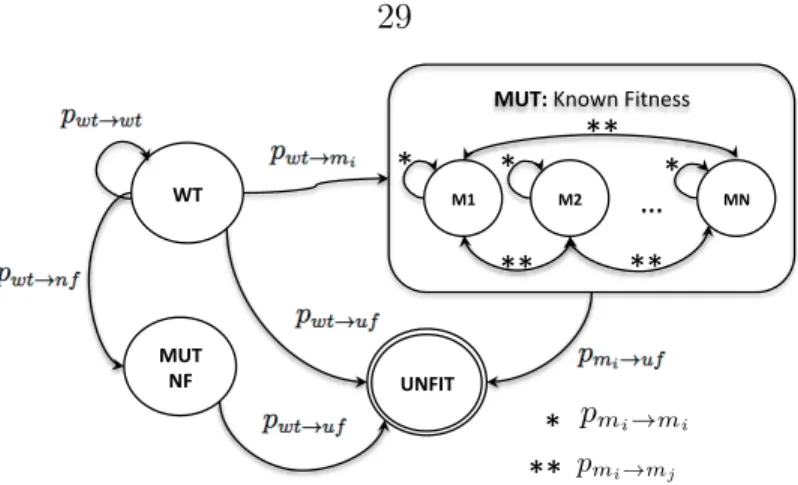
or more mutations. Mutation dynamics are represented by a Markov process.
Let S = {wt, m1, ..., mn, nf, uf} be the state space associated with the Markov process, corresponding to infected cell types where wt is the wild type infected cell, m1, ..., mnare point mutant infected cells that produce virus with known fitness,nf is an infected cell type that produces virus with unknown fitness, and uf is an infected cell type that produces virus considered unfit. As an approximation, we consider infected cells that produce mutant virus where no fitness knowledge to be equivalent in fitness to wild type, and those that produce virus with more than one residue change are considered unfit. Let Xn be a random variable denoting the state of a given cell at time n taking values in S, then its dynamics are given by the following state transition probabilities P ={pij}=P{Xn+1 =j|Xn=i}:
pwt→wt = (1−u)kl
pwt→mi =kcu(1−u)kc−1(1−u)kh pwt→nf =khu(1−u)kh−1(1−u)kc pwt→uf = 1−pwt→wt−pwt→mi−pwt→nf
pmi→mi = 1−Pn
j6=ipmi→mj −pmi→uf
pmi→mj = 3k2
cpwt→mi
pmi→uf =pwt→nf,
(2.10)
for i ∈ {1, ..., n} and j 6=i, and where kl is the length of the entire HIV genome, kc is the length of the genome for which fitness information exists, nc is the number of possible point mutants with known fitness information,kh =kl−kc, anduis the rate of mutation of HIV reverse transcriptase. All other state transition probabilities are not considered. This Markov process at the single cell level induces a Markov process at the population level.
2.4.2 Model Implementation and Simulations
Measuring the shape of viral distributions. The Gini coefficient measures statistical dispersion and is most commonly used as a measure of income inequality
M1# M2# …" MN#
MUT:#Known"Fitness"
UNFIT#
WT#
MUT NF#
*"
**"pmi!mj
**" **"
**"
*"
*"
*"
pmi!mi
Figure 2.7: A finite state space Markov model representation of simplified mutation dy- namics. MUTF is an abstract state that encompasses all point mutations for which fitness information is known, MUTNF is an abstract state that defines all mutations for which fitness information is not known. The WT state is a wild type virus state, UNFIT final state is a state that has no infectivity and is considered unfit with respect to any selective pressure.
in a population. We use this measure as an approximation to the shape of the virus distribution at steady state. The Gini coefficient G is calculated as
G=
Pn i=1
Pn
j=1|yi−yj|
2n2µ , (2.11)
wheren is the number of all possible point mutations,yi is the percent population of a point mutation i that occurs at steady state for all simulations and µ is their mean.
2.4.3 Experimental Methods
Mutagenesis, Virus Production and Cells. Site directed mutagenesis and as- sembly PCR were used to generate YU2-NL43 Env mutants. YU2-NL43 was modified using unique restriction sites EcoRI and XhoI. Inserts were generated by PCR using primers EcoRI-CF (5’-GCCAGCCAGAATTCTGCAACAACTGCTGTTTATCCAT TTCAG-3’) and XhoI-CR-(5’-GCGTCGACCTCGAGATACTGCTCCCACCCCATC- 3’) and individual sense and antisense mutagenesis primers corresponding to YU2- NL43 mutants listed in Figure 2.4. Escherichia coli One Shot STBL3 Chemically Competent cells (Life Technologies) were used to propagate proviral plasmids during
30
a 16 hour incubation at 30◦ C. Stocks were prepared using a DNA Midi kit (Zymo Re- search). All gene constructs were verified by complete sequencing of gp160. Cell-free virus was produced by transfection of HEK293T cells with YU2-NL43 virus coding plasmid using BioT (Bioland Scientific). Viral supernatant was harvested at 48 h post transfection, filtered through a 0.5µm filter and aliquots were stored at -80◦ C. Stock concentrations were quantified by p24 enzyme-linked immunosorbent assay (ELISA) (Cell Biolabs). The YU2 Env/NL43 plasmid was obtained from the Nussenzweig lab, Rockefeller University. The green fluorescent protein (GFP) reporter T-cell line GXR-CEM is previously described