Image reproduced from Efimova, Western European mosaic of the 13th-19th centuries in the collection of the Hermitage, St. These in turn focus on the objects in the collection of the Hermitage Museum in St. Petersburg, Russia.
Malachite Objects Before the 1830s – the Material Body of Evidence
They were completed before 1809 and could not have been part of the group of five bowls mentioned in the Peterhof records. The sampler (Fig. 1.11) in the collection of The Fersman Mineralogical Museum in Moscow, Russia is an example. The attribution of the sample block is not final - micromosaics, intended for the tourist market, could have been purchased in Rome and set into the malachite block elsewhere.
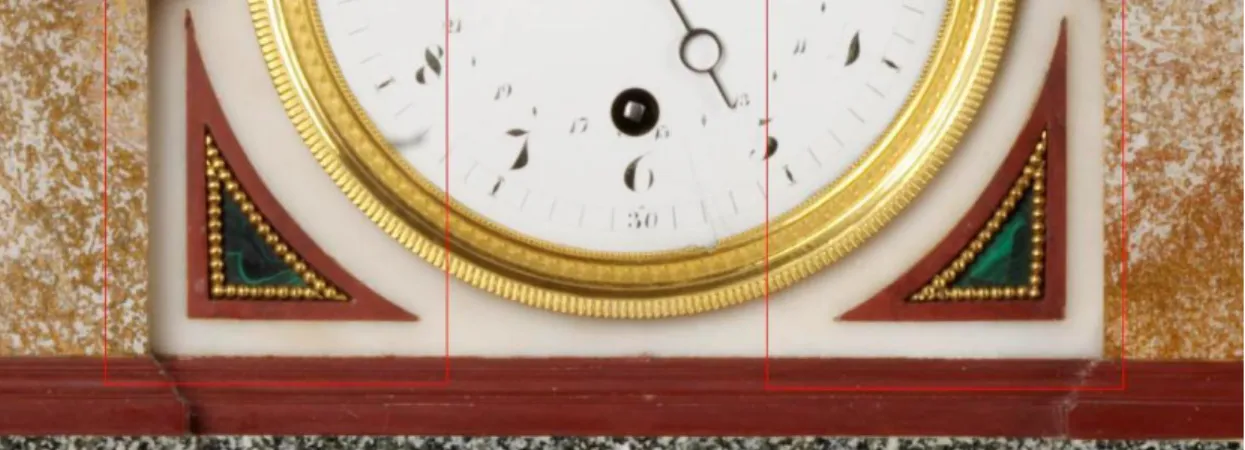
The round clock in the center of the ceiling is flanked by two rectangular lapis-lazuli inlays. While the sample block alludes to antiquity in connection with the study of nature, the Clock testifies to the admiration of ancient history and culture. Most importantly, the two objects demonstrate that malachite appeared in the early 19th century.
Due to striking similarities of the pieces in the Valadier and Sheremetev services, one wonders whether. Analysis of the objects discussed above shows that in the late 18th - early 19th centuries, malachite was an expensive and innovative decorative material found in Neoclassical designs.
Terminology: “Russian Mosaic”
In general, the technique is one of the simplest,53 due to the softness of the stone.54. The earliest citation of the term "Russian Mosaic" found in the course of this study appears in Studies in the History of Stone (Ocherki po istorii kamnya) by Alexander Fersman. In the chapter "Processing of Hardstones", Fersman defined Russian Mosaic as one of the specialties of Peterhof Lapidary Works.
Such an impossible scenario suggests that even in the middle of the 20th century there was no consensus on the meaning of ‗Russian Mosaic'. This suggests that the term may have been introduced later than the technique it denoted. Possibly the answer can be found in trade publications of the 19th and early 20th centuries. The technique was known at the end of the 18th century; it was used to make the jasper columns of the 'Agate Rooms'.
Russian mosaic." Natalija Mavrodina, author of the catalog of Russian stone objects in the Hermitage collection, The Art of Russian Stonecutters: 18.-19. In general, the analysis of the definitions of Russian mosaic shows a constant basic ambiguity about the content of the term, probably due to the lack of connection between the theory and practice of stone cladding.
Malachite and Natural History Collecting: from Enlightened Study to Status
Malachite began to gain popularity in the last quarter of the 18th century after its discoveries in the Ural Mountains of Russia. Malachite deposits in the Gumeshevsky field were depleted by the third decade of the 19th century. It was the first of the three imperial stone carving workshops, two of which were: Peterhof and Yekaterinburg.
Better known in Russia as "copper green" in the second half of the 18th century, malachite - essentially a rich copper mineral containing 57% of the metal - belonged to the domain of metallurgy. They provided detailed descriptions of Gumeshevsky malachite emphasizing the morphological characteristics and beauty of the mineral. The furniture can only be compared to that of the palace that Prince Bezborodko sold to the Emperor.
Specimens of Gumeshevevsky malachite in the collection of the Fersman Mineralogical Museum appear as polished and both cut and polished solid pieces. The entire surface of the cut is polished, revealing a striking display of malachite's intricate inner formations and patterns (fig.
The Pursuit of Taste: Traveling to Italy and Bringing Italy Home
Antiquary for the Pope,' and Denis Diderot French philosopher, art critic and editor-in-chief of the Encyclopedia - compared the simplicity of nature with the perfection of ancient art and idealized both. Winckelmann's and Diderot's views found a following in a wide audience across Europe and America and became "responsible for most of Neoclassical art and for some aspects of the Romantic movement."143 In the decorative arts the philosophers. Both were extremely rare before the second half of the 18th century144 and both were now found regularly and in much the same way, being extracted from "the depths of the earth".145 While ancient cameos were.
Objects in the Second Dejeuner (c. 1816), originally a gift from Louis XVIII to Caroline of Naples and Sicily, now in a private collection (published as part of Christie's London 10 June 2010 sale Centuries of Style: Silver, European ceramics, portrait miniatures and gold boxes) (fig shows images of cameos from the collection of Malachite was found in limited quantities in the distant Ural Mountains, while access to the ancient artifacts Pompeii and Herculaneum was artificially restricted by the kingdom's authorities Treatment of archaeological artifacts in the same way as natural resources, criticized today for a lack of consideration of historical context, derived from an older tradition that favored preserving, embellishing and prominently displaying individual relics of the past.
Although these techniques fell into obscurity, by the mid-sixteenth century they reappeared in new forms and practices skilfully adapted from the ancient models. In the second half of the 18th century, after a period of ―economic recession that took hold between the seventeenth and. Several journeys in Italy helped to develop in him that noble love for the beautiful which constitutes, so to speak, an additional sense.‖165.
The Russian nobility also took advantage of the opportunity to reaffirm their civilized status by traveling to Italy and conspicuously consuming all things Italian. So, after a three-day visit to Prince Conde's Chateau de Chantilly in France, Grand Duke Paul commissioned an album of drawings and plans of the Chateau. In the late 18th century it was rare for an important person not to have a residence inspired by the Villa Rotunda with a replica of Belvedere's Apollo in front of it.
In fact, the cumulative effect of copies of many of the most beautiful statues in Florence, Rome and Naples, which were to be seen inside. Petersburg was perhaps more impressive than anything like it outside of Versailles and many other palaces in Russia. To ensure that Russian creations in architecture and decorative arts were of the same quality as in Europe, Russian clients sought to hire European architects, artists, and artisans.
The Hidden History: Russian Patronage and Italian Artistic Expertise in the
Consultation of documents related to the construction of the Mikhailovsky Castle in the archives of the Cabinet of the Russian State Historical Archives in St. Petersburg. The corners of the square in the center will be decorated with gilded bronze coats of arms. It is not certain whether similar specimens containing malachite were known to collectors in the second half of the 18th century.
Petersburg and Moscow were the result of two government measures adopted in the second half of the 18th century. Fersmana RAN" ("Mosaic objects in the collection of The Fersman Mineralogical Museum of the Russian Academy of Sciences"). Pavlovskogo dvortsa-muzeia (Russian decorative and applied arts in the collection of the Pavlovsk Palace Museum.