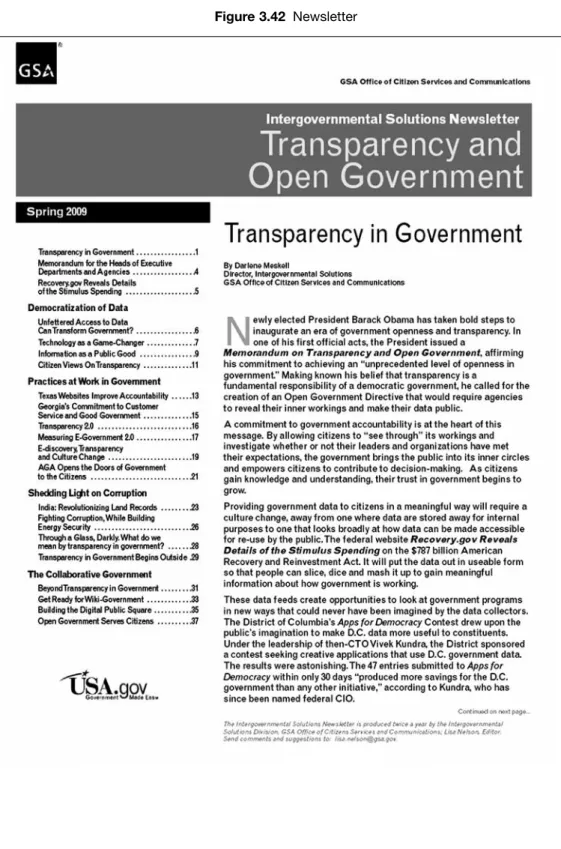
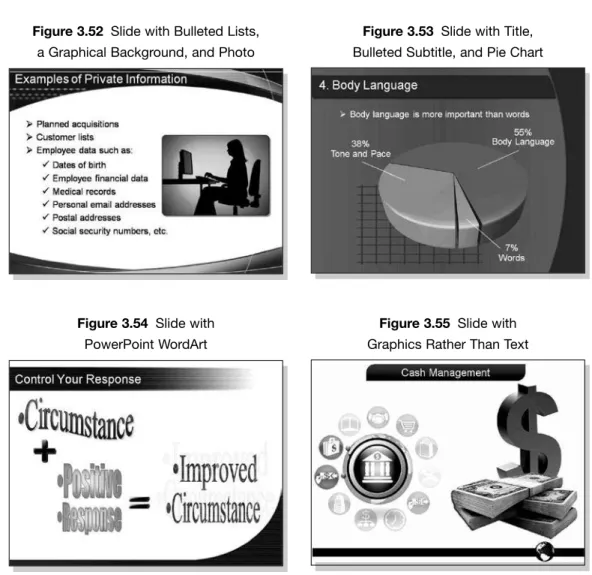
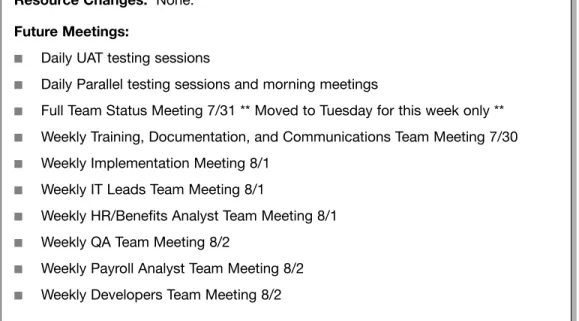
S E C T I O N
3
Sample Business
Documents
427 Section 3 Sample Business Documents
ABSTRACTS
An
abstractis a summary of a larger document, such as a report. Abstracts are also called
summariesor
executive summaries.There are two types of abstracts:
■ Descriptive abstracts
are short summaries that appear on the front page of a formal report or journal article. (Figure 3.1.)
■
A descriptive abstract does not summarize the facts or conclusions of the report.
■
A descriptive abstract introduces the report and explains what the report covers.
Example: This report provides recommendations for the antivirus software currently available.
■ Informative abstracts
summarize the key facts and conclusions of the report. (Figure 3.2.)
■
Informative abstracts are usually one- or two-page documents.
■
Informative abstracts summarize each of the sections in the report.
■
Sentence structure is normally complex and packed with information.
■
An informative abstract is intended to allow readers to determine whether they want to read the report.
■
An informative abstract is not treated as an introduction.
■
Include any statistical details in an informative abstract.
428 The AMA Handbook of Business Writing
Figure 3.1 Descriptive Abstract
Abstract
The U.S. Air Force Research Laboratory has been developing cost effective methods for gathering occupational and training requirements information.
This information has most often been collected at an individual level of analysis focusing on the more behavioral aspects of work. Recent interest in both team and cognitive requirements for work has prompted renewed interest in team task analysis and accurately representing knowledge and cognitive components of work. The U.S. and Allied Military Services have pioneered the development of exemplar methods that serve as the foundation for recent advanced training. This paper highlights recent explorations and advanced training in team task analysis and cognitive task analysis methods.
Implications for increasing the accuracy and efficiency of the requirements analysis process will also be discussed.
(Courtesy of the United States Air Force)
Figure 3.2 Informative Abstract
Summary
The U.S. Fish and Wildlife Service published special rules to establish nonessential experimental populations of gray wolves (Canis lupus) in Yellowstone National Park and central Idaho. The nonessential experimental population areas include all of Wyoming, most of Idaho, and much of central and southern Montana. A close reading of the special regulations indicates that, unintentionally, the language reads as though wolf control measures apply only outside of the experimental population area. This proposed revision is intended to amend language in the special regulations so that it clearly applies within the Yellowstone nonessential experimental population area and the central Idaho nonessential experimental population area. This proposed change will not affect any of the assumptions and earlier analysis made in the environmental impact statement or other portions of the special rules.
(Courtesy of the United States Environmental Protection Agency)
429 Section 3 Sample Business Documents
ACCEPTANCE LETTER
An
acceptance letteris often written to formally acknowledge an employ- ment offer, the receipt of a gift, or the appointment to a public office. An acceptance letter can also be written to formally accept someone else’s res- ignation.
Consider these tips when writing an acceptance letter (Figure 3.3):
■
Begin the letter by thanking the person, business, or organization.
■
Identify what you are accepting and explain what it means to you.
■
Thank anyone who assisted you.
■
State the terms as you understand them.
■
If accepting an employment offer, summarize the start date, job title and description, compensation, benefits, and vacation days offered.
■
Use a positive tone.
■
Be gracious by showing your courtesy, tact, and charm in your writing style.
■
Restate your thanks and appreciation in the closing of the letter.
■
Use the spelling checker in your word processor to check for spelling errors.
■
Read the letter for clarity and to check for grammatical mistakes.
Acceptance letters are typically written to accept:
■
An invitation to a social event
■
A job offer
■
A request to serve in an honorary position
■
A resignation
■
An honor
■
An invitation to a business appointment
■
An invitation to speak
■
A gift
■
A proposal
430 The AMA Handbook of Business Writing
Figure 3.3 Acceptance Letter
Evelyn Wauson
4212 West Church Street Houston, Texas 77096 (713) 555-5555
October 20, 2011
Dear Mr. Harrison,
It was a pleasure speaking with you on the phone this afternoon.
I am very happy to accept the position of LMS supervisor with Harrison Consultants. Thank you very much for the opportunity to join your team.
I am excited about the possibilities for this position, and I am eager to work on the implementation of your new learning management system and corporate online university.
As we discussed in our conversation, my starting yearly salary will be $50,000. I understand that after being employed for 30 days, I will receive health, dental, and life insurance benefits. After working for Harrison Consultants for six months, I will receive one week’s paid vacation.
I am prepared to start work on December 1, 2011 as you requested.
If there is any paperwork I need to complete before I start work, or if you need any additional information, please contact me.
I appreciate the help your associate Ken Knox provided by referring me to you for this position.
Thank you.
Evelyn Wauson
Evelyn Wauson
431 Section 3 Sample Business Documents
ACKNOWLEDGMENT LETTER
An
acknowledgment letteris a response that clarifies what is expected from you. An acknowledgment letter should be sent within two days of receiving the original letter, report, order, or request.
Consider these tips when writing an acknowledgment letter (Figure 3.4):
■
Include a short apology if the acknowledgement letter is delayed.
■
If you are responding to a complaint, be courteous and apologize for any inconvenience or problem.
■
Be sincere.
■
The letter should be addressed to a specific person if possible.
Acknowledgment letters are typically written to:
■
Accept a request to serve in an honorary position or a resignation.
■
Express appreciation for a suggestion.
■
Acknowledge a customer’s order or donation or payment of an overdue balance.
■
Acknowledge the receipt of a report or letter, the receipt of a résumé, or the return of an item for refund, exchange, or credit.
■
Confirm an appointment or meeting, a business agreement, or an error, revision, or correction.
■
Celebrate an anniversary of employment.
432 The AMA Handbook of Business Writing
Figure 3.4 Acknowledgment Letter
Isha Foundation 951 Isha Lane
McMinnville, TN 37110
August 20, 2011
Jeff Collins
3111 North Amber Lane Nashville, TN 37213
Subj.: Tax Year 2011
Dear Mr. Collins,
Thank you for your recent donation of $500 for our outreach program, Isha Care. Your gift will allow us to continue our efforts to provide free medical care to the residents of rural Tennessee.
Your donation is fully tax-deductible, and this letter may serve as a receipt for your tax records. This letter also verifies that you have not received any tangible benefits in return for your donation.
Your generous gift assures a continued investment in the future of Tennessee.
Thank you.
Dr. Jane Morgan
Dr. Jane Morgan
President, Isha Foundation Inc. USA
433 Section 3 Sample Business Documents
ADJUSTMENT LETTER
Adjustment letters
are responses to written complaints. The purpose of such letters is to acknowledge the complaint. The letter is also a legal docu- ment that records what action will be taken.
Consider these tips when writing an adjustment letter (Figure 3.5):
■
Reference the date of the original complaint letter.
■
The letter should review the facts of the case and offer an apology for any inconvenience.
■
When there is no truth to the complaint, courteously explain the reasons as clearly as possible.
■
When the customer’s request is denied, offer some compensation or advice.
■
Take a positive approach to the letter to counter any negative feelings of the reader.
■
The solution is more important than the reasons why something occurred.
■
Cordially conclude the letter and express confidence that you and the reader can continue doing business.
Adjustment letters are typically written to apologize for:
■
A defective or damaged product
■
A missed deadline
■
Making a mistake on a customer’s account
■
A shipping error
■
Damaged property
■
Poor quality or service
434 The AMA Handbook of Business Writing
Figure 3.5 Adjustment Letter
Snack Makers, Inc.
1234 West Main Street Los Angeles, CA 90036
April 20, 2012
Mr. Carl Luntz Store Manager Luntz Grocery 2411 Third Avenue Atlanta, GA 30134
Dear Mr. Luntz:
I would like to apologize for the damaged shipment of Humus Chips.
At Snack Makers, we always try to package our product as securely as possible, but it appears this time we failed.
We have shipped a replacement case of Humus Chips today at no charge.
You should receive them within two days. There’s no need to return the damaged product. You may dispose of the crushed chips anyway you wish.
Being a new company with a new product, we want you to know that we value your business and will do everything we can to make sure this doesn’t happen again.
In addition, I am crediting your account for $155 to reflect a 20% discount off your original order.
I hope you will accept my apologies and will continue to do business with Snack Makers.
Sincerely,
Morton Boyd
Morton Boyd President
Snack Makers, Inc.
435 Section 3 Sample Business Documents
ANNOUNCEMENT LETTER
Announcement letters
should be written in a straightforward and concise style so that readers can get information quickly.
Consider these tips when writing announcement letters (Figure 3.6):
■
For positive announcements, make the letter inviting and to the point.
■
Build morale, confidence, and goodwill.
■
When announcing achievements, try to motivate others to achieve the same goals.
■
Use the announcement to promote your business.
■
Include enough information so that you don’t have to answer questions about the announcement later.
■
When announcing bad news, be considerate and respectful.
Announcement letters are typically written to announce:
■
A new address
■
A change in company name
■
The business schedule
■
A new hire or promotion
■
An employee’s special achievement
■
A retirement
■
A new product
■
A new store opening
■
A layoff
■
A store closing
■
A new policy
■
A contest winner
■
A price change
■
Bad news to employees
■
A training session
436 The AMA Handbook of Business Writing
Figure 3.6 Announcement Letter
System Golf Supplies 4143 Green Avenue Baltimore, MD 21205
May 22, 2012
Ms. Susan Jones Manager
Jones Golfing
1322 North Pleasant Street Baltimore, MD 21075
Dear Ms. Jones:
Due to increased costs for materials used in our manufacturing process, we must unfortunately increase the wholesale cost of our products.
We have examined other ways to reduce our manufacturing costs;
however, we have been unable to reduce costs enough without sacrificing quality. To maintain the superior quality of our products, we must raise our prices. I have enclosed a new price list that will go into effect on July 1, 2012. Any orders placed between now and July 1 will be honored at our previous prices.
We want to thank you for your business in the past, and we hope you understand the necessity for this increase.
Sincerely,
Carl Richardson
Carl Richardson Sales Manager System Golf Supplies
437 Section 3 Sample Business Documents
ANNUAL REPORT
An
annual reportis a document used to disclose corporation information to shareholders—a state-of-the-company report. All U.S. companies that issue publicly traded stock are required to file an annual report with the Securities and Exchange Commission (SEC). The document that is filed with the SEC is the Form 10-K.
Many nonprofit organizations, foundations, and charities produce annual reports to assess their performance. Nonprofit annual reports include the fol- lowing sections (Figures 3.7–3.11):
■
Letter from the chairman of the board
■
A description of the charity, its causes, actions, and accomplishments for the year
■
The financial statement:
■
A letter from the organization’s CPA
■
Income statement
■
Balance sheet
■
A list of directors and officers
If a company is privately owned but has more than 500 shareholders and over $10 million in assets, it is also required to file an annual report.
In addition to Form 10-K annual reports, the same mandated corporations must also file a quarterly Form 10-Q as a quarterly report.
The annual reports required by the SEC follow a strict format and include the following sections (Figures 3.7–3.11):
■
Business overview
■
Risk factors
■
Unresolved staff comments
■
Properties
■
Legal proceedings
438 The AMA Handbook of Business Writing
■
Submission of matters to a vote by shareholders
■
Market for the company’s common equity
■
Related stockholder matters
■
Management’s discussion and analysis of financial conditions and the results of operations
■
Disclosures about market risk
■
Financial statements and supplementary data
■
Changes in accounting
■
Controls and procedures
■
Other information
■
Directors, executive officers, and corporate governance
■
Executive compensation
■
Security ownership of stock by management and certain beneficial owners
■
Relationships and related transaction and director independence
■
Accounting fees and services
■
Exhibits and financial statement schedules
(text continues on page 444)
439 Section 3 Sample Business Documents
Figure 3.7 Annual Report Cover Page
(Courtesy of the U.S. Securities and Exchange Commission)
440 The AMA Handbook of Business Writing
Figure 3.8 Annual Report Table of Contents
(Courtesy of the U.S. Securities and Exchange Commission)
441 Section 3 Sample Business Documents
Figure 3.9 Annual Report Letter from the Chairman
(Courtesy of the U.S. Securities and Exchange Commission)
442 The AMA Handbook of Business Writing
Figure 3.10 Annual Report Organizational Overview
(Courtesy of the U.S. Securities and Exchange Commission)
443 Section 3 Sample Business Documents
Figure 3.11 Annual Report Overview of Organization’s Performance
(Courtesy of the U.S. Securities and Exchange Commission)
444 The AMA Handbook of Business Writing
APPLICATION LETTER
In an
application letter(Figure 3.12):
■
In the first sentence, state what you are applying for.
■
Explain the reasons you are applying and be specific.
■
Give the reasons why you are qualified including your experience, qualifications, accomplishments, and goals.
■
Identify the response you would like to your letter.
■
Identify the date you need a response.
■
Reference any other materials included with the letter, such as a résumé, job application form, letters of recommendation, or work samples.
■
Include your contact information and when you are available.
■
Close the letter with a thank you.
Application letters are typically written to apply for:
■
Employment
■
Admission to a school
■
Admission to a club
■
A foreign work permit
■
A grant
■
A scholarship
■
A travel visa
■
A special program
■
Credit
445 Section 3 Sample Business Documents
Figure 3.12 Application Letter
1322 Forest Lane Dallas, TX 75214 August 11, 2012 Michele Phillips APS Software
13211 Greenville Avenue Dallas, TX 75212 Dear Ms. Phillips:
I am writing to apply for the position you advertised on Monster.com for a quality control manager. As you will see in my résumé, I have the experience to fill this position.
For the past ten years, I have been working in the information technology department at Hopewell Industries where I have been a software
developer, project manager, and manager of QC Testing. My experience has ranged from coding, to managing teams of programmers, to creating test plans, running tests, and managing testers.
Recently, Hopewell Industries decided to outsource the IT function to IBM. While I am sad to leave the company, I am looking forward to a new assignment with fresh faces and new projects.
I have heard about APS Software in various trade journals and would be very interested in becoming part of your team. APS is well known for innovative quality products, and I am excited about the possibility of becoming a part of your success story.
I hope you’ll give me an opportunity to discuss my qualifications and experience. I can be reached at (214) 555-5555 after 6 p.m.
Thank you very much for your consideration for this position.
Sincerely yours,
Alice Grassley
Alice Grassley
Encl.: résumé
446 The AMA Handbook of Business Writing
BROCHURES
Brochures
are often used by businesses to advertise products and services.
There are several different types of brochures:
■
Leave-behind brochures are left after a personal sales presentation.
■
These focus on a full description of the product and its benefits.
■
They echo the sales pitch given by the salesperson.
■
Point-of-sale brochures are designed to catch your interest while waiting in line to check out in a store.
■
They are visually appealing with a catchy headline.
■
Inquiry response brochures are sent to people who have asked for information about a product.
■
These brochures focus on a sales pitch that encourages the reader to take the next step and purchase the product or service.
■
Direct mail brochures are sent to potential customers along with a sales letter.
■
Sales support brochures are used by salespeople during their presentations.
In the planning phase of brochure creation, consider the following:
■
Determine what you want the brochure to do: get orders, inform, get appointments.
■
Determine the audience for the brochure and why they should be interested in your product or service.
■
Develop an outline and divide the content you want to cover into sections.
■
Consider the style of brochure you plan to create, and think about the content that is best for the cover, inside pages, and back cover.
■
Also consider content that is suitable for any sidebars.
■
Determine whether photography or illustrations can be used.
■
If photography is used, also include captions for each photo that focus on benefits.
■
Photos should be at least 300 dpi resolution in order to print
with the best possible print quality.
When writing copy for a brochure, keep the following in mind (see Figures 3.13–3.14):
■
Write from the reader’s point of view.
■
As the reader unfolds the brochure, present the information in the order that a reader would want to receive it.
■
On the cover or first page of the brochure, motivate readers to open the brochure and seek out additional information.
■
For a brochure longer than eight or more pages, include a list of contents highlighted in bold and separated from the rest of the copy.
■
Describe the product or service in terms of what it means to the potential customer.
■
Focus on the benefits rather than the features.
■
Include helpful reference information that will make the reader want to keep the brochure on file.
■
Write in an informal matter-of-fact style, as if you are having a one-on-one conversation with someone.
■
Share your emotions and enthusiasm about the product or service.
■
Don’t waste time on all the details; instead, focus on the key selling points.
■
Organize the content into easily identifiable sections.
■
Ask for an order and provide simple instructions on how to order.
■
Make a persuasive sales pitch.
In designing the brochure and doing the layout, consider the following:
■
Study brochures from other companies and determine which designs are effective and which are not.
■
Avoid packing in too much content.
■
Empty space is okay.
■
Avoid using too many graphical boxes and lines to separate chunks of content.
■
They tend to make your design look cluttered.
■
Use a consistent typeface throughout the brochure.
447 Section 3 Sample Business Documents
448 The AMA Handbook of Business Writing
■
You can change fonts within the same typeface family in various places for emphasis.
■
Consider different fonts, font styles, sizes, and colors for key selling points and headings.
■
Use these techniques sparingly for greater emphasis.
■
Avoid all caps. Use bold style instead.
■
Avoid underlining. Use italics style instead.
■
Avoid putting text over images unless you make the image at least 80% transparent.
■
Avoid putting text columns on the first page or cover.
■
Use no more than 10 words on the cover.
■
Don’t use more than two or three sentences per paragraph with a layout that is no more than nine or ten lines of type.
■
Add a space between paragraphs and do not indent the first word.
■
Use only one space after a period before starting the next sentence.
■
If you have to start a sentence with a number, write it out.
Incorrect: 50% of the homeowners experienced hail damage.
Correct: Fifty percent of the homeowners experienced hail damage.
■
Consider the use of multiple ink colors and colored paper.
■
When creating a layout with photography, don’t position the photos so that they are creased by a fold in the paper.
■
Use desktop publishing software such as Microsoft Publisher, Adobe InDesign, or QuarkXPress.
■
Set the paper size before any design elements are created.
■
Confirm that the printer will be able to print on the intended size paper.
■
Allow for print bleed in order to achieve edge-to-edge printing.
■
To create print bleed, expand your brochure design slightly beyond the edge of the paper with nonessential design elements to allow for trimming.
■
Proofread your final design several times to avoid printing a brochure
with a mistake or typo.
Figure 3.13 Brochure
449 Section 3 Sample Business Documents
(Courtesy of the U.S. Department of Education)
Figure 3.14 Brochure 450 The AMA Handbook of Business Writing
(Courtesy of the U.S. EEOC)
451 Section 3 Sample Business Documents
BUSINESS LETTER
The parts of a
business letterare (Figure 3.15):
■
Address or letterhead—usually a preprinted letterhead with the organization’s name and address. (If letterhead is not used, include the address of the writer along with the date.)
■
Dateline—two to six lines below the last line of the printed letterhead.
■
The date should be written out in this form: January 1, 2012 or 1 January 2012
■
The date can be centered if letterhead is used.
■
If letterhead is not used, the date is included with the address of the writer.
■
Reference line—a numerical file number, invoice number, policy number, or order numbers on a new line below the date.
■
Special mailing notations—special notations such as “Confidential”
two lines below the date.
■
Inside address—the addressee’s title and full name, business title, business name, and full address.
■
Do not abbreviate the company’s name unless it is registered that way.
■
Cities and states should not be abbreviated.
■
Do not use “care of” before a hotel name or company name.
■
Include the appropriate title:
Mr., Ms., Mrs., Miss,or
Dr.■
Business titles are never abbreviated.
■
Attention line—one line space and the phrase “Attention:__________”
after the inside address, if the letter is not addressed to any specific person.
■
You can make the letter go to the attention of a department.
■
An attention line is never used in a letter to an individual but only in a letter having plural addresses.
■
Salutation—“Dear [person’s name],” “Ladies and Gentlemen,”
“Dear Sir or Madam,” “Dear [company name]” one line after the
attention line or the inside address.
■
In business letters, the salutation is followed by a colon.
■
In personal letters, the salutation is followed by a comma.
■
Subject line—an overview of what the letter is about.
■
It can be used in place of a salutation.
■
A subject line can be centered in sales letters.
■
Do not include “Re” or “Subject” before the subject line.
■
Underline the subject line, unless it occupies two or more lines, in which case underline the last line, letting the underline extend the length of the longest line in the subject.
■
Message—the body of your letter with paragraph breaks, optional indentions for paragraphs, bullet lists, and number lists.
■
Complimentary close—two lines below the last line of the message.
■
The close is either left justified or five spaces to the right of center.
■
“Yours truly” or “Very truly yours” can be used when no personal connection exists between the writer and recipient.
■
“Sincerely” or “Sincerely yours” is appropriate when there is an established personal as well as business relationship.
■
“Respectfully yours” is appropriate on letters addressed to a person of acknowledged authority.
■
Avoid using closings such as “Yours for lower prices” or “I remain” or “Cordially yours.”
■
Signature block—justified with the complimentary close with options of typed name and title, signature, or just signature.
■
Never add a blank graphical line for the writer’s signature.
■
A woman should include a courtesy title in her typed signatures to allow the recipient of the letter to reply appropriately.
Example: Miss Louise A. Scott, Ms. Tina Anderson-Tate, Mrs. Pat Brueck
■
Identification initials—the initials of the typist aligned left two spaces below the signature block.
■
Writer’s initials are typed in capitals; the typist’s initials are in lower case.
452 The AMA Handbook of Business Writing
■
A colon or slash is used to separate the initials.
■
Enclosure notation—located with the identification initials or in place of them with the notation “enc,” “encl,” “enclosures (3),” or “3 encs.”
■
Copy notation—left-aligned two lines below identification initials with the notation “cc: [person’s full name or initials].”
■
Postscript—two spaces below the last text on the page with a “P.S.”
and then a short sentence.
■
Use a postscript to dramatize something already included in the letter.
■
Never use a postscript to include something that was forgotten during the writing of the letter. Instead, rewrite the letter.
Figure 3.15 Parts of a Business Letter
453 Section 3 Sample Business Documents
Business Letter Writing Style
Consider the following tips regarding business letter writing style:
■
A good business letter advertises your capabilities and those of your company.
■
A good business letter is neat and symmetrical, with no typographical, grammatical, or spelling errors.
■
The language should be clear and simple.
■
The first sentence should state the purpose of the letter.
■
When responding to a letter, identify the subject and date of the previous letter in the first paragraph.
■
Paragraphs should be short, and each paragraph should focus on a different topic.
■
Use lists or italics where appropriate to make it easier for the reader to find important points.
■
Focus on the reader’s needs and interests.
■
Avoid jargon.
■
End with a call for action.
Example:Can we set up an appointment to discuss your needs on this project?
Business Letter Format There are several different formats for business letters:
■
Block letters (Figure 3.16)
■
Modified block letters (Figure 3.17)
■
Modified semiblock letters (Figure 3.18)
■
Simplified letters (Figure 3.19)
(text continues on page 459) 454 The AMA Handbook of Business Writing
455 Section 3 Sample Business Documents
Figure 3.16 Block Letter
5509 West 34th Street Dallas, TX 75214 July 7, 2011
Michael J. Duffy
Intelligent Computer Systems 3121 Morris Lake Drive, Suite 211 Dallas, TX 75212
Dear Mr. Duffy,
I am writing to apply for the position you advertised in the Dallas Morning News for an e-learning developer. As you’ll see in my résumé, I have the experience to fill this position.
For the past five years, I have been developing e-learning courses for three different companies: IBM, ATT, and Cox Enterprises. My experience has ranged from instructional design, technical writing, graphics
production, multimedia production, and learning management system support.
Currently, I am working as a contractor for Cox Enterprises, where I am finishing a one-year assignment developing training for Oracle Financials.
I have also recently developed documentation and training for PeopleSoft and for Hyperion Planning. I am currently the lead instructional designer on the Oracle Financials project that will conclude at the end of July.
Intelligent Computer Systems is famous for your innovative IT security systems and networking products. I would be proud to be part of the ICS team. I hope you will give me an opportunity to discuss my qualifications and experience. I can be reached at (214) 555-1212 after 6 p.m.
Thank you very much for your consideration for this position.
Sincerely yours,
Jeff Watkins
Jeff Watkins
Encl.: résumé
456 The AMA Handbook of Business Writing
Figure 3.17 Modified Block Letter
5509 West 34th Street Dallas, TX 75214 July 7, 2011
Michael J. Duffy
Intelligent Computer Systems 3121 Morris Lake Drive, Suite 211 Dallas, TX 75212
Dear Mr. Duffy,
I am writing to apply for the position you advertised in the Dallas Morning News for an e-learning developer. As you’ll see in my résumé, I have the experience to fill this position.
For the past five years, I have been developing e-learning courses for three different companies: IBM, ATT, and Cox Enterprises. My experience has ranged from instructional design, technical writing, graphics
production, multimedia production, and learning management system support.
Currently, I am working as a contractor for Cox Enterprises, where I am finishing a one-year assignment developing training for Oracle Financials.
I have also recently developed documentation and training for PeopleSoft and for Hyperion Planning. I am currently the lead instructional designer on the Oracle Financials project that will conclude at the end of July.
Intelligent Computer Systems is famous for your innovative IT security systems and networking products. I would be proud to be part of the ICS team. I hope you will give me an opportunity to discuss my qualifications and experience. I can be reached at (214) 555-1212 after 6 p.m.
Thank you very much for your consideration for this position.
Sincerely yours,
Jeff Watkins
Jeff Watkins
Encl.: résumé
457 Section 3 Sample Business Documents
Figure 3.18 Modified Semiblock Letter
5509 West 34th Street Dallas, TX 75214 July 7, 2011 Michael J. Duffy
Intelligent Computer Systems 3121 Morris Lake Drive, Suite 211 Dallas, TX 75212
Subj.: E-learning developer position
Dear Mr. Duffy,
I am writing to apply for the position you advertised in the Dallas Morning News for an e-learning developer. As you’ll see in my résumé, I have the experience to fill this position.
For the past five years, I have been developing e-learning courses for three different companies: IBM, ATT, and Cox Enterprises. My experience has ranged from instructional design, technical writing, graphics
production, multimedia production, and learning management system support.
Currently, I am working as a contractor for Cox Enterprises, where I am finishing a one-year assignment developing training for Oracle Financials.
I have also recently developed documentation and training for PeopleSoft and for Hyperion Planning. I am currently the lead instructional designer on the Oracle Financials project that will conclude at the end of July.
Intelligent Computer Systems is famous for your innovative IT security systems and networking products. I would be proud to be part of the ICS team. I hope you will give me an opportunity to discuss my qualifications and experience. I can be reached at (214) 555-1212 after 6 p.m.
Thank you very much for your consideration for this position.
Sincerely yours,
Jeff Watkins
Jeff Watkins
Encl.: résumé
458 The AMA Handbook of Business Writing
Figure 3.19 Simplified Letter
July 7, 2011
5509 West 34th Street Dallas, TX 75214
Subj.: E-learning developer position
I am writing to apply for the position you advertised in the Dallas Morning News for an e-learning developer. As you’ll see in my résumé, I believe I have the experience to fill this position.
For the past five years, I have been developing e-learning courses for three different companies: IBM, ATT, and Cox Enterprises. My experience has ranged from instructional design, technical writing, graphics
production, multimedia production, and learning management system support.
Currently, I am working as a contractor for Cox Enterprises, where I am finishing a one-year assignment developing training for Oracle Financials.
I have also recently developed documentation and training for PeopleSoft and for Hyperion Planning. I am currently the lead instructional designer on the Oracle Financials project that will conclude at the end of July.
Intelligent Computer Systems is famous for your innovative IT security systems and networking products. I would be proud to be part of the ICS team. I hope you will give me an opportunity to discuss my qualifications and experience. I can be reached at (214) 555-1212 after 6 p.m.
Thank you very much for your consideration for this position.
Sincerely yours,
Jeff Watkins
Jeff Watkins
Encl.: résumé
459 Section 3 Sample Business Documents
BUSINESS PLAN
A
business planis a proposal for new business or a strategy for expanding an existing business. A business plan includes (Figure 3.20):
■
A detailed description of the product or service.
■
Technical background information that explains the technologies involved.
■
A discussion of the market for the new product or service, including how it compares to existing products and services currently available.
■
The sales of comparison products or services are listed along with projected sales of the new product or service.
■
The differences between the new product or service and existing similar products or services are detailed.
■
The day-to-day operations of the business, including information about how the product or service is produced.
■
Facilities and personnel that the business will require.
■
Project revenues, along with supporting material for how the revenues projections were calculated.
■
Funding requirements to get the business started.
■
Legal issues involving competitors or government agencies.
■
A feasibility section discussing the likelihood of success and the overall investment potential of the business.
■
Investment documentation that details the amounts required for shareholder purchase.
The overall elements of the business plan document include:
■
Cover sheet
■
Statement of purpose
■
Table of contents
■
Description of the business
460 The AMA Handbook of Business Writing
■
Marketing information
■
Competition
■
Operating procedures
■
Personnel
■
Business insurance requirements
■
Capital equipment and supply list
■
Revenue projections
■
Investment requirements
■
Copies of résumés of all principals.
(text continues on page 468)
Figure 3.20 Business Plan
STEWART LAKE STATE PARK BUSINESS PLAN
Submitted to:
Department of Natural Resources Division of Parks and Recreation
Office of the Director
Prepared for the Director by:
Stewart Lake State Park Superintendent and
Division of Parks and Recreation Budget Officer Division of State Parks and Recreation
461 Section 3 Sample Business Documents
(Courtesy of the U.S. Department of Natural Resources)
(continues)
462 The AMA Handbook of Business Writing
Figure 3.20 (continued)
EXECUTIVE SUMMARY/INTRODUCTION
The purpose of the business plan is to assist park management and staff at
Stewart Lake State Park in making decisions regarding the management, operation, and development of park resources. This plan focuses on the financial impacts of management decisions. Information from this document will be used to inform State park management and State legislators of financial impacts at Stewart Lake State Park.
MISSION, VISION, VALUES, AND OBJECTIVES
The mission, vision, values, and objectives of Stewart Lake State Park are as follows:
Mission
Enhance the quality of life through outdoor recreation, leisure, and educational experiences.
Vision
Provide quality outdoor recreational experiences through camping, boating, fishing, biking, hiking, and off-highway vehicle (OHV) trails.
Values
Meeting customer needs; innovation; clean and well-maintained facilities; preserva- tion of natural surroundings and resources; affordable, safe, and accessible recre- ational activities.
Objectives
1. Increase overnight camping revenue (number of visitors and nights stayed) 2. Increase day-use revenues and visitation
3. Increase fishing activities and revenues
464 The AMA Handbook of Business Writing
Figure 3.20 (continued)
Market Trends
General trends in outdoor recreation are as follows:
■ Greater awareness of value of leisure—overall increased demand for leisure activities.
■ Expectation of recreation facilities—more “comfort” oriented.
■ Preference for individual or informal activities is increasing. People are looking for “experiences.”
■ Participation by older adults in active recreation and sport has increased.
■ Average age of outdoor recreation participant is increasing (baby boomers).
■ Number of minority participants is increasing (most notably the Hispanic community).
Market Needs/Demands
The following needs and demands have been identified by park staff based on visitor feedback, trend analysis, and community comments for Stewart Lake State Park.
1. More, larger campsites/hookups for recreational vehicles (RVs) 2. Larger or additional boat ramp
3. Additional fish-cleaning stations (improve existing) 4. Added roads and “turn-around” for boat launching 5. Expanded parking for boats and day users 6. Protected docks (breakwater wall/marina) 7. Improve/expand bathrooms and showers 8. Expand “sandy” beach area for day users 9. Fuel station for boats
10. Improved bathrooms/showers at Knight Hollow and Indian Bay
465 Section 3 Sample Business Documents
11. More “accessible” water; expand culinary water system 12. Connect OHV trails to system outside of park
13. Improve OHV trails inside park
14. Develop group site for Knight Hollow (OHV users)
15. Add paved and non-paved trails for hiking and biking; link to city of Duchesne 16. Emphasize partnership with local businesses for food, rentals, and supplies—no
concessionaire
17. Develop comfort camping facilities (i.e., yurts, cabins)
Financial Analysis
The division staff evaluates potential projects, programs, events, etc., using return on investment (ROI) (the ratio ofmoneygained or lost on aninvestmentrelative to the amount of money invested) and payback period as its methods to measure the acceptability of each project. For long-term capital projects, internal rate of return (IRR) (the annualized effective compounded return rate which can be earned on the invested capital, i.e., theyieldon the investment) and/or net present value (NPV) measures the excess or shortfall of cash flows, inpresent value(PV) terms, once financing charges are met. By definition, net present value cash flow methods are used. As a standard of acceptability, project ROI must meet or exceed the current State Treasurer’s money market fund. Capital project IRR uses a hurdle rate of 3 percent and payback period of 30 years, or the estimated life of the structure/facility, whichever is less. It should be noted, however, that certain projects may be accepted even if the minimum criteria are not met based on such factors as environmental justice, safety, resource protection, heritage preservation, or division objectives.
(continues)
467 Section 3 Sample Business Documents
Summary of Annual Expenses
Expense type Current Proposed Net Effect
($) ($) ($)
Wages and benefits $183,052 $336,872 $153,820
Operating suppies/maintence 4,970 88,890 83,920
Utilities 10,425 23,725 13,300
Other costs
(contractor/professional services) 2,250 9,600 7,350
Overhead 17,200 60,800 43,600
TOTAL EXPENSES $217,897 $519,987 $301,990
Success Monitoring
The performance measures in the following table will be used to monitor and measure the success of the implementation of the above-mentioned strategies.
Performance Measures
Goal Action Item Measure Target Score
Description or Range
Meet or exceed Promote new Match or exceed Maintain or exceed projected visitor use facilities as they are projected revenues projected use for
levels identified for brought on line 3 years
camping, cabins, pavilions, boating, and day use
Organize and hold Establish partnership Schedule and Hold an event each a fishing derby with agencies, clubs, follow through on year for 3 years
associations, and a fishing derby promoters
Organize and hold Establish partnership Schedule and follow Hold an event each a half triathlon with agencies, clubs, follow through on year for 3 years
associations, and a triathlon promoters
468 The AMA Handbook of Business Writing
COLLECTION LETTER
Collection letters
are written to collect amounts owed on a past-due account. When writing a collection letter, consider the following tips (Figure 3.21):
■
Gather all the facts about the customer’s account.
■
Be specific about the amount owed and the date the funds were due.
■
Let the customer know what the penalty will be if he or she fails to pay by a specific deadline.
Example: If your payment is not received by November 1, 2012, your account will be sent to a collection agency.
■
Offer assistance for customers having difficulty paying. Discuss new terms or a payment plan.
■
If you must cancel a customer’s credit, explain your reasons for doing so.
■
Be courteous, but firm.
Collections letters are typically written to:
■
Remind a customer that a payment is past due.
■
Demand payment for a delinquent account.
■
Inform a customer that legal action will be taken for failure to pay.
■
Appeal to a customer to settle an account.
■
Inform a customer of new business terms due to their failure to pay.
■
Offer a customer a payment plan.
470 The AMA Handbook of Business Writing
COMMENDATION LETTER
Commendation letters are often written to praise an employee’s perform-
ance. Praise is a powerful motivator if it is genuine, specific, and timely. When writing a commendation letter, consider the following tips (Figure 3.22):
■
Describe the work or accomplishment that deserves the commendation.
■
Use phrases such as “congratulations,” “exceptional job,” “very impressed,” “must compliment you,” “fine job,” “outstanding success,” “excellent quality,” “professional manager,” “your contribution,” “positive impact.”
■
Describe the person’s qualities that make him or her successful.
■
Use words such as
competence, expertise, diligence, commitment, enthusiastic, contribution, willingness, dedication, professional, extra time and effort, pride, invaluable, initiative, talent, leadership, ability.■
Thank the person for his or her contribution to the organization.
■
Use phrases such as “job well done,” “commend you,” “vital to our success,” “an asset to our company,” “continued success,”
“further recognition,” “thank you,” “keep up the good work,”
“best wishes,” “made the difference.”
Commendation letters are typically written to:
■
Praise an employee’s performance.
■
Compliment an employee from another organization.
■
Praise a product or service.
■
Compliment a guest speaker.
■
Praise a salesperson from a supplier.
■
Praise a chairperson or meeting planner.
■
Compliment an instructor.
■
Praise an employee’s family for the employee’s success.
Figure 3.22 Commendation Letter
Best Value Realty Company 4413 Lake Forest Drive Woodstock GA 30189 October 22, 2012
Jack Moyer 1442 Pine Cliff Tarn Woodstock, GA 30189
Dear Jack:
I wanted to congratulate you for achieving one million dollars in total sales this year.
In the history of Best Value Reality Company, we’ve only had two agents achieve this lofty goal. I would like to commend you for joining this elite group.
Your dedication in making cold calls, your helpful attitude when talking with homeowners, and your ability to help homeowners and buyers reach an agreement have all assisted you in achieving this outstanding success.
I want you to know that your efforts are vital to the success of Best Value Realty Company. You are indeed an asset to our company. Keep up the good work.
Sincerely yours,
Sherry Morgan
Sherry Morgan President
471 Section 3 Sample Business Documents
473 Section 3 Sample Business Documents
Figure 3.23 Complaint Letter
Leon Williams 14 Candler Avenue Atlanta, GA 30311
August 8, 2011
Best Computers and Peripherals 32134 North 33rd Avenue Tulsa, Oklahoma 74102
Gentlemen:
This letter is in reference to an Epson NX515 printer that I purchased online from your company on August 5, 2011. When the order arrived, the box contained an Epson NX415 printer.
While both printers are all-in-one printers, the NX515 has wireless networking capability, while the NX415 does not. There is also a price difference of $45.
I am enclosing a copy of my original online order for your reference.
I would like to return the Epson NX415 and exchange it for the Epson NX515 that I originally ordered. I would like for Best Computers and Peripherals to either send me a prepaid return authorization shipping label or reimburse me for the return shipping cost.
Earlier today, I checked your Web site which said the Epson NX515 is out-of-stock. The Web site did not say this last week when I placed my order. If you are unable to ship an Epson NX515, then I will keep the NX415, but I would like you to credit my credit card for the price difference of $45.
Sincerely yours,
Leon Williams
Leon Williams (918) 555-6666
474 The AMA Handbook of Business Writing
COVER LETTERS
Cover letters
are often sent along with a résumé to emphasize what you can contribute to the hiring organization. When writing a cover letter, consider the following tips (Figure 3.24):
■
Customize the letter for each job.
■
Don’t use a generic cover letter for every job application.
■
Highlight your skills in bold font that match the job description.
■
Make sure the cover letter does not contain any typos or grammatical mistakes.
■
List specific examples of things you’ve accomplished and how each corresponds to the job description.
■
Market your strengths, achievements, work ethic, and personality traits that will benefit the organization.
■
Ask for an opportunity to interview.
Cover letters are typically written to:
■
Respond to an advertisement for employment.
■
Respond to a request for your résumé.
■
Network with contacts during a job search.
■
Accompany a proposal, report, or application.
■
Respond to a job offer.
476 The AMA Handbook of Business Writing
DIRECTIVES
Directives
are memos or emails that give instructions for a task, project, assignment, or new procedure. Directives address a particular problem and indicate a solution.
When writing directives, consider the following tips (Figure 3.25):
■
State the reason for the directive, including a legislative compliance requirement, if any.
■
Include specific instructions on what the reader is expected to do.
■
State deadlines for the task or project.
■
List any benefits that will be achieved from following the instructions detailed in the directive.
■
Include the names and contact information for any resources who can answer questions or assist employees in implementing the directive.
■
Thank the reader, and express confidence that the task or project can be completed.
Directives are typically written to:
■
Establish new policies or procedures.
■
Notify employees of a change in policy or procedure.
■
Announce a special project.
■
Issue instructions regarding a specific task or project.
■
Delegate responsibility.
■
Adjust territories or organizational structure.
Figure 3.25 Directive
ANNOUNCEMENT
To: All Employees
Effective January 1, 2012, new guidelines will go into effect for the use of contractors and consultants.
A written contract must be executed with all contractors and consultants and must include the following:
■ A definition of the services to be performed;
■ The fees to be charged to the company or the method of charging the company for the services; and
■ The length of time the services will be provided.
These guidelines apply to any contractor or consultant currently performing services and to those that may be retained in the future.
I have approved contracts that I can share and will be glad to customize them for specific circumstances you may have.
Please send me a copy of your signed contracts with contractors and consultants, so that I can maintain the agreements in a central location and track contract expiration and compliance.
Finally, these new guidelines establish the dollar limits for approval.
For contracts for fewer than 90 days and less than $25,000, a director may approve the contract. For contracts for more than 90 days or more than $25,000, a vice president must approve the contract. Please ensure that the appropriate approval is obtained prior to engaging a contractor or consultant.
Thank you for your attention to these guidelines. If you have any questions, please let me know.
Edward Gibson Vice President
477 Section 3 Sample Business Documents
479 Section 3 Sample Business Documents
■
Email messages may include hyperlinks to World Wide Web addresses.
■
Use the entire address, including the Internet protocol.
Example:http://www.videologies.com
■
Use the active rather than passive voice in your messages.
Example of passive: Documents were drafted by the committee.
Example of active:The committee drafted documents.
■
Avoid sexist language.
Example: salesperson instead of salesman
■
If you make a request in your message, say “please.”
■
Avoid all capital letters in your messages unless it is a warning like
“DANGER.”
■
When replying to an email, send a copy of the previous message or use a few lines as a quote.
■
For selective quoting, mark the previous message by using two <<
(less than) and two >> (greater than) symbols on each side of the quote.
■
Type your message below the quote or copy.
■
Like a business letter, include a formal signoff.
■
Include a signature (which can be stored as a signature file) with your messages.
■
Include your name, company, email address, phone number, and Web site.
■
Do not include pictures in your signature.
■
Always read and spell-check your messages before you send them.
480 The AMA Handbook of Business Writing
The following are examples of when email is an inappropriate medium for communication:
■
Thank-you notes
■
Long memos
■
Yes-or-no answers (use the phone instead)
■
Job praise (offer it in person or in a letter)
■
Telling your boss you are sick (on the phone instead)
■
Requests for raises, promotions, or resignations (meet in person or write a letter)
■
Jokes
■
Flirting
■
Gossip
ENDORSEMENT LETTER
An
endorsement letteris used to endorse a candidate for an award, to endorse a political candidate, or to endorse a person for a particular position. When writing an endorsement letter, consider the following tips (Figure 3.26):
■
Include your name and organization and your relationship with the person being endorsed.
■
Describe what you are endorsing and why.
■
Explain why the person is entitled to your endorsement.
■
List how long you’ve known the person.
■
List the person’s qualities.
■
Explain what this person will do in the future, given his or her skills and qualities.
■
Include your contact information if the reader needs additional information.
■
Conclude by restating your endorsement.
Figure 3.26 (continued)
I have known Darlene both personally and professionally for over 12 years. She has worked for my company on numerous occasions as a professional on-camera presenter. She is one of the best in her field.
Over the years, I have become friends with Darlene and have discussed her past and present religious beliefs. Darlene grew up in Asheville, North Carolina, on a small farm where her parents still live. Her parents are active in the church and taught Darlene to pray, have faith, and be kind to others. I see the result today as someone who “shines.”
While Darlene considers herself a Christian, she is accepting of other ideas and beliefs. She knows there is more to life than just following the dance steps to salvation. This was demonstrated recently, when she was counseling a woman at her church regarding the death of a loved one. The woman was afraid her dead husband wasn’t going to heaven because he might have violated some of the belief system rules for obtaining salvation. Darlene told this woman something that summarizes why Darlene shines. She said, “People sometimes tend to underestimate the size of God’s love.”
If we jump into the future and listen to Darlene a few years from now after graduating from the Candler School of Theology, I’m sure I’ll hear something just as comforting. Darlene’s unique experience as an on-camera presenter, public speaker, and trainer, combined with the insights and knowledge acquired from this educational experience, should result in someone who not only communicates, but also counsels, heals, and inspires.
I’m excited that Darlene has chosen this path and has chosen to further her knowledge and spiritual growth by applying to Emory University.
It is something to celebrate, a chance to see destiny fulfilled.
Sincerely,
Laura Johnson
Laura Johnson
482 The AMA Handbook of Business Writing
483 Section 3 Sample Business Documents
FORMS
Business forms
are created for common fill-in-the-blank documents such as job applications, health benefit claims, and legal documentation.
For legal documents, write numbers in words and then repeat them immedi- ately in numerals inside parentheses.
Example: ten thousand five hundred and seventy-five (10,575)
For dates in legal forms, the month is always spelled out.
The following words and phrases often used in legal documents (Figure 3.27) are customarily written in full capitals, usually followed by a comma, a colon, or no punctuation:
■
THIS AGREEMENT, made this second day of . . .
■
KNOW ALL MEN BY THESE PRESENT, that . . .
■
IN WITNESS WHEREOF, I have this day . . .
■
MEMORANDUM OF AGREEMENT made this twenty-fifth day of . . . Case titles in legal documents are always underscored, followed by a comma, the volume and page numbers, and date.
Example:Johnson v. Smith, 201 Okla. 433, 32 Am. Rep. 168 (1901).
Notary public forms are used to acknowledge and witness document signa-
tures (Figures 3.28–3.30).
Figure 3.29 Notary Form for a Corporation
For a corporation State of ______________
County of _____________________
On the ____ day of ___________, 20___, before me personally appeared ________________to me known, who, being by me duly sworn, did depose and say that he (or she) resides at ____________; that he (or she) is _________________(title) of ________________(Company), the corporation described in and which executed the foregoing instrument; that he (or she) knows the seal of said corporation; that the seal affixed to said instrument is such corporate seal; that it was so affixed by order of the (title) of said corporation; and that he (or she) signed his (or her) name thereto by like order.
(S)_____________________________
Notary Public [Seal]
Figure 3.30 Notary Form for a Partnership
For a partnership State of ______________
County of _____________________
On the ____ day of ___________, 20___, before me personally appeared ________________________ to me known, and known to me to be a member of ________________________ (name of partnership), and the person described in and who executed the foregoing instrument in the firm name of ________________________, and he (or she) duly acknowledged to me that he (or she) executed the same as and for the act and deed of said firm of ________________________ (repeat name of partnership).
(S)____________________________
Notary Public [Seal]
485 Section 3 Sample Business Documents
486 The AMA Handbook of Business Writing
FUND-RAISING LETTER
Fund-raising letters
are written by nonprofit organizations, schools, civic organizations, and clubs to raise money from donors. When writing a fund- raising letter, consider the following tips (Figure 3.31):
■
Use a personal and conversational tone.
■
Introduce yourself and the organization, and thank readers for their support and interest in the organization.
■
Describe the cause and credentials of the organization.
■
Explain the critical need, what the organization has a