Most of the specimens examined are part of the permanent collection of the skeleton (dry and cleaned and stained preparations). For most characters, the primitive state was assumed to be that shared by all members of the group. Sphyraena shares numerous apomorphies with Scombroidei and is treated as the cladistically most primitive member of the suborder.
In most percoids and all outgroup taxa except Pomatomus , the junction of the infraorbital and supraorbital sensory canals is at the posterior border of the orbit. A thick crescent of adipose tissue along the posterior margin of the orbit is a synapomorphy of Pomatomus and all scombroids. In most percoids and all outgroup taxa, the slightly enlarged anterior cartilaginous tip of the second epibranchial articulates with the second and third pharyngobranchials as shown in Figure 6A–B .
Anterolaterally, it contacts the posterior cartilaginous tip of the second pharyngobranch, and medially rests on a large, usually laterally oriented, cartilaginous condyle on the dorsolateral edge of the third pharyngobranch. Functionally, this specialized second epibranchial-third pharyngobranchial articulation of scombroids allows greater mobility of the pharyngobranchials relative to the epibranchials. In epinephelines, this space is occupied by the cartilaginous tip of the fourth epibranchial bone, which articulates directly with the dorsal surface of the fourth pharyngeal tooth plate; in another.
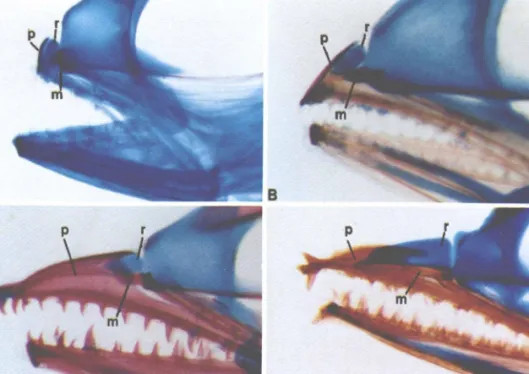
In most percoids and all outgroup taxa, the maxilla and premaxilla are free to move independently of each other and of the snout.

GEMPYLIDAE + SCOMBRIDAE + BILLFISHES
Short, widely spaced, disjoint fin rays characterize the posterior portion of the dorsal fin of most scombroids. The character appears only twice on their cladogram—a derived state (presumably 35–170) is indicated at the Trichiuridae-and-above node, and a reversal (24–26) is indicated as a synapomorphy of the billfishes. State is independently derived for gempylines plus trichiurines and for all scombrids above Grammatorcynus. 1984), is a synapomorphy of Trichiurinae.
A derived condition, development of the dorsal dorsal fin before the soft dorsal fin characterizes all gempylids, and all scombrids except the Scombrini and Grammatorcynus. The distal portion of the proximal-middle radial and the distal radial are longitudinally expanded, so that the first spine lies well anterior to the second. Concomitantly, there is a moderate (in Lepidocybium and Ruvettus) to extreme (all other gempylids) plate-like expansion of the vertical shaft of the first dorsal pterygiophores.
Gempylids share a unique mode of articulation between the proximal-middle and distal radials of the spinous dorsal pterygiophore ( Figures 8B,C and 9C-E ). This is a unique apomorphy of the Gempylidae; the articulation is further modified in trichiurines (see character 30). In most percoids, all outgroup taxa, and all scombroids except trichiurines, the posterior margin of the opercle and subopercle and ventral margin of the lacrimal bone are complete.
Of the original canal-bearing infraorbital bones, only the lacrimal and (in some) the second and/or third infraorbitals remain. An incomplete infraorbital sensory canal and absence of most of the bones that normally bear it is a synapomorphy of trichiurines. Rays of the soft dorsal fin of most acanthomorphs are bilaterally divided, segmented (at least distally), and have open bases that embrace the serial distal radial.
Spinous and soft-ray distal radials both initially appear in development as a knob of cartilage at the distal end of the proximal-middle radial. 1984) consider a 1:1 relationship of the second dorsal fin pterygiophores to neural spines (their character 21) an autapomorphy of trichiurines. In the outgroup taxa, the shelf originates from, and is limited to, the entire medial margin of the third infraorbital.
In most percoids, all outgroup taxa, Sphyraena and most gempilids (including Lepidocybium ), the upper and lower hypural plates remain separate from each other (no fusion between hypurals 2 and 3). 1984) suggested that fusion of the upper and lower hypural plates is characteristic of all scombrids and marine fishes except Scombrini, Gasterochisma and Grammatorcynus. The fusion of the upper and lower hypopural plates is a synapomorphy of scombrids (above Scombrini) and marine fishes.

SARDINI-THUNNINI + SCOMBEROMORUS + ACANTHOCYBIUM + BILLFISHES
There is no heavy coating of mucosal epithelium on the trailing edge of the filamentous blades. This organ arises from the superior rectus muscle of the eye and represents a unique synapomorphy of beaked fishes (see discussion of Gasterochisma). Fishes are the sister group of Acanthocybium, Collette et al. 1984) placed them as the sister group of the Scombridae.
The ambiguity detected by PAUP is the result of the distribution of the derived states of characters 1 and 2. The only other notable feature shared by the three families is the brush-like elongation of the epioccipitals. Treatment of Gempylidae is the most troublesome aspect of the analysis by Collette et al.
My analysis indicates that the Gempylidae (rediagnosed to include the gem pylids by Russo and the trichiurids by Collette et al.) constitute a monophyletic group that is the sister group of the scombrids plus fistfishes. Gempylids share several unique features of the dorsal and analfin pterygiophores and a specialized larval form. My analysis indicates that the most parsimonious placement of the fistfishes within the Scombroidei is as the sister group of Acanthocybium.
This hypothesis is somewhat more modest than that of Collette et al. 1984) who placed the marine fishes as the sister group of the Scombridae, but the discovery of a few additional characters could distort the situation with parsimony. Loss of the subocular shelf is common among perciforms and has clearly occurred several times in the evolution of scombroids. Additional support for the Acanthocybium-billfish connection is evident in the occurrence of five known species of the parasitic copepod Gloiopotes.
I am not convinced that Collette and Russo's analysis supports the hypothesized Acanthocybium-Scomberomorus sister group relationship to the exclusion of piscivorous fish, as they indicate. At least one character reported as a synapomorphy of Scomberomorus and Acanthocybium, the fusion of the fourth and fifth hypural, is incorrect. There is no more reason to reject the Gloiopotes evidence (or to dismiss it as an ecological coincidence) than any of the other associations that Cressey et al.
My ability to investigate various aspects of the osteology of most scombroid genera owes much to his willing cooperation. Niphon spinosus: a primitive epinepheline serranid, with comments on the monophyly and intrarelationships of the Serranidae.