12 The Transformation of Governance in the European Union Edited by Beate Kohler-Koch and Rainer Eising. 18 Public Opinion and the International Use of Force Edited by Philip Everts and Pierangelo Isernia.
Contributors
Series editor’s preface
Despite the limited number of cases examined, the contributions to this volume show that the chances for the use of new technologies largely depend on existing political institutions and the way in which they function. As with every technology, the use of new technology cannot be limited to benevolent enhancements of representative democracies or the enhancement of only social and political engagement.
Preface and acknowledgements
The Internet, Political Organizations and Participation Project (L), which provided much of the theoretical background and ideas on which the book is based.
1 Introduction
Do local politicians in Sweden believe in using the Internet in the political process? 2001) Democracy Online, London: Hansard Society. eds) (1999) Parliament in the Internet Age, Oxford: Oxford University Press.
2 Electronic democracy and the ‘mixed polity’
Second, decisions made and actions taken on behalf of the public must. The New Challenge of Direct Democracy, Cambridge: Polity Press. eds) (1999) Parliament in the Age of the Internet, Oxford: Oxford University Press.
3 The citizen as consumer
It called on the government to: 'Promote citizen participation in democracy as part of the UK online citizens' portal' (Office of the e-Envoy 2000). As the opportunities to leverage the Internet to deliver services became apparent in the mid-1990s, online delivery became a goal of the NPR and the subsequent Reinventing Government initiative. The third common feature of the development of government websites in the United States and the United Kingdom was the increasing identification of users of the websites as consumers and customers, alongside or even instead of.
In the United States, an early priority of the Clinton administration was to deliver benefits online (through the Electronic Benefit Transfer System), including Social Security, Medicare, and Medicaid. Davis is highly critical of the quality and content of information offered online in the United States. In the United Kingdom, the first e-envoy Alex Allan seemed to demonstrate a keen awareness of the consultative potential of the Internet, arguing:
In both of these cases, there was no noticeable impact on the outcome of the hearing. It is now considered one of the most successful local e-democracy initiatives. 2001a) 'Interaction Between States and Citizens in the Age of the Internet', paper presented to the American Political Science Association, San Francisco, August, http://pro.harvard.edu/abstracts/040/040004ChadwickAn.htm, first accessed 16 .September 2001.
4 Digital parliaments and electronic democracy
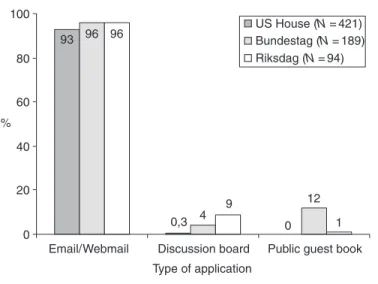
They also do not put their finger on the general problem of conceptual shortcuts in the e-democracy debate. In contrast, in the German Bundestag and the Swedish Riksdag, the committees are not using websites at all and MPs are still a minority online. In the Swedish Riksdag, even the parliamentary party organization has no online presence.
Unfortunately, we do not have quantitative data on the development of personal websites in the US House, Riksdag, and Bundestag. In another step of our analysis, we asked whether personal websites in the US House, the German Bundestag, and the Swedish Riksdag promote access to this type of information. One of the main arenas regarding the debates on the institutional ramifications of the Internet in the German Bundestag has been the special commission (Enquete).
The preceding analysis reveals trends towards more participatory schemes of political representation in the process of setting up networked parliaments. We should rather emphasize the influence of the political context on the future of political representation in the networked society. Democracy? Aldershot: Ashgate. eds) (1999) Parliament in the Internet Age, Oxford: Oxford University Press.
5 Digital democracy
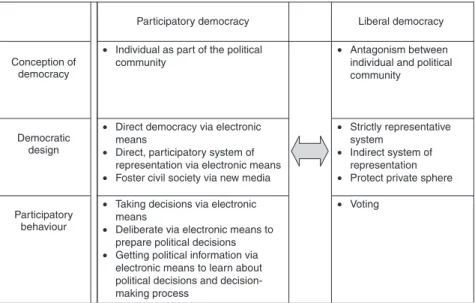
Budge (1996) believes that the development of the Internet makes direct democracy possible in a mass society for the first time. In the model of indirect democracy, only the members of the political elite participate fully in the political process. The data is based on a questionnaire sent to the Swedish chairmen of the municipal council.
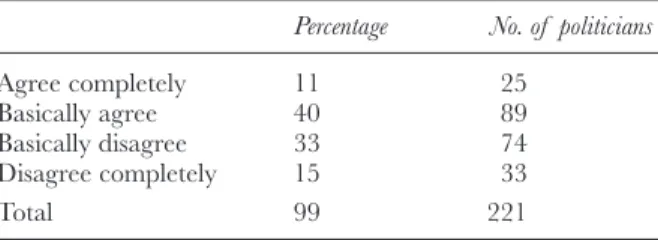
More than 80 percent of respondents agree that technology has the potential to improve the quality of democracy today or in the future. This argument forms an important part of the direct as well as the interactive model of democracy. Most websites had this technology available; 75 percent had the email address of the chairman of the municipal executive committee.
The most significant finding, however, emerged in the third part of the chapter and concerns the lack of causality between the expressed intentions of politicians and local government initiatives. Second, it is clear that politicians' access to and knowledge of the Internet has received little attention. 1999) 'The Internet and Australian Parliamentary Democracy', in Coleman, S., Taylor, J. eds), Parliament in the Age of the Internet, Oxford: Oxford University Press. eds), Land, du välsignade? Gothenburg: SOM-institutet. 1989) Democracy and New Technology, Cambridge: Polity Press.
6 Cyber-campaigning grows up
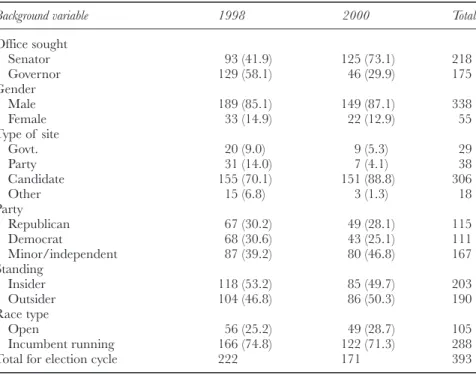
Signs of the Internet's importance also emerged at the local level in the 2000 mayoral race in Snellville, Georgia. Evidence of this growing commitment can be seen in the financial resources channeled toward online campaigns. Overall, more US candidates used the Internet in the 2000 election relative to the large number of Web sites.
Female candidates in the 2000 US Senate race were found to have used a greater percentage of the Web's interactive capabilities than male candidates (Puopolo 2001). In the United States, Republican websites were found to outperform Democrats in 1996 in terms of the information offered about the candidate's political views and amenities. In addition to the types of content available, researchers examined the sites' focus and tone.
For example, the percentages of pages analyzed were the pages of Senate candidates and 58.1 percent of gubernatorial candidates. We supplemented the content analysis with measurements of the focus and tone of the homepage of the website. As Table 6.3 reports, there were no marked differences in the overall tone of cities by election cycle.
7 Global legal pluralism and electronic democracy
The ability of the Internet to shorten space and time barriers is at least. The consent of the state is ensured by the actions of its proxies (state officials) and is thus only indirectly related to the wishes of the state's citizens (Petersmann 1999). First, when the value of N (pool of potential contributors) is relatively large compared to K (threshold community), the importance of each individual.
The introduction of the Internet should significantly reduce the transaction costs associated with organizing a threshold community. However, the impact of the network is not limited to the issue of participation/coordination costs. The introduction of the network can also affect the long-term dynamics of the transnational interaction.
None of the NN players will have an incentive to participate because for them CiVi(Pg). Thus, any viable coalition of the base game will constitute a solution to the repeated game. ICANN (1999) 'The Membership Advisory Committee Commentary on the Principles of the At-large Membership' http://www.icann.org, first accessed 29 November 2000.
8 Problems@labour
In its simplest sense, globalization refers to the "increasing economic integration of the world" toward a global as opposed to an international economy characterized by increasing interconnectedness and. Since the end of the Cold War, there has been a marked escalation in the international activities of trade unions and labor movements. It is in this context that many unions, grassroots activists and labor academics have begun to wonder about the possibilities and activities of the Internet for both union revival and labor internationalism.
The most important aspect of the Internet for internationalism is its ability to store, process and enable additional and alternative hyper-fast 24-hour cross-border information sharing between unions worldwide. Organizational-solidarist perspectives focus on the informational and organizational benefits of the Internet for subjective solidarity building through building a global worker culture within the existing international trade union movement and would best describe Lee's (1997) and Bailey's (1997) position. ) position. There is little doubt that the informative, organizational and solidarity qualities of the Internet are increasingly being used by national and international trade union organisations.
The Internet was crucial to the success of the Australian dockers' 1998 dispute with their government in 1998. Lee (2000c: 5) states that within days of the dispute's start 'the threat of a boycott of the Australian shipping arose. Gittler, A. 1999) ‘Mapping Women’s Global Communications and Networking’, in. ed.), Trade Unions and the New Industrialization of the Third World, London: Zed Books.
9 Rethinking political participation
This is in stark contrast to the lack of formal representation in the Westminster Parliament of the British Green Party. Organizational form is often a reflection of the ideological, cultural or economic goals of its participants. Integral to the choice of organizational form for a group is an understanding of the strategy through which environmental protection or social justice may be.
In comparison, more formally hierarchically structured environmental organizations have a greater number of stages through which approval can be obtained for the use of a technology which may delay or limit the adoption of ICTs. A particularly innovative aspect of ICT use at Woomera2002 was the development of the PIMP system – the Phone indymedia Patch System:. Despite the fact that it was a non-hierarchical group, the use of ICT caused the development of a group of those individuals who were most involved in the use of the technology.25 An informal core had the use of ICTs and subsequently largely controlled their implementation.
At Woomera2002, the radicality of the actions meant that some information (such as the location of refugees) was sensitive and therefore not published online. A test of core exclusivity is the extent to which non-collective members participate in projects such as desert.indymedia. Moreover, the official stages through which information must pass to be published on the national FoE website reinforce the hierarchical structure of the organization on any use of ICT.