The Welfare Experiments:
Politics and Policy Evaluation
ROBIN H. ROGERS-DILLON
STANFORD LAW AND POLITICS
Politics and Policy Evaluation
ROBIN H. ROGERS-DILLON
Stanford Law and Politics an imprint of stanford university press stanford, california
2004
www.sup.org
© 2004by the Board of Trustees of the Leland Stanford Junior University.
All rights reserved.
Library of Congress Cataloging-in-Publication Data Rogers-Dillon, Robin.
The welfare experiments : politics and policy evaluation / Robin H. Rogers- Dillon.
cip:Includes bibliographical references and index.
ISBN 0-8047-4730-X (cloth : alk. paper)—ISBN 0-8047-4746-6(pbk : alk. paper) 1. Public welfare—United States. 2. United States—Social policy—1993–
3. United States—Politics and government—1993–2001. I. Title.
HV95.R58 2004
361.6'0973'09049—dc22 2004001027
Printed in the United States of America on acid-free, archival-quality paper.
Original Printing 2004
Last figure below indicates year of this printing:
13 12 11 10 09 08 07 06 05 04
Designed and typeset at Stanford University Press in 10/12.5Palatino.
Special discounts for bulk quantities of Stanford Law and Politics books are available to corporations, professional associations, and other organizations. For details and discount information, contact the special sales department of Stan- ford University Press. Tel: (650) 736-1783, Fax: (650) 736-1784
List of Figures ix Acknowledgments xi
1. The Politics of Pilot Programs 1 2. Hope and an Experimental Design 23 3. The History of AFDC 51
4. Florida’s Family Transition Program 73 5. Street-Level Policymaking 100
6. Revolution in the States 134
7. The Rhetoric and Institutional Politics of Policy Experiments 159 Afterword: “Superwaivers” 181
Appendix 1. Methodology 193
Appendix 2. Who Was Compliant? 205 Notes 211
Bibliography 231 Index 243
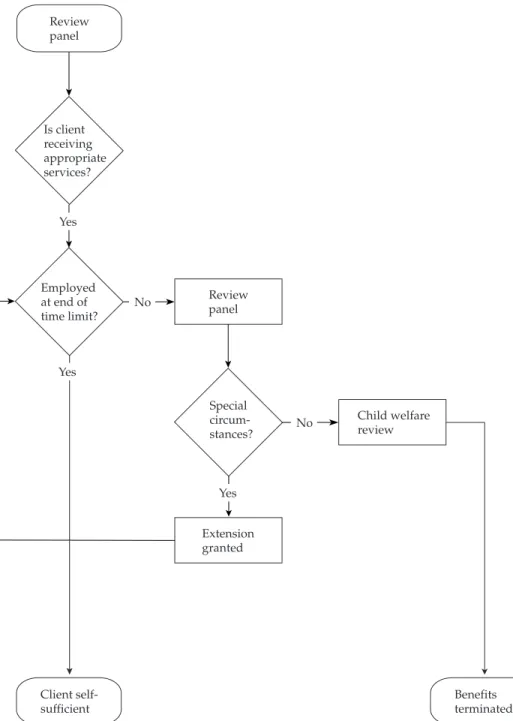
4.1 Flow of clients through FTP as outlined in the
Family Transition Act 79
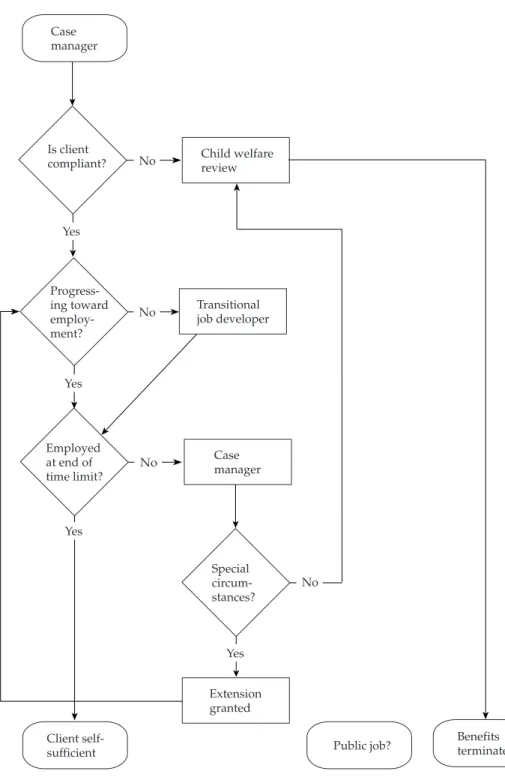
4.2 Flow of clients through FTP as amended by the
federal waiver 86
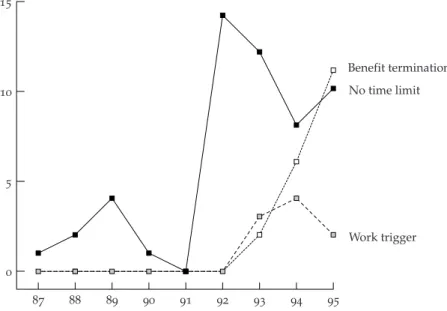
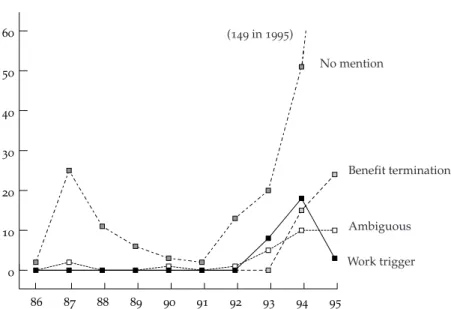
4.3 Flow of clients through FTP as implemented 91 6.1 Waiver requests by type of time limit, 1987–95 154 6.2 Types of time limits specified in articles on welfare
reform, 1986–95 155
I received so much support during the research and writing of this book that attempting to acknowledge these contributions is daunting. I will fall short of the task. Since there is no way to quantify the generos- ity and importance of each contribution, I will order my thanks chrono- logically. First, I would like to thank the Women’s Research and Educa- tion Institute (WREI) for giving me the opportunity to work as a Congressional Fellow for Congressman Charles Rangel in 1995/96—
the height of welfare reform. It was an extraordinary opportunity. I also wish to thank Congressman Rangel and his staff, who permitted me to become involved in welfare reform at a level that went far beyond any of my expectations.
Next, I would like to thank the Manpower Demonstration Research Corporation (MDRC), particularly Dan Bloom and Judith Gueron. Al- though I critique the role that evaluation companies played in the 1990s, I have great respect for the people with whom I worked at MDRC and am personally grateful for the opportunities that they gave me. I also wish to thank the administrators and staff involved in Florida’s Family Transition Program (FTP), particularly Shirley Jacques and John Bouldin. They are remarkable administrators and very gener- ous people.
At the University of Pennsylvania, Robin Leidner, Harold Bershady, Jerry Jacobs, and John Skrentny provided me with great intellectual support and mentorship. At New York University, Lawrence Mead de- serves special thanks for both the longevity of his support and its re- silience. My interest in welfare was ignited in the late 1980s in his un-
dergraduate class on poverty and social welfare. Since then, Larry has been a great mentor and critic. I like to think that we share a commit- ment both to rigorous research, about which we usually agree, and to the good society, where our differences emerge. I hope that as a teacher I bring the same critical support to my students that Larry has brought to me.
The Robert Wood Johnson Foundation and the Institute for Social and Policy Studies (ISPS) at Yale University provided me with a re- markable intellectual home from 1998to 2000as a Robert Wood John- son Health Policy Scholar. At ISPS, I had not only the luxury of time for my research and writing but also the unique opportunity to engage in debate and discussion with outstanding scholars, both established and emerging. Ted Marmor and Mark Schlesinger in particular were gener- ous with their time, which was limited, and their intellects, which ap- peared to have no limits at all. The Health Policy Scholars at ISPS, John Evans, Rogan Kersh, Taeku Lee, Gary McKissick, Eric Oliver, Mark Suchman, Ingrid Ellen, and Brian Gran contributed greatly to my think- ing on health, poverty, public policy, and many others issues, and I thank them.
I would also like to thank my colleagues at Queens College, my in- tellectual home since 2000. Donald Scott, Dean Savage, Charlie Smith, and Hester Eisenstein helped me to find protected research time and provided me with great mentorship. Andy Beveridge, Bernard Cohen, and Charles Turner provided valuable comments on drafts of chapters in the manuscript. Victoria Pitts, my “senior” colleague by one year, has provided wise and often humorous counsel. I would like to make a special acknowledgment of four wonderful students from Queens Col- lege who contributed to the research for the Afterword, Sreekan Cheruku, Enge Ibrahim, Judith Rivera, and Michael Uvaydov. Shree, Enge, Julie, and Mike are proof that the City University of New York, particularly Queens College, attracts some of the best students in the world. David Humphries, a CUNY graduate student, provided me valuable editing and research assistance. I would have been lost with- out him.
I owe one of my greatest debts to Mary Jo Bane and David T. Ell- wood of Harvard University, who agreed to talk with me and enriched this book immeasurably. Another great debt is to Steven M. Teles of Brandeis University. His intellectual generosity and insight are unpar- alleled, and his influence is woven throughout this book. Jill Quadagno read and commented on draft chapters of the manuscript. I am eter-
nally grateful for her support of this project and remain in awe of her intellect. Anonymous reviewers of earlier drafts of the manuscript for Stanford University Press also provided incisive comments. I would also like to thank Lynne Haney of New York University, my co-investi- gator on another project, for graciously reading and commenting on material for the book. Jonathan Imber, the editor of Society, has given me the opportunity to write on issues of welfare policy in that out- standing publication. Some of the ideas that are explored in Chapter Seven of this book were initially raised by me in articles that appeared in Society. Finally, Amanda Moran, my editor at Stanford University Press, has energetically supported this book. An author could not ask for more.
I also received considerable personal support during this project.
First and foremost, I want to thank my husband Chris, to whom this book is dedicated. Our son Nicholas was a year old when I began my residence at the Institute for Social and Policy Studies at Yale and spent the better part of each week away from my family in Brooklyn. Chris picked up the baby and helped me with my bags without a hint of dis- sent. Before and since, Chris has given me tremendous freedom—a room of my own as prescribed by Virginia Woolf—while still being his wonderful and highly original self. I am also indebted to my father, D.
W. Rogers, who conveyed his respect for women’s intelligence so thor- oughly that I was shocked as a young adult to find that the sentiment was not universally shared. Finally, I would like to acknowledge my mother, Kay Rogers, who grew up in a time and a town where college education for women was considered unnecessary, and then sent her daughters off to graduate school. This book would not have been pos- sible without her.
c h a p t e r
The Politics of Pilot Programs
I think it is fair to say the debate is over. . . . We now know that welfare reform works.
President Bill Clinton, 1997
The Personal Responsibility and Work Opportunity Reconciliation Act of 1996(PRWORA) presents a riddle. For decades, substantial wel- fare reform had stalled at the federal level. The reform efforts that did pass, notably the Family Support Act of 1988, were watered down as they worked their way through the massive welfare bureaucracy. Ef- forts at reform had, at best, a slight impact on the majority of welfare re- cipients. Aid to Families with Dependent Children (AFDC) seemed to be a large bureaucracy that would withstand the most virulent political attacks by virtue of its sheer size and age. Then something odd hap- pened. The system crumbled in the span of a few years. The demise of welfare was a matter of fact. Time-limited welfare, a radical departure from AFDC, was taken for granted as an obvious solution to a failed policy just a few years after even minor alterations to AFDC seemed to be a political impossibility. How did this happen?
To address this question, we need to look beyond the traditional ac- tors in policymaking—the interest groups, members of Congress, and presidential administrations. All of these actors were important in wel- fare reform, but they do not fully explain the dramatic restructuring of the American welfare state that took place in 1996. President Clinton’s pledge to “end welfare as we know it” in his 1992 presidential cam- paign laid the groundwork for radical reform of the welfare system.
1
The slogan “two years and you’re off” famously, and unintentionally, paved the way for Temporary Assistance for Needy Families (TANF).1 The Republican takeover of Congress in 1994increased the momentum for welfare reform. In fact, welfare reform was one of the stated objec- tives in the Republican Contract with America, the platform on which many Republican members ran for office and won.
Yet even this constellation of factors fails to explain why such pro- found changes in the American welfare state passed with so little fan- fare and why what had been an unthinkable policy idea became the ob- vious solution to reforming welfare in such a short period. To answer that question, we need to understand the political role of the experi- mental welfare pilot programs and how they became a part of the pol- icy-making process.
The case of welfare reform in 1996raises a set of larger questions:
How is public policy made? How do we decide whether a new policy idea will work? Who determines which path to take when there are competing ideas? Historical institutional research has placed consider- able emphasis on the role of overtly political actors—legislators and in- terest groups—in garnering support for favored policy ideas. In this book, I argue that there is a critical and largely unrecognized institu- tional channel in social policymaking—experimental pilot programs.
Pilot programs are designed to test new policy ideas. They permit pol- icy innovations to leave the realm of political debate and to come to life in programs that affect real people, programs that can be observed and whose results can be measured. They demonstrate to the public and policy elites whether or not a policy will work. Defining what works is a powerful political tool. It is particularly powerful if the definition of what works is framed as a scientific assessment objectively determined outside of the political realm.
Yet pilot programs, as this book demonstrates, are not neutral, and they are not outside of the political process. The very existence of a pi- lot program is often a part of a larger political strategy. Pilot programs can be used to send an idea “to committee” in order to placate advo- cates of a proposed policy even if the broader initiative is dead in the political waters. Similarly, pilot programs can postpone a political con- flict, on the basis that “more research is needed,” until a time when pol- icy actors find more advantages.2Political actors can use pilot programs to claim credit on a policy issue that is not moving through normal leg- islative channels and thus avoid the consequences of failing to act on a popular policy issue. In the early 1990s, experimental welfare pilot pro-
grams were used by both Democrats and Republicans to claim progress as the federal legislative process stalled.3 Evelyn Z. Brodkin and Alexander Kaufman have argued that pilot programs “have a tactical utility in the competition for space on the policy agenda.”4As Wiscon- sin governor Tommy Thompson so brilliantly demonstrated with his highly visible welfare reform pilot programs, pilot programs can also define a policy idea and set the terms of a political debate.
Policy choices are about values and technical efficacy. Political rheto- ric often emphasizes values. What do we want this country to do? What is the proper role of the government? What are America’s fiscal and po- litical priorities? The political realm is home to issues of values and pri- orities. Technical policy questions on the surface appear to be more con- crete. Will a policy do what we want it to do? Will it work? Thus, policy questions are often understood to go through a process from the ab- stract, value-driven decision that the goal of a policy is desirable, to the specific, technical question of what means will attain that goal.5Policy specialists ostensibly have the task of making sure that legislation is technically sound and will promote the values and priorities promised in the original debate. Administrators, in the final stage of bringing a policy to life, are charged with effectively implementing the policy and sorting out the ground-level technical details.
In American culture, however, efficiency and effectiveness are often raised to the level of values themselves. Given this reality, is it then pos- sible to separate the technical from the political? In the quote that began this chapter, Clinton hailed welfare reform by stating “the debate is over. . . . We now know that welfare reform works.” Clinton did not claim that good had triumphed over evil, but rather that a system that workshad replaced a broken one. American politicians often invoke the practicality of their ideas to gain popular support. In effect, they say:
“My ideas work, my opponents’ do not.”
Technical questions, however, are not completely separate from po- litical questions. Claiming that a policy idea works is politically power- ful in itself. This is particularly true if the claim is based on evidence purported to be “scientific.” As I will argue, such evidence often has lit- tle connection to social science. Nonetheless, Americans hold great faith in clinical tests. We believe that nearly all ideas can be scientifically tested and their value empirically proven. Americans are deeply suspi- cious of politics and scientific approaches appear, occasionally, to pro- vide a viable alternative.
Deborah A. Stone has argued that America is engaged in a “rational-
ity project.” “The fields of political science, public administration, law, and policy analysis,” Stone writes, “have shared a common mission of rescuing public policy from the irrationalities and indignities of politics, hoping to conduct it instead with rational, analytical, and scientific methods.”6Even the language that we use to describe the study of pol- itics and society reveals a faith that they can be rendered orderly. Our universities teach political scienceand policy analysis. Our studies of politics and society are housed in divisions of social science. The quest for rationality is particularly strong in the face of the disorder that nor- mally characterizes politics. Americans diligently have sought to ex- pand the former in order to minimize the latter. As Stone notes, “In- spired by a vague sense that reason is clean and politics is dirty Americans yearn to replace politics with rational decisionmaking.”7
A faith in rationality is as central to American identity as is our dis- trust of politics. There is nothing inherently wrong with the American quest for rationality. Our constitutional structure, in one supremely noteworthy example of the triumph of rationality, has produced a sta- ble, prosperous democracy that is to be marveled at more than criti- cized. And I am partial to a legal system based on, at least in principle, reason rather than authority. But there is a point at which the rational- ity project fails. Rather than encouraging knowledge and understand- ing, it obscures truths that do not fit within its rubric. The rationality project becomes procrustean.
In this book, I argue that this faith in the power of rationality to cleanse politics has caused us to overlook the political role of policy ex- periments. Testing policy ideas has not taken policy out of the political realm and placed it into the scientific realm; rather, it has created an in- stitutional role for experimental programs in the policy-making process. Looking at the political role of policy experiments does not di- minish the value of social science research or rationality. Instead, it takes away the blinders that social scientists put on in an attempt not to be distracted from empirical policy evaluation by passing political fash- ions. The desire to remove policy evaluation from politics is a noble one. The idea that “everybody’s entitled to their own statistic” makes people who believe that the world does exist in some measurable way wince. We can do better than that. There is, however, an expanse of ter- ritory between the idea that research is nothing more than politics dressed up in fancy statistics and the idea that social research, particu- larly policy research, can ever fully be extracted from its political con- text.
In this book, I argue that researchers, particularly those involved in policy evaluation, have erred too far in the latter direction. The claim that research can be extracted from politics emanates from two related facts. First, trained and committed evaluation researchers believe that research can provide important and real results that are relevant to so- cial policy. I believe that, too. Second, as policy evaluation became pro- fessionalized in the late 1960s and 1970s, it had to establish its own do- main—what do evaluators do that is different from what other social scientists do? Why should the government listen to evaluators and, in fact, fund them? Here, I believe, evaluators began to stretch their ability to separate policy research and politics beyond the breaking point. In it- self, this is not an unusual or particularly dangerous phenomenon. Pro- fessional groups often exaggerate the distinctiveness of their practices in order to make clear that only those within their fold are capable of providing particular services. In this case, however, the claims of eval- uators had a ripple effect beyond the professional realm. The public ac- cepted the fictitious divide between politics and policy evaluation.
The divide between politics and policy evaluation is inherently at- tractive. It fits with America’s pragmatic bent toward politics—our taste for “what works” over ideological solutions. The best that social science can truly do, however, is to make clear what is involved in a particular program: the outcomes, how the programs actually func- tioned on the ground (not only as written), and the normative and value conflicts inherent within the program both on paper and in prac- tice. Social science cannot tell us “what works” because “what works”
is not solely an empirical question. It is a political one. In the 1990s, the professional claims making of evaluators obscured the political aspects of social experiments. Not surprisingly, politicians then put the fiction of apolitical policy experiments to their own political uses.
Pilot Programs and Welfare Reform
The 1996Personal Responsibility and Work Opportunity Reconciliation Act would very likely not have passed without the pilot programs, which were also known as “waiver” programs because they required the federal government to waive AFDC requirements. Although it is impossible to rule out completely that some other political and institu- tional structure could have produced welfare reform, the evidence that the pilot programs played crucial roles in shaping the policy details of
PRWORA is compelling. It therefore merits looking beyond the con- ventional wisdom that policy experiments play a minor political role. In PRWORA, theempirical resultsfrom the numerous welfare reform ex- periments that preceded it were politically unimportant. However, the existence of the pilot programs reshaped the political landscape and made reform possible.
The pilot programs from 1992to 1996redefined what welfare means in the United States. They did not simply tinker with welfare-to-work programs or make small changes in the incentive structure within wel- fare. These programs redefined welfare as a temporary program rather than an entitlement. They abolished the entitlement to welfare in the public mind well before Congress ended it. More importantly, the pilot programs engaged the public through widespread media coverage. The previous pilot programs were in the domain of experts. The welfare ex- periments of the early to middle 1990s were in the public eye. Covered on the nightly news and in numerous newspaper articles, the welfare experiments changed the politics of welfare reform more visibly and dramatically than ever before.
Pilot programs are “shadow institutions” in the political process.8 They are a way of taking policy ideas and publicly determining whether the ideas are viable. They are also fundamentally tied to the political process both in their administration, which is often filled by political appointees, and in their public role as an institutional channel through which the viability of a public policy is determined. Yet, they do even more than provide an institutional arena for policy ideas that buffers them from the political climate. Pilot programs show us whether the policy will “work” or not. They provide a glimpse of a newborn idea and shape our expectations of what the mature policy will look like well before the evaluation results are out. Arguably, pilot programs are most powerful before the evaluation research is complete, when they have been removed from politics but are not yet mired in empirical results.
Pilot programs can also serve the structural function of weakening policy legacies from below, as they did in the welfare reform experi- ments of the early 1990s. The structure of an existing program is often altered to permit a temporary experiment. By putting new administra- tive structures and procedures in place, even temporarily, the inertia of the old system is broken, creating an opportunity for permanent re- form. Pilot programs, therefore, do not just test policy ideas; they play a political and structural role in the policy-making process. Pilot pro-
grams define the reality of the abstract ideas being debated. They change the bureaucratic structures of the institutions being targeted for reform. In the mid-1990s, pilot programs made time-limited welfare a reality and took away the argument that it could not be done.
This book is about the macro- and micropolitics that made time-lim- ited welfare possible. By analyzing the political role of the pilot pro- grams in an institutional framework, I hope to contribute to a stronger theoretical conceptualization of how and why welfare reform passed in 1996. More broadly, I aim to bring the experimental pilot programs—
shadow institutions—out of the shadows and into mainstream political institutionalist theories of American policy development in sociology and political science. The role of the pilot programs in the welfare de- bate is a central feature of the book. Yet there is strong evidence that the pilot programs did more than shape the debate. These programs struc- turally changed the institutions that provide public assistance, the wel- fare offices themselves, which were notorious barriers to reform.9
The pilot programs eroded the institutional structures of AFDC and made it possible for a new welfare program to take a radically different direction without being dragged down by existing institutional struc- tures and memory. To understand the street-level impact of pilot pro- grams and welfare politics, it is important to look inside the “black box” of implementation. The public faith that policy experiments are re- moved from politics is what gives experimental programs their politi- cal power. Looking inside the “black box,” it becomes clear that these programs are not removed from politics and, furthermore, that they cannotbe removed from politics. Here I wish to make an important dis- tinction. I do believe that policy experiments can and should be pro- tected from overt political manipulation and “cooking the books.”
What cannot be removed from pilot programs is the political and ad- ministrative context in which they operate, which shapes program out- comes even without overt political manipulation or pressure. It is bet- ter for policy evaluation to recognize the inherently political nature of that which it studies than to obscure those aspects of pilot programs that do not fit cleanly into the framework of scientific experimentation.
The refusal to acknowledge political dynamics that are plainly there has political implications of its own, often unintended, and violates the em- piricism of social science research.
The metaphor of states as “laboratories of democracy” has domi- nated and distorted our view of pilot programs. The legitimacy of eval- uation research appears to rest on its ability to render what is funda-
mentally political apolitical. Yet evaluation research can become more important, not less so, if it incorporates research on the political context of implementation more fully into its mandate. Evaluation research and research on welfare state development should not remain as distant as they are now. By developing a sophisticated understanding of the com- plex political and organizational contexts that create pilot programs and provide us with a vision of “what works” in social policy, evalua- tion research can demonstrate the ways in which street-level imple- mentation creates and is created by larger political forces. In turn, polit- ical theorists can incorporate the shadow institution of pilot programs into their understanding of the structural and institutional factors that contribute to the development of the American welfare state. The story of how the 1996welfare reform came to be shows why such broad con- siderations are important to our understanding of the politics of social policy and evaluation research.
Politics and Policy Evaluation
Much of contemporary policy evaluation grew out of the War on Poverty in the 1960s.10 Ambitious new social programs begged the question: Do they work? If America was going to wage a war on poverty, it needed some way of measuring its gains and losses. The government required and funded evaluations as a part of many of the new policy initiatives, including education reforms and community health services. The rise of policy evaluation came out of a profound faith in the ability of science to make daily life better and more rational.
Policy evaluation helped to build a body of knowledge concerning which policy ideas were effective and, perhaps even more importantly, which were not. Evaluation also served an auditing function, ensuring that procedures specified in the policy were actually followed. There was great optimism that the marriage of policy and research would produce and verify vastly improved social programs. Evaluations, however, often brought back dismal news. Few social policies, no mat- ter how ambitious or eagerly anticipated, produced positive measura- ble results.
The aspirations for policy evaluation were not matched by their achievements, though there were moments of triumph for policy eval- uators. The results from randomized policy experiments, for example, played a prominent role in shaping the Family Support Act of 1988. The
manifest power of evaluation results in shaping public policy, however, has been limited by the mismatch between research and political timetables. Program outcomes take time to produce. Windows of polit- ical opportunity are short-lived. Moreover, evaluation results, when they do come in, are rarely dramatic enough to shift a political debate.
Experimental pilot programs, therefore, did not fulfill the dream of making public policy rational and scientific. For that reason many po- litical scientists and even policy analysts dismiss them as having little to no impact on policymaking. In his otherwise excellent book on the politics of the 1996 welfare reform, Ending Welfare as We Know It, R.
Kent Weaver limits his discussion of the role of pilot programs to the impact of the evaluation resultson the policy-making process. He over- looks the pilot programs’ structural and symbolic roles entirely. Per- haps because evaluation grew out of academia and, to paraphrase Henry J. Aaron, the Great Society’s “politics of the professors,” scholars have been surprisingly reluctant to examine the political role of policy experiments. Perhaps there is a fear that acknowledging the political dynamics of policy experiments will undermine their credibility and make the objective facts that social science can produce appear to be no better or worse than statistics generated by stridently ideological Wash- ington think tanks. Yet fears that acknowledging the realpolitik11of pi- lot programs will diminish the purity of social science research is not sufficient justification to blind ourselves to the politics of policy experi- ments. Wishing for clean experiments and seeking objective truth should not obscure the messy political realities of policy evaluation.
Otherwise, professional policy knowledge can obscure as many aspects of social policy as it illuminates.12
The Paradoxes of Welfare Reform
There are two key paradoxes of welfare reform. The first and more su- perficial paradox is how an almost universally despised social program resisted political reform for such a long time. AFDC, commonly known as welfare, had been unpopular since the late 1960s. By the late 1960s, it had come to be seen as a program that supported the “undeserving”
poor. By the mid-1980s, it had become a lightning rod for political anger toward big government. Yet for years the program stood largely un- touched by meaningful reform.
The paradox of an unpopular yet politically invulnerable AFDC is
easily resolved. Public policies, as scholars such as Theda Skocpol and Paul Pierson have noted, create policy legacies that shape our future policy choices.13Simply put, once a policy is adopted it is difficult to veer too far away from that policy’s direction. Social policy tends to move in small steps. We know from economists that we value a dollar that we lose more than a dollar we are given. This, too, has an impact on public policy. Once a benefit is given, it is hard to take that benefit back; constituents may exact their revenge at the next election. Public policies with large bureaucracies also become institutionally en- trenched. Thousands of offices, hundreds of thousands of employees, computer systems, and funding streams all are a part of the adminis- tration of public programs. These programs not only support recipients but also fill buildings, create job ladders, and build pension plans. They create institutional memory. The rules of a program exist not only on paper but also in employees’ memories, in their sense of how things are done, were done, and should be done. So it is perhaps not surprising that a social program as large and as old as AFDC resisted reform. The political institutionalism perspective helps to explain the paradox of a politically unpopular social policy that resisted change by pointing to the policy legacy and deep bureaucratic entrenchment of AFDC.
More difficult to explain is how welfare fell so quickly. Aside from cutbacks in the real value of welfare payments, the program was noto- riously difficult to change. Gaining sufficient political support to pass reform was exceedingly difficult and the little reform that did pass was diluted in the vast bureaucracy. By 1993, the welfare program was deeply reviled but federal welfare reform efforts faced political grid- lock. To understand the rapid demise of AFDC, we must look at the state-level welfare experiments of the early 1990s. Saddled with the strong policy legacy and entrenched bureaucracy of AFDC, welfare was all the more difficult to reform because most of its recipients were chil- dren. There was a political danger, and arguably real concern, that rad- ically overhauling the safety net could harm children. In response to these obstacles, Clinton encouraged and promoted experimental state welfare programs to “test” new ideas.
Clinton’s expansive use of waivers may have come from his own ex- perience as governor of Arkansas. David T. Ellwood, a welfare expert from Harvard’s Kennedy School of Government who served as assis- tant secretary for planning and evaluation at the Department of Health and Human Services (HHS) in the Clinton administration, noted that Clinton always brought a governor’s perspective to welfare issues.
He was a governor, and he always viewed welfare through a governor’s eyes.
It was really interesting. . . . In general he felt, why should a bunch of federal bureaucrats decide what a state can and can’t try to do? So, he was enormously sympathetic. He saw a political side as well. But I think it was much more vis- ceral than that. . . . I just think that he fundamentally didn’t think that the fed- eral government should be getting in the way of states trying to do creative things and he was going to lean over backwards [to help the governors].14 It is not clear that Clinton used the waiver program as a part of an ex- plicit strategy to force congressional action on reform or to circumvent Congress, although the waivers did both of those things. He was, how- ever, aware that these experiments shifted policy-making—or at the very least policy-defining—power away from the federal government and to the states.
Mary Jo Bane, who served as assistant secretary for children and families at the Department of Health and Human Services until she re- signed to protest Clinton’s signing of the welfare reform bill, noted that Clinton’s primary interest in the waiver process was in giving the states, particularly the governors, greater flexibility.
It was pretty clear that the president saw the waiver process as a way of letting the states do welfare reform. It wasn’t that the president was opposed to the evaluations. He thought that that was great and almost always supported strict evaluation stuff. He was sort of a wonk at heart, or in one part of his heart. But the notion that these should be small experiments was not part of the way he thought about [the waivers]. And that became pretty clear early on. We would grumble about it, but it wasn’t on the table.15
Clinton encouraged the governors to use the waivers to circumvent AFDC rules and to encourage innovation in state welfare programs.
The waiver programs also built momentum for welfare reform while the Clinton Administration pursued other policy priorities, notably health care reform.
The ad hoc, governor-centered waiver process created its own mo- mentum. In addition to loosening federal constraints and permitting state innovation, the pilot programs legitimated policy ideas. Officials at HHS were aware of this dynamic. As Ellwood explained, “Our fear was as soon as you were there in the waiver process, as soon as you had indicated that you had no line in the sand, no stopping point on waivers, that legitimated [those policy ideas] or made more difficult the process of drawing lines in the sand on welfare reform nationally.”
According to Ellwood, President Clinton “didn’t see nearly as much
of the domino effect that we [at HHS] felt.”16This political miscalcula- tion by Clinton may be more responsible for sending welfare reform out of the administration’s hands and into the hands of the governors and congressional Republicans than the Clinton team’s use of the infa- mous slogan “Two Years and You Are Off” to describe a policy idea more accurately summarized as “Two Years and You Work.” “There was,” as Mary Jo Bane noted, “an interactive, almost a snowballing ef- fect of one set of waiver approvals [that] would lead to a set of ideas.”17 Quickly, these ideas spiraled away from the work-oriented programs that the administration favored and toward the firm time limits that ul- timately became law.
Governors found waiver programs to be politically popular and a good vehicle for national exposure. States quickly applied for permis- sion to run their own experiments. Mary Jo Bane explained the political motivation for the governors.
Every governor saw it as something to run on. Back in that period, welfare was a huge political issue both at the national level and at many states. It was im- portant in Bill Clinton’s election that he said we would end welfare as we know it. Governors were picking that up. And especially once some governors started to do it other governors felt like they had to have—or state legislators, depend- ing on who was the initiator—felt like they had to have their own welfare re- form plan and if they didn’t, they were somehow soft on welfare and could be vulnerable politically.18
Clinton and the governors were able to claim success at reforming wel- fare through waivers in spite of political gridlock at the federal level.19 This method of credit claiming, however, did more than score political points with the public. It also altered the debate around welfare. In par- ticular, it defined the meaning of time limits, which had been a popular but ambiguous concept in welfare reform.
Clinton had hoped to promote a “work-trigger” model of time-lim- ited welfare, in which welfare recipients would receive cash benefits for a period of time (typically two to five years) and then have access to public jobs but not to continued cash benefits. Republican members of Congress soon were promoting a different welfare reform idea—“ben- efit-termination” time limits, also known as “firm” or “hard” time lim- its. Firm time limits restrict cash benefits to a specified period after which recipients lack access to public jobs or continued cash benefits.
Confusingly, both models of time limits were known as “time-limited”
welfare.
In the late 1980s, strong work requirements for welfare recipients were controversial. There was concern that some welfare families would not be able to handle even supported work, jobs and job training programs embedded into social services in order to ease recipients’
transitions back into the labor market. By 1996, welfare reform with a firm time limit had passed, the states had regained their position as the locus of public assistance programs, and the federal entitlement to wel- fare had been eliminated. There are several competing theories about how this dramatic turn of events happened. None of the explanations, however, is sufficient without acknowledging the structural and politi- cal role of the pilot welfare programs.
Public Opinion, Public Values
One popular theory of why time-limited welfare passed with so little fanfare after years of stalling is that elected officials finally caught up with public opinion, which had been strongly opposed to AFDC for years. But is this true? Did public opinion support firm time limits? Can such dramatic political and institutional change really be attributed to policy actors “catching up” with what the public really knew all the time? It is clear that AFDC had been an unpopular program for years.
The “Welfare Queen” rhetoric of the Reagan era conjured up images of lazy, immoral women raising dangerous children and living too well at the expense of taxpayers. It is a stretch to argue that most lawmakers discovered the public’s distaste for AFDC only in the Clinton era. There was a well-mined trough of political capital in attacking welfare. If pub- lic opinion were truly the driving force behind welfare reform, why had it taken nearly thirty years of public disfavor to affect change? Perhaps public discontent had built up, like a pressure cooker, to finally compel change. R. Kent Weaver notes that public opinion by the 1990s hadbuilt up considerable power to pressure elected officials to reform welfare—
but not in the direction that reform ultimately went.20
Public opinion on welfare in the mid-1990s was unambiguously neg- ative. A1995Kaiser/Harvard survey showed that more than half of all Americans thought AFDC did more harm than good and only 7percent thought the program should continue to exist as it was.21Another poll found that a full 93percent of Americans favored work requirements for welfare recipients and 87percent favored providing public-service jobs to those who could not find private-sector employment.22Accord-
ing to the Kaiser/Harvard poll, however, only 16 percentof Americans favored cutting off welfare benefits after two years even to recipients who were unable to find a job. These numbers clearly support the ar- gument that the American public disliked AFDC and wanted reform.
But they are not by any measure a clear mandate for firm time limits.
They appear to support “work-trigger” time limits that place limits on cash benefits but then offer continued support in exchange for work.
Public opinion in the mid-1990s is best characterized as supporting what Lawrence Mead has termed the “New Paternalism.”23Paternalists advocate a supervisory approach to poverty. In particular, there was strong support for the idea that welfare recipients should be required to work for their benefits. The New Paternalist arguments emphasize the obligations rather than the rights of welfare recipients and accept con- ditional intrusion into the lives of welfare recipients by government agents. The core of the New Paternalist argument is that there are obli- gations of citizenship, most fundamentally work and civil behavior, and that the state has a right to enforce these obligations among those who receive state benefits.
Mead’s views on social welfare may have been more extreme than those of most Americans, but he did tap into widely held sentiments, at least toward recipients of need-based government programs. Few Americans in the mid-1990s seemed to be overly concerned about the work habits or civility of those who did not rely on any sort of public aid. Recipients of social insurance programs such as Social Security were not held to quite the same standards as recipients of need-based programs, although this may be because Social Security targets work- ers.24Regardless, the New Paternalists have a point—most Americans are not willing to help support others simply based on need or legal cit- izenship. There does seem to be a prevailing sense that some sort of so- cial solidarity and enforceable reciprocal obligations should be the foundation for public support. The New Paternalism—although tend- ing to be state-centered and authoritarian—draws from the liberal dem- ocratic values of equality and achievement. Proponents argue that as- sisting the able-bodied withoutreciprocal obligations goes against the core American values of work and independence.
Even if these feelings were particularly strong in the mid-1990s, it is difficult to prove that public values have ever been the primary force in motivating public policy. As John W. Kingdon suggests in Agendas, Al- ternatives, and Public Policies, national values most likely do influence the agendas of elected officials.25It is difficult, however, to make the
case that they directly shape the specifics of policy choices. Theda Skocpol sums up the problems with a national values explanation of policy choices. She writes, “proponents of this [national values] ap- proach have so far failed to pinpoint exactly how cultural values, intel- lectual traditions, and ideological outlook have concretely influenced processes of political conflict and policy debate.”26This point can be il- lustrated by taking an example that should, on its face, be most reflec- tive of public values: the referendum. Policies written and voted on by
“the public” should reflect their values. And yet we know that refer- enda are highly sensitive to manipulations such as the phrasing of a question and the monetary resources of a proposal’s backers. In fact, referenda arguably produce outcomes lessin line with our national val- ues than congressional votes.
Values and national mood may matter in terms of setting the tone and context of a debate, but ultimately individual actors in specific in- stitutions have to put pen to paper to create a policy. By any reading of the public opinion polls of the mid-1990s, New Paternalism in welfare was what most Americans supported. And yet it is not what passed.
TANF is based on firm time limits rather than on mandating work in re- turn for assistance. As a policy, TANF is more in keeping with small government conservatism and the work of Charles Murray, though Murray advocates the elimination of public assistance altogether.27De- spite this fact, there was little public outcry against terminating benefits and in favor of supported work. Public opinions and values did not translate directly into policy action.
A closer look at public opinion hints at why the public accepted the 1996welfare reform law. The Kaiser/Harvard poll shows that in 1995a majority of Americans, 52percent, favored experimenting with welfare re- form at the state level. In contrast, only 29percent favored reform at the national level.28It is important to recognize that by 1995many federal reform plans were entirely focused on giving the states the power to run their own welfare programs. National reform returning power to the states is not what the majority of people favored. They favored state-level experimentation.
Public opinion was unified in its disapproval of the AFDC program.
To many Americans, work and limited cash benefits sounded like a good alternative to endless welfare, but the details of what a new pro- gram would look like were unclear. It appeared in 1994and 1995that both Democrats, particularly the president, and Republicans were sup- porting the same general welfare reform idea—time limits. Yet mem-
bers of each party were hollering loudly that the other party’s propos- als would be catastrophic. Into this bizarre mix of surface consensus and partisan bickering stepped the governors and their experimental state waiver programs.
The waiver programs were (initially) small experimental welfare programs ostensibly designed to test new reform ideas. Most programs were authorized to run for five years. During the demonstration, a small group of people applying for public assistance would be placed in a model program that had new rules, such as a time limit on benefits.
Most of the waiver programs had significant evaluation components.
At the end of the experiment, the outcomes for participants, such as their incomes and marriage rates, could be measured and compared to a control group receiving the old AFDC program. In this way, the pilots could provide a “test” of radical new welfare ideas without disman- tling the federal safety net.
The pilot programs were everyone’s darling children. The president facilitated welfare reform through the state waiver programs, and pre- dominantly Republican (and a few Democrat) governors took full ad- vantage of the opportunities provided by the Clinton administration to advance their states’ visibility as well as their own personal political ca- reers through high profile welfare experiments. In the public eye, the pilot programs, steeped in politics from the beginning, were empirical tests of the new policy ideas. The pilot programs served many political masters and yet maintained a pristine image because they appeared to be scientific, empirical tests of new welfare ideas.
“What works?” is arguably our guiding national question. Here was a situation where the fundamentals appeared to be agreed upon: AFDC was broken, and time-limited welfare was the solution. Policy wonks were arguing over the technical details of what constituted a time limit.
The different definitions of time limits were nearly incomprehensible to most ordinary people—no matter that the configuration of these “de- tails” would amount to radically different policies. In this context, it makes sense that the public did not overtly back either the Clinton plan, which appeared to be more in line with public opinion but was poten- tially expensive and cumbersome, or the Republican plan, but instead backed the pilot programs. As the governors worked with state admin- istrators and policy think tanks to develop various state pilot programs, the American people backed the idea of empirically testing welfare re- form ideas and picking “what works.”
Elite Politics
A second explanation for passage of the Personal Responsibility and Work Opportunity Reconciliation Act, which authorized TANF, centers on the role of elite political actors. The weakness of both the public opinion and the related national values explanations of policy change is that they are necessarily incomplete. Someone still had to put pen to pa- per and draft the legislation. Someone had to vote for it. Someone had to implement and administer the new program. Reform requires a vast and complex network of people operating within particular institu- tional frameworks. The effects of these networks and institutions can- not be accounted for simply by claiming that the policies we have are what the public wants.
Steven M. Teles, in the afterword of Whose Welfare? AFDC and Elite Politics, advances a compelling argument that old-style political ma- chinery played a major role in PRWORA. Before the mid-1990s, Teles argues, welfare reform was primarily the concern of elite intellectuals and federal level politicians. Public opinion was against the program as it stood, but the politics of welfare reform was fundamentally intellec- tual-driven. When President George H. W. Bush and later President Clinton decided to use waivers to permit the states to experiment with welfare reform ideas, they brought a new and powerful group of polit- ical players into the welfare debate—the governors. The governors had good reason to want welfare reform. States were obligated to provide money for AFDC, but with the exception of setting benefit levels—
which typically varied from $300to $500dollars a month for a family of three—the states had little power over AFDC. Many governors, includ- ing Clinton when he served as governor of Arkansas, resented the fiscal obligation and lack of power. Moreover, in the mid-1990s, many states had Republican governors who were ideologically committed to states’
rights and local control. Midwestern states in particular played a lead- ership role in welfare reform. Tommy Thompson (R) of Wisconsin and John Engler (R) of Michigan were two of the most prominent governors in the welfare debate. Lawton Chiles (D) of Florida raced ahead of the midwestern Republicans to make his state the first in which welfare re- cipients reached a time limit. The waiver program afforded governors political power and they took it.
Governors are structurally much more invested in old-style machine politics than are members of Congress, and Teles is undoubtedly right in his assessment that part of what the waivers did was to open a polit-
ical pathway for the governors to exercise their influence. This pathway was reinforced by Clinton’s personal ties and network connections with the governors. As David T. Ellwood explains, “This was a cadre of peo- ple that had been friends throughout—from the 1980s. [Clinton] and Engler and Thompson and all these guys were buddies.”29 The in- creased power of the governors in welfare politics was a predictable outcome of having Clinton, a former governor who had been active in welfare reform issues, in the Oval Office.
One of the most persuasive pieces of evidence for the governors’
power is the fact that PRWORA did in fact shift considerable power and money to the states. Devolution is a logical result of the governors’
influence, particularly given the ideological sympathies of the Republi- can Congress at the time. So perhaps we can view PRWORA as the out- come of normal political channels that experienced a shift in elite net- works. That is part of the story. Certainly, the governors, particularly Thompson and Engler, took full advantage of the opportunities for public grandstanding and political influence presented to them by the waivers. But noting that the waivers gave the governors an opportunity to expand their power and that the governors took this opportunity does not answer the question of how the expanded experimental waiver program changed welfare or how experimental welfare pro- grams became a “shadow institution” in welfare reform.
The waiver process, though vastly expanded under Clinton, was not new. It had been in existence since 1962. In 1986, the Reagan adminis- tration expanded the range of experiments permitted under the waiver provision, arguably with the intention of slowly undermining AFDC.
George H. W. Bush expanded the program in 1992 in order to claim credit for making progress in reforming welfare in his election cam- paign against then-Governor Clinton, who was making welfare reform a core campaign promise.30Once elected, Clinton opened the door to more numerous and radical waiver programs, but even more impor- tantly, he changed the nature of the experimental programs. He put them onto the national stage as test cases. Governors rushed to have their state’s program win. And they understood that winning or losing would be highly public events. Thompson and Engler were, as Carol Weissert writes, “[H]ighly visible leaders who relied on the mass media to persue their goals. Both identified welfare reform as a top priority, and both yoked their political success to it.”31
Although the political opportunity presented by the waivers was critically important in welfare reform, the role of the waiver programs
went beyond shifting the balance of power within official power struc- tures. The programs themselves gained power because their outcomes publicly defined the success or failure of specific welfare reform poli- cies. But why, if it is true that the waiver programs were critical to wel- fare reform, did waiver programs not topple welfare before 1996? The primary reason, as discussed in more detail in Chapter Six, was the scope and role of the pre-1992pilots. Before 1992, the waiver programs were numerically small and often tested minor reforms. Between 1987 and 1991, there were an average of 1.6waiver requests from the states per year.32Between 1992and 1996, the average number of requests per year exploded to eighteen. In total, the states submitted seventy-two waivers between 1992and 1996. Many of the later requests were for large, multiyear programs that fundamentally restructured public as- sistance through work requirements, sanctions (the withholding of cash benefits), and time limits. By 1996, Clinton estimated that 75percent of all AFDC participants were involved in waiver-authorized pilot pro- grams.33This constituted a revolution in welfare before there was offi- cial reform. The existence of pilot programs alone was not enough to topple AFDC. Rather, it was the use of the waiver programs as an insti- tutional channel through which the welfare bureaucracy was restruc- tured and the meaning of welfare reform defined that ultimately re- sulted in the demise of AFDC.
A look at media coverage reinforces the difference between the waivers granted before and after 1992. There were fifty-two articles on welfare reform efforts from 1986to 1991in the New York Timesand the Washington Post.34In contrast, between 1992and 1995, there were 327 articles.35 The post-1992 waiver programs were different from their predecessors in both quantity and quality. For these reasons, welfare ex- periments that were implemented prior to 1992did not have the same impact on public policy as those that came after 1992. The waiver ex- periments that had an impact prior to 1992 influenced policymakers and experts through the strength of their empirical findings. For exam- ple, experiments in the 1980s showed that welfare-to-work programs increased the earnings of participants.36The pilots in 1992and before, particularly in the 1980s, created an intellectual momentum for welfare- to-work programs among elites; the post-1992pilots, in contrast, cre- ated broad-based political momentum for reform.
The Waiver Programs
The state pilot programs altered the welfare system from the ground up. The experimental programs weakened the policy legacy of AFDC by dismantling parts of the state structure (the AFDC bureaucracy) and setting up new structures under the guise of “temporary” reform pro- grams. Because the strategy of the pilot programs was always to gain political support for welfare reform, state administrators understood their mandate as “making welfare reform work”—producing statistical evidence of success in their programs.
The first time-limit welfare program in the country was Florida’s Family Transition Program (FTP). When the FTP began in 1994, “work- trigger” and “benefit-termination” model time limits were competing for dominance in the welfare reform debate. Work-trigger time limits, initially advocated by Clinton, essentially created a public works pro- gram. The policy would have encouraged welfare recipients to find jobs within a particular time frame and provided public jobs to those who failed. The Clinton plan assumed that everyone should work, but that not all welfare recipients would be able to find unsubsidized jobs. The plan advocated by congressional Republicans had a firm time limit.
Under this plan, welfare recipients who did not find a job within the time frame allotted would lose their benefits entirely. There would be no public jobs. The debates over these two plans were both ideological and practical. The ideological question was whether the government had an obligation to poor families who could not find work despite good faith efforts. The practical question was how many of these fami- lies there would be.
Florida’s experimental welfare reform program was set up in part to answer the second question. It had a two-year (and under some cir- cumstances three-year) time limit. The program took welfare recipients and provided them with job training, education, child care, and other services to help them find work. After two years, each participant was expected to have found a job and to be self-sufficient. Every part of the program was devoted to getting former welfare recipients placed in jobs. But there was a safety net. Participants who made a good faith ef- fort to find a job and absolutely could not find one were to be given a public job. How many people would need public jobs, and why, would be a critical test of the assumptions underlying the Clinton and Repub- lican plans. If this small, well-funded program could not make welfare recipients employable, it would heighten fears about too many families
being left without support by the Republican plan. If participants were able to get jobs easily, Clinton’s work program risked looking like an unnecessary and potentially costly new government program.
On paper, the time limit in Florida’s FTP looked very flexible. Ac- cording to the state law and the federal waivers, participants in the FTP who were “compliant” were guaranteed a job. The time limit could be modified or even voided altogether for clients who did not receive ap- propriate services from the state. Notably, by law a substantial portion of this discretionary power lay outside the welfare agency in the hands of a volunteer Citizen Review Panel. The Citizen Review Panel was in- stituted to provide objective oversight of benefit terminations and ex- tensions within the program. In an era marked by a deep distrust of government bureaucracy, the Citizen Review Panel appeared to pro- vide a nongovernmental, nonbureaucratic means for making poten- tially controversial decisions.
The Citizen Review Panel, which seemed to be granted such a star- tling amount of power, was in practice powerless. The administrative mechanisms for eliminating the panel’s power are discussed in Chap- ters Four and Five. Central to this shift in power was the definition of the panel’s role and of the participants’ and program’s obligations, all of which were defined by the welfare agency. The FTP administrators perceived that a participant who was compliant and unemployed would reflect badly on the program. As a result, they set up a series of procedures that made it impossible for anyone to qualify for a public job. In a bit of administrative circularity, part of being “compliant” was being employed by the time limit. Anyone not employed by the time limit was by definitionineligible for a public job.
The media, however, simply reported that no one who had complied with the FTP needed a job at the time limit; everyone who was compli- ant with the program had found a job. This obscured the role of admin- istrative procedures in ensuring that everyone who was at risk of being unemployed at the end of the two years was labeled “noncompliant.”
As it was covered in the press, the FTP appeared to provide support for the idea that welfare recipients who “played by the rules” would find employment under a time-limited system. The Clinton public jobs pro- gram thus seemed to address a problem that did not exist.
The media monitored the experimental welfare programs as if they were clinical experiments rather than aspects of a political strategy;
they looked for and reported numbers that evidenced the success or failure of welfare reform. The administrators, quite self-consciously,
provided numbers that looked like evidence of success. The failure of the media to interrogate the pilot program’s claims of success is strik- ing. Arguably, journalists accepted the administrative numbers with less skepticism than usual because so many of the programs were in- volved in formal evaluations conducted by respected research firms.
The respectability of the numbers provided by the evaluation compa- nies may have rubbed off on the administrative numbers the press re- ported on the same programs.
As time-limited welfare programs appeared to show great success and the street-level structures of welfare were changed to accommodate the waiver programs, two major hurdles of welfare reform were cleared—the idea of firm time limits was accepted as viable policy and the bureaucratic structure of AFDC was weakened. The Florida case shows the mechanisms through which political debate, media atten- tion, and bureaucratic structures interacted with each other and played a role in policymaking by defining what “objectively” worked in wel- fare reform. As Chapter Six details, the experience of Florida was repli- cated throughout the country, albeit with important variations. Why did waivers in one place cause change in other places? Once approved, a waiver reduced the uncertainty and information costs of adopting the policy for other states. This created a path dependency toward those ideas that were tested by entrepreneurial states such as Florida and Wisconsin. As reform programs were tested, many appeared to be suc- cessful. This boosted the legitimacy of these policy ideas and decreased the political costs of adopting similar waivers and advocating the pol- icy ideas nationally. Politicians pointed to the programs serving their communities as being on the forefront of reform, strengthening fami- lies, encouraging work, and saving taxpayer dollars. Before it ever be- came law, welfare reform was ubiquitous. Time-limited welfare was an idea that many states claimed as their own; by 1996, it was the social policy next door.
[Americans consider] politics to be a constraint on good pol- icy making.
Aaron Wildavsky, 20021
In 1995, a group of new congressional fellows was briefed on the ways of Capitol Hill.2A woman wrote two words in large block letters on the black board: POLITICS and POLICY. Politics, she explained, is the fight over values. She acknowledged that politics encompasses complex strategies and grabs for power; no one trying to prepare academics for Capitol Hill would downplay the roles of power in politics. The key point conveyed in that late summer briefing in Washington, D.C., how- ever, was that politics is the fight over whose values dominate. In the day-to-day struggle on Capitol Hill, it is Republican values versus De- mocratic values. Within the parties, there are political battles over whose values, whose vision of society prevails and goes forward to do battle with the opposition. Do the socially conservative values, which hold abortion as murder, prevail within the Republican Party? Or do fiscally conservative but socially moderate forces, which often view abortion as outside the government’s jurisdiction, prevail? For those who are skeptical of viewing politics as a battle over values, it may be useful to think of politics as being about the ends to which the govern- ment is working.
POLICY, the woman wrote on the blackboard, is about MEANS.
Once there is sufficient political agreement—or arm-twisting—that an end, or social goal, has been agreed upon, policy becomes relevant. Pol-
c h a p t e r
Hope and an Experimental Design
2
icy questions, she emphasized, are technical questions. Once politicians agree on an end, then policy experts focus on assessing the best means to achieve the goal. In this formulation, policy experts are akin to doc- tors. They know ways to treat particular problems. There may be, for example, a movement to reduce teenage pregnancy. That is a political goal. A group defines teenage pregnancy as being undesirable, and its reduction as an appropriate goal for the state. The policy question that follows is: What is the most efficient and effective way to reduce teen pregnancies?
The association of politics with ends and of policy with means out- lined on the blackboard that hot summer day is appealing. It is a simple and clean split; the messy world of politics, values, desired social ends are lumped together whereas the cool, pristine world of policy, techni- cal knowledge, efficient means sits on the opposite end of the spectrum.
Yet the difficulty of separating politics and policy leaps out immedi- ately. In the case of teenage pregnancy, for example, one policy expert may identify contraceptive education and availability as the best way to reduce pregnancies. In this case, contraceptive education and avail- ability are means to an end. Contraception education and availability, however, may also be viewed as ends in themselves. The Catholic Church views contraception as a sin, therefore undesirable in itself. The Catholic Church could not endorse a teenage pregnancy prevention program that emphasizes birth control even if it was 100percent effec- tive. That is because, for the Catholic Church, birth control is not only a means to prevent teenage pregnancy—a goal that the Church might support. It is also an end, the prevention of conception, which the Church does not support. Thus, the existence of contraceptive pro- grams may be a value—or end—that is opposed politically. This is true even if it is an effective means to achieve another politically desirable goal—the reduction of teenage pregnancy.
Every policy contains within it provisions that are clearly political. A policy to reduce the number of shooting deaths in the United States could contain provisions to reduce the availability of guns in the United States. The broad goal of reducing gun related homicides might be widely shared. Yet many Americans would still view gun ownership as a right protected by the Second Amendment and might oppose the re- striction of gun ownership in the United States, even if it were a techni- cally efficient way of reducing the homicide rate. “The end doesn’t jus- tify the means” is a phrase commonly used when means to desirable ends violate other ends, other values.
The distinction between politics and policy made on the blackboard during the congressional fellows orientation is a useful fiction. It high- lighted two aspects of day-to-day political work. It also reflects a wish to divide what we want from what we know. What we want, our polit- ical choices, necessarily involves conflicting values and ideologies.
Americans are uncomfortable with ideological politics, which we often associate with fascism, communism, and totalitarian atrocities. As a country, we are much more comfortable with pragmatic issues of what works. American academics and intellectuals have also been enamored of an apolitical and empirical approach to policymaking. Scientific pragmatism is a strand of American pragmatism. Particularly after the Great Society programs failed, academics, many of whom had been in- volved in designing the programs, wanted to bring their expert, objec- tive knowledge to social policy. This impulse to bring scientific meth- ods to policy questions ultimately led to the development of randomized experimentation and testing new policy ideas in pilot pro- grams. But is there a realm in which questions of policy truly can be re- moved from politics? Do experimental pilot programs create that realm?
In this chapter, I trace the history of social science and its relationship to public policy in the United States from the advocacy research of the Progressive Era through the randomized welfare experiments of the 1990s. By the late 1990s, the legitimacy of social science research in pub- lic policy implicitly rested on the—I argue fictitious—abstraction of public policy from its political context. The attempt to remove policy from politics has made evaluation research less objective because it places key empirical facts outside the purview of research.
The idea that policy research can and should black out the political context of policy adoption and implementation rests on a fundamental error—the idea that we can understand causal relationships and predict how