TORTOISE AND THE HARE: A CASE STUDY OF QUOTA LAWS AND WOMEN’S REPRESENTATION IN CONGRESS IN ARGENTINA AND THE UNITED STATES
© 2016
By Hannah M. Arrington
A thesis presented in partial fulfillment of the requirements for completion Of the Bachelor of the Arts degree in International Studies at the
Croft Institute of International Studies Sally McDonnell Barksdale Honors College
The University of Mississippi
University, Mississippi December 2016
Approved:
_________________________________________
Advisor: Dr. Miguel Centellas _________________________________________
Reader: Dr. William Schenck _________________________________________
Reader: Dr. Carrie Smith
Table of Contents
I. Introduction 4
A. Research Question B. Theoretical Framework C. Case Selection
D. Outline
II. Literature Review 10
A. Descriptive and Substantive Representation B. Critical Mass Theory
C. Women’s Double Bind
D. Quota Women, Maternalism, and Resentment of Paternalism
III. Political History and of Argentina 33
A. Argentine Democracy Before the Quota 1. Transition After the Junta
2. The Role of Women in Democratic Transition B. Introduction of the Quota Law
1. The Argentine Quota
2. Margarita Malharro and her Role in Implementing Quotas 3. Carlos Menem and his Expansion of the Quota
4. Women and the Quota Law under the Kirchners
IV. Political History of the United States 44
A. The U.S. Before EMILY’s List
1. Women’s Suffrage and the Role of Women After 1920
2. The Second Wave Feminist Movement
3. The 1980s: Reagan’s Resurgence of Conservatism and Feminist Backlash B. Women’s Progress After EMILY’s List
1. The Creation of EMILY’s List and its Immediate Impact 2. 1992: The Year of the Woman
3. Backlash and the War on Women 4. 2008-2016: Barack Obama’s Presidency
V. The United States and Argentina: A Case of Tortoise and the Hare 56 A. Analysis of the Argentine Quota’s Progress
1. Women in Legislature 2. Women in Cabinet
3. Women in Executive Positions B. Analysis of Women’s Progress in the U.S.
1. The Evolution of Traditional Gender Roles 2. Women in Legislature and Cabinet
3. Women’s Representation Based on Party Membership C. Methodology
D. Research Product 1. Argentina
2. The United States VI. Final Statements
I Introduction
As the first nation to institute a legislative candidate gender quota law, Argentina has been the forerunner in Latin American feminist politics. Under the cupo de ley femenino, the quota mandate that was introduced in 1991, parties and certain governments cabinets are required to fill a set thirty percent of positions on party candidate lists with women (Ley No 24.012). Researchers have presented new and debated theories regarding the quality of
congresswomen’s representation in politics following the introduction of these quotas. Although Argentine female politicians fill a third of seats in both lower and upper congressional houses, they are often perceived as political pawns to male party leaders who seek total obedience from women whom they would not have otherwise elected (Zetterberg). According to researchers Franceschet and Piscopo (2008), congresswomen under quota laws have also been depicted as victims of sexism more than those in non-quota nations. As a result, they potentially face greater obstacles when attempting to effectively introduce and pass legislation. In this thesis I studied whether or not these allegations are true by comparing the cases of Argentina and the United States.
Previous studies on Argentine legislators suggest two theories: 1) that gender quota laws have enhanced women’s presence in Congress but do not resolve issues regarding women’s substantive representation; and 2) that the quota has greatly increased the number of introduced bills on women’s interests but not the amount of those passed. Together, these results provide a theoretical framework upon which I tested my claims.
I hypothesized that, while Argentina’s cupo de ley femenino has improved women’s descriptive representation (i.e. their presence in congress) and substantive representation as a
outcome or advanced congresswomen’s agenda concerning women’s interests. In fact, I suggest that in contrast to the United States’ slow and steady increase in women’s representation, women’s substantive representation in Argentina has stagnated both as a process and as an outcome due to the fast-track structure of quota laws. Just like Aesop’s fable “The Tortoise and the Hare,” I claimed that Argentina has made great strides by introducing the cupo de ley, however has since stopped its progress as the United States makes the steady, but sluggish (or rather tortoise-like) advancement of women’s representation. I used these findings to answer the question: in the race to gender equality in politics, who will win?
Theoretical Framework
In analyzing the efficiency of quota laws, I draw on two literatures: descriptive and substantive representation as well as critical mass theory. Descriptive representation, as shown by women’s presence and image in Congress, is crucial in creating the political environment to foster substantive representation—women’s legislative participation and hopefully success. In order to obtain this descriptive representation, researchers Kanter (1977) Childs and Krook (2009) conclude that there must be a certain number of women present in Congress. This number
—approximately thirty percent of legislators—is defined as a critical mass; by reaching this number, Kanter claims that women’s descriptive representation reaches the point where it inspires greater substantive representation. Once women’s occupancy in government reaches a critical mass of 30%, critical mass theory suggests that there is not just a subsequent growth of women’s bills, but also in passed legislation (Tremblay 2006, 504).
Case Selection
Studies of Argentine gender quota laws and women’s political representation emphasize the structural sexism and limitations put on congresswomen’s ability to impact policy. Similarly,
American research on female legislators indicates a slow rise in their presence in Congress, however women still struggle to climb the political ladder by leading congressional committees and elite circles (Beckwith 2012). My study compares Argentina and the United States because they’ve each led the way in congresswomen’s political development in the Americas and use different methods to improve women’s representation, with varying results. I formed a most- similar, different-outcomes comparison in which these two very different cases face hindrances that affect the dependent variables of women’s success and substantive representation in Congress. Whereas women in Argentina’s Congress used quota laws to create an outcome in descriptive representation, the United States focused on the goal of improving women’s substantive representation. By contrasting their struggles towards gender equity, I evaluate the effectiveness of their differing independent variables: women’s presence in congress, critical mass, and even women’s legislative participation. A comparison between these two nations is crucial to gender studies in politics because it offers insight into women’s political advancement and the reasons behind the separate obstacles they face in Argentina and the US.
Globally, women often identify structural sexism and gendered exclusion as the culprit of our nation’s lack of female representation in legislation and the executive branch (Zetterberg).
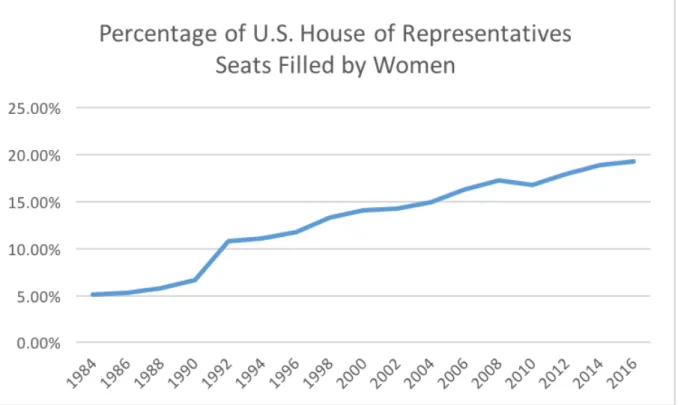
Although we have yet to see a sharp increase or change in women’s representation in the United States, the quality of women’s contribution to politics is not explicitly questioned as it is in Argentina because of the US’ lack of a quota. Argentina’s barricade on further progress is the result of male legislators and the public’s concern that in quota nations women’s achievements are accredited to the quota law rather than the female legislators’ own merits. I have yet to find a case selection which compares both cases. Through conducting my research, I expect evidence of a gradual but continuous growth in American women’s representation compared to
Argentina’s fast-tracked, but since stagnated numbers. I analyzed discursos and records from the Inter-Parliamentary Union to see changes in congresswomen’s presence and policy from 1983 to 2016 in both countries. I also surveyed American and Argentine reports gauging women’s political progress in each country’s congress over these time periods.
Hypothesis
I hypothesized that the United States, despite its long and steady rise in feminism and women’s representation, is still highly gendered in its politics. I researched to see if the
American standard for congresswomen is a paradox in that women struggle to appear feminine and successful in a characteristically male-dominated field. The presumed explanation for this struggle is that femininity (wherein women are defined as soft, meek, and personable) is incompatible to also be viewed as a good politician (i.e. bold, assertive, masculine, which is in turn detrimental to their image as a woman). I theorize that this slows but does not deter political progress. Its influence is due to the cultural, contradictory concept of the ideal female politician.
Ultimately, it stands as a sexist fallacy for women.
My second hypothesis is that Argentina, in acknowledging its lack of modernity due to its deep-seated sexism, uses quota laws as a fast-track to creating a critical mass of female
legislators. However, this will only function when male politicians cooperate. I postulate that women’s descriptive representation under the quota laws is used by male legislators to reach the quota and appease feminist demands without dedicating their focus to further improving
women’s representation in Congress. By fast-tracking a critical mass via quotas, Argentina has legally supported women’s legislative participation, but has yet to cultivate an environment that fosters their success as congresswomen. Rather, it has caused evident stagnation and the
prevention of long term progress for female politicians in Argentina. Through further research, I
sought to show this stagnation as an inevitable consequence of Argentina’s quota design. In a country where women make great strides in Congress but are defined by their traditional gender roles, congresswomen are seen as holding more domestic (and non-public) responsibilities. If constrained by this stereotype, it is impossible for female legislators to install a successful system that doesn’t incentivize the public or male policy-makers to continue to exclude women from powerful political positions.
Even with quotas, Argentina as a whole still faces institutional and cultural barriers that obstruct women’s advancement in legislature. While these roadblocks have slowly been phased out of American culture and politics, Argentina cannot be expected to instantaneously change its cultural and political worldviews to adapt to the cupo de ley. Furthermore, I hypothesized that now matter how much Argentina modernizes, the quota law cannot successfully improve women’s substantive representation under a system where political parties and incumbent male legislators don’t benefit by losing their seats to women.
Outline
The following chapters consist of the literature review, methodology and empirical studies in the cases of Argentina and the United States, profiles of their feminist and political history, the data analysis of each country, and finally my research analysis and conclusion.
Throughout each section, I presented the argument that the United States without a quota law has slowly reached its critical mass of women representatives in politics to gain considerable
substantive representation, which I concluded is the goal and deciding factor in women’s success and proper inclusion in politics. Furthermore, I argued that if more women entered US
legislature, this would only improve congresswomen’s agenda and influence in policy-making, even without a quota. However, when analyzing my comparative research on Argentina’s cupo
de ley, I showed in my retelling of Argentine history and my research product that the quota’s design—not the quota itself—is the culprit for the nation’s stagnation in representation.
Although Argentina has made much faster progress in the same time as the US and was much quicker in obtaining critical mass, I concluded that Argentine women have since hit a wall that American legislators did not face in their shared goal to improve women’s representation.
II
Literature Review Quota Laws
For centuries, women have struggled to gain political representation. First by fighting for superficial, descriptive representation and inclusion in politics, and then by demanding
substantial substantive representation that would translate into political influence and impact policy. Before analyzing women’s representation and critical mass theory in regards to the cupo de ley femenino, it is necessary to understand the history and structure of the quota laws
themselves. They first emerged in Pakistan in 1954 and contributed to the Western second-wave feminist movement beginning in the 1960s. Despite this progress, the global average of female representation in parliament then stabilized and remained largely unaffected. At present, women’s political representation continues to vary between ten and fifteen percent worldwide (Krook 2003, 3). Following the boom in national gender quotas in the 1990s, many activists and policymakers have since questioned the validity of gender quotas in their ability to effectively improve women’s representation. In understanding the various quota systems and the conditions in which they are applied, analysts may venture to answer the question: Do quota laws truly work?
How Quotas Were Introduced
The initial gender quotas were set in Pakistan following the nation’s independence and transition to democracy in 1947. Political unrest and tensions between eastern and western Pakistan led to women’s increased involvement in political movements and the 1954 elections that installed the first ever gender quota law (IPU 2015b). It, along with subsequent laws in Bangladesh and in local Indian governments, simply required that legislators reserve a certain
either via constitutional or electoral laws, or by forcing political parties to adhere to rules set by partisan gender quotas.
The first successful case of gender quota systems was in Norway in 1975, which further spurred the second feminist wave that began in the 60s and encouraged other Nordic states to consider improving women’s political representation. Unlike newly established or unstable democracies, the introduction of gender quota systems in Norway was not simply a result of women’s protest to their marginalization as a group. It had become a strategic and progressive move by governments. Women’s progress in Norway inspired movements across the globe, including Africa’s first quota law in Uganda in 1986 and Latin America’s first use of a quota by Argentina in 1991 (Rande & Ford 2011). In the case of Uganda, the quotas were introduced as a direct result of the nation’s return to democracy after periods of oppression and genocide under Milton Obote and then military dictator Idi Amin. Similarly, South Africa witnessed its first gender quota immediately post-apartheid in 1994. This pattern emerged in Latin America as well, where Argentina and ten other nations installed various quota laws after overthrowing military juntas that had ruled for decades. However, these quotas were not simply applied top- down by governments, but were heavily dependent on women’s grassroots activism and solidarity as a marginalized group. Seeing as sexism (particularly in politics) still exists
regardless of a quota, the quota law itself does not reduce women’s discrimination, but creates a system in which women may address the barriers set for them in political representation. Rather, it is the design of a quota system’s electoral system that effectively tackles the obstacles women face in government.
In response to either political unrest or women’s activism, gender quotas gained global attention and legitimacy by 1990 with the United Nations’ adoption of a quota law in their
Economic and Social Council. It demanded action with its target for women’s representation to reach a critical mass of thirty percent in all decision-making bodies worldwide by 1995. Even in the Middle East, where culture and certain statutes restrict women’s participation, there are exceptions in Tunisia, Morocco, Palestine, Jordan and Egypt where women are reserved seats in certain councils (Rande & Ford 2011). As was the case in the Middle East and Northern Africa, quotas were increasingly used because of government’s pressure from international organizations or from cross-country models that were already successful. These cases provide strong evidence as to why quota laws came about and what prompts countries to use them. Although these nations differ in cultural history and economic development, their various quota systems serve to combat each country’s discrimination and address their women’s need for representation.
How Gender Quotas Work
According to ML Krook (2003), a gender quota system’s function and effectiveness depends on four characteristics: 1) the mandate’s origin, be it by law, constitution, or partisan; 2) the force with which it is implemented and upheld; 3) when in the election process the quota is introduced; and 4) the ways in which legislators “attempt to reform the dynamics of candidate selection,” (Allen, Cutts, and Campbell 2014, 144). These aspects determine which quota design is used, and three systems of origin that have been developed thus far: voluntary quotas,
candidate lists, and lastly the reserved seat system.
i. Voluntary Quotas
Political party quotas (otherwise known as voluntary quotas) are not enacted by any constitutional or legislative decision but are self-installed by political parties. Partisan groups voluntarily construct candidate lists to include a certain percentage of women, either applying a gender quota on just their primary candidate lists or also on all seats the party will occupy post-
election. Political party quotas are the most popular design and represent a majority of quota systems (Dahlerup 2006). They make up over 60% of all national gender quota laws and are used mostly in Europe (Pande & Ford 2011). For example, the United Kingdom voluntarily constructs All-Women Lists to register female candidates on all party electoral lists. In accordance with Dahlerup’s classifications, the UK’s system is a) of partisan origin; b) voluntary; c) upheld by each party throughout the election process; and is a d) majoritarian, first-past-the-post (FPTP) electoral system, therefore it is filtered and reformed by single-member districts (Krook 2003, 14).
European parliaments in particular have used political party quotas to increase women’s representation. As early as 2003, women’s representation reached thirty-two percent in Germany and over thirty-six percent in both Norway and the Netherlands (Dahlerup & Freidenvall 2011, 43). However, other Nordic countries that share a similar history and level of development maintain an “explicit disavowal of quotas in favor of political party targets, [which still]
increased women’s representation to 45% in Sweden [and] 38% in Denmark,” (Krook 2003, 3).
ii. Legislative Quotas
As implied, Legislative or constitutional quota laws are a constitutional or legislative mandate that requires a certain portion of positions on candidate lists to be reserved for women.
38% of quota systems consist of mandates, spanning across Europe and particularly Latin America (IPU 2015a). Constitutional and electoral laws in Argentina increased women’s
representation in congress by over 30% and forced parties to provide more female candidates for upcoming elections. Still, results vary greatly by country. For example, France enacted a 30%
quota that was 1) legislative and; 2) installed in candidate party lists; 3) but it did not have to be upheld in elected seats, which 4) did “not lead to greater female representation… because party
elites have simply not followed the quota regulation,” (Krook 2003, 4). Whereas voluntary quota laws have increased women’s descriptive representation in certain countries like Spain, the force with which and time in which the quota was installed in France did not effectively enforce the quota. By superficially promoting but not guaranteeing the election of women to office, the French quota system became largely unsuccessful, at its peak having just 26.9% of seats held by women (Dahlerup, Freidenvall, and Johansson 2013, 7).
Despite both Spain and France using legislation to demand the election of female politicians now dubbed ‘quota women,’ legislative and constitutional mandates allow
parliaments to repossess and reserve important positions for men (Allen, Cutts, and Campbell 2014, 145). Meanwhile they designate peripheral roles for women, or simply ensure that they meet the quota by nominating them but do not actually elect them. The French nominee system
—along with every other form of quota introduction—has been met with varying levels of acceptance and success by women and politicians alike. Most notably, with legislative quotas it is not explicitly stated where these women must be listed so that “groups who are affected adversely—male incumbents, party leaders and firm owners—respond strategically in order to reduce the impact of gender quotas on leadership outcomes,” (Pande & Ford 2011, 3). Therefore, when either national governments or parties do include women, elite members and party leaders often disregard the quality of women’s representation once the quota has been met. This often leaves women in countries like France and Argentina stuck at the bottom of their party’s candidate lists. Regardless of the origin and means in which women are placed in the political system, they are for the most part ignored.
iii. Reserved Seat Quotas
Reserved seat systems are also constitutional or legislative mandates. However, instead of reserving a certain percentage of previously male positions for women, they create positions for which only women are allowed to run. In theory, this design for quotas should effectively impact women’s descriptive representation while also gradually changing male legislator attitudes towards congresswomen. Furthermore, there is substantial evidence that the public responds similarly. According to Pande and Ford (2011), both male legislators and “voters’
implicit attitudes and willingness to vote for women are strongly and positively changed by persistent exposure to female leaders,” (26). Unfortunately, only 20% of quota laws are reserved seat systems, and they are often in regions of Africa and Asia where women are restricted in their rights to impact policy and even public life (10). Still, select countries like Iraq and Nepal have successfully introduced women into the political sphere where they fill over 25% of seats (IPU 2015a). While reserved seats allow policy makers (read male legislators) to regulate the number of women elected, the other two types of quotas do not set a ceiling on the number or types of positions that women may hold. With all forms of quota laws, nations across the world have applied different systems and have witnessed varying results, indicating that a quota’s success depends on its proper use of a gender quota (as either Proportional Representation or FPTP), not the nation’s cultural history, economic stability, level of development, or even quota system.
Upon analysis it seems that often all quotas face certain obstacles in each country, faring better in certain environments than others. Studies indicate that nations have more easily
introduced quotas when applied to proportional representation systems (PR) over majoritarian systems (FPTP) that work under single-member districts (Dahlerup 2003).There are two main explanations for this. First, PR systems (either by law or by partisan) make political parties
support the adoption of candidate gender quotas in their lists throughout multi-member districts (2003, 14). Whether the lists are open or closed, parties are forced to nominate women across district and party lines in all electoral positions, as opposed to single-member districts. As a result, PR systems have proven to produce greater representation of women compared to those first-past-the-post. However, it is extremely important if the party list is open or not. With closed lists, “proportion and placement matter: these lists increase female representation if women are placed near the top, but not if they are placed near the bottom of the list,” as is seen throughout many Latin American nations (Krook 2003, 14).
Using open party lists, women’s representation is more proportionate but dependent on their party leader’s choice, where the party boss may methodically vote for men before women.
In nations with mandatory legislative quotas, male politicians and the public alike blame international pressures and female legislators for women’s incorporation into congress and leadership positions. They claim that quotas further engender and muddy the already centralized candidate selection process. In these normalized procedures, party leaders (who are often men) are now forced to meet the quota by handpicking women and turning away male colleagues. As a result, PR systems in general do not guarantee an increase in women’s representation, but it does force partisan groups to recruit female candidates and at least superficially promote gender equality. In contrast, majoritarian, single-member districts face worse opposition in that FPTP systems “imply a zero-sum game (if a woman is selected, a man is not), [so] the chance to
‘balance’ nominations is all but impossible.” (Krook 2003, 15). This is further demonstrated by recent studies indicating that the nations with the highest levels of women’s representation are those with proportional representation electoral systems, not necessarily those with a certain type of quota (IPU 2015b).
How Gender Quotas Compare to No Quota
In both quota and non-quota nations, women worldwide have succeeded in gaining representation but still struggle to win support. Although they have similar experience and education as both their male counterparts and non-quota women in legislature, ‘quota women’
are often labeled as ineffective placeholders, unlike their male colleagues or non-quota
congresswomen. Politicians and voters alike repeatedly resist the enforcement of quota laws on the grounds that the women elected under them are political pawns or ‘mujeres de’ (Krook 2003, 14). Those opposed to the quota also believe that targeting gender inequity dilutes candidate pools and replaces eligible male parliamentarians with less qualified women (Murray 2012, 27).
However, the caliber of any legislator, male or female, actually lies in the hands of executive positions with true legislative and political power. Seeing as quota women have consistently shown equal potential and voting tendencies than non-quota women, it seems that female legislators as a group excel in politics as long as they hold the same influence as their male counterparts (Allen, Cutts, and Campbell 2014, 146).
Unfortunately, as quota women are often accused by government parties and electorates as being unqualified or malleable, governments are continually critical of female candidates’
legitimacy. They are viewed as being untrustworthy and easily swayed by emotion and male influence, although it has been shown that “quota women are no more likely to suffer from tokenism, marginalization or invisibilisation than other women legislators,” (Zetterberg 2009, 455). In analyzing the factors associated with gender quotas such as descriptive and substantive representation as well as critical mass theory, researchers may more easily address controversy surrounding the standard for female politicians, with and without gender quota laws.
As the number of gender quotas increases worldwide, perhaps research will indicate that through time quota women’s added experience “increases effectiveness of women political leaders and can result in efficiency gains for the constituency through female representatives” (Pande & Ford 2011, 25).
Descriptive and Substantive Women’s Representation
“Quotas ideally deepen the descriptive representation of women as a group and the substantive representation of women’s group interests,” (Piscopo 2011, 448).
As gender quotas dictate that female politicians are required to fill a certain amount of seats rather than winning office without the quota’s support, ‘quota women’ face greater
obstacles to get elected and pass legislation. According to numerous studies on congresswomen in quota states, researchers have suggested a distinct divergence in women politicians’
representation. Studies suggest that although gender quota laws enhanced women’s presence (or descriptive representation) in politics, they did not necessarily improve women’s substantive representation—the rendering of women’s power to participate in and influence legislature. This difference between agenda-driven substantive representation and descriptive representation (based on demographic backgrounds) provide a theoretical framework. Distinguishing between the two is imperative to understanding the democratic outcome of quota laws and their
effectiveness concerning congresswomen’s political agenda.
Descriptive Representation
Women’s descriptive representation in legislation— the number of women in Congress—
has created “both opportunities for and potential obstacles to [their] substantive representation (the promotion of women’s interests),” (Franceschet & Piscopo 2008, 1). Although descriptive representation is both rising and maintained by quotas, the occlusive collaborations between
gender-specific committee systems in some quota governments blatantly designate women to staying in social and community-based councils. The nuanced networking used in legislative committees set behavioral norms and expectations for women politicians with newer, seemingly progressive (but separate) groups. In doing so, legislators are only setting new glass ceilings. In systems where women must disregard committee arrangements to raise awareness of gender bias, descriptive representation shapes legislators’ shared identity as women and “captures the deliberate and persuasive arguments that construct group interests,” (Piscopo 2011, 452). The sheer presence of women, along with their declaration as a disadvantaged but united minority, strengthens their chances of policy change as a group and allows for better substantive progress.
Therefore, descriptive representation (in order to effectively trigger substantive representation) is not simply the number of women in Congress. It is also congresswomen’s shared obligation to stand up for women as a group; their image as activists provides information to male legislators and the public about women’s issues to promote feminist interests.
However, these congresswomen cannot let their identities as representatives of women overshadow their other policies, or else they risk losing their validity as successful legislators.
Balancing these roles as female politicians, congresswomen are neither “the cipher of universal womanhood nor the embodiment of all possible womanhoods. Rather, [they] render an aspect of
‘being female’ relevant to current political discussions, providing generalized information about women’s experiences, concerns or needs,” (Piscopo 2011, 451). In order to be a catalyst for change, female legislators must first demonstrate that their roles as champions to women are only a component of their political agenda. As women’s congressional presence and activism expands, so too should their image as competent legislators aside from women’s interests.
Ultimately, descriptive representation as congresswomen’s presence serves to advance their
“portrayals of constituents’ circumstances,” and act as a bridge to more significant improvement in substantive representation (448).
Piscopo defines these two aspects of descriptive representation as distinct factors that must coexist in order for women to be as effective as their male counterparts. They must a) increase their numbers in order to reach critical mass so that they can b) capitalize on their platform to promote women while acting as politicians. This should in turn spur policy change and form outlets for them to succeed and advance their political career (i.e. substantive progress).
In measuring descriptive improvements to women’s agency, female legislators must first show their willingness to serve as representatives of a group’s collective identity, concern’s and interests in society. To do so, congresswomen must create a cohesive agenda as women politicians to collaborate their group’s ideas into innovative and effective policies (i.e.
substantive change). Only then can women achieve their goals of equal representation.
Research on women’s legislative representation all presents a common theme: effective representation demands that women have a) diversity and inclusion throughout the political sphere; b) openness amongst other women and a shared identity as a group; and lastly c) a feminist agenda that serves to benefit women through policy change (Manning, Brudnick, and Shogan 2015). Congresswomen’s presence and image is a superficial but very important form of representation. Piscopo defines it as descriptive representation “wherein minorities’ inclusion in the legislature becomes emblematic of the political system’s legitimacy and other traits,”
(Piscopo 2011, 448). Statistics like these portray quota nations as progressive and allows quota women to showcase themselves as good examples and a crucial part of women’s advancement as a whole. For this reason, it is imperative that these congresswomen are not interchangeable or viewed simply as women; they must present themselves as a diverse group with a unique
perspective and contribution to legislature. Archenti explains that there is a need for women
“with different origins and social membership in decision-making” in order to assert women’s legitimacy and agency in politics (2011, 135). In order to avoid claims of being pawns in a predominantly masculine political network, women must validate their views by representing both their sex and their party, successfully balancing the two identities of politicians and minority members.
Substantive Representation
In order to further women’s representation and achieve substantive influence in Congress, female legislators must overcome the sexist structures that keep them from impacting policy.
Modern sexism theory indicates that while fewer people endorse hostile, old-fashioned
prejudicial beliefs, they still do not support gender equality in their actions, attitude or ideologies (Swim, Aikin, Hall, and Hunter 1995, 199). The barriers women face when entering politics are defined as less of an overt aggression against women, but rather an ambivalent, underlying rejection of furthering gender equality. Much like modern sexism, Dr. David Sears of UCLA identified the characteristics of modern racism against African-Americans “as being a) denial of continuing discrimination; b) antagonism toward African-Americans’ demands; and c)
resentment toward special favors for African-Americans,” (Sears & Henry 2005, 200). Similarly, the substantive representation and perceptions of women politicians haven’t improved because of (not despite) the increase in descriptive representation. Due to a quota law’s requirements that women be present in legislature, women face the problem of men denying the need for further progress in the quality of women’s representation. As men choose to antagonize the quota law’s mandate, feminist agendas are stalled and female politicians are resented for occupying men’s seats in parliament. Some legislators don’t believe that measures should be taken to support
women’s empowerment or agency in legislature because the preventative laws are in place; nor do they think that feminist movements hold much weight in today’s world. Men in legislature and the public rationalize their sexism by claiming that they live in a modern society where women no longer face prejudice and are already represented. The existence of a quota law is used as evidence for the modern sexist’s case, ironically to women’s detriment. As opposed to old-fashioned sexism, modern sexism is more ambivalent in nature. It is subtler and more socially accepted, thus proving difficult to discourage as women’s descriptive representation is increasing but their substantive representation is not (Swim, Aikin, Hall, and Hunter 1995, 222).
In addition to modern sexism theory, women’s substantive representation is also stunted by the delegation of female politicians’ legislative roles to topics of women’s interests, the “more fundamental, related to major gendered cleavages, social structures, and institutions,” (Beckwith 2012, 20). Whereas women’s interests can be used to unify women as a source for mobilization and empowerment in women’s issues, it is arguable that women’s interests in legislature have pushed them into the political periphery. It seems that labeling women’s interests delegates women to strictly social, gendered issues like reproductive rights. If congresswomen cannot use their descriptive representation to unite and promote their legitimacy in and outside of women’s issues, their role as politicians diminishes and restricts them from major policies such as national security, economic issues, etc. The lack of female politicians in authoritative public office positions serves “to suppress women’s political participation and the factors that inform and enrich it,” (Beckwith 2012, 22). The resentment of the quota laws (because of its forced descriptive representation of female legislators) has been detrimental to these women’s
substantive representation. Quota women are isolated and referred to as mujeres de or “‘women of [a man],’ that is, partners or relatives of male party leaders,” (Franceschet & Piscopo 2008, 9).
In the case of quota nations, regardless of women’s descriptive representation,
stateswomen are impacted by their substantive representation as a process. Unlike substantive representation as an outcome, as a process women are able to actively participate in politics. The outcome of passing legislation hopefully serves as evidence of women’s legitimacy in politics, thus establishing women’s representation and future gender equality. However, substantive representation as a process does not guarantee its success as policy outcome or the passing of their legislation. It simply allows women the opportunity to present their case through debates and bill proposals rather than ensuring the success of women’s policies. Although the process differs from non-quota countries’ improvements on female politician’s representation, every state struggles with democratic concerns addressed by the same schools of thought. These theoretical underpinnings include a) critical mass theory; b) women’s double bind; and c) resentment of paternalism and its label and mandate effects.
Critical Mass Theory
A crucial factor to gender equality is determining the point at which women’s descriptive representation in Congress is most effective in gaining substantive representation. In other words, calculating the critical mass for the number of women in Congress is vital in helping congresswomen understand the gendered environment they face in politics. Critical mass theory serves as a formula to see how many women must be elected to Congress in order to react how women act and are perceived in legislature. This cause and effect relationship between critical mass and women’s representation differs between quota and non-quota states and provides a theoretical framework for women’s legislative behavior and the outcome they can have on politics.
Recent analyses indicate that critical mass theory is evolving. It was first introduced by Everett Rogers in his socioeconomic text Diffusion of Innovations in 1962, then it was applied to Gender Studies when first researching quota laws. Critical mass theory proposes that “women are unlikely to have an impact until they grow from a few token individuals into a considerable minority, or ‘critical mass,’ of all legislators,” (Childs & Krook 2009, 126). Since then, Dr.
Rosabeth Kanter has discredited this idea, arguing that critical actors— “those who act individually or collectively to bring about women-friendly policy change”—successfully
implement progress, not critical mass. Rather than emphasizing simply the amount of women in politics, studying critical actors focuses on women legislators’ autonomy, interdependence, and coordinated mobilization as a group. (Childs & Krook 2009, 136). Further research also indicates that critical mass is not infallible and that a dramatic change in people’s attitudes and actions regarding sex discrimination must change.
In the case of Western congresswomen, cross national findings broadly support the notion that proportional representation systems result in an increase in female representation (Hinojosa 2012, 187), therefore it is assumed that proportional representation “as a device that tends to safeguard minority rights, can also promote women’s involvement in politics,” (Swers 2005, 103). Data from case studies in quota nations, however, indicate that an increase in women’s descriptive representation directly decreases women’s substantive representation as an outcome. Although substantive representation as a process—the participation of women in Congress—has continued to rise with the increase in number of female legislators, it lessens as an outcome due to women’s augmented input, making “approval of gender-related legislation less likely, especially when a woman sponsors the bill,” (Htun, Lacalle & Micozzi 2013, 97).
Therefore, although critical mass theory suggests that more women always leads to more
representation, reaching critical mass can also trigger a negative backlash to women’s increased political participation. Studies by the Journal of Politics in Latin America note that “the
coefficient for [the critical mass] threshold is positive and highly significant. These coefficients support the intuition that boosting women’s presence is likely to improve processes of legislative behavior regarding women’s rights,” (108). However, any stagnation in women’s representation following the use of quota laws would question the validity of critical mass theory. It presents the question: if women reach critical mass in Congress but still struggle to obtain substantive representation, what force is suspending their further progress? And how can critical actors resolve the issue?
Dr. Drude Dahlerup most recently asserted that Kanter’s concept of critical actors, although an improvement upon critical mass theory, inaccurately suggests that critical mass matters less than the sole efforts of a select group. Dahlerup expands upon Kanter’s theory by stating that incentives for change are dependent on critical acts, or mechanisms that ‘change the position of the minority and lead to further changes,” (Dahlerup 1988, 275). Critical acts rely on more than simple numbers or select individuals. The key to critical acts is “the willingness and ability of the minority to mobilize the resources of the organization or institution to improve the situation for themselves and the whole minority group,” (Childs & Krook 2009, 129). Just as descriptive representation is more than simply women’s presence, critical mass is more than a number. It requires moments of progress brought on by either numbers or people who can create crucial acts to bring about change. Childs and Krook conclude that “there still may be a place for the concept of critical mass—but not critical mass theory—in studies of women’s legislative behavior. This is because critical actors, as we define them, are those who either initiate reforms themselves or play a central role in mobilizing” decisive movements for policy change (Childs &
Krook 2009, 145). As a result, quota laws (as the enforcer of critical mass theory) might increase the likelihood of critical actors as well as acts, however they do not necessarily guarantee better substantive representation than feminist policies applied in non-quota nations.
Women’s “Double Bind”
Regardless of a country’s quota laws or critical mass, researchers find that all women in politics face criticism and issues of substantive representation due to what is called a double bind. Under this pretext, female politicians face conflicting images as policymakers and as women—they must balance their identity as women with the previously considered incompatible role as a politician. Forced to balance the qualities of their sex with those of their profession, this double bind presents the issue that congresswomen are perceived as weak or ineffectual
legislators because they are women.
In response to women’s struggle to balance these roles, Dahlerup (2006) argues that congresswomen’s activity and critical acts as a group—not their presence or critical mass—
weakens gender stereotypes like the double-bind to further representation in politics. The reasoning behind this is that their actions as an underrepresented minority, not their numbers, grants them a certain “tokenism” that breaks down disadvantages of a gendered legislative environment when representation is under 15% (Kanter 1977). For example, although the United States has not reached 30% in women’s congressional representation, American women have acquired the benefits of critical mass at only 15% occupancy in Congress because of their unique perspective as women. These women as individuals have made substantial progress in
substantive representation by being critical actors, or those who act collectively or on their own accord to promote feminist policy change. Most notably, congresswomen who are critical actors not only have a shared identity as women, but also share the common trait of a “relatively low
threshold for political action: they may hold attitudes similar to those of other representatives, but they are much more motivated than others to initiate women-friendly policy reforms,”
(Dahlerup 2006, 138). As introducers of these policies, they are thus viewed as authority figures on the subject of women’s interests, often increasing the chances of a bill’s acceptance by congressmen and the public. Having women act as tokens and critical actors “subjects legislative behavior to empirical investigation, promoting nuanced and more accurate accounts of how the substantive representation of women occurs,” (Dahlerup 2006, 139). Although American
congresswomen have successfully used tokenism to spur policy change, the U.S. has historically been host to cyclical backlash. As demonstrated in my analysis, each age of women’s activism has signaled a responding wave of conservatism that sets back further advancement. Just as was the case in the Tortoise and the Hare, I investigate as to whether the U.S. is slow and steady in its journey to gender equality.
Another component to the double bind is its depiction of traditional gender roles, which is engrained in congresswomen’s identity based on sex. Regarding gender stereotypes, men are judged by their physical strength as well as their logic and reasoning while women are evaluated by their attractiveness and creativity (Schneider & Bos 2014). For this reason, women’s positive stereotypes as being empathetic, warm people have affected their roles in political leadership, focusing on social welfare and local government positions within their community. However,
“negative personality traits for women focus on emotional weakness, such as being whiny and spineless. For men, positive personality traits include agency-related traits of active and tough and negative personality traits include egotistical and greedy,” (Schneider & Bos 2014, 246).
Whereas both men’s positive and negative stereotypes are leadership-oriented traits often characteristic of politicians, none of the traits designated to women (positive or negative)
coincide with traits of a good politician or any leadership role. To summarize, “female politicians are a subtype of women because they share little stereotype content, male politicians are a
subgroup of men because of their overlapping traits,” (249). Although nations without quota laws are not any more or less democratic than other systems, non-quota women are likewise isolated because of the contrasting, superordinate stereotypes for female politicians as a disadvantaged subtype. This presents an obstacle for non-quota congresswomen, who do not have a legislative mandate to help them gain representation or overcome sexism.
To demonstrate this, of the 18 characteristics denoted to most describe women (primarily beautiful, feminine, caring, compassionate, emotional, affectionate, etc.), very few overlap with traits used to describe female politicians (254). In fact, women politicians are trapped by the double bind wherein they are stereotyped as having the negative but dissimilar traits of both women and politicians, yet the positive characteristics of neither. For example, “adjectives related to integrity and empathy were chosen significantly more for women compared to their female politician counterparts, [yet] female politicians were [also] perceived to have twice as many ‘negative female leader traits’ than women,” which suggests that “female politicians are viewed as less equipped to handle a leadership role but also as possessing fewer womanly traits,”
(259).
Regardless of quota laws, it seems all congresswomen are often characterized more by their shortfalls than by their strengths; they lack “leadership, competence and masculine”
qualities because of their femininity yet are also criticized for lacking traits desirable for women (e.g., trustworthy, sensitive or compassionate) (250). As a result of this catch-22 faced by female politicians, non-quota women in Congress must balance the standard traits required of them. It is worth noting that the three “positive politician traits (ambitious, driven, and assertive) are also
traits used in the scale of negative female leaders,” (261). This is especially difficult when there is no positive outcome for them. As a result, congresswomen worldwide must collaborate on policies to gain support and substantial evidence that they as women are qualified policy-makers.
This makes women communal and driven by shared goals and outcomes, whereas men are agentic and policy-driven because they have no need for community outreach and support for their sex.
Due to their different gendered obstacles, women cannot simply accomplish change through years of agency and experience as men do. Unable to simply rise through the ranks on their own volition, women rely on connections either from men in power or from women offering their support. Studies indicate that women are in fact more “similar than different from men in their backgrounds, paths to power, and political ambition,” however their roles are clearly defined by a legislator’s sex and therefore position in the gendered political hierarchy (Schwindt- Bayer 2010, 2). This pattern in women’s climb up the political ladder carries over into their legislative behavior once elected. Rather than using men’s agentic lobbying and making strictly policy-based decisions, congresswomen have been shown to use communal means of promoting their policies and must cooperate with other women to strategically raise awareness for their causes… all within the boundaries set by their double bind.
Quota Women, Maternalism, and Resentment of Paternalism
In fact, recent women’s frustration due to double bind has resulted in a staunch resentment of paternalism for certain politicians and in other cases a rise in women’s maternalism. Drs. Susan Franceschet and Jennifer Piscopo accredit this to the contrasting mandate and label effects. For example, while congresswomen in the United States struggle to strike a balance between suppressing their femininity and using it to discount their negative
politician traits, the quota laws in Argentina “contribute to the perception that female
representatives are needed because of their distinctly feminine perspectives,” (Franceschet &
Piscopo 2008, 6).
The Mandate Effect
Herein lies the important divergence between the mandate effect and the label effect.
Under the mandate effect, women politicians see their role as representatives of women to be an obligatory platform for them to realize their feminist stance and advocate on behalf of their gender. As a result of the mandate effect, some politicians often opt for supporting maternalist policies, even further demonstrating how gender is a large part of their identity as well as their policy decisions. In contrast, the label effect is the result of public attitudes where male
legislators and voters believe that quota women are ineffective or even undeserving of the position to change policy, regardless of whether that is true or not (Franceschet & Piscopo 2008, 6). The phenomenon surrounding congresswomen’s labels as quota women or mujeres de in turn pressures these women to break their obligatory mandate. They see feminist activism as a
reinforcement of their unjust label as ambassadors to only women, therefore they refuse to base their policies on women’s interests.
Both arguments are true; female legislators face the paradox of being maternalist
champions to women while also trying to not limit themselves as representatives of their gender and nothing more. Where quota laws were implemented as a stepping stone for feminist
progress, nations’ commitment to quotas have yet to advance their overall modernity and promises for gender equality (Baldez 2004). For women who fall under the mandate effect, it is most common to adopt a maternalist agenda by basing their platform on “ideals of social harmony still championed [by] the well-ordered family, maintained by a nurturing mother” and
the elite holders of political power (Franceschet & Piscopo 2008, 7). As modern sexism and active chauvinism from male congressmen argue that quota women are simply mujeres de, maternalistic politicians believe that congresswomen “introduce a ‘politics of care,’”
(Franceschet & Piscopo 2016, 24); thus these female politicians claim an ethical stance because according to them “women have a ‘woman’s way of doing politics,’ which is seen as less hierarchical and closer to the people,” (Marx, Borner, and Caminotti 2009, 62).
The Label Effect
On the other hand, many quota women contend that maternalism further diminishes their legitimacy by further engraining gender stereotypes into politics. These congresswomen support the label effect, claiming that their representation should not be a gender issue. According to them, the commitment to women’s progress becomes a matter of class and the elite’s obligation.
It is then the job of the government to ensure women’s rights; it is not just a woman’s responsibility.
Supporters of the label effect reject the use of quota laws as “bottom-up instances” for individual, domestic advocates to use feminist movements and coalitions to demand women’s representation. Instead, congresswomen under the label effect gravitate towards “top-down instances” in which “calculating political elites adopt quotas for publicity purposes, [although]
the mechanisms are less likely to empower women,” (Franceschet & Piscopo 2016, 6). Seeing as this gives select female legislators the opportunity to focus on policies outside of women’s interests, female politicians oftentimes allow elites to believe that “historical leaps in women’s representation are necessary and possible” despite the failure of most fast-track movements for progress (Dahlerup & Freidenvall 2005, 29).
Resentment of Paternalism
Considering quota laws as instantaneous policies for change, researchers argue that they
“directly legislate equality, rather than allow non-discrimination policies to evolve overtime,”
(Franceschet & Piscopo 2016, 8). The United States in contrast holds general resentment towards quota laws as they create backlash to feminist movements and deep trust issues with
stateswomen. Rather, Americans assess that change should be gradual, not forced. According to one study, “trust in politicians and in parliament is higher in countries without quotas than in countries that have quotas,” (Zetterberg 2009, 721). In non-quota states where women must constantly make compromises in substantive representation, their resentment of paternalism has caused a system change sentiment. This means that both women and men are angered by the male, heteronormative nature of most politics and historic male abuse of political power.
Frustrated and restricted by the status quo, a system change sentiment promotes further
resentment and leads to a decline in women’s desire to participate in politics or attempt to gain power themselves as potential congresswomen (Tate 2014, 28).
The mandate effect and label effect are key concepts that can incentivize congresswomen to participate in legislative behavior either as maternalist representatives of women or as
legislators with no regards to gender. However, these theories can also reflect women’s discontent and even resentment of the political system, discouraging any improvements in women’s descriptive or substantive representation. In both quota and non-quota states, understanding these nuanced gender theories is crucial to analyzing the success of women’s representation in politics.
III
Political History of Argentina
Argentina is known for its turbulent political history and has endured numerous coups and changes in government. Women’s history in Argentina is no different; their road towards feminist progress is just as winding and abrupt as the rest of the country’s history. Instead of a steady preparation for women’s inclusion into politics, improvements in Argentina’s gendered political system came through quotas and the expansion and acceptance of feminist statutes throughout times of chaos.
Historically, Argentine female legislators struggled with sexism and the double bind, particularly following their return to democracy in the 1980s. Having just been granted the right to vote in 1947, women’s involvement in public life and politics had been very brief.
Furthermore, the oppression that men and women faced during the military junta in the 70s and 80s left many people confused as to who should lead the government. Yet women did participate in rebuilding the country, and they have made significant strides in politics since 1983. As of last year, Argentina ranked 79th globally in percentage of women in upper and lower congressional houses, showing a 10.9 percent point increase in women’s representation (IPU 2015b). In comparison, the U.S. ranked 97th with an 8.4 percent point change (IPU 2015b). In this chapter, I have organized Argentina’s feminist history into six stages before and after the quota that outline the country’s greatest progress in women’s representation. I also included the obstacles congresswomen faced to further women’s political advancement during each period.
Argentine Democracy Before the Quota
i. Women’s Suffrage as a Stepping Stone to Democracy
Long before the quota law, even during Eva Peron’s activism and women’s suffrage
candidacy as a group. Prior to 1983, women activists embraced their engendered identity so that it would showcase their unique perspective and individual contribution to Argentina’s
democratic future. Cecilia Grierson (Argentina’s comparative Susan B. Anthony), Eva Perón, and the Mothers of the Plaza de Mayo are all examples of influential women who created the foundation for future feminists. However, their idea of feminism contradicted the West’s modern notion that women could act and think outside of their traditionally domestic, feminine role. In Argentina, these feminists “enfranchised women,” arguing that their conservative and virtuous nature would qualify them as good politicians and preventers of further corruption (Elsey 1641).
Gender policies generally took on a “formalist and ‘neutral’ point of view, which made it impossible for the system to identify and respond to women’s concerns and needs,” (Carrio 2012, 164). In response, women began to unionize and broadcast their positions through community programs, furthering the stereotype of female politicians and activists as mere civil servants.
The Argentine suffrage movement began in the 1920s as South America watched the United States and Western Europe grant women the right to vote. Although Argentina had not experienced the West’s slow development and feminist progress, Argentine women united via community outreach and charity work to promote their views for reform. However, before they were able to organize as a united group for suffrage, they required a new civil code that suited their mission for equality. In 1926, suffragists reformed the civil code to grant women better legal status as well as the right to work. Notwithstanding this accomplishment, their ideas did not appeal to those of working-class women who were disenchanted with feminist rhetoric. It was not until 1947 with the election of Juan (and Eva) Perón that the working class supported women’s advancement as they were granted the right to vote.
Eva Peron’s contribution to Argentina’s feminist movement was monumental in that it
“mobilized working-class women in a way that suffrage groups [and political parties] could not,”
(Elsey 1641). The Peróns heralded a new populist ideology and left a legacy that continues to impact Argentine politics today. Their narrative as idols of the poor has since become the template for modern Argentine politicians, who still seek to enchant voters with this Peronist image as guarantors for change. Through her class-focused activism, Eva revamped women’s political role as activists for social justice without addressing feminism or contradicting the traditional ideas of women as wives and mothers. The Peróns campaigned strictly on the virtues of social justice and economic reform, rarely advancing women for the sake of women’s rights.
They focused on class divisions that would gain them support of the middle and lower classes, appealing to women by their social status rather than their gender. Women soon served as voters and politicians to promote the values and concerns of their class, not their sex.
Eva’s political activism was not what we today consider feminism. Her campaign against women’s autonomy and roles contradicts feminist thought, but it was successful because it complimented Argentine tradition. Peronism, despite attacking feminism when it did not
coincide with their party’s agenda, did successfully broaden women’s role in politics. Eva Perón as an iconic woman and representative of her party “challenged the limits to women’s political participation. Her insistence that women subject their political goals to Peronism clashed with feminist views,” but it nonetheless got women to act as politicians outside of social work and community programs (Elsey 1641). Whereas the United States and many other nations showed a steady ramping up toward feminist change, Argentina used feminism and women’s suffrage as a tool to further the country’s overall progress.
ii. Transition After the Junta
Looking at a timeline, it’s evident that women’s suffrage and the passage of women’s interest bills in Argentina didn’t occur in a smooth progression. Just as Argentina faced a tumultuous path in structuring its democracy, Argentine feminists spent decades finding their political role as activists for women. Throughout the end of the military dictatorship, the public rallied behind the centrist social liberalist party UCR (Radical Civic Union) as the government battled an onslaught of repercussions. By 1983, Argentina had lost to the United Kingdom in the Falkland Wars and floundered as its 1982 economic recessions caused a 400% inflation and major debt crisis (Devlin 113). On December 10, 1983 the de facto president Ronaldo Bignone agreed to terminate the junta as a “democratic way out,” and UCR leader Raul Alfonsín was elected president (127). Following the overthrow of the military junta in 1983, feminists and politicians alike founded groups to organize their plans for a future democracy. Whereas activists had spent the last decades rallying against the junta’s oppression and numerous violations, they had not united over a cause they could fight for. By including feminist rhetoric in their
campaigns for election, political parties sought to appeal to women as a group, regardless of their individual views and ideologies.
iii. The Role of Women in Democratic Transition
Argentina had previously witnessed women’s solidarity and activism in the Madres de Plaza de Mayo, a group of mothers and grandmothers of those who disappeared and were killed at the hands of the military regime. Starting in 1977, their weekly protest in front of the
presidential house Casa Rosada was an essential component to the junta’s downfall. Their bravery in showing public opposition demonstrated their power as women. Historically, Argentine women’s political role was limited to topics of community welfare and social
injustice. Looking back on Eva Perón’s activism, women were allowed and even encouraged to
participate in politics as long as it coincided with their party’s platform and ideas of womanhood.
They were restricted by the double-bind in which they could play the role of politicians as long as it did not downplay their identity as domestic women with traditional family values. However, the Madres demonstrated how women were just as affected by the government’s crimes and how women were just as qualified to respond with political action.
The country’s female legislators had struggled with finding their place for activism particularly following their return to democracy in the 1980s. The year 1984 was a landmark in Argentine women’s mobilization, wherein they united in solidarity as a targeted and oppressed majority, namely protesting as the Mothers of the Plaza de Mayo (Carrio 2012, 164). Without the Madres, the country would not have witnessed feminists’ ability to balance womanhood and political activism. Yet women have been unable to strike this balance as a result of male legislators’ inability to reconcile the amount of power they lose by yielding their positions to women. Feminist progress is still used as a promise made by politicians to benefit their personal career and their party’s advancement; women’s representation in politics is not a goal for male politicians, but a tool for their own achievement. As I present in my next chapter, it is
noteworthy that the most headway in women’s interest occurred around election times where men campaigned for women’s rights to get women’s vote. The pattern continues even in today’s elections. Until male legislators in Argentina are able to recognize the democratic virtues and benefits of electing women, further feminist progress cannot occur.
The Introduction of the Quota Law
The cupo de ley femenino was first introduced as a bill in 1989 and passed into legislation on November 6, 1991. In keeping with the quota classifications listed in the literature review, the Argentine quota is defined by these four traits: the quota’s mandate origin, how people seek
office to uphold the quota, when in the election process women are selected, and how they are elected. In Argentina, the quota law is structured as listed below:
Mandate: Legislative quotas Aspirants: Primaries
Candidates: Candidate lists composed by party leaders Election: Process of reserved seats selected by party
This quota design set by legislature explains the reason behind women’s progress in the Argentine Congress as well as their struggles to gain women’s representation. Critical actors such as Margarita Malharro and Carlos Menem also paved the way for feminist legislation, while also preparing the country for major movements and recent elections such as the presidential election of Néstor and Cristina Kirchner.
i. Margarita Malharro and her Role in Implementing Quotas
Despite women’s political involvement throughout Argentina’s regimes and political turmoil, female legislators’ increase in substantive representation after the junta was met with some opposition prior to the quota. Legislator Margarita Malharro de Torres introduced the quota in November 1989, amending Article 60 of the constitution to incorporate the cupo femenino into party lists, but the bill didn’t pass until 1991 (Carrio 2012, 169). It was promoted by the Network of Feminist Politicians and female legislators from 15 different political parties.
Unfortunately, women’s diversity and increase in awareness did not translate into policy change until it they acquired men’s support. For Congresswoman Malharro, she continued on to serve in legislature and gained the support of former president Carlos Menem in order to further advance women’s role in Argentine politics.
ii. Carlos Menem and his Expansion of the Quota
Running on the Peronist platform of amending social injustices, Carlos Menem sought to