Volume 7 Issue 1, October 2019, pp. 1466-1489 https://doi.org/10.35974/isc.v7i1.926
1466
Teachers´ Perception of Coherence in High School Biology Textbooks in Zambia
Kwangaika Mwala Sinjela1, Jimmy Kijai2, Josephine Esther Katenga3
1Faculty of Medicine, Lund University, Sweden
2School of Education, Andrews University, USA
3Faculty of Education and Psychology, Asia-Pacific International University, Thailand [email protected]
ABSTRACT
Textbook coherence is an important aspect of effective teacher´s instruction and performance of students. However, the subject has not been explored regarding school textbooks in Zambia.
This study involved assessing coherence of senior biology high school textbooks (MK Biology10, Longman Biology11 and Pupil´s Biology12) and the extent to which these books are aligned with the biology course syllabus. Using quantitative research design, coherence was conceptualized as a unit of three constructs: alignment and organization, rigor, focus and relevance of contents and connections among ideas. A questionnaire instrument was developed which teachers in Mufulira and certain other districts in Zambia (n = 82) used to assess textbook and textbook-syllabus coherence. Data was analyzed using statistical methods, independent t- tests and One-way ANOVA. Results show that teachers were generally uncertain about coherence levels in the textbooks. Concerning textbook-syllabus alignment, Pupil´s Biology12 was viewed as most coherent with the course syllabus and MK Biology10 as the least.
Assessment of coherence is a complex process but it focuses on few common elements.
Identifying these elements may help teachers improve teaching practice, curriculum developers design coherent curricula and educational activities, and authors produce coherent textbooks.
Further research studies are recommended that would extend the scope of this study to include teachers in all provinces in Zambia, include a mixed method to explore perceptions about coherence, compare coherence of same grade level textbooks, or evaluate coherence of the syllabus and that of other science or non-science textbooks.
Keywords: Textbook coherence, Textbook-syllabus coherence, Biology textbook assessment, Teacher´s perception, Assessment of textbooks in Zambia
INTRODUCTION
Textbooks, being the most widely used classroom teaching resource and highly regarded explicit blueprints for teaching and learning, attract much attention for assessment and evaluation to improve teaching and learning (Edling, 2006; Heyneman, 2006; Khine, 2013;
Mikk, 2000; Sikorova, 2012). One of many aspects of assessment is coherence. Coherence as a feature of a book focuses on logical structure, feature consistency, interconnections of ideas
1467
and interrelation of contents to make a unifying whole (Gardner et al., 2014; Roseman et al., 2010). The current study was conducted with a focus on how teachers perceive coherent structure of biology textbooks in Zambia and the extent to which the textbooks are coherent with the course syllabus.
Background and Context. Biology textbooks examined were authored and published in Zambia for senior secondary (high) school biology subject, a compulsory course for all students taking the national board examinations at the end of grade 12 (see Appendix A). The Zambian high school biology curriculum includes the syllabus, textbooks and the national board examinations. Textbooks are the main resources for biology teaching and the syllabus is an important manual in guiding the timeframe of instruction (Chabalengula et al., 2008). The current biology course syllabus (Appendix B) was revised by Curriculum Development Center (CDC) and implemented in 2013 by the Ministry of Education (MoE) in Zambia (CDC, 2013a, 2013b). The textbooks are used together with the syllabus for preparing national board examinations (CDC, 2013b; Chabalengula et al., 2008; Mumba et al., 2007; Mumba & Hunter, 2009).
Research Problem. Science textbooks endorsed by MoE and CDC are the main instructional materials used in schools in Zambia. Few assessments have been done to inform the initiatives of improving publications in the country, and none exists on this topic. A high school biology textbook authoring project of the researcher was a primary motivation for this study. The books examined potentially promote scientific literacy and have sustained quality education for many years (Chabalengula et al., 2008). Nonetheless, a concern was uncertainty about their levels of coherence. The textbooks do not cover certain biology topics compared to their foreign counterparts. This is similar to the biology course syllabus as identified by Matseleng et al.
(2008). Also, most topics in the textbooks appear to receive limited articulation and there is lack of detailed coverage of biology concepts and unit organization of chapters. One of the books lacks chapter objectives, two lack chapter summaries and all appeared to present several limitations in their pedagogical features. Furthermore, the books are not accompanied by teacher’s editions or textbook user guides. Thus, in view of the above, perceptions held by other teachers in Zambia was sought to investigate the stated assertion on coherence.
The challenge of textbook assessments is not only unique to Zambia. Matseleng et al. (2008) stated that the biology syllabus in Zambia lacked sequencing of topics and a content organizing principle, which is similar to syllabi in many other countries in Africa. Also, Nwafor and Umoke (2016) drew some recommendations from their study conducted in junior secondary
1468
schools in the six geo-political zones of Nigeria that textbooks need periodic assessment and evaluation. Distinguished studies on this subject such as Project 2061 research projects by the American Association for the Advancement of Science (AAAS) and Trends in International Mathematics and Science Study (TIMSS) assessment series, have also shown that textbook and curricula coherence is an important aspect of effective instruction and performance of students but is not widely emphasized (AAAS, 2002, 2005, 2019; Bybee, 2003; Fortus & Krajcik, 2012;
Fortus et al., 2015; Roseman et al., 2010; Schmidt & Houang, 2012; Schmidt & Prawat, 2006;
Schmidt et al., 2005). The absence of an assessment instrument for textbook coherence in literature shows that no particular research has been conducted that involves a large sample of respondents to gauge textbooks’ coherence.
Research Aim and Questions. The purpose of this study was to obtain perceptions on coherence of selected high school biology textbooks in Zambia (MK Biology10, Longman Biology11 and Pupil´s Biology12) and the extent to which the textbooks are coherent with the course syllabus. In relation to this, the study aimed at answering the following questions:
1. What is the level of coherence in senior high school biology textbooks as perceived by biology teachers in Zambia?
2. To what extent are the textbooks coherent with the biology course syllabus?
3. Are there differences in teachers’ perceptions of coherence based on grade level textbooks?
4. Are there differences in teachers’ perception of textbook coherence based on gender, qualification, experience, district and discipline?
Summary of the Study. This study was conducted as a thesis project and employed a cross- sectional survey research design. The methods involved developing a perception survey instrument followed by data collection and analysis. Regarding textbook coherence, the findings show a general uncertainty of coherence levels in the textbooks among teachers and the levels of coherence across the textbooks was perceived as not significantly different.
Regarding textbook-syllabus coherence, a perception of 80%-90% textbook-syllabus alignment and Pupil´s Biology12 was perceived as most coherent with the syllabus while MK Biology10 the least. Lastly, group analysis revealed similar perceptions. Teachers’ assessments provide useful feedback with significant implications and provide contributions as highlighted under the discussed recommendations.
1469
LITERATURE REVIEW
Definition of Coherence. Researchers have defined and described coherence based on several aspects. The first focuses on logical and sequential organization, addressing consistency, interdependency and assemblage of contents in a book (Pressbooks, 2018; Roseman et al., 2010). This definition aligns with the view of coherence in AAAS research projects that textbook coherence encompasses organization, content balance, alignment with standards of a discipline and pedagogical-feature consistency (AAAS, 2002, 2005). Another aspect lies in the context of linguistics in which coherence is one of the criteria required for a text to have a communicative function (Ocak & Baysal, 2016). The third aspect focuses on connections among concepts and ideas in the textbook, encompassing vertical and horizontal dimensions (Bybee, 2003; Roseman et al., 2010). The vertical dimension of coherence is what some studies identify as elements of focus and rigor of contents (Gardner et al., 2014; Schmidt, 2003), and the horizontal dimension as elements of inter-topic, inter-chapter or inter-unit organization and connectivity of ideas in a textbook (AAAS, 2005; Barry, 2003; Bybee, 2003; Roseman et al., 2010; Schmidt, 2003). The last aspect focuses on student engagement and describes coherence as a motivational signature that goes beyond the textbooks to include curricula and instruction in relation to student performance and achievement (Schmidt, 2010; Valverde et al., 2002).
Nature and Significance of Coherence. The nature of coherence focuses on answering the question: how does a coherent textbook or a coherent curriculum look like? Main researchers on this subject including Roseman et al. (2010), Schmidt (2003), Gardner et al. (2014) and Bybee (2003), Fortus and Krajcik (2012) and Project 2061 researchers (AAAS, 2005, 2019) agree to the following aspects as major constructs of coherence:
1. content-key ideas alignment and organization, 2. connections among ideas,
3. content-standard coherence, 4. learning goal coherence,
5. vertical and horizontal coherence, and 6. intra-unit and inter-unit coherence.
The significance of coherence focuses on validating its elements such that the textbook makes sense, forms a meaningful whole, connects to the real world and enhances comprehensibility.
Thus, coherence is significant in:
1. long-term retention of knowledge (Arzi et al., 1985),
1470
2. enhancing knowledge transfer (Perkinson & Salomon, 1988) and integration of new ideas to existing knowledge (Roseman, Stern & Koppal, 2010),
3. enhancing achievement of content learning goals and curricula activities (Shwartz et al., 2008),
4. supporting multidisciplinary connections and dependencies (Shwartz et al., 2008), 5. developing literacy and providing a strong foundation for future learning (Smith, et
al., 2017), and
6. interconnecting information from several contents and contexts within the particular discipline and to real world (Duschl, Schweingruber & Shouse, 2008).
The Curriculum/Syllabi, Curriculum Developers and Authors and Coherence. Many science books designed for students are configured after curricular and/or syllabi (Chabalengula et al., 2008; Shwartz et al., 2008). In addition, they are often informed by research implications, learning goals set by curricula or standards developers and other stakeholders (Barlow, 2011; Krajcik et al., 2008; Muller, 2009). They are also shaped by author’s style, knowledge, expertise and experience (Bybee, 2003). Thus, coherence in textbooks is shaped by the curriculum or syllabus, by developers of learning standards and by authors.
Teachers and Coherence. Teachers also play a key role in delivery of coherent instruction.
Also, the benefits of teacher’s assessment have been shown to be an important way of enhancing improvement of instruction materials (Adibelli-Sahin & Deniz, 2017; Bergqvist &
Chang, 2017; Yadava & Pruya, 2017). Teachers’ perceptions influence practice, judgement and decision making in regard to choice of material and instruction of contents (Pedersen &
Liu, 2003). Thus, inquiry into this subject through the lens of teacher´s perceptions was necessary.
Conceptual Framework
In this research, coherence is presented as a quality of a textbook to exhibit consistency, logical sequence and interconnections among ideas and concepts of a discipline in a well-organized and aligned manner. It is viewed to consist of rigorous, focused and relevant text, and pedagogical features structured coherently with the text. Also, it is viewed as gauged by its impact on instigating motivation, engagement and stimulation of interest in the reader, and by easily aiding apprehension of concepts, formation of conceptual connections and in aiding teaching and instruction. Lastly coherence, is viewed as easily identified through its distinctive indicator elements.
1471
The conceptual framework which defines the relationships among concepts and provides a model that drive this study was assembled from characteristics of coherence highlighted in the reviewed literature. It describes how the three elements (coherence indicators) merge to define textbook, syllabus or curriculum coherence. Textbook coherence is proposed to be dependent on the soundness of its indicators as well as on the coherence of the particular curriculum or syllabus. Figure 1 is the conceptual framework that illustrates the model of this research study.
Figure 1. Conceptual Framework [adapted from (New Zealand Online Curriculum, 2015)]
Indicators of Textbook Coherence. Textbooks’ elements derived as constructs and indicators of coherence in this study are: (a) content alignment and organization, (b) rigor, focus and relevance of ideas, and (c) connections among ideas (Figure 1). Content alignment denotes the arrangement of ideas relative to one another, and organization as the structure of content arrangement in a textbook. Rigor means the robustness of contents in a textbook with emphasis on integration of fundamental ideas and processes (Gardner et al., 2014), including the capacity to develop metacognition abilities through provision of opportunities as reflected in Bloom´s taxonomy of educational objectives (Blyth, 1966; Crowe et al., 2008; Cullinane & Liston, 2016; Michael & Coffman, 1956). Focus entails the tackling of ideas in a manner that brings various details into clear conceptualizations (Schmidt, 2003). Relevance involves usefulness and applicability of contents or elements of a textbook, with reduced distracting ideas, avoidance of subtle inaccuracy contents, such as clarifying ideas, or decorated diagrams and avoidance of interesting but not relevant ideas (Mayer, 1996; Richard et al., 1995; Roseman et al., 2008). Lastly, coherence textbooks are organized with linking ideas. This study derived three kinds of connections among ideas from Project 2061 study on high school biology textbooks, including (1) connections among key ideas, (2) connections between key ideas and
1472
their prerequisites, and (3) connections between key ideas and other related ideas (AAAS, 2005).
Textbook-syllabus coherence. The examination of biology textbooks-syllabus coherence in Zambia has not been explored. Thus, it in the interest of this study to include in the conceptual framework teachers’ assessment of this important aspect. The syllabus specifies learning outcomes and objectives used for board examinations at the end of high school (DCD, 2013b;
ECZ, 2018). Thus, the degree of usefulness of the textbook in achieving national learning objectives in schools depends on how coherent it is with the syllabus of the course
METHODS
Design. The current study employed a cross-sectional survey research design. Surveys are systematic and scientific methods of gathering data (McBurney & White, 2009) and have been shown to be reliable (Schaeffer & Presser, 2003), valid for non-experimental studies and allow examination of complex relationships through analysis of respondents´ responses (Kellerman
& Herold, 2001). This design was deemed appropriate for the present study as no causal conclusions were intended and because cross-sectional surveys collect data at a point in time, and are suitable for variables that are usually unchanging (Bhat, 2018; Spector, 2019).
Respondents and Textbook Materials. The sample included 82 Zambian high school biology teachers from four provinces: Copperbelt, Lusaka, Northern and Southern Provinces. A purposeful approach was used for selection of target schools which were government/public or private. The population of the study comprised of teachers currently teaching biology, and these were given the opportunity to assess only the grade textbook of their expertize. Three textbooks were assessed: MK Biology10, Longman Biology11 and Pupil´s Biology12, designed for grades 10, 11 and 12 respectively (Avis et al., 2015; Katete et al., 2012; MKBiologyPanel, 2014). See Appendix A for details and references of the textbooks.
The Instrument. The data collection instrument developed was a questionnaire that consists of three parts: (1) the demographic sheet that describes the characteristics of respondents in 9 statements, (2) the textbook coherence assessment survey (TCAS) including 21 statements that assesses coherence in the textbooks and (3) the textbook-syllabus coherence assessment survey (TSCAS) that assesses coherence between the textbooks and the course syllabus in 5 statements. Design of the TCAS and TSCAS scales was consistent with the conceptual framework of the study. The 5-point Likert-type rating of equal range was used for participant’s scoring of each statement in the TCAS Scale with Strongly Agree (5), Agree (4),
1473
Undecided/Unsure (3), Disagree (2), and Strongly Disagree (1), and a percentage range between 70% and 100% was used for respondent’s scoring of each statement in the TSCAS scale. Wording of the statements was kept simple to avoid ambiguous reading and assessment, and the statements were stated positively to foster straight forward decision making, to minimize response bias and to prevent reverse coding during analysis.
A pilot study was conducted to test for validity and reliability. Face and content forms of validity were used to ensure measurements of the intended outcomes and Cronbach alpha coefficients were computed to determine the reliability of the instrument (Table 1). The Cronbach alphas for TCAS subscales: alignment and organization (5 items), rigor, focus and relevance (11 items) and connections among ideas (5 items) were 0.60, 0.70 and 0.63 respectively. The TSCAS scale (textbook alignment with syllabus, 5 items) also had a very good consistency with a Cronbach alpha coefficient of 0.71. Cronbach values above 0.7 are ideally considered acceptable (Pallant, 2016). However, since the values are sensitive to the numbers of items in the scale, low values such as 0.5 for short scales (e.g. with less than 10 items) are also acceptable (Pallant, 2016). Thus, the TCAS subscales and the TSCAS scale had good internal consistency. Responses from independent groups based on qualification, work experience and discipline variables were also used to test for internal consistency of the instruments.
Table 1. Variable descriptive statistics and reliability estimates (n = 82) Coherence indicators M SD Items Cronbach’s alpha
Alignment & organization 3.43 0.69 5 0.60
Rigor, focus and relevant 3.44 0.51 11 0.70
Connections among ideas 2.84 0.65 5 0.63
Alignment with syllabus 2.53 0.54 5 0.71
Data Collection. Data was collected by means of a cross-sectional survey from mid-March to mid-April 2019. Schools were chosen based on contactable school heads. Respondents were approached for data collection in their respective schools through biology/science department heads, after being guaranteed consent by the district education officer and by the school’s administrator. They were requested to consent before completing the questionnaire, after confidentiality terms were assured. Questionnaires were collected immediately after the respondents completed filling or at an appointed later time. An online survey was also undertaken as a supplementary form of data collection. Respondents who opted to complete
1474
the survey online were accessed by sending the questionnaire link via email, WhatsApp or Facebook.
Data Analysis. The TCAS-TSCAS questionnaire was used as an indirect assessment tool.
Frequency statistics was used for description of sample and demographic characteristics.
Respondent´s responses were scored by Likert Scale values for TCAS scale and percentage values for TSCAS, and mean, standard deviation and percentages were used for initial analysis of data. Higher scores on the scale reflected higher perceptions of coherence in the textbooks. Reliability of the instrument was achieved through analysis of Cronbach alpha values as described above. A One-way Analysis of Variance (ANOVA) test was performed to determine whether there were significant differences in perceptions about coherence across grade level textbooks. Independent t-tests were also employed for independent group sample analysis to investigate variances in assessment of coherence among the groups. Statistical significance was set priori at 0.05. In addition to tests of statistical significance, Cohen´s d (ES(d)) calculations were used for determining effect sizes for independent t-tests and Eta squared (η2) for determining effect sizes for ANOVA tests. Data analysis in all aspects was done using the Statistical Analysis Package for Social Sciences (SPSS).
RESULTS
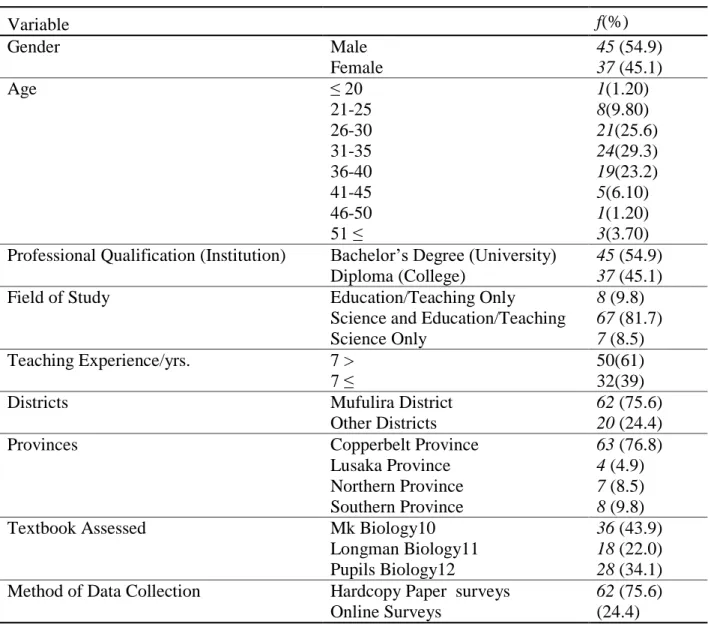
Description of Respondents Table 2 shows demographic variables of the respondents. A relatively higher proportion of teachers, about 55% were male. 78.1% of teachers were between 26-40 years of age, including about a third (29.3%) in the 31-35 age range. A proportion of 81.7% respondents studied secondary science education and 61% had less than 7 years of teaching experience. The survey was done only in 4 out of 10 provinces in Zambia and most respondents (about 76%) were teachers from Mufulira district in Copperbelt Province. Most teachers assessed MK Biology10 (about 44%), twice compared to teachers who assessed Longman Biology11 (22%). Those who assessed Pupils Biology12 were more than a third (about 34%). Lastly, 24% respondents responded using the online survey and 76% by completing hardcopy surveys.
1475
Table 2. Demographic Characteristics of the sample (n = 82)
Variable f(%)
Gender Male 45 (54.9)
Female 37 (45.1)
Age ≤ 20 1(1.20)
21-25 8(9.80)
26-30 21(25.6)
31-35 24(29.3)
36-40 19(23.2)
41-45 5(6.10)
46-50 1(1.20)
51 ≤ 3(3.70)
Professional Qualification (Institution) Bachelor’s Degree (University) 45 (54.9)
Diploma (College) 37 (45.1)
Field of Study Education/Teaching Only 8 (9.8)
Science and Education/Teaching 67 (81.7)
Science Only 7 (8.5)
Teaching Experience/yrs. 7 > 50(61)
7 ≤ 32(39)
Districts Mufulira District 62 (75.6)
Other Districts 20 (24.4)
Provinces Copperbelt Province 63 (76.8)
Lusaka Province 4 (4.9)
Northern Province 7 (8.5)
Southern Province 8 (9.8)
Textbook Assessed Mk Biology10 36 (43.9)
Longman Biology11 18 (22.0)
Pupils Biology12 28 (34.1)
Method of Data Collection Hardcopy Paper surveys 62 (75.6)
Online Surveys (24.4)
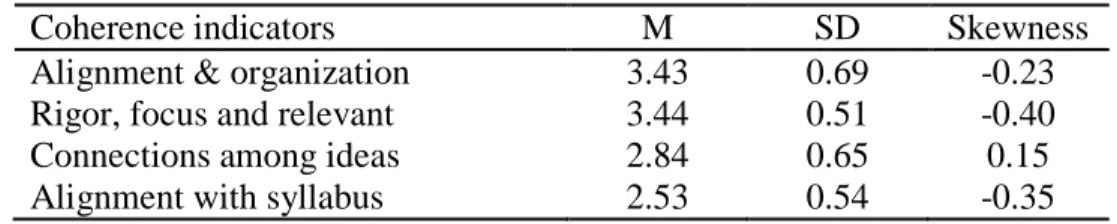
Assessment of Coherent Indicators. Table 3 presents variable mean, standard deviation and skewness values of coherence indicators. Skewness test for normality showed clustering of scores above the mean score (negative skewness) for all aspects except connections among ideas. These skewness statistics are within ±1 and, thus, the variables are deemed normally distributed (Ho & Yu, 2015; Pallant, 2016).
Table 3. Variable descriptive statistics (n = 82)
Coherence indicators M SD Skewness
Alignment & organization 3.43 0.69 -0.23
Rigor, focus and relevant 3.44 0.51 -0.40
Connections among ideas 2.84 0.65 0.15
Alignment with syllabus 2.53 0.54 -0.35
1476
The following summary can be drawn from statistical analysis of results for each research question:
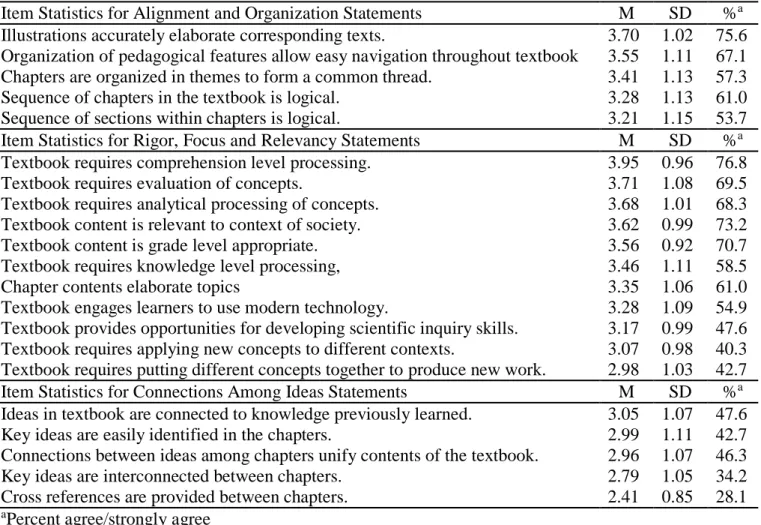
Research question 1 – Perceived Level of Textbook Coherence. Generally, respondents were “neutral” on all three aspects of textbook coherence: alignment and organization (M = 3.43), rigor, focus and relevance (M = 3.44) and connections among ideas (M = 2.84). This reflected uncertainty. In terms of coherence indicators, all the three textbooks were perceived as having higher levels of rigor, focus and relevant contents but none as having adequate connections among ideas.
Table 4. Means and Standard Deviation of Survey Items on Perceptions of Coherence in the Textbooks (n = 82)
Item Statistics for Alignment and Organization Statements M SD %a Illustrations accurately elaborate corresponding texts. 3.70 1.02 75.6 Organization of pedagogical features allow easy navigation throughout textbook 3.55 1.11 67.1 Chapters are organized in themes to form a common thread. 3.41 1.13 57.3
Sequence of chapters in the textbook is logical. 3.28 1.13 61.0
Sequence of sections within chapters is logical. 3.21 1.15 53.7
Item Statistics for Rigor, Focus and Relevancy Statements M SD %a
Textbook requires comprehension level processing. 3.95 0.96 76.8
Textbook requires evaluation of concepts. 3.71 1.08 69.5
Textbook requires analytical processing of concepts. 3.68 1.01 68.3 Textbook content is relevant to context of society. 3.62 0.99 73.2
Textbook content is grade level appropriate. 3.56 0.92 70.7
Textbook requires knowledge level processing, 3.46 1.11 58.5
Chapter contents elaborate topics 3.35 1.06 61.0
Textbook engages learners to use modern technology. 3.28 1.09 54.9 Textbook provides opportunities for developing scientific inquiry skills. 3.17 0.99 47.6 Textbook requires applying new concepts to different contexts. 3.07 0.98 40.3 Textbook requires putting different concepts together to produce new work. 2.98 1.03 42.7
Item Statistics for Connections Among Ideas Statements M SD %a
Ideas in textbook are connected to knowledge previously learned. 3.05 1.07 47.6
Key ideas are easily identified in the chapters. 2.99 1.11 42.7
Connections between ideas among chapters unify contents of the textbook. 2.96 1.07 46.3
Key ideas are interconnected between chapters. 2.79 1.05 34.2
Cross references are provided between chapters. 2.41 0.85 28.1
aPercent agree/strongly agree
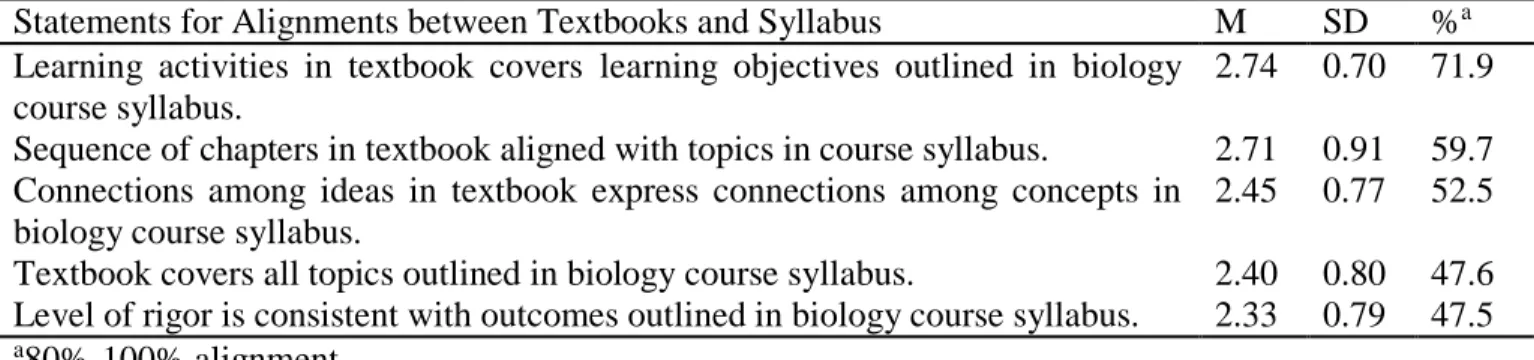
Research Question 2 – Perceived Textbook-Syllabus Coherence. Regarding textbook- syllabus coherence, teachers perceived an 80%-90% alignment (M = 2.53). Table 5 presents the mean, standard deviation and assessment percentage for perceived alignment between the textbooks and the syllabus. Highest perception of textbook-syllabus coherence was reported
1477
for textbooks´ learning activities covering objectives in the syllabus (M = 2.75, SD = 0.70) and textbooks´ rigor as a reflection of this aspect in the syllabus was perceived as the least (M = 2.33, SD = 0.79).
Table 5. Means and Standard Deviation of Survey Items on Perceptions of Textbook- syllabus Coherence (n = 82)
Statements for Alignments between Textbooks and Syllabus M SD %a Learning activities in textbook covers learning objectives outlined in biology
course syllabus.
2.74 0.70 71.9 Sequence of chapters in textbook aligned with topics in course syllabus. 2.71 0.91 59.7 Connections among ideas in textbook express connections among concepts in
biology course syllabus.
2.45 0.77 52.5 Textbook covers all topics outlined in biology course syllabus. 2.40 0.80 47.6 Level of rigor is consistent with outcomes outlined in biology course syllabus. 2.33 0.79 47.5
a80%-100% alignment
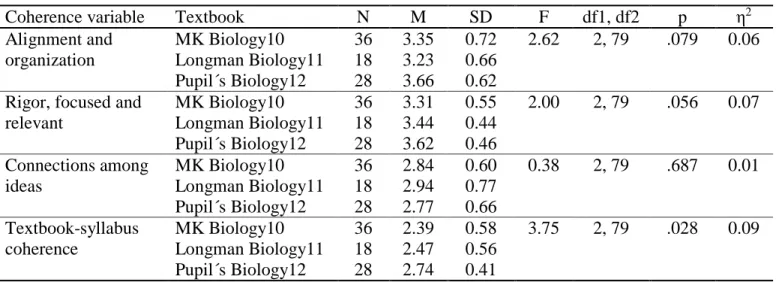
Research Question 3 – Grade Level Textbooks Differences on Perceived. Coherence The levels of coherence across grade level textbooks was not perceived as significantly different with one-way between-groups ANOVA (Table 6).
Table 6. One-way Analysis of variance results comparing coherence across the textbooks Coherence variable Textbook N M SD F df1, df2 p η2 Alignment and
organization
MK Biology10 36 3.35 0.72 2.62 2, 79 .079 0.06 Longman Biology11 18 3.23 0.66
Pupil´s Biology12 28 3.66 0.62 Rigor, focused and
relevant
MK Biology10 36 3.31 0.55 2.00 2, 79 .056 0.07 Longman Biology11 18 3.44 0.44
Pupil´s Biology12 28 3.62 0.46 Connections among
ideas
MK Biology10 36 2.84 0.60 0.38 2, 79 .687 0.01 Longman Biology11 18 2.94 0.77
Pupil´s Biology12 28 2.77 0.66 Textbook-syllabus
coherence
MK Biology10 36 2.39 0.58 3.75 2, 79 .028 0.09 Longman Biology11 18 2.47 0.56
Pupil´s Biology12 28 2.74 0.41
ANOVA shows that differences exists among groups, but not which groups exactly differ (Pallant, 2016). Thus, due to the moderate significant difference concerning textbook-syllabus difference (p = 0.028, η2p = 0.09), post-hoc multiple comparisons using the least significant difference (LSD) test was run which indicated that Pupil´s Biology12 was significantly
1478
perceived to be more aligned with the syllabus than MK Biology10, but not more than Longman Biology11 (Table 7).
Table 7. Post hoc multiple comparison (using LSD) for assessment of textbook-syllabus coherence
Coherence variable Textbook N M Longman
Biology11
Pupil´s Biology12 Textbook-syllabus
coherence
MK Biology10 36 2.39 **
Longman Biology11 18 2.47 Pupil´s Biology12 28 2.74
**p ≤ .01
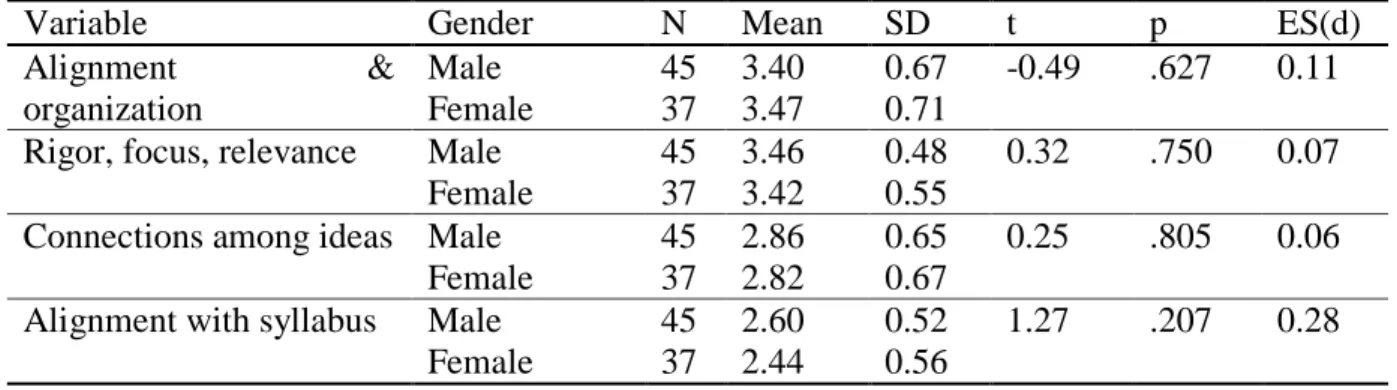
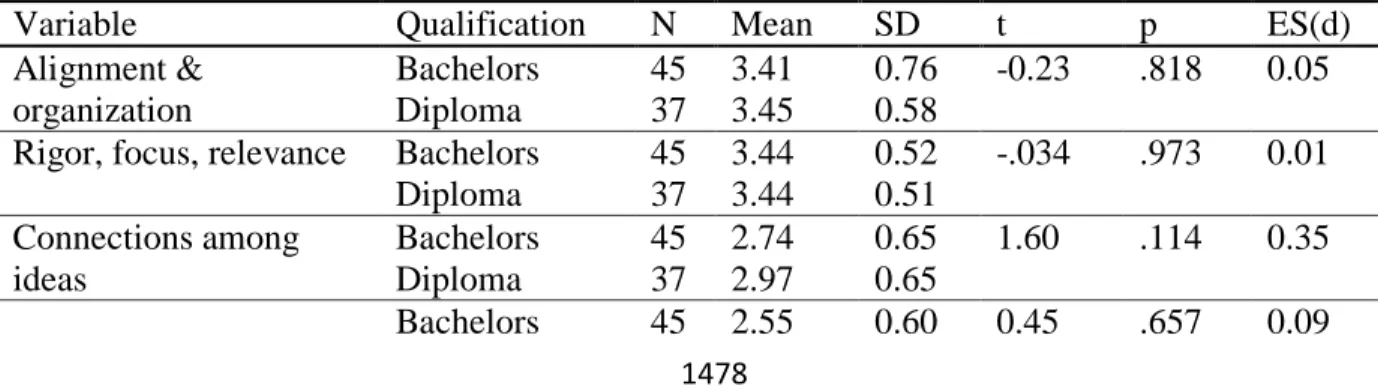
Research Question 4 – Group Analysis. Group analysis using independent t-tests (and a One- way ANOVA for examining differences in perception of textbook and textbook-syllabus coherence based on field of study) revealed similar perceptions of textbook and textbook- syllabus coherence in all variable group pairs of gender (Table 8), qualification (Table 9), work experience (Table 10), place of work (Table 11) and field of study (Table 12).
Table 8. Did perceptions on textbook coherence between male and female teachers differ?
Variable Gender N Mean SD t p ES(d)
Alignment &
organization
Male 45 3.40 0.67 -0.49 .627 0.11
Female 37 3.47 0.71
Rigor, focus, relevance Male 45 3.46 0.48 0.32 .750 0.07
Female 37 3.42 0.55
Connections among ideas Male 45 2.86 0.65 0.25 .805 0.06
Female 37 2.82 0.67
Alignment with syllabus Male 45 2.60 0.52 1.27 .207 0.28
Female 37 2.44 0.56
Table 9. Did perceptions on textbook coherence between teachers with degrees (university graduates) and those with diplomas (college graduates) differ?
Variable Qualification N Mean SD t p ES(d)
Alignment &
organization
Bachelors 45 3.41 0.76 -0.23 .818 0.05
Diploma 37 3.45 0.58
Rigor, focus, relevance Bachelors 45 3.44 0.52 -.034 .973 0.01
Diploma 37 3.44 0.51
Connections among ideas
Bachelors 45 2.74 0.65 1.60 .114 0.35
Diploma 37 2.97 0.65
Bachelors 45 2.55 0.60 0.45 .657 0.09
1479 Alignment with
syllabus
Diploma 37 2.49 0.46
Table 10. Did perceptions on textbook coherence between teachers with working experience of 7 or more years and those with less than 7 years of teaching experience
differ?
Variable Experience N Mean SD t p ES(d)
Alignment &
organization
> 7 years 50 3.45 0.64 0.37 .710 0.08
≤ 7 years 32 3.39 0.76
Rigor, focus, relevance > 7 years 50 3.46 0.47 0.44 .663 0.10
≤ 7 years 32 3.41 0.58 Connections among
ideas
> 7 years 50 2.93 0.64 1.52 .135 0.35
≤ 7 years 32 2.71 0.67 Alignment with
syllabus
> 7 years 50 2.44 0.57 -1.76 .083 0.40
≤ 7 years 32 2.65 0.48
Table 11. Did perceptions on textbook coherence between teachers from one district (Mufulira) and those from other districts differ?
Variable District N Mean SD t p ES(d)
Alignment & organization Mufulira 62 3.38 0.69 -1.06 .295 0.27
Other 20 3.57 0.67
Rigor, focus, relevance Mufulira 62 3.45 0.49 0.27 .792 0.07
Other 20 3.41 0.59
Connections among ideas Mufulira 62 2.85 0.64 0.25 .806 0.06
Other 20 2.81 0.70
Alignment with syllabus Mufulira 62 2.52 0.46 -0.22 .827 0.06
Other 20 2.55 0.75
Table 12. Did perceptions on textbook coherence between teachers with different tertiary education differ? One-way ANOVA
Coherence variable Textbook N M SD F df1, df2 p η2 Alignment &
organization
Education only 8 3.50 0.96 0.613 2, 79 .544 .015 Science and Education 67 3.39 0.65
Science only 7 3.69 0.71
Rigor, focused and relevant
Education only 8 3.49 0.45 1.197 2, 79 .308 .029 Science and Education 67 3.41 0.53
Science only 7 3.71 0.39
Connections among ideas
Education only 8 2.35 0.46 2.657 2, 79 .076 .063 Science and Education 67 2.89 0.67
Science only 7 2.97 0.51
Textbook-syllabus coherence
Education only 8 2.53 0.41 .219 2, 79 .804 .001 Science and Education 67 2.51 0.53
Science only 7 2.65 0.82
1480
DISCUSSION
Several studies done on coherence were conducted in other countries with different challenges in science education, and with unlike academic and social contexts. The results and conclusions from these studies differ from level to level and from country to country. The purpose of this study was to obtain perceptions on coherence of MK Biology10, Longman Biology11 and Pupil´s Biology12 textbooks, and the extent to which these books are coherent with the course syllabus. The rationale for assessing coherence via lens of teachers was regarded for their weightier opinions regarding selection of materials for instruction than students, and that the criteria of assessment demands expertize, which cannot be offered by students (Gurung &
Landrum, 2012; Landrum & Hormel, 2002; McKeachie, 2002). Assessment of coherence was chosen for its potency as a communicative factor in a book (Ocak & Baysal, 2016). An assessment was preferred rather than an evaluation because evaluation rubrics of coherence found in literature appear abstract, sophisticated and need training of participants.
This research is significant because it is the first to apply literature on coherence assessment of textbooks to the Zambian context. Research, monitoring and evaluation sections of the Zambia Education Curriculum Framework 2013, p60 (CDC, 2013b) present the foci of reforms on improving teaching practices and maximizing resource use, but is silent on reforms on instructional materials. Thus, this study provides empirical data that has been scanty for teachers, authors and curriculum developers regarding such considerations.
Respondents. Results of the study show that the teachers were generally uncertain about coherence levels in the textbooks, and Pupil´s Biology12 was viewed as most coherent with the course syllabus and MK Biology10 as the least. A highest proportion of responses for MK Biology10 possibly reflected a current popularization of MK biology textbooks in Zambia.
However, despite significance differences in proportions of respondents in the textbooks assessed, perceptions about levels of coherence across the textbooks were not different.
Textbook Coherence. Substantive analysis of coherence at times demands reviewers to examine the same content or material (Gardner et al., 2014; Roseman et al., 2010). However, in this study, results of assessments on different textbooks were combined during analysis since the focus was coherence indicators. It is hard to say why most respondents were generally undecided for the claim that textbooks are coherent, H0: M ≥ 3 (H1: M < 3). In addition, although the books were perceived as coherent in terms of alignment and organization and rigor, focus and relevance of contents, they were all perceived as lacking coherence in terms
1481
of connections among ideas. Inadequate explicit coherence in the textbooks would be a reasonable argument for this.
Textbook-Syllabus Coherence. A good textbook-syllabus coherence is expected to reveal significant synergy where the textbook reveals clarifying content and coherence as revealed in the syllabus (Bybee, 2003). Therefore, it was found necessary to assess textbook-syllabus coherence. Textbooks are usually designed to cover syllabus learning outcomes and prepare students for board examinations. This was reflected in a relatively high perception about textbook-syllabus alignment (between 80%-90%), for the stated claim that the textbooks would be coherent with the syllabus, H0: 2.5 ≥ 3 (H1: M < 2.5).
Grade-Level Textbook Coherence. The claim that there would be no significant difference across the textbooks when coherence indicators were examined (H0: 𝛍 T1 = 𝛍T2 = 𝛍T3; Ha:
at least one of the means is different) was not rejected. Thus, the investigation of coherence of individual textbooks was not necessary. Contrary to the above, variance analysis showed a significant difference regarding textbook-syllabus coherence across the textbooks. Pupil´s Biology12 was significantly more coherent with the syllabus than MK Biology10 but not more than Longman Biology11. In fact, the type and sequence of chapters in Pupils´ Biology12 is almost identical to that of topics in the course syllabus (ECZ, 2018; Katete et al., 2012). Since MK Biology10 and Longman Biology11 were published after the biology course syllabus (Avis et al., 2015; MKBiologyPanel, 2014), one would expect these books to be more aligned with the course syllabus (CDC, 2013a) than Pupil´s Biology12 which was published a year before the syllabus was implemented (Katete et al., 2012). However, this was not the case. A use of textbooks to guide design of the syllabus may be one argument for this variance, similar to settings where textbooks are used in designing learning standards and outcomes (Belcher &
Williams, 1995; Valverde et al., 2002).
Group Analysis. The assumption of equality of the distribution in assessment of coherence by different groups: gender, qualification, work experience, location (district) and field of study (discipline) was satisfied. Group differences did not have a significant effect on assessment of coherence, as expected. In addition, this analysis served to test for the strength of the instrument and the robustness of results. Teachers in Mufulira were the main target population and their perceptions on coherence was similar to those of teacher in other districts. Because of this similarity, a fair degree of external validity is inferable, mitigating for the small sample size (n
= 82).
1482
The Findings and Literature. This study is the first assessment research of coherence involving textbooks in Zambia. It is also the first to use an assessment questionnaire for analyzing coherence, the first to assess via lens of teachers´ perceptions as well as the first to include assessment of all textbook contents and to investigate the extent of textbook-syllabus coherence. As such, direct comparisons to research on coherence are limited. Nonetheless, similar to this study, several studies focus on the same elements or indicators of coherence (Bybee, 2003; Cuevas et al., 2009; Fortus & Krajcik, 2012; Fortus et al., 2015; Gagné et al., 2013; Gardner et al., 2014; Shwartz et al., 2008; Sikorski & Hammer, 2017). In addition, except a study by Ainsworth and Burcham (2007), most studies reviewed haven´t involved students in assessing or evaluating coherence of textbooks similar to this study.
A few differences from the literature were found. Firstly, this study involved the use of a simple assessment questionnaire compared to many studies of detailed coherence analysis using evaluation and intricate assessment tools (Ainsworth & Burcham, 2007; Bybee, 2003; Cuevas et al., 2009; Fortus & Krajcik, 2012; Gagné et al., 2013; Gardner et al., 2014; Ibáñez et al., 2019; New Zealand Online Curriculum, 2015; Roseman et al., 2008; Schmidt & Houang, 2012;
Schmidt & Prawat, 2006; Schmidt et al., 2005; Shin et al., 2009; Shwartz et al., 2008; Sikorski
& Hammer, 2017). Secondly, this study assessed coherence involving all chapters in three different textbooks across three grades rather than particular topics as in studies by Fortus et al. (2015), Roseman et al. (2010) and Gardner et al. (2014). Lastly, this study found consistency of perceptive judgements about connections among ideas contrary to results in a study by Roseman et al. (2010) on biology textbooks in the US. These researchers found less consistency on judgements pertaining to connections than judgements pertaining to alignment among reviewers. In addition, guidelines for determining alignment were more explicit than those for making connections in a coherent textbook (Roseman et al., 2010). In this study however, the perception of connections among ideas was consistent across all the three textbooks. Perhaps the difference lies in the method used, instrument measure, sample size and overall design of the studies. On the other hand, both studies reveal consistency in judgments about alignment and organization.
Limitations. The main limitation in this study is the amount of sample data. There was no missing data but the sample size of 82 may limit scalable statistical power (Seale, 2004). The second limitation lies in the use of a questionnaire when seeking for perception which may not capture in-depth perceptions as evaluations normally do. Also, the study analyzed perceived perceptions on coherence instead of the actual assessments data opposite to methods in several
1483
studies (Fortus & Krajcik, 2012; Fortus et al., 2015; Gardner et al., 2014; Hsueh & 薛耕欣, 2012; Roseman et al., 2010). Triangulating this design with an evaluation tool or a qualitative design may delimit this. Lastly, limitations are recognized in the methods including confounding factors (assessing for cohesion instead of coherence) and data collection.
Involving research assistants may be associated with low motivation and participation of respondents. Besides, some respondents could not be reached well with online surveys which is a possible reason for low participation rate. Online surveys also have other cons such as internet and window problems, end-user verification and presence of the interviewer to answer respondent´s queries.
Implications for Teaching Practice. This study highlighted certain aspects of textbooks that may require teachers’ attention during instruction. The intent is not to characterize textbooks in dichotomous terms, but to offer insights on how to identify patterns of coherence. This may help teachers to rectify weaknesses identified with coherence and deliver instruction that facilitates student achievement. As such, it is recommended that educational workshops, seminars and other trainings include coherence of curricula and textbooks to raise awareness on the subject.
Implications for Textbook and Curriculum Development. Authors of science textbooks in Zambia possibly appreciate the significance of coherence in science books and designing textbooks coherent with the course syllabi. Thus, examining coherence aspects in the textbook and the syllabus more closely during textbook design is recommended.
Implications for Future Research. The study was limited mostly to teachers in Mufulira district, and the sample size was small. The scope of this study should be extended to include a larger sample of teachers in other provinces in Zambia. Also, a qualitative study is recommended to further explore the reasons for the perceptions about coherence in this study.
Research is also recommended to assess and compare coherence of textbooks of same grade levels and coherence of foreign textbooks in comparison to those published in Zambia.
Research assessing junior secondary science textbooks may find this study useful to build upon.
This study is also recommended, with modification of the instrument, to assessments of non- science textbooks. Lastly, a study evaluating coherence of the Zambian biology course syllabus is highly recommended so that improvements to textbooks are nested in empirical studies.
Conclusion
Based on the problems identified, the findings obtained in this study indicate to satisfy the goal of assessing coherence of MK Biology10, Longman Biology11 and Pupil´s Biology12, and the
1484
extent to which these textbooks are coherent with the biology course syllabus in Zambia. The questionnaire instrument developed is simple and is likely to yield consistent and valid results if other high school science textbooks were analyzed under similar settings. The uncertainty shown by teachers about coherence levels in the textbooks highlights the significance of researcher´s concerns on the topic as stated in the problem statement. Also, while some differences may exist, it is fair to make similar predictions about the textbooks´ coherence levels as no significant difference across the textbooks was found. The study was the first in its nature, thus lack direct link to literature. Assessing coherence is a complex process but focuses on few elements. This study offers empirical data on these elements and the findings obtained may help biology authors to produce coherent textbooks, curriculum developers to design coherent standards and education activities and teachers to improve teaching practice.
Recommendation
The study also offers empirical evidence substantiating the initiatives of MoE and CDC which called for publications of improved textbooks. The findings obtained are also useful baseline data for studies recommended.
REFERENCES
AAAS. (2002). AAAS Annual Report 2002. Retrieved from
https://www.aaas.org/resources/aaas-annual-report-2002
AAAS. (2005). High School Biology Textbooks: A Benchmarks-Based Evaluation: Project
2061 Analysis Procedure. Retrieved from
http://www.project2061.org/publications/textbook/hsbio/report/crit-used.htm AAAS. (2019). Project 2061. Retrieved from https://www.aaas.org/
Adibelli-Sahin, E., & Deniz, H. (2017). Elementary teachers’ perceptions about the effective features of explicit-reflective nature of science instruction. International Journal of Science Education, 39(6), 761-790.
Ainsworth, S., & Burcham, S. (2007). The impact of text coherence on learning by self- explanation. Learning and Instruction, 17(3), 286-303.
Avis, J., Clintheroe, F., Mudenda, K., & Ritchie, E. (2015). Longman Biology. Learner’s book Grade 11. Lusaka: Longman Educational Publishers Ltd.
Barlow, D. (2011). Designing Coherent Science Education: Implications for Curriculum, Instruction, and Policy. Education Digest, 76(7), 72-72.
1485
Barry, S. (2003). Why Schools Matter: A Cross-National Comparison of Curriculum and Learning. William H. Schmidt Curtis C. McKnight Richard T. Huong HsingChi Wang David E. Wiley Leland S. Cogan Richard G. Wolfe. In (Vol. 96, pp. 218) Reston: National Council of Teachers of Mathematics.
Belcher, C. D., & Williams, W. (1995). Middle School Science Teachers' Perception of Textbook Congruency with Classroom Needs. Retrieved from http://ludwig.lub.lu.se/login?url=http://search.ebscohost.com/login.aspx?direct=true
&db=eric&AN=ED389696&site=eds-live&scope=site
Bergqvist, A., & Chang, R., Shu-Nu. (2017). The Influence of Textbooks on Teachers' Knowledge of Chemical Bonding Representations Relative to Students' Difficulties Understanding. Research in Science & Technological Education, 35(2).
Bhat, A. (2018). Cross-sectional study- definition with examples. Retrieved from https://www.questionpro.com/blog/cross-sectional-study/
Blyth, W. A. L. (1966). Taxonomy of Educational Objectives. Handbook I: Cognitive Domain B. S. Bloom. In (pp. 119): Faber & Faber Limited.
Bybee, R. W. (2003). The Teaching of Science: Content, Coherence, and Congruence. Journal of Science Education & Technology, 12(4), 343.
CDC. (2013a). Biology Syllabus Grade: 10-12. Lusaka: CDC.
CDC. (2013b). The Zambia Education Curriculum Framework 2013. Lusaka, Zambia:
Curriculum Development Center.
Chabalengula, V. M., Mumba, F., Lorsbach, T., & Moore, C. (2008). Curriculum and Instructional Validity of the Scientific Literacy Themes Covered in Zambian High School Biology Curriculum. International Journal of Environmental & Science Education, 3(4), 207-220.
Crowe, A., Dirks, C., & Wenderoth, M. P. (2008). Biology in bloom: implementing Bloom's Taxonomy to enhance student learning in biology. CBE Life Sciences Education, 7(4), 368-381.
Cuevas, N. M., Matveev, A. G., & Feit, M. D. (2009). Curriculum Mapping: An Approach to Study the Coherence of Program Curricula. Department Chair, 20(1), 23.
Cullinane, A., & Liston, M. (2016). Review of the Leaving Certificate biology examination papers (1999–2008) using Bloom’s taxonomy–an investigation of the cognitive demands of the examination. Irish Educational Studies, 35(3), 249-267.
ECZ. (2018). Biology 5090. Lusaka: Examination Council of Zambia
Edling, A. (2006). Abstraction and authority in textbooks: the textual paths towards specialized language: Uppsala: Acta Universitatis Upsaliensis: Uppsala University Library [Uppsala universitetsbibliotek] [distributör], 2006.
1486
Fortus, D., & Krajcik, J. (2012). Curriculum Coherence and Learning Progressions. Second International Handbook of Science Education In (pp. 783-798). Berlin, Germany:
Springer, Dordrecht.
Fortus, D., Sutherland Adams, L. M., Krajcik, J., & Reiser, B. (2015). Assessing the Role of Curriculum Coherence in Student Learning about Energy. Journal of Research in Science Teaching, 52(10), 1408-1425.
Gagné, P., Dumont, L., Brunet, S., & Boucher, G. (2013). Curriculum Alignment: Establishing Coherence. Collected Essays on Learning and Teaching, 6, 7-12.
Gardner, A. L., Bybee, R. W., Enshan, L., & Taylor, J. A. (2014). Analyzing the Coherence of Science Curriculum Materials. Curriculum & Teaching Dialogue, 16(1/2), 65-86.
Gurung, R., & Landrum, R. E. (2012). Comparing Student Perceptions of Textbooks: Does Liking Influence Learning?. International Journal of Teaching and Learning in Higher Education, 24(2), 144-150.
Ho, A. D., & Yu, C. C. (2015). Descriptive Statistics for Modern Test Score Distributions:
Skewness, Kurtosis, Discreteness, and Ceiling Effects. Educ Psychol Meas. 75(3), 365-388). doi: 10.1177/0013164414548576
Hsueh, K.-H., & Chang, Shufang. (2012). Readability Analysis and Curriculum Coherence of Readings between Junior High School and Senior High School English Textbooks in
Taiwan. In 國民中學三年級與高級中學一年級英語(文)教科書課文適讀性與
銜接度之探究. China: Department of Education National Taichung University.
Ibáñez, R., Moncada, F., & Cárcamo, B. (2019). Coherence Relations in Primary School Textbooks: Variation across School Subjects. Discourse Processes. 56(8), 764-785.
Retrieved from
http://ludwig.lub.lu.se/login?url=http://search.ebscohost.com/login.aspx?direct=true
&db=edselc&AN=edselc.2-52.0-85060577240&site=eds-live&scope=site.
doi:10.1080/0163853X.2019.1565278
Katete, L., Hanyuma, F., Katambala, P. L., & Mwale, R. (2012). Biology 12. Pupils Book.
Senior Secondary Course. Lusaka: Mwajionera Publishers.
Kellerman, S. E., & Herold, J. (2001). Physicians responses to surveys: A review of the literature. American Journal of Preventive Medicine, 20(1), 61-67. doi:
https://doi.org/10.1016/S0749-3797(00)00258-0
Khine, M. S. (2013). Analysis of Science Textbooks for Instructional Effectiveness. In: Khine M. (eds) Critical Analysis of Science Textbooks. Dordrecht: Springer.
Krajcik, J., McNeill, K. L., & Reiser, B. J. (2008). Learning-Goals-Driven Design Model:
Developing Curriculum Materials That Align with National Standards and Incorporate Project-Based Pedagogy. Science Education, 92(1), 1-32.
1487
Landrum, E. R., & Hormel, L. (2002). Textbook Selection: Balance Between the Pedagogy, the Publisher, and the Student. Teaching of Psychology, 29(3), 245-248.
Matseleng, A. S., Dempster, E. R., & Barlow-Zambodla, A. (2008). Learning from Africa:BiologyA report of Umalusi’s researchcomparing Biology syllabuses andexaminations in South Africawith those inGhana, Kenya, and Zambia. Retrieved
from Pretoria, South Africa:
https://www.researchgate.net/publication/273703361_Curriculum_comparison_Biol ogy
Mayer, R. E. (1996). Learners as information processors: Legacies and limitations of educational psychology's second metaphor. Educational Psychologist, 31(3), 151- 161.
McBurney, D. H., & White, T. L. (2009). Research Methods: Cengage Learning.
McKeachie, W. J. (2002). McKeachie's teaching tips: strategies, research, and theory for college and university teachers: Boston: Houghton Mifflin Co., cop. 2002 11. ed.
Michael, W. B., & Coffman, W. E. (1956). Book Reviews: Taxonomy of Educational Objectives, The Classification of Educational Goals, Handbook I: Cognitive Domain, by Benjamin S. Bloom (ed.). New York: Longmans, Green and Company, I956.
Educational & Psychological Measurement, 16(3), 401.
Mikk, J. (2000). Textbook: Research and Writing. Baltische Studien zur Erziehungs und Sozialwissenschaft, Band 3 (Baltic Studies for Education and Social Sciences, Volume 3). NY: Peter Lang Publishing, Inc.
MKBiologyPanel. (2014). Senior Secondary Biology. Learners’ Book Grade 10. Lusaka: MK Publishers Ltd.
Muller, J. (2009). Forms of knowledge and curriculum coherence. Journal of Education and Work, 22(3), 205-226.
Mumba, F., Chabalengula, V. M., Wise, K., & Hunter, W. J. F. (2007). Analysis of new Zambian high school physics syllabus and practical examinations for levels of inquiry and inquiry skills. Eurasia Journal of Mathematics, Science and Technology Education, 3(3), 213-220.
Mumba, F., & Hunter, W. (2009). Representative nature of scientific literacy themes in a high school chemistry course: the case of Zambia (Vol. 10).
NewZealandOnlineCurriculum. (2015). Coherence. Retrieved from http://nzcurriculum.tki.org.nz/Principles/Coherence
Nwafor, C. E., & Umoke, C. C. (2016). Evaluation of Some Approved Basic Science and Technology Textbooks in Use in Junior Secondary Schools in Nigeria. Journal of Education and Practice, 7(14), 69-78.
1488
Ocak, G., & Baysal, E. A. (2016). Evaluation of English Textbooks in Terms of Textuality Standards. Journal of Education and Training Studies, 4(12), 36-44.
Pallant, J. (2016). SPSS Survival Manual: A Step by Step Guide to Data Analysis Using IBM SPSS (6 ed.). New York: Open University Press.
Pedersen, S., & Liu, M. (2003). Teachers’ beliefs about issues in the implementation of a student-centered learning environment. Educational Technology Research and Development, 51(2), 57.
Pressbooks. (2018). Defining Content Structure. Content Organization. Authoring open
textbooks. Retrieved from
https://press.rebus.community/authoropen/chapter/defining-content-structure/
Richard, E. M., Kathryn, S., Gregory, B., & Rebecca, M. (1995). A Generative Theory of Textbook Design: Using Annotated Illustrations to Foster Meaningful Learning of Science Text. Educational Technology Research and Development, 43(1), 31.
Roseman, J. E., Linn, M. C., & Koppal, M. (2008). Characterizing curriculum coherence. In Y. Kali, M. C. Linn, & J. E. Roseman (Eds.), Designing coherent science education:
Implications for curriculum, instruction, and policy. New York: Teachers College Press.
Roseman, J. E., Stern, L., & Koppal, M. (2010). A Method for Analyzing the Coherence of High School Biology Textbooks. Journal of Research in Science Teaching, 47(1), 47- 70.
Schaeffer, N., & Presser, S. (2003). The Science of asking questions Annual Review of Sociology, 29, 65-88.
Schmidt, W. H. (2003). The Quest for a Coherent School Science Curriculum: The Need for an Organizing Principle (Vol. 20).
Schmidt, W. H. (2010). Are National Standards the Right Move? Educational Leadership, 67(7), 24-24.
Schmidt, W. H., & Houang, R. T. (2012). Curricular Coherence and the Common Core State Standards for Mathematics. Educational Researcher, 41(8), 294-308.
Schmidt, W. H., & Prawat, R. S. (2006). Curriculum coherence and national control of education: Issue or non-issue? Journal of Curriculum Studies, 38(6), 641-658.
Schmidt, W. H., Wang, H. C., & McKnight, C. C. (2005). Curriculum coherence: an examination of US mathematics and science content standards from an international perspective. Journal of Curriculum Studies, 37(5), 525-559.
Seale, C. (2004). Researching Society and Culture. London: Sage publications Ltd.
1489
Shin, N., Stevens, S., & Krajcik, J. (2009). Learning Progressions to Support Coherence Curricula in Instructional Material, Instruction, and Assessment Design.
Shwartz, Y., Weizman, A., Fortus, D., Krajcik, J., & Reiser, B. (2008). The IQWST Experience: Using Coherence as a Design Principle for a Middle School Science Curriculum. Elementary School Journal, 109(2), 199-219.
Sikorova, Z. (2012). “The Role of Textbooks in Lower Secondary Schools in the Czech Republic.” IARTEM E-Journal, 4(2), 5–20.
Sikorski, T.-R., & Hammer, D. (2017). Looking for Coherence in Science Curriculum. Science Education, 101(6), 929-943.
Spector, P. E. (2019). Do Not Cross Me: Optimizing the Use of Cross-Sectional Designs.
Journal of Business & Psychology, 34(2), 125-137.
Valverde, G. A., Schmidt, W. H., Bianchi, L. J., R.G, W., & Houang, R. T. (2002). Textbook Structure. According to the Book. Berlin, German: Dordrecht. Springer.
Yadava, S., & Pruya, R. y. c. (2017). A study of the perception of teachers towards NCERT science textbooks at upper primary stage. International Journal of Current Research, 9(7), 53738-53741.
![Figure 1. Conceptual Framework [adapted from (New Zealand Online Curriculum, 2015)]](https://thumb-ap.123doks.com/thumbv2/123dok/12299784.0/6.893.106.781.330.526/figure-conceptual-framework-adapted-new-zealand-online-curriculum.webp)