The Upright Go Wearable Posture Device: An Evaluation of Postural Health, Improvement of Posture, and Salivary Cortisol Fluctuations in College Students
By:
Alexandra Lauren Elliott
A thesis submitted to the faculty of The University of Mississippi in partial fulfillment of the requirements of the Sally McDonnell Barksdale Honors College.
Oxford April 2019
Approved by ___________________________________
Advisor: Carol Britson, Ph.D.
___________________________________
Reader: Clifford A. Ochs, Ph.D.
___________________________________
Reader: John Samonds, Ph.D.
© 2019
Alexandra Lauren Elliott ALL RIGHTS RESERVED
ACKNOWLEDGMENTS
I must extend thanks to Dr. Carol Britson for allowing me the opportunity to complete my thesis under her guidance. This project would not have been possible without Dr. Britson’s generosity with her time, ideas, and constructive criticism. I also would like to thank her for supporting my future career as a medical doctor. My
experiences with Dr. Britson are integral in my academic career, and thanks to her, I will enter medical school as much more confident and equipped student.
I would like to thank Dr. Clifford A. Ochs for his support in my future as medical doctor. In addition, I thank him for reading the following pages and for his constructive criticism. I also thank him for attending my thesis defense.
I would like to thank Dr. John Samonds for his advice in my academic career. I appreciate his willingness to read my thesis and provide suggestions. I would also like to thank Dr. Samonds for attending my thesis defense.
ABSTRACT
ALEXANDRA L. ELLIOTT: The Upright Go Wearable Posture Device: An Evaluation of Postural Health, Improvement of Posture, and Salivary Cortisol Fluctuations in
College Students
(Under the direction of Carol A. Britson)
Health professionals consider improper posture as a risk factor for
musculoskeletal disorders, chronic pain, and additional health issues. The chief aim of my study was to investigate links between poor posture and health, particularly in college students. To collect data regarding postural health, I distributed an exploratory survey to Human Anatomy and Physiology II (BISC 207) students at the University of Mississippi in Spring 2018. Students reported significant concern with quality of personal posture and significant experience with negative side effects of poor posture. Results
demonstrated a need for postural education, leading to phase 2 of my experiment, the evaluation of the Upright Go wearable posture training device in improving user posture.
The Upright Go development team claims the device provides an efficient and comfortable method to improve postural health. This insight into student experience and information on the Upright Go allowed me to generate the second phase of my
experiment and create testable hypotheses: (1) the Upright Go device will work to prevent back slouch, thus reducing mean percent of time slouching in students and (2) improved postural health can physiologically influence neuroendocrine responses, such as decreased cortisol levels. Upright Go devices were used on the Human Anatomy &
Physiology I (BISC 206) volunteers during laboratory periods of the fall 2018 semester.
The second phase of my study began with an intake survey given to BISC 206 students in fall 2018. Results indicated students had significant postural issues and verified that these students were willing to try the Upright Go device. The Upright Go experiment involved
four experimental groups: no treatment, text reminders to correct posture, Upright Go in tracking mode, and Upright Go in tracking and training mode. Over the course of
treatment sessions, all volunteers provided three saliva samples. Samples were frozen and tested for cortisol levels using an Eagle Biosciences ELISA kit.
To analyze the effectiveness of the Upright Go device, I used a 2-way ANOVA to evaluate the mean percent of time slouching as recorded by the Upright Go device. This data did not differ significantly between sessions and groups (F = 2.83, d.f. = 2, p = 0.085). Results from a 2-way ANOVA also indicate that there were no significant changes in salivary cortisol levels between experimental groups (F = 1.23; d.f. = 3; p = 0.302) or treatment sessions (F = 0.21; d.f. = 2; p = 0.813). To evaluate student perceived postural improvement, I distributed an exit survey to students. The majority of
experimental group 2 participants indicated no substantial postural improvement. All experimental group 3 students noticed a substantial improvement in posture. Three students in experimental group 4 noticed substantial postural improvement and group 4’s Upright Go data demonstrates a decreasing percent of time slouching with each treatment session. Students predominantly found the Upright Go device to be comfortable and effective. The majority of exit survey questions for experimental groups 2, 3, and 4 yielded observable trends in results, yet most of these trends were not statistically significant. The small sample sizes in these groups limited the statistical power of
Upright Go data and exit survey results. Overall, exit survey results demonstrate that this study has produced a positive, significant change in student awareness of proper postural management. A larger and longer-term study is necessary to fully evaluate the Upright Go device and the effect that improved posture may have on salivary cortisol levels.
TABLE OF CONTENTS
LIST OF TABLES………..………...vii
LIST OF FIGURES………...….……ix
INTRODUCTION.………..1
MATERIALS AND METHODS………7
RESULTS………..…15
DISCUSSION.………...……20
LIST OF REFERENCES………...……30
APPENDIX A.………..…….…50
APPENDIX B.……….…..54
APPENDIX C.……….…..56
APPENDIX D.………...…57
LIST OF TABLES
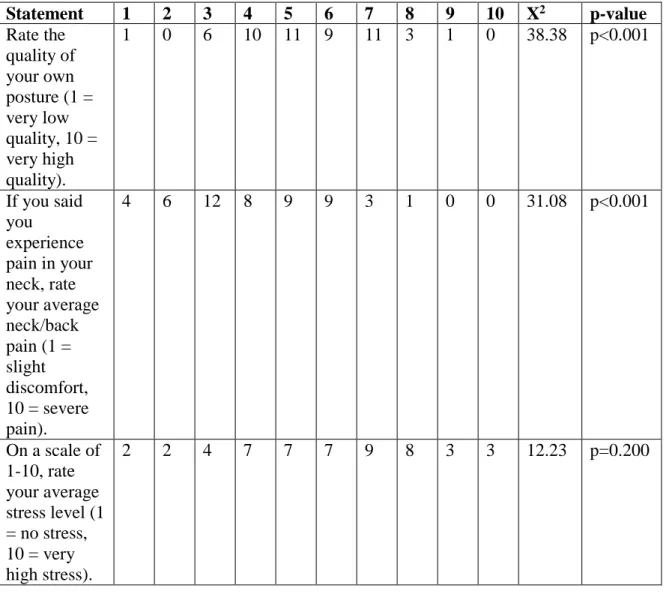
TABLE 1: BISC 207 student responses on the spring 2018 exploratory survey; the Likert-style statements assessed student understanding of posture
significance, student willingness to wear a device to improve posture, and student evaluation of personal posture (SA = strongly agree, A = agree, N
= neutral, D = disagree, SD = strongly disagree; d.f. = 4)...32 TABLE 2: BISC 207 student responses on the spring 2018 exploratory survey;
questions assessed student knowledge of posture significance, student experience with back/neck pain, and student evaluation of personal
posture (1 = low, 10 = high; d.f. = 9)………..…………...34 TABLE 3: BISC 207 student responses on the spring 2018 exploratory survey;
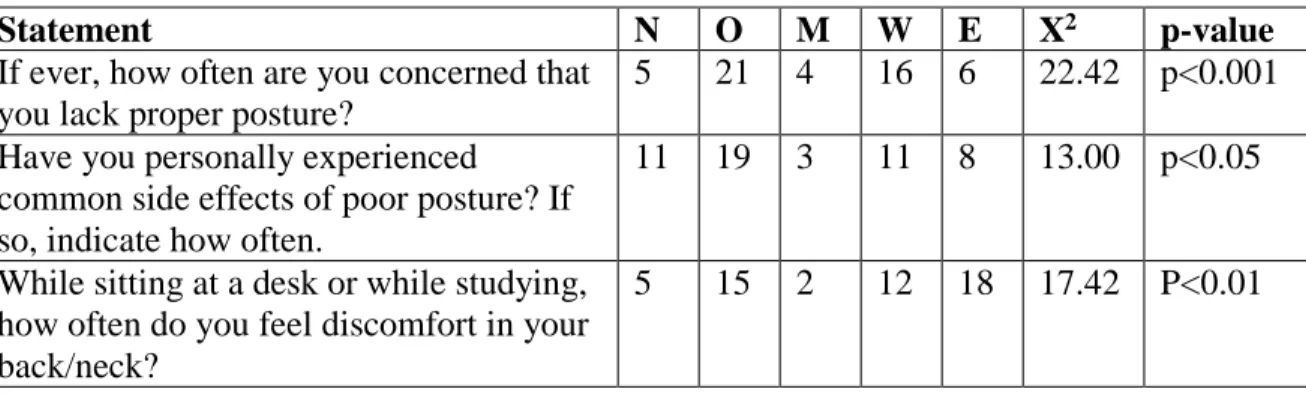
questions analyzed student evaluation of personal posture and experience with postural issues (N = Never, O = Occasionally, M = monthly, W = weekly, E = everyday; d.f. = 4)………..………36 TABLE 4: BISC 206 student responses on the fall 2018 intake survey; questions
assessed student evaluation of personal posture, student experience with neck/back pain, and student stress levels (1 = low, 10 = high; d.f. =9).…37 TABLE 5: BISC 206 student responses on the fall 2018 intake survey; questions
analyzed student evaluation of personal posture and student experience with postural health issues (N = never, O = occasionally, M = monthly, W
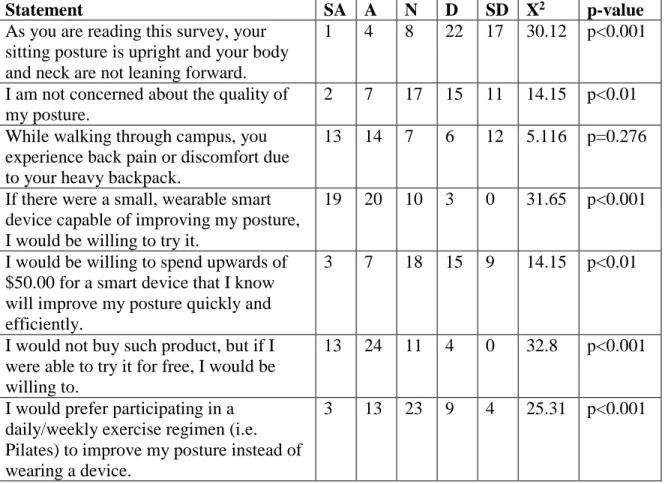
= weekly, E = everyday; d.f. = 4). ………...….…38 TABLE 6: BISC 206 student responses on the fall 2018 intake survey; the survey
consisted of Likert-style statements regarding student evaluation of personal posture, student experience with postural health issues (i.e.
neck/back pain), and student willingness to wear a small, smart device to improve user posture (SA = strongly agree, A = agree, N = neutral, D = disagree, SD = strongly disagree; d.f. = 4).………..…….39 TABLE 7: BISC 206 student responses to Likert-style statements on the fall 2018 exit
survey; the Likert-style statements assessed experimental group 1’s perception of the study (SA = strongly agree, A = agree, N = neutral, D = disagree, SD = strongly disagree; d.f. = 4)………...….……40 TABLE 8: BISC 206 student responses (group 2) on the fall 2018 exit survey; the
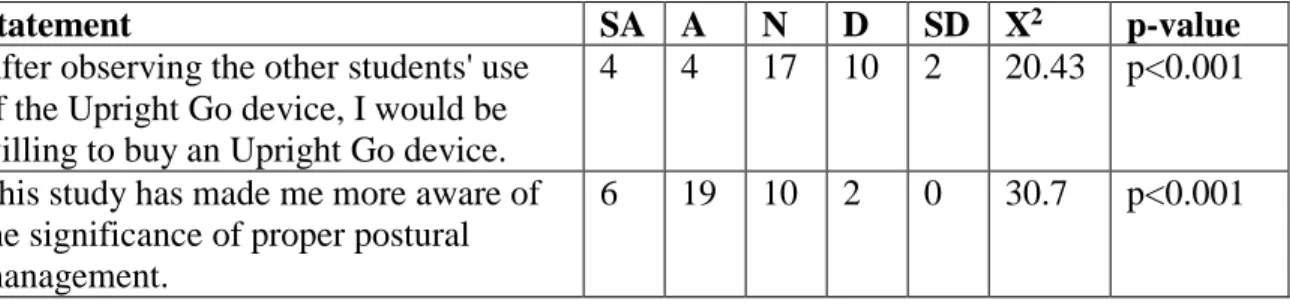
Likert-style statements evaluated the effects of periodic text reminders reminding volunteers to obtain an upright posture (SA = strongly agree, A
= agree, N = neutral, D = disagree, SD = strongly disagree; d.f. = 4)…...41 TABLE 9: BISC 206 student responses (group 3) on the fall 2018 exit survey; the
Likert-style questions evaluated student perception of postural change and
student opinion on the effectiveness of the Upright Go device in tracking mode (SA = strongly agree, A = agree, N = neutral, D = disagree, SD = strongly disagree; d.f. = 4)………..………...42 TABLE 10: BISC 206 student responses (group 4) to Likert-style statements on the fall
2018 exit survey; survey questions evaluated student perception of postural change and student opinion on the effectiveness of the Upright Go device in tracking and training modes (SA= strongly agree, A = agree, N = neutral, D = disagree, SD = strongly disagree; d.f. = 4).……….…...43
LIST OF FIGURES
FIGURE 1: The mean percentage of time BISC 206 students in experimental groups 3 and 4 spent in a slouching posture while wearing the Upright Go device.
The error bars represent ± 1 standard error. Data was taken during three consecutive laboratory periods, each one week apart. Students in
experimental group 3 wore the Upright Go device in tracking mode only.
Students in experimental group 4 wore the Upright Go device in tracking and training modes. At the conclusion of each laboratory session, student posture data was downloaded directly from the individual Upright Go devices into the Upright Go smartphone application. Results from a 2-way ANOVA indicate that Upright Go data did not differ significantly between sessions (F = 0.977, d.f. = 2, p = 0.395). The 2-way ANOVA results also indicate that Upright Go data did not differ significantly between
experimental groups 3 and 4 (F = 3.585, d.f. = 1, p = 0.074). Overall, student mean percent of time slouching did not differ significantly
between sessions and groups (F = 2.83, d.f. = 2, p = 0.085)……….……45 FIGURE 2: The mean salivary cortisol concentration (ng/mL) of 206 undergraduate
students enrolled in BISC 206 at the University of Mississippi. The error bars represent ± 1 standard error. Samples were obtained over the course of three separate laboratory sessions. Averages are shown for Group 1 (no treatment), Group 2 (text reminders), Group 3 (tracking mode), and Group 4 (tracking and training modes). Results from a 2-way ANOVA confirm that participant salivary cortisol levels post-treatment do not differ
significantly between groups (F = 1.23; d.f. = 3; p = 0.302). Additionally, results from a 2-way ANOVA confirm that participant salivary cortisol levels do not differ significantly between sampling periods (F = 0.21; d.f.
= 2; p = 0.813)……...………...……….……… 46
INTRODUCTION
Proper postural control is not only vital to keep one’s body in a secure position while sitting, standing, or lying down, but it is an important indication of one’s health. In 1947, the Committee of the American Academy of Orthopedic Surgeons described proper posture as “…the state of muscular and skeletal balance which protects the supporting structures of the body against injury or progressive deformity…” (AAOS, 1947). Though clinical definitions of good and bad postures are widely acknowledged, it has proven difficult to determine an optimal posture for all people. Research on various sitting postures describes optimal sitting posture as a mid-range position of the pelvis, slight lumbar lordosis, slight thoracic kyphosis, and with the head in a well-balanced position (Korakakis et al., 2019). Korakakis et al. (2019) results indicate 98.2% of
physiotherapists selected an upright posture with low thoracic flexion, proper head alignment over the trunk, anterior pelvic tilt, and slight lumbar lordosis as most optimal.
Nonetheless, evidence proves that there is no one “optimal” posture, especially when considering the varying ergonomic conditions and health states existing among humans.
Moreover, evidence supports that any prolonged postural stance can lead to back/neck discomfort (Sorensen et al., 2015).
A myriad of factors can contribute to or enhance the development of improper posture and its negative effects. A study regarding backpack carriage in adults discusses how load carriage can adversely affect physiological functions like gait, energy
consumption, trunk muscle activity, stance stability, and pulmonary function. Whilst carrying a backpack, subjects were found to have increased cervical extension, thoracic and trunk forward lean, and repositioning errors in all spinal regions (Chow et al., 2011).
Though spinal curvature improved after removal of backpacks, curvature did not return to preload levels, increasing the risk for spinal injury (Chow et al., 2011). Chow et al.
(2011) suggests that this alteration in spinal proprioception explains the possible link between backpack carriage and back/neck pain.
Buchbinder et al. (2013) found low back pain to be the greatest source of
disability worldwide. In comparison to healthy patients, those with low back pain display decreased balancing ability and delayed response time (Xia et al., 2008). A review of home posture habits and low back pain in adolescents found that “the observed association between home postural habits and low back pain could be a reflex of a
population that spends much time in inappropriate passive postures at home” (Filho et al., 2015). Hurwitz et al. (2018) found low back pain to be a serious public health issue, affecting over a half a billion people worldwide; the study predicts a continual increase in low back pain with aging populations.
Twenge et al. (2018) found that technological progression in the twenty-first century has substantially increased average screen time (i.e. time spent using a
technological device) and the time humans spend sedentary (i.e. time spent with little or no physical activity). In seven years, the percentage of Americans who possess
smartphones has increased from 39% to 77%, and 94% of citizens in the 18-29 age group now own smartphones (Pew Research Center, 2018). Akodu (2018) claims that
physiotherapy undergraduates are vulnerable to smartphone addiction, and this addiction can decrease craniovertebral angle, leading to a forward head posture that invariably causes an increase in scapular dyskinesis in young adults. A five-year cohort study among young adults revealed that texting on mobile phones is significantly associated
with musculoskeletal symptoms in the neck and upper extremities (Gustafsson et al., 2016). Rebold et al. (2016) found that postural stability significantly decreased while college students used a cell phone, causing a predisposition for greater risks like falls and musculoskeletal injuries. Further research on texting and its effects on neck muscle activity found that while cell phone texting produces fatigue, it does not produce any significant muscle activity versus non texting (Maltagah, 2018).
Poor posture has increased the prevalence of spinal pain, low back pain, chronic disease, and musculoskeletal disorders in today’s society. Consequently, research regarding strategies and protocols to counteract these undesirable health effects has increased considerably. Santos et al. (2017) employed posture education programs for school children that improved dynamic posture and helped maintain this improvement after five months. Wang et al. (2018) created an intelligent wearable device able to monitor cervical vertebra posture and send data to a smart phone application. This function allows physicians to monitor a patient’s cervical curvature levels and allows users to monitor their own posture in real time, helping to improve posture and prevent cervical diseases (Wang et al., 2018). “Wearables,” small devices worn on the body that track parameters such as physical activity and heart rate, are becoming increasingly prevalent, with a projected use of 187 million devices by 2020 (Simpson et al., 2019).
The ability of wearables to track spinal posture and deliver real-time feedback to users proves to be clinically applicable in ergonomic settings (i.e. alert worker when sitting in improper postural state) and physical rehabilitation settings (i.e. allow physical therapist to track patient’s posture and instruct patient from home). Simpson et al. (2019) asserts that wearables have potential to improve posture, treat musculoskeletal disorders (e.g.
adolescent idiopathic scoliosis), detect falls in one’s home, and decrease the need for supervision by health professionals. Yet, when assessing the validity of these
technologies, the question of practicality arises. Simpson et al. (2019) indicates that device validity increases with the amount of sensors attached to the body, but additional sensors may decrease comfort for users.
Puisis (2019) ranked the top seven posture correctors to buy in 2019, including the Marakym Posture Corrector, FFitCare Posture Corrector, Upright Go Posture Trainer, Back Brace Posture Corrector, ITA-MED Posture Corrector, Evoke Pro Back Posture Corrector, and the Leonisa Perfect Everyday Posture Corrector. Six of the seven devices listed are simply supportive back/neck braces that function to relieve back/neck pain and to train the spine into correct alignment. While today’s market offers various wearable posture correctors, few possess technology capable of offering real-time feedback to users. Two notable devices capable of this function are the Lumo Lift and the Upright Go. The Lumo Lift is a small, posture-training device that is worn under the collarbone, and attaches to one’s body by means of a magnetic clip (Simpson et al., 2019). When a user assumes improper posture, the Lumo Lift provides vibrational feedback to alert the user of his/her body position (Simpson et al., 2019). Lumo Lift has a smartphone application that displays posture data, step count, distance traveled, and energy
expenditure (Simpson et al., 2019). Similar to the Lumo Lift, the Upright Go is a small, discreet posture-training device that attaches to the skin of one’s upper back by silicon adhesives. Upright Go has a smart phone application that enables the user to track progress and posture tendencies in real time. The Upright Go application provides a personalized training schedule and daily goals for the user. The Upright Go device has
two different modes: tracking and training. The tracking mode does not vibrate users during slouching, but simply inputs data into the application to track progress. The training mode provides instant postural feedback by gently vibrating the subject when he/she slouches.
The Upright Go development team claims their device will reduce back strain, reduce stress, boost work productivity, and boost confidence. A goal of this study was to evaluate and test Upright Go’s claims. With my evaluation into the relationships between posture and wellness, I was able to generate several testable hypotheses regarding the improvement of postural health in the students participating in the study: (1) the Upright Go device will work to prevent back slouch, thus reducing mean percent of time
slouching in students. Assuming student posture improves with the use of the Upright Go, I predict an overall decrease in back and neck pain in these students.
A study regarding body posture effects on self-evaluation found that upright postures positively influence self-related attitudes and increase optimistic thoughts (Brinol et al., 2009). Thoracic kyphosis (stooped posture) is indicative of depression (Gupta, 2009), and research on people with depressive symptoms proves that stooped posture actually enhances negative emotion, fatigue, and the severity of depression in subjects compared to those in an upright posture (Wilkes et al., 2017). Furthermore, research investigating the effect of different postural stances (open or closed postures) on speech performance found that “high-power posers,” or those with open, upright posture, were able to “better maintain posture, project more confidence, and present more
captivating and enthusiastic speeches” (Cuddy et al., 2018). A previous study by Cuddy
and colleagues found that these “high-power poses” produce hormonal changes such as decreased cortisol levels and increased testosterone (Carney et al., 2010).
Numerous studies have evaluated the effects of psychological stress on immune functions and health outcomes, and there is significant evidence that muscular feedback affects stress levels. The Hypothalamic-Pituitary-Adrenal Axis (HPA Axis) produces the predominant physiological response to stress. Once activated, this axis induces
hypothalamic release of corticotropin releasing factor, leading to release of
adrenocorticotropic hormone and the adrenal glucocorticoids, corticosterone and cortisol (Haussmann et al., 2006). The findings of Haussman et al. (2006) confirm that the increase in glucocorticoid concentrations above normal levels are symptomatic of stress, and higher increases in these concentrations for prolonged periods of time are
symptomatic of stressful situations. Based on a culmination of the previous studies, I constructed my second hypothesis: (2) improved postural health can physiologically influence neuroendocrine responses, such as decreased cortisol levels.
MATERIALS AND METHODS Phase I: Spring 2018 Exploratory Survey
Two hundred and eight undergraduate students enrolled in Human Anatomy and Physiology II (BISC 207) at the University of Mississippi were recruited to participate in my initial survey. During the spring of 2018, the students received an email containing an invitation to complete the survey and link to access the survey. Out of the two hundred and eight students enrolled in the course and recruited to participate in the survey, one hundred and fifteen students completed the survey. Before beginning the survey, all students confirmed that they were over eighteen years of age. This experiment was IRB approved (Protocol #18x-206 approved as Exempt under 45 CFR 46.101(b) (#2).
Data Collection
The survey consisted of thirty-two questions assessing student knowledge of posture significance, musculoskeletal disorders, back/neck pain, student evaluation of personal postural health, and student willingness to wear a device to improve their posture. The survey included mainly Likert-style questions; the description of survey questions and response options are located in Appendix A. The survey was delivered online using Qualitrics ™, and survey results were downloaded directly from said software.
Analytical Methods
All data was analyzed using Chi-square analyses on Microsoft Excel. The significance level was set to α = 0.05 for all calculations.
Phase II: Posture and Salivary Cortisol Levels
During the fall of 2018, students enrolled in Human Anatomy and Physiology I (BISC 206) at the University of Mississippi were recruited to participate in the second phase of the study. The study was conducted with students enrolled in BISC 206
laboratory sessions on Tuesday and Thursday at 3:00 P.M. I was only available to attend BISC 206 laboratory sessions on Tuesday and Thursday. Laboratory sessions at 3:00 P.M. were chosen due to the known diurnal fluctuation in cortisol concentration, with the lowest concentration usually occurring in late afternoon (Sharpley et al., 2010). The Institutional Review Board at the University of Mississippi approved this experiment under protocol number 19-013.
Protocol
During the first laboratory session, I gave a verbal description of the study and provided students with consent forms. Students were asked to indicate on the consent form if they were willing to participate in the experimental groups wearing the Upright Go device. During the second laboratory session, I collected baseline data through a Likert-style intake survey, a saliva sample, and a saliva sample intake survey. The baseline data intake survey (fall 2018 intake survey) provided a condensed version of the spring 2018 exploratory survey. The fall 2018 intake survey is located in Appendix B.
The saliva sample intake survey contained questions regarding the students’ daily stress levels, physical activities, and prior food consumption. This survey is located in
Appendix C. Before saliva sample collection, I demonstrated the correct procedure for providing a saliva sample and transferring it into the vial. The collection procedure includes rinsing the mouth with water, allowing ten minutes for saliva to accumulate in
the mouth, and then opening the mouth and allowing one’s saliva to slowly drip into a 2ml vial. Before samples were collected, each saliva vial was labeled with the
corresponding student’s numeric code. Sampling protocols accounted for circadian rhythm of cortisol, gender and its affect on cortisol levels, and various factors such as food eaten, medications, and exercise. All saliva samples were collected at the same time of day and were immediately frozen following collection to preserve for quantification at the end of the semester. The freeze/thaw method used on samples has been proven to have no influence on salivary cortisol stability or concentration (Nalla et al., 2014).
The experiment included four total experimental groups. Group 1 participants did not wear the Upright Go device and did not receive instructions or reminders to improve posture. Group 2 participants did not wear the Upright Go device, but received text reminders to correct posture every fifteen minutes. Group 3 participants wore the Upright Go device during each treatment session; the device was set to tracking (i.e., data
collection) mode only. Group 4 participants wore the Upright Go device during each treatment session; the device was set to tracking and training mode. Group 4 volunteers underwent two twenty-minute training sessions each lab period. When slouching was detected during training sessions, the device alerted students with a slight vibration; the vibration was set at the same intensity for each student. In between training sessions, I switched the device to tracking mode through the Upright Go smartphone application.
The Upright Go device has a sleek, non-invasive design; it was not obstructive or
noticeable on the user’s body. The experimental procedures did not interfere with the lab activities or work of the students.
After the first laboratory session, I generated an anonymous code for each student.
Throughout the study, only this code was associated with the survey responses and saliva samples. To distinguish between the Tuesday and Thursday sections, the code began with either “TU” or “TH.” The “TU” or “TH” was followed by an individual number (1-27) assigned to each student. For saliva samples, another number was added (1, 2, or 3) to differentiate between the first, second, and third sampling sessions. Students were then randomly assigned to one of the four experimental groups. Students selected to be in experimental groups 2, 3, and 4, were notified via email prior to the beginning of the second lab session. Group 2 consisted of eight students, group 3 consisted of four
students, and group 4 consisted of four students. The small sample sizes in groups 3 and 4 were due to the limited number of Upright Go devices. The remaining students in each laboratory were assigned to Group 1, the control group.
During the third laboratory session, group 1 students were instructed to conduct all laboratory activities as normal. Group 2 students were instructed to check his/her phone for text reminders and otherwise conduct all laboratory activities as normal. Group 3 and group 4 students were shown how to wear the Upright Go device and were
otherwise instructed to conduct all laboratory activities as normal. Before the end of the laboratory session, students provided a second saliva sample and answered a saliva intake survey (identical to the first). In the fourth laboratory session, students were provided with the same group instructions. There were no surveys distributed or saliva collected.
In the fifth laboratory session, students were again provided with the same group instructions. Before the end of the laboratory session, students provided a third saliva sample and answered a third saliva intake survey. Students received the text reminders or
wore the Upright Go device during the third, fourth, and fifth laboratory sessions only.
During these sessions, I collected the students’ Upright Go device data via the Upright Go smartphone application.
During the final lab session, students were given an exit survey specific to each student’s experimental group. This survey is located in Appendix D. The exit survey was used to assess the effectiveness of the Upright Go device on improvements in self-
confidence, self-productivity, and stress. Along with the results generated through the Upright Go software, I assessed whether students who wore the device believed their posture improved due to usage of the Upright Go device. I also evaluated whether the students would recommend Upright Go to other users, the ease of using the device, and how obstructive the device seemed to daily activities. Participants in Group 1 were asked two general questions regarding the Upright Go device. Participants in Group 2, those who received text reminders to fix their posture, were asked general questions regarding the Upright Go device and questions regarding the effectiveness of the text reminders.
Participants in Group 3 and Group 4, those who wore the Upright Go device in tracking or training modes, were asked additional questions regarding the ease of the device and how obstructive the device seemed to daily activities.
Over the course of three lab sessions, I took a total of three saliva samples from each student. In an attempt to prevent sugar from increasing cortisol release, students were not allowed to eat during lab or prior to sample collection (Haussmann et al., 2006).
Since cortisol levels vary widely throughout the day (Sharpley et al., 2010), saliva samples were taken at the same time each day. On 11 December 2018 and 16 January 2019, samples were thawed and tested for cortisol levels using two Eagle Biosciences
Salivary Cortisol Ultrasensitive ELISA (Enzyme-Linked Imunnosorbent Assay) kits.
This specific ELISA test kit uses competitive binding; the antigen (cortisol from
standards and participant samples) and the enzyme-labeled antigen (cortisol-Horse radish peroxidase) compete for binding to antibody binding sites on an antiserum (goat anti- rabbit gamma globulin) (Eagle Biosciences INC., 2017). Thus, available cortisol will decrease the cortisol-enzyme’s ability to bind to the antiserum. ELISA uses the relationship between the ligand concentration and the amount of cortisol-enzyme conjugate bound to the antiserum to produce a calibration curve. To begin, 25 μL of the ready-to-use Salivary Cortisol ELISA calibrators (0, 0.1, 0.3, 1.0, 3.0, 10.0 and 30
ng/ml), controls, and saliva samples were pipetted into each well of a 96 well plate coated with goat anti-rabbit gamma globulin. Next, 50 μL of Cortisol-Horseradish peroxidase and 50 μL of Cortisol ELISA antibody were added to all wells. After a one-hour incubation period, the wells were decanted and washed with 300 μL of a diluted wash solution. The wash solution functioned to rid the wells of unbound components. Next, 100 μL of Color Development was added to each well, turning the samples blue. The intensity of the blue color produced by the Color Development is inversely related to the amount of cortisol in each sample. After an additional 30-minute incubation, 100 μL of a stopping solution was pipetted into all wells, turning the samples yellow. The stopping solution functioned to end the enzyme-substrate reaction.
The prepared 96 well plates were read using BioTek ELx808 Absorbance Microplate Reader set at 450 nm. The BioTek Gen5 Microplate Data Collection &
Analysis Software provided the absorbance value of each sample; greater absorbance values indicate lower cortisol concentration while lower absorbance values indicate high
cortisol concentration. In Microsoft Excel, the known standards of the ELISA kit and absorbance values were used to construct the standard curve. The curve provided an equation that allowed calculation of the actual cortisol concentration.
Data Collection
All surveys were distributed to students in an envelope labeled with students’
assigned numeric codes. Once students completed the survey, they placed it back into the envelope, sealed the envelope, and passed it back to me. I was responsible for manually tallying all survey responses and for inputting the results into Microsoft Excel for analysis.
The Upright Go device has a smartphone companion application. I downloaded the Upright Go application and used it to sync all posture data. At the conclusion of each lab section, I downloaded all posture data from the Upright Go devices. The Upright Go application provided real time posture feedback, and it saved the number of minutes subjects spent in an upright or slouched posture. I also used this application to switch experimental group 4’s devices between tracking and training mode.
Statistical Analysis
The significance level was set to α < 0.05 for all calculations and all survey data was analyzed using Chi-square analyses on Microsoft Excel. Upright Go data was analyzed using descriptive statistics. I also used a 2-way Analysis (ANOVA) from Statistical Packing for the Social Science (SPSS) v22 to evaluate the mean percent of time slouching as recorded by the Upright Go device. The two factors evaluated were treatment group and treatment session. A 2-way ANOVA was also used to analyze
calculated cortisol concentrations for the two factors: experimental group and sample session. The level of significance was set to α < 0.05 for all tests.
RESULTS Phase 1: Spring 2018 Exploratory Survey
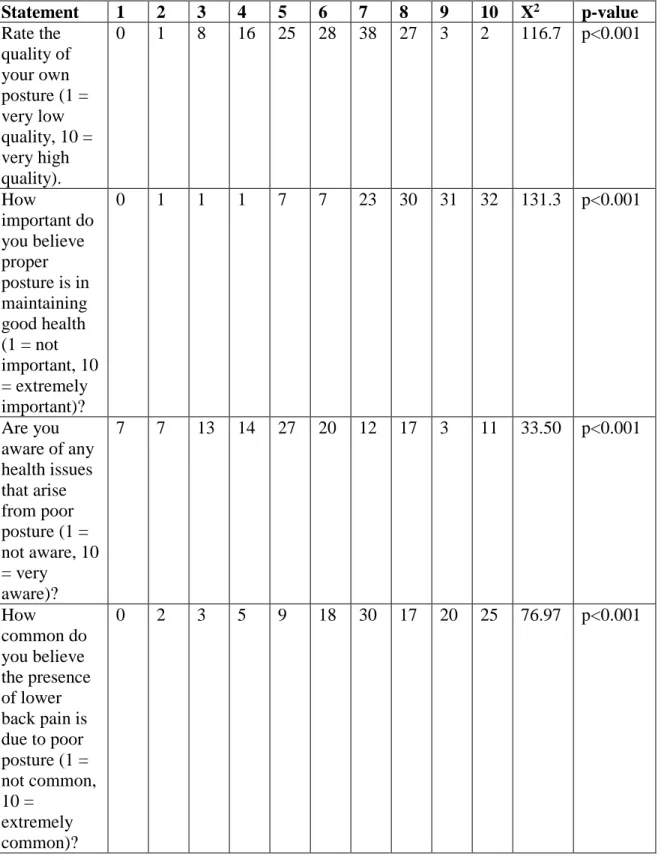
Students agreed that proper posture is important to maintenance of good health (X2 = 131.3, d.f. = 9, p < 0.001). Students were also significantly aware of the common side effects of poor posture such as back pain, neck pain, increased cortisol levels, decreased rate of digestion, musculoskeletal disorders, and depression (Table 1). In addition, students significantly agreed that texting on mobile phones is highly correlated with neck pain and musculoskeletal symptoms (Table 1). The majority of students indicated they are concerned about the quality of their posture (X2 = 60.83, d.f. = 4, p <
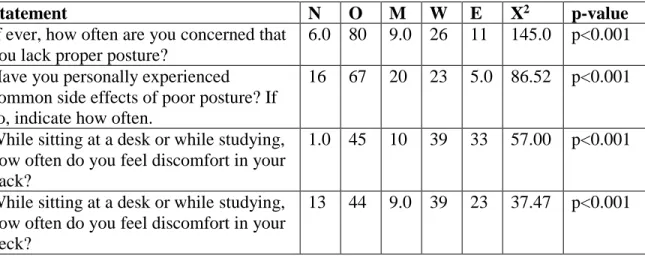
0.001; Table 1). When asked to rate their posture on a scale of 1-10 (1 = low quality, 10 = high quality), only 3.38% of students rated their posture as a 9 or 10. Most students indicated they were often concerned that they lack proper posture, and a vast amount of students answered that they commonly experience common side effects of poor posture (Table 3). 79.8% of students indicated that they spent either 10 to 15 hours or over 15 hours sitting at desk weekly. Furthermore, over half of the students indicated they
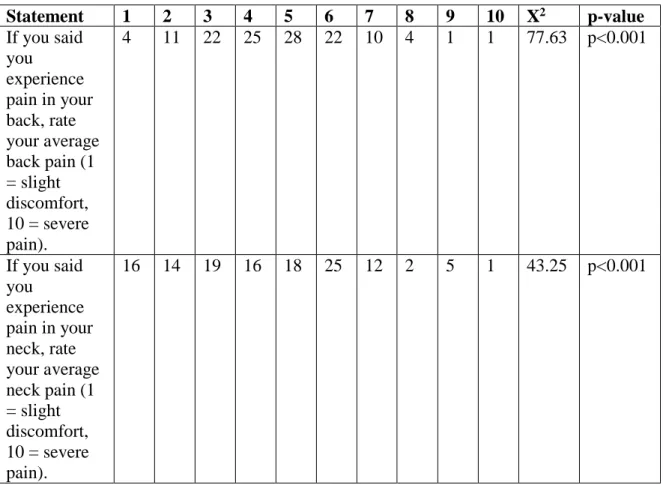
experience neck/back discomfort while sitting at a desk either weekly or every day (Table 3); the most common pain ratings were 3, 4, 5, or 6 (Table 2). The majority of students either disagreed or strongly disagreed with the statement, “As you are reading this survey, your sitting posture is upright and your body and neck are not leaning forward”
(X2 = 34.22, d.f. = 4, p < 0.001). The majority of students also agreed that while walking through campus, they experience back pain and discomfort and feel the need to adjust walking stance to alleviate backpack weight.
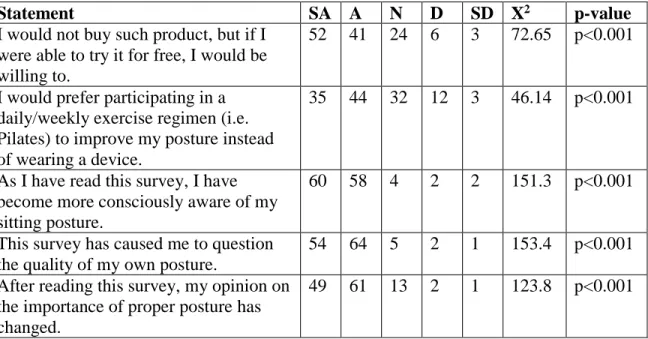
Almost all students either agreed or strongly agreed with the statement, “If there were a small, wearable smart device capable of improving my posture, I would be interested in trying it” (X2 =115.9, d.f. = 4, p < 0.001). However, student willingness decreased when students were asked to spend upwards of $50.00 for such device (Table 1). The majority of students indicated that by the end of the survey they were more consciously aware of their sitting posture, they now question the quality of their own posture, and that their opinion of postural importance has changed (Table 1).
Phase 2: Fall 2018 Intake Survey
Most students indicated they are concerned about the quality of their posture (X2 = 14.15, d.f. = 4, p < 0.001; Table 6). Student posture ratings were mostly mid-range (Table 4), and a significant amount of students indicated that while completing the survey, they did not possess proper sitting posture (Table 6). The majority of students felt back/neck pain while studying either weekly or everyday (Table 5); the pain ratings were mostly mid-range (Table 4). Heavy backpack carriage also proved to be a significant cause of back pain and discomfort (Table 6). Students were very willing to wear a small, smart device to improve posture for free (X2 = 32.8, d.f. = 4, p < 0.001). However, the students were not willing to buy such product for upwards of $50.00 (Table 6). Students felt neutral regarding the choice between a daily exercise regimen or wearing a device to improve posture (Table 6).
Phase 2: Upright Go device (Tuesday and Thursday laboratories)
Between the first, second, and third treatment sessions, respectively, experimental group 3 (tracking mode) students spent the following mean percent of time slouching:
52.8%, 33.1%, and 74.3%. Between the first, second, and third treatment sessions,
respectively, experimental group 4 (tracking and training mode) students spent the following mean percent of time slouching: 45.6%, 35.6%, and 23.0%. However, results from a 2-way ANOVA indicate that Upright Go data did not differ significantly between sessions (F = 0.977, d.f. = 2, p = 0.395). The 2-way ANOVA results also indicate that Upright Go data did not differ significantly between experimental groups 3 and 4 (F = 3.585, d.f. = 1, p = 0.074). Overall, student mean percent of time slouching did not differ between sessions and groups (F = 2.83, d.f. = 2, p = 0.085).
Phase 2: Salivary Cortisol (Tuesday and Thursday laboratories)
The salivary cortisol results were analyzed between all experimental groups:
group 1 (no treatment), group 2 (texting reminders), group 3 (tracking mode), and group 4 (tracking and training mode). Results from a 2-way ANOVA confirm that participant salivary cortisol levels post-treatment do not differ significantly between groups (F = 1.23; d.f. = 3; p = 0.302). The salivary cortisol results were also analyzed between the three separate sampling sessions: the baseline data sample, sample after first treatment, and sample after third treatment. Results from a 2-way ANOVA confirm that participant salivary cortisol levels do not differ significantly between sampling periods (F = 0.21;
d.f. = 2; p = 0.813).
Phase 2: Exit Survey Data
Experimental group 1 (no treatment) received an exit survey with only two questions. Students predominantly indicated they either felt neutral or against the idea of buying an Upright Go device (Table 7). However, results show a significant increase in the students’ personal awareness of proper postural management (Table 7).
All students in experimental group 2 (text reminders) noticed postural
improvement within at least two weeks of treatment (X2 = 7, d.f. = 4, p = 0.136). Students were asked how strongly they agreed or disagreed with the statement “After receiving periodic reminders to fix my posture, I have noticed a substantial improvement of my posture.” 3 students agreed with the previous statement, while 5 students responded neutrally (Table 8). Additionally, results demonstrate a decrease in student back/neck pain and increase in self-productivity (Table 8). However, there were no significant changes in student self-confidence or stress levels (Table 8). Students were also asked how strongly they agreed or disagreed with the statement “After evaluating the other students' use of the Upright Go device, I would be willing to buy an Upright Go device.”
3 students agreed with the statement, 3 responded neutrally, and 2 disagreed with the statement (X2 = 5.75, d.f. = 4, p = 0.219). Finally, results demonstrate a significant increase in student awareness of proper postural management (Table 8).
All students in experimental group 3 (tracking mode only) noticed postural improvement within 1-6 days of treatment (X2 = 16, d.f. = 4, p < 0.01). Students in experimental group 4 (tracking and training mode) noticed postural improvement within 2 weeks of treatment (X2 = 8.5, d.f. = 4, p = 0.075). After wearing the Upright Go device, all students in experimental group 3 noticed a substantial improvement in personal
posture (Table 9) and most students in experimental group 4 noticed a substantial improvement in personal posture (Table 10). The majority of students in group 3 did not notice less back/neck discomfort, while most students in group 4 did notice less
back/neck discomfort (Table 9, 10). Though the results lacked statistically significant p- values, most students in experimental group 3 claimed to notice an increase in self-
productivity, decrease in stress levels, and increase in self-confidence (Table 9).
However, most students in experimental group 4 indicated no change in self-confidence, self-productivity, or stress levels (Table 10). Both groups predominantly claimed the Upright Go device was easy to use, hardly noticeable on one’s body, and not obstructive to class activities (Table 9, Table 10). Experimental group 4 claimed the device’s
vibration alerts were gentle and did not interfere with current activities or thought
processes. Group 4 also found it easy to maintain proper posture during training sessions, thus avoiding vibration alerts (Table 10). Both groups largely indicated they would not personally purchase the device, but would recommend the Upright Go device to other users (Table 9, Table 10). All students in experimental group 3 agreed they would have experienced enhanced postural improvement had they worn the device in training mode.
To conclude, both groups predominantly preferred an exercise regimen to improve posture to the use of the Upright Go (Table 9, Table 10).
DISCUSSION Phase 1: Spring 2018 Exploratory Survey
Espert et al., (2017) suggests there is a lack of education in postural importance, and that many students are unfamiliar with the principles of ergonomics and do not possess a correct sitting posture. However, nearly all responses in the spring 2018 exploratory survey indicated that students understand proper posture is important to maintaining good health. Additionally, students indicated that low back pain is a prevalent issue and that texting on mobile phones is highly correlated with
musculoskeletal disorders. Overall, students seemed to value maintaining a proper postural stance; these results demonstrate that undergraduate students have at least a partial understanding of postural importance and its related issues. Conversely, these same students claimed to experience many issues due to improper postural control, prolonged sedentary time, and heavy backpack carriage. Santos et al., (2017) data supports the survey results by demonstrating an abnormal occurrence of back pain and postural deviation in children and adolescents.
Specifically, BISC 207 students had a high prevalence of posture deviations and back pain due to heavy backpack carriage. Due to the findings that backpack carriage causes a spinal repositioning error that possibly causes neck/back pain and increased predisposition to spinal injury (Chow et al., 2011), the high prevalence was expected.
Results from the spring 2018 exploratory survey demonstrate that students commonly experienced side effects of poor posture and were significantly concerned about the quality of personal posture. I anticipated these results; the study requirements and high amounts of sedentary time that higher education systems impose on students is known to
compromise physiological health and decrease muscle strength (Vainshelboim et al., 2019).
The spring 2018 exploratory survey results demonstrate an obvious necessity for improvement of postural health in students at the University of Mississippi. By providing insight into student experience with posture related issues, I was able to create testable hypotheses regarding postural improvement and postural related issues. Student
responses in this survey allowed me to identify that most undergraduate students would be willing to wear a smart device capable of improving posture. Though not as many students indicated they would buy such a product, the vast majority claimed they would try a product for free.
Phase 2: Fall 2018 Intake Survey
In order to supplement the main experimental procedures (Upright Go and saliva collection), I distributed a condensed intake survey to the BISC 206 students in fall 2018.
In this survey, the effects of the study requirements of a higher education system (Vainshelboim et al., 2019) were reiterated: BISC 206 students were often concerned they lacked proper posture and student experience with the side effects of poor posture was very prevalent. The students responding to this survey knew they would potentially receive the experimental treatment, and nearly all indicated they would be willing to try a smart device capable of improving posture. This data allowed me to proceed with the Upright Go experiment.
Phase 2: Upright Go device
As technology in the twentieth century has progressed, smart devices that are capable of measuring physiological parameters like heart rate, sleep, and step count have
become increasingly popular. In particular, a new market of wearable devices is
expanding; scientists have now created smart devices capable of tracking spinal posture and delivering real-time feedback to users. Simpson et al. (2019) has revealed that spinal posture can be accurately measured through technologies such as the Lumo Back and The Lumo Lift. Wang et al. (2018) created a smart wearable device able to track cervical curvature and send the data to a mobile phone application, allowing physicians to monitor patients with live biofeedback. Since there exist few scientific reviews on the accuracy of these devices, I chose to analyze the effectiveness of the Upright Go. As treatment sessions progressed, experimental group 4’s (tracking and training mode) postural data demonstrates a decrease in slouching. However, no such trend was found in experimental group 3’s (tracking mode) data. These results suggest that the training mode of the Upright Go device is effective at improving postural habits. Though, Upright Go
ANOVA results indicate that mean percent of time slouching did not differ significantly between individual treatment sessions or experimental groups. Due to the results, I am unable to draw definite conclusions regarding the Upright Go device’s ability to improve user posture.
In addition to my study, Bevelaqua (2018) is currently conducting a randomized control study on the Upright Go device at the Columbia University Irving Medical Center. Similar to my reasoning to evaluate the Upright Go device, Bevelaqua (2018) recognizes the prevalence of back pain in students, noting that back pain is directly correlated with poor posture. Furthermore, Bevelaqua (2018) emphasizes that prolonged sitting in poor posture can hasten the development of muscular imbalance and
weaknesses. Bevelaqua (2018) aims to determine if the Upright Go device will improve
postural management and pain control in those with posture related low back pain.
Publication of results will not occur until August 2019.
Phase 2: Salivary Cortisol
Nair et al. (2014) found that postural interventions causally affect mood, behavior, and physiology. “Upright” participants in this study reported feeling more excited and confident while “slumped” participants reported feeling more fearful, sluggish, and upset (Nair et al., 2014). Carney et al. (2010) found that as subjects adopted a more upright posture, subject cortisol levels decreased. In my study, experimental group 1 (no
treatment) and 3 (tracking mode) students were not expected to obtain improved posture, and therefore no change in salivary cortisol levels. Experimental group 2 (text reminders) and 4 (tracking and training mode) were expected to obtain increased upright posture, and therefore an accompanying decrease in salivary cortisol levels. I expected to observe significant differences in cortisol levels between those groups with postural
enhancements and those without. Since the Upright Go development teams claims the device is fast and habit building, I also expected postural health to increase with every treatment session. Thus, I anticipated a significant difference in student saliva samples between each sampling session.
However, I did not identify significant differences in my salivary cortisol results.
Experimental group 2 exit survey responses indicated that three students saw substantial improvement in posture, while five students noticed no change in posture. Even if all students had noticed a substantial improvement in posture, results are based solely on student perception, ultimately preventing conclusiveness on whether postural
improvement actually occurred. However, the Upright Go smartphone application data
allows me to confidently assess whether student posture improved. Since experimental group 4 results demonstrate a trend in decreased slouching with each treatment session, the lack of significance between groups suggests that postural deviations may not affect salivary cortisol. Yet, Upright Go data indicates that mean percent of time slouching did not differ significantly between individual treatment sessions or experimental groups.
This data prevents me from concluding that postural improvement occurred, ultimately providing no evidence to anticipate a decrease in salivary cortisol levels.
An obvious limitation in my salivary cortisol experiment is the small sample size of my study. In addition, Matsuda et al. (2012) claims that one’s diet and timing of food consumption affects cortisol secretion; some limitations of this cortisol experiment include extraneous factors like inability to control the physical activities and diet of the subjects. Since circadian rhythm is known to influence cortisol level (Matsuda et al., 2012), I was careful to retrieve saliva samples at the same time each day. Finally, I was unable to control various stressors in student lives that had potential to increase cortisol levels and produce bias in results. However, the short survey given to students before each sampling session was meant to assess these factors.
Phase 2: Fall 2018 Exit Survey
The fall 2018 exit survey assessed the effectiveness of the Upright device on improvements in self-confidence, self-productivity, and stress. Along with the results generated through the Upright software, I assessed whether students believe their posture has improved with the Upright Go device. I also evaluated the Upright Go development team’s claims and whether the students would recommend the Upright Go to other users.
Group 1 students did not undergo treatment, and therefore did not experience personal postural improvement. Students claimed they were unwilling to purchase the Upright Go device, which is understandable due to the absence of perceived effectiveness of the Upright Go. However, these students could have developed an opinion on the Upright Go device through observation of other classmates. Finally, since results show a significant difference in student awareness of proper postural management, I conclude this study provided at least, a temporary educational benefit to students.
The majority of experimental group 2 participants (text reminders) indicated no substantial change in posture, though three students did indicate substantial postural improvement. Since students were frequently reminded to correct posture, improvement in posture was expected. The lack of improvement in posture is likely due to the students’
inability to check personal cell phones during various laboratory activities. However, even with better posture, this technique is still not practical for everyday use. While all students claimed to notice postural improvement within two weeks, some saw postural improvement more quickly, which explains the statistically insignificant results regarding this question. Xia et al. (2008) found an association between low back pain and home posture habits, and I saw that half of the students also experienced a decrease in back pain. To continue, Nair et al. (2014) indicated that upright postures can reduce stress responses and positively affect mood and behaviors. I expected to observe a decrease in stress levels, increase in self-productivity, and increase in self-confidence, and although trends in results were apparent, results were not statistically significant. Furthermore, it is possible the students in favor of purchasing the Upright Go device or recommending it to others personally experienced benefits of improved posture and wished to continue this
improvement. This survey detected a significant increase in student awareness of the significance of proper posture, suggesting that the goal of educating students on postural importance was achieved. However, the remaining survey results were not statistically significant; this is likely due to the small sample size of experimental group 2 (n=8).
All students in experimental group 3 (tracking mode only) experienced a significant improvement in posture within 1-6 days and all students in experimental group 4 (tracking and training) saw improvement within two weeks. Treatment sessions were one week apart, so I can assume that students noticed postural improvement after only one or two treatment sessions. Because the effectiveness of the Upright Go device lies in its ability to provide real-time postural feedback in training mode, these results were not expected for experimental group 3 students. Although the Upright Go device is discreet and hardly noticeable on one’s body, I can deduce that even slight awareness of the device on one’s body caused the subjects to obtain better posture. Three students in experimental group 4 agreed they observed a substantial improvement in posture, while one student disagreed. Students in group 4 were expected to perceive improvement in posture after undergoing training sessions, yet survey results were not statistically
significant. A lack of change in student self-confidence, self-productivity, or stress levels was expected for experimental group three. However, since group 3 students did perceive an improvement in posture, it would have been plausible to observe changes in the previous factors. Experimental group 4 showed no significant changes in self-confidence, self-productivity, or stress levels. Because students did undergo posture training, I
anticipated positive changes in the previous factors. It can be expected that students who
did notice a positive change in these factors also observed an improvement in their posture.
Experimental group 3 and 4’s results align with the Upright Go development team’s claims that the device is easy and comfortable for prolonged wear. Simpson et al.
(2019) indicates that devices with few sensors may be inaccurate, and accuracy comes with sacrificing comfort for the user. Experimental group 4 experienced the vibrational alerts during training mode, and still claimed the device was unobtrusive to class activities and thought processes, further supporting Upright Go’s claims. Effective commercialization of such devices understandably necessitates a balance between accuracy and comfort for users, and my study results suggest the Upright Go may have achieved just that. Since these subjects are college students, it is possible that personal funding to purchase a device over $50.00 may be limited, which could explain why students were reluctant to buy the Upright Go yet willing to recommend it to other people. Overall, the participants favored the Upright Go and found potential in its use.
Experimental group 3 evaluations of the Upright Go device are limited due to the fact that students did not experience the device’s vibrational alerts during training mode.
Overall Conclusion
There exist several scholarly articles regarding wearable, smart devices similar to the Upright Go. However, there is only one existing study on the Upright Go device, and publication of the results will not become available until August 2019. The ultimate goal of my study was to examine the potential of the Upright Go device in improving postural health in undergraduate students at the University of Mississippi. Assuming postural health improved, the second goal of my study was to detect if this improvement can alter
neuroendocrine responses, specifically cortisol levels. The data generated in my study allows me to make several conclusions regarding the impact my study had on participants and the legitimacy of the Upright Go development team’s claims. Survey responses from all groups demonstrate that my study has produced a significant and positive change in student awareness of proper postural management. Experimental group 3 did indicate substantial improvement of personal posture, though the Upright Go smart phone
application data does not demonstrate a detectable pattern. Lack of statistical significance in experimental group 4’s exit survey data indicates student posture did not improve. Yet, three out four students agreed to have substantial improvement in posture, while only one student disagreed with this statement. Results from the Upright Go application also suggest that the training mode vibrations may be effective in improving user posture.
Experimental groups 2, 3, and 4’s exit survey responses yielded observable trends; however, most results were not statistically significant. In addition, the Upright Go data yielded observable trends, yet mean percent of time slouching did not differ significantly between treatment sessions or experimental groups. The lack of significant results is not likely due to ineffectiveness of the text reminders or the Upright Go device, but due to extraneous factors. First, the participants wore the device only three times, one hour each, over the course of three weeks. In order for proper postural stances to become habitual, the Upright Go development team suggests daily training sessions. Additionally, in the ongoing Upright Go study at Columbia University Irving Medical Center,
participants will wear the device every day over a four-week period (Bevelaqua, 2018).
This immense increase in time spent wearing the Upright Go device will understandably produce more statistically powerful results. Second, in Bevelaqua’s study, forty-five
participants will wear the Upright Go in the training mode, while my study used only four students participating in training mode. Third, during the laboratory sessions, students were seated at a desk and were often required to use microscopes, which could have affected students’ ability to maintain an upright posture. Finally, the small sample sizes in experimental groups 2 (n = 8), 3 (n = 4), and 4 (n = 4) decreased the reliability and
statistical power of Upright Go data and survey results. With such a small sample size, and such low p-values, there is a high probability of type II errors in my results. The small sample sizes were due to economical limitations in purchasing the Upright Go devices. In order to generate more conclusive data, my study necessitates a much larger sample size, which requires an increased amount of Upright Go devices and participants.
LIST OF REFERENCES
Akodu, A.K., Akinbo, S.R., & Young, Q.O. (2018). Correlation among smartphone addiction, craniovertebral angle, scapular dyskinesis, and selected anthropometric variables in physiotherapy undergraduates. Journal of Taibah University Medical Sciences, 13(6), 528-534.
AAOS, P.C. (1947). Posture and its Relationship to Orthopedic Disabilities. A Report of the Posture Committee of the American Academy of Orthopedic Surgeons.
Bevelaqua, A.C. (2018). https://clinicaltrials.gov/ct2/show/study/NCT03769246
Brinol, P., Petty, R.E., Wagner, B. (2009). Body posture effects on self-evaluation:A self validation approach. European Journal of Social Psychology, 39, 1053-1064, doi:
10.1002/ejsp.607
Buchbinder, R., Blyth, F.M., March, L.M., Brooks, P., Woolf, A.D., & Hoy, D. G.
(2013). Placing the global burden of low back pain in context. Best Practice and Research Clinical Rheumatology, 27, 575-589.
Carney, D., Cuddy, A. J. C., & Yap, A. (2010). Power posing: Brief nonverbal displays affect neuroendocrine levels and risk tolerance. Psychological Science, 21, 1363- 1368.
Chow, D., Hin C., Ou D., & Lai, A. (2011). Carry-over effects of backpack carriage on trunk posture and repositioning ability. International Journal of Ergonomics, 41, 530-535.
Cuddy, A., Wilmuth, C., & Carney, D. (2012). The Benefit of Power Posing Before a High-Stakes Social Evaluation. Harvard Business School Working Paper, No. 13- 027.
Espert, J.C., Moscardo, A.P., & Alemany, I.C. (2017). Wrong postural hygiene and ergonomics in dental students of the University of Valencia (Spain) (part 1).
European Journal of Dental Education, doi: 10.1111/eje.12255.
Filho, N.M., Coutinho, E.S., Silva, G.A. (2015) Association between home posture habits and low back pain in high school adolescents. Springer-Verlag Berlin Heidelberg, 24:425-433, doi: 10.1007/s00586-014-3571-9
Gustafsson, E., Thomée, S., Grimby-Ekman, A., & Hagberg, M. (2016). Texting on mobile phones and musculoskeletal disorders in young adults: A five-year cohort study. Applied Ergonomics, 58, 208-214.
Gupta, R.K. (2009). Major depression: An illness with objective physical signs. World Journal of Biological Psychiatry, 10, 196-201.
Haussmann, M., Vleck, C., & Farrar, E. (2007). A laboratory exercise to illustrate increased salivary cortisol in response to three stressful conditions using competitive ELISA. Adanced Physiology Education 31, 110-115.
doi:10.1152/advan.00058.2006.
Hurwtiz, E.L., Randhawa, K., Yu, H., Cote, P., & Haldeman, S. (2018). The Global Spine Care Initiative: a summary of the global burden of low back and neck pain
studies. European Spine Journal, 796. doi:10.1007/s00586-017-5432-9.
Korakakis, V., O’Sullivan, K., O’Sullivan, P., Evagelinou, V., Sotiralis, Y., Sideris, A., Sakellariou, K., Karanasios, S., & Giakas, G. (2019). Physiotherapist perceptions of optimal sitting and standing posture. Musculoskeletal Science and Practice, 39, 24-31.
Maltagah, H. (2018). Effects of texting on muscle activity and neck flexion in college
students.
Matsuda, S., Yamaguchi, T., Okada, K., Gotouda, A., Mikami, S. (2012). Day-to-day variations in salivary cortisol measurements. Journal of Prosthodontic Research 56, 37-41.
Nair, S., Sagar, M., Soller, J. II, Consedine, N., & Broadbent, E. (2015). Do slumped and upright postures affect stress responses? A randomized trial. Health Psyhchology, 34(6), 632-641.
Nalla, A.A., Thomsen, G., Knudsen, G.M., & Frokjaer, V.G. (2014). The effect of storage conditions on salivary cortisol concentrations using an Enzyme
Immunassay. Scandinavian Journal of Clinical and Laboratory Investigation, 92- 94, doi: 10.3109/00365513.2014.985252.
Nath, N., Akhavian, R., & Behzadan, A. (2017). Ergonomic analysis of construction worker’s body postures using wearable mobile sensors. Applied Erganomics, 62, 107-117.
Puisis, Erica. (2019). The 7 Best Posture Correctors to Buy in 2019. Retrieved from https://www.verywellhealth.com/best-posture-correctors-4171981
Rebold, M.J., Croall, C.A., Cumberledge, E.A., Sheehan, T.P., Dirlam, M.T. (2017). The impact of different cell phone functions and their effects on postural stability.
Performance Enhancement & Health 5:3, 98-102.
Salivary Cortisol Ultrasensitive ELISA Assay Kit, v. 3.0. Eagle Biosciences, INC., Nashua, NH, U.S., 2017. Accessed on: April, 10, 2019. [Online]. Available:
https://eaglebio.com/wp-content/uploads/data-pdf/cor32-k01-ultrasensitive- cortisol-elisa-saliva-assay-kit.pdf
Santos, N.B., Sedrez, J.A., Candotti, C.T., Vieira, A. (2017). Immediate and follow-up effects of a posture education program for elementary school students. Sociedade de Pediatria de São Paulo, 35, 199-206.
Sharpley, C.F., Kauter, K.G., & McFarlane, J.R. (2010). Diurnal Variation in Peripheral (Hair) vs. Central (saliva) HPA Axis Cortisol Concentrations. Clinical Medicine Insights: Endocrinology and Diabetes, 3, 9-16
Simpson, L., Maharaj, M.M., Mobbs R.J. (2019). The role of wearables in spinal posture analysis: a systematic review. BMC Musculoskeletal Disorders, 20:55, doi:
10.1186/s12891-019-2430-6.
Sorensen, C.J., Norton, B.J., Callaghan, J.P., Hwang, C.T., Van Dillen, L.R. (2015). Is lumbar lordosis related to low back pain development during prolonged
standing? Man. There. 20, 553-557.
Twenge, J.M., & Campbell, K.W. (2018). Associations between screen time and lower psychological well-being among children and adolescents: Evidence from a population-based study. Preventative Medicine Reports, 12, 271-283.
Vainshelboim, B., Brennan, G.M., LoRusso, S., Fitzgerald, P., Wisniewki, K.S. (2019).
Sedentary behavior and physiological health determinants in male and female college students. Physiology & Behavior,
https://doi.org/10.1016/j.physbeh.2019.02041.
Wang, Y., Zhou, H., Yang, Z., Samuel, O., Liu, W., Cao, Y., Li, G. (2018). An intelligent wearable device for human’s cervical vertebra posture monitoring. The Instititute of Electrical and Electronics Engineers Xplore, doi: 10.1109/EMBC.2018.85128 96.
Wilkes, C., Kydd, R., Sagar, M., & Broadbent, E. (2017). Upright posture improves affect and fatigue in people with depressive symptoms. Journal of Behavior Therapy and Experimental Psychiatry, 54, 143-149.
Xia, Y., Ishii, K., Matsumoto, M., Nakamura, M., Toyama, Y., & Chiba, K. (2008).
Radiographic predictors of residual low back pain after laminectomy for lumbar spinal canal stenosis: minimum 5-year follow-up. J Spinal Disord Tech, doi:
10.1097/BSD.0b013e318074dded.
Table 1. BISC 207 student responses on the spring 2018 exploratory survey; the Likert- style statements assessed student understanding of posture significance, student
willingness to wear a device to improve posture, and student evaluation of personal posture on the (SA = strongly agree, A = agree, N = neutral, D = disagree, SD = strongly disagree; d.f. = 4).
Statement SA A N D SD X2 p-value
I am not concerned about the quality of my posture.
4 12 25 55 31 60.83 p<0.001 Poor posture can compress your digestive
organs, which can greatly reduce your rate of digestion and metabolism.
17 72 35 2 1 136.9 p<0.001
Poor posture can increase your body's cortisol level, causing you to become increasingly stressed.
8 48 62 7 2 119.7 p<0.001
As you are reading this survey, your sitting posture is upright and your body and neck are not leaning forward.
11 22 13 45 36 34.22 p<0.001
While walking through campus, you experience back pain or discomfort due to your heavy backpack.
44 42 19 12 10 42.49 p<0.001
While walking through campus, you adjust your walking stance to alleviate the weight of your backpack.
28 48 18 27 6 37.45 p<0.001
Poor posture is correlated with
depression, digestion issues, increased risk of disease, headaches, and blood vessel constriction.
15 61 35 12 4 82.88 p<0.001
Texting on mobile phones is highly correlated with an increase in upper neck pain and occurrence of musculoskeletal symptoms.
58 50 14 3 1 114.9 p<0.001
Chronic low back pain is a leading cause of disability worldwide.
17 54 43 11 1 69.39 p<0.001 Increased stress to your neck can lead to
osteoarthritis.
16 73 33 3 1 139.5 p<0.001 If there were a small, wearable smart
device capable of improving my posture, I would be interested in trying it.
29 70 17 8 2 115.9 p<0.001
I would be willing to spend upwards of
$50.00 for a smart device that I know will improve my posture quickly and efficiently.
16 47 31 23 9 115.4 p<0.001
Table 1 cont.
Statement SA A N D SD X2 p-value
I would not buy such product, but if I were able to try it for free, I would be willing to.
52 41 24 6 3 72.65 p<0.001
I would prefer participating in a daily/weekly exercise regimen (i.e.
Pilates) to improve my posture instead of wearing a device.
35 44 32 12 3 46.14 p<0.001
As I have read this survey, I have become more consciously aware of my sitting posture.
60 58 4 2 2 151.3 p<0.001
This survey has caused me to question the quality of my own posture.
54 64 5 2 1 153.4 p<0.001 After reading this survey, my opinion on
the importance of proper posture has changed.
49 61 13 2 1 123.8 p<0.001
Table 2. BISC 207 student responses on the spring 2018 exploratory survey; questions assessed student knowledge of posture significance, student experience with back/neck pain, and student evaluation of personal posture (1 = low, 10 = high; d.f. = 9).
Statement 1 2 3 4 5 6 7 8 9 10 X2 p-value Rate the
quality of your own posture (1 = very low quality, 10 = very high quality).
0 1 8 16 25 28 38 27 3 2 116.7 p<0.001
How
important do you believe proper posture is in maintaining good health (1 = not important, 10
= extremely important)?
0 1 1 1 7 7 23 30 31 32 131.3 p<0.001
Are you aware of any health issues that arise from poor posture (1 = not aware, 10
= very aware)?
7 7 13 14 27 20 12 17 3 11 33.50 p<0.001
How
common do you believe the presence of lower back pain is due to poor posture (1 = not common, 10 =
extremely common)?
0 2 3 5 9 18 30 17 20 25 76.97 p<0.001