All Rights Reserved. The Southern Baptist Theological Seminary has permission to reproduce and disseminate this document in any form by any means for purposes chosen by the Seminary, including, without limitation, preservation or instruction.
TO PERSONAL CHARACTERISTICS AND LEADERSHIP TECHNIQUES
A Dissertation Presented to the Faculty of
The Southern Baptist Theological Seminary
In Partial Fulfillment
of the Requirements for the Degree Doctor of Education
by
Russell Neal Wheelington May 2005
Copyright 2005 by Wheelington, Russell Neal
All rights reserved.
INFORMATION TO USERS
The quality of this reproduction is dependent upon the quality of the copy submitted. Broken or indistinct print, colored or poor quality illustrations and photographs, print bleed-through, substandard margins, and improper alignment can adversely affect reproduction.
In the unlikely event that the author did not send a complete manuscript and there are missing pages, these will be noted. Also, if unauthorized copyright material had to be removed, a note will indicate the deletion.
®
UMI
UMI Microform 3181606
Copyright 2005 by ProQuest Information and Learning Company.
All rights reserved. This microform edition is protected against unauthorized copying under Title 17, United States Code.
ProQuest Information and Learning Company 300 North Zeeb Road
P.O. Box 1346 Ann Arbor, M148106-1346
THE LONGEVITY OF YOUTH MINISTERS IN RELATIONSHIP TO PERSONAL CHARACTERISTICS AND
LEADERSHIP TECHNIQUES Russell Neal Wheelington
Read and Approved by:
~{;,:.~
Brian C. Richardson (Cliairperson)
Mark E. Simpson
Date
/3!4zT 2dD5
THESES Ed.D • • W57L O_1~~lOJ945_57 8
and the Holy Spirit, Teacher, Guide, and Comforter.
Page LIST OF TABLES . . . VI
PREFACE Vlll
Chapter
1. INTRODUCTION 1
2 5 Research Concern
Research Purpose
Delimitations of the Study . . . 5
Research Questions . . . 6
Terminology ... ; . . . 6
Procedural Overview . . . 8
Research Assumptions . . . .. . . 8
2. PRECEDENT LITERATURE Ethics, Morals, and Values 10 12 The Minister and Spiritual Gifts . . . 13
Leadership Technique . . . 18
The Call to Ministry . . . 25
Youth Ministry . . . 34
111
Thriving in Youth Ministry Profile of the Current Study
45 54
3. METHODOLOGICAL DESIGN ... 57
Design Overview ... 57
Population ... 57
Sample ... 58
Delimitations ... 58
Limitations of Generalizations ... 60
Instrumentation ... 60
Procedure ... 61
4. ANAL YSIS OF FINDINGS ... 63
Compilation Protocol Findings and Displays 63 64 Evaluation of the Research Design ... 95
5. CONCLUSIONS ... 99
Research Purpose ... 99
Research Implications Research Applications 99 146 Further Research ... 154
IV
1. INITIAL CONTACT CONVERSATION TO AGENCIES 159 2. LONGEVITY AND LEADERSHIP TECHNIQUE SURVEY. . . 160 REFERENCE LIST ... 164
v
Table Page
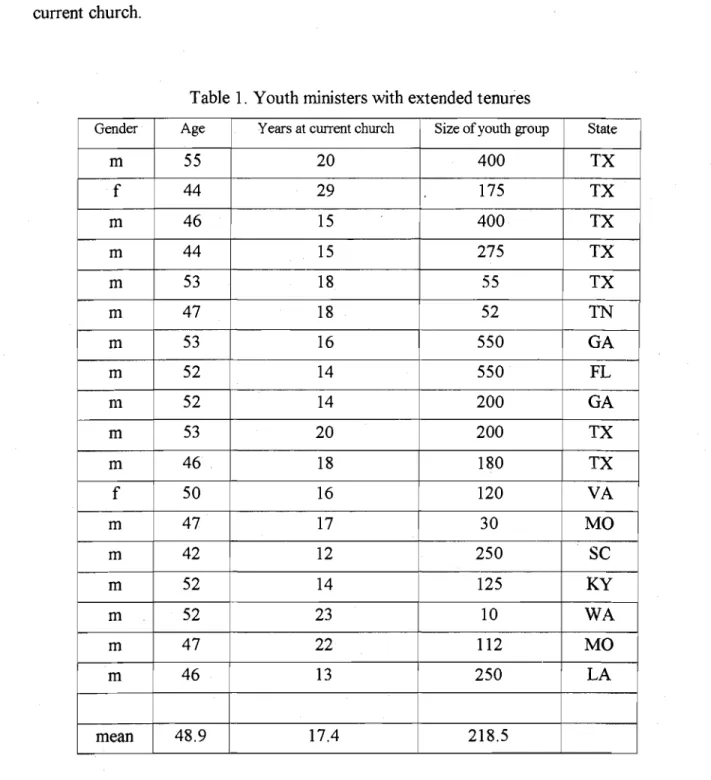
1. Youth Ministers with Extended Tenures . . . 65
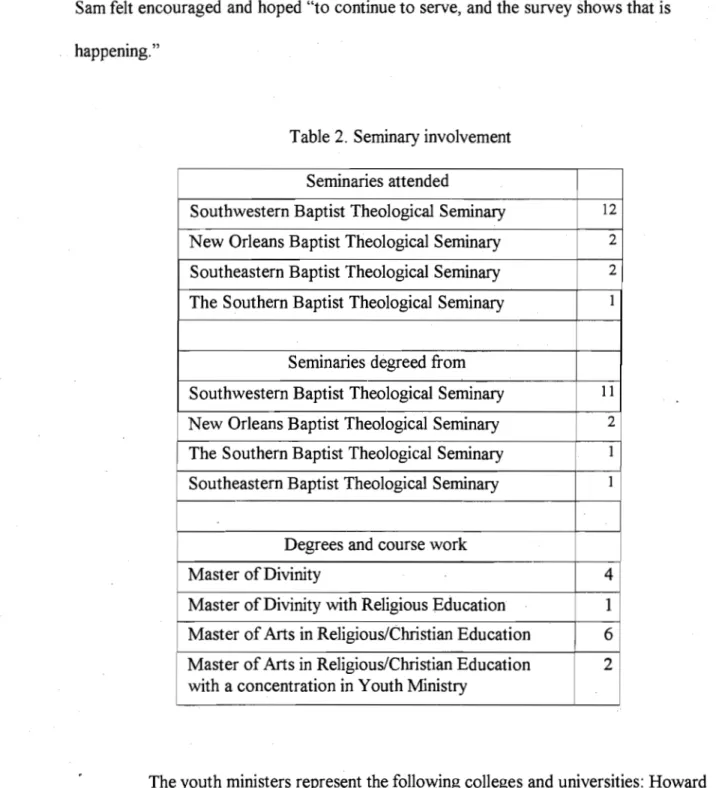
2. Seminaries Attended ... 67
3. States of Residence ... 69
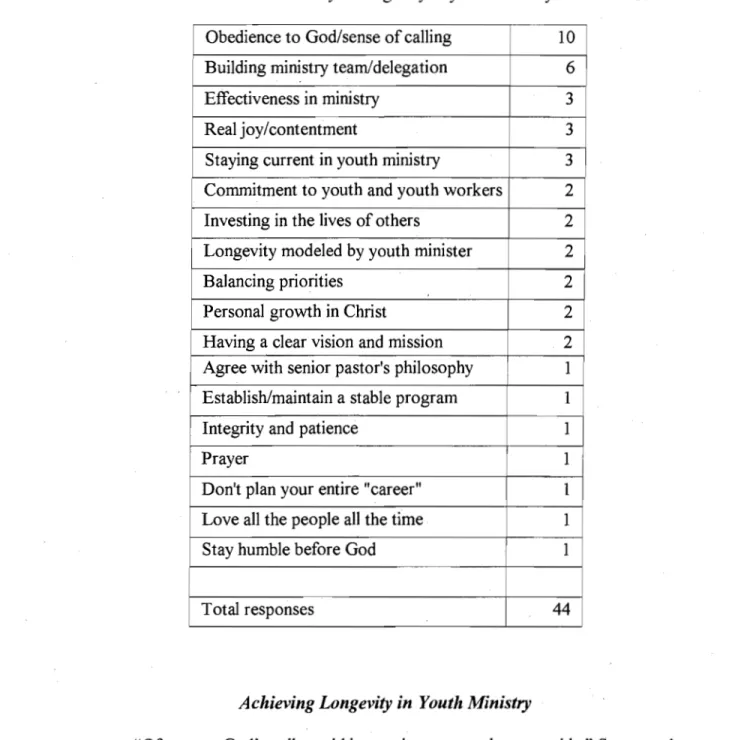
4. To What do You Attribute Your Longevity in Youth Ministry? ... 71
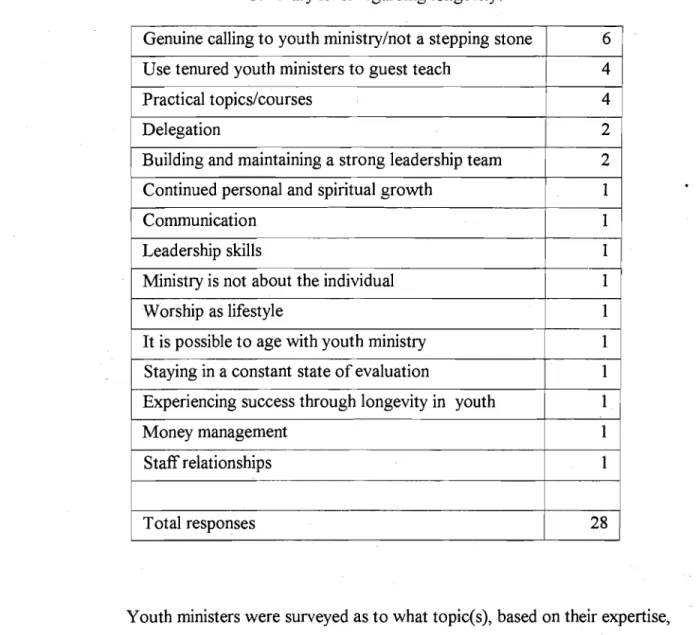
5. How Can the Reality of Youth Ministry be Achieved? 74 6. What do You Feel Should be Taught at the University and Seminary Level Regarding Longevity? ... 75
7. What is Your Greatest Joy From Having an Extended Tenure? ... . 78
8. Based on Your Expertise, What are Some Elements of Leadership? .... 80
9. What do You See as Your Personal Leadership Style? ... . 82
10. In Your Opinion, Has Your Leadership Style Contributed Y L . . M" ? to our ongevIty In InIstry. ... . 82
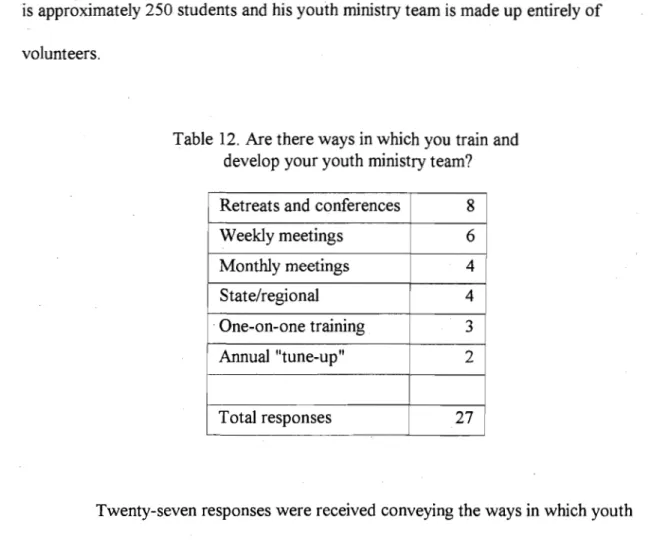
11. Describe Your Youth Ministry Team and Its Function 8j 12. Are There Ways in Which You Train and Develop Your Youth Ministry Team? ... 85
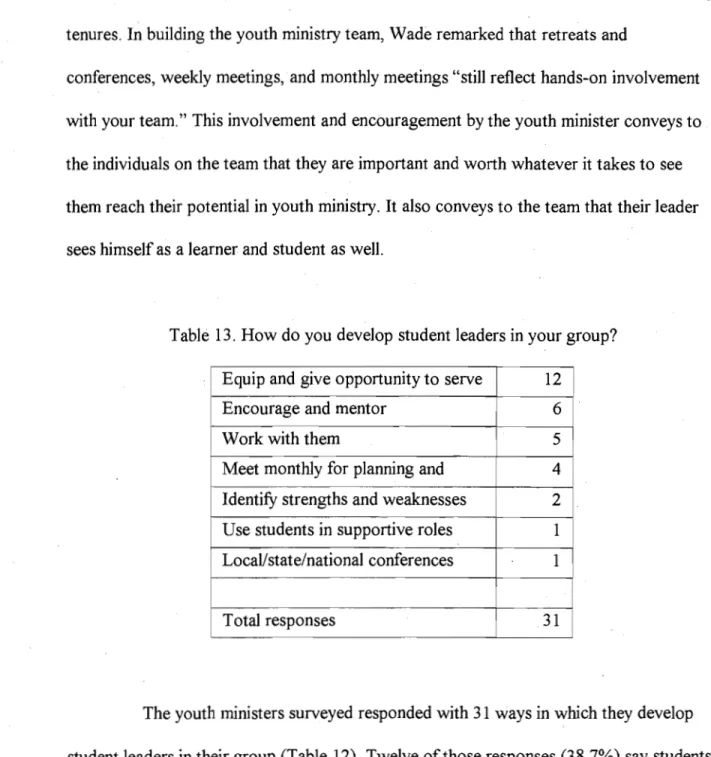
13. How do You Develop Student Leaders in Your Group? ... 86
14. Describe Your Call to Ministry ... 88
VI
15. How did You Know You Were Specifically
Called to Youth Ministry? . . . 89
16. How was Your Call Affirmed? 90
17. What do You Feel is a Common Misconception Regarding
the Call to Ministry? . . . 92 18. Primary Spiritual Gifts Indicated . . . 92 19. How are Your Spiritual Gifts Affirmed in Your Ministry? 93 20. Have Your Spiritual Gifts Changed During
Y our enure T 10 . Mi' mstry. ? . . . . 94
VB
I would like to thank and acknowledge Dr. Brian C. Richardson for his passion and leadership in youth ministry. His commitment to training and educating youth ministers will ensure youth ministry will continue to thrive and grow the Kingdom for generations to come.
I am also thankful to Dr. Mark E. Simpson for his tireless work and leadership in the School of Leadership and Church Ministry's Ed.D. program. His patience and determination to see each student through, particularly this writer, went far beyond the call.
I would also like to thank Dr. Ted Cabal for his years offriendship and encouragement. He continues to be the embodiment of character, integrity, and courage.
Dr. Marsha K. Omanson's attention to detail and thoroughness are beyond comprehension. She has made this study better than the author ever thought possible.
I would be remiss to not thank the youth ministers who participated in this study and truly made it possible by raising the standard in youth ministry. We still have much to learn from them.
Finally, I would like to thank my wife, Laurie, and sons, Caleb and Nathan, for helping me keep it all in perspective. God continues to love, bless, and teach me through them.
Vlll
INTRODUCTION
Because of the impact and influence a youth minister has with students, longevity in youth ministry is something to be addressed. If a youth minister leaves his position for another place of ministry it can have negative short and long-term
consequences, a position that is vacated after eighteen months or less is even more damaging. This damage is compounded if the next youth minister is also short term.
Students and adults alike may develop a certain mistrust towards their new youth minister because they may be thinking he, too, will soon be leaving. "With so many foundational habits and values being formed in the adolescent years, whether they be positive or negative, the youth minister is more needed than ever before. From a Christian education perspective, this "window" of adolescence is approximately six to ten years in duration, from the time they enter middle school until at least the time they graduate form high school" (Vukich and Vandegriff2002, 226). If churches and youth programs experience a pattern of leaving in their leadership it can create somewhat of a vacuum of mistrust between students and ministers. There are those youth ministers who stay in one place of service for an extended amount of time. These youth ministers have much to teach present and future youth ministers concerning ministry and leadership.
1
Research Concern
Some literature shows the average stay for an individual in youth ministry is eighteen months (Dean 2002). Others would argue that this is statistically on the high side. Merton Strommen, author, founder, and former president of Search Institute, states,
"This oft observed fact has led to a much quoted but unsubstantiated statistic: the tenure of the average youth minister on a particular job is a year and a half or less. I know of no study that establishes that statistic. Someone must have made an estimate based on personal observation - and being a person of some authority, has been quoted ad infinitum" (Strommen, Jones, and Rahn 2001,34). While the tenures may change from year to year, the fact remains that youth ministers have a notorious reputation for leaving after short amounts of time spent at one church. Whether these departures are the result of a church's pastor, committee, or from the minister's personal desire to pursue a different church, a revolving door at a youth minister's position leaves students and parents feeling neglected and desperate for consistency. "The bottom line is that the church must upgrade its efforts or be forever irrelevant with its perceived lackluster effort for God. Barna also states that close to 85 percent of decisions made for Christ will be made before a person's eighteenth birthday" (Vukich and Vandegriff2002, 226).
Short-term departures are merely symptoms of greater problems that exist within churches, institutions of higher education, and in the personal life ofthe minister.
"Quick departures have a lot to do with inadequate preparation and unrealistic
expectations" (Fields 2002). When youth ministers know how to interpret their call to ministry they are better able to approach ministry from the standpoint of getting in it to stay. Youth ministers that set a realistic and proper pace in ministry it assures long-term
results and the ability to finish strong (Fields 2002). No one benefits from youth. ministers who prematurely exit positions and leave a spiritual and leadership void in the lives of students and the church. Students are stripped of a leader and friend who can relate to their needs and parents are also left without a partner in ministering to their children.
There have been those student ministers who simply leave when times get tough.
"Longevity in our field is uncommon. This is both unfortunate for the individuals who leave and tragic for the health of the church. The longer you work in youth ministry, the easier it becomes, and the better you minister to students" (Fields 2002).
Society created this need and desperation for youth ministry without even knowing it; yet now the challenges are before us. "What we now call the 'youth culture' grew out of the vacuum created by adults who wanted to be young and a society that had lost its respect for tradition" (Patterson 45, 1984). Teens are searching for something in their life that makes sense and gives them hope. There is a staggering amount of
influences and religions in the world that are competing for the attention and dedication of youth, someone who will embrace a set of beliefs and carry their message on to the generations that follow. Inevitably, many of these teens will find themselves in our
churches searching for answers and comparing Christianity to the many other possibilities they see as potential solutions for life's questions. "For the first time since 1986, church attendance among teenagers is on the rise and they are there because they want to be there" (Dean 2001, 19). The church needs to be continually prepared for these young people when they visit. Many churches underestimate teens in thinking students are simply looking for another social group to belong to or to have another hang out away from home, however, youth are desiring something much more. Phil Briggs,
Distinguished Professor of Collegiate Ministry and Youth Education at Southwestern Baptist Theological seminary, says "Youth want something to believe in - something to give themselves to - something that answers the big question - something to live by"
(Briggs 2000). Knowing this, churches and educational institutions should be fervently raising up ministers who are prepared to confront the challenging issues of culture and do that while being a constant in students' lives, and not be compared to a "migrant worker."
This generation of young people make up a large part of our society worldwide.
"Approximately one person in five is between fifteen and twenty-four, or 18% of the world's population" (Dean 2001,18). This alarming figure should compel churches and institutions of education to address this percentage with appropriate purpose and
leadership. Instead, inconsistency in leadership gives the fifteen to twenty-four year olds the opportunity to drive today's culture in regard to morality and influence. Ethicist Paul Ramsey has observed that "ours is the only era in the entire history of human life on this planet in which the 'elders' of the tribe ask its newer members what the tribal rules and standards of expected behavior would be" (Patterson 1984, 45). The leadership that once existed in relationships with young people have gone by the wayside. Teens then are left to fend for themselves in a world where truth is relative and one can determine their own set of beliefs without the help or guidance of adults. Once this freedom is handed over, it is difficult, if not impossible, to get back. "Teenagers are driving our culture and they won't be giving the keys back anytime soon" (Dean 2001, 18). Even with the
insurmountable challenge in impacting students and young adults, with the love of God through Christ, there is always hope. Just as students are set in their minds as to how to conduct themselves, there also needs to be a group of youth ministers who are even more
resolved to influence and lead these students towards a bright future. Stepping back and looking at the big picture, "Could there be a better time to enter ministry, especially ministry with young people?" (Dean 2001,19).
Research Purpose
This research investigated the factors leading to the longevity of youth
ministers with extended tenure positions in relationship to organizational climate factors, leadership techniques, ministerial calling, and spiritual giftedness.
Delimitations of the Study
This research was delimited in several ways. First, the study was delimited to youth ministers who have been in youth ministry for ten years or more. While the phenomenon of youth ministers who stay in their positions for months or a couple of years is widespread, this research focused on those who have been in youth ministry for an extended amount of time. Though some called to ministry may see youth ministry as a stepping stone to the pastorate or another area of ministry, those who will be involved in this study have already made long careers out of youth ministry.
Second, the study was delimited to youth ministers who have been at their current church for a minimum of ten years. This gave the researcher the opportunity to see what type of impact remaining at one church· can have on the minister and inevitably their youth. And if, in fact, the church itself played a part in retaining the minister. While it is not unheard of for those in youth ministry to make careers of it, to have remained at their current church for ten years makes these ministers all the more uncommon.
Third, the study was delimited to youth ministers who have been a primary minister that sees to the spiritual growth of youth. This staff minister will have been responsible for knowing and understanding youth culture, as well as being able to relate and have compassion for students.
Fourth, the study was delimited to youth ministers who are responsible for developing and implementing a comprehensive program for youth as a part of the larger purpose and mission of the church. This would include planning activities and events that attend to the spiritual needs of youth.
Research Questions
1. What are the common demographic characteristics of youth ministers who have extended tenures?
2. What organizational climate factors do youth ministers repOli as contributing to their longevity in youth ministry?
3. What are the common leadership techniques of youth ministers who have extended tenures?
4. What is the perception of the call to ministry in youth ministers who have extended tenures?
5. What are the common spiritual gifts of youth ministers who have extended tenures?
6. What is the nature of the relationship between a youth minister's longevity, demographic characteristics, spiritual gifts, climate factors, and leadership technique?
Terminology
Several terms warranted definitions as they pertain to this work in order to better understand the research and its findings.
Expert. An individual who has special skill, knowledge, and understanding derived from their experience and training. This knowledge will be beyond what the typical person who may hold the same position and title may have.
Expertise. Expert opinion or commentary based on an indIvidual's experience and knowledge.
Leadership techniques. The technique the youth minister utilizes to mobilize and "get things done through other people" (Stanley 2003, 23). This would include but not be limited to receiving and casting vision, influence, communication, relationships, and delegation. The premise to effective leadership is the assumed goal or goals that are being pursued.
Longevity. While relative by nature, this term will be used in this study to distinguish the length of time a youth minister has remained in their current position and church. This term will reflect the number of years a youth minister has remained at a position and church. For this study the term will be indicative often years or longer.
Organizational climate. "A relatively enduring quality of the internal environment of an organization that ( a) is experienced by its members, (b) influences their behavior, and (c) can be described in terms of the values or a particular set of characteristics (or attributes) of the organization" (Tagiuri 1968,27).
Organizational climate factor. "One of the basic elements, dimensions, or characteristics of the organizational climate in a given local church" (Pettegrew 1993, 5).
Short tenure. For this study, short tenure will refer to youth ministers who were in positions for thirty six months, three years, or less.
Spiritual gifts. A spiritual gift "has been described as a special qualification granted by the Spirit to every believer to empower him to serve within the framework of the body of Christ. A gift is a divinely ordained spiritual ability through which Christ enables His church to execute its task on earth" (Flynn 1974,25-26). This research will further narrow this definition as it applies to leadership and longevity in youth ministry.
Youth minister. For this research the term youth minister will represent a minister whose responsibility is to minister to the needs of students in middle school and high school. This area of ministry picks up where the children's ministry of the church leaves off and before the area of college and young adult ministry begins. Another term associated with and used synonymously with youth minister will be minister to youth.
Procedural Overview
The researcher contacted youth ministers who fit the delimitations of the study and sent each a survey created by the researcher. Upon their completion of the survey, the researcher compiled the responses. The compiled responses were then sent to three of the youth ministers from the sample to better obtain their insight into the phenomenon of longevity in youth ministry. From this, the results and the youth minister's comments were compiled into one final study.
Research Assumptions
Several foundational assumptions were made at the outset of this study. The first assumption of this study is that youth ministers were able to fill out a given survey.
This would include being able to effectively convey responses to demographic survey
questions. It is also assumed the youth minister will take the amount of time needed to complete the survey.
The second assumption of this study was that youth ministers could articulate . their call to ministry, specifically youth ministry. This should include how the youth
minister knew he or she was called to youth ministry and what keeps them in youth ministry. An understanding of what it means to be called by God based on their expertise and knowledge would also be assumed. Misconceptions regarding the call to ministry was also addressed by the sample of youth ministers in relation to their expertise and
experience.
The third assumption of this study was that the youth ministers surveyed know and understand their spiritual gifts. The youth minster was expected to understand how their spiritual gift fits into their area of ministry and leadership technique. The spiritual gifts used in leadership and longevity are identified and defined, however, application of the spiritual gifts listed in the survey question is implied.
The fourth assumption of this study was that the youth ministers surveyed know and understand the reason for their longevity. These youth ministers should be able to convey the factors leading to their extended tenure. This would include the ability to look beyond invitations to move to another church and/or position.
Finally, the fifth assumption of this study was that the youth ministers surveyed were able to identify their leadership techniques. This would include how they build and train their ministry team. It would also include how the youth minister develops student leaders.
PRECEDENT LITERATURE
When a youth minister is in a position for a brief amount of time, he does not get to see the impact he would have on students nor does he see any long-term goals come to fruition. Harm is also done to the students' ability to trust, which is damaged with the view that their leader will only be temporary.
Youth ministry is not simply a stepping stone to other positions in ministry. By observation, many who enter youth ministry with the intention of remaining there,
however God some.times calls them to other areas or positions of ministry. There are those, nonetheless, who accept a youth ministry position knowing full well that it is merely a stepping stone to what they feel they is their ultimate goal in ministry. When this is known, students will be very hesitant and even skeptical about investing and trusting their lives to those ministers who are there temporarily and looking to move on.
A youth minister who is an effective leader will be affirmed in the call to ministry with youth. This call is confirmed by students as they continue to grow in their faith and by students who make decisions for Christ. Adult volunteers also playa major role in the affirmation of the youth minister. A team of youth workers who are as passionate about ministry with youth as the minister greatly affirms the youth minister's call with their loyalty, trust, and shared vision. The call to ministry will also be affirmed
10
by seeing goals attempted and eventually achieved by the team under the leadership of the youth minister.
The issue of short-term youth ministers, regardless of how rampant it is or is not, is fixable. Fleeting youth ministers is an issue that is not beyond repair. Perhaps if those going into youth ministry better understand their call, there would be less turn over in that position. This could be accomplished by professors, teachers, and mentors who specifically guide students through the process and understanding of the call to ministry itself
A youth minister who better understands his call to youth ministry will be more likely to remain in that position. This study will assist in evaluating the characteristics and expectations offuture youth pastors who pursue the call to youth ministry. When a minister accepts and embraces his call to youth ministry he will be less likely to leave his position of ministry when difficulties come. The minister acknowledges a higher calling as he pushes through issues that typically surround any area of ministry. When it is time for a youth minister to leave, it will be because he understands God is calling him to another place of ministry and no other reason.
There are vast amounts of literature and information on job satisfaction, leadership, call to ministry, youth ministry, and thriving in youth ministry. While much has been written on burnout in youth ministry, comparatively less has focused on those in youth ministry with extended tenures. Still, even less has been written on leadership from the youth minister's perspective. This section will address and present theoretical
foundations based on these subjects, as well as the youth minister and spiritual gifts,
leadership techniques of youth ministers, the call to ministry, youth ministry, and thriving in youth ministry.
Ethics, Morals, and Values
The Christian should seek to be beyond reproach in the areas of ethics, morals and values. Believers should also understand that their calling is to a higher standard than the one in which the world proposes. God asks those who love him to be like him,
therefore, the believer is to take on the attitude and mind of Christ in all things. "The absolute basis of Christian ethics is God. There is no standard or law beyond God"
(Knight 1998, 175). This also exhorts the believer to be a hard worker and good steward of all the things which God has given him responsibility (1 Corinthians 15: 10). Christians are to be productive members of society and to be proponents of fairness and equality in the areas of unity. The Christian should seek ways in which to serve others. Believers should also seek to be peacemakers in all situations,this, however, does not prescribe the believer to become a victim to the world. Likewise, Christians should make it their goal and purpose to protect and care for those who are unable to care for themselves or are being victims at the hand of one who is more powerful (Luke 10:25-37). Believers are also commanded to love one another, even as Christ loves them (John 13 :34). "Christian help to another individual should rather be seen as an outflowing of interest in and care for others because ofa personal acceptance of God's love" (Knight 1998,177). This is the unity which binds all things together. Christians are to treat their bodies as the temple of God in which he resides as the Holy Spirit (Romans 12: 1-2). The believer's life should project the fruits of the spirit: love, joy, peace, patience, kindness, goodness, faithfulness,
gentleness, and self-control (Galatians 5:22-25). These should be evident through the actions and attitudes of those who follow Christ. The actions and attitudes of the
Christian should flow from the very heart of God and not seek anything in return or favor from man (Hebrews 8: 10). If any believer boasts he should boast only in the Lord and what the Lord has done as this acknowledges to the believer that it is God through whom we can do all things (Philippians 3:7-10, 4:13).
The Minister and Spiritual Gifts
"Now about spiritual gifts, brothers, I do not want you to be ignorant"
(1 Corinthians 12: 1). This charge and encouragement by Paul to the Corinthian church still applies to the church today. Many believers are either mistaken in regards to spiritual gifts or are without knowledge and understanding about giftedness in the Holy Spirit.
Scripture lists nineteen gifts of the Holy Spirit: apostleship, prophecy, evangelism, shepherding, teaching, exhortation, knowledge, wisdom, ministering, hospitality, giving, government, showing mercy, faith, discernment, miracles, healing, tongues, interpretation (Romans 12:3-8, lCorinthians 12:8-10,28-30, Ephesians 4:11). While this list is not exhaustive as to how the Holy Spirit may gift a believer, it is, nonetheless, a
comprehensive look at how believers are gifted.
The church, or body of believers, is to be about the task of building up one another in the faith and in serving the cause of the church. "Through His truth comes spiritual fortifying of the individual and hence of the corporate church" (Thomas 1999, 88). By design, giftedness by the Holy Spirit is not meant to end in the believer, but to be a part of a greater organism and its purpose of glorifying God. "Gifts are for the common
good, not individual glory" (Flynn 1974, 20). Believers are not to use the spiritual gifts to draw attention to themselves, rather to draw attention away from themselves and to Christ, the object of the believer's attention and affection. "This glorification of Christ is the hallmark of all true ministry of the Spirit in our midst" (Baxter 1983, 76). These spiritual gifts are designed for those who have placed their trust in Christ. It should be no surprise then that the world does not comprehend the nature of the gift or the Giver.
"Because these gifts are spiritual in nature, they are not going to be readily understood by those who do not have a personal relationship with Christ" (Stanley 1999, 1).
Every Believer Is Gifted
Since these gifts have to do with spiritual edification, they are given when a person comes to a point of belief in Jesus Christ. Believers do not have to wait for a period of time before they are gifted by the Holy Spirit. "A believer, therefore, receives his spiritual gifts at the moment of conversion. These gifts may not show up immediately, but they are as latently within us as are natural gifts at our physical birth" (Baxter 1983, 52). Believers are not limited to one specific gift but may possibly have two or more gifts which are to be used to encourage the church. "Every child has a gift or gifts. At the moment of a believer's baptism into the body of Christ at regeneration, he is given a gift which should be exercised for the health of the whole body" (Flynn 1974, 17).
These gifts from the Spirit link believers together and creates dependence and accountability in one another. While the speaking gifts may be more visible and draw attention to the believer, the ministering gifts are no less important in their supportive role. "Every single member is absolutely necessary for the smooth operation of the
spiritual body. Every gift, no matter how apparently insignificant, is vital to the effective functioning of the body of Christ" (Thomas 1999,214). This interdependence among believers creates a web of sorts where one is effected, all are affected. Believers are connected to one another and are not intended to live outside the body. "The mutual ministry of gifts rules out the lone wolf No one is gifted enough, wise enough, or strong enough to live apart from others" (Flynn 1974,21).
While every member of the body of Christ has been given one or more spiritual gifts, this does not assume the believer is using their gift. "Though not every believer is exercising his gift, nor even knows what it is, nevertheless every child of God has
received one or more gifts to be used for the upbuilding of the church, and for which one day he will render an account" (Flynn 1974, 18). The faith and responsibility that comes with receiving a gift from the Holy Spirit should also urge and move the believer to activity in using their gift or gifts. God's intention for believers is to be active in sharing the faith and building up the body of Christ. "The church was never design by God to include spectators" (Stanley 1999, vii).
Recognizing Spiritual Gifts
Believers are charged with the responsibility of recognizing their spiritual gifts for the good of the body . "You are responsible for identifying your gift, developing it, and then using it for the glory of God" (Stanley 1999, vii). Christianity is a journey in which the believer's faith is designed to be in constant use. So, too, in the recognition of spiritual gifts as the believer understands his role in the body. "The development of your spiritual gifts begins with an act of faith in the Lord Jesus Christ that He can and will
work through you" (Stanley 1999, 105). As the believer finds his place of service in the body, he is affirmed by the Holy Spirit. Where tasks before conversion may have seemed menial and without merit, now the believer can find joy in those same tasks and be blessed. "Recognizing our spiritual gifts can also make service for God a real blessing instead ofa burden" (Baxter 1983, 66). Believers can now have a sense of meaning and accomplishment. This new sense of worth and meaning could also lead to a person's job satisfaction and ultimately longevity.
There are methods of discovering and being affirmed in recognizing one's spiritual gift. First, "we need the responses of other people" (Thomas 1999, 208). Just as God will use a new believer to build up the body of Christ, he also uses the responses and voices of other believers to affirm one's gifts and purpose. With this approach, however, there also needs to be insight in whom the believer looks to for affirmation and advice.
The believer should "seek out the reaction of others who are mature and respected Christians" (Thomas 1999, 208). Since these gifts are given by the Holy Spirit, only Christians will understand their source, purpose, and power.
Next, a believer should experiment with gifts in order to better see how he fits into the body of believers. While there are spiritual gifts inventories available that a believer can take to identify a spiritual gift, the most effective way is for the believer to experiment in different areas of service to see which he is most affirmed in. "No amount of spiritual-gift surveys can replace this. Experimentation is the proving ground where actual discovery comes" (Thomas 1999, 207). During this experimentation there is no better affirmation in recognizing one's spiritual gift than the Holy Spirit's comfort and peace. "When a person experiments in one or more of the eights areas, he or she will
sense an inner satisfaction not found in others, a satisfaction consisting of knowing the special worthwhileness of the activity in which he or she has just engaged" (Thomas 1999,207).
The Duty in Spiritual Gifts
Heaven is the reward of belief in Christ, however, there must be purpose for believers while they remain in the world. "God would have taken us to heaven
immediately at conversion had He no purpose for us here" (Flynn 1974, 15). Believers are to bring glory to God through Jesus by spreading the Good News and building up the body of Christ, the church. When one makes a decision for Christ, they are also making the commitment to live a changed life in which serving others is a priority. "When God reveals your gift or gifts, you are immediately under obligation to use them for His glory"
(Baxter 1983, 73). The believer should respond to this obligation not out of duty but compelled by love to serve the One who made reconciliation with God possible. The Apostle Paul understood this great responsibility as he received and used his gifts of service. "The burden of the gift pressured him to preach. The stewardship of the gift necessitated that he preach. But the joy of the gift inspired him to preach!" (Baxter 1983, 73).
Believers are not expected to use their gifts to no end or without purpose, they become part of a larger organism. "For every gift the Holy Spirit bestows, the Spirit has planned a sphere of service" (Flynn 1974, 17). Just as the Spirit gives the gift, he has also set aside an environment or ministry for the believer to exercise their gift. While a
spiritual gift is given to an individual, it is also given to the church at large. "The gifts
were given to the church as a body, and not just to individuals. The purpose of the gifts is, therefore, tied to the church as a corporate grouping of individuals endowed with spiritual gifts, that the total body may be equipped to function" (Baxter 1983, 78). This alone implies that if believers are not using and exercising their spiritual gifts, then the body becomes weak and even dysfunctional.
As it has been stated that believers can have more than one gift, these gifts would complement each other when in use. "Two or more gifts may often operate simultaneously, blending together. Just as a candle on a three-branch candelabra may shine separately and distinctly while the other two remain unlit or two or three may shine jointly, so a person may have just one gift in exercise, or at another time gifts may glow
comingled" (Flynn 1974, 19). For example, a believer may have the gifts of teaching, insight, and wisdom. When in front of his class, all three gifts may be in use, whereas when he is studying only insight and wisdom may be active.
Leadership Technique
The leader must have techniques which project the understanding that he has vision for where he is leading others. "Where there is no vision, people perish" (Proverbs 29:18). The seriousness ofleadership is such that peoples lives are at stake, and the responsibility of the leader is to the extent that he is accountable for those following him.
The ability to see, understand, and effectively pursue vision is critical in leadership technique. "Without vision, the last place you ought to be is in a leadership post, regardless of the underlying reason" (Barna 1992,25). The leader, above all people, should know where the organization or team is going. Along with this vision should come
the commitment to share that vision with others. Leadership techniques should
incorporate an effective means by which others may know what the vision is and how it will be accomplished. Vision is essential to good leaders; without it they have nowhere to go. Succinctly put, "leaders must know where they're going if they expect others to
"
willingly join them on the journey" (Kouzes and Posner 1995, 23). In one regard leaders do go alone, but they are not out there alone. They need others to make the vision a reality and so the team ventures out as well. There are no successful leaders who can legitimately say they accomplished their goal with no other help or assistance. One such visionary and company is The WaIt Disney Corporation, few organizations today have the staying power that the Disney Corporation has enjoyed. While the name of the company bears the name of one man, the organization itself was built and is maintained by a large group of people who share in the vision. That WaIt Disney so readily acknowledged the value of collaboration is a measure of his greatness - or perhaps the cause of it (Capodagli and Jackson 1999, 79).
"In those churches where clear, substantive, productive communication takes place consistently, growth is more likely to occur than in churches where effective
communication is a hit-or-miss affair. Articulating the vision is one of the most important types of communication" (Barna 1992, 132). Communicating the vision and means to the group allows them to not only understand where they are going but allows them the opportunity to own the goal which the group is trying to reach. People must invest and believe in what they are trying to accomplish. Embracing the concept gives people the opportunity to internalize the goal. When an individual or team takes personal ownership of the vision, they become more passionate and committed to seeing it realized.
Finally, leadership technique should incorporate unconditional servanthood.
The leader should seek to serve those who are following. This allows people to see that the leader is actually serving a greater purpose than himself by serving and empowering others. "Whoever wants to be become great among you must be your servant, and
whoever wants to be first must be a slave of all. For even the Son of Man did not come to be served but to serve, and to give His life as a ransom for many" (Mark 10:44-45).
Personal Character in Leadership
Personal character is a component that can make or break an institution or philosophy. The ideas and principles brought forth by the leader should be reflected in the organization or ideas he represents. "Character - the inner world of motives and values that shapes our actions - is the ultimate determiner of the nature of our leadership. It empowers our capacities while keeping them in check. Character weaves such values as integrity, honesty, and selfless service into the fabric of our lives, organizations, and cultures" (Thrall 1999,2). The leader who desires followers must show himself to be a person who is genuine in their dealings with others; there would be no other motives other than ones presented. The personal character of a leader should be one of integrity, honesty, and trustworthiness. This leader should align themselves with truth and live it out personally and corporately. "On the character ladder, we must never mistake
"alignment to please" with "alignment with truth," either in our responses to authority figures or in other's responses to our authority" (Thrall 1999, 103). This alignment with truth should be the measuring rod by which all actions and attitudes of the leader are measured. If a leader is to be "faulted" on anything they should always err on the side of
truth. When a leader chooses to please others he begins a downward spiral in integrity.
This is due to the understanding that one can never please everyone all the time,
attempting to do so undermines truth and fairness. The leader should also subject himself to the higher authority of truth, obeying what he knows to be true. "Obedience from the heart develops trust and acceptance" (Thrall 1999, 104). The leader should seek to take on the character of Christ as being the ultimate servant-leader. "Ultimately, our standards for character should not come from tests, but rather from God" (Tru:all1999, 100).
Leadership Characteristics
"Leadership has about it a kinesthetic feel, a sense of movement. Leaders "go first." They're pioneers, they begin the quest for a new order and venture into the unexplored territory and guide us to new and unfamiliar destinations" (Kouzes and Posner 1995, 36). Leadership is what it means to go, travel, and guide; it evokes images of breaking new ground and going where no individual, company, or ministry has gone before. Images of attempting and accomplishing amazing ministry, business, and athletic feats coincide with leadership. "Leadership is a calling, a vocation, not a position. It is a skill one performs; it is a service one renders. True leadership is a working relationship among group members" (Lewis 1996, 46). The old saying, "great leaders are born" may carry with it some truth and validity but it mistakenly implies that leadership cannot be learned. Leadership does not simply happen; it can be taught, learned, and developed (Giuliani 2002). Leaders must have opportunity and reason to lead. This happens not only through circumstances but also through the encouragement of others. Like Abraham, leadership may signify to get moving without even knowing what the end looks like.
Leadership is more than simply accomplishing a goal; it is something much bigger than that. It is about taking people on a journey (Stanley 2003). The goal is simply the end result, along the way people should be stretched and understand more about who they are and what they are capable of doing individually and corporately. When a leader is truly effective, those under him/her will be motivated to please their leader (Briner and Pritchard, 1997). Those under the leader know they are being looked after corporately and individually.
Leadership is more than someone yelling "follow me," it is about a relationship out of mutual respect. "Leadership is a reciprocal process between those who choose to lead and those who choose to follow" (Kouzes and Posner 1995, 19). Long-lasting and wise leadership does not rule with an iron fist, making demands and bringing about punishment for those who do not measure up. It is about a relationship where everyone knows and understands their role. Leaders do not command and control, they serve and support (Kouzes and Posner, 1995). If anyone leader had the right and position to demand to be followed it was Jesus, the Creator and Sustainer of the earth. And yet, He chose another way to come and live among man. Christ took the role and position of a commoner among the people. "Christ's strongest leadership trait, His servant attitude, shows us a way to manage and motivate people to willing action by helping them become all they were created to be in reaching their fullest potential" (Hind 1989, 54). The model leader then, is the one who empowers and invests his life in others.
Followers will go to great lengths if they know their leader not only cares for them but sees themselves as one of their own. Leaders eat with their troops, which means he has personal contact with those un~er his care and shares in their experiences (Briner
and Pritchard, 1997). When the time comes and a ministry goes through a difficult time, those following know that there. is a trustworthy leader they can follow; one who instills courage in the hearts of those who follow (Stanley 2003). True leadership is about encouragement and convincing others they can do more than they believe they can as they press on to the shared goal. "Discouragement may be tough to handle, but it's certainly not impossible. Remember, it is not a terminal disease" (Swindoll 1978, 97).
Leaders are responsible for the enormous task of setting the tone of the team (Capodagli and Jackson, 1999). Communication is about dialogue, not monologue. A team leader should not lose sight of the goal in light of fostering relationships, rather the goals and relationships should coincide with one another in establishing common ground among followers. A successful leader will establish and manage a climate that encourages creativity while keeping team members on track to accomplish assigned goals (Capodagli and Jackson, 1999), giving individual team members the encouragement and freedom to explore their different areas of interest in ministry.
The leader is also broken before the Lord; known as a person who is not afraid or hesitant to fall before God and open his heart and emotions to him~ "Nehemiah was called to build the wall, but first he wept over the ruins. A leader must have compassion"
(SwindoIl1978, 35). God is never simply an idea or someone who gives the leader what he asks for, he is the boss who asks the leader to partner with him in accomplishing a task or goal. This relationship is evident and visible to those who see the leader throughout the day. And in the leader's wisdom he constantly consults his Father about everyday tasks.
This upholds the idea that leaders are ultimately followers. "The mark of a serious leader is he goes first to God with the problem" (Swindoll 1978,37). True leaders are servants
of God and others. In this responsibility, God raises them up to attempt and accomplish great things.
Managemf!nt Skills
Along with being an effective leader one must strive for wisdom in using management skills. This bears a great deal of importance in that there must be organization and structure in order to pursue and complete the task at hand. This organization and skill must also incorporate the ability to know and understand people.
As Scripture puts it "as shrewd as snakes and as innocent as doves" (Matthew 10: 16).
This challenges the manager to not be naive, yet be trusting and open to others.
Proper management is something that happens over time. As the vision grows, as well as the number of people following the vision, the skills and organization to keep these things in line must grow as well. Skilled management must evolve. "Whoever can be trusted with very little can also be trusted with much, and whoever is dishonest with very little will also be dishonest with much" (Luke 16: 10). Like leadership, management must be tried and tested.
This skill should also effectively place others in positions where they are most gifted and can best serve the vision and purpose. Wisdom in understanding how each person may best serve can be crucial to a healthy pursuit of the goal. Once people have embraced and owned the goal, they should be placed in positions where they will most effectively serve the purpose. This requires the management skills needed to move and train people in their respective positions. It also motivates the manager to continually challenge and encourage those who are working under him. Leadership and management
are two sides of the same coin. Each one distinct, yet functions properly and effectively when utilized together.
The Call to Ministry
It is evident in Scripture and in the lives of believers that God desires to enlist and include believers in His work. Could God accomplish His task without the assistance of man? Yes. And yet because of His great love for mankind to know him more, he asks those who love him to be a part of His ongoing work. "God has always called human beings to share in the divine mission in the world - and he still does" (Johnson 2002, ix).
It is not surprising, then, that God would continue to call out those believers for special service. "Calling is the truth that God calls us to himself so decisively that everything we are, everything we do, and everything we have is invested with a special devotion, dynamism, and direction lived out as a response to His summons and service" (Guinness 1998,29).
Since God is a God of creativity, His call may come to a person in a number of ways; perhaps after working in a particular area of ministry. The thought about serving God in that capacity full-time begins to foster the idea of doing exactly that. "There are those for whom the call comes as a growing conviction. It may emerge through an upbringing in the life and work of the church, with the prospect of serving it in full-time ministry evolving as a professional option" (Watson 1982,29). For others the call may corne in a different way altogether. Many is the time when, after a youth camp worship service or mission trip, young people may begin to understand that God has placed before them a life called to vocational ministry. "The call of God to a vocation begins as an idea
in your mind, often triggered by an event" (Johnson 2002, 21). This form of calling is followed up by the individual seeking more into what they believe God is showing them.
Individuals experiencing these types of calling are being summoned and invited by God to a life of service to the body of believers. "Individuals are called to carry out special tasks for the church and through the church" (Montgomery 1981, 16). So it is not only the call to serve the body but to also include the body in carrying out ministry and the work of Christ. The church becomes the vehicle through which God accomplishes His task.
Those called must also understand that they are being challenged to live to the approval of God alone. The distraction of having the approval of others or the popularity of the position are very real, nonetheless, it is not others approval the one who is called should be seeking or trying to fulfill. "A life lived listening to the decisive call of God is a life lived before one audience that trumps all others - the Audience of One" (Guinness 1998, 70).
Youth ministers sometimes face the stigma that the call to youth ministry is a somewhat lesser call than, for example, that of pastor or minister of music. God calls whom he calls and to the positions of ministry he has planned for them in fulfilling His purpose. It is not left to the individual to decide in what capacity he will serve. Rather, the call of all believers is a call to obedience and service. "It is the responsibility of the lay leadership and the other pastors at a church to remind everyone that youth ministry is a calling" (Borthwick 1983, 77). The church and youth ministers need to be reminded that youth ministry is a calling, set apart by God just like any other pastoral staff position.
Sometimes these positions are overlooked or are perceived as less since they are not in front of the church family on a consistent basis.
The Call and the Individual
On one front, this writer struggled with inadequateness and unworthiness with the call to ministry. In fact, these two things almost kept this writer out of ministry altogether. "A sense of unworthiness and doubt accompany virtually every response to God's call. The problem is too big, the task too large, the work too strenuous for our paltry abilities" (Schnase 1991,42). The problem for some is that they rely too much on their abilities in pursuing and achieving these challenges when it is God who does the empowering and the giving of abilities to reach the goals. Those called do, however, have the responsibility and charge to further themselves in several aspects. "I believe it is incumbent on called ones to go to their ministry tasks armed with skills and knowledge, passion and principles, cultural awareness and theological vision" (Lamport 1999).
When one feels God is calling and working through the many facets of what that means, there must be a point when the one called does in fact acknowledge it and get on board with God in ministry. "Accepting the call of God into our lives means
responding positively to God's perceived intention for us and emerging from the struggle in peace" (Johnson 2002, 25). While it may be viewed by some as giving up much of what the world has to offer, it provides a deeper meaning and understanding of one's life than what the world has to offer. Also, while the call to ministry is one where humility is essential, hearing God's call bestows unequaled honor to the minister (Johnson 2002).
It is important in the physical and spiritual life of the minister to continue to understand who they are in ministry. The many frustrations and hindrances of the called life is filled with reasons to leave the call behind. Ministers need to remind themselves of God's calling on their lives (Johnson 2002). This constant reminder is helpful and
essential if the minister is going to continue to be healthy in ministry. Where verbal affirmation and encouragement may be lacking, the one called should continue to listen spiritually for God's encouragement and affirmation. Those who thrive in ministry regularly take time to reflect on God's calling in their life (Lawson and Keehn, 2000).
This connection to God gives the minister the confidence neeQed to persevere, particularly during those times when nothing seems to go right. "I sensed that I really matter, that what I do has significance, that God can use me. I felt part of something so much bigger than myself, a small trickle pouring into a running river whose currents are eternal" (Schnase 1991, 27).
Working Through the Call
As one recognizes the call and begins to understand the part they play in it, the individual will work through it while understanding more of who they are and whose they are. Sometimes people will be misguided by their own ambitions and believe they are called to ministry. Again, the camp experience may draw those who feel they are called to ministry but this can be driven by the ego and the desire to be in the spotlight. "We need a solid understanding, or theology, of calling. I often sense that people understand calling to be merely feelings stemming from prayer, ideas, or thoughts" (Wright 2004). This is one of the reasons why those in ministry and leadership need to be able to discern between an individual's desire and the call of God. Those who feel like they are called must listen for affirmation and wisdom from those around them. Even this is just one more aspect of a system in checks and balances in understanding the call to ministry.
A calling is internal and external, subjective and objective. The internal comes from our prayer lives, as well as the thoughts and feelings that arise, as we consider the
direction God wants us to take. The external comes from the offer from a church to move into a position. It also comes from the feedback we receive from others who know us well and can give us a fair assessment of whether or not the position, and even the move, is right for us. It's subjective, in that we can gain a sense and follow intuition; and yet it's objective, in that people who know us well can tell us if a particular position is right for us. (Wright 2004)
Even with these checks and balances in place, discernment on the individual's part must play an active role in the perception and understanding of what is being presented to them. "Discernment is the process of determining what is God's call to us and what is not" (Johnson 2002, ix). One way in wh~ch an individual can ascertain God's will for them is through others. God will use the voice of someone else to be His audible voice in many situations. The called one should seek out someone who will be honest and tell them the truth even if it may not be something the person wants to hear. Finding a trusted friend to discuss this matter is pivotal in affirming God's call (Johnson 2002).
This friend should be one who has a healthy and growing spiritual life and is known for their readiness to pray. Seeking out someone who is not growing spiritually could result in being misled and making the wrong decision.
Another way in which a person can work through their call is to test it. For example, if an individual is feeling the call to youth ministry the person should get more involved with the youth, perhaps in more of the behind the scenes processes so the individual can get a better picture of what it takes to accomplish tasks and goals.
Speaking with the current youth minister about this would also allow him to put the individual in positions to better understand what goes on. This constant testing in search of understanding God's will also helps us stay connected to God. "Testing the call to ministry is our opportunity to mature to a new and mor sustaining understanding"
(Schnase 1993, 15). This not only helps us understand our call but the process is designed to grow the individual in maturity; all in preparation for ministry.
Finally in working through the call to ministry, the person should begin to devise a plan as to how to accomplish short-term goals. Having made these moves to clarify and validate your call, begin developing a strategy. "Pray for guidance from God"
(Johnson 2002, 27). Once the call is made and accepted, a plan should be made as to how and when the individual will be in a place of ministry and the steps that will need to be taken to grow that ministry ..
Challenges in the Call
The call to vocational ministry is a constant exercise of faith. Many times one does not get the complete picture of what and where they will be in ministry. If an individual had the total picture of all that was to come for them in ministry, it could give them the urge to bring about a change in the plan. "God's call cannot be manipulated or shaped by human hands but must be obeyed without any certain knowledge of where it will lead. Therefore, its way is always dark, lighted by only a tiny flicker of faith that creates enough courage for one step at a time" (Johnson 2002, 11). This walking in darkness with only a few feet lit ahead of the person creates trust and dependence on God which needs to carry over into every aspect of their professional and personal life.
As one reads Paul's life of ministry in the New Testament, it is readily seen that he was barraged with trials and challenges in his faith. The minister today is also bombarded with opposition in various forms, such personal attacks and resistance to their leadership, but the one called can take heart that God is still in control of what seems to
be chaos at the time. "A spiritual leader must not be surprised about what he enters into and experiences" (Blackaby and Brandt 1997, 16). The fact that not only does God know about these attacks but also provides a way through them should be of great comfort to the minister. Again, these challenges in the faith, particularly in the call to ministry, are orchestrated to grow the minister's experience in faith and develop moment by moment dependency on the One who called.
Responsibilities of tlte Call
With a tremendous call comes great responsibility, which should not be taken lightly or for granted. The call of God is a call to servanthood. A minister can quickly find himself in trouble when he forgets or mistreats the Gospel he is called to serve. "You are the custodian of the most important information in the world. You are a specialist in what God has to say to people through the Bible. Your divine calling far supercedes all other professions" (Blackaby and Brandt 1997, 22). While the world may place a high value on a professional athlete, actor, or actress, there cannot be a price placed on the position of God's called.
The minister is also expected to keep in constant touch with God. The one who is called should continually desire to not only maintain, but to grow in their relationship with' the One called them. When this communication, or connection, is broken or compromised, the minister places himself and those under his care in very real danger.
For the minister, communicating with God is not an option. "There is no possibility of a person being a spiritual leader who does not understand the absolute priority and urgency of being a person of prayer" (Blackaby and Brandt 1998, 14). The Bible paints a clear
picture of the spiritual leader ofa group of believers as the shepherd of the group. In the same way, the minister needs to think of himself as a redemptive shepherd. "Your role
,
then, as a spiritual catalyst, is to bring all of the people of God He entrusts to you into the fullest possible personal and corporate relationship with the loving Christ, God being your helper" (Blackaby and Brandt 1997, 19).
The minister called by God, in remembering that there is a higher standard than what the world conveys, must also remember that sometimes the methods in dealing with others will be beyond what the world would imagine. "If you are to lead the people of God, you must be a spiritual leader" (Blackaby and Brandt 1997, 12). While the world may encourage others to "look out for number one," the leader called by God seeks to serve and look out for others and to see others as more important than them self Although it has been mentioned several times, it bears repeating that the minister called by God should revisit their call and remember the point of acceptance to it. "One of the most valuable tasks of ministry is the reexamination of our call" (Schnase 1991, 31).
Finally, part of the responsibility of the minister called by God is doing
whatever it takes to not only see that others succeed but to see that other areas of ministry succeed as well. Ministers need to make the effort to nurture staff unity. "Be a fan of other ministry areas in your church. Focus on your common ministry calling" (Lawson and Keehn 2000). The minister would do well to keep in mind that the same God who singled them out and called them is the same God who called others to ministry as well.
This commonality among staff members is a way in which each one should feel a sense of accountability and responsibility. And working on staff should be a great joy. "Your work relationships can make your ministry a joy or a misery. Staff relationships that deteriorate
into animosity or indifference suck the joy out of a thriving ministry" (Lawson and Keehn 2000).
As the call is something to be nurtured and constantly cared for, it is also a tremendous source of strength and stability in the life of the one who is called. There is something about this special call that brings about balance to the lives it touches and allows the one it chooses to see things for what they truly are. "A true call will persist when other offers try to tum us aside, and will be a bulwark for survival when the going gets tough" (Flynn 1992, 23). This call is more than a passing experience and becomes who the mini~ter is and even how he is known. Within the call the minister shall certainly find the answer to the question, "why am I here?" It is eternally deep and infinitely rewarding. "The call, one of our richest spiritual resources, is our way considering carefully whom we serve, and why. Ifwe lose touch with that call, we lose the higher vision, the treasure at the heart of our faith that makes sacrifice worthwhile and ministry meaningful" (Schnase 1991, 20). Because God is alive, so too, are his truths. The call of God is not something that one can own or buy, rather it is something that owns the believer. "Embracing a call from God must move us steadily toward being fully embraced by the call of God. We don't possess the call; the call possesses us" (Johnson 2002, 115).
Also, the call to ministry is not something that God revokes or changes His mind about in a believer. Even if a person refuses the call and walks away from it when it is presented by God, it remains. There are many ministers who came back at a later point in their life to accept their call. "If you should miss the call or successfully resist the call for a period of time, be assured it will not go away" (Johnson 2002,27). Each call is as unique as the individual to which it is being presented. And God may call others at
different times in their lives. Some may have had the call at an early age, where others received the call as an adult. This can be summed up in a simple statement: "follow your calling, whatever it is" (Olshine 2004).
Youth Ministry
By comparison to other ministries in the church, youth ministry is still in its infancy. The idea to have one individual whose responsibility is to teach, nurture, and reach young people would be foreign in Biblical times. The teaching of children and youth was something that was inbred into, not only each family, but into the community offaith as a whole. "Not only were children to be taught the faith in every conceivable situation in life; the children were to be taught the faith by the whole community, not just members of their immediate family" (Patterson 1984,44). Therefore, there simply wasn't a need for a youth minister as long as the faith community and families remained intact.
Today, however, is a different picture altogether. One would be hard pressed to find a society in history that is more the antithesis of what the family structure was in that time. "Parents in the church today feel threatened and out of their depth when it comes to communicating the message of the Gospel to their children. They are not only insecure in their grasp of the Gospel, they are insecure in their grasp of their children" (Patterson 1984,46). Beyond the systematic breakdown of the family is the dysfunction of society as it relates to God. The family unit is a fatality of the deterioration of society. "A study suggests that thirty-four percent of church-going adults have never experienced God in worship. Another study revealed that one of seven youth and young adults says that belonging to a church is not necessary to being religious" (Dean 2002).
Youth ministry was conceived or grew out of a need to give students a spiritual leader, to help nurture them in their walk and to bring other youth to the faith.
Youth ministry is not a business, primarily dependent on presentation, programs, strategy or market share in order to flourish. It's a spiritual activity. Youth ministry is .not a social science, primarily dependent on cultural insight, research, or
precision in order to flourish. It's a spiritual activity. Youth ministry is not a human activity, primarily dependent on human interests, human relationships, or human nature in order to flourish. It's a spiritual activity. (patty 2005,2)
Even now there is a growing number of youth ministers who are ill prepared to handle the responsibilities and challenges of youth ministry. While some are legitimately called, they enter ministry empty handed. "Although one's call should be the solitary basis for entering youth ministry, one's preparation for the profession of youth ministry has been seriously neglected" (Lamport 1999). In an effort to better prepare and support those in youth ministry, many companies have been birthed to help educate youth
ministers. These are great companies who are doing phenomenal work but many youth ministers still do not understand. There are great concerns for the indignant people in the profession of youth ministry who refuse sufficient training for their jobs because they have been with idea books (Lamport 1999). Formal training and education in youth ministry are being side stepped for a quick fix in new games and technology.
No discernible behavior difference occurs in the lives of "students" after spending, in some cases, eighteen years in Sunday School. What I do hear is anguish from the unfortunate ones left behind after the youth minister has left (again) either to another job (less than two years on average), another profession (less than five years on average), or finally (and mercifully) to receive formal education. Let me be clear:
formal ministry education is not the answer to all maladies in the world of youth ministry, but it's a lot better than ignorance. (Lamport 1999)
While many of these organizations specializing in youth ministry are
supportive and valuable, there is simply no substitute for formal education in one's field.