In addition, there is a lack of literature on the thermal modeling of the metal hydride heat pump (MHHP). In the diploma thesis, a transiently coupled model of heat and mass transfer in cylindrical coordinates is developed to predict the operation of heat pumps based on metal hydrides.
122 5.11 Effect of heat source temperature on cycle time and SCP 125 5.12 Effect of cooling temperature on hydrogen transferred during. 140 5.26 Effect of half-cycle time on COP and cooling load 141 5.27 Effect of heat source temperature on the amount of hydrogen.
LIST OF TABLES
NOMENCLATURE
INTRODUCTION
- HYDROGEN ENERGY ECONOMY
- METAL HYDRIDES
- THERMODYNAMICS OF METAL HYDRIDE FORMATION
- CLASSIFICATION OF METAL HYDRIDES
- APPLICATIONS OF METAL HYDRIDES
- MOTIVATION FOR THE PRESENT WORK
- STRUCTURE OF THE PRESENT THESIS
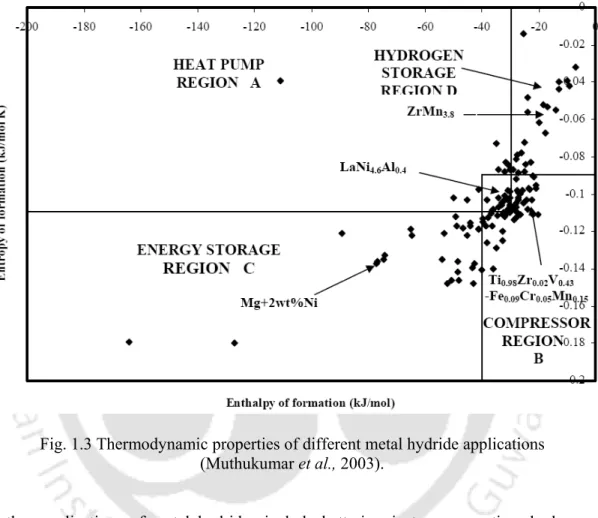
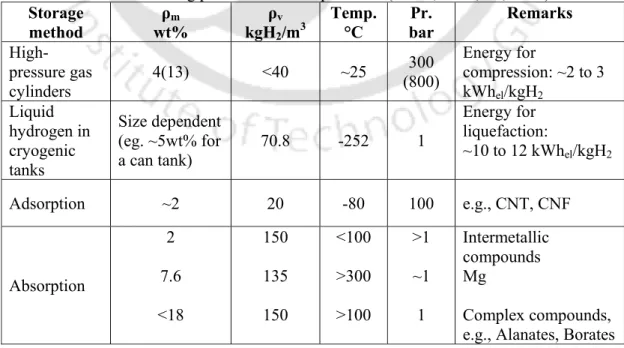
Metal H+ 2←Metal Hydride Heat+ (1.2) The detailed thermodynamics of metal hydride formation is discussed in the next section. During the formation of metal hydride [(α+β) phase], three phases exist, one gaseous phase (hydrogen) and two solid phases (metal and metal hydride).
STATE-OF-THE-ART
STUDIES ON HYDRIDING AND DEHYDRIDING KINETICS
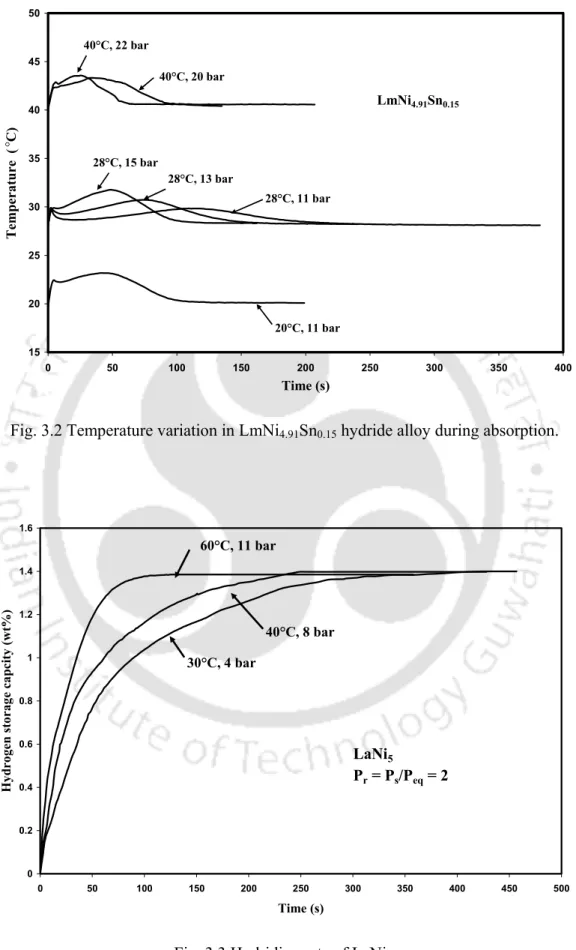
1983) developed an experimental setup for investigating the reaction kinetics of hydrogen absorption in LaNi5 at a constant hydrogen pressure and in the temperature range 15-80οC. They showed that the rate constants are independent of the pressure and concentration in the (α+β) phase region.
HEAT AND MASS TRANSFER IN HYDRIDE BEDS
His numerical results showed good agreement with his reported experimental data. 2000) developed a two-dimensional mathematical model for evaluating the transient heat and mass transfer in a LaNi5 hydride bed using the finite element method. Their computational results showed good agreement with the experimental data. 2005) presented a two-dimensional mathematical model during the absorption of hydrogen by a metal hydride bed, taking into account the complex heat and mass transfer with internal heat generation.
SINGLE STAGE METAL HYDRIDE HEAT PUMPS
- Experimental Studies on Single Stage Metal Hydride Heat Pumps
- Numerical Studies on Single Stage Metal Hydride Heat Pumps
- Studies on Compressor Driven Metal Hydride Heat Pumps
- Crossed van’t Hoff line Single Stage Metal Hydride Heat Pumps
In this section, some of the literature on the thermal modeling of single-stage metal hydride heat pumps is presented. They predicted the performance of the metal hydride heat pump operating with the same hydride pair (Gopal and Murthy, 1995c).
DOUBLE STAGE METAL HYDRIDE HEAT PUMPS
- Experimental Studies on Double Stage Metal Hydride Heat Pumps
- Numerical Studies on Double Stage Metal Hydride Heat Pumps
-dimensional mathematical model for evaluation of transient heat and mass transfer in metal hydride layers. 1995) • The performance of a metal hydride cooler was numerically predicted by solving transient heat and hydrogen transport processes between LaNi4.5Al0.5. regeneration alloy) and LaNi5 (cooling alloy) of the reaction bed.

CLOSURE
In order to optimize the operation and bed parameters of the metal hydride-based heat pump, a detailed theoretical investigation on the heat and mass transfer aspects of metal hydride reaction beds is needed. Only a few mathematical studies on single-phase metal hydride-based heating and cooling systems have been reported in the literature. No mathematical study on the two-stage metal hydride heat pump has been reported in the literature.
The heat and mass transfer aspects of a metal hydride heat pump with a crossed van't Hoff line have not been described in the literature. Therefore, there is a need to investigate the feasibility of a metal hydride-based crossover van't Hoff heat pump.
OBJECTIVES OF THE THESIS
REACTION KINETICS STUDIES
JOHNSON-MEHL-AVRAMI (JMA) MODEL
- First Order JMA Model
- Order Obtained From Experiment Eq. (3.1) can also be written as
JANDER DIFFUSION MODEL (JDM)
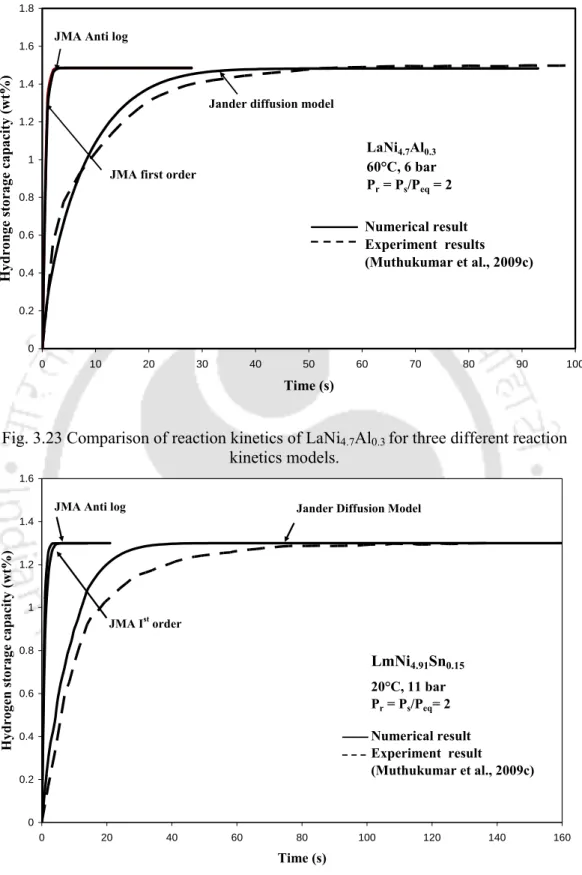
The reaction rate constants are calculated from the slopes of the straight lines fitting the experimental (–ln[1-f(t)] vs. t) plots. The activation energies and reaction rate constants are in Eq. 3.6) to determine the mass flow rate of the hydrogen. The reaction rate constant in the (α+β) phase region is calculated from the slope of the interpolated straight line.
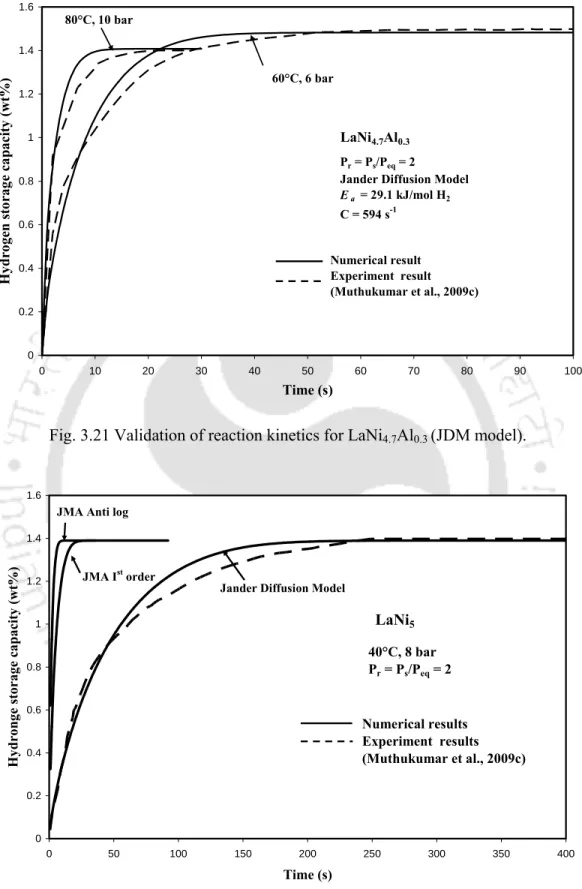
In the first-order Johnson-Mehl-Avrami (n = 1) model, the reaction rate constants are calculated from the slopes of the straight lines that fit the experimental (–ln[1-f(t)] vs. t) plots. Therefore, the diffusion of the hydrogen atom through the metal hydride is the rate-limiting step for LaNi5, LaNi4.7Al0.3 and LmNi4.91Sn0.15.
40°C, 8 bar
- SUMMARY
The hydration kinetics of several metal hydrides commonly used for heat pump applications have been studied at various operating temperatures and pressures. Two widely used reaction kinetics models, namely the Jander diffusion model (JDM) and the Johnson–Mehl–Avrami (JMA) model were considered for the present investigations. The activation energies and reaction rate constants of the aforementioned hydride bonds were determined by constructing the Arrhenius plot.
Exact activation energy values were determined for selected metal hydrides by comparing reaction kinetics data obtained from these models with corresponding experimental data. The calculated activation energy and reaction rate constants are used for further investigations in single-stage metal hydride heat pumps and double-effect two-stage metal hydride heat pumps.
HEAT AND MASS TRANSFER MODELS
SINGLE STAGE METAL HYDRIDE HEAT PUMP (SS-MHHP)
- Physical Model and Principle of Operation
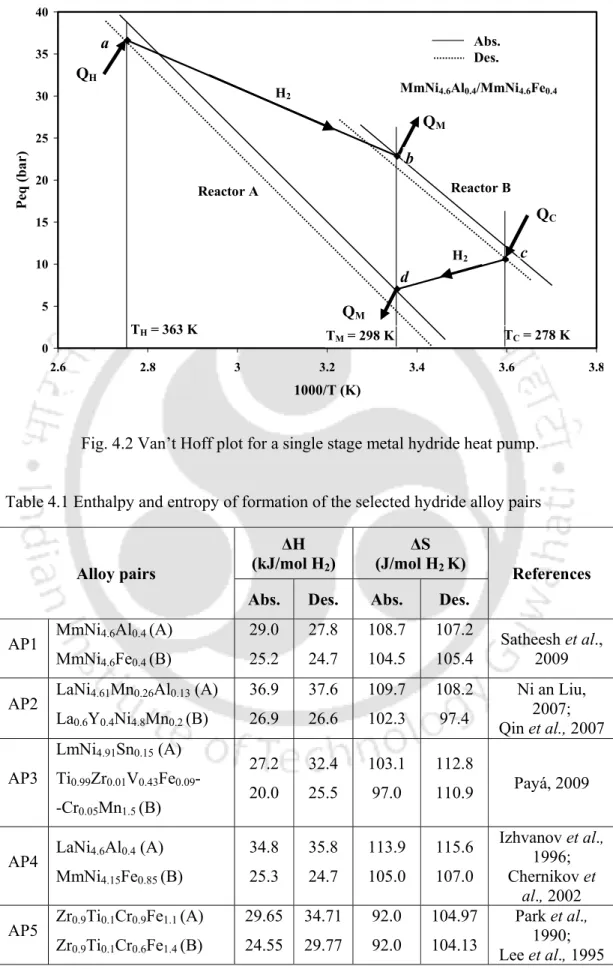
- Selection of Metal Hydride Pairs
- Problem Formulation
- Performance Analysis
- Solution Methodology
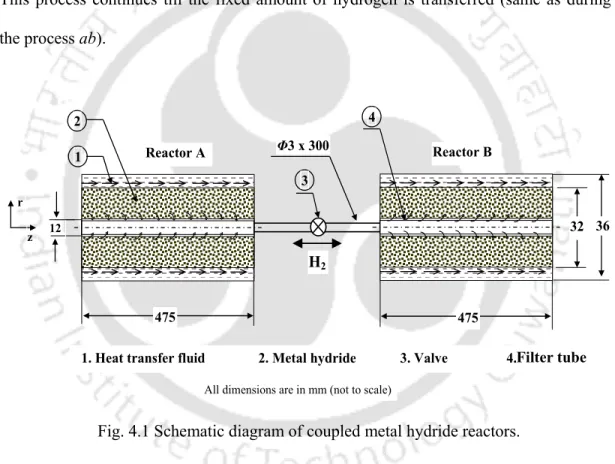
To investigate the temperature distribution of the hydride layer, hydrogen concentration and equilibrium pressures of selected pairs of hydride alloys. The final boundary conditions (left and right) of the reactors are assumed to be adiabatic (shown in Figure 4.3). T and Tf indicate the temperature of the hydride layer at the outer radius and the heat transfer fluid, respectively.
The rise in temperature of the reactor B is found using the energy equation given as. The reaction rate constants and the activation energies of the selected hydride alloy pairs are listed in Table 4.3.
DOUBLE STAGE DOUBLE EFFECT METAL HYDRIDE HEAT PUMP (DSDE-MHHP)
- Physical Model and Principle of Operation
- Selection of Metal Hydride Pairs
- Problem Formulation
- Performance Analysis
- Solution Methodology
- Physical Model and Principle of Operation
- Performance Analysis
- Solution Methodology
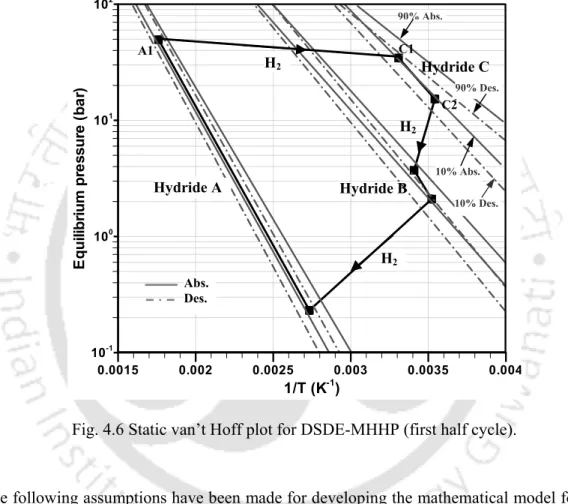
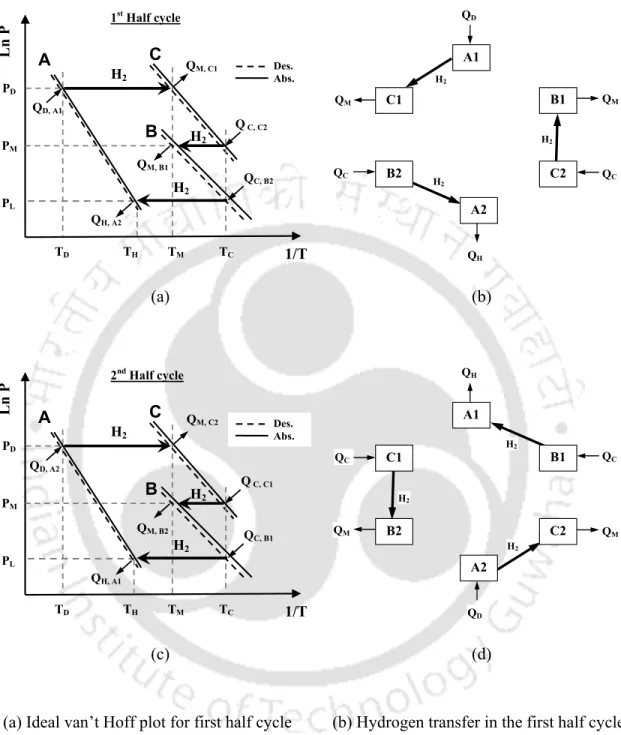
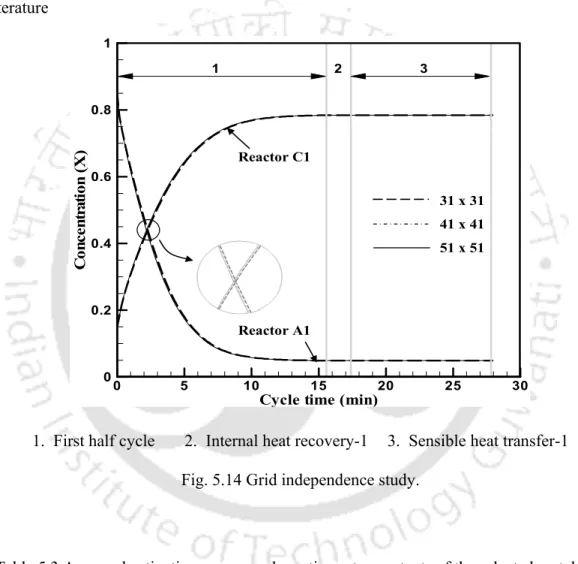
The second half cycle will start at the end of the sensible heat transfer process. Initially, at the beginning of the first half cycle, all the reactors (A1, A2, B1, B2, C1 and C2) are in equilibrium with the hydrogen gas. In the next section, the mathematical modeling of the hydrogen exchange process between the reactors A1 and C1 is explained.
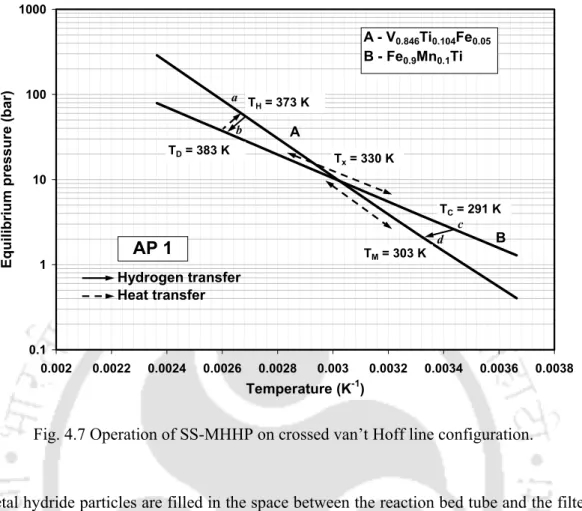
The design of the reactor geometry and the mass flow rate of heat transfer fluids (thermo oil for reactor A1 and A2 and water-glycol mixture for reactor B1, B2, C1 and C2) used for the different reactors were taken from the literature (Klein and Groll, 2002) The present numerical study is conducted based on the experimental data reported by Klein and Groll (2002) and Klein (2007). The performance of the crossed van't Hoff line SS-MHHP is described by COP and SCP.
RESULTS AND DISCUSSION
SINGLE STAGE METAL HYDRIDE HEAT PUMP
- Validation of SS-MHHP’s Thermal Model
- Importance of Variable Wall Temperature Convective Boundary Conditions Fig. 5.4 shows the variations of hydride concentrations in reactors A and B over a cycle
- Various Heat Interactions during the Operation of SS-MHHP
- Operation of SS-MHHP on Dynamic van’t Hoff Plot
- Performance Studies of SS-MHHP
- Summary of SS-MHHP’s Thermal Modeling
We can see that, under the boundary condition of constant wall temperature, the average concentration in the reactor changes only in the radial direction. It is observed that the difference in equilibrium pressure between the reactors leads to rise/fall. The lowest average layer temperatures obtained in the cd process in reactor B for the boundary conditions of constant and variable wall temperatures are 271 K and 269.1 K, respectively.
This is due to an increase in the driving potential for hydrogen transfer at higher temperature TH. This is due to the increased driving potential for hydrogen transfer during the second half of the cycle.
DOUBLE STAGE DOUBLE EFFECT METAL HYDRIDE HEAT PUMP
- Validation of DSDE-MHHP’s Thermal Model
- Variation of Hydride Properties and Heat Interactions during Operation of DSDE-MHHP
- Operation of DSDE-MHHP on Dynamic van’t Hoff Plot
- Performance investigation of DSDE-MHHP
The dynamic PCT characteristics of the reactor C1 (connected to the reactor A1 during the first half cycle) during the absorption of hydrogen are shown in Fig. The effect of heat source temperature (TD) on the amount of hydrogen between the paired reactors and the cooling capacity is shown in Fig. For the given operating conditions, the amount of hydrogen transferred between the reactors A1 and C1 (at high pressure level) during the first half cycle increases with heat source temperature.
The effect of heat sink temperature on the amount of hydrogen transferred between a pair of reactors and on the cooling capacity of the DSDE-MHHP system is shown in Fig. TM on the amount of hydrogen transferred between reactors B2 and A2 (78.4 g) at low pressure is negligible.
Sensible heat exchange factor (φ)
Summary of DSDE-MHHP’s Thermal Modeling
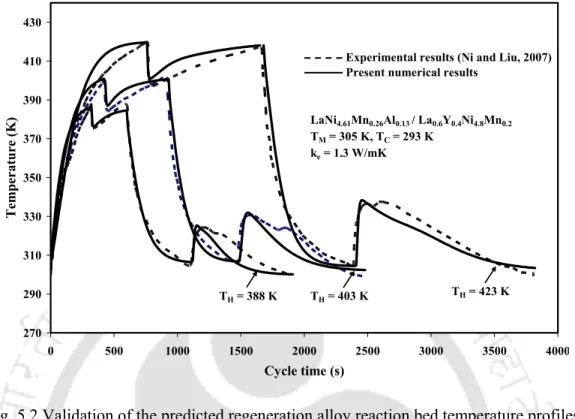
The present computational results of all hydride bed temperatures were compared with experimental data reported by Klein (2007) and good agreement between them was observed. For selected operating temperatures, the COP and SCP of the DSDE-MHHP system were evaluated with the experimental data. Heat and mass transfer studies were extended to predict the performance of DSDE-MHHP using the aforementioned hydride pair.
The effects of TD, TM, and TC operating temperatures, half-cycle time, hydride mass ratio, and sensible heat exchange factor on system COP and SCP were investigated. In general, the present numerical model allows obtaining optimal operating parameters, such as heat source, cooling and cooling temperatures, half-cycle time, hydride mass ratio, and sensible heat exchange factor without conducting an experimental study. expensive.
CROSSED VAN’T HOFF LINE METAL HYDRIDE HEAT PUMP
- Performance Prediction of Crossed van’t Hoff MHHP
- Summary of Crossed van’t Hoff line SS-MHHP’s Thermal modeling
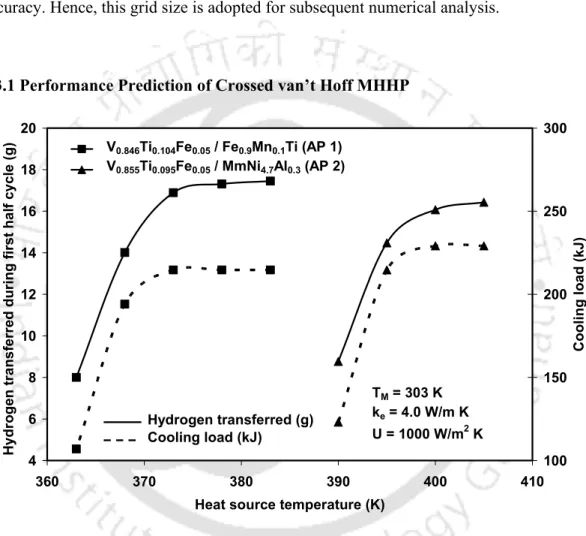
Depending on the arrangement of the heat pump (either conventional MHHP or crossed van't Hoff MHHP), the SCP does not change. The necessary heat energy to be supplied to the crossed van't Hoff MHHP is approx. 370 kJ (does it for per kg ) and 355 kJ for AP 1 and AP 2 respectively. Due to an increase in hydrogen transfer between the reaction beds with cooling temperature, the performance (COP, SCP and heat energy utilized) for crossed van't Hoff MHHP found to increase.
Results show that the crossed van't Hoff SS-MHHP achieved nearly 60% higher COP than the conventional SS-MHHP. So far, no theoretical and experimental works have been reported in the literature dealing with the crossed van't Hoff MHHP.
CONCLUSIONS
REACTION KINETICS STUDIES
The activation energies of LaNi5, LaNi4.7Al0.3 and LmNi4.91Sn0.15 hydride bonds are obtained from the Arrhenius plot and their values are 28.0 kJ/mol H2, respectively, using the Jander diffusion model. The reaction rate constants of the aforementioned hydride bonds are 86, 594, and 846 s-1, respectively, using the Jander diffusion model.
HEAT AND MASS TRANSFER MODELS .1 Single Stage Metal Hydride Heat Pump
- Double Stage Double Effect Metal Hydride Heat Pump
- Crossed van’t Hoff line Single Stage Metal Hydride Heat Pump
The effects of heat source, heatsink and cooling temperatures on the amount of hydrogen exchanged between the coupled reactors, COP and SCP of SSSE-MHHP system are studied in detail and the optimum operating temperatures of the selected metal hydride pairs are found out. For a given heat sink temperature, the COP and SCP of the system are found to increase with heat source and cooling temperatures and decrease with heat sink temperature. The following conclusions are drawn from the performance study of the dual stage dual effect metal hydride heat pump system.
The effects of different operating temperatures, half-cycle time, hydride mass ratio and sensible heat exchange factor on COP and SCP of the system are studied. The effect of motion heat and cooling temperatures on system COP is more significant than that of coolant temperature.
APPENDIX – A
REACTION KINETICS STUDIES EXPERIMENTAL SET-UP
The right side of the reactor is connected to a filter assembly that prevents the hydrogen gas from carrying away the metal hydride dust during desorption. Before absorption and desorption can begin, a metal hydride activation process may be required to create clean particle surfaces. At the beginning of the experiment, the region containing the metal hydride (region 2) is discharged (the metal hydride is completely discharged) and region 1 is compressed to the desired level.
A hydrogen uptake of the sample is determined from the loss of gaseous hydrogen (measured by the differential pressure transducer). Due to the instantaneous high flow rate and the rapidly changing pressure at the beginning of the experiment, the system is not in thermodynamic equilibrium.
APPENDIX – B
DISCRETIZATION OF GOVERNING EQUATIONS
Energy Equation
Continuity Equation
Sung (1999) Technical note conjugate heat and mass transfer in metal hydride bearings in the hydration process, Int. Nasrallah (2010) Numerical simulation of heat and mass transfer in metal hydride hydrogen storage tanks for fuel cell vehicles, Int. Ramana (2009) Numerical simulation of coupled heat and mass transfer in metal hydride-based hydrogen storage reactor, J.
Miura (2000) Numerical analysis of heat and mass transfer characteristics in the metal hydride bed, Int. Li (2010) Numerical analysis of heat and mass transfer during absorption of hydrogen in metal hydride-based hydrogen storage tanks, Int.
List of Publications