Chapter 5
Regulatory/Systemic Reforms for Maintaining/Enhancing Competitiveness: The Importance of Developing a Multi-tiered
Strategy NAKAGAWA Junji
Policy recommendations of this chapter
1) The TPP should constitute the core of a strategy for regulatory/systemic reform. Japan should aim to achieve broad-based and highly effective regulatory/systemic reforms through the TPP and to develop the regulatory/systemic reforms incorporated in the TPP into the de facto global standards in the future by expanding the community of countries participating in the TTP and by referencing the TPP in all FTA negotiations with other countries/regions.
2) Japan must exercise leadership in endeavoring to achieve international regulatory/systemic harmonization and standardization via the WTO and other multilateral forums. This will require, however, that Japan’s regulatory/systemic experiences as well as those of East Asian countries, which learned many lessons from Japan’s experiences to achieve their own economic growth, be carefully considered, theorized and then presented as feasible regulatory/systemic models for other countries as well.
3) Alongside the measures referred to in 1 and 2 above, Japan must pursue regulatory/systemic reform on its own as well in parallel cooperation with other key economies in developing and implementing a strategy for multi-tiered regulatory/systemic reform.
Introduction
What measures should be taken to maintain and enhance the economic power and competitiveness of Japan in the increasingly challenging internal and external environment surrounding the country? This chapter argues that domestic regulatory/systemic reforms are indispensable in order to maintain and enhance Japan’s economic power and competitiveness. This chapter further argues that for the steady promotion of regulatory/systemic reforms, Japan’s
independent efforts to improve its regulatory/systemic framework alone is insufficient and a multi-tiered strategy for regulatory/systemic reforms is required that encompasses, among others, bilateral talks on regulatory/systemic reforms with major powers, regulatory/systemic reforms through bilateral and regional free trade agreements such as Economic Partnership Agreements (EPAs) and the Trans-Pacific Strategic Economic Partnership Agreement (TPP), and the achievement of international regulatory/systemic harmonization and the acquisition of international standards through multilateral forums in individual regulatory areas.
There is a consensus in public economics that in order to foster market competition and revitalize the economy, regulatory/systemic reforms that promote deregulation and the increasingly limited scope of government intervention in the market with an appropriate safety net are effective.
Japan and other major developed countries alike have actually been implementing broad-based regulatory/systemic reforms since early 1980’s. However, with the advancement of globalization, the international environment of regulatory/systemic reforms today has significantly changed. With the increasingly reduced room for unilateral implementation of regulatory/systemic reforms by individual countries, it is now considered critical to promote international regulatory/systemic harmonization in a multi-tiered manner through the effective use of bilateral, regional, or multilateral forums and ensure global dissemination of regulatory/systemic frameworks that are favorable to one’s own country as international standards.1
Today, it is the U.S. and Europe that lead the movement toward international regulatory/systemic harmonization and the establishment of international standards that is underway in a broad spectrum of regulatory areas.2 The most important reason why the U.S. and Europe have been able to take a leadership role in the movement toward international regulatory/systemic harmonization and the establishment of international standards is that these countries have the largest and strongest economic power in today’s increasingly global economy combined with their dominant position as a source of international standards and best practice in the regulatory and systemic areas (i.e., “soft power”). In 19th century Europe, there were multiple empires that had colonies all over the world. The U.K. in particular had overwhelming national power during the period from the late 19th century to the early 20th century. The U.S. rose to supremacy during the period of peace after the First World War and held sway over the world economy following the Second World War. It has maintained the position as the world’s largest economy to today. In addition, these countries undertook regulatory/systemic reforms before the
rest of the world and disseminated the reform results internationally, thereby making earnest efforts toward regulatory and systemic harmonization on a global scale and the acquisition of international standards. In particular, Europe, with an increasing sense of danger and feelings of rivalry toward U.S. economic supremacy during the process of its own economic integration, has promoted regulatory and systemic harmonization within the European region and strived to reflect the results of such harmonization in the ongoing movement toward global regulatory and systemic harmonization and the establishment of international standards.
Japan compares unfavorably with the U.S. and Europe in terms of both economic power and the ability to disseminate international standards or international best practice with respect to regulatory/systemic areas. Although Japan is currently the world’s third largest economic power, it was only during the 1970’s that Japan achieved rapid economic growth and joined the ranks of the major economies, once having been defeated in WWII and stripped of all its colonies. By that time, many of the international forums aimed at regulatory and systemic harmonization on a global scale and the establishment of international standards had already been established, and Japan was a latecomer to them. From then until today, Japan has focused on catching up with, rather than taking the leadership role in, such movement toward international harmonization and the establishment of international standards in the area of regulatory/systemic reforms.
In order to maintain and enhance its economic power and competitiveness in the world today, Japan needs to grow out of such a position and, along with the U.S. and Europe, take a leadership role in the global movement toward international harmonization and standardization of regulations.
Based on this awareness, this chapter argues that Japan needs to develop and implement a multi-tiered strategy for regulatory/systemic reforms and explores specific measures to do so. This chapter consists of three sections. Section 1 reviews the historical development of regulatory/systemic reforms in Japan and observes how the international context of regulatory/systemic reforms today is vastly different from that in the past. Section 2, after systematically discussing the measures that should be taken to address the political challenge of trade/investment liberalization and expansion, which is particularly important for the maintenance and enhancement of the economic power and competitiveness of Japan, clarifies how the efforts to realize such trade/investment liberalization and expansion often involve regulatory/systemic reforms in Japan as well as in its investee countries and trade partners and how, to that end, Japan needs to deploy regulatory/systemic reform efforts in a multi-tiered manner by combining
unilateral regulatory/systemic reforms with regulatory/systemic reforms pursued through bilateral, regional, and multilateral agreements. Section 3 discusses the merits and limitations of regulatory/systemic reforms pursued through the Trans-Pacific Strategic Economic Partnership Agreement (TPP), which at present has the biggest strategic importance for Japan as a means to promote regulatory/systemic reforms. Lastly, this chapter concludes by summarizing the conclusions of this chapter and shedding light on future challenges.
1. Historical development and the international context of regulatory/systemic reforms
(1) Historical development of regulatory/systemic reforms
The current Democratic Party of Japan (DPJ) administration also recognizes the importance of regulatory/systemic reforms in the maintenance and enhancement of Japanese economic power and competitiveness. The “Basic Policy on Comprehensive Economic Partnerships” adopted pursuant to the Cabinet decision on November 9, 2010 under the Kan administration stated that “while opening up the country and importing the best management resources in order to enhance its potential for growth, the Government of Japan, with a view to achieving active economic partnerships and eliminating non-tariff barriers, will decide on a concrete plan (on regulatory/systemic reforms [note added by the author])… through the Government Revitalization Unit.”3 The “Strategy for Rebirth of Japan” compiled by the Noda administration on December 24, 2011 also supported the promotion of regulatory/systemic reforms in multiple sections such as those on the redesigning of energy/environmental policies4 and on the improvement of productivity in the service industry and the creation of new industries/markets in response, among others, to the declining birthrate and aging population.5 Regulatory/systemic reform efforts are currently being made under the leadership of the subcommittee of the Government Revitalization Unit, a unit of the Cabinet Office, on regulatory/systemic reforms.6
Since the establishment of the Second Ad Hoc Research Committee on Administrative Reform (“Daini Rincho” chaired by Toshio Doko) in 1981 under Prime Minister Zenko Suzuki’s administration, Japan has already been working on regulatory/systemic reforms for three decades.7 Regulatory/systemic reforms in this period, as part of administrative and public finance reforms aimed at the reconstruction of public finances, were centered around the privatization of inefficient public sector businesses such as the privatization of Nippon Telegraph and Telephone Public Corporation (1985) and Japan National Railways (1987)8. In 1995, a deregulation subcommittee
(chaired by Yoshihiko Miyauchi) was formed under the Administrative Reform Committee of the Government to broadly discuss regulatory/systemic reforms (deregulation) aimed at reducing government intervention in the market through regulations. The body to promote regulatory/systemic reforms has since continued to exist in various names and organizations,9 leading to the current subcommittee on regulatory/systemic reforms within the Government Revitalization Unit, which assumed that function in 2010. During this period, the results of the Government’s regulatory/systemic reform efforts have been documented as regulatory/systemic reform promotion plans and implemented in phases for each successive three-year planning period.10
Looking back the progress of regulatory/systemic reforms in Japan since the early 1980’s, as already mentioned, the initial reform efforts were focused on the privatization of public sector businesses, which had significant implications as a measure to reconstruct public finances.
However, the reform priority was gradually shifted to the full revision and elimination/deregulation of government regulations that prevented competition in the market. The “Implementation Policies for Regulatory/Systemic Reforms” (June 2010), which is the latest regulatory/systemic reform plan, set forth 61 reform items in total, which are categorized into four areas: green innovation, life innovation, agriculture, and other. Most government agencies are subject to these reforms.11
(2) The international context of regulatory/systemic reforms
A characteristic feature of the international context of regulatory/systemic reforms today is that it has significantly changed from that of the past.
It is not quite accurate to view Japan as having promoted regulatory/systemic reforms independently based on internal motives even in the early 1980’s when Japan started to undertake such reforms for the first time on a full scale. Japan has been promoting regulatory/systemic reforms by referencing the experience of various foreign countries, particularly the U.S.12 Amid the intensifying trade friction and investment friction, Japan had been incessantly requested by the U.S., Europe, and others to open its market since the late 1980’s. One aspect of regulatory/systemic reforms in Japan was that they were promoted as a response to such foreign pressure.
The first example of regulatory/systemic reforms as part of a response to foreign pressure was the Structural Impediments Initiative (SII) talks held during the period from 1989 to 1990. These
talks were held to address and improve the structural issues of both Japan and the U.S. underlying the current account and trade imbalances between the two countries. The requests for improvement made by the U.S. through these talks included measures that led to regulatory and systemic reforms in Japan, such as reform of the distribution system, regulation on exclusive trade practice, and reconsideration of intragroup transactions. Based on the results of these talks, Japan implemented various regulatory/systemic reforms including the amendment of the Act on the Adjustment of Business Activities of Retail Business at Large-scale Retail Stores and the more effective enforcement of the Anti-monopoly Act.13 After the SII talks, Japan and the U.S. continued bilateral talks whose main themes included regulatory/systemic reforms. In particular, from 1997 to today, Japan-U.S economic talks have been held under names that highlight regulatory/systemic reform topics such as deregulation, regulatory reform and economic harmonization (U.S.-Japan Enhanced Initiative on Deregulation and Competition Policy (1997-2001), U.S.-Japan Regulatory Reform and Competition Policy Initiative (2001-2009), and U.S.-Japan Economic Harmonization Initiative (2010-)). Japan has also continued to have talks with the EU on regulatory/systemic reforms toward trade and investment liberalization and/or facilitation since 1994 under the name of Japan-EU Regulatory Reform Dialogue.14 As outlined above, the international context of regulatory/systemic reforms in Japan until recently can be characterized by (1) regulatory/systemic reforms undertaken by referencing and imitating regulatory/systemic reforms in foreign countries, particularly in the U.S. (unilateral referencing and imitation) and (2) regulatory/systemic reforms through regular talks with the U.S. and Europe (response to foreign pressure between two countries).15
The current international context of regulatory/systemic reforms is significantly different from that in the past in the following three aspects. First, as globalization advances, the activity of companies has extended freely across national boundaries. Companies now determine the optimal location for their activity (e.g., production location, source of procurement of raw materials/parts, and market) in consideration of regulatory and systemic differences by country. The era has arrived in which companies choose countries.16 Regulatory authorities of each country have started to work on regulatory/systemic reforms that provide regulatory/systemic environments that are more favorable to companies than other countries in order to attract foreign companies to and to keep domestic companies in the domestic market (regulatory competition).17 Second, for fear of such regulatory competition leading to a regulatory race to the bottom, countries started to work on the achievement of international regulatory and systemic harmonization more earnestly than ever
before by coordinating the content and the pace of regulatory/systemic reforms through multilateral forums, the most important of which is the OECD. The OECD started to conduct research and studies on regulatory reform in the mid-1990’s. In the latter half of 1990’s, it conducted extensive research on regulatory reforms in various countries around the world and complied and published the research results as regulatory reform best practices that are relevant in various regulatory areas and topics.18 Furthermore, the OECD has been conducting research and evaluations on regulatory reforms in its member countries since the late 1990’s, the results of which have been published one after another.19 Although the OECD’s evaluation on regulatory reform in itself does not have any binding power, it works as a pressure on the member nations toward gradual convergence of their regulations and systems to the best practice as it is supported by a broad research and studies on regulatory reform and is based on the best practices of regulatory reform. In addition, since the mid-1990’s, the activities of multilateral forums oriented toward international regulatory and systemic harmonization have been gaining momentum. In particular, the WTO established in 1995 not only established international agreements oriented toward international regulatory and systemic harmonization directly related to international trade such as those on rules of origin (Agreement on Rules of Origin) and dumping regulations (Anti-Dumping Agreement), but also established international agreements on international harmonization of intellectual property rights (TRIPS Agreement) and food sanitation/safety standards (SPS Agreement), fostering the significant development of international regulatory and systemic harmonization in these areas.20
The third important change that characterizes the international context of regulatory/systemic reforms today is the rising movement toward international regulatory and systemic harmonization through bilateral or regional free trade agreements (FTAs) or Economic Partnership Agreements (EPAs). The movement toward concluding FTAs/EPAs gained momentum in the late 1990’s. The underlying factor was that by that time, the WTO was practically dysfunctional as a forum for international regulatory and systemic harmonization. The GATT, which is the predecessor of the WTO, was a club-type international organization that strongly reflected the intentions of major trading countries.21 However, under the WTO system, it was difficult for a few major trading countries to take the initiative in the decision-making process as the number of member nations increased. This is clearly indicated by the recent collapse of the Doha talks 10 years after their inception in 2001. In combination with the failed efforts of the major developed countries to expand the agendas of the Doha talks to include new areas such as competition and investment,22
the major developed countries, particularly the U.S. and Europe, shifted the focus of their trade policy to international regulatory and systemic harmonization through FTAs and EPAs in the late 1990’s. Notifications to the WTO indicate that the number of regional trade agreements (FTAs, EPAs and customs unions) increased from only 27 in 1990 to 511 as of January 15, 2012.23 Japan has also entered into 13 EPAs so far starting from the EPA with Singapore signed in January 2002.24 In addition, EPA negotiations with South Korea, the Gulf Cooperation Council (GCC), and Australia are currently underway and a Japan-China-South Korea EPA and a Japan-EU EPA are undergoing discussions toward the commencement of negotiations. In February 2012, preliminary talks started toward participation in the Trans-Pacific Strategic Economic Partnership Agreement (TPP) negotiations.
FTAs and EPAs cover not only the liberalization of trade (products and services) between the parties to the agreement, but also the liberalization of the government procurement and investment markets. They also cover regulatory and systemic harmonization at levels that are higher than those under the WTO framework in the areas that are not governed by WTO orders in addition to those governed by these orders. For example, they include such areas as trade facilitation, intellectual property rights, e-commerce, investment protection, competition law/policy, labor, and the environment.
In this way, the international context of regulatory/systemic reforms in Japan today has become more complex and multi-dimensional than before. In addition to regulatory/systemic reforms through traditional channels such as (1) unilateral imitation or referencing and (2) response to foreign pressure between two countries, regulatory/systemic reforms are currently promoted in a multi-tiered manner, in consideration of (3) the intentions of both domestic and foreign companies, through (4) multilateral or (5) bilateral and regional forums.
2. Regulatory/systemic reforms aimed at trade and investment liberalization and expansion
What regulatory/systemic reforms are needed for Japan to maintain and enhance its economic power and competitiveness? This study report is based on four pillars: (1) securing labor resources and youth employment, (2) liberalizing trade and expanding domestic investment, (3) harmonizing regulations and establishing R&D systems for international standards, and (4) human resources development for Japan’s international competitiveness, and is aimed at clarifying necessary measures for each of these policy objectives. However, (3) above, which is the topic of this chapter,
is considered to be a means of achieving the other three policy objectives rather than an independent policy objective in itself. This is because many of the measures to be taken by the government to achieve any of these policy objectives are implemented through regulatory/systemic reforms25 and various measures to achieve these policy objectives are often overlapping and complementary to each other. Therefore, this chapter focuses on the policy objective (2) liberalizing trade and expanding domestic investment in particular and discusses regulatory/systemic reforms necessary to achieve it. If such regulatory/systemic reforms are also effective in achieving the other policy objectives ((1) and (4) above), this will be pointed out in each case.
Then, what regulatory/systemic reforms are necessary for promoting trade liberalization and domestic investment expansion? In the rest of this section, measures for trade liberalization and domestic investment expansion in an era in which companies choose their markets are classified into (1) measures to support the expansion of Japanese companies into overseas markets, (2) measures to maintain and enhance the locational competitiveness of domestic Japanese companies and (3) measures to promote investment in Japan by foreign companies, based on the combination of companies choosing markets (Japanese companies and foreign companies) and the markets being chosen (overseas markets and Japanese markets), and necessary regulatory/systemic reforms are discussed separately for each category.
(1) Measures to support the expansion of Japanese companies into overseas markets
Measures to support the expansion of Japanese companies into overseas markets are generally classified into three groups: (1) securing investment access to overseas markets by Japanese companies, (2) improvement of the investment environment in overseas markets for Japanese companies, and (3) resolution of taxation and pension issues associated with overseas expansion by Japanese companies. What measures are included each group? Which among these measures can be implemented through regulatory/systemic reforms in overseas markets and in Japan? What forums are appropriate for promoting them?
(a) Securing investment access to overseas markets by Japanese companies
Measures necessary for securing investment access to overseas markets by Japanese companies include (1) relaxation or elimination of investment restrictions in overseas markets and (2) opening up of the overseas government procurement markets.
The most effective measure to realize relaxation or elimination of investment restrictions in overseas markets is to conclude bilateral investment treaties (BITs) or EPAs with major investee countries and to hold them responsible for relaxation or elimination of investment restrictions as an obligation under the international agreement. The number of BITs is rapidly increasing as developing countries and countries with economies in transition are taking increasingly aggressive policies for attracting foreign investment capital.26 BITs generally include provisions for investor protection after investment is made (national treatment, most-favored-nation treatment, expropriation and compensation, dispute settlement through investor state arbitration,27 etc.) (investment protection agreement). Recently concluded BITs often provide for national treatment not only after investment is made, but also at the stage of investment approval. National treatment at the stage of investment approval is particularly effective for relaxation or elimination of investment restrictions as it means the liberalization of investment in the relevant sector (investment protection/liberalization agreement).28 Japan has so far entered into 15 BITs, of which 6 BITs concluded in or after 2002 are investment protection liberalization agreements.29 In addition, most of the EPAs concluded by Japan include in their investment chapters the same provisions as investment protection liberalization agreements.30
The government procurement market (purchase of goods and services by government agencies), which is said to account for 10 to 15% of GDP, is a promising investment target for Japanese companies, but countries often impose various restrictions on foreign companies’ entry to the government procurement market for the protection of domestic industries and other reasons. The WTO Agreement on Government Procurement (GPA) permits foreign companies to enter into government procurement markets whose scale exceeds a certain amount and encourages the parties to the agreement to open up the government procurement market by increasing the transparency of government procurement (introduction of an open bidding system, disclosure of bidding information, etc.).31 However, the parties to the WTO Agreement on Government Procurement are only 15 countries/regions including Japan, the EU, and the U.S. Therefore, in order to secure
investment access to the government procurement markets of other countries by Japanese companies, Japan can only negotiate opening up of these markets through bilateral or regional EPAs. Japan entered into an EPA with Mexico in which Mexico promised to open up its government procurement market. However, the current EPAs with other countries/regions merely provide for exchange of information on government procurement and future negotiation for opening up the government procurement market due to strong opposition of the other party to the agreement to the opening up of such a market.32
Within the government procurement market, infrastructure improvement is one of the areas expected to grow rapidly in the future, particularly in the emerging economies of Asia. For the promotion of Japanese companies’ entry into this market, aggressive support by the government through such means as summit diplomacy, information gathering, and loans and guarantees provided by government-affiliated financial institutions is effective. Under the “New Growth Strategy” approved by the Cabinet in June 2010 that identified the packaged promotion of overseas expansion of infrastructure-related industries as a national project, the Japanese government is currently working on the creation of a system for such promotion through public-private collaboration.33
(b) Improvement of the investment environment in overseas markets for Japanese companies
Measures necessary for the improvement of the investment environment in overseas markets for Japanese companies include those related to the improvement of the business environment of investee countries such as the improvement of regulations and systems of investee countries and the application and administration thereof. More specifically, they include (1) improvement of the legal system that is fundamental to business activities (e.g., accounting system, companies law, contract law, and bankruptcy law), (2) prohibition of performance requirements,34 (3) lower customs duties imposed by the investee country, (4) trade facilitation in the investee country (e.g., simplification and digitization of the customs procedure and increased transparency of the customs procedure), (5) facilitation of the acquisition or renewal of a working visa by Japanese employees, (6) international harmonization and increased transparency of the standards/authentication system of the investee country, (7) restriction on government intervention in technology transfer agreements, (8) increased protection of intellectual property rights in the investee country (including improved enforcement), (9) fair enforcement of the competition law in the investee
country (in particular, more effective enforcement with regards to the state enterprises of the investee country), (10) guarantee of free transfer of funds in and out of the investee country (including transfer of profit out of the investee country), and (11) guarantee of an appropriate settlement procedure for disputes with the investee country (e.g., investor-state arbitration).
The most important means for Japan to promote the measures listed above is to include these matters in the investment chapter of a BIT or EPA with the investee country and to hold the investee country responsible for the compliance with them as an obligation under the international agreement. Most of the investment chapter of the BITs and EPAs concluded by Japan include provisions concerning (2) through (11) above, thereby striving to improve the business environment in the investee countries for Japanese companies, although the specific content of the agreement differs slightly from one agreement to another. In addition, many of the EPAs concluded by Japan include a chapter on the improvement of the business environment, which proscribes the establishment of a formal opportunity for discussion toward the improvement of the business environment (subcommittee on the improvement of the business environment), thereby striving to include in the agenda and resolve certain types of issues such as those that are faced by Japanese companies, those that are difficult to be proposed as a discussion agenda by any single company, and those that are relevant to the industry as a whole.35 Among the measures listed above, (1) improvement of the legal system that is fundamental to business activities is an issue that is related to the legislative power of investee countries. As such, it is difficult to address this issue through BITs or EPAs. However, Japan is offering technical assistance to support the improvement of the fundamental legal system in certain investee countries that are countries with economies in transition such as Vietnam and Laos.36
In addition, mutual recognition of the authentication system for industrial products of the investee country under a bilateral agreement can be used as a complementary measure for promoting (6) international harmonization and increased transparency of the standards/authentication system of the investee country (mutual recognition agreement). Japan concluded its first mutual recognition agreement with the EU in 2001 in four areas including telecommunications equipment (effective on January 1, 2002) and has subsequently concluded mutual recognition agreements with the U.S., Singapore, the Philippines, and Thailand (in the case of Singapore, the Philippines, and Thailand, a mutual recognition chapter is included in the EPA).37
In order to improve the investment environment in overseas markets for Japanese companies, the effective use of multilateral agreements and multilateral forums is also important. In particular, the WTO has established many agreements that lead to the improvement of the investment environment in overseas markets. The TRIMs Agreement of the WTO addresses (2) prohibition of performance requirements, while the TRIPS Agreement provides for (7) restriction on government intervention in technology transfer agreements and (8) increased protection of intellectual property rights in the investee country (including improved enforcement). With regard to (6) international harmonization and increased transparency of the standards/authentication system of the investee country, detailed disciplines are prescribed in the SPS Agreement (covering food sanitation/safety standards) and the Agreement on Technical Barriers to Trade (“TBT Agreement,” covering the standards/authentication system for industrial products other than those covered by the SPS Agreement). In addition, with regard to (4) trade facilitation in the investee country, detailed rules are prescribed in the Revised Kyoto Convention on the Simplification and Harmonization of Customs Procedures (effective February 3, 2006) adopted by the World Customs Organization (WCO).38 As for (9) fair enforcement of the competition law in the investee country, active efforts are being made toward the international convergence of the competition law and competition policy through the International Competition Network (ICN), which was established in October 2001 under the leadership of the U.S. and in which most countries in the world that have their own competition law/policy participated.39
Lastly, regarding (6) international harmonization and increased transparency of the standards/authentication system of the investee country, it is important for Japan to make a positive approach through public-private collaboration to the relevant global forums (such as the International Organization for Standardization (ISO) and the Codex Committee on Food Hygiene) so that the standards made in Japan will be adopted as international standards. Japan established strategic objectives on international standardization in 2006 and started to create a system to strategically promote international standardization.40
(c) Resolution of taxation and pension issues associated with overseas expansion by Japanese companies
Expansion into overseas markets by Japanese companies entails such issues as (1) international double taxation on income from a foreign operation or international tax evasion using tax havens or
transfer prices in intra-group transactions and (2) situations where employees who are assigned to a post in a foreign country for a long term may be forced to participate in pension plans in both Japan and the foreign country at the same time or may not be qualified to receive pension benefits when they retire due to the lack of the number of years of participation to either the Japanese pension plan or the pension plan of the foreign country or both. In order to resolve these issues, Japan needs to enter into international agreements with the relevant foreign countries to take necessary measures.
Countries generally address the problems of international double taxation and tax evasion by concluding bilateral tax treaties. Tax treaties take measures to prevent international double taxation, for example, by limiting the taxing power of the country of origin and by limiting the scope of the income that is taxable by the source country (the country in which income is generated) (the source country can impose taxes only on the business income generated from the activities of a foreign operation such as a foreign branch and tax rates applicable to investment income (dividend, income, and rent) is subject to certain upper limits). They also take measures to crack down on international tax evasion, for example, by providing for the exchange of taxpayer information (including bank secrecy) between the tax authorities of the parties to the treaty and by adjusting the transfer pricing taxation of the parties to the treaty (i.e., taxation based on fair transaction price rather than transfer price). As of October 31, 2011, Japan was a party to 52 tax treaties.41
Countries generally deal with the pension issues associated with overseas business expansion by entering into bilateral social security agreements. In order to avoid double payment burden of pension premiums, social security agreements provide that expatriate employees should be exempted from the participation in the pension plan of the foreign country to which they are dispatched if the period of domicile in that country is within a certain period. They also address the issue of insufficient years of participation in the pension plan by providing that, for expatriate employees, the number of years of participation in the pension plans of both the home country and the foreign country to which they are dispatched should be aggregated so that they will be qualified to receive pension benefits based on the aggregated number of years of participation either in the home country or in the foreign country. Japan has so far entered into social security agreements with 15 countries including the U.S. and South Korea and is currently under negotiation for the conclusion of such agreements with 8 countries including China and Australia.42
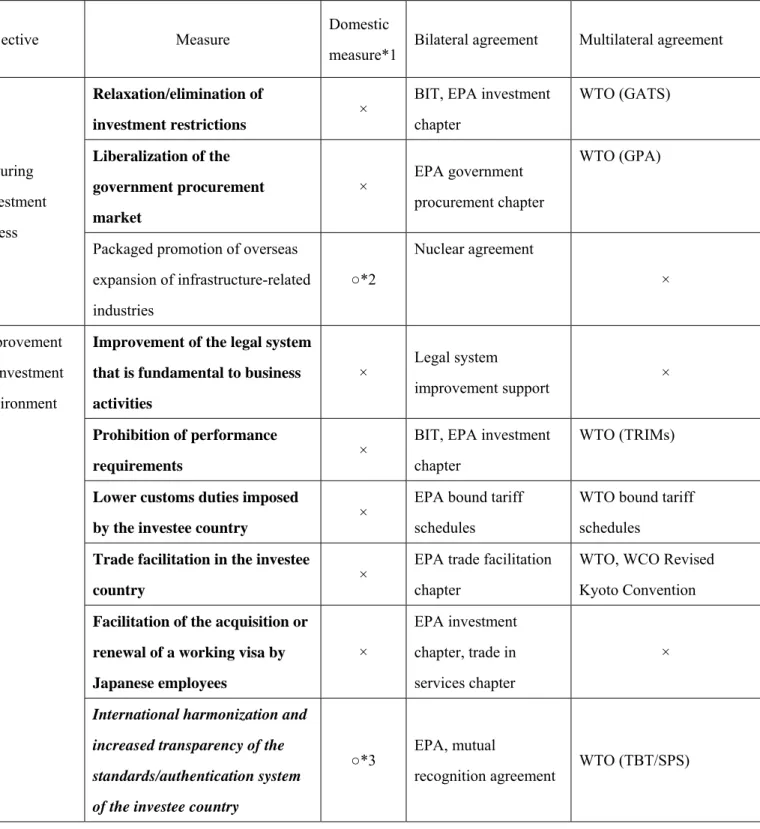
Table 5-1 summarizes the measures to support Japanese companies’ expansion into overseas markets and the means to implement them as discussed above in this section.
Table 5-1 Measures to support Japanese companies’ expansion into overseas markets and means to implement them
Objective Measure Domestic
measure*1 Bilateral agreement Multilateral agreement
Relaxation/elimination of investment restrictions
× BIT, EPA investment chapter
WTO (GATS)
Liberalization of the government procurement market
× EPA government procurement chapter
WTO (GPA) Securing
investment access
Packaged promotion of overseas expansion of infrastructure-related industries
○*2
Nuclear agreement
×
Improvement of the legal system that is fundamental to business activities
× Legal system
improvement support ×
Prohibition of performance requirements
× BIT, EPA investment chapter
WTO (TRIMs)
Lower customs duties imposed by the investee country
× EPA bound tariff schedules
WTO bound tariff schedules
Trade facilitation in the investee country
× EPA trade facilitation chapter
WTO, WCO Revised Kyoto Convention Facilitation of the acquisition or
renewal of a working visa by Japanese employees
×
EPA investment chapter, trade in services chapter
× Improvement
of investment environment
International harmonization and increased transparency of the standards/authentication system of the investee country
○*3 EPA, mutual
recognition agreement WTO (TBT/SPS)
Restriction on government intervention in technology transfer agreements
×
EPA intellectual
property chapter WTO (TRIPS)
Increased protection of intellectual property rights in the investee country
×
EPA intellectual
property chapter WTO (TRIPS)
Fair enforcement of the competition law in the investee country
× EPA competition
chapter ICN
Guarantee of free transfer of funds in and out of the investee country
×
EPA investment
chapter ×
Appropriate settlement
procedure for disputes with the investee country
× BIT, EPA investment
chapter ×
Improvement of the business environment of the investee country
×
EPA business environment
improvement chapter
×
Prevention of international double taxation on income from a foreign operation and measures against international tax evasion
○*4
Tax treaty
× Taxation /
pension
Resolution of the issues of double participation in pension plans and insufficient years of participation
○*5
Social security
agreement ×
*1 Indicates measures to be taken by Japan in its domestic market and does not include measures to be taken by investee country in its domestic market.
*2 Strategy for packaged promotion of overseas expansion of infrastructure-related industries
*3 Strategic objectives on international standardization
*4 Measures under domestic tax laws to be taken in response to tax treaties
*5 Measures to be taken by Japan in its domestic market in response to social security agreements (Source: Prepared by the author)
In Table 5-1 above, the items written in bold characters indicate those requiring regulatory/systemic reforms in the investee country and the items written in italic characters indicate those requiring regulatory/systemic reforms in Japan. The item written in bold italic characters, i.e., international harmonization and increased transparency of the standards/authentication system of the investee country, requires regulatory/systemic reforms in both Japan and its investee countries.
(2) Measures to maintain and enhance the locational competitiveness of domestic Japanese companies
The maintenance and enhancement of the locational competitiveness of the companies that choose to stay in Japan is a necessary measure to prevent the industrial infrastructure in Japan from hollowing out and to secure domestic employment. Measures necessary for achieving this objective are classified into four groups: (1) trade liberalization and facilitation, (2) regulatory and systemic improvements in export destination countries, (3) improvement of regulatory and systemic environments in overseas markets that are competitively disadvantageous to domestic Japanese companies, and (4) improvement of the domestic business environment. Similar to sub-section (1) above, the rest of this sub-section clarifies specific measures included in each group and means to implement them as well as which among these measures can be implemented through regulatory/systemic reforms in Japan and in its trade partners.
(a) Trade liberalization and facilitation
Trade liberalization (reduction of customs duties) is a necessary measure to take for both Japan and its export destination countries. Reduction of customs duties in Japan will reduce the procurement cost for imported raw materials and capital goods for domestic Japanese companies.
Reduction of customs duties in Japan’s export destination countries will reduce the export price of the domestic Japanese companies. The combined effect of these reductions will be the improvement of the export competitiveness of domestic Japanese companies. Similarly, trade facilitation in both Japan and its trade partners (export destination and import source countries) is also expected to improve the export competitiveness of domestic Japanese companies.
Means for Japan to promote trade liberalization include reduction of customs duties through the WTO and EPAs. Reduction of customs duties promised by each member country under the
framework of the WTO is applied to all member countries43 on a most-favored-nation basis, thereby contributing significantly to the improvement of the export competitiveness of the domestic companies of member countries. EPAs promise the liberalization of substantially all trades between the parties to the agreement (i.e., zero customs duties), thereby achieving more trade liberalization than the tariff rate promised under the WTO framework (bound tariff rate).
As discussed in sub-section (1)(b) above, with regard to trade facilitation, detailed rules are prescribed in the Revised Kyoto Convention on the Simplification and Harmonization of Customs Procedures (effective February 3, 2006) adopted by the World Customs Organization (WCO).
Furthermore, the parties to an EPA may agree on higher levels of trade facilitation than prescribed in the Revised Kyoto Convention in the trade facilitation chapter of the EPA.
(b) Regulatory and systemic improvements in export destination countries
In addition to reduction of customs duties and trade facilitation in the export destination countries, the export competitiveness of domestic Japanese companies can be improved through the improvement of regulations and systems in the export destination countries. The measures to achieve this objective include (1) stronger discipline on trade remedies for export destination countries (antidumping, countervailing duties, and safeguards), (2) harmonization and improved transparency of the standards/authentication system in export destination countries, (3) international standardization of Japanese technologies, and (4) increased protection of intellectual property rights in export destination countries.
The export destination countries of Japan may abuse trade remedies and unfairly restrict or preclude exports from Japan for the purpose of protecting their domestic industries. In particular, the U.S. has practically precluded exports of steel and other industrial products from Japan for the past 30 years by taking antidumping measures. Since such abuse of trade remedies is likely to violate the WTO disciplines such as the WTO Anti-dumping Agreement, it should be effective to make an appeal of the elimination of such measures through the dispute settlement procedure of the WTO. Japan has so far made 14 appeals through the dispute settlement procedure of the WTO, of which 6 appeals were related to U.S. antidumping laws and measures. Japan won most of these cases.44
In order to avoid a situation in which the standards/authentication system of export destination countries serve as trade barriers to exports from exporting countries, detailed disciplines for international harmonization and increased transparency of the standards/authentication system are prescribed in the TBT Agreement and the SPS Agreement of the WTO. The application of these rules is ensured through the WTO dispute settlement procedure as in the case of the Anti-dumping Agreement. It is also effective to provide for additional disciplines in an EPA to supplement the TBT and SPS Agreements and to introduce mutual recognition of the authentication system under a mutual recognition agreement.
In the same way, in order to increase the protection of intellectual property rights in export destination countries, it is effective to take advantage of the TRIPS Agreement and to prescribe in the intellectual property rights chapter of an EPA levels of protection of intellectual property rights that exceed those in the TRIPS Agreement (TRIPS-plus).
For international standardization of Japanese technologies, measures that are different from those discussed above should be taken. That is, as discussed in subsection (1)(b) above, it is effective to make a positive approach through to the relevant global forums (such as the International Organization for Standardization (ISO) and the Codex Committee on Food Hygiene) so that the standards made in Japan will be adopted as international standards. If technology developed and held by a domestic Japanese company is adopted as the international standard, that company can enjoy economy of scale as it can sell products using the common technology in both domestic and overseas markets. It can also expect to generate additional revenue through licensing of said technology to foreign companies.
(c) Improvement of regulatory and systemic environments in overseas markets that are competitively disadvantageous to domestic Japanese companies
Domestic Japanese companies may suffer from competitive disadvantages in competing with foreign companies in overseas markets or in the Japanese market due to differences in the regulatory and systemic environment. If the environmental standards or the labor standards in a foreign country are less strict than those in Japan or the enforcement of environmental or labor laws in a foreign country is insufficient, the companies of that country will have a competitive advantage over Japanese companies as the former can enjoy lower costs for the compliance with the environmental or labor standards than Japan companies. In order to correct this situation, it is
necessary to have such a country raise the levels of its environmental and labor standards or the enforcement thereof, thereby equalizing the costs for the compliance with environmental and labor standards in both countries. FTAs concluded by the U.S. generally include environmental and labor chapters to prescribe disciplines to ensure equalization of the costs for the compliance with environmental and labor standards between the parties to the agreement (e.g., duties of the parties to the agreement to fully enforce the environmental laws of the respective countries and to comply with the labor standards that are internationally accepted). The EPAs concluded by Japan do not include such provisions, but they should be considered for inclusion in future EPAs.
(d) Improvement of the domestic business environment
In some cases, the regulatory and systemic environments in Japan cause competitive disadvantages to domestic Japanese companies, and any such competitive disadvantages of domestic Japanese companies should be eliminated by improving them. More specifically, they should be improved through (1) increased protection of intellectual property rights in Japan, (2) more strict antimonopoly regulations on public enterprises, (3) acceptance of foreign workers, (4) amendment to employment and labor laws, and (5) reduction of corporate income tax rate to international levels.
Increased protection of intellectual property rights in Japan is important for the protection of profits of companies that have advanced technologies and the content industry. Japan launched the Strategic Council on Intellectual Properties chaired by the Prime Minister in April 2002 and announced the Intellectual Property Policy Outline in July of the same year.45 The Outline includes the list of systematic measures to enhance the international competitiveness of domestic industries such as promotion of the creation of intellectual property by universities and other institutions, promotion of the creation of intellectual property by for-profit companies and other bodies, speeding up of the patent examination and approval procedure, creation of an intellectual property high court, and protection of intellectual property in new areas (post-genome research results, technologies related to regenerative medicine and gene therapy, and increased protection of copyright on the Internet), which have been implemented successively. The Outline is developed and implemented independently by Japan. However, much of the content of it is actually implemented as part of the efforts toward international harmonization of the protection of intellectual property through such means as referencing or imitation of best practice in overseas
markets and the TRIPS Agreement or TRIPS-plus provided for in the intellectual property chapter of EPAs.
Efforts toward more strict antimonopoly regulations on public enterprises include the correction of the preferential treatment of the Japan Post Bank and Japan Post Insurance Co., Ltd. after their privatization (such as the preferential treatment in terms of the upper limit on deposit protection and the exclusive ability to sell financial instruments through the network of post offices). This is a matter that has been strongly requested by foreign financial institutions, particularly U.S. financial institutions. However, correction of such preferential treatment will also lead to the improvement of the competitive conditions for domestic Japanese financial institutions.
Promotion of the acceptance of foreign workers is an effective measure also for securing labor resources, which is one of the policy objectives covered by this study report. The measures set forth in the basic employment policy announced by the Ministry of Health, Labour and Welfare in February 2008 include, from the perspective of improving international competitiveness, (1) promotion of the employment of foreign workers in specialized/technical areas, (2) helping foreign students studying in Japan to find a job in Japan, and (3) improvement of the work environment for foreign workers.46 As a measure to promote the employment of foreign workers in specialized/technical areas, Japan permits foreign nurses and nursing care workers to work in Japan under the EPAs with Thailand, Indonesia, the Philippines, and Vietnam. However, the number of such workers remains small due to practical barriers such as the Japanese national examination.
Therefore, it is necessary to implement additional measures to promote such acceptance. The immigration laws of Japan do not permit unskilled foreign workers to enter into or stay in Japan.
However, it is reported that, in some cases, foreign trainees/interns staying in Japan under the foreigner training/technical internship program are employed as low-wage workers.47 It is necessary to ensure that the program is administered properly through the oversight of the competent government agencies and the guidance and enlightenment activities of the Japan International Training Cooperation Organization (JITCO), which is the body that administers the training/internship program.48
Higher elderly employment and improvement of the employment of young people through amendment to employment/labor laws is a necessary measure for Japan, where the total population is declining, to secure the necessary labor force for domestic Japanese companies.
The corporate income tax rate is higher than major economies in the world, which makes the business cost for Japanese companies expensive. A reduction of the corporate income tax rate to the levels of major economies in the world is expected to eliminate some of the competitive disadvantages of domestic Japanese companies.49
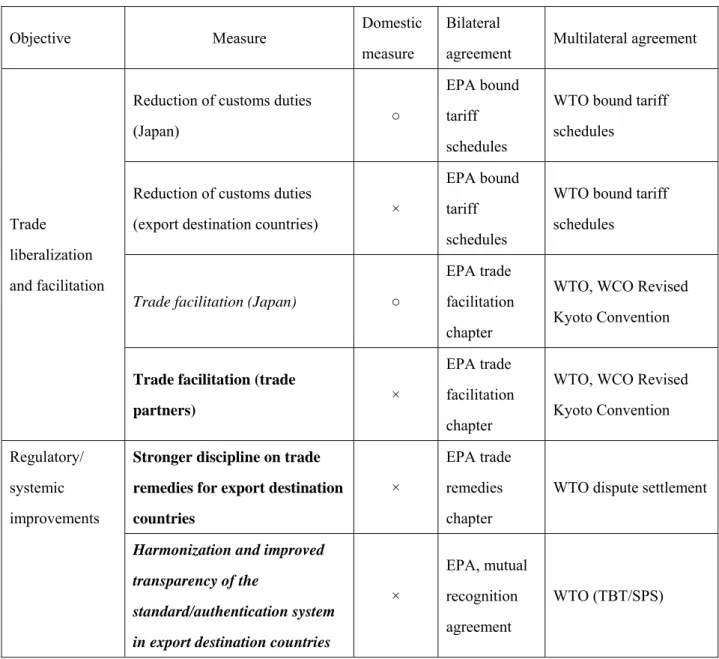
Table 5-2 summarizes the measures to maintain and enhance the locational competitiveness of domestic Japanese companies and the means to implement them as discussed above in this section.
Table 5-2: Measures to maintain and enhance the locational competitiveness of domestic Japanese companies and the means to implement them
Objective Measure Domestic
measure
Bilateral
agreement Multilateral agreement
Reduction of customs duties
(Japan) ○
EPA bound tariff schedules
WTO bound tariff schedules
Reduction of customs duties
(export destination countries) ×
EPA bound tariff schedules
WTO bound tariff schedules
Trade facilitation (Japan) ○
EPA trade facilitation chapter
WTO, WCO Revised Kyoto Convention Trade
liberalization and facilitation
Trade facilitation (trade partners)
×
EPA trade facilitation chapter
WTO, WCO Revised Kyoto Convention
Stronger discipline on trade remedies for export destination countries
×
EPA trade remedies chapter
WTO dispute settlement Regulatory/
systemic improvements
Harmonization and improved transparency of the
standard/authentication system in export destination countries
×
EPA, mutual recognition agreement
WTO (TBT/SPS)
International standardization of
Japanese technologies *1 × ISO, etc.
Increased protection of intellectual property rights in export destination countries
×
EPA intellectual property chapter
WTO (TRIPS)
More strict environmental standards and their enforcement in overseas markets
×
EPA environment chapter Regulatory/ ×
systemic
reforms More strict labor standards and their enforcement in overseas markets
× EPA labor
chapter ×
Increased protection of intellectual property rights in Japan
*2
EPA intellectual property chapter
WTO (TRIPS)
More strict antimonopoly regulations on public enterprises
*3
EPA competition chapter
×
Acceptance of foreign workers ○ EPA service
chapter ×
Amendment to employment/labor laws
○ × ×
Improvement of the domestic business environment
Reduction of corporate income
tax rate to international levels ○ × ×
*1 Strategic objectives on international standardization
*2 Outline of Intellectual Property Strategy
*3 Correction of the preferential treatment of the Japan Post Bank and Japan Post Insurance Co., Ltd.
(Source: Prepared by the author)
In Table 5-2 above, the items written in bold characters indicate those requiring regulatory/systemic reforms in the trade partners and the items written in italic characters indicate those requiring regulatory/systemic reforms in Japan. The item written in bold italic characters, i.e., international harmonization and increased transparency of the standards/authentication system of the export destination countries, requires regulatory/systemic reforms in both Japan and its export destination countries.
(3) Measures to promote investment in Japan by foreign companies
Facilitation of direct investment in Japan by foreign companies with excellent technical strength and know-how is an effective measure to maintain and expand the competitiveness of Japan, which will also contribute to higher employment. Since the launch of the Japan Investment Council chaired by the Prime Minister in July 1994, Japan has been developing and implementing a comprehensive national strategy for promoting investment in Japan by foreign companies. The
“Program for Promoting Japan as an Asian Business Center and Direct Investment into Japan”
compiled in December 2011 by the Conference on Promoting Japan as an Asian Industrial Center and Direct Investment into Japan, which was launched in November 2011 under the Noda administration, systematically indicates the priority measures to achieve this policy objective.50 In this sub-section, measures to promote investment in Japan by foreign companies are classified into three groups: (1) securing investment access to the Japanese market by foreign companies, (2) improvement of the business environment in the Japanese market for foreign companies, and (3) resolution of taxation and pension issues associated with investment in Japan by foreign companies.
The rest of this sub-section clarifies specific measures included in each group and means to implement them, as well as which among these measures can be implemented through regulatory/systemic reforms in Japan and in its trade partners.
(a) Securing investment access to the Japanese market by foreign companies
Measures to secure investment access to the Japanese market by foreign companies include (1) relaxation or elimination of investment restrictions in the Japanese market and (2) liberalization of the government procurement market.
Under the amendment to the Foreign Exchange and Foreign Trade Act (Act No. 228 of 1949) in 1980 and the subsequent amendment in 1998, relaxation or elimination of investment restrictions in
the Japanese market has been progressed considerably. The current Foreign Exchange and Foreign Trade Act provides that Japan shall determine whether to accept or reject direct investment in Japan that is likely to cause any of the following situations by the examination of applications submitted in advance: (a) national security is impaired, the maintenance of public order is disturbed, or the protection of public safety is hindered and (b) it results in significant adverse effects to the smooth management of the Japanese economy (Article 27)51. It is not necessary to submit an application in advance for other investments. With the exception of investments that are subject to certain restrictions or conditions under individual laws governing certain industries,52 investment access to the Japanese market by foreign companies is guaranteed as a general rule.
The Japanese government procurement market is open widely to foreign companies. Under the tables attached to the WTO Government Procurement Agreement (revised in December 201153), Japan opens up the procurement in an amount of 100,000 SDR (15 million yen) or more to the companies of the parties to the agreement with regard to the procurement of goods and services by all central government agencies. The procurement by many of prefectural governments, government-designated cities, and independent administrative institutions is also open to these companies subject to a certain minimum procurement amount. In addition, Japan opens up the government procurement market for companies of countries other than the parties to the WTO Government Procurement Agreement under individual EPAs concluded with these countries.
Furthermore, in the areas of procurement of various goods, supercomputers, computer products, non-R&D satellites, electric telecommunication equipment, medical equipment, construction services, etc., Japan has implemented a voluntary measure to open up the procurement market more than the extent required by its obligations under the WTO Government Procurement Agreement, in consideration also of the Japan-U.S. negotiations. Japan has also established a government procurement complaint review committee to respond to complaints made by foreign companies regarding government procurement.54
(b) Improvement of the business environment in the Japanese market for foreign companies
Many of the measures to improve the business environment in the Japanese market for foreign companies are the same as the measures to maintain and enhance the locational competitiveness of domestic Japanese companies discussed in (2). This is because these measures aim at improving the business environment for companies located in Japan, regardless of whether they are Japanese
companies or foreign companies, to compete against foreign companies in the domestic and overseas markets. Therefore, many of the measures listed in Table 5-2 are also effective for the improvement of the business environment in the Japanese market for foreign companies.
Additional measures include the use of special economic zones to provide exceptions to the provisions of otherwise applicable regulations or tax, budgetary, or financial support to foreign companies with excellent technical strength or know-how. The aforementioned “Program for Promoting Japan as an Asian Business Center and Direct Investment into Japan” announced in December 2011 includes the effective use of special economic zones as one of the measures to promote investment in Japan by foreign companies.55
(c) Resolution of taxation and pension issues associated with investment in Japan by foreign companies
As in the case of a Japanese company operating in a foreign country, expansion into the Japanese market by foreign companies entails such issues as (1) international double taxation on income from an operation in Japan or international tax evasion using tax havens or transfer prices in intra-group transactions and (2) situations where foreign employees who are assigned to a post in Japan for a long term may be forced to participate in pension plans in both Japan and the foreign country at the same time or may not be qualified to receive pension benefits when they retire due to the lack of the number of years of participation to either the Japanese pension plan or the pension plan of the foreign country or both. The measures to address these issues are the same as those listed in subsection (1)(c) above.
Table 5-3 summarizes the measures to facilitate investment in Japan by foreign companies and the means to implement them as discussed above in this section.
Table 5-3 Measures to facilitate investment in Japan by foreign companies and means to implement them
Objective Measure Domesti c measure
Bilateral agreement Multilateral agreement
Relaxation/elimination of investment restrictions
○ BIT, EPA investment
chapter WTO (GATS)
Securing investment
access Liberalization of the government procurement market
○ EPA government
procurement chapter WTO (GPA) Attracting foreign companies using
special economic zones
○*1 × ×
Prohibition of performance requirements
○ BIT, EPA investment
chapter WTO (TRIMs)
Reduction of customs duties (Japan) ○ EPA bound tariff schedules
WTO bound tariff schedules Reduction of customs duties (trade
partners)
× EPA bound tariff schedules
WTO bound tariff schedules
Trade facilitation (Japan) ○ EPA trade facilitation chapter
WTO, WCO Revised Kyoto Convention
Trade facilitation (trade partners) × EPA trade facilitation chapter
WTO, WCO Revised Kyoto Convention Facilitation of the acquisition or
renewal of a working visa by employees
○
EPA investment chapter, trade in services chapter
×
Acceptance of foreign workers ○ EPA service chapter × Improvement of
investment environment
Amendment to employment/labor laws
○ × ×
International harmonization and increased transparency of the standards/authentication system of Japan
○ EPA, mutual
recognition agreement
WTO (TBT/SPS)
Restriction on government
intervention in technology transfer agreements
○ EPA intellectual
property chapter WTO (TRIPS)
Increased protection of intellectual property rights (Japan)
○ EPA intellectual
property chapter WTO (TRIPS) More strict antimonopoly regulations
on public enterprises
○ EPA competition
chapter ICN
Appropriate settlement procedure for investment disputes
○ BIT, EPA investment
chapter ×
Reduction of corporate income tax rate to international levels
○ × ×
Improvement of the business environment
○*2
EPA business environment
improvement chapter
×
Prevention of international double taxation on income from a foreign operation and measures against international tax evasion
○ Tax treaty ×
Taxation / pension
Resolution of the issues of double participation in pension plans and insufficient years of participation
○ Social security
agreement ×
*1 The use of special economic zones included in the “Program for Promoting Japan as an Asian Business Center and Direct Investment into Japan” (comprehensive special zones for international strategy, comprehensive special zones for regional revitalization, and special zones for reconstruction).
*2 Invest Japan Business Support Center, JETRO.56 (Source: Prepared by the author)
In Table 5-3 above, the items written in italic characters indicate those requiring regulatory/systemic reforms in Japan and the items written in bold characters indicate those requiring regulatory/systemic reforms in the trade partners. The item written in bold italic characters, i.e., international harmonization and increased transparency of the standards/authentication system of Japan, requires regulatory/systemic reforms in both Japan and its trading partners.
(4) Regulatory/systemic reforms aimed at trade and investment liberalization and expansion:
Summary
This section has classified the measures for trade liberalization and domestic investment expansion into three categories: (1) measures to support the expansion of Japanese companies into overseas markets, (2) measures to maintain and enhance the locational competitiveness of domestic Japanese companies and (3) measures to promote investment in Japan by foreign companies, and has discussed the content of the necessary regulatory/systemic reforms for each category. What has been clarified by this discussion is that the regulatory/systemic reforms to achieve these three groups of policy objectives have much in common and significant overlap ((1) ≈ (2) ≈ (3)).
However, this is, in a sense, natural. In the current times in which companies choose countries, the environment in which Japanese companies can comfortably operate their business (in Japan and overseas) coincides with the environment in which foreign companies can comfortably operate their business (in Japan). Therefore, this leads to the conclusion that it is desirable to improve the business environment both in and outside Japan equally through regulatory/systemic reforms. This is the reason why it is necessary to develop a multi-tiered strategy to simultaneously promote regulatory/systemic reforms in Japan and those in the investee countries and trade partners of Japan.
Lastly, regulatory/systemic reforms necessary for trade and investment liberalization and expansion by Japan are summarized below to recapitulate the analysis in this section.
Regulatory/systemic reforms are a broad concept and include regulatory/systemic reforms with different characteristics. They are classified into the following five groups based on their content and characteristics: (1) relaxation/elimination of regulations, (2) more strict regulations and their enforcement, (3) regulatory harmonization, (4) regulatory jurisdiction coordination, and (5)
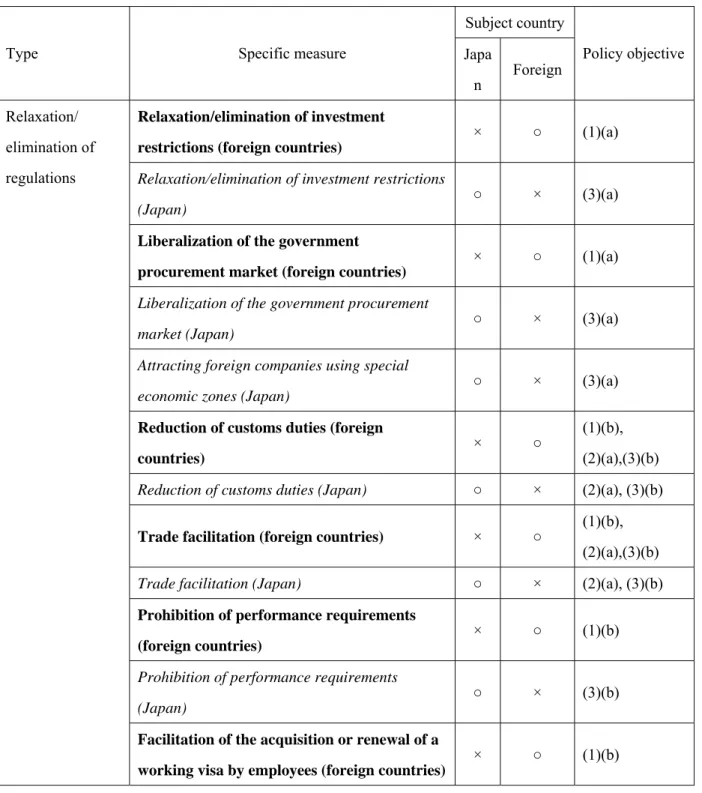
increased transparency of regulations. Based on this classification, Table 5-4 summarizes regulatory/systemic reforms necessary for trade and investment liberalization and expansion by Japan.
Table 5-4 Regulatory/systemic reforms aimed at trade and investment liberalization and expansion
Subject country
Type Specific measure Japa
n Foreign Policy objective Relaxation/elimination of investment
restrictions (foreign countries) × ○ (1)(a)
Relaxation/elimination of investment restrictions
(Japan) ○ × (3)(a)
Liberalization of the government procurement market (foreign countries)
× ○ (1)(a)
Liberalization of the government procurement
market (Japan) ○ × (3)(a)
Attracting foreign companies using special
economic zones (Japan) ○ × (3)(a)
Reduction of customs duties (foreign
countries) × ○ (1)(b),
(2)(a),(3)(b)
Reduction of customs duties (Japan) ○ × (2)(a), (3)(b)
Trade facilitation (foreign countries) × ○ (1)(b), (2)(a),(3)(b)
Trade facilitation (Japan) ○ × (2)(a), (3)(b)
Prohibition of performance requirements
(foreign countries) × ○ (1)(b)
Prohibition of performance requirements
(Japan) ○ × (3)(b)
Relaxation/
elimination of regulations
Facilitation of the acquisition or renewal of a working visa by employees (foreign countries)
× ○ (1)(b)