During gait, increasing heel height caused them to raise their center of mass (COM) of the body and range more. Effects of heel height and high heel shoe wearing experience on plantar pressure and human limits of stability.
INTRODUCTION
- Research Background
- Literature Review
- Kinetics Effects
- Kinematics Effects
- Posture and Balance Effects
- Other Effects of High Heeled Shoes
- Research Rationale
- Research Objectives
- Thesis Organization
Only limited studies have been done to examine the effects of habituation using high-heeled shoes. There are numerous studies that have been conducted to investigate the effects of high-heeled shoes on the biomechanics, gait and posture of users.

HEEL HEIGHT, HEEL CONTACT AREA AND SHOE WEARING EXPERIENCE
Objective
Method
- Participants
- Instruments
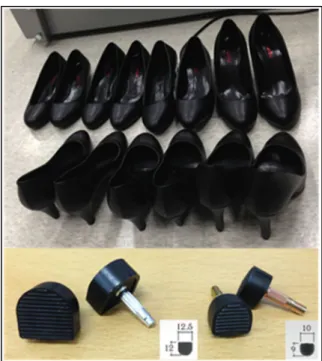
- Experimental shoes
- Pro Balance Master system
- Electromyography (EMG) system
- Plantar pressure measure system
- Experimental Design and Procedures
- Muscle activities recording preparation
- Plantar pressure measurement preparation
- Postural control and balance test
- Functional mobility test
- Data Processing and Analysis
- Postural control
- Functional mobility
- Muscle activities
- Plantar pressure
- Statistical Analysis
Electrodes were placed over the muscle belly at a level equal to one-third of the distance from the fibular head to the lateral malleolus (Nardone, Romano, and Schieppati 1989). Participants were asked to sit in a chair with their back against the back of the chair.
Results
- Postural Control and Balance
- Functional Mobility
- Muscle Effort
- Plantar Pressure
- Force distribution
- Peak pressure
- Center of pressure (COP) location
- Overall Experimental Results
- Correlation Analysis
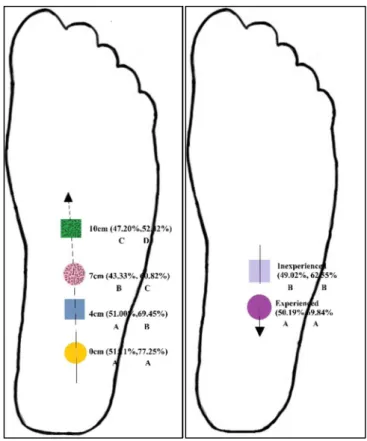
Shoe heel height and experience wearing high heels had significant effects on the force distributed under the toe, forefoot, midfoot and heel of wearers. An increased heel height shifted force distribution from the heel and midfoot regions to the forefoot and toe regions.
Discussion
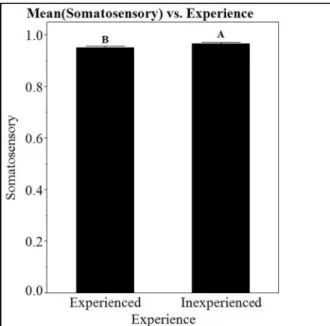
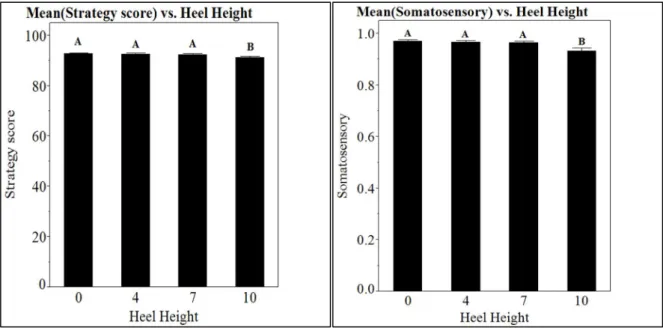
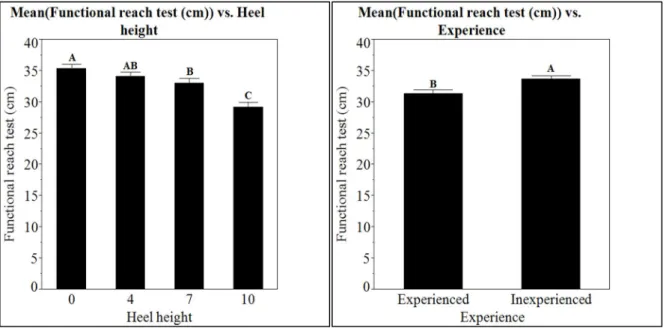
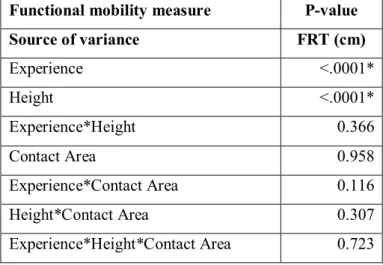
Wearing high-heeled shoes impaired a person's static balance in terms of postural control and balance and functional mobility. The present findings appear to be consistent with other research that found that high heel wearers experienced discomfort with heel heights ranging from 6 to 9 cm (Lee et al. 2001).
Conclusion
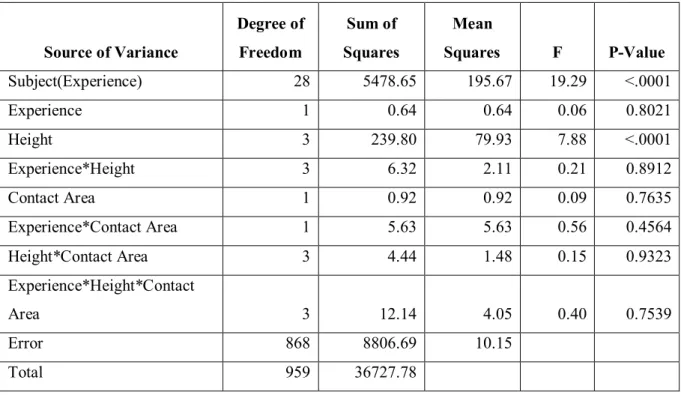
Another limitation of this study is the unbalanced sample sizes between the experienced group (N1=10) and the inexperienced group (N2=20) caused by the difficulty of finding experienced high heel wearers within the campus, which affects the statistical power of this study, especially while assessing the effect of shoe wearing experience.
HEEL HEIGHT, HEEL CONTACT AREA AND SHOE WEARING EXPERIENCE
Objective
Method
- Participants
- Instruments
- Experimental shoes
- Pro Balance Master system
- Electromyography (EMG) system
- Plantar pressure measure system
- Walking path
- Motion analysis system
- Experimental Design and Procedures
- Plantar pressure measurement preparation
- Kinematic data recording preparation
- Static and dynamic motion capture
- Limits of Stability test (LOS)
- Functional mobility test
- Muscle activities recording preparation
- Walking test
- Data Processing and Analysis
- Stability limits
- Functional mobility
- Gait kinematics
- Muscle activities
- Muscle fatigue
- Plantar pressure
- Statistical Analysis
Before the start of the tests, participants were given a detailed explanation of the study, signed an informed consent and completed a short questionnaire about history of wearing high-heeled shoes. A 5 second static trial was conducted to allow the cameras to capture each of the reflective markers and was used as a reference for further analysis process. For the TUG test, participants were asked to sit with their hips all the way back from the chair in a chair with armrests.
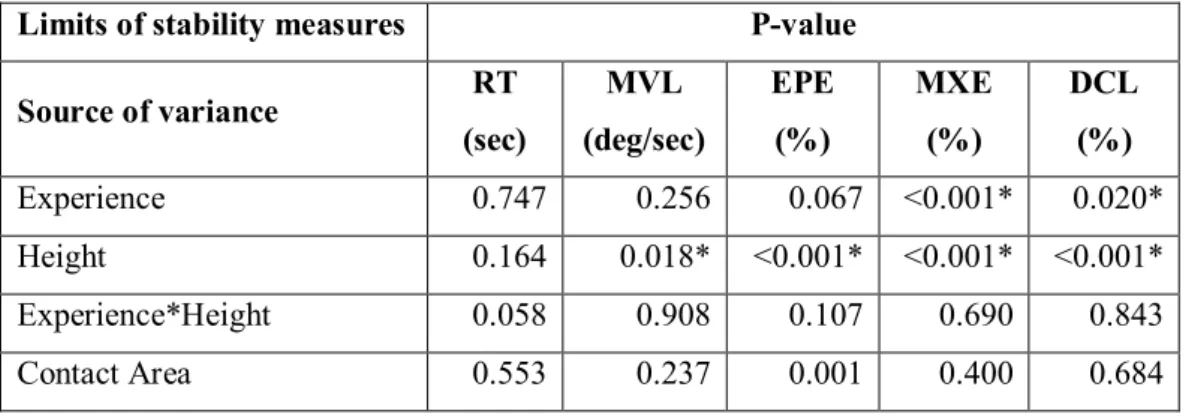
The experimenter started the timing on the word "GO" and stopped the timing when participants sat back on the chair with their back on the back of the chair (see Figure 32). Directional control (DCL) represents a comparison of the amount of movement in the intended direction toward the target and extraneous movement away from the target. Locations of the segmental centers of mass were determined from the positions of these markers and the calculated joint centers.
A shift of the MPF of the EMG signal to the lower part indicated muscle fatigue (De Luca 1997).
Results
- Limits of Stability
- Functional Mobility
- Gait Kinematics
- Mean of center of mass (COM) location and range of displacement
- Ankle dorsi/plantar
- Knee flexion
- Elbow flexion
- Hip flexion
- Muscle Activities
- Muscle effort
- Muscle fatigue
- Plantar Pressure
- Force distribution
- Peak pressure
- Center of pressure (COP) location
- Overall experimental results
When the heel height reached 7 cm, their movement and directional control decreased (see Figure 36). As the heel height increased, the time required to complete the TUG test was longer. Effect of heel height (left) and effect of experience (right) in the timed and go (TUG) test (Experiment 1).
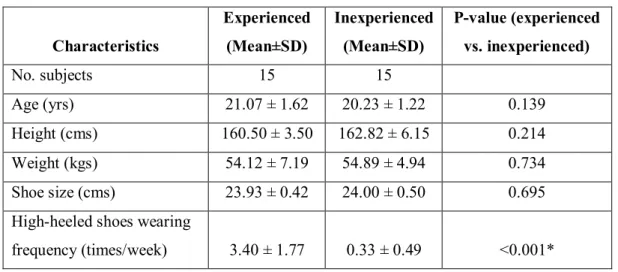
Heel height and shoe wearing experience had a significant effect on Timed Up and Go (TUG) completion time (see Table 20). Effect of heel height (left) and effect of experience (right) in the timed and go (TUG) test (Experiment 2). Heel height and experience wearing high-heeled shoes were found to significantly affect the range of left and right knee flexion (see Table 23).
As heel height increased, ROM was dramatically reduced for both the left and right knees (see Figure 45).
Discussion
With an increase in heel height, the current study showed that the location of the body's center of mass (COM) increased gradually. The results of the current study are consistent with those of Joseph (1968) Soames and Evans (1987) and Stefanyshyn et al. The extent of displacement of the COM was significantly greater when walking in high-heeled shoes, with the heel height of 10 cm. 2001) found that the range of COM displacement was significantly greater for increasing heel height, even starting when the heel height was only 4.5 cm.
When the height of the heel reached 10 cm, the ankle did not recover from the plantar flexion position even in the swing phase of walking, so the ankle could not fully compensate for the unnatural position of the foot, and therefore became more unstable. This result may confirm why wearing high-heeled shoes led to increased femininity of gait (Morris et al. 2013) with more hip sway. Protective arm positions during walking have been found in infants and children with cerebral palsy (Ledebt 2000; Meyns et al. 2012).
It seems possible that this result is due to its important role in stabilizing the patella, when the knee joint is in a less stable state (Balcarek et al. 2014).
Conclusion
In further investigation, we will consider subjective perception so that it can better explain this result. For example, this study was carried out in the laboratory and the dynamic tasks were carried out over two sessions of a 2 hour period. In reality, individuals may have to stand and walk on their shoes during most of their working day.
The participants also had to walk on a treadmill at a standardized speed, without an incline, for a short period of time. However, their COP was located more medially during walking, which could be indicative of an adaptive effort of wearing high-heeled shoes to minimize inverted posture and thus reduce the risk of lateral ankle sprain. Because their COP is located more medially, they exert more intense effort on the tibialis anterior muscle, which is responsible for inversion of the foot, in addition to the gastrocnemius medialis muscle to compensate.
With a smaller heel contact area, the participants fatigued their calf muscles faster than the larger heel contact area, suggesting that the muscle fatigue will contribute to the subjective feeling of discomfort or pain when the participants walked in these shoes.
SUBJECTIVE PERCEPTION ON HUMAN BALANCE
- Objective
- Method
- Participants
- Instruments
- Results
- Perceived Balance
- General Complaints of Wearing High Heeled Shoes
- Perceived Discomfort
- Overall Experimental Results
- Discussion
- Conclusion
Experience wearing high-heeled shoes and heel contact area had no significant effect on perceived balance score. As heel height increased, participants felt less comfortable walking in high-heeled shoes from 4 cm heel height. Several of the experienced participants reported ingrown toenails and cracked heels as a result of wearing high-heeled shoes.
However, more inexperienced participants reported blisters and corns when wearing high-heeled shoes (see Figure 68). Inexperienced wearers of high heel shoes reported more discomfort in the ankle, hip/thigh, toe, midfoot and heel compared to the experienced wearers. However, experienced wearers reported more discomfort on their knee, lower leg, neck and forefoot when wearing high-heeled shoes (see Figure 69 and Figure 70).
Experienced high heel wearers reported greater discomfort on their neck and trunk after walking for 10 minutes compared to inexperienced wearers (see Figure 74).

CONCLUSIONS
Overall discussions
Experienced wearers showed an adaptation effect, indicated by smaller loads and lower pressure under the forefoot region, longer COP path length demonstrating a more natural heel-to-toe movement, and shifting their COP back to the posterior and lateral side of the foot as if they stood lower on the shoes than they actually were. During walking, not only on the gastrocnemius medialis muscle, they also exerted more effort on the tibialis anterior muscle, possibly due to the higher maximal reversal range of motion compared to inexperienced wearers. They showed a more flexible adaptation of movement patterns at the knee, hip and elbow which may provide them with better stability when walking with high heels.
They also had more neck and trunk discomfort since they started using an upper body control strategy. It could not simply be concluded that higher-heeled shoes did not affect postural control, or that experience wearing high-heeled shoes provided benefits to the wearers. By understanding how they can achieve a certain level of balance performance, a better conclusion can be drawn about the use of high-heeled shoes in the short or long term.
It is also recommended for regular wearers of high-heeled shoes to alternate footwear on some days of the week and wear flat shoes to prevent shortening of the calf muscle bundle and stiffening of the Achilles tendon (Csapo et al. 2010).
Summary of main findings
A further study could assess the long-term effects of wearing high-heeled shoes found in this study in real work environments with a longer experimental duration, for example changes in walking pattern and fatigue at the end of the work day. Lower extremity muscle activity during walking: Electromyographic measurements of walking in high-heeled shoes compared to walking in trainers. Comparison of kinematic and kinetic methods for calculating the vertical movement of the body's center of mass during walking.
-high-heeled shoes and knee joint torque associated with the development and progression of knee osteoarthritis. Changes in ankle range of motion and muscle strength in habitual wearers of high heels. Changes in COP and foot pressure after one hour of walking in high-heeled and flat shoes.
The relationship between step parameters, joint angles, and body part trajectories during high-heeled walking in women. Foot posture and arch classification among adolescents wearing and not wearing high heels. Influence of high-heeled footwear on kinematics, kinetics and muscle EMG of normal female walking.