가시광선과 유기광촉매를 이용한 VMV(para-methoxybenzyl ether) 그룹의 탈보호 반응 개발. 이 담론은 리학지가 『유교』라는 제목으로 간행하였다. 안덕장의 원리와 원리 연구에 대한 이론을 평가한다.
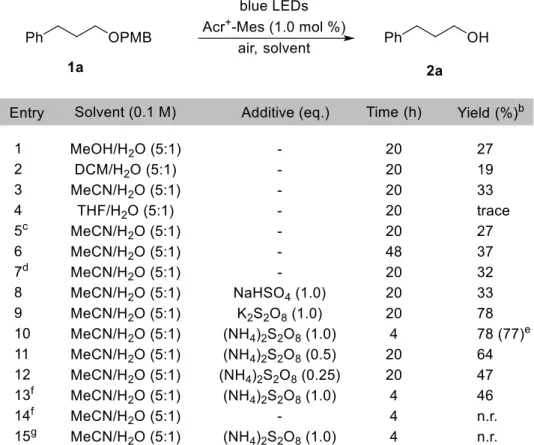
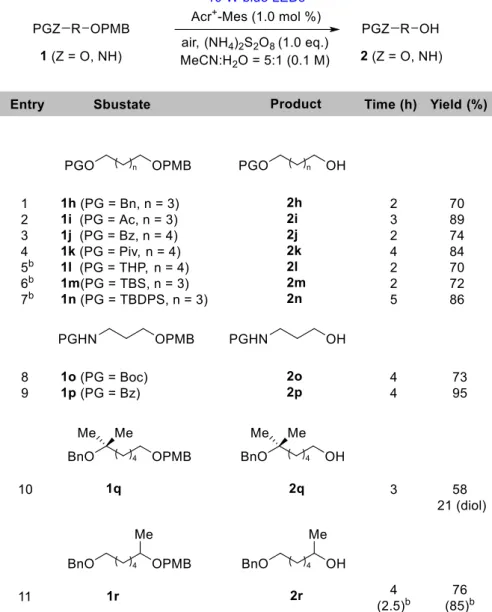
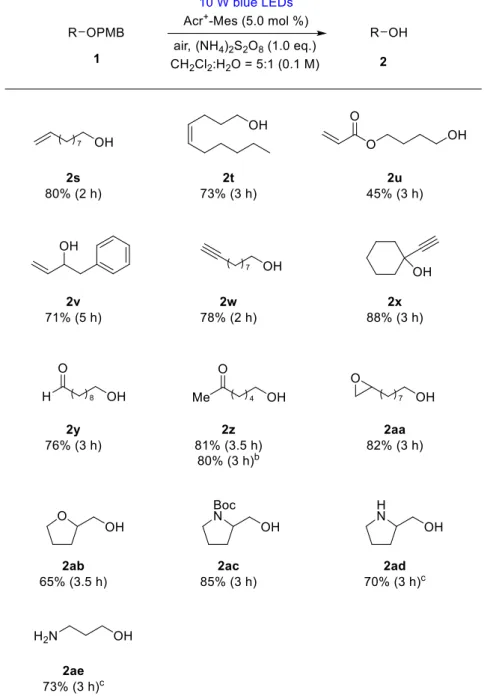
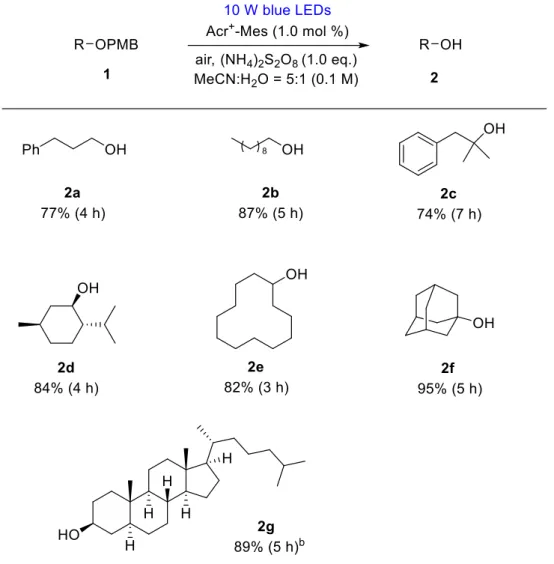
In the developed method, different functional groups and protecting groups were tolerated to achieve good to excellent yields in short reaction times. Significantly, the method developed was compatible with PMB ethers derived from primary, secondary and tertiary alcohols and a gram-scale reaction. Mechanistic studies support a proposed reaction mechanism involving single electron oxidation of the PMB ether.
유기 가시광선 광촉매와 공기 및 과황산암모늄[(NH4)2S2O8]을 최종 산화제로 사용하여 p-메톡시벤질 에테르를 효율적이고 환경 친화적으로 탈보호하는 방법입니다. 응답시간 내에 우수한 성능을 발휘하도록 개발되었습니다. 메커니즘 연구는 파라메톡시 벤질 에테르가 단일 전자에 의해 산화되는 메커니즘을 입증했습니다.
서 론
결과 및 토의
최적화된 조건을 설정하여 가시광선 광촉매를 이용한 PMB 에테르의 탈보호 범위와 일반성(1a-g)을 다음과 같이 조사하였다(표 2). 우리가 개발한 방법은 기존 광촉매를 이용한 PMB 에테르의 탈보호 반응에 비해 반응 시간이 더 짧은 것으로 나타났다. 이어서, 다른 보호 그룹이 있는 경우 알코올 및 아민에 대한 탈보호 가능성을 조사했습니다.
그러나 PMB 에테르 보호는 중화 조건에서는 덜 효과적이었습니다. 마지막으로 우리는 산성 보호기에 대해 허용 가능한 반응 조건을 찾았습니다. 다양한 유형의 PMB 에테르가 있는 경우 선택적으로 보호가 해제되었습니다.
개발된 반응은 다양한 작용기 및 보호기에 대한 탁월한 내성을 나타냅니다. 이 결과는 VMV 에테르 1a와 여기된 광촉매 사이에 SET가 발생했음을 보여줍니다.
결 론
실 험
TLC 모니터링을 통해 반응이 완료된 후, 포화 NaHCO 3 수용액(20 mL)을 혼합물에 첨가하였다. 혼합물을 에틸아세테이트로 3회 추출한 후 황산마그네슘으로 용액 중의 수분을 제거하고 필터를 통해 여과한다. 그런 다음 회전 증발기를 통해 순수한 용액에서 용매를 제거하고 해당 알코올 2를 컬럼 크로마토그래피(용리제: 에틸 아세테이트/헥산 또는 DCM/메탄올)를 통해 분리/정제합니다.
TLC 모니터링을 통해 반응이 완료된 후 혼합물은 포화됩니다. 혼합물을 에틸 아세테이트를 사용하여 3회 추출하였다. 그런 다음 황산마그네슘을 사용하여 용액의 물을 제거하고 필터를 통해 여과합니다.
참고문헌
Carbamoyl radicals via photoredox decarboxylation of oxamic acids in aqueous media: access to 3,4-dihydroquinolin-2(1H)-ones. Visible light photoredox-catalyzed hydroalkoxymethylation of activated alkenes using α-silyl ethers as alkoxymethyl radical equivalents. Electron transfer state of 9-Mesityl-10-methylacridinium ion with a much longer lifetime and higher energy than that of the natural photosynthetic reaction center.
Simultaneous production of p-tolualdehyde and hydrogen peroxide in photocatalytic oxygenation of p-xylene and reduction of oxygen with 9-mesityl-10-. Visible light sensitizer-catalyzed highly selective photooxidation of thioethers into sulfoxides under aerobic conditions. Direct α-Arylation of Ethers by Combining Photoredox-Mediated CH Functionalization and the Minisci Reaction.
Highly active and selective manganese C=O bond hydrogenation catalysts: the importance of the multidentate ligand, the ancillary ligands and the oxidation state. Traceless Regulating Group Strategy in the Ru-catalyzed, Formal [3+3] Annulation of Anilines with Allyl Alcohols: A One-Pot, Domino Approach to Quinoline Synthesis. Chemoselective continuous flow hydrogenation of aldehydes catalyzed by platinum nanoparticles dispersed in an amphiphilic resin.
Aerobic oxidative deprotection of benzyl-type ethers under atmospheric pressure catalyzed by 2,3-dichloro-5,6-dicyano-1,4-benzoquinone (DDQ)/tert-butyl nitrite. Synthesis of pyrazines and quinoxalines via acceptorless dehydrogenative coupling routes catalyzed by manganese tang complexes. Efficient generation of highly functionalized fused oxazepine frameworks based on a KAN-catalyzed four-component tetrahydropyridine synthesis/ring-closing metathesis sequence.
A mild method for the generation of p-methoxybenzyl cation through NIS-mediated activation of p-methoxybenzyl 4-pentenyl ether. An efficient activation of the hydroxyl function by (diethylamino)sulfur trifluoride (DAST): Chiral preparation.
Acknowledgement