Here, we demonstrate a reliable Na metal anode for the seawater battery by covering the Cu current collector with graphene monolayer. Further deliberate modification of the graphene surface using O2 plasma and thermal treatments supports the importance of homogeneity of the interface to the pantograph. Problematically, heterogeneous Cu surfaces covering with islands of oxide layer significantly changed the surface morphology of coated Na metal and consequently resulted in the drop in the electrochemical performance due to the inhibiting effect on Na ion diffusion near the current collector surface.
Successful implantation of the graphene-coated Cu current collector as anode in a seawater battery dramatically improved the battery performance, which was confirmed by monitoring the discharge/charge performance and durability of LED lighting. Schematic of the cell design and tree-like Na dendrite growth on the plated Na metal. The data indicate the presence of oxide layer in thermally annealed Cu current collector (d) Galvanostatic plating strip profiles of graphene Cu (red line), 6 sec O plasma treated graphene Cu (blue line) and pristine Cu (black line) current collectors after thermal treatment at 185 ˚C for 15 minutes. e) Schematic figure of Na nucleation and growth on partially surface-oxidized Cu and graphene-coated partially surface-oxidized Cu current collector surface. f) Formation energy of Na crystal according to the number of Na crystal layers on four different surfaces, such as bare Cu (Cu), surface-oxidized Cu (Cu_O), graphene-coated Cu (Cu@G) and graphene-coated surface-oxidized Cu (Cu_O@G). e–h) Histograms of the ID/IG intensity ratio in Raman images of (a–d).
Series photos of 49 LED lamps on the Arduino breadboard show that the light intensity and sustained time of graphene-covered Cu current collector are brighter and longer than the pristine Cu current collector.
Single layer graphene passivation on Cu current collector to control nucleation of Na dendrite
Introduction of metal-based rechargeable batteries
However, due to the risk of dendrite growth and frequent defects, there were problems with the commercialization and recall of the batteries. Sony has made many advances in the commercialization of lithium-ion cells by replacing such lithium metal with carbonate-based cathodes, and this is still ongoing. In recent years, studies on lithium metal anode have been actively researched to meet the rapidly growing large capacity, and attention has been paid to the core research field.
However, the Li-metal-based batteries for an energy storage system are losing interest due to cost-ineffective and time-consuming extraction process from nature, as shown in Figure 1.3, and this trend is exacerbated by the tremendous need for Li-ion secondary batteries in electric vehicles and potential ESS Figure 1.1 The schematic of Li-ion battery: Cathode, anode, electrolyte and separator.
The property of Na metal as anode materials and research trend
However, there is a significant problem with Na dendrite formation, as such uncontrollable surface growth often leads to premature cell failure, low Coulomb efficiency, and potential safety concerns.22-26 To effectively prevent side effects in the Na metal Several approaches have been developed to simulate the passivation of Li metal, such as tuning the current density of the current collector to extend the Sand time, increasing the surface tension for mechanical suppression, and adjusting the electrolyte concentration for supersaturated cations in the medium.26-31.
Dendrite growth problems and other’s research approach
In addition, the decomposition of the sodium anode penetrates the separator, causing a short circuit and loss of electrolyte and a rapid decrease in efficiency. To solve Na-dendrite growth on the anode surface, there are several recent innovative studies to passivate Na metal and extend the lifetime of Na metal-based batteries, using e.g. Thus, we assume that it is necessary to carefully observe the formation of the Na dendrite on the current.
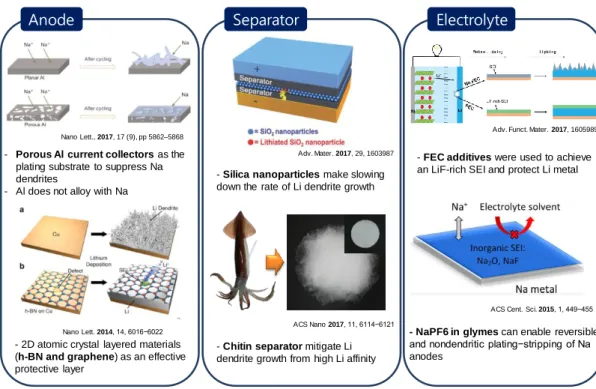
Graphene passivation for mitigating dendrite growth
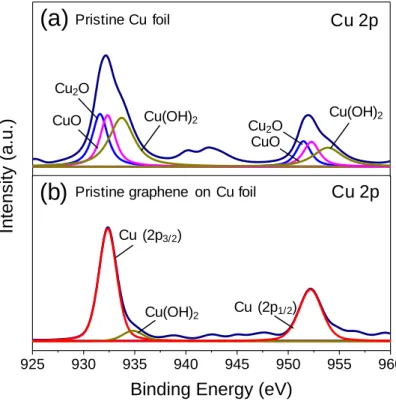
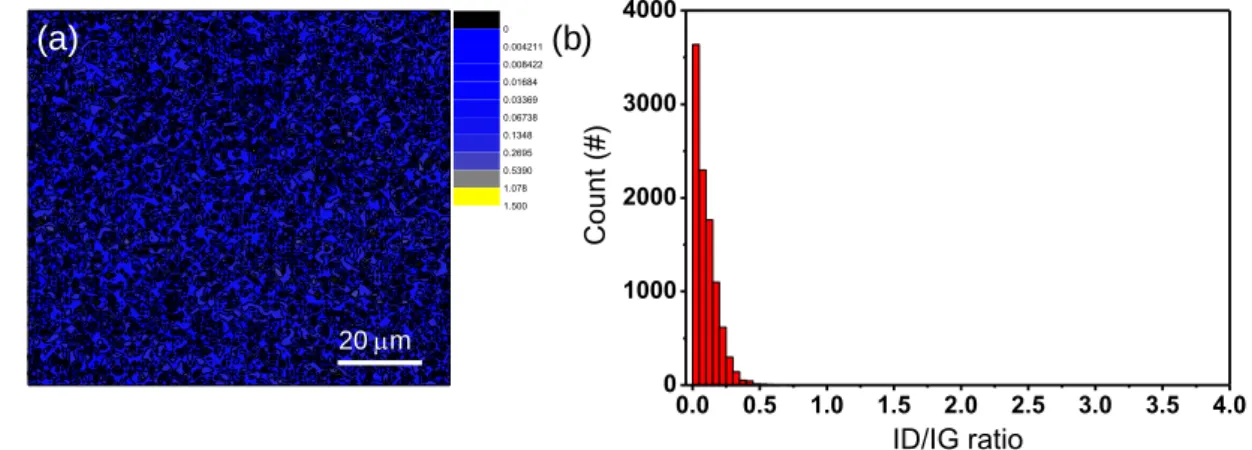
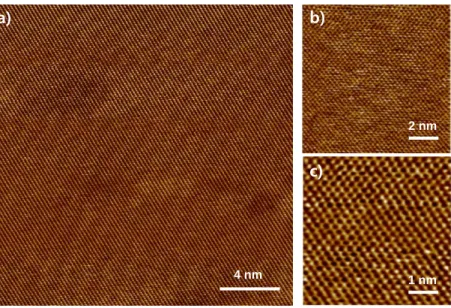
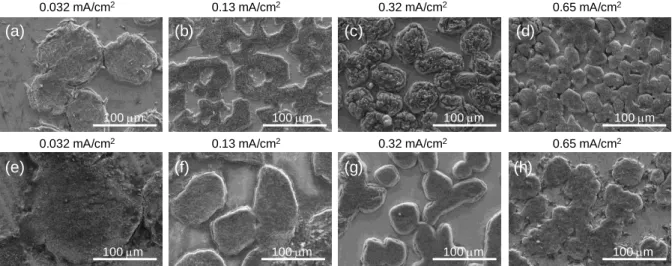
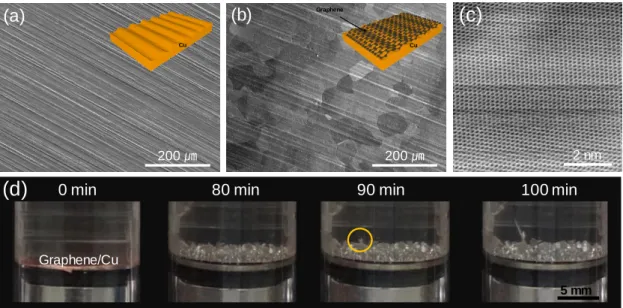
For example, a plane view scanning electron microscopy (SEM) image of the pristine Cu current collector in Figure 1.6a shows a corrugated surface with heterogeneous interface, which can sufficiently lower the energy barrier (ΔG*=16π γ3 Vm2 /3 F2| η|2) for facile formation of Na-core species. To passivate the chemically heterogeneous Cu current collector surface, a single-layer graphene was applied to cover the Cu foil by conventional CVD process, as shown in Figure 1.6b. The graphene covered interface was further confirmed by spatial Raman spectroscopy in Figure 1.7, XPS investigations in Figure 1.8 and scanning.
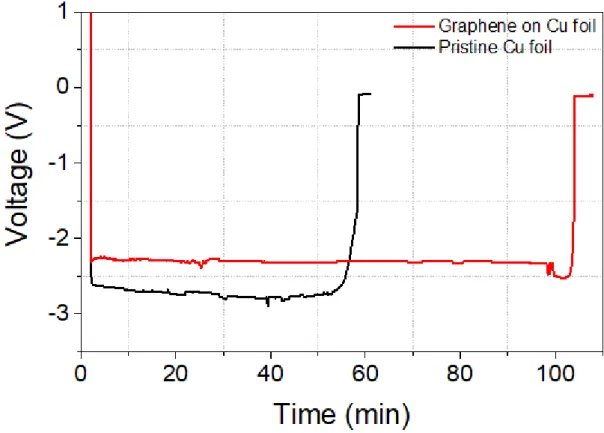
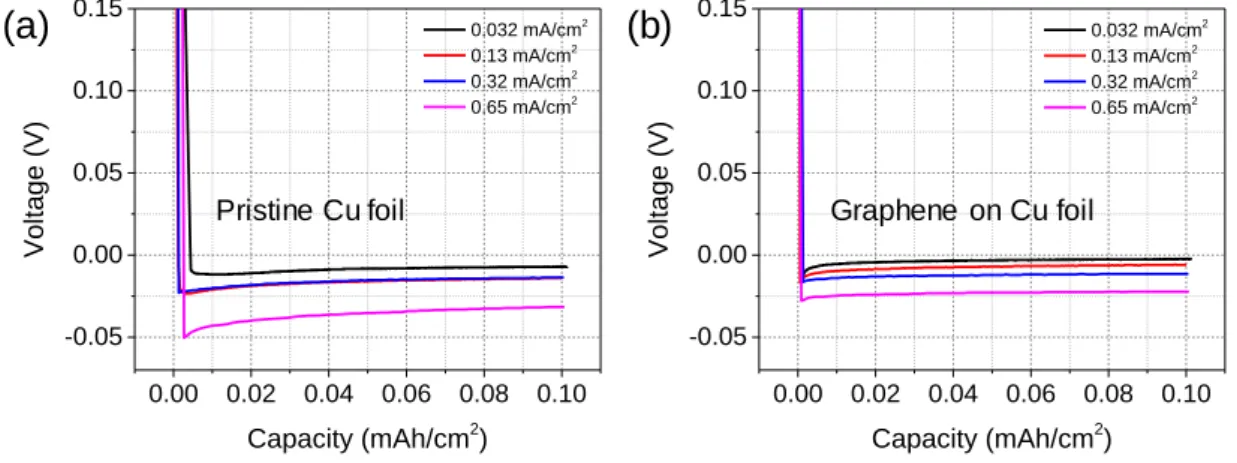
As shown in Figure 1.6d, the atomically uniform graphene surface on Cu foil successfully delays the onset time of Na dendrite formation on the graphene-coated current collector, implying that the simple passivation of the current collector by graphene can delay the formation of Na. dendrite (Figure 1.10 for voltage responses of pristine Cu and graphene covered Cu foil cells). Nucleation rates are reduced by 40-60% on the graphene-coated Cu current collector (Figure 1.13). The effect of the graphene layer on Cu foil was further investigated by galvanostatic plating and stripping measurements, as shown in Figure 1.17a and b.
In potential profiles, the graphene-coated current collector has a lower nucleation overvoltage of 40 mV, with more stable coating/removal cycles than the pristine copper foil with a fixed current of 0.032 to 0.65 mA/cm2 at 1000 s (data at 0.65 mA). . /cm2 for 1000 s is shown in Figure 1.18). The small plateau overvoltage of 18 mV in the graphene-coated current collector in Fig. 1.17b also reveals that the homogeneous graphene surface plays a key role in reducing not only the nucleation overvoltage at the beginning of the deposition process, but also the cell potential during coating and Na removal. Furthermore, the Coulombic efficiency of the graphene-coated Cu current collector is maintained even after 200 deposition/removal cycles (150 h), while the pristine Cu current collector suddenly degrades in efficiency after a few cycles (Figure 1.17c).
In Figure 1.17d, semicircles at the 5th, 10th, and 15th cycle of the Cole-Cole plot show that the diameter of the semicircles for graphene-. To confirm the significant role of homogeneous current collector surface, artificial defects were created on the graphene layer by O2 plasma treatment, and the test results are shown in Figure 1.19a. As the O2 plasma exposure time increased from 1 to 9 s, increasing D band (1345 cm-1) and decreasing 2D band (2680 cm-1) were observed in Raman spectra, reflecting the formation of graphene defects on the surface (Figure 1.20) ).
These results imply that the Cu current collector surface was further disturbed by oxidation during high-temperature annealing (Figure 1.19c).48 In contrast, the graphene-coated Cu surface was not significantly altered by thermal annealing, as shown in Figure 1.19c (bottom). The graphene-coated Cu sample showed negligible changes in color (Figure 1.21) and XPS profile after thermal annealing treatment. The result in Figure 1.19d shows that the highly oxidized Cu surface exhibits higher nucleation and plating potential than the graphene-coated Cu with or without 6 s O2 plasma treatment.
Our results (Figure 1.22) show that the adsorption tendency of Na+ ions is in the following order: partially surface-oxidized Cu > graphene-coated, partially surface-oxidized Cu.
Rechargeable Seawater battery using graphene coated Cu current collector
- The characteristics of seawater battery
- Improvement of Seawater battery by applying graphene passivation
- Experimental Section
- Graphene synthesis and measurement
- Materials and cell fabrication
- Characterizations
- Morphology characterization
- Computer simulation
- Conclusions
Considering that the Na metal anode in a seawater battery is plated from a seawater cathode during the charging process (2 NaCl(aq) 2 Na(s) + Cl2(g), E = 4.07 V),50-51 the versatility of graphene-coated current collector can be demonstrated by application in the seawater battery cell. As shown in the schematic of the seawater battery architecture in Figure 2.1a, the NASICON ceramic separator between seawater cathode and an aprotic electrolyte-containing anode allows Na metal to be used in the seawater without additional passivation. Using a carbon cathode current collector in seawater, Na metal can be plated on a graphene-coated current collector of Na ions in seawater.
In addition, we confirmed the Coulombic efficiency of the symmetric cell with a NASCON spacer, resulting in the current graphene-coated collector showing more stable wear and tear characteristics (Figure 2.2). Before measuring the seawater battery cycle, we first put 2.0 mAh/cm2 with 0.075 mA/cm2 Na metal in the current collector from the anode side from seawater and performed discharge/charge with the fixed current of 0.075 mA/cm2 for 5 hours. .52 Figure 2.1d shows the galvanostatic charge/discharge degradation profiles of graphene-coated and clean Cu current collectors. A more stable voltage plateau with a cycle profile about twice as long is achieved for the graphene-coated current collector.
Due to the improved seawater battery performance by controlling the current collector surface, discernible differences in the light intensity and sustained lighting time were achieved for 49 LEDs connected in an Arduino breadboard, as shown in Figure 2.1e. The luminance of LED light for the graphene-coated Cu current collector was detectable for over 5 h, while the pristine Cu current collector exhibited a shorter lifetime (about 2.5 h), as shown in the insets of Figure 2.1e. The 2032 cell and the anode side of the seawater battery were separated in the Ar-filled glove box to observe the surface morphology.
In conclusion, we report that the surface-controlled current collector with a coated graphene layer is an effective way to mitigate Na metal dendrite growth for highly reliable seawater batteries. The homogeneous surface of the Cu current collector coated with graphene not only reduces the number of nuclei formed on it, but also increases the electrochemical performance. In particular, predictions of the initial phase of Na deposition from theoretical calculation support that a homogeneous current collector surface created by graphene coating on the Cu surface is a key factor for reducing the nucleation number and growth rate of Na in symmetric cells .
Promisingly, we have successfully implemented our graphene current collector in a seawater battery using a NASICON ceramic separator. The reliable performance with longer cell life clearly demonstrated that deactivating the surface current collector in the Na-metal-based battery is a robust yet viable strategy for seawater batteries. Lee, W.; Yao, H.; Yan, K.; Zheng, G.; Liang, Z.; Chiang, Y.-M.; Cui, Y., Synergistic effect of lithium polysulfide and lithium nitrate to prevent lithium dendrite growth.
M.; Park, J.-S.; He, J.; Kim, J.; Kim, Y., Greatly improved voltage efficiency of seawater battery using chloride ion trapping electrode.