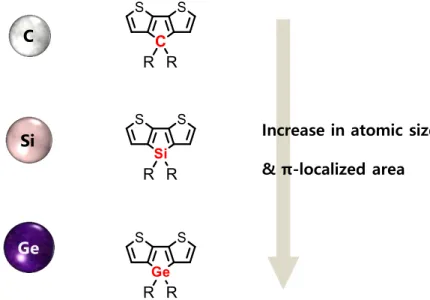
Within the organic solar cell community, an analogue of DTSi has been demonstrated, namely dithienogermol (DTGe), in which the Si atom is replaced by a germanium (Ge) atom. Bright-field transmission electron microscopy images comparing thermally annealed BHJ DTGe(FBTTh2)2:PC71BM (a,b,e,f) and DTGe(FBTBFu)2:PC71BM.(c,d,g,h) at 130 oC (a-c) and using 0.4% addition of DIO solvent (e-h) at different magnifications. Stability of DTGe(FBTTh2)2 solar cell devices with different architectures after encapsulation (epoxy/glass cover) and continuous exposure to simulated AM1.5G solar irradiation (1000 W/m2).
J-V transmission electron microscope images of 7:3 DTGe(ThFBTTh2)2:PC71BM (a-c) and 5:5 DTGe(FBTTh3)2:PC71BM (d-f) bulk heterojunctions. Solar cell characteristics of DTGe(ThFBTTh2)2 and DTGe(FBTTh3)2 devices treated with CH2Cl2 vapor.
Synthesis of TMS-DTGe-TMS
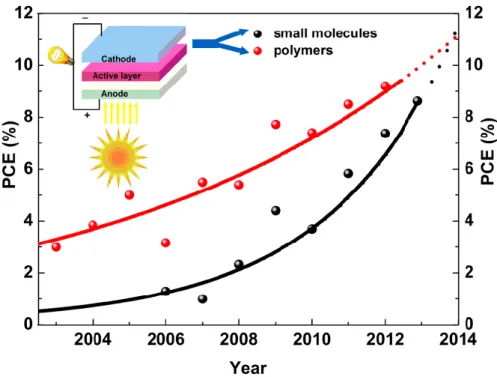
Organic photovoltaic materials are particularly important due to their low-cost, solution-oriented processing, light weight, flexibility, and broad chemical functionalities compared to inorganic materials, even though relatively low efficiencies still remain obstacles. To improve the performance of organic solar cells, several attempts are being made to provide information about the donor and acceptor materials. The substantial researches started from the discovery of the perylene-iodine complex in 1954, which has highly conductive properties.
After that, the highly electrically conductive material iodine-doped polyacetylene discovered by Shirakawa, Heeger, and MacDiarmid helped launch the field of organic conducting polymers. Some devices can convert visible light into electricity, so-called Organic Photovoltaics (OPV), using photoactive layers composed of donor and acceptor organic semiconductor materials.

Comparison between Polymeric and Nonpolymeric-containing OSCs
Most studies in this field have focused on developing new molecular structures and engineering new device architectures to optimize light absorption and extract this absorbed energy as efficiently as possible. Among the most successful synthetic approaches to the design of new molecular structures is the push-pull chromophore approach, in which the electron-donating (D) and electron-accepting (A) aromatic moieties are coupled via a π-bridge (D–A structure), leading to semiconducting materials with intense charge transfer absorption bands and tunable energy band structures.[1] Among the large number of molecular chromophores reported in the literature, relatively few structures possess all of these properties.
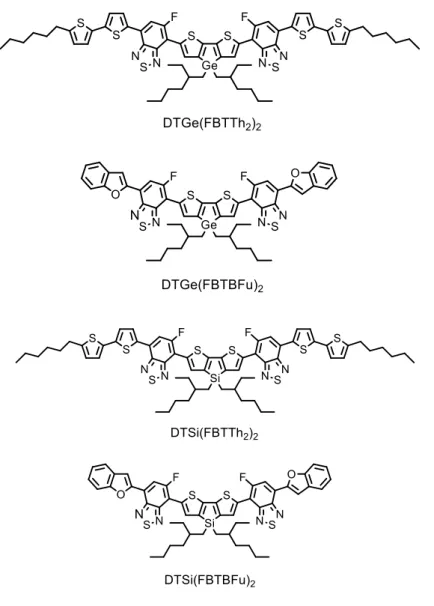
A molecular platform based on the dithienosilole (DTSi) group developed by Bazan and colleagues[5] has led to the material 7,7′-(4,4-bis(2-ethylhexyl)-4H-silolo[3,2 - b:4,5-b′]dithiophen-2,6-diyl)bis(6-fluoro-4-(5′-hexyl-[2,2′-bithiophen]-5-yl)benzo[c][ 1,2,5]thiadiazole), DTSi(FBTTh2)2, which has proven to be one of the most successful molecular chromophore structures to date, yielding PCE up to 9% in a single-junction device. In particular, DTGe-based polymers have been synthesized, providing excellent solar cell performance with PCE up to 8%.
The Synthetic Method of Aryl-Aryl Cross-Coupling Reaction
Study on Structural Variation of DTGe-Containing Small-Molecules by Tuning End- Capper
- Synthesis and Characterization
The development of clean and renewable energy is one of the great scientific and technological challenges of the 21st century. The virtually unlimited energy available as sunlight makes photovoltaic devices an attractive and fascinating possibility as a future renewable energy source. To harness solar energy cheaply and efficiently, organic bulk heterojunction (BHJ) solar cells have emerged as a technology with unique potential.
Despite the potential utility of the DTGe skeleton, the application of DTGe in small molecule solar cells has not yet been thoroughly investigated. During the final stages of this project, Sun et al reported one of the DTGe derivatives used in this study,[7] here my in-depth study reveals fundamental structure-property relationships in a relevant class of small Ge-containing semiconductors. ; how the substitution affects the morphology, crystal structure, optical, thermal, and material properties compared to analogous Si-containing small molecules. Furthermore, we describe the influence of different end groups, bithiophene (Th2) and benzofuran (BFu), linked to the Ge-fused core framework.
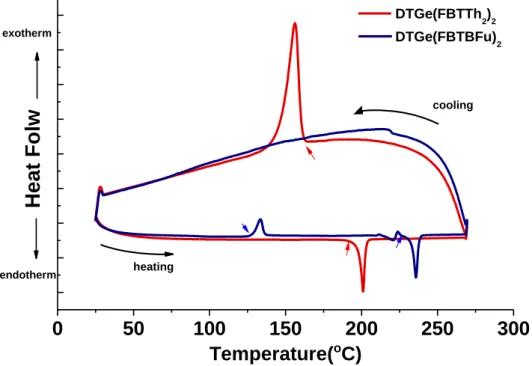
The two DTGe small molecules were synthesized by attaching different end capping groups to the fixed DTGe core unit as illustrated in Figure 6. All final target small molecules exhibit excellent solubility in organic solvents such as chloroform, THF, chlorobenzene and dichlorobenzene. Differential scanning calorimetry (DSC) traces of DTGe(FBTTh2)2 and DTGe(FBTBFu)2 are shown in Figure 7, which present melting transitions at 200 oC and 220 oC, respectively, upon heating.
The thermal property of DTGe(FBTBFu)2 is significantly different from that of DTGe(FBTTh2)2 with subtle difference in molecular structure. In general, as the size of the molecule increases, a higher temperature is required to break the crystallinity. Thus, the lower melting point of DTGe(FBTTh2)2 can be attributed to the presence of hexyl side chains at the ends of the molecule compared to DTGe(FBTBFu)2.
Temperature( o C)
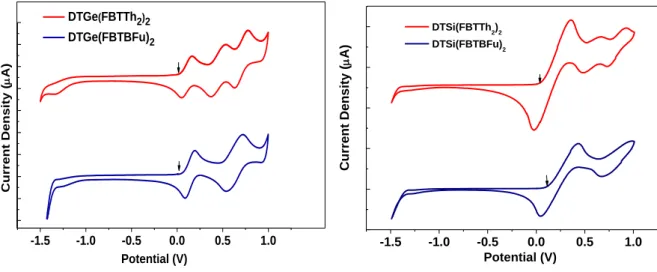
The highest occupied molecular orbital (HOMO) and lowest unoccupied molecular orbital (LUMO) energy levels of DTGe(FBTY)2 were estimated by cyclic solution voltammetry (CV), which shows a deep HOMO level and a corresponding energy band gap for both compounds. DTGe(FBTBFu)2 based solar cells are expected to yield relatively higher open circuit voltages. Both compounds have reversible and distinct oxidation peaks, indicating their ability to donate electrons and act effectively as donor materials when mixed with an acceptor material.
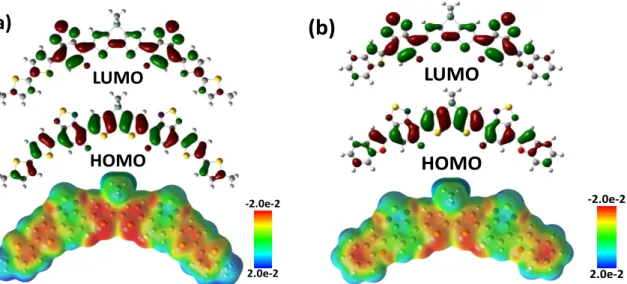
Frontier orbital geometries and electrostatic potentials calculated by density functional theory for (a) DTGe(FBTTh2)2 and (b) DTGe(FBTBFu)2. The frontier orbital geometries are shown in Figure 9, while the frontier orbital energies are shown in Table 2.

HOMOLUMO
The HOMO and LUMO orbitals of the molecules are typical for conjugated molecules with the electron density of the HOMO orbitals localized on the double bonds of the thienyl rings and the E1g orbitals of the benzenoid subunits of the benzothiadiazole (BT) moieties. The LUMO orbitals are localized on the heteroatoms (nitrogen and sulfur) of the BT moieties and on the bonds connecting the aromatic rings and the double bonds arranged in the quinoidal structure. All these values have no significant differences from Ge analogues and thus practically indistinguishable.
It is evident that the molar extinction coefficient (ε) of the charge transfer band of terminal BFu molecules is lower than ε of terminal Th2 molecules. These absorption spectra are consistent with the sum of the absorption spectra of pure donor materials and PC71BM. The GIXD pattern of Th2-containing small molecules clearly exhibits crystalline peaks while BFu-containing small molecules show poor crystallinity with or without the processing additive DIO (S4).
It is noteworthy that small molecules containing Th2 show stronger π−π stacking peaks compared to those with BFu moieties, despite the rigid, planar nature of the BFu group and the shorter π−π stacking distance. Although the defocusing used to obtain clear images of the crystals makes quantitative comparisons difficult, it appears that the size and density of the crystalline features in the DTGe(FBTTh2)2 compound may be slightly larger than the Si counterpart; an average of 62 truncated. The surface morphology is similar to the observed DTSi(FBTTh2)2, but the feature size of the Ge compound is larger than that of the Si compound.
The slightly rougher surface observed in the AFM images is consistent with the larger size and density of crystalline features observed in the TEM images of the DTGe composites. The device properties of DTGe-based composites were found to follow the device characteristics of DTSi-based composites. For DTGe(FBTTh2)2 the optimal processing conditions included a 6:4 mix ratio, 0.4% DIO solvent additive and an annealing step at 70 to 80 oC – the same optimal conditions used for the processing of DTSi(FBTTh2)2 .

Conventional
Inverted
Introduction of Thiophene Spacer to DTGe(FBTTh 2 ) 2
- Synthesis and Characterization
Solar cells were prepared from mixtures of DTGe(ThFBTTh2)2 and DTGe(FBTTh3)2 with PC71BM as acceptor. Without thermal annealing, the optimal blend ratio of DTGe(ThFBTTh2)2 was found to be 6:4 and exhibited a short circuit current (JSC), open circuit voltage (VOC) and fill factor (FF) of 5.1 mA/cm2, resp. 0.567 V and 27.3%, giving a modest power conversion efficiency of 0.79%. These conditions led to devices with a JSC, VOC, and FF of 8.3 mA/cm2, 0.670 V, and 52.2%, respectively, corresponding to a dramatically improved power conversion efficiency of 2.9% over the as-cast device.
The optimal blend ratio for as-cast DTGe(FBTTh3)2 devices was found to be 6:4, which exhibited a JSC, open-circuit voltage VOC and fill factor FF of 5.1 mA/cm2, 0.567 V and 27.3%, respectively, yielding a modest power conversion efficiency of 0.79%. These conditions resulted in devices with a JSC, VOC, and FF of 10.1 mA/cm2, 0.752 V, and 41.6%, respectively, corresponding to a dramatically improved power conversion efficiency of 3.16%. Optimal SVA processing time for DTGe(ThFBTTh2)2 devices was 80 seconds, yielding devices with a JSC, VOC, and FF of 11.8 mA/cm2, 0.540 V, and 56.2%, respectively, corresponding to a dramatically improved power conversion efficiency of 3.60%.
The optimal SVA processing time for DTGe(FBTTh3)2 devices was also 80 seconds, but the performance of these devices was slightly less than that of devices processed by thermal annealing, including a JSC, VOC and FF of 9.5 mA /cm2, 0.613 V and 51.8% respectively, corresponding to an energy conversion efficiency of 3.03%. In Chapter 2, the optimal SVA processing time for DTGe(ThFBTTh2)2 devices was 80 seconds, yielding devices with a JSC, VOC and FF of 11.8 mA/cm2, 0.540 V and 56.2% respectively, which corresponds to a dramatically improved energy conversion efficiency of 3.60%. The measurements were performed at an analyte concentration of 1-2 mg/ml with a scan rate of 0.1 V/s in a nitrogen bubble.
The reaction procedure and purification were followed using the same methods as those used for DTGe(FBTTh 2 ) 2 . The reaction procedure and purification were followed using the same methods as those used for DTGe(FBTTh2)2. Pd(PPh 3 ) 4 was added thereto and the reaction mixture was heated to 85 oC for 24 hours.
The reaction procedure and purification were carried out using the same method as compound ii'. The reaction process and purification were carried out using the same method as the compound DTGe(FBTTh3)2.

감사의 글 (Acknowledgement)