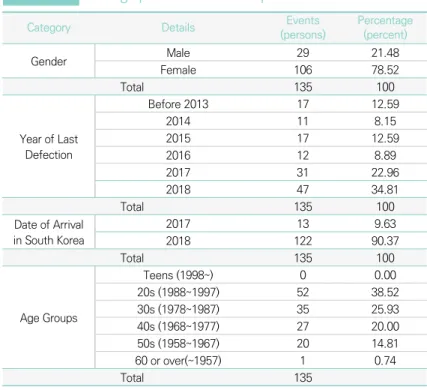
The 2019 White Paper on Human Rights in North Korea is based on interviews with 135 North Korean defectors. The White Paper on Human Rights in North Korea 2019 is written in accordance with the following principles:.

Extrajudicial, Summary, or Arbitrary Execution
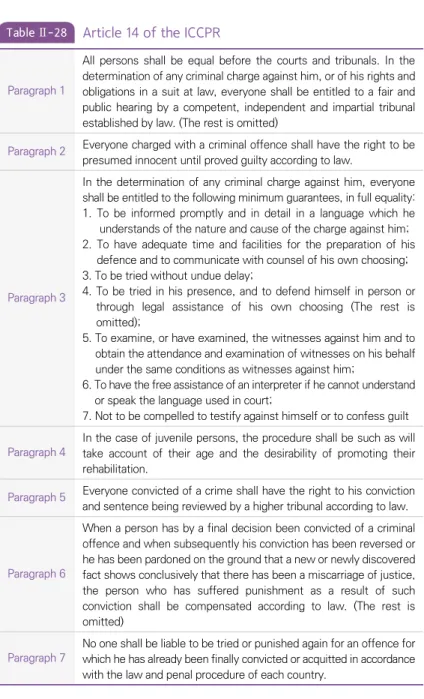
Amnesty, pardon or commutation of the death penalty may be granted in all cases. According to the provisions of Article 6 of the PGP, Article 14 of the PPPPP (which establishes the right to a fair trial) and Article 15 of the PPPPP (which establishes the principle of prohibition of retroactivity of punishment), extrajudicial, summary, or arbitrary enforcement is prohibited.
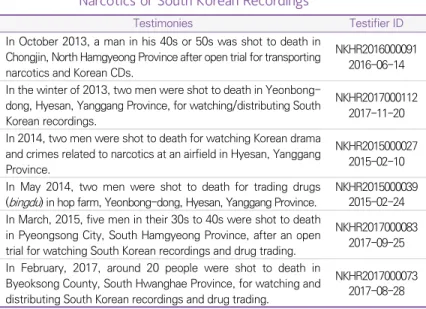
Broad Imposition of Death Sentence for Crimes
When the act in Paragraph 3 is particularly serious, they will be subject to lifelong corrective labor or the death penalty. When the act in paragraph 3 is particularly serious, they will be subject to unlimited term corrective labor or the death penalty.

Death Sentence to Juvenile Offenders and Execution of Pregnant Women
Other Infringements on the Right to Life
Evaluation
As in the UDHR, Article 7 of the ICCPR also prohibits torture and inhuman treatment, and goes even further by banning medical and scientific experimentation. No one shall be subjected to torture or to cruel, inhuman or degrading treatment or punishment.
Torture and Inhumane Treatment in the Handling of Criminal Cases
Despite these regulations in North Korea's Criminal Law and Criminal Procedure Law, torture and inhumane treatment often occur in the actual process of handling criminal cases. A North Korean defector who was arrested for illegal border crossing and held at the Musan County Security Department in North Hamgyeong Province for 20 days in 2014 was severely mistreated during the investigation process.
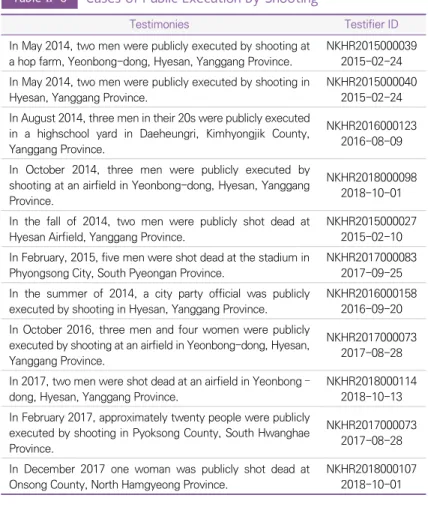
Public Execution of the Death Penalty
The UN Human Rights Committee expressed concern about the public execution of the death penalty in several national reports, including that from North Korea. The UN Special Rapporteur on Torture and Other Cruel, Inhuman or Degrading Treatment or Punishment also noted the issue of the public execution of the death penalty.
Enforced Disappearances
In general, public capital punishment executions are more concentrated in border areas than inland, and in urban areas than in rural areas. This may be because there are relatively more illegal activities taking place in border regions and cities, and North Korean authorities are trying to warn and incite fear among the residents of those regions through public executions.
Evaluation
Part Ⅱ, Chapter 7, “Right to a Fair Trial”; Part Ⅴ, Chapter 1, “Political Prison Camps”; Part Ⅴ, Chapter 5, “Separated Families, Abductees, and Prisoners of War from the Korean War.” perspective of the executed as well as cruel, inhumane, and degrading treatment of those forced to witness the execution. No one should be held in slavery; slavery and slave trade in all their forms will be prohibited.
Labor Training Punishment for Minor Offenses
Penalties depriving personal liberty and imposing prescribed labor in the North Korean penal code include custodial sentences – i.e. unlimited time-limited corrective labor sentence and time-limited prison sentence - and work training sentence (Article 27). Indefinite or fixed-term correctional sentences detain criminals in prison camps (kyohwaso) and force them to work, with the period of fixed-term correctional labor ranging from one year to fifteen years (Article 30).
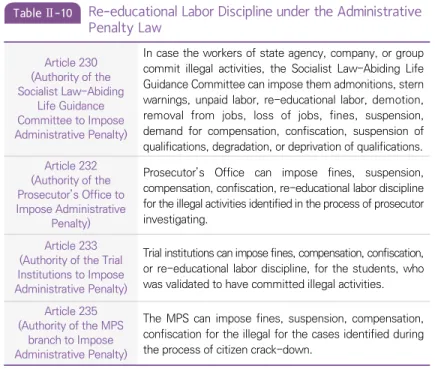
Re-educational Labor Discipline
The Public Prosecution Service may impose fines, suspension, compensation, confiscation and re-education labor discipline for the illegal activities identified during the prosecutor's investigative process. Litigation institutions may impose fines, compensation, confiscation or retraining labor discipline on the students found to have committed illegal activities.
Labor Exploitation of Prisoners in Holding Centers (jipkyulso)
In 2014, the witness cleaned dry fields at the detention center in Chongjin City, North Hamgyeong Province for four months. In July and August 2014, the witness was mobilized for cement construction work when he was detained at the detention center in Hyesan, Yanggang Province.
Arbitrary or Unlawful Arrest/Detention
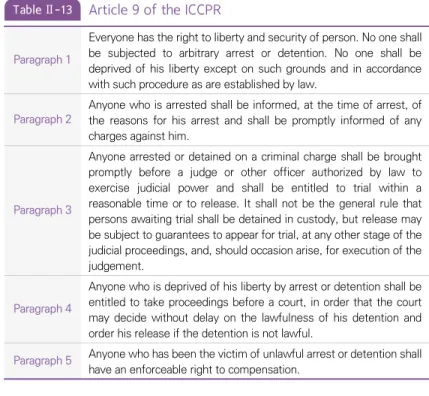
Anyone who is arrested must be informed of the reasons for the arrest upon arrest and immediately informed of any charges against him. North Korea's Law on Criminal Procedure Regarding Arrest or Detention During Preliminary Inspection states that "a preliminary inspection officer may arrest or detain a person under preliminary inspection to prevent evasion of preliminary inspection or trial or interference with investigation" (Article 175). .
Insufficient Procedural Guarantee of Liberty and Security of Person
The initial investigation of a criminal case, where a work training penalty can be applied, must be completed within ten days. Persons undergoing preliminary investigation in cases where a work training penalty can be imposed must be detained for five days.

Evaluation
In the Common Core Documents submitted to the UN in 2016, North Korea also mentioned a compensation system for those whose rights are violated.48. reasons for his or her arrest and the facts of the charge. It appears that North Korea also does not recognize the right to demand a review of the legality of arrest and detention.
Inhumane Treatment of Persons Deprived of Liberty
From February 28 to March 20, 2015, the witness was detained at the Hyesan Detention Center in Yanggang Province. From October 2014 to March 2015, the witness was detained at the Hyesan Detention Center in Yanggang Province.

Issues Related to Treatment of Unconvicted Prisoners
However, it seems unlikely, given that some detention centers force prisoners to work (see Part II, Chapter 3 "The right not to be forced to work") and that access to a defense lawyer is not effectively guaranteed (see Part II, Chapter 7, "The right to a fair trial"), etc.
Issues Related to Treatment of Convicted Prisoners
A North Korean defector who was detained in Gaechon Kyohwaso from September 2014 to June 2015 said she worked in the eyelash unit and knitting unit respectively for five months. In September 2014, the witness was held in Gaechon Kyohwaso and was forced to carry 2,000 anthracite coal briquettes a day, tie cabbages and make ropes.
Issues Related to Treatment of Unconvicted and Convicted Juvenile Prisoners
In particular, the level of violence and harsh treatment imposed in MSS detention centers and detention centers located in border areas is extremely serious. However, there has been evidence that in the case of labor training camps and prison camps that incarcerate those who have been sentenced, the level of violence and harsh treatment has decreased significantly compared to the past.
Using Travel Permits to Control People and Restrict Movement
In 2015, the witness traveled from Hyesan, Yanggang Province, to South Hamgyeong Province, without a travel permit. In June 2017, the witness obtained a travel permit by bribing an officer with a pack of cigarettes to go to a relative's house in Gimchaek, North Hamgyeong Province from Hyesan Yanggang Province.

Restriction of Access to Certain Areas and Forced Deportation
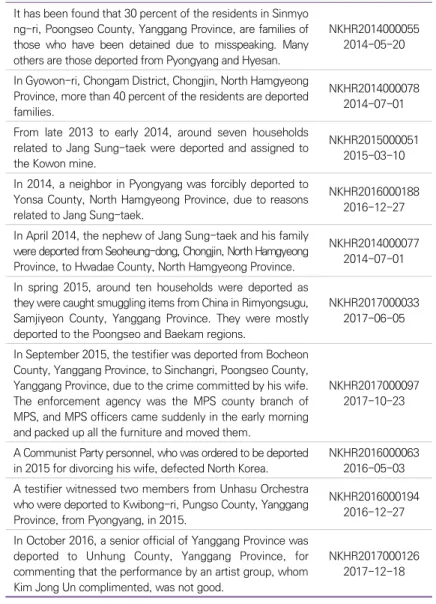
If restricting access to certain areas through a strict travel permit issuing process constitutes a passive violation of the right to freedom of movement and residence, forced deportation carried out by the North Korean authorities is a form of active violation. It was found that 30 percent of the residents in Sinmyo ng-ri, Poongseo District, Yanggang Province, are relatives of those detained due to mistakes.
Restrictions on Entry to Border Areas and Prohibition against the Freedom to Leave
Article 221 of the North Korean Penal Code (charge for illegal border crossing) states that those who are guilty. The 2018 investigation shows that the right to freedom of movement and residence of the North Korean people is seriously violated by the policies of the North Korean authorities.
Lack of Judicial Independence
People's jurors participate in trials at first instance (Article 9 of the Law on the Constitution of Courts). Judgments and decisions are adopted by majority vote among the judge and the people's jurors (Article 17 hereof).
Unfair Trials
The North Korean defector, who tried to cross the border illegally in August 2012 in Hyesan, Yanggang Province, responded that the role of the judge was average, but that of the prosecutor, defense and people's jurors were very active used to be. The witness was severely abused for twenty days in the MSS detention center and was tried publicly without prior interrogation, without the presence of judges, prosecutors, layers and judges of the people's court.133.
Operation of Quasi-Judicial Systems
A prosecutor at the MSS prosecution makes a decision on behalf of the Central Court, the trial takes place behind closed doors and a sentence is imposed in accordance with the Criminal Law. Administrative penalties are also provided for in the Law on the Implementation of Public Security and in the Law on Prosecution and Supervision.
Infringement on the Right to Defense
The Criminal Procedure Code also provides, "a person undergoing preliminary investigation or a person accused of a crime has the right to legal assistance from a defense attorney of his choice". The North Korean Criminal Procedure Code provides, “a designated defense attorney may contact and interview a person undergoing preliminary investigation or a person accused of a crime.
Insufficient Guarantee of the Right to Appeal and Perfunctory Operation of the Appeal System
When the witness stated that his family did not have money for a bribe, the defense counsel acted in favor of the prosecutor during the trial itself. A North Korean defector who was put on trial in Samjiyeon County, Yanggang Province in August 2014 did not appeal the court's decision because the process may take another year or two.
Infringement on Foreigners ’ Right to Trial
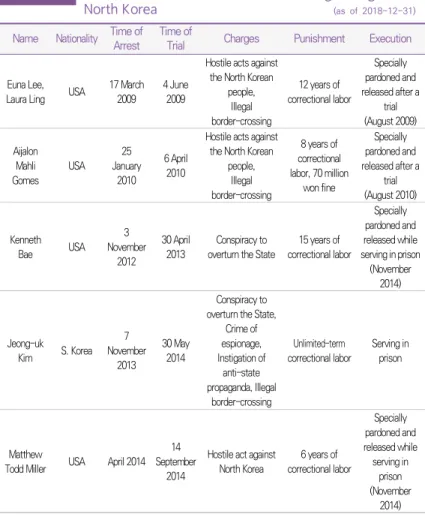
The second characteristic is the arbitrary limitation of the right of foreigners to consult the consul during the period of detention. National Human Rights Commission of Korea, "Statement of the Chairman of the National Human Rights Commission of Korea to Protect the Human Rights of Republic of Korea Citizens Detained in North Korea," May 12, 2015.
Evaluation
Everyone has the right to legal protection against such interference or attacks.” Article 17 of the ICCPR also provides for the right to privacy. This chapter will examine the main issues related to the right to privacy in North Korea.
Infringement on Privacy through the General System of Surveillance of the People
The head of the people's unit is appointed by the People's Committees of the city/province (district) on the recommendation of the residents. It seems that since the Kim Jong Un regime came to power, the surveillance and violation of people's private lives has increased through the People's Unit and Life Review Sessions.
Violation of Privacy through Unlawful House Investigations & Communications Interference
The right to freedom of thought, conscience and religion is related to the freedom of one's inner world and constitutes one of the most basic human rights. This chapter will now examine the situation regarding the right to freedom of thought, conscience and religion through major issues.
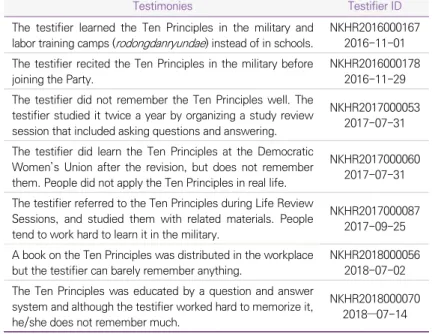
Maintaining the Unitary Suryong Ruling System and the Ten Principles
The strengthening and idolatry of the Suryong unified ruling system is embodied in the Ten Principles of Unified Ideology. The name was changed to "Ten Principles for Firmly Establishing the Party's Unified Management System" (hereinafter referred to as "Ten Principles").
De Facto Restriction of Religious Freedom
The fact that freedom of belief is limited is also shown by the cases of punishments for people involved in religion and defectors who are forcibly repatriated to North Korea. When they were repatriated to North Korea and subjected to MSS interrogation, there were many cases of arrests related to "Christianity".
Heavier Punishment for Superstitious Behavior
Everyone has the right to freedom of expression; this right includes the freedom to seek, receive and impart information and ideas of all kinds, regardless of frontiers, orally, in writing or in print, in the form of art or through any other means of one's choice. This chapter will examine the main issues related to freedom of expression in North Korea.
Restrictions on Forming and Expressing Political Opinions
The exercise of the rights provided for in paragraph 2 of this article entails special duties and responsibilities. In the Democratic People's Republic of Korea, the rights and duties of the citizens are based on the collectivism of
Arbitrary Censorship and Control of the Press and Publication