Summary of “THE IMPACT OF HRM PRACTICES AND POLICIES IN KAZAKHSTAN COMPANIES ON THE MANAGEMENT OF EMPLOYEE STRESS”. The aim of the research paper is to determine the impact of HRM practices and policies on employee stress levels and develop practical recommendations to minimize it. The study may be useful for further research on HRM practices and policies in the mining sector in the Republic of Kazakhstan.
The aim of the thesis research is to develop practical recommendations for the management of certain practices and policies that influence stress management in the exploration company. To develop practical recommendations for managing practices and policies affecting stress management at the company “AMG” in Nur-Sultan, Republic of Kazakhstan. The aim of the study is the policies and practices implemented in the geological exploration company “AMG” with 204 employees.
The results of the research conducted show a balance between practices and policies that increase and minimize work-related stress. Previously, it was argued that work-related stress has a negative impact on staff's physical and psychological well-being.
Stress assessment and stress management
All too often, work-related psychological stress leads to low staff morale, absenteeism, high turnover, reduced productivity and presenteeism (Limm et al., 2011). 2018) investigated research about the stress of mining workers in Australia and found that among 897 workers more than 40.7% have very high work-related stress. The result is 31.4% employee absenteeism, 28.3% absenteeism in Australia's mining industry, leading to reduced productivity and profit.
According to Street et al. 2018) absenteeism due to work-related stress costs $153.8 million to mining companies in Australia, representing more than 8% of profits. The following theory is that people in the same company can react differently to occupational stress, where the main role is played by three factors: 1. Women are emotionally labile and tend to seek help, men deny the existence of stress by drinking alcohol and cigarettes when stress occurs.
Analyzing the research data, the occurrence of stress depends on individual perception, factors such as support, assessment of the situation and gender. In the next chapter, the researcher will conduct a literature review and analysis on certain practices and policies used in the "AMG" mining company in Nur-Sultan city.
The impact of HRM practices and policies on work related stress
Organizational change
However, organizational changes are not always successful and the reason for this may be the harming of employees due to new interventions (Fugate et al. 2012). This state is the result of thinking that the change will cause negative consequences, such as learning additional processes, increased responsibility or not ensuring job security. In addition, Dahl, Greubel and Kecklund, cited in Wisse and Sleebos (2016), demonstrated in correlational studies of stress and drug addiction that high risk of drug taking is associated with organizational change.
Smollan (2012) divided organizational change into three phases 'before change', in 'change process' and 'after change' to define which phase causes work-related stress. Organizational changes always capture these factors to increase employee productivity and eventually mental stress and emotional exhaustion occur (Karasek, 2004). Armstrong-Stassen's (2005) study on organizational change of middle and lower managers in the public sector found that over 73% of employees experienced a negative consequence, e.g.
After Smollan (2012), the organizational changes caused several uncertainties: employees did not know what to expect in the future, whether they would stay in their previous job, whether they would be able to cope with the new circumstances, whether they would have a good relationship with their colleagues, or they would lose their role and status at work. Inadequate support from staff as a result of the change caused upset, aggression, accusations towards management of incompetence and cynicism (Smollan, 2012).
KPI and employee evaluation
These feelings reduce job satisfaction, the employee's sense of worth and need, leading to depression and stress. And if management does not take timely measures to reduce the factors highlighted by Smollan (2012) and other aforementioned researchers, work stress is inevitable, which means that organizational changes will fail during implementation. Mallow (2017) argued that if the company has met the planned KPI, this is an increase in the company's reputation and success.
However, if the organization failed to achieve the planned KPI, this is the reverse of favorable outcomes. Depending on how realistic the goals are, the employee's emotional and physical well-being is affected. However, predicting that KPI only exacerbates occupational stress is not possible, as companies try to set tasks that are feasible for employees, and they often aim to increase productivity.
In summary, if KPI consists of unrealistic demands, there are all the predictors for stress, which is detrimental to the productivity and effectiveness of the employee and the company. However, if the KPI is realistic and in line with the employee's abilities and knowledge, the employee's psycho-emotional state will be healthy, balance will be maintained, organizational results will be better, and the employee's work efficiency will be higher are.
Onboarding program
Salary, career advancement, rewards and reputation are at stake and if the appraisal is unsatisfactory then the worker would become depressed which is a sign of stress. And the onboarding program, or organizational socialization, is a process that reduces stress (uncertainty, fear) and increases the newcomer's ability to contribute to the new work environment. Consequently, Gallup (2017) noted that 88% of employees who were not offered an onboarding program experienced work-related stress in the workplace, which was represented by uncertainty related to new corporate tasks, roles, and relationships. .
Allison (2018) confirmed that as a result of the lack of an onboarding program, newcomers were unable to build relationships with colleagues and could not fully understand what was required of them. However, according to Glasdor (2018), it is noted that not all companies have a successful onboarding program for new workers. According to a study conducted by Careerbuilder and Silkroad Technology, it was observed that 9% of new employees quit due to a poorly adapted onboarding program, and in addition, over 30% of employees said that their managers were not involved in supporting them during the onboarding process.
These results lead to the fact that people need an adjustment program and it should be well structured with support from a mentor (manager) for successful completion of tasks, for socialization in a new workplace, for minimizing professional stress and avoiding of dismissal. The onboarding program created satisfaction, a sense of job readiness, a sense of value, and a sense of acceptance by colleagues for more than 60% of respondents in Allison's (2018) study. A 90-day analysis of the impact of Twitter's newcomer onboarding program found that 100 percent of new hires were satisfied with the onboarding program and felt comfortable from day one.
86% of employees reported that their manager helped them during the onboarding program, which reduced their anxiety and increased their sense of security (Chen, 2020). Therefore, an effective onboarding program has a positive impact on newcomers by minimizing fear and anxiety and increasing job satisfaction. To summarize this section, onboarding programs minimize work stress if they are structured correctly and if the new employee feels comfortable and confident in his/her work environment from day one.
These feelings are in conflict with work stress, which causes consequences in the form of frustration, dismissal and reduced reputation for the company.
Training and development
The quantitative method was used to analyze the attitudes of miners towards the practices and policies in the company and to evaluate their impact on occupational stress. In order to achieve the qualitative research objectives, 6 respondents from the company participated in the interview. As previously mentioned, the questionnaire was conducted in the "AMG" mining company of Kazakhstan.
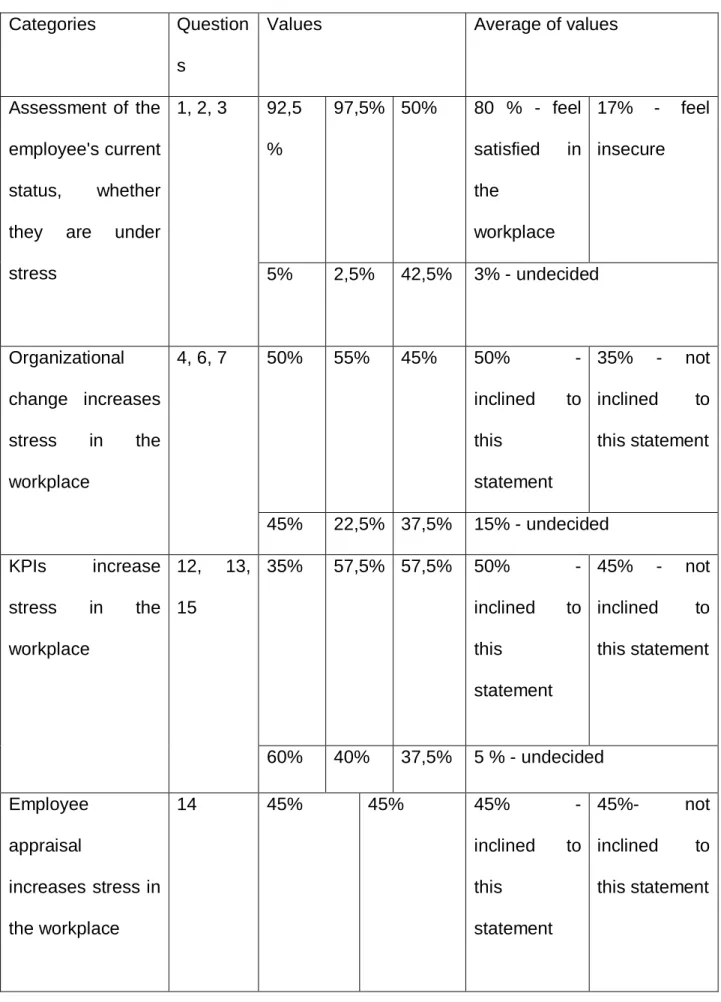
The main mission of the company is to always look to the future and develop. One of the company's strategies is to enter the international arena and compete with the world's leading mining companies. For question 7, the analysis showed that 45% of the participants highlighted the lack of support in the organizational process.
In the exploration company, two policies were investigated, employee value policy and innovation. As mentioned earlier in the methodology, the researcher conducted semi-structured qualitative research interviews with 6 employees. In question 1, the answers of employees differed, 2 participants agreed that stress in the workplace can be understood as prolonged fatigue and irritability.
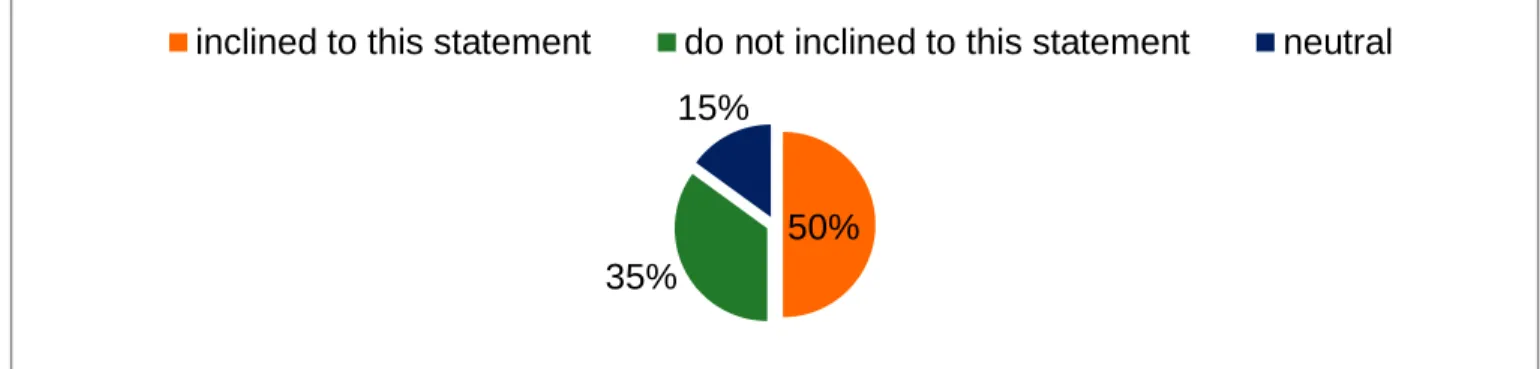
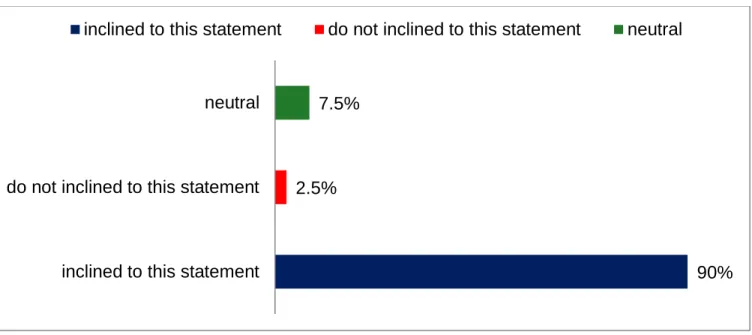
Respondents stated in the interview that the company is often subject to organizational changes, but the form of ensuring these changes often suffers. Both in the questionnaire and in the interviews, the respondents showed a positive opinion about the training and adaptation program. Training in the mining company is encouraged, and it has been found that the company pays a lot of attention to the development of workers' skills in their specifics and in general training courses such as management and excel.
First, the practices and policies studied in the study only covered one mining company in Kazakhstan and the findings could not fully capture the attitudes of all workers in the mining sector. Second, only 40 out of 204 employees participated in the survey and the results do not include the perceptions of all employees at “AMG.” The practices and policies used in the mining company strike a balance between stress enhancers and stress suppressors.
This questionnaire will help determine how useful the meeting was, whether changes are necessary, how important the changes are in the company. The next stressor is a KPI based on questionnaire and interview results; it was found that there are two factors that increase stress in a mining company - lack of information and high stated KPI. Linking work-family conflict to job attitudes: the mediating role of social exchange relationships”, The International Journal of Human Resource Management, Vol.
Describe your research design and how human participants will be involved. The study will take place in the "AMG" mining company in Nur-Sultan city.