TITLE:
PERCEPTIONS OF UNIMAS STUDENTS ON PORNOGRAPHY ADDICTION
Norfarhana Binti Ambran
Bachelor of Psychology (Honours) 2021
UNIVERSITI MALAYSIA SARAWAK Grade: ________________
Please Tick (√) Final Year Project Report Masters PhD
DECLARATION OF ORIGINAL WORK
This declaration is made on the 15 day of June 2021
Student’s Declaration:
I NORFARHANA BINTI AMBRAN (68643), FACULTY OF COGNITIVE SCIENCES AND HUMAN DEVELOPMENT hereby declare that the work entitled PERCEPTIONS OF UNIMAS STUDENTS ON PORNOGRAPHY ADDICTION is my original work or from any other sources except where due reference or acknowledgement is made explicitly in the text, nor has any part been written for me by another person.
15 June 2021 __________________
______________________________
(Date submitted) NORFARHANA BINTI AMBRAN (68643)
Supervisor’s Declaration:
I DR. JAMAYAH BINTI SAILI hereby certifies that the work entitled, PERCEPTIONS OF UNIMAS STUDENTS ON PORNOGRAPHY ADDICTION was prepared by the above-
named student, and was submitted to the “FACULTY” as a partial fulfilment for the conferment Bachelor of Psychology (Honours), and the aforementioned work, to the best of my knowledge, is the said student’s work.
Received for examination by: _________________ Date: __________________
(DR. JAMAYAH BINTI SAILI
√
I declare this Project/Thesis is classified as (Please tick [√ ])
CONFIDENTIAL (Contains confidential information under the Official Secret Act 1972) * RESTRICTED (Contains restricted information as specified by the organisation where
research was done) * OPEN ACCESS
Validation of Project/Thesis
I therefore duly affirmed with free consent and willingness declare that this said Project/Thesis shall be placed officially in the Centre for Academic Information Services with the abide interest and rights as follows:
• This Project/Thesis is sole legal property of University Malaysia Sarawak (UNIMAS).
• The Centre for Academic Information Services has the lawful right to make copies for the purpose of academic and research only and not for other purposes.
• The Centre for Academic Information Services has the lawful right to dignities the content for the Local Content Database.
• The Centre for Academic Information Services has the lawful right to make copies of the Project/Thesis for academic exchange between Higher Learning Institute.
• No dispute or any claim shall arise from the student itself neither third party on this Project/Thesis once it becomes sole property of UNIMAS
• This Project/Thesis or any material, data and information related to it shall not be distributed, published or disclosed to any party by the student except with UNIMAS permission.
Student’s signature: _____________________ Supervisor’s signature: _____________________
(15 June 2021) (Date) Current Address:
Notes: *If the Project/Thesis is CONFIDENTIAL or RESTRICTED, please attach together as annexure a letter from the organization with the period and reason of confidentiality and restriction.
√
[The instrument was duly prepared by The Centre for Academic Information Services]
The project entitled ‘PERCEPTIONS OF UNIMAS STUDENTS ON PORNOGRAPHY ADDICTION’ was prepared by Norfarhana Binti Ambran and submitted to the Faculty of Cognitive Sciences and Human Development in partial fulfillment of the requirements for a Bachelor of Psychology (Honours).
Received for examination by:
--- (DR. JAMAYAH BINTI SAILI) Date:
---
Grade
ACKNOWLEDGEMENT
First and foremost, praises and thanks to Allah, the Almighty, for His showers of blessings throughout my research work to complete the research successfully.
I would like to express my deep and sincere gratitude to my supervisor, Dr Jamayah binti Saili for providing valuable guidance throughout this research. Her determination, sincerity and motivation have deeply inspired me. Besides, she also taught me useful methodology on how to carry out this qualitative research, and she also taught me how to analyses its data. It was a utmost privilege and honour to work and study under her guidance.
Beyond that, special thanks to my research participants for spending some of their time to share their experience and knowledge with me. It would be impossible for me to finish my final year project research without their contributions.
Apart from that, I am incredible indebt to my parents for their love, prayers, supports, encourage and sacrifices for educating and preparing me for my future. Thanks also to all my siblings for always supporting me emotionally while conducting this study.
I am also grateful to all my friends for their help and consistent encouragement as well as for being my emotional support throughout my research work.
Finally, my thanks go to all the people who have supported me to complete the research work directly or indirectly.
ABSTRACT
Pornography is considered a taboo topic in Malaysia. This research explores the perception of pornography addiction among UNIMAS students on their general opinions toward
pornography addiction, their insights on the effects of pornography addiction on an individual’s well-being, and their perspectives on the cross-cultural issues of religious views on pornography addiction. As well as discovering students’ opinions on the initiative to prevent pornography addiction in Malaysia. Eight participants asked were interviewed with a semistructured questionnaire in the face-to-face interview. Data collected in this study were voice recorded, transcribed, and then using Thematic Analysis by Braun & Clarke’s phases of analysis. The finding revealed that UNIMAS students from the Faculty of Cognitive Sciences and Human Development know what pornography addiction is. They can distinguish the effects of pornography addiction on individual well-being. The participants also reported on the cross-cultural differences in pornography addiction issues and also shared their religious
views regarding pornography addiction. The suggestions and recommendations on how we can avoid or prevent pornography addiction among students were also discussed.
ABSTRAK
Pornografi dianggap sebagai topik terlarang di Malaysia. Penyelidikan ini meneroka persepsi tentang ketagihan pornografi di kalangan pelajar UNIMAS mengenai pendapat umum mereka terhadap ketagihan pornografi, pandangan mereka mengenai kesan ketagihan pornografi terhadap kesejahteraan individu, dan perspektif mereka mengenai isu-isu silang budaya pandangan agama mengenai ketagihan pornografi. Serta menyelongkar pendapat pelajar mengenai inisiatif untuk mencegah ketagihan pornografi di Malaysia. Lapan peserta yang ditanya telah ditemuramah dengan soal selidik separa berstruktur dalam wawancara tatap muka. Data yang dikumpulkan dalam kajian ini adalah suara yang direkodkan, disalin, dan kemudian menggunakan analisis tematik oleh fasa analisis Braun & Clarke. Penemuan mendedahkan bahawa pelajar Unimas dari Fakulti Sains Kognitif dan Pembangunan Manusia tahu apa yang ketagihan pornografi. Mereka boleh membezakan kesan ketagihan pornografi pada kesejahteraan individu. Para peserta juga melaporkan mengenai perbezaan rentas budaya dalam isu ketagihan pornografi dan juga berkongsi pandangan agama mereka mengenai ketagihan pornografi. Cadangan dan cadangan tentang bagaimana kita boleh mengelakkan atau mencegah ketagihan pornografi di kalangan pelajar juga dibincangkan
TABLE OF CONTENTS
1.0 CHAPTER 1: INTRODUCTION……...………... 2
1.1 Background of the study…..………... 2
1.2 Problem Statement……….. 5
1.3 Objectives………... 7
1.3.1 General objectives of study……….. 7
1.3.2 Specific objectives of study……….…. 7 1.4 Research Framework……….. 8
1.5 Conceptual and Operational Definitions………. 8
1.5.1 Students……….... 8
1.5.2 Perceptions………... 9
1.5.3 Pornography………. 9
1.5.4 Addiction……….. 10
1.6 Significance of the study………. 10
2.0 CHAPTER 2: LITERATURE REVIEW………..………... 12 2.1 Pornography Addiction ………...…………... 12
2.2 Pornography, Cybersex & Internet Addiction...……….………….... 15
2.3 Pornography Addiction Study in Malaysia………. 17
2.4 Stereotypes & Stigmas on Pornography Addiction……….... 20
2.5 Pornography Addiction Treatment & Interventions………...…… 22
2.6 Theoretical Context………. 24
2.6.1 Positive Emotions…………...……….. 25
2.6.2 Engagement……….. 25
2.6.3 Relationship……….. 25
2.6.4 Meaning……….... 26
2.6.5 Accomplishment………... 26
3.0 CHAPTER 3: METHODOLOGY …………...……… 27 3.1 Research Design………. 27
3.2 Research Participants, Location, Population & Pilot Test………. 28
3.3 Data Collection….……..……… 29
3.3.1 In-Depth Interview……….………. 29
3.4 Reliability and Validity……….. 29
3.5 Ethics of study……… 30
3.5.1 Participant Information Sheet……….. 30
3.5.2 Informed Consent Form………... 31
3.6 Data Analysis Procedures………….…..….………... 31
3. 7 Summary……….……… 33
4.0 CHAPTER 4: FINDINGS………..……… 34 4.1 Demographic Information………..
34
4.2 Findings………..
34
4.2.1 Theme 1: Perception of Pornography Issues.………..
36
4.2.1.1 Definition & Understanding………...
36
4.2.1.2 Cross Cultural Acceptance……….
39
4.2.1.3 Moral & Religious View……….
42
4.2.2 Theme 2: Pornography Effects……….
44
4.2.2.1 Mental & Physical Health………...
44
4.2.2.2 Educational Benefits..……….
45
4.2.3 Theme 3: Prevention Initiatives………...
46 4.2.3.1 Sex
Education………. 46
4.2.3.2 Religion Approach………..
48
4.2.3.3 Awareness Advertisement………..
49
5.0 CHAPTER 5: DISCUSSION………. 52 5.1 Perception of Pornography Addiction Issues………...
52
5.2 Pornography Effects………...
55
5.3 Prevention Initiatives………..
57 5.4 PERMA Model of
Wellbeing………. 60
5.4.1 Positive Emotions…………...………..
60
5.4.2 Engagement………..
61
5.4.3 Relationship………..
63
5.4.4 Meaning………....
64
5.4.5 Accomplishment………...
65 5.5 Limitation of
Study………. 65
5.6 Suggestions & Recommendations………..
66
5.7 Conclusion………..
67
6.0 REFERENCES……… 69 7.0 APPENDIXES…………...……….. 86
A. Sample Transcript………...
86
B. Participant Information Sheet………...
108 C. Participants Informed
Consent……… 109 D. Semi-structured Questions……….. 117
E. Gantt Chart………..
118
8.0 LIST OF TABLES
i. Table 1: Demographic Information………
34 ii. Table 2: Research
Findings……… 35
9.0 LIST OF FIGURES
i. Figure 1: Research Framework………..
8
ii. Figures 2: Step-by-Step Thematic Analysis by Braun & Clarke (2006)………
32 iii. Figures 3: Theme 1: Perception of Pornography Issues.……… 36 iv. Figures 4: Theme 2: Pornography Effects……….. 44 v. Figures 5: Theme 3:
Prevention Initiatives……… 46 CHAPTER 1:
INTRODUCTION
1.0 Introduction
This chapter will be discussing the inductor details of the study. This chapter contains the background of study, statements of problems, research objectives, the definition of terms used in this study, the research framework, the significance of study and the limitation of the study.
1.1 Background of the Study
In Jodi, Seman, and Mohammad (2013) study, it stated in their examination on 'Salah Laku Seksual Dalam Kalangan Remaja' the soonest time of members who participate in sexual activities is 13 to 15 years of age with most noteworthy rate 45.5% of the 55 members. Their investigation additionally appeared, 52.73% of the members participate in sexual activity by watching porn video or compact disc (CD). Accordingly, one reason an individual associated with sexual activities in early age (adolescent) is by watching erotic entertainment such as pornography. In spite of the adverse consequence on one's physical, enthusiastic, social, or monetary prosperity, pornography dependence is a habit model of impulsive sexual movement through constant utilization of explicit substance.
Pornography is not classified by the DSM-5 or ICD-11 as a mental disorder or addiction.
(Parker, 2020).
Sexuality is an intrinsic aspect of human nature and is recognized globally to both males and females as a significant health-related quality of life issue. As you get older, the need to be close to someone is very normal, including the desire to continually enjoy an active, fulfilling sex life (Minhat et al., 2019). According to Villines, (2020) in her article stating “some doctors view porn addiction as a hypersexual disorder — a paragliding word that involves habits like excessive masturbation. A research carried out in 2019 indicates
that the prevalence of these conditions may be around 3–6%. Because of an absence of formal direction, the rates were hard to resolve”.
Hypersexual disorder is frequently viewed as one of the behavioural addictions. Any of those psychological addictions is regularly viewed as a hypersexual condition. It is utilized as an overall system tending to various inappropriate exercises, like redundant masturbation, cybersex, utilization of erotic entertainment, phone sex, agree to grown-up sexual cooperation, visits to strip clubs, and so forth (Karila et al., 2014). The approach of advanced media has opened a supply of habit-forming conduct that is irksome, especially web enslavement. Gaming, shopping, wagering, cybersex, and so forth will be a specific web work that would zero in on this issue with the capability of risk habit-forming action;
in the present circumstance, it would fill in as a mechanism for explicit indications of such conduct (Chamberlain et al., 2016; Ioannidis et al., 2018).
There is a greater amount of a habit than having a profound craving in something. It's anything but a psychological condition that influences the mind and body which permits the individual to feel obligated, despite the fact that this can prompt injury, to keep on burningthrough a drug or to participate in an action. As indicated by Raypole (2019), the individual in question feels an outrageous flood of dopamine when an individual with compulsion first takes the medication or takes part in the work on, delivering sensations of pleasure and reward. With time, their bodies may create less dopamine and experience the flood of dopamine relying upon the drug or conduct. Dependence instigates desire and reward-related cerebrum regions. The dopamine creation in the body explicitly controls fixation (Raypole, 2019). Watching pornography subsequently delivers extra dopamine into the individual mind, permitting them to observe more pornography to encounter joy.
As the body becomes acclimated to the medication, delivering dopamine time after time
makes an individual encounter less satisfaction. Along these lines, an individual watch more pornography to acquire more pleasure and get dependent without knowing it.
Harper and Hodgins (2014) published a report on the analysis of correlates of problematic Internet pornography use by university students in the Journal of Behavioural Addictions. Their analysis is to assess whether or not the consumption of Internet pornography is directly associated with impaired psychosocial functioning. This examination includes 105 female and 86 male college understudies (mean age 21) from Calgary, Canada, who were given IP use tests, psychosocial working (uneasiness and depression, satisfaction of connections with others), habit-forming propensities, and utilization of habit-forming IP. The questionnaire was conducted by Qualtrics online and was performed by each user in small groups on a private personal computer.
Harper and Hodgins (2014) utilize a shortened version of the Short Symptom Inventory (BSI-18) to measure clinical markers of distress such as somatization, anxiety, and depression. Participants in active relationships completed a seven-item relationship evaluation measure to determine their overall level of satisfaction with their present relationship. Due to its high association with feelings of boredom in marriages, a widely recorded phenomenon with high pornography usage of the internet, this scale was selected.
They conclude at the end of their research that low psychosocial functioning happens when a person is detected as using addictive internet pornography. This research is a reasonable guide for our initial study concentrating on the perceptions of UNIMAS students regarding addiction to pornography
1.2 Problem Statements
According to Lim (2018), Malaysia was included in the World Press Freedom Ranking by reporters at 146 out of 180 countries (the higher the rank, the stricter it censorship).
Pornography is one of the subjects of these censorship rules and legislation. Lim (2018) also stated, it is illegal to possesses anything that is pornographic in nature (pictures, magazines, DVDs, video clips etc.), but there are no laws against watching porn online.
This indicates that pornography is not available in any Malaysia websites but watching porn is not illegal.
However, in Malaysia, watching porn is considered as uncommon due to society beliefs’
which indicating watching porn is unacceptable. Many people (especially teenagers and young adults) can still access porn websites and regularly visiting illegal websites through Google (Lim, 2018). Therefore, this research deemed important value in exploring broader perspectives of university students in UNIMAS regarding pornography addictions.
In Malaysia, watching porn is considered taboo in religious aspects. Nashih, (2020) claimed that it is ‘haram’ to watch porn from an Islam perspective. A person is not supposed to do or consume any sexual-related thing as it is forbidden in Islam. According to the websites of the Gospel Broadcasting Network (n.d.), those who view porn are being psychologically, emotionally, and spiritually disloyal to their respective spouses, as well as engaging in something which is sinful in God's eyes. Sherkat and Ellison (1997) stated pornography was firmly objected to by religious groups as fornication that incites sexual urges for people outside marriage and allows masturbation. Therefore, participants also will include their religious perspectives in the interview and it might as well affect their judgments regarding pornographic.
The frequency of greater levels of guilt over sexual activity and higher levels of sexual dysfunction, in general, is also intensified by stronger moral beliefs (Ley, 2016).
Participants’ insights might be clouded by their moral beliefs and eventually refrain them from sharing their real perspectives.
Conducting a literature review in study research is crucial as it help us to demonstrate understanding of the subject matter, justifying the study and setting research question, setting a theoretical framework, developing research methodology and to support the current findings (Proofed, 2016). Atilano (2020) stated a researcher would be able to conclude, from the number of articles published by the author and the number of times the author has been cited by other scholars, that the author in question is an authority in the field and thus a key reference for consultation in the latest study to be carried out. Thus, past study that has been conducted by experts on the related topic is assumed reliable to help our study for further understanding.
However, a study regarding pornography addiction especially in Malaysia is not broad. In Malaysia only, few researches been conducted about this issue and mostly focuses on adolescents. It is important to have a lot of study regarding pornography addiction to support our study, but, lack of previous study can restrict our in-depth understanding on this topic.
To study further about pornography addiction all across the country, it is necessary for the candidates to fully understand the purposes of the study conducted by the researcher in order to get a successful result. To make a relevant and convincing study about pornography, it is essential for us to conduct a study on this topic frequently to spread the importance of pornography addiction awareness among Asian countries, especially in
Malaysia. Research on Pornography Addiction in Malaysia is very little and by conducting this study on UNIMAS students, we will narrow the gap between the previous study regarding this topic. It might as well help future studies to prepare suitable research on this topic in Malaysia. By frequently conducting this study in Asian countries such as Malaysia, it will bring more people to learn and seek help for this type of addiction. Pornography addiction awareness may help reduce the abortion and abandoned baby cases that happened in Malaysia. So, it is essential for us to spread awareness regarding this issue in Malaysia especially among teenagers and young adults.
1.3 Objectives
1.3.1 General Objectives
To study the perception of pornography addiction among UNIMAS students.
1.3.2 Specific Objectives
1. To explore students’ general opinion toward pornography addiction
2. To explore students’ insights on the effects of pornography addiction toward individual’s well-being
3. To determine students’ perspective on cross-cultural issue about pornography addiction
4. To discuss students’ religious view regarding pornography addiction
5. To identify students’ opinion on initiative to prevent pornography addiction in Malaysia.
1.4 Research Framework
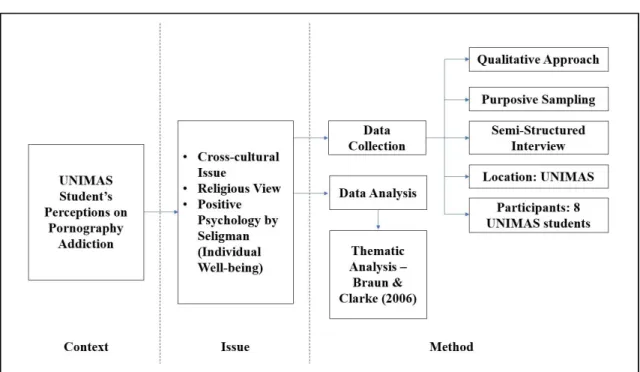
Figure 1: Research Framework
From the context of UNIMAS student’s perception on pornography addiction, researcher will be focusing on cross-cultural issue, religious view regarding pornography addiction and positive psychology approach (individual well-being) by Seligman.
1.5 Conceptual and Operational Definitions 1.5.1 Student
Conceptual definition: According to Oxford English Dictionary (2019), student is defined as a person studying in university or other place of higher education. Merriam-Webster (2019) defines student simply as a scholar or learner. A student needs to perform multiple tasks, assignments and exams during their time in universities to excel in their academics.
Students are also expected to overcome many challenges to shape themselves to become fine leaders and manpower for the future of a county (Ali et. al, 2009). A student who has not yet received a first degree is called an undergraduate student (Merriam-Webster, 2019)
and they usually study in academic programs up to the level of a bachelor’s degree (Frahm, 1979).
Operational definition: Individuals who undergo undergraduate programs at the local public university, University Malaysia Sarawak (UNIMAS), are the students at the focus of this study.
The students consist of undergraduates who are preparing for their first bachelor’s degree and studying under any programs in all faculty in UNIMAS.
1.5.2 Perception
Conceptual definition: Perception is the mechanism of knowledge or comprehension of sensory input (Qiong, 2017). Perception is described by the Longman Dictionary of Contemporary English as the way you believe about something and your understanding of what it is like, the way you experience things through your senses of seeing, hearing, etc., and the natural capacity to easily comprehend or note things. According to Cherry (2020), the sensory awareness of the world is perception. It requires both the detection of environmental stimuli and behaviour in response to these stimuli.
Operational definition: Perception in this context is insight, opinions, ideas, and experiences from UNIMAS students regarding pornography addiction issues.
1.5.3 Pornography
Conceptual definition: The disparity between pornography (illicit and rejected material) and erotica (which is widely accepted) is primarily contextual and represents shifts in cultural norms (Jenkins, n.d.). In that it defies adherence to a monogamous meaning, pornography is an unethical notion. A medical dictionary published in 1857, one of the
earliest English descriptions, suggests that pornography is “a description of prostitutes or prostitution, as a matter of public hygiene” (Kendrick, 1987).
Operational definition: Pornography in this context can be presented in various media, including magazines, animation, writing, film, video games, and video games.
1.5.4 Addiction
Conceptual definition: Addiction is a complicated illness characterized by compulsive drug use despite negative consequences (Parekh, 2017). According to Tyler (2014), a chronic brain system disorder that includes reward, motivation, and memory is addiction. Human bodies decide if a drug or activity produces compulsive or obsessive "reward" seeking and a lack of therapy for the consequences. Addiction is defined as the psychological and physical incapacity to quit using a prescription, therapy, activity, or drug, despite the fact that it causes psychological and bodily harm (Felman, 2018).
Operational definition: Addiction in this context is a repetitive behaviour that negatively impact the individual lifestyles, well-being and relationships.
1.6 Significance of the Study
This research is to study more about the perception of UNIMAS students regarding pornography addiction. This study may help students to learn more about this issue and might as well help spread awareness about porn addictions among students. Spreading awareness on this topic is important in order to reduce the possibilities of addiction as well preventing any undesired sexual activities (rape, accident pregnancy, abandoning baby, etc.)
This research also helps us to understand better young adult and adult perspectives on this issue and it might help experts to invent a better treatment and intervention for an
addicted person. Studying pornography addiction might guide parental control especially toward adolescents. By receiving feedback and insight from students who are young adults helps us to provide proper information for parents to prevent their children from engaging in pornography.
Furthermore, this study is purposely conducted to spread pornography addiction awareness toward female and male students. Conducting a study of pornography addiction surely can help them to have more self-control and it can learn the negative effect it has on our physical and mental health. Besides that, we also can reduce abandon baby cases, especially in Malaysia by spreading the knowledge about pornographic addiction toward an individual.
Exploring more on how religion might help control the urges of watching porn and the effects of watching porn on their moral beliefs can reduce the possibilities in consuming pornography online as their conscience aligns with the guilt they might feel when watching porn in the future. Thus, studying in-depth on pornography issues can help our society to be
healthier emotionally, mentally, and physically.
CHAPTER 2 LITERATURE REVIEW
2.0 Introduction
This chapter will elaborate the cause of porn addiction, the differences between porn addiction, cybersex and internet addiction, pornography addiction treatment and intervention, stereotype and stigmas as well as theory of positive psychology.
2.1 Pornographic Addiction
According to Dines (2012), a person presumed to be addicted to porn when they disregard their job, a large amount of money they do not possess, become alienated from others, and sometimes experience depression. They notice that there might be something odd, they feel out of balance, and they do not even know how to escape. Some may have been so addicted that they have begun to use hard porn and end up masturbating to visuals that have disgusted them before. All of these men feel profoundly humiliated and terrified because they have no idea when all this is going to end (Dines, 2010). An individual is unable to stop using porn when they want to and keep using it even in a situation that imposes physical dangers is showing addicted behaviour toward pornography (The Recovery Village, 2019).
Pietrangelo (2019) claimed in her research that the Diagnostic and Statistical Manual of Mental Disorders (DSM) never recognize porn addiction as an established mental disease problem. She also reported that a 2002 study undertaken at Indiana University by the Kinsey
Institute for Sex, Gender, and Reproduction Research showed that 9 percent of people who watch porn had unsuccessfully tried to stop it. She explained a person who has behaviours such as investing an excessive amount of time watching porn until neglecting responsibilities, feeling guilty about the consequences of watching porn, and unable to enjoy sex without engaging in porn might be addicted to pornography. Individuals are also considered addicted if they tend to insist their partner watch porn or act out porn fantasies even though they refuse to do it.
Attwood, Smith, and Barker (2018) found that “the existing data revealed a number of different interpretations for how people view pornography, each leading generally to a different orientation to porn, and from that, correlates with how often and with what engagement they engage; what platforms they choose what tools they find interesting and exciting (visuals, scenes, narratives); and what they feel when watching porn”. Their research on why people watch porn reveals that the participants watch porn is due to boredom, the desire to relieve, basic intensification of body pleasures, insufficient sexual opportunity, discovery of one's sexual self/identity, enjoyment of voyeurism, thrill of erotic encounter, etc.
The exploitation of technology is one of the causes of pornography addiction as a person do not know how to control their curiosity and lack of observation from parents lead teenager to use internet wrongly (Amirul & Nooraini, 2020). A research by Grubbs et al. (2015) reveals that the mere fact that porn addiction occurs may be a significant cause of the distress that certain people feel while watching porn (Villenes, 2020). In the meantime, experts and advocates who support the existence of addiction to pornography claim that this is a complex process with a number of potential triggers, including most addictions. Some of these causes may include;
• Relationship Problems: An individual outlet for sexual frustration from their relationship is by watching pornography
• Unhealthy Cultural Norms: Ideas on how people should look and act during sex, the styles of sex a person should enjoy, and related standards may attract pornography to some individuals.
• Underlying Mental Health Conditions: To avoid psychological distress, a person might use pornography as escape mechanism.
• Biological Causes: The risk of addiction can be raised by some biological causes, including changes in brain chemicals whenever a person watches porn.
With the introduction of sexually stimulating sensory impulses, sexual desire in the brain begins at the medial preoptic region, the nucleus of the telodiencephalic reproductive network (Kim et al., 2013). Till now, when coping with online sexual behaviour, new trends have been identified, such as the prevalence of online dissociation that causes
"mental and emotional detachment when engaged, time and depersonalization compromised" (Chaney & BurnsWortham, 2014). In comparison to other online behaviours that endorse the hypothesis that cybersex issue usage may be linked to both internet and sex addiction, this dissociation has already been identified (Griffiths, 2012;
Schimmenti & Caretti, 2010). This clarified, however that pornography addiction differs with broad likelihood as the exact explanation for it is far too wide.
"Researchers calculated that 60% of people (mean age: 25 years) had difficulty getting erections with real partners, but were able to achieve erections with pornographic material," according to Love et al. (2015). The effects of porn addiction can be extreme. In several ways, the repeated use of pornography lowers the standard of relationships. The
effects of pornography use on intimate relationships are one of the most common reasons people seek rehabilitation because of problems with pornography use. Infidelity and the failure of essentially stable relationships. The effects of addiction to pornography can include financial problems and unemployment (The Recovery Village, 2019). In certain cases, while watching pornography can have a negative impact on people's attitudes and habits, the extent and scope of these results remain uncertain, as does the mediating influence of personality and upbringing causes.
In phrases of what they discover as attractive, Weinberg and et al. (2010) found a sturdy hyperlink among the extent of looking porn and the quantity of individuals' sexual repertoire. As one woman commented, "Because of porn, I actually have to turn out to be a whole lot more open, accepting, and interested by maximum sexual acts". This research illustrates Liberman's (2015) statement that feminist porn visitors often declare to look at porn as a way to discover and divulge the heart's contents to various sexual practices. A group of Danish teens was requested by Hald and Malamuth (2015) for approximately self- perceived porn intake outcomes. Both male and woman members suggested greater nice results than negative ones in diverse regions in their lives, along with sexual knowledge, emotions on sexual activity, and perceptions of the other sex. This observation indicates the positive results of pornography.
Some people think porn can lead to aggressive actions and discriminatory behaviours, but the data for this is questionable, and those impacts can be dramatically minimized by effective sex education. Thus, the consequences of pornography can be seen as entirely absent, entirely negative, entirely positive, or a combination of positive and negative (Weinberg et al., 2010).