perkasa sarawak timber industry development corporation
january-march 2012 quarterly newsletter
INCREASE
MARKET
SHARE
SARAWAK TIMBER INDUSTRY DEVELOPMENT CORPORATION (STIDC) Wisma Sumber Alam, Jalan Stadium, Petra Jaya,
93050 Kuching,
P.O.Box 194, 93702 Kuching, Sarawak, Malaysia.
Tel: 6082-473000 Fax: 6082-442691 E-mail: [email protected]
PERKASA quarterly newsletter is published by Sarawak Timber Industry Development Corporation (STIDC). All rights reserved. No part of this publication may be reproduced in any form without prior consent of the Publisher.
The title “PERKASA”, its logo and contents remain the property of the Publisher. Opinions expressed by advertiser are not necessarily of the Publisher or Editor
Datu Haji Sarudu Haji Hoklai General Manager
CHIEF EDITOR Tuan Haji Hashim Haji Bojet
Deputy General Manager EDITOR
Sharifah Norolah Binti Wan Ahmad Corporate Affairs Manager
WRITER Norman Botes Noma MARKET PERFORMANCE /
TRADE STATISTICS Ermi Fariza Rambli
03
Editorial
News
04 Investment And Timber Selling Mission
06 3 MoUs Signed
08 Media Night
Feature
10 Increase Market Share
12 Furniture Industry Development Seminar
14 Smart Partnership
16 Timely Initiative
2011 Market Performance
18 January to December 2011
Trade Statistics, Sarawak
22 January to December 2011 | January to December 2010
contents
STIDCwebsite:
www.sarawaktimber .org.my
editorial
A
t this time of the year the people are contemplating on the New Year resolution. As for us, we remain focus on our role as the leader and catalyst of the wood-based sector in Sarawak amid the global economic uncertainty.The global phonema which has direct impact on the economy warrants our continuous commitment and steadfastness in facing the challenges. With the
Government’s Economic Transformation Plan (ETP) and the Government’s
Transformation Plan (GTP), we hope that it would east the impact of the volatile world economy on business sectors including the wood-based industry.
The year of the dragon which symbolises auspiciousness, courage, vitality, strength and abundance of good fortune also brings optimism of the economic recovery and that the business sectors would rise above the challenging time.
It is therefore vital that the industry players support the government’s efforts in strengthening the economy and find ways to boost demand in order to remain competitive at the global arena. It is also imperative that they formulate their business contingency plans innovatively in order to move in pace with the current situation.
With this
opportunity, we wish all the readers a happy and
prosperous new year
K
orea is among Sarawak’s important markets for timber and timber products particularly plywood, sawn timber and veneer. Timber trade between the two started back in 1964 with the export of logs.The overall export of timber and timber products to Korea was on up trend over the last five years from 478,315 m³ worth RM478 million in 2006 and reached its highest point at 756,856 m³ worth RM740 million in 2009 and eventually dropped to 692,891 m³ worth RM701 million in 2010.
Exports to Korea accounted for 11% of the state’s overall export value of timber and timber products in 2009. However, the market share dropped to 10% in 2010 with plywood as the main timber products exported and made up 74% of the overall export volume or 512,299 m³ and 81% of value or RM571 million. This was followed by logs with 73,175 m³ worth RM33 million, veneer 47,516 m³ worth RM42 million, sawn timber 37,672 m³ worth RM35
million and mouldings 2,959 m³ worth RN5 million. Other products included particleboard (2,202 m³), MDF (1,33 m³), laminated board (2,803 m³) and blockboard (311 m³).
Recognising the importance of Korean market STIDC had organised an investment and timber selling mission to Seoul, Korea on 10-15th January 2012. Minister of Resource Planning and Environment II as well as Minister of Public Utilities and Minister of Industrial Development cum STIDC Chairman, Datuk Amar Haji Awang Tengah Ali Hassan led the 75-member delegation. The mission was also participated by by assistant ministers and senior officials of the government and the private sector.
The highlights of the mission included the Sarawak Investment and Timber Seminar, individual business meeting, special meeting and briefing
MISSION
AND TIMBER SELLING
• Visit to Dongwha Enterprise Co. Ltd. led by Datu Haji Len Talif Salleh (7th right)
SUMMARY
The overall export of timber and timber products to Korea was on up trend over the last five years
Recognising the importance of Korean market STIDC had organised an investment and timber selling mission to Seoul, Korea
The mission among others aimed at enhancing buyers’
confidence and expanding Sarawak’s timber market in Korea The mission among others aimed at
enhancing buyers’ confidence and expanding Sarawak’s timber market in Korea. It was also to obtain current information on the Korean economic outlook and the timber market as well as other economic activities in Seoul so as to promote and increase the sales of other timber species and products. In addition, it also aimed to entice potential investors in the timber and non-timber related sectors and to establish and strengthen trade relationship with the existing and potential buyers and end-users.
The highlights of the mission included the Sarawak Investment and Timber Seminar, individual business meeting, special meeting
and briefing to delegation by Malaysian External Trade Development Corporation (MATRADE), MIDA as well as the Embassy officials and head of Sarawak delegation and related officials.
The mission also saw the delegation visiting Dong-bu Hi Tek Co. Ltd, Young Lim Co.Ltd, Dongwha Enterprise Co.Ltd, Samsung Digital City, Global Brain and Business Group, Borneo International Furniture IBIF Borneo) Factory and showroom and Korea Forest Service.
• The Honourable Datuk Amar Haji Awang Tengah (5th left) and adviser of Samsung’s Corporate Human resources team, Mr. Yongho Heu (6th left) and the delegation from Sarawak pose for a photo at Samsung Digital City, Gyeongi Province
Trade and Investment Seminar •
3 MoUs Signed
STA, KLIC, KPTC and KWA signed three MoUs
• STA Chairman, Datuk Wong Kie Yik (2nd right) exchanging the documents with Mr. Lee Kyong Ho witnessed by Mr. Don-Koo Lee (3rd left), The Honourable Datuk Amar Awang Tengah (3rd right) and Datuk Ramlan Ibrahim
Individual Business Meeting •
• Datuk Amar Haji Awang Tengah (seated) testing the locally made Belian chair.
T
hree Memorandums of Understanding (MoUs) were signed between Sarawak Timber Association (STA), Korea Lumber Industry Co-operative (KLIC), Korea Timber-Plywood Confederation (KPTC) and Korea Wood Association (KWA) in conjunction with the Sarawak Investment and Timber Selling Mission to Seoul, Korea on 11th January 2012.Witnessing the signing ceremony of the MoUs were the Minister of Korean Forest Service, Mr. Don Koo Lee, Minister of Industrial Development cum Second Minister of Resource Planning and Environment of Sarawak, the Honourable Datuk Amar Haji Awang Tengah Ali Hassan and the Malaysian Ambassador to Korea, Datuk Ramlan Ibrahim.
STA was represented by its Chairman, Datuk Wong Kie Yik. KLIC, KPTC and KWA on the other hand were represented by their respective Chairmen namely Mr. Lee Kyong
Ho, Mr. Lee Sang Wong and Mr. Yang Yang Koo.
With the signing of these MoUs, the wood- based sector in Sarawak can look forward to fostering a closer networking and bilateral co-operation with the South Korean timber industry players. “We are looking forward for a better mutual understanding on trade policies and practices, including the legality system in Sarawak through these MoUs”
Datuk Wong Kie Yik said.
SUMMARY
With the signing of these MoUs, the wood-based sector in Sarawak can look forward to fostering a closer networking and bilateral co-operation with the South Korean timber industry players
The efforts of both Sarawak and South Korea in strengthening the bilateral ties and in conducting the seminar marked a new milestone for co-operation, trade and investment for mutual benefit
There has been an uptrend in terms of trade and bilateral relationship among the heads of government to the private sector between Malaysia and the Republic of Korea
“The Sarawak Investment and Timber Selling Mission to Seoul, Korea is part of the continuous efforts of the state government to promote the timber and timber products in the Korean market apart from creating awareness on the investment opportunities in Sarawak” the Honourable Datuk Amar Haji Awang Tengah Ali Hassan
The Honourable Datuk Amar Haji Awang Tengah, in his keynote address said these MoUs would further strengthen trade relationship between the wood- based industry players in Sarawak and their Korean counterparts. He also hoped that these MoUs would boost trade and investment for both Sarawak and South Korea.
In his speech, Mr. Don Koo Lee commended the efforts of both Sarawak and South Korea in strengthening the bilateral ties and in conducting the seminar adding that these efforts marked a new milestone for co-operation, trade and investment for mutual benefit.
Meanwhile, Datuk Ramlan said there has been an uptrend in terms of trade and bilateral relationship among the heads of government to the private sector between Malaysia and the Republic of Korea. This is vital in facilitating the trade and investment between the two countries.
addresses Korean captaions of industries at the round table discussionin Seoul
• The Honourable Datuk Amar Haji Awang Tengah (middle) presenting souvenirs to Mr. Don-Koo Lee, Minister of Korea Forest Service while Malaysian Ambassador to Korea Datuk Ramlan Ibrahim looks on
MEDIA NIGHT
STIDC acknowledging the media contribution
M
edia plays important role in disseminating precise information to the public.In Sarawak, the media works closely with both the government and private sectors including the forestry and timber fraternities in giving the latest information on current issues.
To acknowledge the media contribution, STIDC had organised the friendly Bowling Competition and Media Appreciation Night at the leading hotels in Kuching, Sarawak on 12th February 2012.
• STIDC General Manager, Datu Haji Sarudu Haji Hoklai (3rd right) together with the VIPs at the Media Appreciation Night. Also seen the STIDC Deputy General Manager, Tuan Haji Hashim Bojet (right)
SUMMARY
The media night aimed to further strengthen the rapport with members of the media.
STIDC will continue to work closely with the local media to reach out to the public on government policies.
It is crucial for members of the media to write carefully and to continue to enhance their writing standard.
This event aimed to further strengthen the rapport with members of the media. It also provided the platform for the media to understand the roles of the related agencies as well as the actual situation in both fraternities.
The forestry and timber sectors in Sarawak are not spared from various challenges such as the adverse impact of the global economic downturn as well as the
allegations made by foreign NGOs. With the help of the media the challenges could be handled and addressed effectively by giving
the correct information. This is important so as to rectify misconception over these sectors.
STIDC General Manager, Datu Haji Sarudu Haji Hoklai said the Corporation will continue to work closely with the local media to reach out to the public on government policies. Describing the media as the agent of change, he said they play a vital role in educating the readers. He advised them to write meticulously in order to maintain the reputation of the sectors concerned.
The local media should never rely on or totally believe the reports from foreign media on certain issues but instead must always seek the truth through fact finding and investigation, he said.
It is also crucial for members of the media to write carefully and to continue to enhance their writing standard. This is to ensure that they are not lagged behind their counterparts elsewhere. This is because unscrupulous reporting could tarnish the image of the State and adversely affect investments, he emphasised.
• STIDC General Manager, performing the symbolic opening of the Bowling Friendly Competition
• Stage presentation by members of the media
T
he Sarawak Furniture Industry Development Seminar 2012 which was jointly organised by FRIM, Universiti Malaysia Sarawak (UNIMAS) and STIDC marked a new milestone in sustaining the local furniture industry based on research, development and commercialisation (R,D&C). It also provided the avenue for discussion among the industry players and the related agencies on ways to further develop the local furniture industry particularly in Sarawak, the Honourable Dato Sri Douglas Uggah Embas, Natural Resources and Environment Minister said.The furniture industry is the major segment of the down-stream manufacturing activities of the wood-based industry which is dynamic whether at the global or national level. Over the past decades, the global furniture trade had grown tremendously. According to the Centre for Industrial Studies (CSIL) in Milano, Italy, the value of the global furniture trade had increased from US$42 billion in 1997 to US$100 billion in 2010.
Malaysia had also achieved an encouraging performance both in furniture production and export, thereby contributing significantly to the national economy. Ministry of International Trade and Industry (MITI) statistics showed that in 2010 there were 1,800 furniture companies in the country with 34,000 workers. Over 90% of the locally made furniture was exported to the United States, Japan and Singapore. The national export value of furniture in 2010
INCREASE MARKET SHARE
The value of the global furniture trade had increased from US$42 billion in 1997 to US$100 billion in 2010. Local furniture entrepreneurs should strive to increase their market share
• Natural Resources and Environment Minister, the Honourable Dato Sri Douglas Uggah Embas (4th right) and the Malaysian Forestry Research and Development Board Chairman, the Honourable Hajjah Nancy Haji Shukri (2nd left) witnessing the exchange of MoU documents between FRIM, UNIMAS and STIDC
was RM7.96 billion compared with RM5.09 billion in 2001. During the corresponding period, the national import value of furniture had increased from RM0.38 billion to RM1.31 billion, the minister said.
He stressed that although the future of this industry is bright due to increasing demand from international market, the national furniture industry including in Sarawak is facing various challenges due to:
• stiff competition particularly from the emerging economic powers like China, Indonesia and Vietnam;
• the level of application on the latest designing and furniture technology among the local furniture industry players is still low as compared with their regional and international counterparts;
• the local furniture industry is still inclined to the medium and low end markets, thus there immense opportunities to produce high end products for niche market;
• volatile global economy and fluctuation in currency rates pose adverse impacts to operational cost and returns of the furniture industry.
In handling these challenges, he said the National Timber Industry Policy (NATIP) had underlined various strategies to transform the wood-based industry including the furniture sector. The policy aims to reduce the export of timber, sawn-timber and plywood to 40% and at the same time increase the export of value-added products such as furniture and construction components to 60% by 2020.
In line with this, FRIM was tasked to lead the Third Main Committee which focuses on innovation and technology. This committee among others, aimed to produce new value- added products including furniture through research and development programmes.
Dato Sri Douglas elaborated that the current global market scenario is “green product”
centric. Hence, the establishment of a sustainable and environmental friendly furniture manufacturing industry is imperative. Aspects
like ‘zero or low formaldehyde emission’ and
‘Life Cycle Analysis’ warrant serious attention in ensuring continuous environmental protection.
In the context of Sarawak, he emphasised that the state which is rich in forest resources has huge potential in wooden furniture manufacturing and export.
However, in 2010, Sarawak contributed only 3% out of the national export value for furniture. This figure is considered negligible as compared with the Peninsular Malaysia and Sabah who contributed 74% and 13%
respectively.
Describing this seminar as timely, he said it could boost the morale of the furniture entrepreneurs particularly in Sarawak to implement and integrate research and development in order to produce value-added products according to international standards.
Besides, it helps to expedite technology transfer among the industry players.
According to him, the government through STIDC had concerted the efforts by establishing various furniture industrial complexes towards strengthening the furniture industry in order to be highly competitive either at the local or global markets. He urged the Sarawak furniture entrepreneurs to focus on producing value- added products for niche market besides optimising the utilisation of alternative raw material like Acacia mangium as it could fetch a high export value and to complement the raw materials from natural forests.
He added that the signing of MoU between FRIM, UNIMAS and STIDC is poised to strengthen the furniture industry in Sarawak.
Under the MoU, the three entities will
establish a Furniture Testing Laboratory and to intensify the furniture industry in Sarawak.
FRIM will provide technical advisory services on lab specification, tools and training.
Gradually, this lab will be developed into a Furniture Excellent Centre in order to serve as a reference centre for industry players, researchers and students. UNIMAS will initiate a programme on designing based on the local ethnic motifs and innovation.
STIDC on the other hand will play its role in developing the infrastructure.
The minister was confident that the close co-operation between the three bodies through this MoU will definitely benefit the local furniture industry in producing the furniture products according to international requirements and specifications. The efforts to transform the local furniture industry through technology transfer are parallel with the government’s intention to integrate this sector, he said.
“More interaction of this nature is needed by the industry players including the Sarawak Furniture Industry Association, Sarawak Timber Association as well as the related agencies in enhancing the understanding on the current requirements and needs of the stake-holders. It is hoped that this seminar would chart a strategic direction towards a sustainable furniture industry in Sarawak.
FRIM, UNIMAS, MITI and STIDC also plan to organise several workshops on furniture industry in the near future. Hopefully, these efforts will further strengthen the value-chain of the furniture industry in Sarawak and will benefit the entire spectrum of the local wood-based industry” Dato Sri Douglas Uggah Embas, Natural Resources and Environment Minister.
SUMMARY
The national export value of furniture in 2010 was RM7.96 billion compared with RM5.09 billion in 2001
The government through STIDC had concerted the efforts towards
strengthening the furniture industry in order to be highly competitive either at the local or global markets
MoU between FRIM, UNIMAS and STIDC is poised to strengthen the furniture industry in Sarawak
W
ith 70% of its landmass covered with forests, Sarawak is blessed with abundant of natural resources particularly timber.Therefore, the state has the potential to become the furniture hub to cater for both the local and export markets.
In 2010, Sarawak’s furniture sector contributed only 3% out of RM8 billion of the national export revenue. This is despite the fact that Malaysia ranks number ten in the world in terms of furniture export. The export products from Sarawak were mostly garden furniture.
In order to leverage the Sarawak’s furniture sector, the Sarawak Furniture Industry Development Seminar was jointly organised by the Forest Research Institute Malaysia (FRIM), Universiti Malaysia Sarawak (UNIMAS) and STIDC on 14th-15th February in Kuching, Sarawak.
INDUSTRY
DEVELOPMENT SEMINAR
New dimension
for the furniture
entrepreneurs in
Sarawak
“It is hoped that the synergy between the state and federal government agencies would pave the way for new opportunities and provide new dimension for the furniture entrepreneurs in Sarawak to forge ahead” STIDC General Manager, Datu Haji Sarudu Haji Hoklai.
The seminar aimed to provide the platform for deliberation, co-operation and sharing of ideas to further develop the furniture sector in Sarawak. It also provided the latest information on furniture making technology and research as well as the potential of raw materials from planted forest.
In ensuring the success of this industry, STIDC General Manager, Datu Haji Sarudu Haji Hoklai said STIDC would continue to formulate a sustainable enhancement plan through strategic alliance with the related agencies of the state and federal governments including FRIM and UNIMAS.
According to him, these agencies make ideal partners due to their respective strength with STIDC monitoring the raw materials as well as implementing the furniture vendor development programme and developing the furniture complexes in Sarawak. While FRIM specialises on wood-
based products research and development, UNIMAS on the other hand has the furniture designing technology.
He added that this strategic alliance had identified key areas of collaboration taking advantage of Sarawak’s potential due to sustainable supply of raw materials to become the global player. The potential areas of collaboration include the
organisation of seminar on the development of Sarawak’s furniture industry, the
development of furniture testing lab, product development as well as promotional and marketing programmes.
The seminar saw the presentation of 14 papers covering topics on the trends and challenges faced by the furniture industry, the constrains of furniture exports, the importance of designing and testing requirements, the raw material supply as well as the financial and incentive supports available.
SUMMARY
Sarawak has the potential to become the furniture hub to cater for both the local and export markets
STIDC would continue to formulate a sustainable enhancement plan through strategic alliance with the related agencies of the state and federal governments
This strategic alliance had identified key areas of collaboration taking advantage of Sarawak’s potential due to sustainable supply of raw materials to become the global player
A memorandum of understanding was also signed between the three agencies for collaboration in furniture designing and development, training, technical services and the establishment of a furniture testing laboratory.
T
he furniture Industry players must strive for continuous improvement amid the challenging and robust scenario in the industrial sector by enhancing the quality of services as well as the furniture products designing. To remain relevant, they should also ensure that there is perpetual newness in this sector in tandem with the global situation, Deputy Vice Chancellor (Research and Innovation) of Universiti Malaysia Sarawak (UNIMAS), Prof. Dr Peter Songan said in conjunction with the launching of the Sarawak Furniture Industry Seminar on 14th February 2012 at a leading hotel in Kuching, Sarawak.This seminar reflects the initiative in catalysing and encouraging the human capital development among the furniture
SMART
PARTNERSHIP
Demonstrates a complete value chain in the development of the furniture industry in
Sarawak
entrepreneurs in Sarawak to produce high quality furniture. UNIMAS had identified the Industrial Design as one of the research niche areas which provides opportunities for training and skill development in designing besides giving exposure on designing process and management, technology and commercialization. Furniture designing R&D services are also available for the local industry players. Plans are also underway to develop knowledgeable, skilled and strategic minded workforce to enhance the value of human resources in order to remain relevant with the current environment and future challenges, he added.
“The smart partnership between FRIM, UNIMAS and STIDC demonstrates a complete value chain in the development of the furniture industry in Sarawak. This augurs well with the dynamic transformation of the wood-based sector in Malaysia which
SUMMARY
The furniture Industry players must strive for continuous improvement amid the challenging and robust scenario in the industrial sector
This seminar reflects the initiative in catalysing and encouraging the human capital development among the furniture entrepreneurs in Sarawak to produce high quality furniture
The participants stand to gain from this seminar in terms of knowledge, skill and technological know-how
is vital to the national economy” Prof. Dr Peter Songan said.
According to him, the participants stand to gain from this seminar in terms of knowledge, skill and technological know-how which will eventually lead to the formation of a highly competitive and innovative furniture entrepreneurial community. This will ensure that the furniture sector move in pace with the global technology which is changing rapidly aside from sustaining the national furniture export.
TIMELY INITIATIVE
STIDC’s initiative in establishing the Furniture Testing Laboratory in Sarawak is appropriate and timely
“It is hoped that the
smart partnership
between FRIM, UNIMAS
and STIDC would become
the impetus to leverage
the Sarawak’s furniture
industry in producing the
down-stream value-added
products and remain at
the competitive edge” the
Honourable Hajjah Nancy
Haji Shukri
M
alaysian Forestry Research and Development Board (MFRDB) Chairperson, the Honourable Hajjah Nancy Haji Shukri described the STIDC’s initiative in establishing the Furniture Testing Laboratory in Sarawak as appropriate and timely.Speaking at the launching of the Sarawak Furniture Industry Development Seminar 2012, she expressed optimism that the synergy between FRIM, UNIMAS and STIDC is poised to create new expertise in furniture testing to help the local furniture industry producing the furniture products and meeting the international specifications and requirements. In the long run, she said this lab would become the furniture reference centre for industry players, researchers and students and eventually help to produce the furniture products according to international standards.
With the signing of the Memorandum of Understanding between FRIM, UNIMAS
The Honourable Hajjah Nancy opined that the interaction and meeting of this nature ought to be intensified in order to understand and meet the current needs and demands of the consumers. She also hoped that this seminar would conclude with a strategic direction towards sustaining the furniture industry particularly in Sarawak.
SUMMARY
The synergy between FRIM, UNIMAS and STIDC is poised to create new expertise in furniture testing
To transform the furniture industry in Sarawak, the support of the local related entities are imperative
The interaction and meeting of this nature ought to be intensified in order to understand and meet the current needs and demands of the consumers
and STIDC, she believed that the STIDC’s objective in establishing the Furniture Testing Laboratory in Sarawak would soon be a reality. The laboratory, which will be the first in the state will facilitate the local furniture entrepreneurs in manufacturing the furniture products according to the standard requirements and compete in the global arena.
It is hoped that this seminar would foster a closer relationship between the relevant agencies in Peninsular Malaysia and Sarawak in realisation of the government’s aspiration to transform the furniture industry in Sarawak, she said. Towards that end, she stressed that the support of the entities like FRIM, UNIMAS, STIDC as well as the furniture associations particularly in Sarawak are imperative. Through this seminar, issues related to raw materials, wooden furniture designing, challenges in the furniture sector, finance as well as incentives would be addressed, she added.
• STIDC General Manager, Datu Haji Sarudu Haji Hoklai (right) briefing the Natural Resources and Environment Minister, the Honourable Dato Sri Douglas Uggah Embas (middle) and the Malaysian Forestry Research and Development Board Chairman, the Honourable Hajjah Nancy Haji Shukri (2nd right) at the furniture exhibition.
Also seen is the STIDC Deputy General Manager, Tuan Haji Hashim Haji Bojet (left)
performance
JANUARY-DECEMBER
EXPORT VALUE OF LOGS & TIMBER PRODUCTS
T
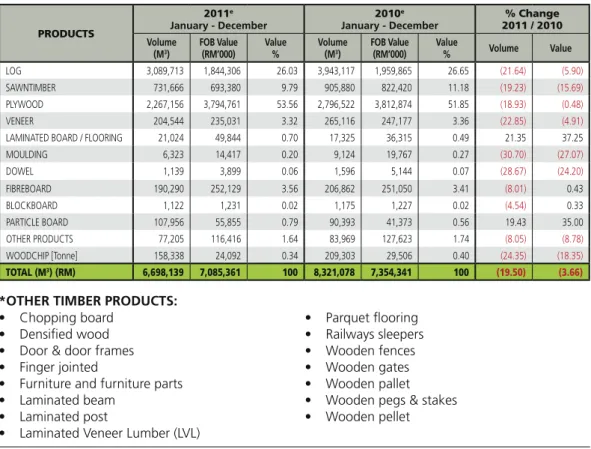
he value of log and timber products exported for 2011 decreased by 4% worth RM7.09 billion compared to the same period last year at RM7.35 billion.There were decreased in the overall values of logs and timber products exported. Respective decreases in export value were that of logs (6%), sawn timber (16%), plywood (0.5%), veneer (5%), moulding (27%), dowel (24%) and woodchips (18%) from January to December 2011 compared to the corresponding period in 2010.
Despite the decrease in values exported of all timber products, there were respective increases in the value of laminated board/flooring (37%), fibreboard (0.43%), blockboard (0.33%) and particle board (35%).
Plywood remained the major contributor accounting for 54% @ RM3.8 billion of the total export value, with logs (26% @ RM1.8 billion) and sawntimber (10% @ RM0.7 billion) as second and third place respectively. (Table 1)
market
LOGS •
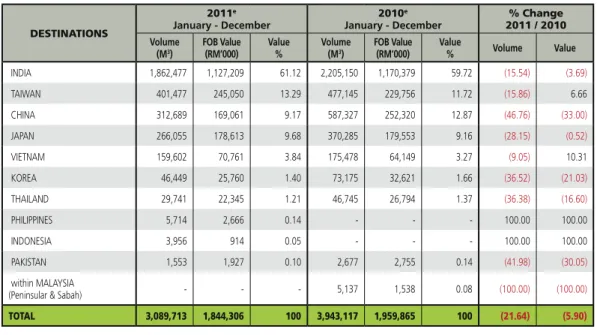
The volume of log exported for 2011 decreased by 22% to 3.1 million m3 from 3.9million m3 and the value decreased by 6% to RM1.84 billion from RM1.96 billion compared to the same period of last year.India remained the largest buyer of the State’s logs by purchasing1.9 million m3 of the overall volume exported valued at RM1.1 billion followed by Taiwan (0.401 million m3, RM245 million) and China (0.312 million m3, RM169 million). India was still the largest importer of log in 2011 however they had decreased their purchased by 16% compared to similar period in 2010 followed by Taiwan (16%) and China (47%) respectively.
Export of logs to major buyers like India, Taiwan and China constituted 84% of the total export volumes and also contributed 86% to the total export values of logs from January to December 2011.
Average FOB unit value of logs increased by 20% from RM497 to RM597 for 2011 compared to similar period in 2010. (Table 2)
Japan maintained its position as the number one buyer of plywood with the purchase of 1.3 million m³ or 58% of the volume exported valued at RM3.8 billion.
Other major plywood importers are Korea making a purchase of 11% at 0.24 million m3 with the value RM324 million and Taiwan (10% at 0.225 million m3
@ RM311 million), in which they contributed RM3.0 billion to the overall volumes of plywood exported for the period.
The volume of plywood exported to Japan increased by 5% from 1.2 million m3 to 1.3 million m3 followed by Korea (decreased by 53% from 0.51 million m3 to 0.24 million m3) and Taiwan (decreased by 22% from 0.29 million m3 to 0.23 million m3).
Export of plywood to major buyers like Japan, Korea and Taiwan constituted 78% of the overall exported volumes and contributed 79% to the overall revenues for 2011.
Average FOB unit value of plywood increased by 23%
from RM1,363 to RM1,673 for 2011 compared to similar period in 2010. (Table 4)
SAWN TIMBER •
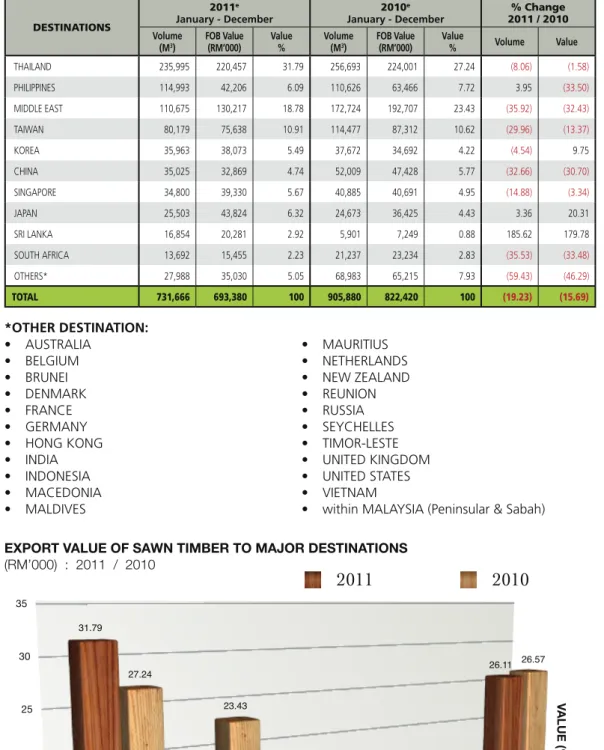
Volume and value of sawn timber exported for 2011 decreased by 19% to 0.73 million m3 from 0.91 million m3 and the value decreased by 10% to RM693 million from RM822 million compared to that of similar period in 2010.Thailand remained the number one importer of the State’s sawn timber, by purchasing 32% of the overall volume at 0.24 million m3 and valued at RM220 million followed by Philippines (0.115million m3 @ RM42 million) and Middle East (0.111 million m3 and @ RM130 million) respectively.
The volume of sawntimber exported to Thailand decreased by 8% from 0.26 million m3 to 0.24 million m3, followed by Philippines (increased by 4% from 0.111 million m3 to 0.114 million m3) and Middle East (decreased by 36% from 0.173 million m3 to 0.111 million m3).
Export of sawntimber to major buyers like Thailand, Philippines and Middle East constituted 63% of the total export volumes and contributed 60% to the total export values of logs from January to December 2011.
Average FOB unit value of sawntimber increased by 4% from RM908 to RM948 for 2011 compared to similar period in 2010. (Table 3)
OTHER TIMBER
PRODUCTS •
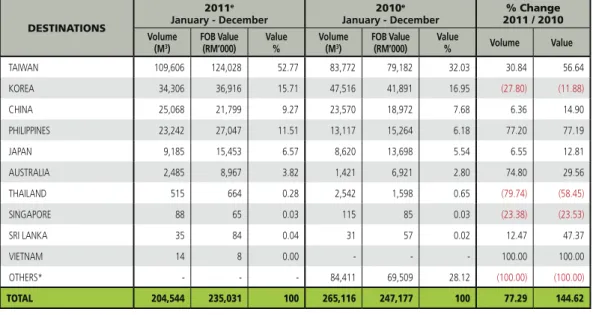
Other timber products includes veneer, dowels, moulding, particleboard, fibreboard, block board, laminated board, woodchip and other timber products (mention in Table 1).Value of export of these products was at RM0.75 billion accounted for 11% of the overall value of the timber and timber products exported from January to December 2011.
Respective decreases in export volumes were that of veneer (23%), moulding (31%), dowel (29%), fibreboard (8%), blockboard (5%) and woodchips (24%). In spite of the overall decrease in export volume, there were an increase for laminated board (21%), and particle board (19%) in the January to December 2011 compared to the corresponding period in 2010. (Table 5, 6, 7, 8, & 9)
FUTURE OUTLOOK •
Thefuture outlook for the Malaysian timber industry in 2012 remains uncertain as prices of timber and timber products remain weak as compared to last year performance. (Source: ITTO).
According to some analysts that, this could be attributed to slow recovery in housing construction sector in Japan after earthquake-Tsunami last year.
The situation is further aggravated by slowdown in the global economy resulting in trade deficit and fuel import rise up. This could weigh on timber prices and timber companies earnings and this probably continue until 2013. (Source: Borneo Post) The world economic is predicted to grow
moderately, assuming that Europe market will not collapse due to its financial crisis. Therefore, the timber industries should be better prepared to grow in consonance with the growth of the world economy.
PRODUCTS
2011e
January - December 2010e
January - December % Change
2011 / 2010 Volume
(M3) FOB Value (RM’000) Value
% Volume
(M3) FOB Value (RM’000) Value
% Volume Value
LOG 3,089,713 1,844,306 26.03 3,943,117 1,959,865 26.65 (21.64) (5.90)
SAWNTIMBER 731,666 693,380 9.79 905,880 822,420 11.18 (19.23) (15.69)
PLYWOOD 2,267,156 3,794,761 53.56 2,796,522 3,812,874 51.85 (18.93) (0.48)
VENEER 204,544 235,031 3.32 265,116 247,177 3.36 (22.85) (4.91)
LAMINATED BOARD / FLOORING 21,024 49,844 0.70 17,325 36,315 0.49 21.35 37.25
MOULDING 6,323 14,417 0.20 9,124 19,767 0.27 (30.70) (27.07)
DOWEL 1,139 3,899 0.06 1,596 5,144 0.07 (28.67) (24.20)
FIBREBOARD 190,290 252,129 3.56 206,862 251,050 3.41 (8.01) 0.43
BLOCKBOARD 1,122 1,231 0.02 1,175 1,227 0.02 (4.54) 0.33
PARTICLE BOARD 107,956 55,855 0.79 90,393 41,373 0.56 19.43 35.00
OTHER PRODUCTS 77,205 116,416 1.64 83,969 127,623 1.74 (8.05) (8.78)
WOODCHIP [Tonne] 158,338 24,092 0.34 209,303 29,506 0.40 (24.35) (18.35)
TOTAL (M3) (RM) 6,698,139 7,085,361 100 8,321,078 7,354,341 100 (19.50) (3.66)
TABLE 1. EXPORT SUMMARY OF TIMBER AND TIMBER PRODUCTS FROM SARAWAK
EXPORT VALUE OF MAJOR TIMBER & TIMBER PRODUCTS FROM SARAWAK (RM’000) : 2011 / 2010
• Chopping board
• Densified wood
• Door & door frames
• Finger jointed
• Furniture and furniture parts
• Laminated beam
• Laminated post
• Laminated Veneer Lumber (LVL)
• Parquet flooring
• Railways sleepers
• Wooden fences
• Wooden gates
• Wooden pallet
• Wooden pegs & stakes
• Wooden pellet
*OTHER TIMBER PRODUCTS:
Notes:
• Fibreboard include MDF and HDF
• Total of volume (m3) does not includes woodchips (tonne)
• a = annual & total include application/permit to transport goods within the Federation [Customs Decleration Form No.3 (CDF3)]
• e = estimate & uncheck data; total does not include application/permit to transport goods within the Federation [Customs Decleration Form No.3 (CDF3)]
DESTINATIONS
2011e January - December
2010e January - December
% Change 2011 / 2010 Volume
(M3) FOB Value (RM’000) Value
% Volume
(M3) FOB Value (RM’000) Value
% Volume Value
INDIA 1,862,477 1,127,209 61.12 2,205,150 1,170,379 59.72 (15.54) (3.69)
TAIWAN 401,477 245,050 13.29 477,145 229,756 11.72 (15.86) 6.66
CHINA 312,689 169,061 9.17 587,327 252,320 12.87 (46.76) (33.00)
JAPAN 266,055 178,613 9.68 370,285 179,553 9.16 (28.15) (0.52)
VIETNAM 159,602 70,761 3.84 175,478 64,149 3.27 (9.05) 10.31
KOREA 46,449 25,760 1.40 73,175 32,621 1.66 (36.52) (21.03)
THAILAND 29,741 22,345 1.21 46,745 26,794 1.37 (36.38) (16.60)
PHILIPPINES 5,714 2,666 0.14 - - - 100.00 100.00
INDONESIA 3,956 914 0.05 - - - 100.00 100.00
PAKISTAN 1,553 1,927 0.10 2,677 2,755 0.14 (41.98) (30.05)
within MALAYSIA
(Peninsular & Sabah) - - - 5,137 1,538 0.08 (100.00) (100.00)
TOTAL 3,089,713 1,844,306 100 3,943,117 1,959,865 100 (21.64) (5.90)
TABLE 2. EXPORT OF LOG BY COUNTRY OF DESTINATIONS
EXPORT VALUE OF LOG TO MAJOR DESTINATIONS (RM’000) : 2011 / 2010
DESTINATIONS
2011e January - December
2010e January - December
% Change 2011 / 2010 Volume
(M3) FOB Value (RM’000) Value
% Volume
(M3) FOB Value (RM’000) Value
% Volume Value
THAILAND 235,995 220,457 31.79 256,693 224,001 27.24 (8.06) (1.58)
PHILIPPINES 114,993 42,206 6.09 110,626 63,466 7.72 3.95 (33.50)
MIDDLE EAST 110,675 130,217 18.78 172,724 192,707 23.43 (35.92) (32.43)
TAIWAN 80,179 75,638 10.91 114,477 87,312 10.62 (29.96) (13.37)
KOREA 35,963 38,073 5.49 37,672 34,692 4.22 (4.54) 9.75
CHINA 35,025 32,869 4.74 52,009 47,428 5.77 (32.66) (30.70)
SINGAPORE 34,800 39,330 5.67 40,885 40,691 4.95 (14.88) (3.34)
JAPAN 25,503 43,824 6.32 24,673 36,425 4.43 3.36 20.31
SRI LANKA 16,854 20,281 2.92 5,901 7,249 0.88 185.62 179.78
SOUTH AFRICA 13,692 15,455 2.23 21,237 23,234 2.83 (35.53) (33.48)
OTHERS* 27,988 35,030 5.05 68,983 65,215 7.93 (59.43) (46.29)
TOTAL 731,666 693,380 100 905,880 822,420 100 (19.23) (15.69)
TABLE 3. EXPORT OF SAWN TIMBER BY COUNTRY OF DESTINATIONS
EXPORT VALUE OF SAWN TIMBER TO MAJOR DESTINATIONS (RM’000) : 2011 / 2010
• AUSTRALIA
• BELGIUM
• BRUNEI
• DENMARK
• FRANCE
• GERMANY
• HONG KONG
• INDIA
• INDONESIA
• MACEDONIA
• MALDIVES
• MAURITIUS
• NETHERLANDS
• NEW ZEALAND
• REUNION
• RUSSIA
• SEYCHELLES
• TIMOR-LESTE
• UNITED KINGDOM
• UNITED STATES
• VIETNAM
• within MALAYSIA (Peninsular & Sabah)
*OTHER DESTINATION:
DESTINATIONS
2011e January - December
2010e January - December
% Change 2011 / 2010 Volume
(M3) FOB Value (RM’000) Value
% Volume
(M3) FOB Value (RM’000) Value
% Volume Value
JAPAN 1,307,042 2,369,847 62.45 1,245,661 1,853,303 48.61 4.93 27.87
KOREA 239,950 324,099 8.54 512,299 570,808 14.97 (53.16) (43.22)
TAIWAN 225,202 310,645 8.19 287,927 358,998 9.42 (21.78) (13.47)
MIDDLE EAST 210,770 297,548 7.84 338,578 429,833 11.27 (37.75) (30.78)
PHILIPPINES 61,619 103,301 2.72 55,541 80,857 2.12 10.94 27.76
CHINA 48,419 97,211 2.56 60,285 86,830 2.28 (19.68) 11.96
UNITED STATES 44,076 86,360 2.28 68,966 118,502 3.11 (36.09) (27.12)
HONG KONG 37,599 52,750 1.39 50,109 63,714 1.67 (24.97) (17.21)
AUSTRALIA 21,062 46,561 1.23 31,031 59,388 1.56 (32.13) (21.60)
SINGAPORE 18,005 22,620 0.60 25,309 29,363 0.77 (28.86) (22.96)
OTHERS* 53,413 83,819 2.21 120,815 161,278 4.23 (55.79) (48.03)
TOTAL 2,267,156 3,794,761 100 2,796,522 3,812,874 100 (18.93) (0.48)
TABLE 4. EXPORT OF PLYWOOD BY COUNTRY OF DESTINATIONS
• BELGIUM
• BRUNEI
• CANADA
• COTE D’IVOIRE
• CYPRUS
• DOMINICAN REPUBLIC
• GERMANY
• INDIA
• INDONESIA
• IRELAND
• ITALY
• LIBERIA
• MALDIVES
• MALTA
• MAURITIUS
• MEXICO
• NETHERLANDS
• NEW ZEALAND
• NORTHERN MARIANA ISLANDS
• RUSSIA
• SOUTH AFRICA
• SRI LANKA
• THAILAND
• UNITED KINGDOM
• VIETNAM
• within MALAYSIA (Peninsular & Sabah)
*OTHER DESTINATION:
EXPORT VALUE OF PLYWOOD TO MAJOR DESTINATIONS (RM’000) : 2011 / 2010
DESTINATIONS
2011e January - December
2010e January - December
% Change 2011 / 2010 Volume
(M3) FOB Value (RM’000) Value
% Volume
(M3) FOB Value (RM’000) Value
% Volume Value
TAIWAN 109,606 124,028 52.77 83,772 79,182 32.03 30.84 56.64
KOREA 34,306 36,916 15.71 47,516 41,891 16.95 (27.80) (11.88)
CHINA 25,068 21,799 9.27 23,570 18,972 7.68 6.36 14.90
PHILIPPINES 23,242 27,047 11.51 13,117 15,264 6.18 77.20 77.19
JAPAN 9,185 15,453 6.57 8,620 13,698 5.54 6.55 12.81
AUSTRALIA 2,485 8,967 3.82 1,421 6,921 2.80 74.80 29.56
THAILAND 515 664 0.28 2,542 1,598 0.65 (79.74) (58.45)
SINGAPORE 88 65 0.03 115 85 0.03 (23.38) (23.53)
SRI LANKA 35 84 0.04 31 57 0.02 12.47 47.37
VIETNAM 14 8 0.00 - - - 100.00 100.00
OTHERS* - - - 84,411 69,509 28.12 (100.00) (100.00)
TOTAL 204,544 235,031 100 265,116 247,177 100 77.29 144.62
TABLE 5. EXPORT OF VENEER BY COUNTRY OF DESTINATIONS
EXPORT VALUE OF VENEER TO MAJOR DESTINATIONS (RM’000) : 2011 / 2010
• FINLAND
• within MALAYSIA (Peninsular & Sabah)
*OTHER DESTINATION:
DESTINATIONS
2011e January - December
2010e January - December
% Change 2011 / 2010 Volume
(M3) FOB Value (RM’000) Value
% Volume
(M3) FOB Value (RM’000) Value
% Volume Value
UNITED STATES 385 1,431 36.70 684 2,463 47.88 (43.69) (41.90)
EU 265 979 25.11 220 928 18.04 20.10 5.50
AUSTRALIA 139 336 8.62 217 456 8.86 (36.10) (26.32)
SOUTH AFRICA 138 388 9.95 160 466 9.06 (13.86) (16.74)
INDIA 116 442 11.34 53 185 3.60 120.13 138.92
SWITZERLAND 49 189 4.85 49 202 3.93 0.37 (6.44)
JAPAN 43 115 2.95 58 198 3.85 (26.95) (41.92)
CANADA 5 19 0.49 33 110 2.14 (84.65) (82.73)
TAIWAN - - - 75 122 2.37 (100.00) (100.00)
MIDDLE EAST - - - 47 14 0.27 (100.00) (100.00)
TOTAL 1,139 3,899 100 1,596 5,144 100 (28.67) (24.20)
TABLE 6. EXPORT OF DOWEL BY COUNTRY OF DESTINATIONS
EXPORT VALUE OF DOWEL TO MAJOR DESTINATIONS (RM’000) : 2011 / 2010
DESTINATIONS
2011e January - December
2010e January - December
% Change 2011 / 2010 Volume
(M3) FOB Value (RM’000) Value
% Volume
(M3) FOB Value (RM’000) Value
% Volume Value
JAPAN 2,582 5,311 36.84 1,497 2,834 14.34 72.45 87.40
KOREA 992 2,135 14.81 2,959 5,099 25.80 (66.46) (58.13)
AUSTRALIA 983 2,356 16.34 2,173 5,795 29.32 (54.77) (59.34)
TAIWAN 682 1,940 13.46 520 1,329 6.72 31.13 45.97
EU 561 1,329 9.22 901 2,099 10.62 (37.68) (36.68)
SINGAPORE 127 145 1.01 151 276 1.40 (16.21) (47.46)
UNITED STATES 117 617 4.28 183 715 3.62 (35.97) (13.71)
SEYCHELLES 84 59 0.41 31 28 0.14 175.20 110.71
CANADA 71 309 2.14 357 1,045 5.29 (80.19) (70.43)
SOUTH AFRICA 42 75 0.52 130 230 1.16 (68.02) (67.39)
OTHERS* 82 141 0.98 222 317 1.60 (63.25) (55.52)
TOTAL 6,323 14,417 100 9,124 19,767 100 (30.70) (27.07)
TABLE 7. EXPORT OF MOULDING BY COUNTRY OF DESTINATIONS
EXPORT VALUE OF MOULDING TO MAJOR DESTINATIONS (RM’000) : 2011 / 2010
• CAMBODIA
• CHINA
• INDIA
• IRAQ
• MALDIVIES
• MAURITIUS
• TURKEY
*OTHER DESTINATION:
DESTINATIONS
2011e January - December
2010e January - December
% Change 2011 / 2010 Volume
(M3) FOB Value (RM’000) Value
% Volume
(M3) FOB Value (RM’000) Value
% Volume Value
JAPAN 146,168 208,229 82.59 137,500 187,847 74.82 6.30 10.85
INDONESIA 17,002 16,745 6.64 24,611 21,347 8.50 (30.92) (21.56)
PHILIPPINES 8,775 8,359 3.32 9,655 7,836 3.12 (9.12) 6.67
TAIWAN 4,148 4,524 1.79 4,312 4,176 1.66 (3.79) 8.33
THAILAND 3,669 3,312 1.31 1,657 1,559 0.62 121.39 112.44
CHINA 2,123 2,196 0.87 2,890 2,822 1.12 (26.54) (22.18)
VIETNAM 1,821 1,713 0.68 2,799 2,721 1.08 (34.95) (37.05)
BRUNEI DARUSSALAM 1,797 1,631 0.65 3,753 3,523 1.40 (52.10) (53.70)
NETHERLANDS 1,290 2,264 0.90 1,170 1,852 0.74 10.24 22.25
INDIA 1,041 681 0.27 1,714 1,072 0.43 (39.22) (36.47)
OTHERS* 2,455 2,475 0.98 16,801 16,295 6.49 (85.39) (84.81)
TOTAL 190,290 252,129 100 206,862 251,050 100 (8.01) 0.43
TABLE 8. EXPORT OF FIBREBOARD BY COUNTRY OF DESTINATIONS
EXPORT VALUE OF FIBREBOARD TO MAJOR DESTINATIONS (RM’000) : 2011 / 2010
• AUSTRALIA
• KOREA
• NETHERLANDS
• SINGAPORE
• within MALAYSIA (Peninsular & Sabah)
*OTHER DESTINATION:
Notes:
• Fibreboard include MDF and HDF
DESTINATIONS
2011e January - December
2010e January - December
% Change 2011 / 2010 Volume
(M3) FOB Value (RM’000) Value
% Volume
(M3) FOB Value (RM’000) Value
% Volume Value
INDONESIA 45,684 23,239 41.61 45,380 20,951 50.64 0.67 10.92
VIETNAM 17,997 8,726 15.62 6,299 2,919 7.06 185.73 198.94
INDIA 15,417 7,932 14.20 6,636 2,788 6.74 132.34 184.51
PHILIPPINES 12,453 6,694 11.98 11,102 5,465 13.21 12.16 22.49
KOREA 9,698 5,707 10.22 2,202 912 2.20 340.35 525.77
BRUNEI 2,512 1,264 2.26 214 104 0.25 1,072.12 1115.38
JAPAN 2,191 1,315 2.35 1,603 835 2.02 36.71 57.49
BANGLADESH 1,121 297 0.53 5,248 1,450 3.50 (78.64) (79.52)
CHINA 884 681 1.22 3,506 2,030 4.91 (74.78) (66.45)
within MALAYSIA
(Peninsular & Sabah) - - - 5,921 2,919 7.06 (100.00) (100.00)
OTHERS* - - - 2,282 1,000 2.42 (100.00) (100.00)
TOTAL 107,956 55,855 100 90,393 41,373 100 19.43 35.00
TABLE 9. EXPORT OF PARTICLE BOARD BY COUNTRY OF DESTINATIONS
EXPORT VALUE OF PARTICLE BOARD TO MAJOR DESTINATIONS (RM’000) : 2011 / 2010
• HONG KONG
• JORDAN
• KENYA
• SINGAPORE
• UNITED ARAB EMIRATES
*OTHER DESTINATION:
Publications Catalogue:
go to
Utilising technology and innovations for timber products are the hallmarks of STIDC’s continuous pursuit of excellence for the timber industry and rightly, nothing should go to waste.
In this aspect, STIDC has strived to make use of every part of the log for useful purposes and further enrich downstream industries for the benefit of the State and its people, now and for the future. STIDC firmly believes that forest resources should be optimally utilised for a sustainable future.
PERBADANAN KEMAJUAN PERUSAHAAN KAYU SARAWAK Sarawak Timber Industry Development Corporation (STIDC)
Wisma Sumber Alam, Jalan Stadium, Petra Jaya, 93050 Kuching, P.O. Box 194, 93702 Kuching, Sarawak, Malaysia.
Tel: 6082-473000 Fax: 6082-442691 E-mail: [email protected]
www.sarawaktimber.org.my