Asiatic, Vol. 14, No. 2, December 2020 89
A Pragma-Rhetorical Study of Persuasion in American and Iraqi Billboards
Siham Mohammad Hasan AlKawwaz,1 University of Kufa, Iraq Maarif Jameel Thamir Altamimi,2 University of Kufa, Iraq
Abstract
The present study investigates pragmatic and rhetorical aspects of the advertising message to explore how persuasion takes place. It aims to identify and analyse the persuasive appeals, rhetorical devices, and speech acts the advertisers use in the headlines of some American and Iraqi billboards. For this purpose, an eclectic model has been adopted which consists of Searle’s (1969) speech acts theory, Lucas’s (2009) persuasive appeals, McQuarrie’s and Mick’s (1996) rhetorical devices, and Cook’s (2001) advertising context. The findings of the study showed that American and Iraqi billboards have a lot in common.
The advertisers relied mainly upon the tropes of ellipsis and hyperbole in writing advertisements. Pathos appeal was employed as the basic tool to achieve persuasive impact on potential customers. Moreover, directives, representatives, and commissives were the main acts through which persuasion was realised.
Keywords
Persuasive appeals, pragma-rhetorical, advertising, speech acts, billboard advertisements, rhetorical device
Introduction
Advertising is a communication process in which there is a sender, receiver, and a message. Such a message is found implicit in the advertising instrument whether it is a TV commercial or a print advertisement. An advertisement is usually designed to have an influence upon the behaviour and/or thoughts of the target audience. It follows that advertising is by no means a random process. It is, rather, a purposeful act aimed at convincing potential buyers.
Such a characteristic is well manifested in advertising language and is different from that used in everyday communication. What distinguishes advertising text is the way it is formulated to make it more persuasive and attractive than that of ordinary conversations.
1 Siham AlKawwaz is Assistant Professor at the University of Kufa. She has several publications to her credit in the areas of pragmatics and semantics. She has been a member of International Pragmatics Association (IPrA) in Belgium since 2001. Email: [email protected]
2Maarif Altamimi is an MA student of Linguistics in the Department of English Language and Literature at the University of Kufa. Her research interests include discourse analysis, pragmatics, and sociolinguistics. Email: [email protected]
Asiatic, Vol. 14, No. 2, December 2020 90
Consequently, achieving persuasion requires adopting certain strategies and utilising devices such as those used for appealing to human emotions or rationality. Advertisers can deliver their advertisements through a variety of mass media such as radio, newspapers, outdoor displays, and television (Janoschka 15; 18). Interestingly, each of these has its own merits and demerits and that is why clients prefer not to rely upon a single medium in advertising their commodities.
In recent years, billboards, as a type of outdoor advertising, have rapidly developed and flourished in cities and towns, as the medium is suitable for commodities that fall within the public interest (Sahaf 478). Linguistically, billboard advertisement is a unique category, especially when it comes to headline3 structure, because it has to be cleverly written in order to achieve readability, understanding, and memorability of the advertisement – all within certain limits of time and space. Persuasion in the billboard medium has been addressed from different perspectives, rhetorically and stylistically. However, few studies have investigated the pragmatic and rhetorical aspects of billboards, especially those contrasting American and Iraqi advertisements. The present study attempts to bridge this research gap by answering the following questions:
a. What are the rhetorical devices and persuasive appeals which are used most in American and Iraqi advertisements?
b. Do American and Iraqi advertisements share common rhetorical devices and persuasive appeals?
c. What kinds of speech acts are employed by advertisers for persuasion?
d. What role does the advertising context play in billboards?
Persuasion and Rhetoric
Persuasion owes much of its current state to the Greek philosopher Aristotle (384-322 BC). It was always seen related to rhetoric as being its main aim and purpose. Aristotle (Herrick 69) views persuasion as the expected outcome of adopting the rhetorical means of language. For him, persuasion includes two types of proofs: artistic and inartistic. In the case of artistic proof, it represents the way the persuasive discourse is organised, the process of choosing evidence and delivery style, as well as language choices. Conversely, inartistic proof consists of those things that are beyond the speaker’s control, for instance, the occasion, the time given to, and the physical appearance of, the speaker (Larson, 20). In his book Rhetoric, Aristotle defines rhetoric as “the faculty of observing in any given case the available means of persuasion” (qtd. in Mey 864). It is not enough for a speaker to know what to say; it is also necessary to
3 A headline carries the essence of the advertising message by summarising the body copy. It usually appears at the top or bottom of an advertisement. For illustration, see Appendix A.
Asiatic, Vol. 14, No. 2, December 2020 91
know how to say it. Aristotle also stresses the importance of language distinctiveness which can be produced by means of rhetorical devices like metaphors. As such, rhetoric proposes persuasion, for it is concerned with how to say things. Further, rhetoric accounts for the stylistic choices by which one can persuade an audience.
Persuasive Appeals
It was Aristotle who first presented what is known as proofs taken as the means through which the primary goal of rhetoric, that is, persuasion, can be achieved.
Persuasive appeals are of three types: logos, ethos, and pathos. According to Aristotle, logos is used to refer to the availability of proofs whether in words, arguments, or the logic of speech. It is regarded as a closely related domain to logic, for it is based on reasoning or inference making (Herrick 79). Since logical appeals are aimed at the thinking side of the audience, authors depend on evidence and reasoning as the main tools by which persuasion is achieved.
Evidence may be in the form of quotations, statistics, or testimony which can be used to support a particular point of view. Additionally, reasoning can be the outcome of various sources such as analogy, principle, or cause and effect relation (Lucas 362-7).
Ethos generally refers to the credibility of the speaker making the argument. There is a big chance to believe what someone else says if s/he has good ethics. This means that ethos appeal uses the speaker’s own trustworthiness or credibility to make a case and thus gain the approval needed (Ramage et al. 111). Credibility embraces two more components: competence and character. Competence includes sincerity, expertise, and knowledge of the speaker, while character refers to the way the audience considers the reputation, trustworthiness, and physical appearance of the speaker (Lucas 353).
The third appeal, that is, pathos, is closely related to emotions. It is usually directed towards the feelings of people to make them feel proud, afraid, angry, shameful, and so forth (Lucas 370). In this respect, Aristotle describes pathos as “putting the audience in the right frame of mind” (Herrick 79-80).
Creating pathos appeal requires certain strategies like concrete language, specific examples, illustrations, narratives, and metaphors (Ramage et al. 113).
Pragma-Rhetorical Perspective
The term pragma-rhetorical describes the use of pragmatic and rhetorical devices and strategies in analysing certain stretches of speech. The present study will be following Larrazabal’s and Korta’s (2002) concept of pragma-rhetorical in which pragmatic and rhetorical devices and strategies are identified and
Asiatic, Vol. 14, No. 2, December 2020 92
analysed separately. It differs from that of Dascal’s4 (2003), as his is limited to figures of speech and persuasive appeals, treating them as pragma-rhetorical devices all at once. Accordingly, the pragmatic side of the current study includes identifying types of speech acts, while the rhetorical part deals with the persuasive appeals and rhetorical devices to present a comprehensive framework of persuasion in billboard advertising language.
Previous Studies
A few studies on persuasion in billboards have been conducted. Angriani et al (2017) analysed smartphones billboard advertisements of several cell phone companies to find out which of the rhetorical appeals were employed most by advertisers. The tool adopted for analysis was based on Ramage et al’s (2010) rhetorical appeals. The results revealed that logos was the basic appeal used to persuade potential customers. This is because advertising cell phones is related to technology and needs to be proven scientifically. Another study was done by Maalej (2015) who investigated the utilisation of stylistic features in advertising discourse as a means of persuasion. Sixty-five billboards in the city of Tunis were analysed in terms of certain stylistic strategies, namely phonological, syntactic, and code mixing. In addition, the pragmatic function, that is their persuasive impact on potential buyers were investigated. The results showed that persuasion depended on phonological, syntactic, code-mixing, and other strategies.
The pragmatic and rhetorical aspects of persuasion in billboards have not been given much attention. For this reason, this study attempts to fill this gap by focusing on the pragma-rhetorical roadmap advertisers follow to attain persuasion. The study can be of value for rhetoricians, pragmatists, and psycholinguists as well, since they are all interested in influencing others.
Data Collection
The data of the present study consists of fifty billboard advertisements (poster panel5 and bulletin type6). Twenty-five advertisements are Arabic (mainly in Iraqi dialect), while the other twenty-five are English (basically American).
These advertisements fall into the most common type of advertisements, namely the commercial consumer type which is usually concerned with
4 Rhetoric makes use of rhetorical devices which are primarily pragmatic-based, as they result from flouting certain conversational maxims. At the same time, Aristotle’s appeals involve inferences as much as figures of speech do. That is, pathos appeal can be detected when irony is employed, since it indicates anger. Thus, we infer that someone is upset when s/he says one thing to mean the opposite. Similarly, irony is figured out as a result of flouting Grice’s maxim of quality which says: “do not say what you believe to be false” (605-618).
5 A poster panel consists of a paper pasted to boards to be placed alongside highways.
6 Bulletins are more like posters, but they are much larger and are painted directly onto the board.
Asiatic, Vol. 14, No. 2, December 2020 93
positively affecting consumers’ attitude towards a particular commodity of some company or business to make a purchase. The data collected is a heterogeneous collection of advertisements representing various products and services such as cars, banking services, colleges, foods and drinks, and the like.
Moreover, the part that will be analysed is typically the headline, for it carries the central theme of the advertising message (Janoschka 22). Besides, a billboard has only the headline as its advertising text. The American billboard advertisements used in this study were produced by some advertising companies and agencies: Clear Channel, Regency, Lamar, Az Billboard , Ashby, Via, Adams, and Ace. The Iraqi billboard advertisements were mainly photographed in the city of Najaf streets using cell-phone cameras. The Iraqi advertisements were translated into English for analysis (see Appendix D).
Model of Analysis
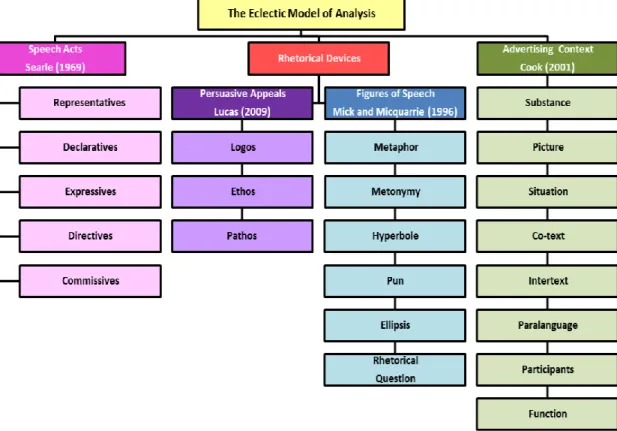
The current study has provided both qualitative and quantitative analysis of its data. The qualitative part seeks to introduce an in-depth description of the data by drawing upon an eclectic model to discover the pragma-rhetorical aspects of persuasion in billboard headlines. The quantitative part, on the other hand, was dedicated to discussing the statistical results of the study. The model adopted for analysing the data qualitatively is a combination of the following:
First: Searle’s (1969) classification of speech acts – representatives, directives, commissives, expressives, and declaratives – employed to identify the kinds of acts used for persuasion.
Second: Lucas’s (2009) model for analysing the persuasive appeals, which include logos, ethos, and pathos.
Third: Mick and McQuarrie’s (1996) model for analysing the rhetorical devices copywriters7 employ in advertisements. The latter model embraces two main categories of figures of speech widely used in advertisements, namely schemes and tropes. The tropes are, in turn, divided into two types, destabilisation and substitution. In the present study, only certain tropes were investigated. These were metaphor, pun, hyperbole, ellipsis, rhetorical question, and metonymy. The selection of these six was based on the information found in advertising strategies, the copy structure of billboards, and the results of some research papers on figures of speech. However, schemes were excluded because of their insignificant role in advertising since they are limited to providing advertisement memorability (Moriarty et al. 271).
Fourth: Cook’s (2001) model of advertising context without which advertisement analysis would not be complete. Context cannot be dismissed because it does add or change the meaning of an advertisement. It is an indispensable part to fully understand the communicated message. In Cook’s
7 Those who write the text of advertisements.
Asiatic, Vol. 14, No. 2, December 2020 94
view, an advertising context consists of eight basic elements: substance, music and pictures, paralanguage, situation, co-text, intertext, participants, and function.
Figure 1. The Eclectic Model of Analysis Results and Discussion
This section introduces the results and discussion of the data based on the four models employed. It also provides a statistical analysis of the findings.
Speech Acts
Representatives, directives, and commissives were the most frequent speech acts in American billboards at 52%, 48%, 36%, respectively. Representatives were used as a means through which assertions or descriptions about the advertised product were given. For instance, in headline 1, the cold-brewed coffee served is described as surprisingly smooth suggesting non-grainy drink.
Similarly, there was a heavy reliance on directives presented as a piece of advice, a request, or an invitation, thus creating a welcoming or friendly atmosphere.
Asiatic, Vol. 14, No. 2, December 2020 95
Headline 22 is introduced via a directive in which the advertising message represents a request from Peapod Delivery Company, telling its customers to spare themselves the long ride of picking up the groceries and leave it to Peapod instead. Commissives were indirect and combined with other speech acts, namely representatives and directives. For example, headline 16 is both a representative and a commissive. It is a representative, for the headline gives a description of the results a woman gets after using Matrix hair products, while as a commissive, it represents an implied promise to customers of silky hair.
Declaratives and expressives were not used at all.
Figure 2. Percentages of Occurrence of Speech Acts in American and Iraqi Advertisements
The Iraqi headlines revealed similar results as shown in Figure 2.
Representatives had the highest frequency which comprised 68% of the data (headline 6,7), whereas directives were the second most frequent speech act 32% (headline 11,20). This shows that Arab copywriters preferred representatives more because they may want to avoid imposition. With respect to commissives, their percentage of use was 32% (headline 4). In the case of declaratives and expressives, like their American counterparts, no instances were noticed.
It can be argued that such a high occurrence of representatives is attributed to the fact that the advertisers typically followed the common method of selling, which simply requires introducing the audience to the necessary information about the advertised commodity and then leaving them to decide. In the case of directives, the high percentage indicates that the
0%
10%
20%
30%
40%
50%
60%
70%
English ads Arabic ads
Asiatic, Vol. 14, No. 2, December 2020 96
advertisers aimed to encourage the target audience to purchase. Advertisers also employed commissives occasionally through promising as a kind of guarantee to create trust between the audience and the manufacturers and affect their buying decision-making. Declaratives and expressives were excluded as advertisers found certain acts more persuasive than others.
Persuasive Appeals
Pathos was the main appeal on which the advertisers relied for persuasion, and it comprised 88% of the data. It was produced by using either words or visuals, or both as in headline 12, where the word “fresh” along with the picture of the steaming cup of coffee and macaroon biscuits next to it formed pathos by appealing to human senses of taste and smell. By contrast, ethos was rarely used in the remaining 12% found in headlines 3, 5, and 23. In 3 and 5, ethos was realised through celebrity endorsement, whereas in 23 the long experience and good reputation of the insurance company formed ethos by mentioning the date at which the company first started its business. Logos was used at all.
Similarly, the Iraqi advertisements displayed a heavy reliance upon pathos appeal which comprised 100% of the data, unlike ethos and logos which were discarded altogether.
As shown in the previous discussion, pathos was noticed to be the appeal the advertisers used most to influence potential buyers. This can be justified in two ways. Most of advertising strategies are largely pathos-based.
The association principle strategy works by attaching certain positive feelings with the commodity to make it desirable. In the same way, humour and children strategies both make use of human emotions as a shortcut to persuading them to buy the advertised product. The other reason for using pathos more might be the fact that humans are more affected by emotions and feelings than by reason (Thompson 10).
In this vein, through analysing persuasive appeals, it was found that there were certain emotions or appeals that were mostly used by the advertisers to demonstrate pathos. These include happiness, comfort, security, price, high quality, human senses, and health. Moreover, it was noticed that the Iraqi advertisers used the Iraqi local dialect rather than classical Arabic as a way to create casual impact as noticed in the words تبرش (drink) and ةيطوق (can). Such informal atmosphere can have an overwhelming effect upon customers’ buying choices, because the local dialect gives the advertising message the power to connect to them emotionally.
Asiatic, Vol. 14, No. 2, December 2020 97
Figure 3. Percentages of Occurrence of Persuasive Appeals in American and Iraqi Advertisements
The exclusion of logos appeal might be ascribed to consideration to keep the advertising text short, as logos requires using more words and space which is not possible in the billboard medium. Such finding contrasts with that of Angriani’s (2017) in which logos was the basic appeal used to get a potential customer persuaded since advertising cell phones is related to technology and needs to be proven scientifically. In the case of ethos, the paucity of this appeal in the Iraqi advertisements might be related to the advertisers’ belief that the audience has little trust in authorities. Nevertheless, persuasive appeals, in general, were not achieved via words per se, but they were reached through advertisement picture(s), background colour, and typeface.
Rhetorical Devices
From Figure 4, it seems that in the American advertisements the tropes of hyperbole and ellipsis had high averages of use 28% and 32%, respectively.
Hyperbole was used to increase advertisement impact on consumers and make the commodity more desirable as in headline 13, in which the taste of the coffee was overstated by associating it with happiness. Likewise, ellipsis was employed abundantly as in headlines 10 and 23. Interestingly, the part elided was mainly the initial part. For example, before making ellipsis, headline 10 could read (we are introducing…). Figure 4 also showed that metaphor was the least used of all other rhetorical devices – 12% (headlines 2, 13). In headline 2, the new car of Ford Mustang was compared to a wild horse to indirectly refer to its strength
0%
10%
20%
30%
40%
50%
60%
70%
80%
90%
100%
Ethos Logos
Pathos English ads
Arabic ads
Asiatic, Vol. 14, No. 2, December 2020 98
and speed. Oddly, pun, metonymy, and rhetorical question scored no occurrences in the analysed data.
Figure 4. Percentages of Occurrence of Tropes in American and Iraqi Advertisements
Corresponding to the American data, the Iraqi headlines achieved the highest frequencies of hyperbole and ellipsis, 40% and 48%, respectively (headlines 5,16). On the contrary, the tropes of metaphor, metonymy, and rhetorical question had the lowest frequencies of 12%, 4%, and 4% in the same order (20, 17, and 13). Unexpectedly, the rhetorical device of pun was not used at all. The advertisers used hyperbole abundantly for the sake of attracting the reader’s attention which is an important goal to have in mind when writing advertisements in general and billboards in particular (Cruse 80). In this respect, Claridge notes that using overstatement is one way of making something look valuable and hence desired by people. She adds that hyperbole is a source of ambiguity behind which the speaker hides to evade being precise and accurate regarding a certain thing or subject, which is in this case the commodity being advertised (209, 217).
Concerning ellipsis, the restrictions imposed by the copy structure of the billboard medium, namely space and time, played a major role in limiting the advertising text to just few words and that explains the wide use of such a trope (Lawrence et al. 12). In Cruse’s view, ellipsis is used basically for purposes related to the economy of expression (54). Keeping the headline short will, in turn, fulfil further advertising goals, such as making the text easily understandable and memorable. He also points out that certain parts are
0%
5%
10%
15%
20%
25%
30%
35%
40%
45%
50%
English ads Arabic ads
Asiatic, Vol. 14, No. 2, December 2020 99
omitted for a stylistic end. Put another way, ellipsis gives an advertisement a conversational style which reinforces the effectiveness of the advertising message. Additionally, being brief is a clever tactic to arouse the reader’s curiosity to continue reading to know more about the product. It can be noticed that the advertisers designed most of the advertisements in a way like puzzles. In other words, the short headline acts as a trigger that motivates the reader to look for the other pieces in the advertising text or picture.
Commenting on the low percentage and exclusion of the other tropes, the copywriters avoided using them due to the indirect characteristic they have in common. All the four devices – metaphor, metonymy, pun, and rhetorical question – were used as an indirect way of referring or talking about a particular thing. In effect, this forms an obstacle to achieving immediate understanding which goes against billboard advertising goals. This is because, generally, passers-by and drivers give only a couple of seconds of their attention to billboards and thus they better be as simple and clear as possible to be immediately grasped by those desiring to buy the products.
Advertising Context
Pictures were used heavily in the American advertisements consisting mainly of the advertised commodity or something related to it except for Billboard 8, in which no picture was used to focus on the advertising message. In doing so, the art directors sought to give the potential buyers or customers an idea about what is being promoted.8 The colours of the advertisement background were all bright and vibrant; they were mostly blue (the sky) or white, and at other times related to those of the products (Billboard 7). In some of the advertisements, the background was part of the advertisement picture which was typically of a landscape. Such simple background was intended to assure readability of the advertising text and avoid distracting the audience’s attention. All in all, an advertisement picture and a background were almost always designed in such a way as to make them eye catching (Lawrence et al. 12). Besides, they provided the basic material for pathos by appealing mainly to human senses as well as the feelings of happiness and joy (Jaiswal and Veerkumar 23). Also, the pictures contributed to ethos through celebrity endorsement as in Billboard 5 in which the famous actor George Clooney (1961-) appears as a kind of recommendation.
Most advertisement headlines were written in simple typeface using ALL CAPS and of larger size than the other advertisement elements. This was intended to attract the audience’s attention and make the headlines easily readable (Ramage et al. 166). However, there were times in which a combination of fonts, sizes, and colours was used for the sake of emphasising
8 See Appendix E.
Asiatic, Vol. 14, No. 2, December 2020 100
some information or facts about the product or the service (Billboard 7).
Furthermore, the art directors drew upon the logo colours as a guide in selecting the typeface colour to relate the claim made in the headline to its source, that is, the manufacturers or the business owners whose commodity was being promoted and hence making the advertisement more persuasive (Billboard 7). The last component to be mentioned here is the co-text. In order to keep the advertisement layout non-distracting, the copywriters mainly relied upon the brand name and product name9 as the co-text for most of the advertisements under study, unlike subheads and slogans10 which were used occasionally.
The Iraqi billboards had a lot in common with their American counterparts concerning the advertising context with some minor differences.
The art directors used the picture of the commodity itself or something closely associated with it to advertise it (Billboard 12). Unlike advertisements in English, there was a dearth in using pictures relying instead on the advertisement background alone (Billboard 21). This might have a bad impact on the efficiency of an advertisement, for a crucial component was dropped, while it could contribute significantly to setting persuasive appeals as well as making the advertising text attention-grabbing.
The same applies to the Iraqi advertisements since the art directors based their choice of colours on those of logo and product (Billboard 5).
Nevertheless, some of the colours were dull or pale as compared with the colours of the American background. This could cause the advertisements to lose their power of attracting the passers-by and drivers. It might also affect the clarity of the advertising text and hence make it difficult to read (Billboard 11).
The colours that the Iraqi advertisements chose were all catchy, using Kufic typeface of the same letter size, which is not commonly used in handwriting or printing (Billboard 15). As regards the co-text, it was primarily the brand name;
and at other times no co-text was used as in Billboard 5. Still, one can come across other instances of co-text as in slogan, subheading, and product name.
The pictorial element was set skilfully to the extent that there seemed no need for the headline. That is, the advertisement picture together with its background represented a graphic translation or visual embodiment of the headline. At other times, it supported or completed what had been already stated in the headline. This is quite reasonable since a billboard advertisement is a visual-based medium (Moriarty at el. 273). For this reason, the art directors acted smart by taking into consideration the limited time and space of this
9 For example, L'Oréal is the brand name of a cosmetics company, whereas ELVIVE shampoo and INFALLIBLE foundation are product names of the same company of L'Oréal.
10 See Appendix A.
Asiatic, Vol. 14, No. 2, December 2020 101
advertising type by letting the picture speak for itself, making it worth a thousand words.
Conclusion
This paper has explored the persuasion process in the American and Iraqi billboards, adopting a pragma-rhetorical approach. An eclectic model was employed which included: Searle’s (1969) speech acts theory, Lucas’s (2009) persuasive appeals, McQuarrie and Mick’s (1996) rhetorical devices, and Cook’s (2001) context of advertising. The findings revealed that only three types of speech acts were used, namely representatives, directives, and commissives. The first two acts achieved the highest frequency in both American and Iraqi billboard advertisements. However, representatives scored higher percentage than that of the directives – 52% in the American advertisements and 68% in the Iraqi ones. This is attributable to the advertisers’ preference for using representatives because it is the usual old-fashioned way through which potential customers are introduced to the necessary information about the advertised product.
Regarding the rhetorical devices, not all the six tropes were used. Both American and Iraqi copywriters mostly used hyperbole and ellipsis. Ellipsis came first in both American and Iraqi advertisements, making the percentage 32% and 48%, respectively. By drawing heavily upon such a device, the copywriters considered the word limit imposed by the advertising space and the short time of exposure characteristic of a billboard medium. Besides, ellipsis creates a casual impact, which leads to building intimacy with the reader.
Hyperbole ranked second with a percentage of 28% and 40%, respectively. The reason behind the wide use of overstatement was to grab the audience’s attention and make the advertised product look desirable. Other tropes achieved low scores which could be taken as an attempt on the part of the copywriters to keep the advertising message direct and clear.
As far as the persuasive appeals are concerned, pathos appeal had the highest percentage of use which reached 88% in the American advertisements and 100% in the Iraqi ones. Their decision of using pathos rather than the other appeals was based on the fact that appealing to emotions and feelings is the window from which the advertisers can get into people’s minds more effectively than employing ethos or logos appeals. How pathos appeal was realised came not from the advertising text only, but from its graphical part as well. Despite the role the text of the headline played in creating an emotional appeal, the advertisements pictures were a far richer source. They mainly contained children, smiling people or characters, food, and drinks. It can be argued that the advertisement picture and/or background were the real heroes in the story of persuasion. Besides they significantly contributed to constructing pathos and ethos appeals, since they either explained or completed what had
Asiatic, Vol. 14, No. 2, December 2020 102
been expressed via words. Sometimes, they mirrored the advertisement headlines to the extent that no words were needed. They did a great job in making an advertisement understandable, memorable, and eye catching. It is noteworthy that the pictures and colours in the American advertisements were catchier than those in the Iraqi ones.
In the light of what was mentioned above, the American and Iraqi billboard advertisements appeared to have many similarities in the use of persuasive appeals, speech acts, and rhetorical devices. Such resemblances indicate that the American and Iraqi advertisers followed the universal rules set for billboards advertising.
Works Cited
Abrams, M. H. A Glossary of Literary Terms. Boston, MA: Thomson, Wadsworth, 2005.
Angriani, Dyta Deasy (2017). “Rhetorical Appeals of Smartphones Advertisements on Billboards”. Jurnal Linguistik Terapan Pascasarjana
Unimed., 14. 1 (2017): 19-26.
http://jurnal.unimed.ac.id/2017/index.php/JLT-Unimed
Allot, Nicholas. Key Terms in Pragmatics. Continuum International Publishing:
New York, 2010.
Austin, John. How to Do Things With Words. London: Oxford University Press, 1962.
Bach, Kent, and Robert M. Harnish. Linguistic communication and speech acts.
Cambridge: CUP, 1979.
Bootwala, Shaila, M.D., Lawrence, and S. R., Mali. Advertising and sales promotion.
Pune: Nirali Prakashan, 2007.
Claridge, Claudia. Hyperbole in English: A corpus-based study of exaggeration.
Cambridge: Cambridge University Press, 2011.
Cook, Guy. The Discourse of Advertising. 2nd ed. Abington: Routledge, 2001.
Corbett, Edward. Classical rhetoric for the modern student. 3rd ed. New York: Oxford University Press, 1990.
Cruse, Alan. A Glossary of Semantics and Pragmatics. Edinburgh: Edinburgh University Press, 2006.
Cutting, Joan. Pragmatics and discourse: A resource book for students. London:
Routledge, 2002.
Dascal, Marcelo. Interpretation and Understanding. Amsterdam: John Benjamins Publishing, 2003.
Herrick, James. The History and Theory of Rhetoric: An Introduction. 5th ed. New York, NY: Taylor & Francis, 2013.
Horn, Laurence R. and Gregory Ward, eds. The handbook of pragmatics. Malden MA: Blackwell, 2004.
Asiatic, Vol. 14, No. 2, December 2020 103
Huang, Yan. Pragmatics. Oxford: Oxford University Press, 2007.
Janoschka, Anja. Web Advertising: New Forms of Communication on the Internet.
Amsterdam: John Benjamins Publishing, 2004.
Jucker, Andreas and Irma Taavitsainen, eds. Speech acts in the history of English.
Amsterdam, The Netherlands: John Benjamins Publishing, 2008.
Larrazabal, Jesus M. and Kepa Korta “Pragmatics and rhetoric for discourse analysis: Some conceptual remarks”. The University of the Basque
Country, Manuscrito,25:2, 233-248 (2002).
https://www.researchgatenet/publication/247220236. 2019.
Larson, Charles U. Persuasion: Reception and responsibility. 12th ed. Boston, MA:
Wadsworth, Cengage Learning, 2010.
Levinson, Stephen C. Pragmatics. Cambridge: Cambridge University Press, 1983.
Lucas, Stephen E. The Art of Public Speaking. 10th ed. New York, NY: The McGraw-Hill Companies, 2009.
Maalej, Zouheir A. “Persuasion in the Discourse of Billboards: A Stylistic Account”. King Saud University, Research Gate, (2015): DOI:
10.13140/RG.2.1.5040.0800
McQuarrie, Edward F. and David Mick. “Figures of Rhetoric in Advertising Language”. The Journal of Consumer Research, 22.4 (1996) :424-438. DOI:
10.1086/209459·
Mey, Jacob L. Concise Encyclopaedia of Pragmatics. Oxford: Elsevier Ltd, 2009.
Moriarty, Sandra, Nancy D Mitchell, William D Wells. Advertising & IMC:
Principles and Practice. 9th ed. Upper Saddle River, NJ: Pearson/Prentice Hall, 2012.
Ramage, John D. John C Bean and June Johnson. Writing Arguments: A Rhetoric with Readings. 8th ed. USA: Pearson Education, 2010.
Sahaf, Musadiq A. Strategic Marketing: Making Decisions for Strategic Advantage. 2nd ed. Delhi: PHI Learning Pvt. Ltd, 2019.
Searle, John R. Speech acts: An Essay in the Philosophy of Language. New York, NY:
Cambridge University Press, 1969.
Taufik, Kani Sulam, Samiati Tarjana, and Joko Nurkamto. “The Persuasive Utterances in a Political Discourse (The Case Study of the Regent Election Campaign of Pasuruan, East Java-Indonesia)” International Journal of Linguistics 6.1, (2014): 192. 207.doi:10.5296/ijl. v6i1.4780.
Thompson, Peter. Persuading Aristotle: The timeless art of persuasion in business, negotiation and the media. Australia: Allen & Unwin, 1998.
Veerkumar, Vashima and Neerja Jaiswal. Impact of Television Advertisement on Purchases made for children. Hamburg: Anchor Academic Publishing, 2015.
Verschueren, Jef. Understanding Pragmatics. London: Oxford University Press, 1999.
Yule, George. Pragmatics. Oxford: Oxford University Press, 1996.
Asiatic, Vol. 14, No. 2, December 2020 104
Appendix A. Copy Structure of Print Ad
Asiatic, Vol. 14, No. 2, December 2020 105
Appendix B. Table of Arabic Romanization System
Arabic
Vowel Symbol Arabic
Vowel Symbol Arabic
Vowel Symbol
َ a أ َ ā ي َ ī
َ u ى َ á و َ aw
َ i و َ ū ي َ ay
Arabic
Consonant Symbol Arabic
Consonant Symbol Arabic
Consonant Symbol
أ ā-a ز z ق q
ب b س s ك k
ت t ش sh ل l
ث th ص ṣ م m
ج j ض ḍ ن n
ح ḥ ط ṭ ھ h
خ kh ظ ẓ و w
د d ع ʻ ي y
ذ dh غ gh ء ʼ
Final - medial
ر r ف f ة h-t
Asiatic, Vol. 14, No. 2, December 2020 106
Appendix C. Headlines of American Ads 1. Surprisingly smooth
2. A wild horse needs room to roam 3. Hydrate naturally
4. Enjoy summer
5. George Clooney’s choice 6. Please don’t eat the billboard
7. Unlimited data in the middle of anywhere 8. Better business lending
9. We’re here to help
10. Introducing the all new CLA
11. Don’t stay with an airline that turns you off 12. Start your day fresh
13. Happiness tastes like this 14. Vote 4 comfort
15. Spend less 16. Sleek look
17. Easy parking I am the app for that 18. Give your sandwich the royal treatment 19. Explore your potential, pursue your passion 20. We turn prices upside down
21. Get noticed
22. Next time, skip the drive we deliver 23. Insurance service since 1907
24. Outdoor furniture, designed for summer 25. Hook me up
Adapted from ALA-LC Romanization Tables accessible in https://www.loc.gov/catdir/cpso/roman.html.
Asiatic, Vol. 14, No. 2, December 2020 107
Appendix D. Transliterations and Translations of Iraqi Headlines 1. ةظحللا قوذ Taste the moment (dhuq al-laḥẓah)
2. لثملأا كرايتخا ايكوا Aukia is your best choice (Okyā…ikhtīyāruka al- amthal)
3. لاحلا لدعت انتفلس Our loan betters your financial situation (silfatnah tʻdil al-ḥāl)
4. كل نمأأ ....ربوا OBR....it is safer for you (Obir…aʼmanlak)
5. قارعلاب ةقاط ةيمك ربكا The largest amount of energy in Iraq (akbar kamīyat ṭāqah bil-ʻirāq)
6. ةريبك تاحاجنل ةديدج ةبيكرت A new formula for huge successes (tarkībah jadīdah li-najāḥāt kabīrah)
7. ةيرصعلا ذفاونلا ةماخف The magnificence of the modern windows (fakhāmat al-nawāfidh al-ʻaṣrīyah)
8. ةدوجلا نع لزانتلا Never giving up on quality (lā tanāzul ʻan al-jawdah) 9. كئابحأ ىلا برقا نك Be closer to your loved ones (kun aqrab ilá aḥibāʼik) 10. لايجلأا عنص يف ةدايرلا We are the pioneers in education industry (al- rīyādah fī ṣunʻ al-ajyāl)
11.فلا 350 طسق و نويلم 4ب كراد زجحا Reserve a house with a down payment of 4 million plus an installment of 350 thousand (iḥjiz dārak bi 4 malyūn wa qsṭ 350 alf)
12. انلها تبرش...عوكن Niguu....the Iraqi traditional juice (Nghūʻ…. sharbat ahalnā)
13.؟ةبخنلا تاربتخم مي لماشلا صحفلا تيوس Have you had the full health checkup at Al Nukhba labs? (sawīt al-faḥṣ al-shāmil yam mukhtabarāt al-qimah) 14.لصلأا نحن We are number one in air conditioning business (naḥnu al- aṣil)
15.ةيلاثملا ةلئاعلا ةرايس The perfect family car (sayarat al-ʻāʼilah al- mithālīyah)
16. مهيدل لضفملا معطلا The favorite flavor for them (al-ṭʻm al-mufaḍal ladaīhum)
17.ةديدجلا دوسلأا ةيطوق The new can of the lions made special for the lions of Mesopotamia lovers
(quṭīyat al-usūd al-jadīdah li-ʻushāq usūd al-rāfīdaīn)
18. ديكأ جزاط ديدج لكش A new packaging...definitely fresh (shakal jadīd ṭāzaj akīd)
19. تويبلا لمجأو ملاعملا رهشلأ غابصأ Paints for the most famous features and the most beautiful houses
(aṣbāgh liʼashhar al-maʻālim wa ajmal al-bīūt) 20. لبقتسملا يف نك Join the future (kun fi al-mustaqbal)
Asiatic, Vol. 14, No. 2, December 2020 108
21. كنلاعأب فلتخم نك Let your ad be different (kun mukhtalif bi-iʻlānik) 22.لهسا ةايحل...يك Qi...for an easier life (kī…. liḥayāt ashal)
23. رعس لضفأب ةديرف ةماقأب عتمتسا Enjoy a unique stay at the best price (istamtiʻ bi-iqāmah farīdah bi-afḍal sʻr)
24. تنرتنلإاب عمتستل راعسلأا انضفخ We cut prices so you can enjoy the internet (khafaḍnā al-asʻār li-tastamtiʻ bi-al-antarnat)
25. يماس عم ةيزيلكنلاا ملكت Speak better English with Sami (takalam al- ingilīzīyah maʻa Samī)
Asiatic, Vol. 14, No. 2, December 2020 109
Appendix D. Examples of American and Iraqi Billboards
Billboard 8
Billboard 7
Billboard 12
Asiatic, Vol. 14, No. 2, December 2020 110
Billboard 21
Billboard 5
Billboard 11
Asiatic, Vol. 14, No. 2, December 2020 111
Billboard 15