Putiaº
UNIVcKti1Tt MALAYSIA SAItAWAK.
P. KHIDMAT MAKLUMAT AKADEMIK UNIMAS
tllutll IIIIIMIý
1000165788IIII Itl IN
EVALUATION AND ANALYSIS ON EXISTING SANITARY LANDFILL'S LINER AND LEACHATE COLLECTION SYSTEMS
ADNAN B BAUSAH
This project is submitted in partial fulfillment of
the requirements for the degree of Bachelor of Engineering with Honours (Civil Engineering)
Faculty of Engineering
UNIVERSITI'. VIALAYSIA SARAWAK 2006
Universiti Malaysia Sarawak
1k
Judul: EVALUATION AND ANALYSIS ON EXISTING SANITARY LANDFILL'S LINER AND LEACHATE COLLECTION SYSTEM
SESI PENGAJIAN: 2002-2006
Saya ADNAN B BAUSAH
(HURUF BESAR)
mengaku membenarkan tesis ini disimpan di Pusat Khidmat Maklumat . nkademik, l: ni\ersiti Mala\sia Saratiak dengan s\arat-sýarat kegunaan seperti berikut:
BORANG PENYERAHAN LAPORAN PROJEK TAHUN AKHIR
Hakmilik kertas projck adalah di ha\Nah nama penulis melainkan penulisan sehagai projek hersama dan dibiayai oleh l'NIMAS, hakmiliknya adalah kepunyaan tNIN1AS.
2. Naskhah salinan di dalam hentuk kertas atau mikro hama holch dibuat den-, an kchenaran hertulis daripada penulis.
ý. Pusat Khidmat Maklumat Akademik. UNIMAS dibenarkan memhuat salinan untuk pengajian mereka.
4. Kertas projek hanya holeh diterbitkan dengan kehenaran penulis. Ba\aran ro\alti adalah mengikut kadar yang dipersetujui kelak.
5. * Saya membenarkan/tidak mcmbenarkan Perpustakaan membuat salinan kertas projek ini schaeai hahan pertukaran di antara institusi pengajian tinggi.
6. ** Sila tandakan f X ) di mana kotak yang herkenaan
I I
VIA IFI RHAI)
T1DAh TFRHAI)
(Mengandungi nwkluniat Nang herdarjah keselamatan atau kepentingan MalaNsia seperti Nang termaktuh di dalam AhIA RAIISIA RASMI 197-1).
I
N
(Mengandungi makIumat II: RIIAI> \ang Ielah ditentukan uleh urganisasi hadan di mana pemelidikan dijalankanl.
- I)isahkan oIrh A . ý1
Li
(T: 1NU. al: 1NGAN PFNII IS) FAJUA IANO: aN III N1"LIJ ý1
Alamat map: A
-' Lurune Hahih
AN Rahman Batu 2 Jalan
Apa,
91000Ca\ýau
DR. tillI NOOR I IM) \ 13l l: '1113 1 \. +ma Pcmclia l
Gu il. l,:
06
OlI N Zoo6 1
aril. h:j ti
N I00t
( A 1: 1 I a1 I'ouin,,, sam_ tidak bcrkcnaan.
. Iika hcrtas I'rqjek ini St 1. I1 alau Il: RI1A1). Aa laropirl. an ýural daripada pihak hcrkuasa or-'anisasi hcrkenaan dcnoan mcnýcriakan >ckdi lempoh kcvtas projcl.. Ini pcrlu dikclaskuý scbagai St LlTalau TI: RIIaI).
APPROVAL SHEET
This project report attached here to, entitled "EVALUATION AND ANALYSIS EXISTING SANITARY LANDFILL'S LINER AND LEACHATE COLLECTION SYSTEMS" prepared and submitted by Adnan Bin Bausah in partial fulfillment of the requirements for the degree of Bachelor of Engineering (Civil) is hereby accepted.
Dr. Siti Noor Linda Taib Civil Engineering Department Faculty of Engineering
Universiti Malaysia Sarawak
ý -) 'k N 1 ov ý
Date
For my beloved mother and father My lovely sister
Ross Azura hl Zahil Thanks far everything
ACKNOWLEDGEMENT
Bismillahirrahmannirrahim.
In the name of Allah the Gracious and the Merciful.
First of all, I would like to dedicate my sincere appreciation and gratitude to my supervisor, Dr Siti Noor Linda Taib for her patient assistance, guidance and attention in accomplishing this project.
A very special appreciation to Mr. Henry Sebastian the director of Chemsain Konsultant Sdn. Bhd, Mr. Wong Yih Chung the senior engineering and coordinator of EDS Konsultant Sdn. Bhd and also for Mr. Wee Shin Hee, manager of Tradimas
Sdn Bhd. for their support and cooperation in providing information and sharing their experiences and knowledge for this project.
I also would like to express my sincere and earnest appreciation to my parent and family members for their encouragement and endless support. I also want to extend my appreciation to my friends for their help.
Finally, I am very pleased and honored to mention my special thanks to my friends. lecturers and staffs of Faculty of Engineering. Universiti Malaysia Sarawak.
i
I uau.
TABLE OF CONTENTS CONTENT
ACKNOWLEDGMENT TABLE CONTENT LIST OF FIGURE LIST OF TABLE
NOMENCLATURE AND NOTATION ABSTRAK
ABSTRACK
CHAPTER I INTRODUCTION 1.1 General Overview
1.2 Major Criteria Discussion 1.3 Objective
1.4 Scopes Of Study 1.5 Summary Of Chapters
CHAPTER 2 LITERATURE REVIEW
2.1 Project Definition 2.2 Landfill Sanitary
2.2.1 Definition
2.2.2 Structure Of Sanitary Landfill 2.3 Leachate
UNIVERSITI MALAYSIA SARAWAK
PAGE
ii V vi
V11
X
xi
I
,
ý 4 5 6
7
8
8 9 11
ii
2.3.1 Definition
2.3.2 Factor Effected Leachate Composition 2.3.3 Leachate Generation
2.3.4 Environment And Leachate 2.4 Leachate Collection
2.4.1 Definition
2.4.2 Component Of Leachate Collection 2.4.3 General Design Criteria
2.4.4 Design Intensity 2.5 Liner Of Landfill
2.5.1 Definition 2.5.2 Liner Material
CHAPTER 3 METHODOLOGY
3.1 General
3.2 Side Slope Stability Of Liner Structure.
3.3 Estimation Of Total Leachate Production 3.4 Calculate Leakage Rate
3.4.1 Through Geomembrane Liner 3.4.2 Through Composite Liner 3.5 Internal Drainage Analysis
11 14 16 18 18 18 20 21 22 22 22 23
26 26 28 29 29 i0
32
III
CHAPTER 4 ANALYSIS AND DISCUSSION 4.1 Liner Structure
4. 1.1 Mambong Sanitary Landfill 4.1.2 Bekenu Sanitary Landfill 4.2 Side Slope Calculation
4.2.1 Side Slope Of Mambong Sanitary Landfill 4.2.2 Side-Slope Stability Of Bekenu Landfill.
4.3 Leachate Rate Through The Liner
4.4 Estimation Of Overall Leachate Production
33 33 36 43 43 46 49 52
4.4.1 Mambong Sanitary Landfill 52
4.4.2 Bekenu Sanitary Landfill 53
4.5 Estimation Of Pipe Effective Discharge 4.6 Leachate Treatment Plant
4.6.1 Mambong Sanitary Landfill 4.6.2 Bekenu Sanitary Landfill 4.7 Discussion
55 57 57 60 62
CHAPTER 5 CONCLUSION AND RECOMMENDATIONS 69 REFERENCE
APPENDIX
iN,
LIST OF FIGURE
FIGURE PAGE
Figure 2.1 Sanitary Landfill Plan
Figure 2.2 Sanitary Landfill Cross Section Figure 4.1 Mambong Center Cross Section Figure 4.2 Bekenu Center Cross Section Figure 4.3 Fabric Separation Layer
Figure 4.4 Synthetic As Reinforcement Layer Figure 4.5 Synthetic As Protection Layer Figure 4.6 Examples Of Geomembrane Figure 4.7 Needle Punching On GC L Figure 4.8 Side Slope Of Landfill Liner Figure 4.9 Side Slope Of Landfill Liner
9 10 34 37 38 39 39 40 42 43 46
V
LIST OF TABLE
TABLE PAGE
Table 2.1 Typical Chemical Concentration In Young Leachate 13 Table 2.2 Typical Chemical Concentration In Older Leachate 14 Table 2.3 Potential Health Effect Due To Leachate 19
Table 4.1 Chemical Resistance Of Geomembrane 40
Table 5.1 Comparison Between Geomembrane And TRISOPLAST" 64
vi
NOMENCLATURE
BOD = Biological Oxygen Demand
BES = Bentonite Enhanced Soils
BS = British Standard
COD = Chemical Oxygen Demand
HDPE = High Density Polyethylene
NH3-N = Ammonia nitrogen
NO3-N = Nitrate nitrogen Org-N = Organic nitrogen
PVC = Polyvinylchloride
UV = Ultraviolet
NOTATION
a = area of single defects
A, = considered geomembrane surface area Ai. = area of landfill
A. = area in flow of pipe
B = length of rectangular defect
vii
b = length of square defect b, ti = width of infinitely long
C = carbon
cm = centimeter Cgo, Cq
, = Contact quality factor d = diameter of circular defect F = shear force
FS = safety factor
g = acceleration of gravity
g = gram
H = hydrogen
h = individual lift height of waste
h = hydraulic head on top the geomembrane
L = liter
m = meter
mm = millimeter
n = Manning's roughness coefficient, n = 0.01 1 for HDPE pipe
N = nitrogen
N = normal force
r, = number of defects in the geomembrane area
O = oxygen
Org = organic
viii
P = precipitation q = amount of leachate
Q* = leachate rate through infinite long defect QC = leachate rate through circular area QP = discharge of pipe
Qr = leachate rate through rectangular defect Q, = leachate rate through square area Rp = hydraulic radius of pipe
s = time in second Sr = Slope of the pipe
t = thickness of material of liner structure III = individual width of waste
W = the weight of lift thickness ß = the slope angle
Y = unit weight of waste
6 = the friction angle between two material
a = strees
5act = actual stress 6, = yield stress
ix
ABSTRAK
Dalam hierarki pengurusan sampah pepejal daripada kawasan perbandaran dan domestik, pelupusan sampah adalah peringkat yang terakhir.
Namun begitu permasalahan sampah pepejal tidak habis dengan tersedianya pusat pelupusan sampah yang dikenali sebagai Sanitary Landfill. Sejak akhir- akhir ini negara sering di kejutkan dengan berita pencemaran air yang berpunca daripada air larut resap atau leachate. Kaedah pelupusan sisa pepejal yang ideal
bukan sahaja memerlukan pelupusan secara fizikal, akan tetapi juga pengurusan air larut resap yang dihasilkan. Air arut lesap merupakan air hujan yang meresapi sisa pepejal terdedah atau yang terletak dalam ruang pelupusan, membawa pelbagai mineral terlarut termasuk bahan kimia dan biologi. Isu-isu pencernaran yang kritikal akan timbul seandainya peresapan larut lesap ini ke dalam tanah tidak disekat dengan baik kerana peresapannya mampu mencemari air bawah tanah seterusnya ke sumber aliran air berhampiran. Kajian ini adalah untuk menilai sejauh mana penggunan lapisan TRISOPLASTCK) di Mambong dan lapisan geo-komposit di Bekenu berupaya menghalang peresapan air larut resap ke sumber air bawah tanah. Kajian ini juga turut menilai reka bentuk sistem saliran air larut resap di kedua-dua pusat dan pelan rawatan yang dijalankan.
Kajian ini diharap dapat merumuskan persoalan apakah kedua-dua pusat ini mampu beroperasi dengan baik di Malaysia yang menerima taburan hujan yang tinggi setiap tahun atau tidak
x
ABSTRACT
Waste disposal is the last stage in the hierarchical of a municipal waste management. However, solid waste problems do not end with the application of Sanitary Landfill in the waste disposal. Currently, the burning news of water pollution sources from leachate had spread nationwide. The ideal procedure of solid waste disposal does not only involve the physical management of waste but also the management of leachate. Leachate is rain water absorbed into waste which then caries dissolved mineral including chemical, biological and other substances. The issues of pollution can be critical if leachate is not properly blocked from entering into the soil as it can pollute the underground water and nearby water resources. This study was conducted to investigate the effectiveness of using the TRISOPLAST® layer in Mambong and geo- composite layer, in Bekenu to prevent the absorption of leachate into the underground water. This study also investigates the design of the leachate channel system and the treatment plan for both sites. This study would be able to determine whether both centres can operate efficiently or not in Malaysia where heavy rainfall is received annually.
xi
CHAPTER 1
INTRODUCTION
1.1 General Overview
Sanitary landfill is a system for managing solid waste. The basic of this system was introduced in 1500 B. C at Greek-city state of Athens. The laws state that the waste must be located far away from the gates of the city with the distance of not less than I mile.
Fulfillment of landfill sanitary is very important for this moment. The need is parallel to the addition of population of society and industrial growth. Sanitary landfill is one of the solutions to overcome waste problem besides reuse and
i
recycling campaign. To add, sanitary landfill may have a live span more than estimated if the recycling program succeeds in reducing volume of waste.
Sanitary landfill is a combination of several technologies from several disciplines. Although this system has a risk due to the possibility of water pollution caused by infiltration of leachate into the ground water resource. landfill still applies even in modern countries.
The government or private agencies that are involved in the waste management are only developing this system in the big city because of the cost, technologies limitation and the area's requirements. Two (cost and technologies) of these three elements are also the requirements needed to achieve zero problems in this
system.
In Malaysia, including Sarawak, sanitary landfill is applied to overcome solid waste problem. Many actions have been taken by the State Government and the company or organization to reduce problem involving landfill including application of latest technology.
1.2 Major Criteria Discussions
There are two main criteria to consider in this study. First, the liner construction and the second one is the leachate collection. A landfill liner is the most important part in a landfill construction. It has a function to avoid water pollution due to leachate. The liner material must be able not to allow the leachate to infiltrate the soil under the liner structure, which then enters the groundwater sources. The infiltration of leachate to the ground water makes the water unsafe to the public.
Thus, the liner must be able to contain and has the ability to stop leachate infiltration.
Leachate that is produced in the landfill site consists of chemical and biological components, is collected from the bottom of the landfills by a series of collection pipes installed into the base of the landfill. The leachate percolates through the waste and enters into the pipes where it collects.
Leachate managing plant includes the collection and removal of the leachate from the dumpsite and the treatment process. There are many methods to apply in managing the leachate and each method has its own advantage respectively. Some method is useful in one aspect but not efficient if applied in another aspect. Because of this reason, the selection of technology is done after considering many criteria.
1.3 Objective
The determination of municipal agency in Kuching and Miri areas to apply the sanitary landfill as the alternative way to manage the solid waste is a right decision. This will reduce the solid waste problem rising from community around residence area in these mushrooming cities I Sarawak. Sanitary landfill replaces old method to disposal of waste.
The existing sanitary landfill in Mambong uses technology from Germany in its liner construction. Besides that, the drainage system designs for the landfill also become the interests in this investigation. This landfill project consists of a few new imported technologies that are firstly applied in South East Asia region. Its success in reducing solid waste problem is expected to will be followed by other countries.
The questions are how effective is the use of sanitary landfill's liner and leachate collection systems in our country (tropical country) and what are the steps done to avoid the problem due to leachate? The main objective of this Final Year Project is to investigate the liner construction and leachate collection in landfill.
These two elements are the main factor to consider that leachate from landfill is not a peril to the environment.
4
1.4 Scope of Study
Landfill sanitary is one field that is too wide to discuss. To achieve the objective of this Final Year Project, the study is just to spot the related element of sanitary landfill. The followings are the main topic that will be discussed:
Find out the meaning of landfill sanitary elements. It is important to know what the definition of terms used in sanitary landfill operation. Progress of study will be smooth if the right terms are known.
This study also looks out the main structure of landfill sanitary in term of liner and drainage. The purpose of each element and the material used in construction are
studied.
Besides that, the discussions include analysis on the type of material and the suitability to use it in our country. Because a lot of technologies that have been applied are imported, so a task in this project to observe the suitability of the element.
Finally, is the study on leachate. What its component, why is it hazard to the environment and what are the steps performed to reduce the risk. Other topics which influence leachate are also discussed.
5
1.5 Summary of Chapters
Summary of the whole topic by chapter are explains below:
Chapter 2 is literature review. This chapter will discuss about project definition, sanitary landfill, structure of sanitary landfill, factor effected leachate composition, leachate generation, environmental and leachate, leachate collection, component of leachate collection, general design criteria, design intensity, liner of landfill and liner material.
Chapter 3 is methodology. This chapter discuss about side slope stability of liner structure, estimation of total leachate production, calculate leakage rate through liner and internal drainage analysis.
Chapter 4 is analysis and discussion. This chapter is analyzed and discuss of the liner and leachate collection of landfill in both of landfill case study.
Chapter 5 is conclusion and recommendation. Some conclusion and recommendation from the analysis are listed in this chapter.
6
CHAPTER 2
LITERATURE REVIEW
2.1 Project Definition
This final year project is entitled Evaluation And Analysis On Existing Sanitary Landfill's Liner Construction And Leachate Collection Systems. The existing landfill in Sarawak state are in Mambong in Kuching that uses application of new advanced technology to manage the dumpsite area and in Miri that use the different method in terms of liner construction and material and leachate treatment plants.
7
2.2 Sanitary Landfill
2.2.1 Definition
Sanitary landfill is defined as a land disposal site employing an engineered method of disposing of solid wastes on land in manner that minimizes environmental hazards by spreading the solid wastes to the smallest practical volume, and applying and compacting cover material at the end of each day (Chow et al., 1988)
In developing and managing sanitary landfill some elements need to be considered, such as legal requirement, cooperation between two or more municipals, social and political aspects and long term planning. These elements are very important to achieve high quality in managing solid wastes.
Generally there are two basic methods involved in constructing sanitary landfill. Area method and trench method, where many sites apply both either simultaneously or sequentially.
Solid waste is disposed on site surface, compacted, and then covered daily with soil. This is called area method. Different to trench method, waste is placed in trench and compacted. The use of any of the method depends on the site condition.
8
Usually the area method is applied if the site is flat or rolling terrain and canyons. The disadvantage of this method is the cover material is from off site which will increase the cost. The trench method is used on level or gentle sloping land where the water table is not high. The cover material found from on site (result of excavated site).
2.2.2 Structure of Landfill
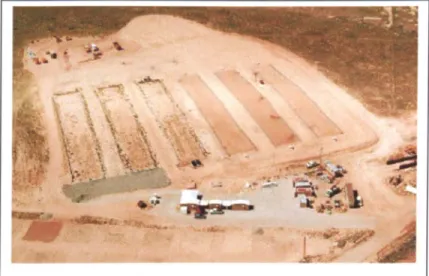
Sanitary landfill is made up of five major components such as a liner system, storage space for placing the waste that is usually arranged in cells, a leachate collection system, a gas collection system and cover or capping. Figure 2.1 and figure 2.2 are the sanitary landfill top view and the fundamental cross section of landfill.
Figure 2.1 Sanitary Landfill Top View
9