
There has been an increase of 2 million social media users since 2020, and a long period of social media use led to psychological consequences of depression and low psychological well-being. Compulsive social media use and social media fatigue were reported as factors leading to poor psychological well-being. Therefore, this study aimed to investigate the associations of compulsive social media use, social media fatigue and psychological well-being, and social media fatigue as a mediator of the relationship between compulsive social media use and psychological well-being.
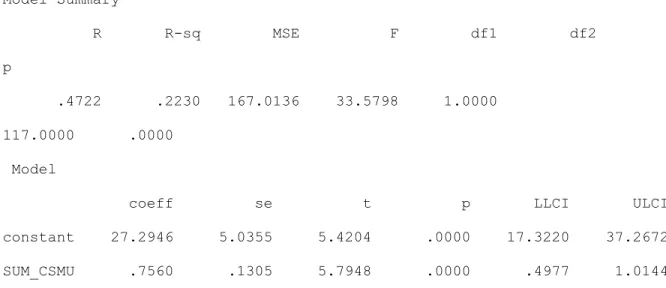
The result of Pearson correlation analysis depicts a significant negative relationship of compulsive social media use and psychological well-being; a significant positive association between compulsive social media use and social media fatigue; significant negative association between social media fatigue and psychological well-being. Furthermore, PROCESS macro mediation analysis determined that the mediating role of social media fatigue in the association between compulsive social media use and psychological well-being was not significant. This attached research paper titled "Association of Compulsive Social Media Use and Psychological Well-Being: Social Media Fatigue as a Mediator among Young Adults in Malaysia" prepared and submitted by Foong Chee Ee, Lau Yau Chee and Sarvinna a/ p.
CIUS Compulsive Internet Use Scale CSMU Compulsive Social Media Use LCM Limited Capacity Model MCO Movement Control Order OCS Online Cognition Scale PWB Psychological Wellbeing.
Introduction
According to Bright et al. 2015), users tend to avoid social media due to information overload. Additionally, the consequences of PWB associated with CSMU is a global issue emerging as heavy social media use links to poor mental health among Indonesian adults (Sujarwoto et al., 2019). According to the Malaysian Communications and Multimedia (2017) report, young adults spend about 8 hours a day on social media and online searches.
Moreover, SMF is a new problem where users tend to withdraw from the use of social media due to feeling overwhelmed. Based on the research field in Malaysia, only very few studies have investigated compulsive use of social media and PWB, and there are limited studies found in the Malaysian context on SMF. Conceptual definition: Compulsive social media use (CSMU) is defined as the voluntary and unconscious behavior to access social media platforms and in turn negatively affect both body and mind (Aladwani & Almarzouq, 2016).
Operational definition: The Social Media Fatigue Scale (SMFS; Bright et al., 2015) is used to measure SMF in this study.
Literature Review
Compulsive Social Media Use and Social Media Fatigue
Previous studies have examined antecedents of SMF such as social networking sites (SNS), privacy concerns, self-disclosure, parental encouragement, parental concerns, parental control, parental permission (Dhir et al., 2019); motivational factors such as self-promotion and entertainment, and personal traits such as exploration, religiosity, and deficient self-regulation (Islam et al., 2020) and information overload, compulsive use, fear of delay, time cost, and privacy concerns (Zhang et al. al. ., 2020). Not only that, but the consequences of SMF have also been investigated, including a decrease in academic performance (Dhir et al., 2019) and fatigue (Zhang et al., 2020). This has been explained by information overload through the CSMU and consequent exhaustion (Whelan et al., 2020).
However, the relationship between CSMU and SMF is not well explored in the local context. Therefore, the researchers focus on the impact of social media addiction on emotional exhaustion in an academic setting rather than social media emotional exhaustion (Nabila et al., 2017; Tomaszek & Muchacka-Cymerman, 2021).
Social Media Fatigue and Psychological Well-Being
In local studies, the available literature in the areas of SMF focuses on examining positive antecedents such as mindfulness and its associations with SMF (Abdul Kadir et al., 2021; Jayaraja et al., 2017; Lai et al., 2021). However, more studies on the associations between SMF and PWB will be needed to determine their associations. This study aims to examine the associations between SMF and PWB among young adults in Malaysia.
The mediating role of Social Media Fatigue between Compulsive Social Media Use and Psychological Well-Being
The current study implements the Stressor-Strain-Outcome (SSO) framework, which was implemented by Koeske & Koeske (1993). Literature that adopted the SSO model in social media context study includes Dhir et al. 2018), whose stressors use compulsive social networking sites (SNS) and fear or miss out; tension is SNS fatigue; outcome is depression and anxiety. In addition, Pang's (2021) research model also included stressors such as compulsive WeChat use and information overload; stress is social media fatigue; the outcome is emotional stress and social anxiety.
According to cognitive load theory (Sweller, 2011), mental fatigue can occur when the amount of information exceeds one's cognitive capacity, leading to impaired emotion regulation (Grillon et al., 2015). In the situation of CSMU, the users have higher chances of being influenced by information overload, which leads to SMF (Kamal et al., 2020). In the social media context, SMF leads to social media users' higher odds of depression and anxiety level (Dhir et al., 2018).
With the associations of stressor-outcome (H1), stressor-strain (H2) and stressor-outcome linkage (H3), H4 hypothesized that SMF would mediate the associations between CSMU and PWB.
Methodology
According to Muller's survey (2022), young adults make up 46% of the 4160 respondents, which is the majority of social media users. The Compulsive Internet Use Scale (CIUS), developed by Meerkerk et al. 2009) was adopted in this study to measure compulsive use of social media. The Social Media Fatigue Scale (SMFS) was developed by Bright et al. 2015), with five items ranked on a seven-point scale.
The reliability for compulsive social media use (CSMU), social media fatigue (SMF), and psychological well-being (PWB) is. The findings of the current study support hypothesis one, where compulsive social media use (CSMU) is negatively associated with psychological well-being (PWB) among young adults in Malaysia. This finding is consistent with the SSO framework, where CSMU is the stressor that causes social media fatigue (strain).
The use of social media is one of the daily practices in society, especially among young adults, as a source of information and entertainment. In addition, a reminder could be implemented for the users to be aware of their social media usage. As a result, the social media company was able to retain more users by protecting their users' emotions and PWB.
Finally, these findings suggested links to Compulsive Social Media Use (CSMU), Social Media Fatigue (SMF), and Psychological Well-Being (PWB). How compulsive use of social media affects performance: Insights from the United Kingdom in terms of purpose of use. Exploring the effect of overload on discontinuous intention of social media users: A S-O-R perspective.
A meta-analysis of problematic social media use and mental health. https://www.usf.edu/ucm/marketing/intro-social-media.aspx. How compulsive WeChat use and information overload affect social media fatigue and well-being during the COVID-19 pandemic. The social media party: Fear of missing out (FoMO), intensity, connection, and well-being on social media.
The association between social media use and psychological well-being among young adults in Malaysia: social media fatigue as a mediator. This research project aims to determine the mediating role of social media fatigue in the relationship between social media use and psychological well-being among young adults in Malaysia. By completing three sectors related to compulsive social media use, social media fatigue, and psychological well-being.
UNIVERSITI TUNKU ABDUL RAHMAN
ABSTRACT (5%) Max Score
For the experiment, report experimental manipulation, participant flow, treatment adherence, baseline data, side effects and side effects, assignment method and implementation, masking. if applicable to the research design).
DISCUSSION AND CONCLUSION (20%) Max Score
The originality parameters required and the limits approved by UTAR are as follows: i) The overall index of similarity is 20% or below, and. ii) Match of individual sources listed must be less than 3% each and (iii) Matching texts in continuous block must not exceed 8 words. Note: Parameters (i) (ii) will exclude quotes, references and text matches that are less than 8 words. It is mandatory for the supervisor/examiner to provide general feedback on research projects graded A- and above or F.
It is hereby acknowledged that Foong Chee Ee (ID no: 18AAB04501) has completed this final year project/dissertation/thesis* entitled The association between compulsive social media use and psychological well-being among young adults in Malaysia: Social media fatigue as a mediator under the supervision of Mr. Tan Soon Aun (supervisor) of the Department of Psychology and Counseling, Faculty/Institute* of Arts and Social Sciences. I understand that the University will upload a copy of my final project/dissertation/thesis* in PDF format to the UTAR Institutional Repository, which may be made available to the UTAR community and the public. It is hereby acknowledged that Lau Yau Chee (ID no: 18AAB04605) has completed this final year project/dissertation/thesis* entitled The association between compulsive social media use and psychological well-being among young adults in Malaysia: Social media fatigue as a mediator under the supervision of Mr. Tan Soon Aun (supervisor) of the Department of Psychology and Counseling, Faculty/Institute* of Arts and Social Sciences.
It is hereby acknowledged that Sarvinna a/p Vasuthevan (ID no: 18AAB05688) has completed this final year project/dissertation/thesis* entitled The association between compulsive social media use and psychological well-being among young adults in Malaysia: Social media fatigue as a mediator under the supervision of Mr. Tan Soon Aun (supervisor) of the Department of Psychology and Counseling, Faculty/Institute* of Arts and Social Sciences. Title of thesis The relationship between compulsive social media use and psychological well-being among young adults in Malaysia: The required originality parameters and UTAR-approved limits are as follows: i) The overall similarity index is 20% and below, and. ii) The matching of the separately mentioned sources must each be less than 3%, and (iii) The matching texts in continuous blocks must not exceed 8 words.
Note: Parameters (i) (ii) will exclude citations, bibliography and text matches that are less than 8 words. Note Supervisor/candidate(s) are expected to provide a soft copy of the complete set of originality report to Faculty/Institute. Based on the above results, I hereby declare that I am satisfied with the originality of the Final Year Project Report submitted by my student(s) as mentioned above.
