It is hereby certified that GRACE ONG (ID No: 13UJM00024 ) completed this thesis entitled "YOUNG ADULTS AND ONLINE DATING: AN EXPLORATORY STUDY" under the guidance of prof. Sharon Jacqueline a/p Albert Wilson of the Department of Mass Communication, Faculty of Creative Industries, and prof. David Tneh Cheng Eng from the Department of Modern Languages, Faculty of Creative Industries. This thesis/dissertation entitled "YOUNG ADULTS AND ONLINE DATING IN MALAYSIA: AN EXPLORATORY STUDY" was prepared and submitted by GRACE ONG in partial fulfillment of the requirements for the degree of Master of Communication at Universiti Tunku Abdul Rahman.
Introduction
Online Dating in Malaysia
Whether it's the embarrassment caused by online dating apps being popularly known as "hook-up apps" or the perception that online dating app participants are less able to find love offline, a a large number of six in ten Malaysian millennials reported that they were embarrassed to admit that they had met their partner through online dating, including apps (YouGov, 2017). In contrast, the smaller percentage of online daters, made up of older adults, differ, with only one-fifth (18%) of baby boomers being ashamed of online dating (YouGov, 2017).
Problem Statement
This has been even more limited in Malaysia, as according to Alam et al. 2018), locally the country is at its starting point for online dating research. As of 2018, there were no previous studies on factors influencing users of online dating sites in Malaysia (Alam et al., 2018).
Research Question and Objective First Research Question
While real-life interactions allow people to use their tone of voice, body language, and care to convey a person's message, online data is refined into photos and a biography like the one shown in Appendix A. Therefore, the question The second research attempts to discover the extent to which online participants manage their online self-disclosure in their online dating profiles. This research question seeks to understand the impact of face-to-face dating in the context of self-disclosure for participants as well as their matches on online dating applications.
Methodology
As self-disclosure increases in a linear fashion, it is expected that the amount of information provided will be greatest in a face-to-face setting as online communication moves away from edited images and text messages. This research will not limit users to specific apps, but will open to users of online dating apps in general.
Definition of terms
- Online Dating
- Online Dating Applications
- Self-Disclosure
- Self-Presentation
- Swiping and Matching
- Hook-ups and Casual Sex
Self-disclosure of superficial information such as daily hobbies is important to start a relationship (Ying et al, 2016). While all interactants experience the pressure of impression management with the desire to be authentic, online communication offers greater control over self-presentation behavior and strategy due to its asynchronous nature (Ellison et al, 2006).
Theoretical Framework
Uses and Gratifications Theory
Applying the U&G to online dating, Snell (2016) wrote that users use online dating sites for dual purposes. Second, based on the U&G theory in the context of social networking sites, since online dating can be considered as a form of social networking sites, it makes sense that people can use these sites in a similar way (Snell, 2016).
Social Penetration Theory
Taylor, Altman, and Sorrentino (1969) found that self-disclosure is influenced by the variables of reward or cost outcomes as well as the individual's commitment to the relationship. The researchers labeled distinctions of personality traits where the variations between high disclosers and low disclosers were identified as a function of the increased sensitivity of high disclosers to the selection and recognition of person-oriented stimuli compared to low disclosers (Taylor et al, 1969). .
Chapter Overview
Therefore, in this study, this theory is appropriate to use because self-disclosure is essential to forming friendships or relationships online or offline, and it is essential to understand the depth and breadth of disclosure.
The Revolution of Online Mobile Dating Apps
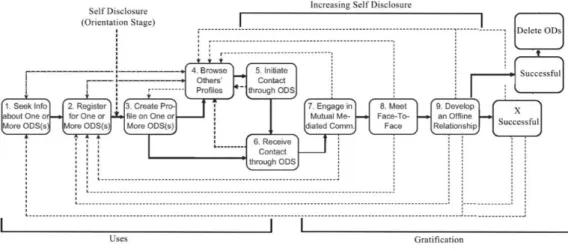
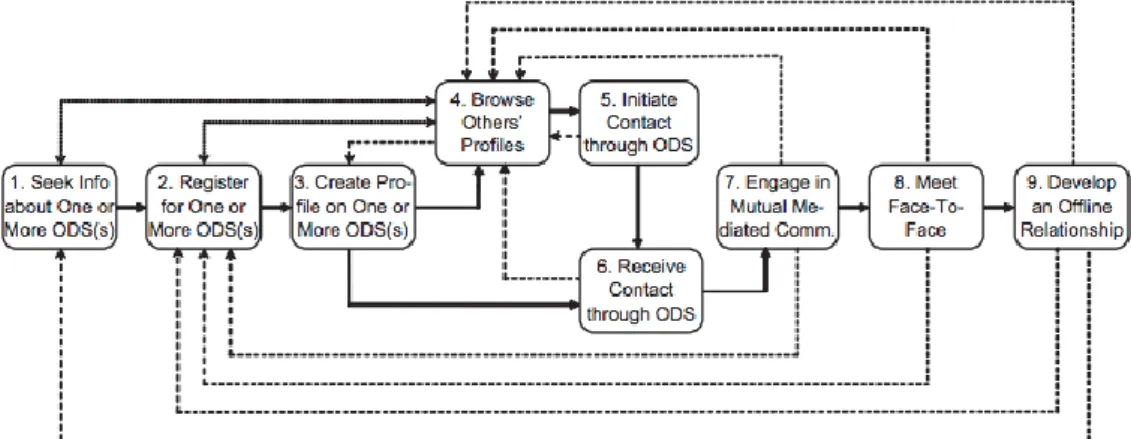
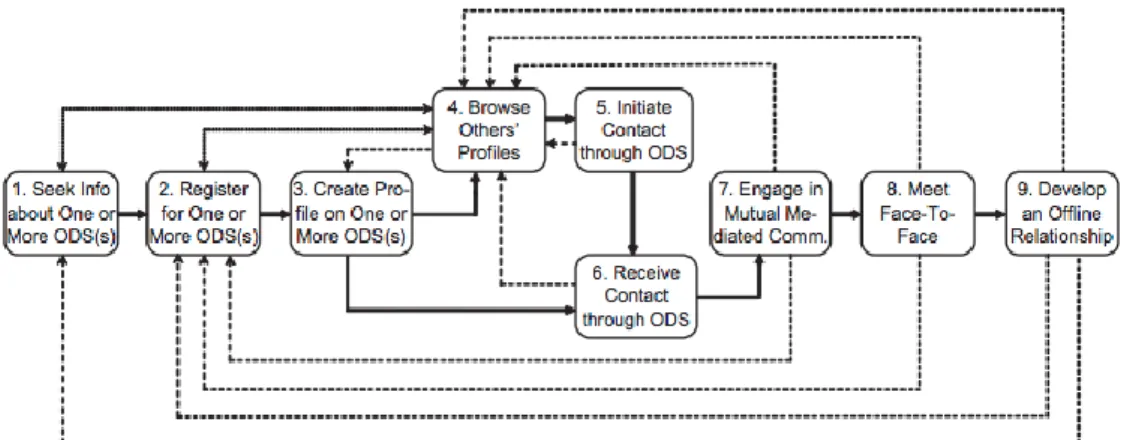
The nine steps of the online dating process as explained by Finkel et al (2012) in a diagram depicting how users move from information seeking to registering for online dating apps, to creating their profiles. When it comes to step 3 in terms of creating profiles on one or more online dating sites, photos are usually uploaded as a means of self-presentation and self-disclosure of the participant.
Motivations for Online Dating
In regards to looking for romantic partners, Chan (2018) stated that among the individuals he interviewed in China, Katie, 33, uses the online dating app OkCupid with the motivation for long-term relationships, although "some people are only looking for forward [hookups]” (p.6) Research conducted by LendEDU (2017) reported that 44.44% of total millennial online dating users in America used Tinder primarily for.
Sexuality and Usage of Online Dating Apps
Social stigma of online dating apps
Therefore, in this study, it is crucial to discover and understand the role that online dating apps play in the lives of young adults, especially in Malaysia.
Theoretical Framework
Uses and Gratifications Theory
Focusing on Tinder, Timmermans and De Caluwéb (2017) identified a comprehensive list of 13 motivations among users on this online dating application, based on the U&G theory. Besides using the app for hookups, Tinder users use it to look for romance and to socialize. From a U&G perspective, Timmermans and De Caluwéb (2017) argued that it is not simply the existence of mobile dating apps such as Tinder that facilitate motivations such as casual sexual behavior, but rather the sexual motivations that lead to the use of Tinder leads, and that the satisfaction of finding a sexual encounter will encourage users to continue using the app.
Social Penetration Theory
- Self-Disclosure and Social Penetration Theory
As a result, users may find that it is easier to change their self-presentation in online environments such as dating apps such as Tinder, where profiles and messages can be carefully crafted and thought out (Walther, 1996). Ward (2017) extends this research and added that there is an important distinction in online-to-offline relationships between expected online interaction and expected face-to-face communication rather than specifically short-term interactions compared to long-term interactions. While Ward J (2017) focused only on the self-presentation propensity of users of online dating apps in the pre-match phase, before participants have begun electronic conversation with the other party, this study attempts to address both pre-match and post-match to include. match stages, taking into account the self-disclosure that takes place not only on online dating profiles, but also in the online chats and offline chats that take place, if users have moved on to face-to-face encounters.
Where Uses and Gratifications Meets Social Penetration theory
With the concept of SPT, we can see that self-disclosure starts at the profile creation level, where users select what information they want to reveal about themselves (including the depth or breath of this information). As contact is made, self-disclosure normally increases in a one-on-one setting, where users can ask and answer questions in a conversation. When self-disclosure happens offline in a positive and consistent way with how conversations happen online, an offline relationship is developed.
METHODOLOGY
- Inductive and deductive approach
- Thematic Analysis
- Observation
- Scope of Study
- In-depth Interview : Semi-Structured Interview
- The Interview Process
- Observations from In-depth Interviews
- Observations as an observatory participant
- Sampling Procedure
- Data Collection via Convenience Sampling
- Data Collection via Snowball Sampling
- Data Analysis
- Concerns
In non-participant observation, Spradley (1980) states that the researcher has no level of involvement with insiders. The researcher has been granted permission to use this interview guide to be adapted for this study in Malaysia. Self-disclosure was less compared to the male participants, although female participants felt more comfortable sharing information with the fact that the researcher was also involved in the online dating process as a participant observer.

FINDINGS
- Research Sample Demographics
- The role of online dating in the lives of young adults
- Main 6 motivation themes for online dating usage
- Swiping Behaviour
- Self-disclosure on Online Dating apps
- Self Disclosure on Online Dating Profiles
- Initial Online Conversations
- Self-disclosure in face-to-face settings
- Misrepresentation
- Ghosting
- Preferences for Offline Dating
- Summary of Findings
- Discussion
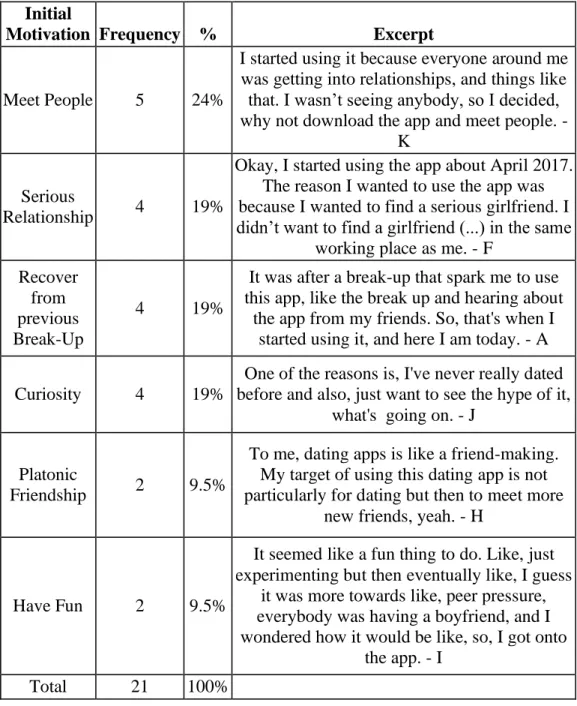
These initial motivations changed over the course of using online dating apps (n=8), with some users reporting that they wanted to meet people first or for fun, then a romantic relationship (n=4). Participants (n=4) indicated that they felt that entering into a serious relationship would provide additional satisfaction to their main motivation for joining online dating apps. Among those interviewed, 6 participants stated that their in-person dates resulted in casual sex, although this was not their main motivation for using online dating apps.

Decide to be Friends
Theoretical Implications
By combining uses and gratifications theory with SPT, this study depicts how rational users of online dating applications approach the use of this technology in a methodological way, as seen in the steps of Finkel et al's (2012) diagram with individual initial intrinsic motivations, which can be influenced by positive and negative extrinsic factors that promote or discourage their use of dating apps. Several dating apps like OKCupid have features where users can select the 'connections' they are looking for, such as short-term and long-term dates, connections or new friends, but this is often still confusing due to secondary and latent motivations that each user has has. Perhaps future dating apps could apply primary and secondary motivations for using the app, as well as a 'safety scorecard' primarily for female participants to see how safe women feel around a prospective male match.
Limitations
Recommendations
Conclusion
Exploring the needs participants have to fulfill while using online dating applications.
Motivations Introduction
Gaining insight into user's initial motivations for downloading and online dating application Objective 2. Exploring the needs that participants are expected to fulfill while using online dating applications. Understanding what participants expect from online dating (Rest N, 2015) and what main motivations they had when they downloaded the app and created their profile. Exploring attitudes towards online dating, both from the participants' perspectives of online dating itself and from other online perspectives.
Experiences Introduction
What do you look for when judging online profiles? Holiday, 2015) Have you planned to arrange real-life dates through these online dating apps. Uses and Pleasures Theory in the 21st Century. https://www.pewresearch.org/internet online-dating-. Retrieved from https://www.oii.ox.ac.uk/news/releases/new-study- discovers-changing-trends-in-online-dating/. Is the use and gratification approach still relevant in a digital society?