Persistence of Poverty among the Badjaos of Bongao, Tawi-Tawi, ARMM, Philippines
KURAIZA USMAN1 and ROWENA DT. BACONGUIS2*
ABSTRACT. The study sought to understand the persistence of poverty among the Badjao people in Tawi-Tawi, Autonomous Region of Muslim Mindanao (ARMM), Philippines. Considered the poorest in their communities, Badjaos are Sea Gypsies of Sulu and Celebes seas who are scattered in different coastal areas in Mindanao. Specifically, the study aimed to determine the educational background, psychological outlook, economic, nutrition and health conditions, political and social capabilities, and access to government services of the Badjaos. These factors are referred to as conditions that facilitate or hinder mobility in society. Thus, their absence can further bind people in a state of poverty or what is referred to as deprivation trap. Semi-structured questionnaires were used to investigate the socio-economic conditions of the respondents. Two gate keepers helped the researchers identify the respondents based on their availability and willingness to discuss their situations. The selected research sites were two villages in Bongao, Tawi-Tawi, which are known as Badjao communities. Results showed that respondents suffer from a deprivation trap, a condition that keeps people in poverty. A model for program implementation that is guided by collaboration, networking, and cultural sensitivity is proposed. Program components of the proposed model focus on informative, persuasive, participatory, and formative interventions.
Keywords: Badjaos, indigenous people, poverty, deprivation trap, model for program implementation
1Director, National Service Training Program, Tawi-Tawi Regional Agricultural College, Bongao, Tawi-Tawi, Philippines
2Professor, College of Public Affairs and Development, University of the Philippines Los Baños, Laguna, Philippines
*Corresponding author: (+63 49) 536-0407, [email protected] ________________________
INTRODUCTION
Poverty is an undesirable human state characterized by deprivation of essential assets and opportunities like source of income, shelter, health services, basic education, information, public utilities and sanitation (ADB, 2009). Easterly (2006) explains the multidimensionality of poverty and discusses that the Millenium Development Goals enumerated investments in public administration, human capital, and infrastructure to escape poverty. The 2015 Sustainable Development Goals expand the targets but essentially centers on improvements in human capital, infrastructure, and good governance.
While interventions have been forthcoming, the conditions of the Badjaos seem to have not improved since the time Nimmo (1968) published his study on the Badjaos. Macalandag (2009) summarized the descriptions of the Badjaos as marginalized, excluded, despised, and confined to the lowest rungs of the social ladder. Waka (2016) describes them as more disadvantaged than other economic groups.
However, accurate statistics regarding the number of Badjaos remain elusive as census survey among this group is problematic given that they are out in the sea or looking for opportunities to earn (Maulana, 2017).
One of the poorest regions and provinces in the Philippines is the Autonomous Region of Muslim Mindanao (ARMM) and the province of Tawi-Tawi where Badjaos abound. The region also has the highest illiteracy rate in the country, the lowest participation rate in school, and the highest percentage of people with no grade completed (Philippine Statistics Authority, 2015). Historically, ARMM was created in 1990 to hasten the economic development of the Muslim areas. ARMM is composed of different Muslim and non-Muslim indigenous and ethnic tribes or communities, one of which is the Badjao indigenous people.
The Badjaos are called by many names, the most common of which is Sama Dilaut. Historically, the Badjaos were a highly mobile people leading a nomadic lifestyle and depended mainly on fishing for their survival (Nimmo, 1968). The Badjaos’ lack of entitlement and poor condition have led some of them to move to urban areas looking for supplementary employment and income, most of them ending up as beggars because of their illiteracy, ignorance, and lack of skills.
An investigation of the conditions of the Badjaos can provide in-depth insights into dimensions of chronic poverty. To do this, the deprivation trap of Chambers (1983) was used to illustrate persistence of poverty conditions among the Badjaos. He discussed five clusters that interact and keep people bound in poverty: lack of assets, physical weakness, isolation, vulnerability, and powerlessness.
Lack of assets contributes to lack of food, small bodies, malnutrition, low immune response, inability to reach or pay health services, inability to pay the cost of schooling, lack of wealth (savings), and lack of socio-political influence or “voice.” Physical weakness contributes to weak labor (inability to cultivate, work longer hours, and lower wages) and inability to overcome a crisis. Isolation means lack of education, remoteness, inability to access services, and lack of contact with political leaders or with legal advice. Vulnerable households are those who are powerless, unable to respond to unforeseen circumstances which can also be a result of lack of belief in the ability to address problems. Finally, lack of socio-political power means weak negotiating skills and lack of skills to compete in the job market. Psychological outlook was added as an area of investigation following Ray’s (2002) discussion of aspiration failure that binds them to their vulnerable situations.
Specifically, the study aimed to: 1) describe the demographic, economic, nutritional and health, and socio-political conditions and psychological outlook of Badjaos in Bongao, Tawi-Tawi; 2) describe their access to government and non-government services; and 3)propose a poverty alleviation model for the Badjaos.
METHODOLOGY Locale of the Study
The Badjaos are found in Zamboanga City, Basilan, Sulu, Tawi- Tawi, and even in the cities of Davao, Metro Manila, Cebu, Batangas, and some other areas in the country. Based on the census conducted in ARMM by the Philippine Statistics Authority, it was reported that the enumerators had a hard time counting boat dwelling groups, which makes it difficult to actually count and estimate the population of all sea faring groups, such as the Badjaos, in all areas of the country’s territorial waters (Maulana, 2017). The National Commission for Culture and the Arts (2015) estimated that there were 30,068 Badjaos in Tawi-Tawi. The highest concentrations were in the Municipalities of
Sitangkai (1,075) and Bongao (660). Tawi-Tawi, where the study was conducted, is an island province in the southern Philippines located in the ARMM.
The Province of Tawi-Tawi shares its sea borders with the Malaysian State of Sabah and the Indonesian Kalimantan province.
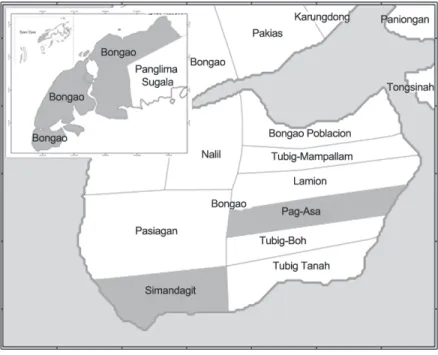
It is home to a large population of Badjaos. The study sites, Barangay Simandagit and Barangay Pag-asa, were recommended by officials of the Municipality of Bongao who identified these villages as heavily populated by the Badjaos.
Figure 1. Geographical location of study site
Research Design
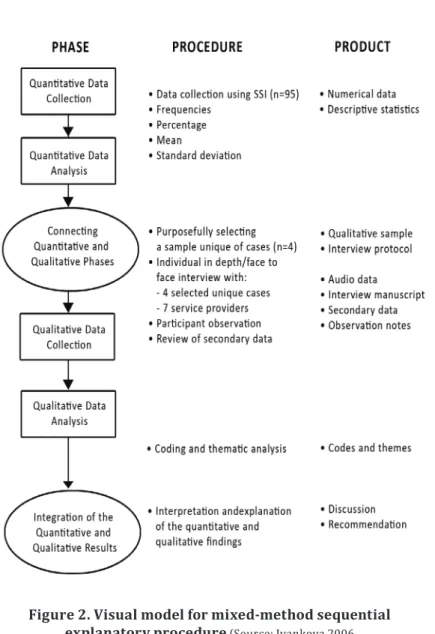
This study employed a mixed-method sequential explanatory research design. Quantitative data from survey was used in determining the over-all condition of households in the study area, while the qualitative data from two sets of key informants (KIs) was used to validate, substantiate, and qualify statistical results. Figure 2 outlines the procedures of the study as adopted from the mixed-method sequential explanatory design developed by Ivankova (2006).
Figure 2. Visual model for mixed-method sequential explanatory procedure (Source: Ivankova 2006 as cited in Ivankova, Creswell, & Stick, 2006)
Results of the survey were analyzed using descriptive statistics. Responses of the key informants shared during the survey and follow-up interviews were likewise recorded, transcribed, and analyzed based on themes. Details of the transcriptions are reflected in the quoted statements in the results and discussions.
Respondents of the Study
Respondents of the survey were selected using purposive sampling from among adult Badjaos who signified interest and willingness to take part in the study. The study was confined in the two Badjao communities in Barangay Pag-asa (Luuk Banca) and Barangay Simandagit (Sama Kasulutan).
One of the problems encountered was the frequent travels or migration of Badjaos. The list coming from the barangay was also not updated. Hence, it was difficult to randomly select respondents from a list of residents, which led the authors to allocate a number of interviewees from each barangay. Initially, an arbitrary number of 50 respondents from each barangay was set.
Written letters were sent to local leaders who helped identify the respondents. Based on theoretical sampling, the number could go higher if there were answers that were different from what was already gathered and could therefore provide more insights to the study. The local contacts or “gate-keepers” informed all identified respondents of the interviews prior to the actual interview. The study aimed to interview 100 respondents from the two villages with 50 respondents each. Ultimately, 95 interviews were conducted as the five who initially signified willingness to be interviewed could not be located during the visits.
The number of respondents was deemed sufficient as stories shared by the key informants provided quality data to answer the research objectives. Key informants were selected based on their length of experience as members of the community and their willingness to be interviewed. Consent to be interviewed and to record the interviews were sought orally. Following the semi-questionnaire, the KIs elaborated on their life conditions and their insights on the Badjao community. The primary author, assisted by local researchers who spoke the local language fluently, conducted the interviews.
Structure of Semi-structured Interview (SSI)
A semi-structured survey (SSI) questionnaire was distributed to selected respondents in Barangay Pag-asa (46%) and Barangay Simandagit (49%) in the Municipality of Bongao, Tawi-Tawi. The same flow of discussion was followed for the KIs, but the discussion took hours as personal reflections and stories were investigated.
The SSI was divided into themes such as education, economic activities and assets, nutrition and health, psychological outlook, access to services, and participation to programs. These themes were derived from the deprivation trap discussions of Chamber (1983) who also discussed lack of assets, powerlessness, physical weakness, isolation, and vulnerability. In addition, the structure of the SSI is guided by the various discussions in popular and scholarly articles reviewed, the initial interviews with those who have worked in the area, and the concrete observations of the main author during the initial scanning of the area.
The questionnaire is reflective of nutritional status adapted from the Radimer/Cornell Questionnaire of Food Security (Swindale
& Bilinsky, 2006). Answers to questions were measured with three- point scale responses of “never,” “sometimes,” and “always” coded as 3, 2, and 1 by the authors. “Always” referred to frequent encounter of the condition, which is the opposite of “never,” while “sometimes” is in between “always” and “never.”
RESULTS AND DISCUSSIONS
Socio-Demographic Profile of the Respondents
Almost all respondents were female. Men were responsible for earning a living and therefore, most of them were busy fishing or attending to other odd jobs at the local pier during the day and hence, could not be interviewed.
Respondents were between 17 to 65 years old. Few (10%) of the respondents were unable to indicate their age because their births were not registered with the local registry. Many of the respondents also admitted that they estimated their ages as they do not observe birthday celebrations and thus were unable to keep track of their age.
Majority (86%) of the respondents were married.
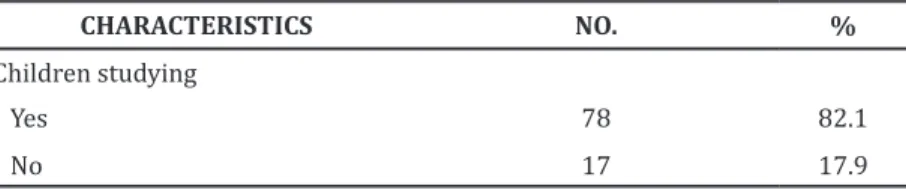
Meanwhile, more than one-third (39%) of the respondents had 4-6 children. A majority (82%) of the respondents said their children are studying.
Illiteracy was prevalent among the respondents with more than half having no formal schooling. The data speak of the problems
Table 1. Socio-demographic profile of survey respondents
CHARACTERISTICS NO. (n=95) %
Sex
Female 91 95.8
Male 4 4.2
Age
17-24 14 14.7
25-34 30 31.6
35-44 22 23.2
45-54 15 15.8
54-65 5 5.3
Cannot determine 9 9.5
Mean 32
Range 17-65
Marital Status
Married 82 86.3
Widow/Widower 7 7.4
Separated 5 5.3
Single 1 1.1
Highest Educational Attainment
No formal schooling 55 57.9
Primary 20 21.1
Intermediate 9 9.5
High School Level 8 8.4
College Level 1 1.0
College Graduate 2 2.1
Number of Children
0-3 31 32.6
4-6 37 38.9
7-9 22 23.2
10-12 5 5.3
Mean 5
Range 0-12
besetting the community as many Badjaos are unable to read and write.
However, the low educational attainment among respondents does not reflect the Badjao’s valuation of education in general. With the four KIs, all were unable to attend any formal school yet they shared a common belief that education is important. One recognized that education is very crucial to avoid being deceived by others. However, due to economic hardships, they were unable to continue formal schooling. Referring to an adult literacy program that one of the KIs attended, she explained:
“I want to become literate and be able to read, write, and learn simple mathematics, so that we can be compared with other people and not easily fooled. That is why I am here now attending the class. Some of my children are studying now. But I do not know if they can finish their studies.”
Except for one single respondent, all respondents reported to have an average of five children per family. Based on the National Demographic and Health Survey, higher education is inversely proportional to number of children. Majority reported having children attending pre-school and elementary school (National Statistics Office, 2008). Results show a growing recognition among community villagers of the importance of education and improved access to schools within the community. One KI said:
“It is good the Sisters (referring to the Daughters of Charity) are helping our children in school. They have a feeding program. We have many kids from the barangay studying there because they do not take for granted the kids. School supplies are given for free, and they also have this feeding program. We do not worry much if our children are unable to eat at home before going to school because we know there is food in the center. Having been able to finish elementary will have a big impact on our lives. Not having been schooled at all is terrible.”
Table 1. Socio-demographic...(Continuation)
CHARACTERISTICS NO. %
Children studying
Yes 78 82.1
No 17 17.9
Economic Profile
Main sources of income. Most of the respondents derived their income from activities that do not require formal skills training such as fishing, selling goods in the streets, or working as kargador (porter).
A sizable number (38%) of the respondents were fishermen (Table 2).
Badjaos live in coastal areas and learned the trade from their parents.
One respondent explained that since he was six years old, his father and mother would bring him along to go fishing, and now it is his main source of income. On the other hand, women performed fish vending or
“lako.” One KI spoke of the difficulty of fishing as a livelihood:
“I am only a fisherman. My livelihood is very difficult because we often stay in the open sea for two to three days trying to bear the heavy rains, big waves, or the scorching heat of the sun. What is worst is that we only bring in very minimal amount, the highest of which is PhP300. Sometimes it is PhP100 or PhP50, and there are times, there is none. With the PhP300, we still need to deduct from that amount our expenses and then divide what is left among us fishers. I do not have a pump boat that is why I go with neighbors who have pump boats. There are instances when we cannot go fishing due to a bad weather.” (1USD =P50.00).
To augment income from fishing, one female respondent sells gamay (seaweeds). If there are no available seaweeds to sell, she would look for coconut leaves in the area and make brooms to sell. Even with such alternatives, she earns only about PhP50-100 on a lucky day. As she explained:
“My income is very small. It could hardly feed our big household.
It is not enough to meet our daily consumption… How much more to save? It is an advantage that my children can already help me earn income. They work as ‘kargador’ at the local pier and market.”
With their meager household income, adults resort to desperate efforts. Children who are supposed to be in school are pulled out from their classes and are encouraged to look for additional sources of income. A mother confessed that she used to advise some of her children to cut classes so that they could assist her in looking for means of survival. Such actions in turn compromise the schooling of their children and their hope for better life. Worse, the income generated from child labor is not even considerable. Most of the Badjao
children engage in begging or scavenging, which fetches very little income. Other options provide earnings that are not commensurate to the hazards involved. For instance, children would amuse passengers of sea vessels by asking them to throw coins which they would recover by diving.
Badjao men, specifically the younger ones, engage in low paying jobs like working as kargador or laborer at local pier and market, while daughters work as housemaids in nearby villages. Respondents see these activities as easy sources of income because they have neither special skills nor education to qualify for other professions. This condition is referred to in the deprivation trap as physical weakness and lack of assets leading to further isolation and vulnerability (Chambers, 1983).
While they are known for being skilled mat weavers, most Badjaos do not engage in this craft because it requires capital. It also takes time to sell finished products. Mat weaving is, therefore, not considered economical, as the Badjaos need to address immediate needs like food.
Estimated monthly income. Nearly half (42%) of the respondents reported to have income between PhP1,501-PhP3,000 (1USD = PhP50) per month, while 25 percent earned below PhP1,500.
Very few (7%) earned income above PhP3,000, and very few (6.3%) also said that they could not estimate as they spend whatever they earn for the day and, in some instances, do not earn at all (Table 3). The Table 2. Main sources of household income
MAIN OCCUPATIONa NO. %
Fishing 36 37.9
Laborer/Kargador 21 22.1
Fish vending 18 18.9
Housemaid 8 8.4
Mat weaving 5 5.3
Street food vending 4 4.2
Seaweeds/Shells vending 2 2.1
Scavenging 1 1.1
aMulitple responses
difficulty of looking for income on a day to day basis, resulting mostly from their physical labor, is translated into helplessness as reflected in one respondent’s complaint:
“My work is very difficult, I need to find seaweeds and sell it in the market or streets. If there are no available seaweeds to sell, I look for alternatives like coconut leaves and make them into brooms.
I have small paddled banca (boat), which I use for my livelihood activities. I want to get out from this burden of work. I feel that I cannot do this any longer. My physical body wants to give up.”
Table 3. Estimated monthly household income of Badjaos in Philippine Pesos (PhP)
INCOME NO. %
<1,500 24 25.3
1,501-3,000 40 42.1
3,001-4,500 7 7.4
4,501-6,000 10 10.5
6,001-7,500 4 4.2
Can not answer 6 6.3
Note: 1USD = PhP50
The unstable income is reflected in a degree of uncertainty among respondents. A female respondent who works as a laundry woman and earns around Php100 a day, whenever such work is available, narrated:
“One hundred pesos for laundry is already something very difficult to get for many of us. That amount can only buy a slice of cassava and few pieces of fish, and these are not enough for our day’s consumption. My five children are all studying. Most of the time I cannot provide for their needs. Sometimes, I do not know what to do.”
“It is hard to find a good job when you have not finished your studies. This is the only work that I can do because I have never gone to school. I need to face the reality and suffer the consequences of my fate.”
The Philippine Statistics Authority (2015) calculates that for 2015, the monthly food threshold is pegged at PhP6,329 (1 USD=PhP50) for a family of five. Clearly, the income of the Badjaos, whose number of children ranged from 2 to 12 with an average of five, is insufficient to provide their basic family needs.
There are a few industries open to the Badjaos, and one of which is mat weaving. A typical mat weaver could earn PhP300 to PhP500 per mat. However, materials for making the mat are inaccessible. One female respondent said that she knows how to weave but could not engage in the craft. In order to gather pandan leaves, the raw material for the mats, one needs to ride a banca (boat) to another island. Mat weaving is a long process, and one cannot immediately earn money from it.
“It is difficult to make pandan mats. You need to cook the pandan leaves, place them under the sun to dry, then remove the upper portion of the leaves. It is really a long process and difficult to make. It takes weeks before you can make one mat. At the same time, we cannot find pandan near this place. We need to go to other places and ride a boat, which entails costs.”
This economic state could be attributed to a combination of lack of education, lack of skill, and lack of opportunities. As such, when people fall ill, there is no money to buy medicine. The interconnectedness of conditions of vulnerability as discussed in the deprivation trap is clearly evident in the Badjaos’ lack of assets.
Housing Conditions
The lack of assets is visible to any outsider based on the nature of housing materials used by the Badjaos. Historically, Badjaos built bamboo and nipa huts elevated about 3 m from the sea by bamboo stilts. The elevation was meant to protect them during high tide and against hostile strangers. Fronting their houses are open platforms that serve as boat landing dock. More bamboo platforms would be built to connect the isolated houses to one another, which then formed a cluster of houses. Some Badjaos already built their houses on the shore.
Nimmo (1968) explains that this practice may have resulted from the desire to easily sell fish catch and for the children to have better access to schools.
All respondents have houses made of light materials such as nipa or a combination of nipa and bamboo; wood and bamboo; nipa, sack, plastic, and cardboard paper. The Badjaos’ residences are highly vulnerable during storms as the houses are on stilts. One respondent pointed out that his house has stilts about 15-ft high, but he still fears for their security. He narrated:
“Every time there is bad weather, we are worried because we cannot sleep the whole night. Early in the afternoon, we start packing our things and eat early. After everything is gathered, we vacate the house and stay under the coconut trees beside the cemetery. There are times when most houses are destroyed.”
While sharing his story, he pointed to some houses and continued sadly:
“We do not have any choice. We do not have other places where we can build a house. There is no land available for us.”
His nipa house is about 3x4-m big. The floor is a combination of wood and bamboo, and the wall is made of plywood. The house sits on top of a stilt about 15-ft tall from the sea ground. The house contains only the basic necessities: mat; pillow; clothes; few kitchen wares like plates, glass, and simple cooking wares; and a clay stove.
Majority (65%) of the respondents use kerosene or gas- operated lamps. A few (35%), those who are in the shoreline, use a combination of electricity and kerosene or gas-operated lamps. One respondent explained that having electricity is not a priority. Most are concerned about having meals on the table. Besides, most of them do not own appliances.
Almost the entire province of Tawi-Tawi uses rain as major water source. In the event that there is no rain or the rain water gathered runs out, residents would source water from communal pumps, open wells, and faucets.
Water supply has been a perennial problem for most Badjaos living in these areas. Despite the availability of a water facility, most of the residents could not afford to spend for the connections.
Most of the respondents’ toilet facilities are open structures.
A hole inside their house or beside the house serves as toilet bowl, and wastes are discharged directly to the sea. The hole is merely covered with cloth, cartoon, or sack.
Nutritional Status
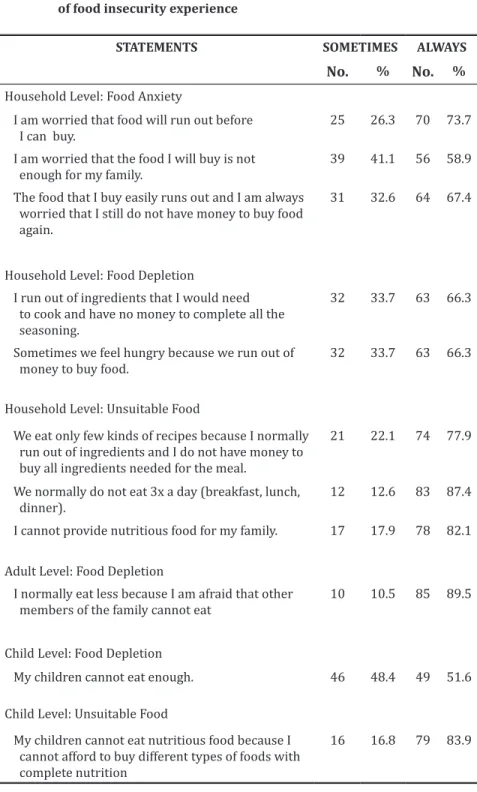
The intent of this portion was to determine whether they are able to eat nutritious food on a regular basis as an indication of their nutritional condition. Results show that the Badjaos were always anxious having no food, being hungry, and being unable to serve nutritious food (Table 4).
The Badjaos choose to prepare daily viands with no condiments.
For as long as there is a slice of cassava, they can cook it as “tompeh” or
“sianglag” (roasted ground cassava). This serves as their main staple.
Fish soup is prepared only by boiling lemon grass and salt. Due to low income, most of the Badjao families experience hunger which they consider “normal.” One KI explained:
“We always run out of food. If I cannot bring home money or food in exchange for products, we cannot eat. We have to wait for my other children who also help in looking for other means of survival. Otherwise, we skip our meals and just drink water. There are times when we would borrow from the sari-sari store (local community store). Oftentimes, however, we would not be granted.
What we usually do is just to sleep away the pain of hunger or beg from neighbors or other villages just so we can eat for the day.”
Another KI lamented:
“I let my children eat before I eat or I divide first the food before I call them to eat.”
Thus, this kind household level food anxiety and food depletion is reflected as well in what they serve their children. As one mother confirmed,
“I cannot provide nutritious food for my children. Most of the time, I serve only one kind of food like cassava.”
Results also indicate high food insecurity, lack of food variety, and high incidence of hunger in the study area. Majority of the children in the study area were also malnourished, underweight, or stunted.
Official statistics (Philippine Food Security Information System, n.d.) recorded a high level of 45 percent children between 0-5 that were stunted in ARMM in the year 2015. Save the Children (2014) also estimated that 40 percent of the children who are underweight were in Sulu, Tawi-Tawi, Maguindanao, and Lanao del Sur. What is worse
Table 4. Percentage distribution of households by frequency of food insecurity experience
STATEMENTS SOMETIMES ALWAYS
No. % No. %
Household Level: Food Anxiety
I am worried that food will run out before
I can buy. 25 26.3 70 73.7
I am worried that the food I will buy is not
enough for my family. 39 41.1 56 58.9
The food that I buy easily runs out and I am always worried that I still do not have money to buy food again.
31 32.6 64 67.4
Household Level: Food Depletion
I run out of ingredients that I would need to cook and have no money to complete all the seasoning.
32 33.7 63 66.3
Sometimes we feel hungry because we run out of
money to buy food. 32 33.7 63 66.3
Household Level: Unsuitable Food
We eat only few kinds of recipes because I normally run out of ingredients and I do not have money to buy all ingredients needed for the meal.
21 22.1 74 77.9
We normally do not eat 3x a day (breakfast, lunch,
dinner). 12 12.6 83 87.4
I cannot provide nutritious food for my family. 17 17.9 78 82.1 Adult Level: Food Depletion
I normally eat less because I am afraid that other
members of the family cannot eat 10 10.5 85 89.5
Child Level: Food Depletion
My children cannot eat enough. 46 48.4 49 51.6
Child Level: Unsuitable Food
My children cannot eat nutritious food because I cannot afford to buy different types of foods with complete nutrition
16 16.8 79 83.9
is the fact that the Badjaos considered these conditions commonplace and normal. In fact, they are so used to scarcity that they believe that
“mere presence of food does not entitle a person to consume it.” While the lead author was conducting the interview with one mother, the neighbors’ toddler son was crying frantically. She apologized shyly and said: “He has not eaten anything since yesterday.” In the deprivation trap, this condition is referred to as physical weakness, a condition that complicates one’s ability to perform well in school and further pushes them towards isolation.
Health Conditions
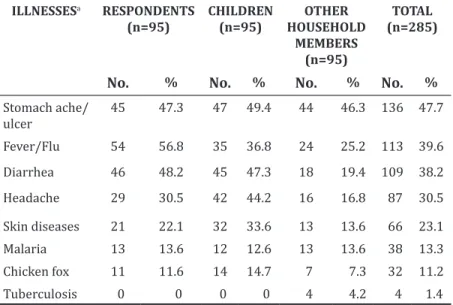
According to almost half (48%) of the respondents, stomach ache and ulcer were the most common illnesses in their community, affecting mostly children (49%). Fever and flu were also prevalent (40%), and adults (57%) were most affected. Tuberculosis, according to them, occurred very rarely (1%). Table 5 shows the common illnesses in the study area and their frequency among household members.
Table 5. Common illnesses in Badjao communities ILLNESSESa RESPONDENTS
(n=95) CHILDREN
(n=95) OTHER HOUSEHOLD
MEMBERS (n=95)
TOTAL (n=285)
No. % No. % No. % No. %
Stomach ache/
ulcer 45 47.3 47 49.4 44 46.3 136 47.7
Fever/Flu 54 56.8 35 36.8 24 25.2 113 39.6 Diarrhea 46 48.2 45 47.3 18 19.4 109 38.2 Headache 29 30.5 42 44.2 16 16.8 87 30.5 Skin diseases 21 22.1 32 33.6 13 13.6 66 23.1 Malaria 13 13.6 12 12.6 13 13.6 38 13.3 Chicken fox 11 11.6 14 14.7 7 7.3 32 11.2 Tuberculosis 0 0 0 0 4 4.2 4 1.4
aMultiple responses
Prevalence of stomach ache or ulcer could be attributed to food scarcity among households and a common consequence of skipping meals. High occurrence of diarrhea (38.2%) also indicates improper hygiene and poor food handling practices in the area. Drinking rain water and water sourced out from deep wells and water pumps can contribute to the prevalence of the illness among the Badjaos.
It is interesting to note that these health concerns have become commonplace and normal in the study area. One KI casually narrated that members of her family usually suffer from stomach ache or ulcer, fever, diarrhea, headache, and skin diseases. She explained further:
“Every month, we always suffer from different kinds of sickness, especially stomach ache. Maybe because we do not eat regularly.
But we are already used to this kind of situation. It is not only us; even my neighbors and almost all families in this area are suffering from the same problem.”
One KI described how his 7 year-old son met an accident a few days ago when he fell off the stilts directly into the water underneath their house along with heavy round timbers. The child was badly injured and could hardly move after the fall. At the same time, his daughter was afflicted with a skin disease which they are unfamiliar with. When asked if he had brought either of them to a doctor, health center, or hospital, he answered:
“No, ma’am, we do not have money. I just put some herbal leaves which I know can help relieve my children of the illness.”
Poverty Rating of Households
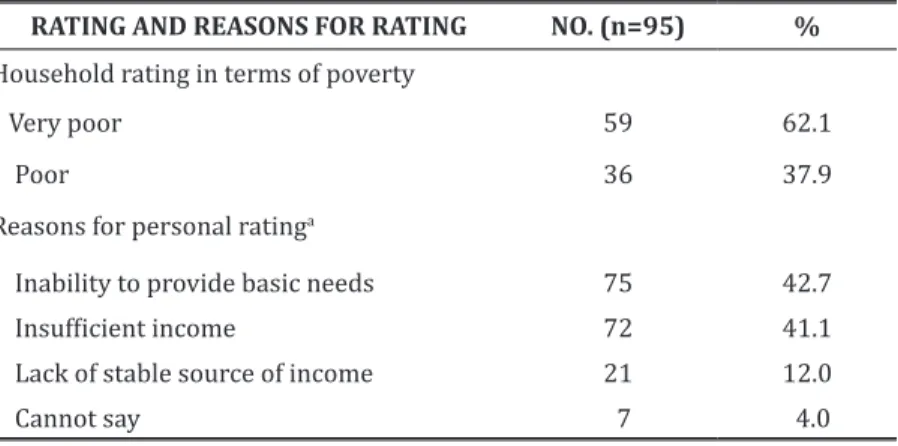
Respondents rate themselves as very poor. This perception is borne out of the realization that even some basic necessities are beyond their capability because they do not have a stable source of income. Table 6 shows the Badjaos’ rating of household poverty and their reasons for their perceptions.
Psychological Outlook
Respondents were asked about their aspirations for themselves and their children. The discussion centered on their lifestyle, what
Table 6. Common illnesses in Badjao communities
RATING AND REASONS FOR RATING NO. (n=95) % Household rating in terms of poverty
Very poor 59 62.1
Poor 36 37.9
Reasons for personal ratinga
Inability to provide basic needs 75 42.7
Insufficient income 72 41.1
Lack of stable source of income 21 12.0
Cannot say 7 4.0
aMultiple responses
they want for themselves, and what they dream for their children.
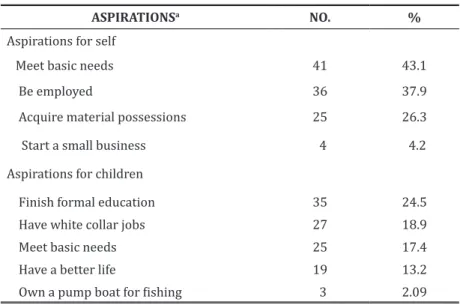
Ray (2002) speaks of aspiration failures among poor, older adults in highly stratified societies. Respondents characterized their lifestyle as unpredictable and unstable, especially in terms of income. However, when asked about their aspirations in life, a significant number (43.1%) expressed hopes of meeting basic needs such as being able to eat three times a day, being able to provide children’s needs in school, or owning a simple house that will protect them from stormy weather (Table 2).
One KI explained:
“I just want to be happy. I want to improve my families’ life. I have been sacrificing for a long time but nothing good has happened yet.”
Results support the explanation of Ray (2002) that the poor do aspire for better conditions, but since the gap is too wide between the rich and the poor, the poor become frustrated and consider that all things are largely unreachable. This is a situation that illustrates a feeling of being trapped in a condition wherein the Badjaos feel that they could not change their current situations. Nevertheless, the Badjaos do aspire for a better future for their children. The aspirations, as shown in Table 7, are modest, as Badjaos seek to meet basic needs and find employment.
About one-fourth (24%) of the respondents wanted their children to finish formal education. They viewed education as a way to have a better life. Some of them wanted their children to have jobs such as becoming a teacher, police, or midwife. It could be noted that these are the types of profession they are most familiar with, as teachers teach their children, midwives help them give birth, and policemen are regularly seen in the market area.
Notably, a few (13%) wanted their children simply to have a better life but they could not specify further. They simply defined better life as “anything better than their current situation.” One respondent explained that he wanted a pump boat simply because they did not have one when he was a child. Now that he is already a father, he still does not own a pump boat. This reflects an inter-generational sense of deprivation among community members.
What is perhaps more alarming than this sense of deprivation is the perception that it is a shared reality and is, therefore, almost natural. Referring to perennial health problems in the area, one key informant captures this outlook that poverty is almost normal:
Table 7. The Badjaos’ aspirations
ASPIRATIONSa NO. %
Aspirations for self
Meet basic needs 41 43.1
Be employed 36 37.9
Acquire material possessions 25 26.3
Start a small business 4 4.2
Aspirations for children
Finish formal education 35 24.5
Have white collar jobs 27 18.9
Meet basic needs 25 17.4
Have a better life 19 13.2
Own a pump boat for fishing 3 2.09
aMultiple responses
“We are already used to this kind of situation (hunger). It is not only us, even my neighbors and almost all households in this area are suffering from the same problem.”
While Ray (2002) notes that frustrations can lead to protest, the Badjaos seemed resigned to their conditions with no hope for a better future within their lifetime.
Access to Services
Access to services was determined by investigating the organizations with projects in the study area and the number of respondents who were able to avail of the services of institutions who have projects in the area. To determine the institutions with projects, government offices were first visited. Other organizations mentioned by the government offices were also visited. All organizations were asked about their past and present projects in Bongao.
Table 8 shows the organizations with projects in the area, which directly or indirectly target the Badjao community. It can be gleaned that Badjaos have no easy access to services. The projects from the LGU appear far and between and only indirectly. The Office of Southern Cultural Communities (OSCC), on the other hand, does not have funding and operates only as coordinating body for various projects directed to cultural communities. The Department of Education and the Department of Social Welfare and Development (DSWD) have special projects on education that benefit cultural communities. While DSWD implements the cash transfer program for the poorest members of the society, no Badjao is part of the program. Directly benefitting the Badjao communities are those that are managed by foundations and religious organization that center on literacy and health, with one providing microfinance assistance.
Participation in Projects
The lack of access to services was worsened by feelings of being an outsider in the bigger community. As one KI explained:
“Once, there was a medical mission conducted in the town proper.
We were not able to avail of the services because we were shy to mingle with other people. We did not know anybody whom we can approach.”
Table 8. Organizations with past and present projects in the area INSTITUTIONS/
CLASSIFICATION/
ACTIVITIES
YEAR TARGET
BENEFICIARIES BADJAO COMMUNITIES Office of the Mayor (Local Government Unit)
Coastal Environment
Protection Program 2007 All constituents Indirect beneficiaries Repair of school building,
day care centers 2007 All constituents Indirect beneficiaries Medical Mission in
partnership with the Philippine Charity Sweepstakes
2007 Specific
to Badjao communities
Direct beneficiaries
Citizen Education: Voting
rights, where to vote During election period
All constituents Direct beneficiaries
Office of Southern Cultural Communities
(Regional Office under the Autonomous Region in Muslim Mindanao) Currently has no funds for
projects and works as coordinating body for projects directed to cultural communities
Department of Education (National agency) Basic Education
Assistance for Mindanao (BEAM) funded by Australian Aid
2012-2017 Indigenous
peoples Direct
beneficiaries
Non-formal education, 10
hours per week 2002 Indigenous
peoples Direct
beneficiaries Department of Social Work and Development (National agency)
Supplemental feeding at
the day care centers Occasional All day care
center children Direct beneficiaries Health literacy Occasional All communities Indirect
beneficiaries
Table 8. Organizations with past...(Continuation) INSTITUTIONS/
CLASSIFICATION/
ACTIVITIES
YEAR TARGET
BENEFICIARIES BADJAO COMMUNITIES Magbasa Kita Foundation, Inc. (Foundation established by former Sen. Santanina Rasul)
Literacy for Peace and Development (LIPAD) with three-month class sessions every Saturdays and Sundays for adult learners
Continuing Illiterate adults Direct beneficiaries
Health Promotions Education is a health literacy program
Continuing Poor
communities Direct beneficiaries
Daughters of Charity of Saint Vincent de Paul (Religious organization) Badjao Village Learning
Center which conducts pre-school education with feeding program and Alternative Learning System (ALS) for adults
Re-opened in 2011 and continuing
Poor
communities Direct beneficiaries
Vicariate Social Development Foundation (Religious organization) Micro-financing Continuing Poor
communities Direct beneficiaries
Another KI expounded:
“It is very rare that we get to be chosen as beneficiaries. Nobody among us was chosen to become part of the Conditional Cash Transfer. We are always not part of programs.”
For one, there is no clear count of the Badjao population as they are highly mobile. Secondly, because of their lack of entitlements and very low income, it is difficult for the Badjaos to comply with the requirements of the program such as opening a bank account.
The requirements make it impossible for the Badjaos to avail of the programs of the government.
Notably, only about one-third (38%) of the respondents were able to attend the projects offered by various institutions. Respondents explained that they were not able to do so because they were not around, did not have any idea about the activities, or were not invited.
Among the key informants, one has never attended any educational program. He said he was not informed of an adult literacy program that was held every weekend at the day care center. He often wondered why a group of mothers met there regularly. He assumed that the activity was exclusively for women.
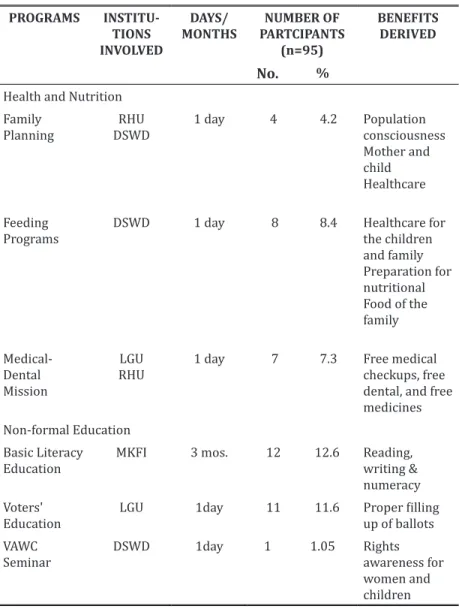
Table 9 presents the projects accessed by the respondents and the benefits they derived from participating in the projects. Not reflected here are the programs participated in by their children.
Participation in Community Activities
Almost all respondents attend wedding ceremonies or wakes in the community. They usually offer personal services like helping the host in cooking, serving visitors, and washing dishes. Whenever they have extra money or materials, they donate or share these to the hosts.
The Badjaos believe that if you extend help to your neighbors, you are also likely to receive help when you need it.
While the sense of community among themselves is high, Badjaos, however, rarely attend official functions such as the Municipal or Provincial Day celebrations unless invited to participate in parades or games (palaro) (Table 10).
Results show that Badjaos have very few opportunities to participate in community activities other than in social activities in their own community or in religious occasions. When they participate, what they offer are their personal services which illustrates their sense of community. It also indicates lack of resources to share. Low participation could also be attributed to the fact that they are often preoccupied with making a living.
An overwhelming majority (88%) of the respondents participate in elections. This could be because many of them were fetched by supporters of various candidates. With regard to approaching local leaders during times of need, most (62.1%) of the respondents said that they have already experienced doing so, while about one- third (35%) of them have not yet tried. Of the 59 respondents who did,
Table 9. Kinds of educational opportunities participated in by respondents
PROGRAMS INSTITU- TIONS INVOLVED
DAYS/
MONTHS NUMBER OF PARTCIPANTS
(n=95)
BENEFITS DERIVED
No. %
Health and Nutrition Family
Planning RHU
DSWD 1 day 4 4.2 Population
consciousness Mother and child Healthcare Feeding
Programs DSWD 1 day 8 8.4 Healthcare for
the children and family Preparation for nutritional Food of the family Medical-
Dental Mission
RHULGU 1 day 7 7.3 Free medical checkups, free dental, and free medicines Non-formal Education
Basic Literacy
Education MKFI 3 mos. 12 12.6 Reading,
writing &
numeracy Voters'
Education LGU 1day 11 11.6 Proper filling
up of ballots VAWC
Seminar DSWD 1day 1 1.05 Rights awareness for women and children Note: A few were able to attend to more than one intervention.
Legend:
DSWD - Department of Social Welfare and Development LGU - Local Government Unit
MKFI - Magbasa Kita Foundation Inc.
RHU - Rural Health Unit
Table 10. Participation of the respondents in community activities
COMMUNITY ACTIVITIES NO. %
Wedding ceremonies 95 100.0
Funeral 95 100.0
Religious festivals 27 28.4
Municipal/Provincial Day
celebration 19 20.0
Note: Multiple responses
Table 11. Political participation of the respondents
RESPONSE NO. %
Participation in choosing or electing our leaders
Yes 84 88.4
No 8 8.4
No answer 3 3.1
Ways in going to the precinct Fetched by candidates’
supporters from other municipalities
37 44.6
Went on our own 31 37.3
Fetched by candidates’
supporters within municipalities
15 18.07
Kinds of assistance received
Medical assistance 25 46.8
Basic goods 16 27.1
White cloth (for dead family
member) 13 22.0
Financial assistance 11 18.6
Opinion/advice 8 13.6
majority (80%) of them were given the assistance they requested. The usual items given to them were white cloth (for members of the family who died), medicines, basic goods (sugar, coffee, and rice), money, and recommendation for medical checkups. They also received opinions or advice for their problems. When one KI’s husband died several years ago, she approached their village leader for help. The village leader referred the problem to the municipal officials and the KI was given a white cloth to wrap her husband’s body and a sack of rice.
Badjaos generally ask for assistance from their leaders, and this is one reason they actively participate in elections. The KI explained:
“We are after a leader who can understand our situation and who is helpful and kind to us. In times of emergency, we can expect something from them. Like during the death of my husband, we were given rice and white cloth. And it was really a great help to us.”
CONCLUSIONS
The inter-related factors identified as considerable constraints in achieving development goals are highly interlinked. The conditions below, which formed the major themes resulting from the study, illustrate the conditions of deprivation that keep the Badjaos poor:
Low Educational Background, Lack of Skills, and Low Aspirations Majority of the respondents were either illiterate or were unable to finish elementary. Therefore, they do not have the necessary knowledge and skills, and thus engage in low paying jobs. Their irregular and meager income prohibits their children’s continued attendance in school, which compromises their hopes for better life.
Moreover, low educational status and limited access to capability-training seminars adversely affected productivity and livelihood opportunities. Since individuals with low educational background lack aptitude, competency, or skills necessary for regular- paying jobs, they have very limited opportunities to have regular income. Hence, they tend to have low aspirations in life.
Low Income and Lack of Assets
The Badjaos’ household income could hardly sustain basic family needs including food. There are times when Badjaos skip meals or adults skip meals and let the children eat. These meals often consisted only of cassava and fish. Most respondents acknowledged that they could not even provide a safe shelter for their family.
Respondents shared the difficulty of having a stable source of income. The respondents’ main occupation was fishing. Although they are good in fishing, income from fishing is uncertain because of a number of factors such as the weather (that is, if weather is good then fishers can get good catch), market price, and the quality of the catch (referring to kinds and size of fish caught). Furthermore, they have to pay for the use of pump boat that they do not own. Income from seaweeds vending, on the other hand, is highly erratic as it depends on what can be harvested along the shoreline. Meanwhile, mat weaving requires capital and raw materials, which are not readily accessible from their village.
The Badjaos also lack financial resources to spend for school expenses, to help neighbors in need, and to avail of medicine and health care services. This lack of financial resources intertwines with poor nutritional status and labor productivity that in turn affect prospects of better life. Even pursuing lucrative livelihood alternatives like mat weaving is problematic due to inaccessible raw materials and lack of capital for the venture.
This lack of income is actually brought about by a chain of related factors: the lack of knowledge and skills lead to difficulty in finding a decent-paying job, which consequently requires the respondents to engage in any kind of work for as long as they have money to earn however minimal. The kind of work they engage in is unstable and therefore income is uncertain.
The Badjaos do not own any piece of land and, thus, build their houses on stilts on the shore line or near coastal areas occupying government property. They use light materials for their houses. They own only basic kitchen utensils such as pots, plates, and kerosene or gas-operated lamps.
Poor Nutrition and Health Conditions
Habitual skipping of meals within the day may lead to poor household nutritional status and affect the health conditions of the households. This situation is an off-shoot of the inability to buy food. As a result, these two compounding issues negatively affect the attendance to school as households prioritize participating in activities that would bring in food.
Health condition of residents of the selected communities was generally poor. Prevalence of illnesses such as stomach ache and diarrhea could be results of poor hygiene and unsafe water supply. In addition, conditions of toilet and types of housing structures reflected an unsanitary environment. Taken together, these features are overwhelming factors that hinder human resource productivity and over-all progress in the community.
Poor Social and Political Capabilities
The members of the community have very little to offer, which is why they are unable to share information or share labor and materials. Because of this, they try to live harmoniously with one another and settle problems on their own. For them, it is important to settle problems as they cannot afford conflict within the community as this will disrupt their already difficult daily living. In the rare instances where there are services available to the community members such as medical missions which they know they need, they shy away as they feel that they are not part of these activities and that they will not be entertained.
Poor Access to Limited Services
General lack of access to basic utilities and public services in the community is seen as a barrier of progress in the area. Existing programs of DSWD on Conditional Cash Transfer and Comprehensive Livelihood Emergency Employment Program, which aim to help the poor family in their livelihood, do not benefit the Badjaos.
In terms of public utilities, availability of water for households had been a long-standing problem among the Badjaos. Thus, the more common source of water for drinking and other household needs such as for washing clothes are rainwater and deep well. However, collection of rainwater is also constrained by seasonality and lack of water tank or drums. Electricity is available in the area, but like water utilities, the main problem in access is due to the prohibitive cost of connections and monthly payments.
The general lack of social and political activity in the area is a major constraining factor toward an empowered community. The lack of organization exacerbates the problem of participation due to the lack of juridical body that could ventilate their concerns and represent them in socio-political fora. The Badjaos’ limited involvement in social and political affairs of the community could have been mitigated by membership and participation in local organizations that could enhance their social interaction and collective decision-making skills.
Socio-cultural discrimination is another constraining variable against. Many of the respondents admitted that they do not participate in many training programs or avail of public services because they are not prioritized or are discriminated.
Figure 3 shows the summary of the constraining factors, which contribute to the Badjaos’ poverty conditions. The summary shows the poor conditions of the Badjaos as reflected in the major items investigated in the study. These emergent themes are results of interlocking causes, one of which is the general perception that these groups of people are nomadic in nature. This perception, however, has been detrimental in terms of provision of services. The respondents of this study, for example, are residents of the barangays where they live, yet there is an apparent lack of data regarding their identity. Hence, there are very few services directed to Badjaos. If there are, these services are limited. These deprivation conditions evidently trap the Badjaos in a state of poverty.
Accordingly, the Badjaos have a short developmental horizon.
While they aspire for modest improvements in their children’s lives, the pressing need for daily survival dictates their decisions. Thus, children skip school because of the need to help provide for their daily subsistence. Eventually, the next generation could end up with menial jobs because of problems related to illiteracy and lack of skills.
Compounding this is the pervading belief that hunger and lack of entitlements is normal. This psychological belief system shrouds the deprivation that the Badjaos continually endure.
Figure 3. Deprivation trap of Badjaos
RECOMMENDATIONS
The Badjaos have suffered decades of social exclusion from mainstream society. The intertwining and reinforcing conditions that keep them poor and the lack of specific interventions to help them exacerbate the situation. The conditions that trap them in a cycle of deprivation include the lack of adaptive capacity (low educational background which leads to lack of skills and low aspirations) that leads to lack of access to capital (low income and limited economic opportunities), poor nutrition and health condition, and poor social and political capabilities reinforced by the lack of social capital.
The nature and descriptions of individual conditions under the conditions of deprivation discussed by Chambers (1983) are different from what the Badjaos suffer from. Previous researchers studying deprivation have not yet investigated the compounding effect of the psychological belief system of the Badjaos that deprivation is normal and should be endured.
The study thus provides a graphic picture of deprivation suffered by one of the poorest communities in the Philippines. While it has been acknowledged that the Badjaos belong to the poorest groups of society, there were very few studies that investigated their conditions.
There is limited research regarding actual conditions of the Badjaos.
The documentation of these conditions reveals the urgency to develop interventions that specifically cater to the needs of the Badjaos.
However, helping the Badjao community overcome poverty is a complex task. The Badjaos display wariness towards outsiders. They feel that they are excluded from interventions or would not be entertained.
The Badjaos feel more at ease when they know somebody that they can relate with.
Based on the data gathered, the researchers developed a collaborative and culturally sensitive model of program intervention for the Badjaos (Figure 4). The components of the program are participative so as to make the Badjaos feel that the program is for them; informative to ensure wider participation; persuasive so the Badjaos feel that the program will directly benefit them; and formative to address individual and community needs. Results show that the Badjaos need many formative interventions at the personal level. At the same time, they need to be able to work as a community to articulate their needs and work for the improvement of their community.
Moreover, the program would be guided by collaboration and networking of various institutions as not one agency can provide all of the needs. For example, free tuition alone will not encourage the Badjaos to stay in schools as they have to look for income. Provision of short term medical missions will also not work as the people shy away from these activities. Cultural sensitiveness should be a key principle in any undertaking. Policies formulated should thus adhere to these principles.
Hence, components of the program focus on participation, information giving, consensus building, capacity development, and organizational building.
Capability-building programs are considered crucial in moving marginal groups out of poverty (Farrington, Christoplos, Kidd, Beckman, & Cromwell, 2002) and help them escape abject social status (Bartholomew & Bourdon, 2002). Of immediate need would be livelihood activities related to fishing, fish processing, and mat weaving as well as literacy programs that could cater to more members of the
community. Capacity building, for example, should not only focus on providing training but also on helping the Badjaos in the whole supply chain of their major enterprise – that of fishing and mat weaving. These people are skilled mat weavers but do not practice such skills because of problems related to capital, sourcing out of materials, and marketing.
The National Commission on Indigenous Peoples could be the active force in providing policy directions and coordinating with different agencies, specifically ARMM and OSCC. The lack of adaptive capacity and access to capital and services should be addressed through informative, formative, and persuasive interventions underlined by participatory approaches.
Figure 4. Model for program implementation for the Badjaos