(AI) TO SUPPORT THEIR WORK BY TECHNOLOGY ACCEPTANCE MODEL ANALYSIS
CHAYANAN CHAROENWATANAKHUN
A THEMATIC PAPER SUBMITTED IN PARTIAL FULFILLMENT OF THE REQUIREMENTS FOR THE DEGREE OF MASTER OF MANAGEMENT
COLLEGE OF MANAGEMENT MAHIDOL UNIVERSITY
2022
COPYRIGHT OF MAHIDOL UNIVERSITY
ACKNOWLEDGEMENTS
This research could not be accomplished without the cooperation of numerous persons who assisted in the development of the research. Therefore, I would like to thank Associate Professor Nathasit Gerdsri, Ph.D. and the College of Management at Mahidol University for his useful and constructive recommendations on this project.
Moreover, I would like to thankful to my family for their support that they always give me a full support and my friend for their wonderful support during this project and especially my girlfriend who help me a lot on this project to coordinate with all of the lawyers’ respondent and give me a lot of perspective of the lawyers that really helpful on this research.
Lastly, I would like to thank to College of Management at Mahidol University (CMMU) this university made me a better person giving me a lot of practical knowledge that really useful in my real life.
Chayanan Charoenwatanakhun
LAWYERS’ INTENTION TO USE ARTIFICIAL INTELLIGENCE (AI) TO SUPPORT THEIR WORK BY TECHNOLOGY ACCEPTANCE MODEL ANALYSIS
CHAYANAN CHAROENWATANAKHUN 6349122
M.M. (ENTREPRENEURSHIP MANAGEMENT)
THEMATIC PAPER ADVISORY COMMITTEE: ASSOC. PROF. NATHASIT GERDSRI, Ph.D., ASSOC. PROF. WINAI WONGSURAWAT, Ph.D., NISIT MANOTINGVORAPUN, Ph.D.
ABSTRACT
The development of artificial intelligence has created new opportunities and challenges in every business sector including E-Commerce, Information Management Systems (IMS), and Manufacturing systems. To illustrate, AI eliminates daily routine work, redundant data entry, and monitoring processes. Furthermore, AI reduces human error including the decision-making process and document reviewing. Moreover, lawyers have enormous papers work and various law articles to review. This research explored the acceptance of lawyers in the artificial intelligence to facilitate their occupation via AI-based technology in construction using the technology acceptance model (TAM). The analysis of Lawyers' Intention to use Artificial Intelligence (AI) to support their work using Technology Acceptance Model consists of 100 samples was verified by using descriptive statistic and using inferential statistic method.
According to the research results, the technological factors along with lawyer' attitudes and intentions of using Artificial Intelligence (AI) had a highest on the perceived usefulness and the perceived ease of use and high on the perceived of sense of trust, perceived of legal use and cost via AI-based technology. In addition, the data analysis of independent variable results that factor affecting lawyers' attitudes towards using AI showed that reliability, legal use and cost factors had a statistically significant positive effect on attorneys' attitudes towards using AI at 0.05.
KEY WORDS: LAWYERS/ TECHNOLOGY ACCEPTANCE MODEL/ INTENSION TO USE/ AI TECHNOLOGY
40 pages
CONTENTS
Page
ACKNOWLEDGEMENTS ii
ABSTRACT iii
LIST OF TABLES vii
LIST OF FIGURES ix
CHAPTER I INTRODUCTION 1
1.1 Background 1
1.2 Technology Acceptance Model 1
1.3 Statement of Research Problems 1
1.4 Objective 2
1.5 Summarization of Methodology 2
1.6 Expected Deliverables 2
CHAPTER II LITERATURE REVIEW 3
2.1 The Extension of AI to Legal Industry 3
2.1.1 AI Capabilities and Incapabilities. 3
2.1.2 RLTAM 4
2.2 Just Walk Out Technology in Thailand 6
CHAPTER III RESEARCH METHODOLOGY 8
3.1 Overview of the methodology 8
3.2 Research question 9
3.3 Data collection technique 10
3.4 Hypotheses 10
3.5 Analytical approach 12
CHAPTER IV DATA ANALYSIS RESULT 13
4.1 Respondents’ demographic 13
4.2 Lawyer' Attitudes and Intentions of using Artificial
Intelligence (AI) 15
4.3 Reliability Test 19
CONTENTS (cont.)
Page
4.4 Hypothesis Testing 20
4.4.1 The Summary of Research Hypothesis Testing Results 22
CHAPTER V CONCLUSION AND RECOMMENDATION 23
5.1 Conclusion 23
5.2 Research limitation 23
5.3 Future research 24
REFERENCES 25
APPENDICES 26
Appendix A: Questionnaire 27
Appendix B: Information from SPSS 30
BIOGRAPHY 40
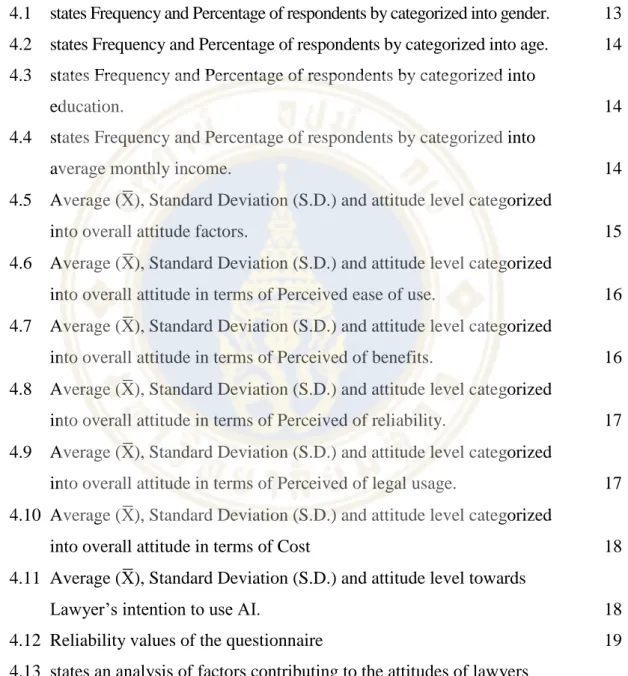
LIST OF TABLES
Table Page
4.1 states Frequency and Percentage of respondents by categorized into gender. 13 4.2 states Frequency and Percentage of respondents by categorized into age. 14 4.3 states Frequency and Percentage of respondents by categorized into
education. 14
4.4 states Frequency and Percentage of respondents by categorized into
average monthly income. 14
4.5 Average (X̅), Standard Deviation (S.D.) and attitude level categorized
into overall attitude factors. 15
4.6 Average (X̅), Standard Deviation (S.D.) and attitude level categorized
into overall attitude in terms of Perceived ease of use. 16 4.7 Average (X̅), Standard Deviation (S.D.) and attitude level categorized
into overall attitude in terms of Perceived of benefits. 16 4.8 Average (X̅), Standard Deviation (S.D.) and attitude level categorized
into overall attitude in terms of Perceived of reliability. 17 4.9 Average (X̅), Standard Deviation (S.D.) and attitude level categorized
into overall attitude in terms of Perceived of legal usage. 17 4.10 Average (X̅), Standard Deviation (S.D.) and attitude level categorized
into overall attitude in terms of Cost 18
4.11 Average (X̅), Standard Deviation (S.D.) and attitude level towards
Lawyer’s intention to use AI. 18
4.12 Reliability values of the questionnaire 19
4.13 states an analysis of factors contributing to the attitudes of lawyers
to use AI 21
4.14 Model Summary 21
4.15 Summary of Research Hypothesis Testing Results 22
LIST OF FIGURES
Figure Page
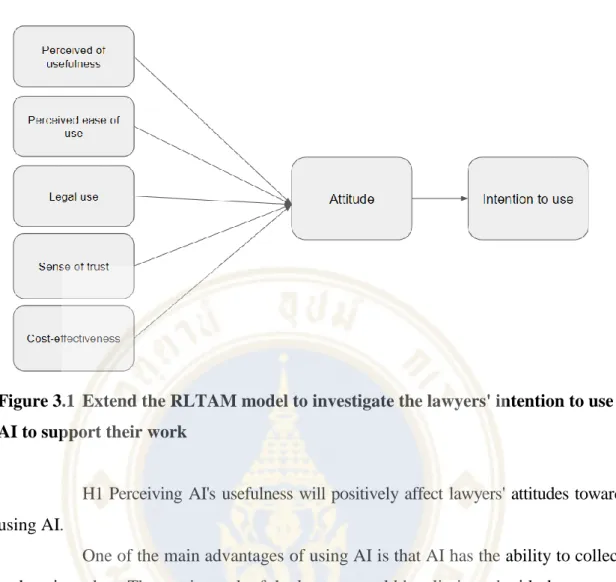
3.1 Extend the RLTAM model to investigate the lawyers' intention to
use AI to support their work 11
1
CHAPTER I INTRODUCTION
1.1 Background
The advancement of technology impacts every business sector including E-Commerce, Information Management Systems (IMS), and Manufacturing systems.
The major advancement is Artificial Intelligence (AI). AI improves business to become more efficient and accurate. For instance, AI eliminates daily routine work, redundant data entry, and monitoring processes. AI reduces human error including the decision- making process and document reviewing. In addition, lawyers have enormous papers work and various law articles to review. This research investigates the acceptance of lawyers to artificial intelligence technology to facilitate their works. The research question is “what are the key factors affecting the lawyers' acceptance on the use of AI technology applications for their works.”
1.2 Technology Acceptance Model
The Technology Acceptance Model (TAM) is an information system to measure the interaction of user acceptance to technology. User intentions to use artificial intelligence are determined by two main factors including perceive of usefulness and perceive ease of use. First, perceive of usefulness occur when the user feels the necessity and advantages of using new technology to facilitate their daily work. Second, perceive ease of use happen when the new technology eases their tasks
1.3 Statement of Research Problems
1. Some lawyers are accustomed to their traditional working ways and barely accept artificial intelligence.
2. Application of technology failure may occur when TAM is used to investigate the user intention.
1.4 Objective
To apply TAM for measuring the lawyer’s intention to use new technology for facilitating their work
1.5 Summarization of Methodology
1. Quantitative research is conducted by using questionnaires to exploit the lawyers’ intention to apply artificial intelligence.
2. TAM model receives from output process of one and two to perform and obtain the analytical model which affects attitude-behavior of the user.
3. Statistical Analysis is conducted from quantitative research to suggest a new business model which facilitates lawyer’s work.
1.6 Expected Deliverables
1. The analytical data of TAM is received to investigate the lawyer's intention to use and apply artificial intelligence to support their work.
2. The new business model is obtained for improving the quality of daily lawyers’ work which reduces complexity, redundancy, and human error.
To summarize, there could be future business model opportunities for the lawyer and law firm's to integrate the new technology to the focal system of their work.
This research benefits not only the lawyers perspective but also the law firm client satisfaction by reducing a human mistake.
2
CHAPTER II
LITERATURE REVIEW
This chapter briefly discussed (1) the extension of AI to the legal industry (2) Just Walk Out Technology Model application.
2.1 The Extension of AI to Legal Industry
Has two different objectives such as AI capabilities and incapabilities to replace human and RLTAM proposal, TAM extension, to intertwined legal service.
Lawyer works are performed with high-pressure, and complex setting which requires confidence, intelligence, and professional traits. In addition, client’s negotiation often requires softskill inlcuidng inquisitive and sense of justice skill. There are several tasks that AI can replace and support humans while there are numersous skill which are irreplaceable.
2.1.1 AI Capabilities and Incapabilities.
AI has the ability to collect and retrieve data. Routine lawyer’s tasks are supported with AI, including information search and screening of relevant and duplicate information from a significant number of sources and information. One of the interviewees mentioned that AI can provide repeatable labor and alternative legal services, such as compiling and searching a large number of data files, allowing attorneys to devote more time and resources to delivering high-quality legal services and enhancing service efficiency.
In addition, AI has the ability to analyze and predict cases. The capability of AI automatically discovers significant data discovery. Hughe amount of data supports a robot in making a rule to perform the analysis and prediction. Current legal practice is not conducive to the stable implementation of the law since there are numerous disagreements and ambiguities in the law. As a result, people are confused about specific
situations, which is not conducive to the law's implementation. Due to the objectivity and fairness of their robotic operations, the development of AI robot attorneys will increase the law's predictability and stability.
On the other hand, there are some aspects in which AI cannot replace human, including no intuition, empathy, creativity, psychological welfare, and negotiation ability., Robot responses are not intuitive as human responses when perceiving the grammar and legal wording. The interviewee responded, Humans can intuitively react to or evaluate a large number of simple details, whereas AI tends to be the opposite. The simpler things are for humans, the more complicated they are for artificial intelligence.
The study of expressions, emotional experiences, and intuitive feelings, for instance, may be conducted instantaneously by humans, whereas AI will need to perform a huge number of operations and analyses for these facets. In addition, Robot does not feel empathy or understand the difficulties, anxieties, and expectation of the client which may lead them to work unreasonably toward the client. Moreover, the lawyer can use creativity to solve the circumstance by creating a new solution. In contrast, AI depends on programming software and datasets to achieve human creativity, resulting in a limited capacity. The interviewee mentioned that “Science cannot explain the way people think; thus, technology cannot produce AI robot lawyers who can think like humans” In addition, legal service includes psychological warfare techniques that determine the adversaries. The lawyer requires the combinations of techniques with an offensive or defensive method and launch strategies. Moreover, lawyers take significant time to develop and train their negotiation ability.
2.1.2 RLTAM
RLTAM is composed of 5 facets including legal use, perceived ease of use, sense of trust, perceived of usefulness, and user intention.
First, legal use facet is divided into two elements including legal permission, and legal imputation. Legal permission founded that the AI robot must be licensed and authorized by the national law. Legal imputation refers to legal principle that AI is compulsory to have legal responsibility.
Second, perceived ease of use is referred to the perception of AI robots whether they are easy to use and, operate by the lawyer. It is agreed among all the interviewees
that the AI robot lawyer are easy to use. This leads to the AI robot ability to substitute for human data collection and retrieval. Big data refers to the ability to use big data in data collection, and retrieval for case analysis and prediction abilities. Absolute rationality refers to the ability to process a case, and follow a procedure by the engineer, and target by the client without being affected by the human emotion. Memory storage refers that AI having the ability of the robot to store a large amount of data through cloud storage and retrieve the data.
Third, a sense of trust is created in the belief of integrity, goodwill, ability, and predictability of new technology and platform. Machine safety is the AI ability to reflect the security of data storage and information. In addition, AI has the capacity to outsmart humans in the near future. One of the interviewees has given a claim by “AI robot lawyers are very powerful in data processing, analysis, and retrieval. I believe these characteristics are very useful and will help me with a considerable amount of work; hence, I will be happy to use robots.” Moreover, Human-Computer Interaction is the interaction between use of AI robots and humans to contribute to multiple fields including computer science, psychology, sociology, and law. It is mandatory for AI robot and lawyers to have a good interaction experience which can affect the purchase decision and customer loyalty.
Forth, perceived of usefulness is agreed among all the interviewees that robotic lawyers are efficient and helpful. In problem-solving, it is agreed among all interviewees that AI lawyer is able to produce the best solution to solve the problem. In addition, low price is another element that the respondent has agreed that human lawyer is not pricing effective as robot lawyer. Moreover, it is more convenient to consult with a robot lawyer rather than a human lawyer. The respondent reviewed that “Human lawyers may get tired when they work too much. AI robot lawyers never complain, and they are not governed by emotions”
Lastly, the user intention refers to the willingness of the client to adopt the robot lawyer. The respondent has claimed that ”If the state passes a law, then AI robot lawyers can be used on a large scale. They will assume legal responsibility or can clearly find the subject of responsibility. We are willing to hire AI robot lawyers because they are easy to use, low cost, and trustworthy.” Most of the respondents have a positive attitude toward the hiring of AI robot lawyers.
2.2 Just Walk Out Technology in Thailand
Just Walk Out Technology (JWOT) is the new technology in retailing shopping industry that provides a fresh experience and convenience to the convenience store customer. Finding the significant factor that influences the attitude, behavioral intention and the relationship between the factor of using JWOT in Thailand are the objectives of the research, The research is completed on 400 respondents in Bangkok to gain customer intention to buy and behavior. TAM extension is constructed with the support factor while data analysis is conducted by SPSS with multiple regression analysis, independent sample t-test, and one-way Analysis of Variance (ANOVA) technique. There are 13 hypotheses for conducting research as written below.
1. Perceived of usefulness with a positive impact on attitude 2. Perceived of entertainment with a positive impact on attitude 3. Perceived ease of use with a positive impact on attitude
4. Perceived ease of use with a positive impact on perceived of usefulness 5. Perceived ease of use with a positive impact on entertainment value 6. Perceived ease of use with a positive impact on perceived of usefulness 7. Perceived ease of use with a positive impact on entertainment value 8. Perceived trust with a positive impact on attitude
9. Attitude with a positive impact on behavioral intention
10. Consumer technology with a positive impact on behavioral intention 11. Subjective norm with a positive impact on behavioral intention
12. Difference in demographic characteristics with a positive impact on adoption
13. Difference in shopping habits and smart card experience with impact on adoption
The expected outcome is to identify the significant variable that has an impact on Thai people's attitude and behavioral intention to adopt JWOT. The research methods are classified into two main parts which focuses group interviews and questionnaires. The focus group is randomly selected to gain the information and insight of JWOT before developing the questionnaire based on the information from the interview.
The result shows that the attitude positively influences the behavioral intention to use. The perceived ease of use has a direct impact and an indirect impact on the perceived of usefulness. Behavioral intention to use is positively affected by the Social Norm in which it is the external factors. The perceived ease of use has a significantly higher effect than the perceived of usefulness. It is significantly in contrast with the other studies which claim that the perceived of usefulness is a decisive factor toward adopting new technology while the perceived ease of use is minor factors. It is not difficult to use JWOT because it does not require the client to change their behavior and shopping routine. The customers do not need to prepare the case and wait for inline in which this enhances the perceived ease of use to recieved the higher important score. In addition, the respondent's intention is affected the social norm. Peer influencer has lower influence level than the social influence that is from mass media. The has given more proof that the intention to use is influenced more by individual beliefs, commercials, and news. In the demographic background, the majority of people who are commonly accepted have a salary between 30,001-50,000 baht and the highest degree in Batchelor.
This lead to the rejection of technology anxiety because of most people have effiecient financial resources and have well educated society which lead them to be familiarized with the new technology, compare to lower salary group.
There are four major implications of the research including the positive perception of usefulness, personal background influencation, location of the store, and benefit of other retail businesses. First, the respondent’s attitude has a significant impact on the intention to use JWOT. The positive perception of ease of use and usefulness is compulsory for generating a positive attitude toward JWOT. Second, the persona background has a strong impact toward the perception of JWOT, intention to use and technology anxiety. The income level and education level has a strong implication toward the factor of accepting the new technology. Third, the location of the respondent has significant implications in which the frequent customer of the store that is located near BTS/MRT/ARL have higher intention to use compared to those who are not often got to the store. Fourth, the finding of the research benefits other related business as supermarkets. The owner of the store can consider that the application of JWOT may benefit their business.
3
CHAPTER III
RESEARCH METHODOLOGY
This chapter summarizes the overview of the research methodology of lawyers’ intention to use Artificial Intelligence (AI) to support their work by Technology Acceptance Model analysis by using questionnaire formation, data collection, multiple regression analysis, and reliable test. AI, the emerging technology has become a big impact on every business in terms of improving the efficiency of the business and impact cost-effectiveness. AI is one of the technologies that come to help in terms of eliminating the routine work, data collection, and monitoring of the process that could support the lawyer’s work in Thailand by using RLTAM-based theory to determine and explain the important factor that influences the lawyers' attitude and intention to use AI to support their work. This chapter mainly focuses on the methodological discussion.
This study's research and measurements are based on earlier empirical study research.
The conclusion is derived from the data collecting and data screening report.
3.1 Overview of the methodology
The purpose of this study is to identify the most influential factor on attitudes and intentions to use, Also, to explain the relationship between these variables and the attitudes and behavioral purpose of Thai lawyers to utilize AI to support their work.
3.2 Research question
There are 3 parts of the research question
1. Screening question to classify the respondents who are the lawyers 2. General question to collect the demographic background information of the respondents including gender, age, education level, and the average income for the analysis process.
3. Specific question to determine the significant criteria from the respondent of their attitude and behavior intention to use AI to support their work divided by six constructs as below:
Perceive of usefulness
1) I find that using AI will be useful
2) Refer to the video, I find that AI can support my work 3) Overall using AI will be beneficial to my work 4) AI can reduce my workload
Perceive ease of use
1) Using AI helps me to save time in finding an information 2) Using AI helps me to predict and analyze the case
3) Using AI helps me save time in reviewing the contact 4) AI can help me to collect data
Sense of trust
1) I think I can trust the AI how AI works 2) I feel unsafe with AI
3) I think that my information will safe when using AI 4) I think that using AI will not interrupt my privacy
Legal use
1) I think AI will accept by the government soon 2) I think AI will be legally used soon
Cost-effectiveness
1) I think that using AI has a high cost to pay
2) I think that using AI will help me to save the cost
Intention to use
1) I tend to use new technology to support my work 2) Overall using AI will be beneficial to my work 3) I think AI can not replace the human
4) I tend to use AI in the future
3.3 Data collection technique
For the data collection method, This research collects the data from an online survey by using google form as a tool for collecting the data. This survey aims to collect data from lawyers in Thailand.
The lawyers' group on Facebook and the line application channel are used to distribute the questionnaires. The lawyers’ group will provide significant information that shows the attitude and intention to use AI to support their work.
3.4 Hypotheses
With a literature review on RLTAM and related studies, It was anticipated that the generic causalities discovered in RLTAM would also apply to the intention of Thai lawyers to utilize AI. This paper proposes the following theories and an expanded RLTAM framework.
Figure 3.1 Extend the RLTAM model to investigate the lawyers' intention to use AI to support their work
H1 Perceiving AI's usefulness will positively affect lawyers' attitudes toward using AI.
One of the main advantages of using AI is that AI has the ability to collect and retrieve data. The routine task of the lawyers could be eliminated with the support of AI. Moreover AI also has the ability to analyze and predict the case. AI will be technically useful to provide high-quality legal service and improve service efficiency that can have a positive attitude to intention to use AI.
H2 Perceiving the ease of use of AI will positively affect lawyers' attitudes toward using AI.
According to the study, AI is easy to operate or use resulting in its capacity to replace human data collection and retrieval. Case prediction and analysis capabilities reveal that robots possess talents in huge data processing, absolute rationality, memory storage, and other perceptive and user-friendly features. Consequently, perceptual easy- to-use facets are investigated using huge data, absolute rationality, and memory storage.
are analyzed based on big data, absolute rationality, and memory storage that can increase a positive attitude to the intention to use AI.
H3 A sense of trust in AI will positively affect lawyers' attitudes toward using AI.
One of the basic factors is trust in using the new technology is machine safety.
AI has a lot of capability to support the lawyers' work but the most concern will be the safety and trust in using the AI that can make a positive attitude toward using AI.
H4 AI's legal acceptance will positively affect lawyers' attitudes toward using AI.
As the legal issue is a sensitive thing to be concerned about. The legal permission of the AI will be one of the factors that would affect the lawyers’ attitude. It should be legal and recognized by the government first which can increase the positive attitude of the lawyers toward using AI.
H5 Increasing or reducing the cost of work will positively affect lawyers' attitudes toward using AI.
According to one of the business aspects that all of the entrepreneurial concern are cost effectiveness to bring the new technology to adopt with their business.
The cost of adoption the new technology are high or low and the how technology could save their cost that is one of the big concern of the entrepreneurial which will be affect to their attitude toward using the new technology and for this research that can be affect to lawyer attitudes toward using AI to support their work.
3.5 Analytical approach
This research is examined by using descriptive statistic method to see what the significant characteristics of the sample size is and see the frequencies of the sample size to find the pattern to analyze the data. Second using inferential statistic method which is a multiple regression analysis to analyze the relationship between a single dependent variable and a number of independent variables.
4
CHAPTER IV
DATA ANALYSIS RESULT
The study of Lawyers' Intention to use Artificial Intelligence (AI) to support their work using Technology Acceptance Model consists of 100 samples. The researcher has presented data analysis outcomes to explain and interpret by categorized data into 4 parts as follows:
Part 1 Respondents’ demographic
Part 2 Lawyer' Attitudes and Intentions of using Artificial Intelligence (AI) Part 3 Reliability Test
Part 4 Hypothesis Testing
4.1 Respondents’ demographic
The researcher has analyzed data of respondents who are a lawyer with experience in using AI total of 100 respondents by categorized age, gender, education, and average monthly income into frequency and percentage as shown in table 4.1-4.4 as follow:
Table 4.1 states Frequency and Percentage of respondents by categorized into gender.
Gender Frequency Percentage
Male 44 44.0
Female 56 56.0
Total 100 100
According to Table 4.1, most respondents included 56 female or accounted for 56%. Following by 44 male or 44% of the remaining respondents are male.
Table 4.2 states Frequency and Percentage of respondents by categorized into age.
Age Frequency Percentage
22 - 30 years old 56 56.0
31 - 40 years old 22 22.0
41 - 50 years old 16 16.0
51 - 60 years old 6 6.0
Total 100 100
From Table 4.2, most respondents are Gen Y people aged 22-30 years old, with 56 respondents or 56%. Following by respondents with age 31-40 years total of 22 respondents or 22% while 6 respondents or 6% of the total respondents are people with age 51-60 years old.
Table 4.3 states Frequency and Percentage of respondents by categorized into education.
Education Frequency Percentage
Bachelor’s degree 72 72.0
Master’s degree 28 28.0
Total 100 100
Table 4.3 shown that 72 respondents have graduated the Bachelor’s degree or accounted for 72% of total respondents. In addition, 28 respondents or 28% of total respondents have graduated the Master’s degree.
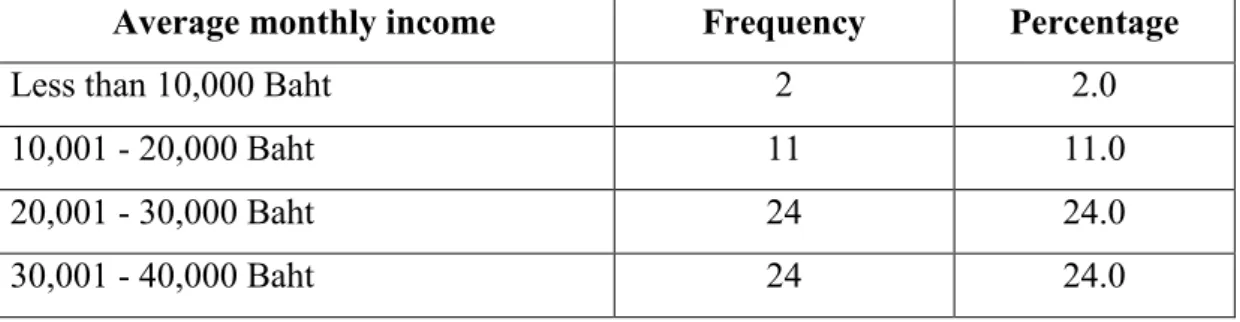
Table 4.4 states Frequency and Percentage of respondents by categorized into average monthly income.
Average monthly income Frequency Percentage
Less than 10,000 Baht 2 2.0
10,001 - 20,000 Baht 11 11.0
20,001 - 30,000 Baht 24 24.0
30,001 - 40,000 Baht 24 24.0
Table 4.4 states Frequency and Percentage of respondents by categorized into average monthly income (cont.)
Average monthly income Frequency Percentage
40,001 - 50,000 Baht 18 18.0
More than 50,000 Baht 21 21.0
Total 100 100
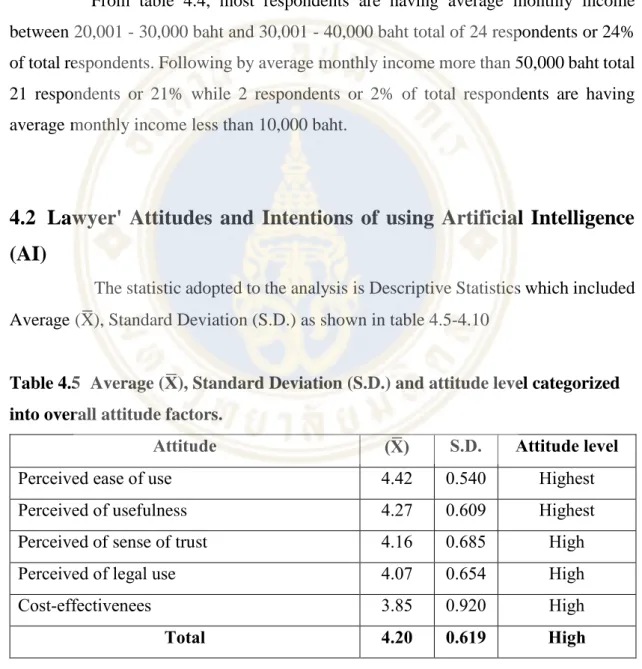
From table 4.4, most respondents are having average monthly income between 20,001 - 30,000 baht and 30,001 - 40,000 baht total of 24 respondents or 24%
of total respondents. Following by average monthly income more than 50,000 baht total 21 respondents or 21% while 2 respondents or 2% of total respondents are having average monthly income less than 10,000 baht.
4.2 Lawyer' Attitudes and Intentions of using Artificial Intelligence (AI)
The statistic adopted to the analysis is Descriptive Statistics which included Average (X̅), Standard Deviation (S.D.) as shown in table 4.5-4.10
Table 4.5 Average (X̅), Standard Deviation (S.D.) and attitude level categorized into overall attitude factors.
Attitude (X̅) S.D. Attitude level
Perceived ease of use 4.42 0.540 Highest
Perceived of usefulness 4.27 0.609 Highest
Perceived of sense of trust 4.16 0.685 High
Perceived of legal use 4.07 0.654 High
Cost-effectivenees 3.85 0.920 High
Total 4.20 0.619 High
From table 4.5, most respondents are having overall attitude towards intentions of using Artificial Intelligence (AI) in High level (X̅ = 4.20). When considered each
factor, Perceived ease of use has highest average (X̅ = 4.42), following by Perceived of benefits with highest average (X̅ = 4.27), and Cost with highest average (X̅ = 3.85), respectively.
Table 4.6 Average (X̅), Standard Deviation (S.D.) and attitude level categorized into overall attitude in terms of Perceived ease of use.
Perceived ease of use (X̅) S.D. Attitude level AI helps in time-saving for searching for information 4.50 0.644 Highest AI helps me to forecast and analyze the case 4.10 0.835 High AI helps in time-saving for contact checking 4.02 0.804 High
AI helps colleting information 4.34 0.699 Highest
Total 4.42 0.540 Highest
According to Table 4.6, most respondents had attitudes towards the intention to use AI in terms of Perceived ease of use at the Highest level (X̅ = 4.42). When considering each aspect, the use of AI helped respondents save time in searching for information with the Highest level ( X̅ = 4.50), followed by AI helps to colleting information with the Highest level (X̅ = 4.34). The last aspect, AI save time for checking contacts with the Highest level (X̅ = 4.02), respectively.
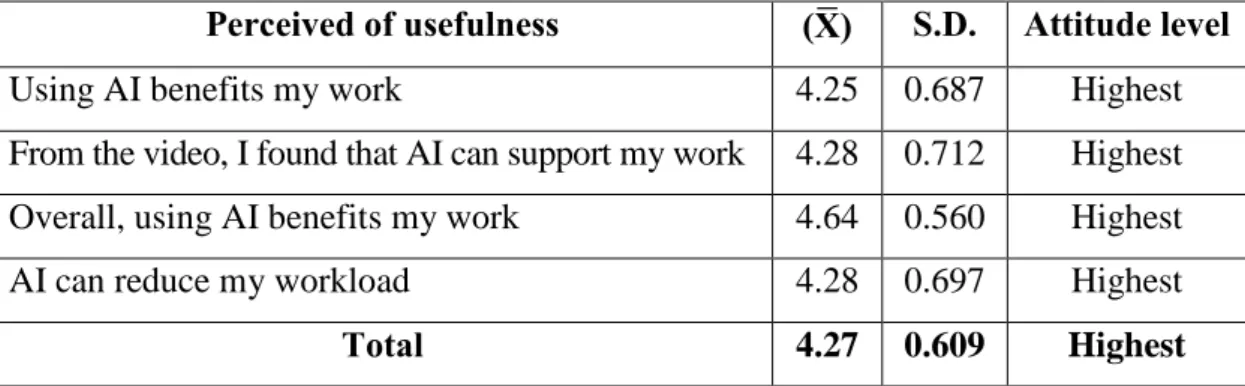
Table 4.7 Average (X̅), Standard Deviation (S.D.) and attitude level categorized into overall attitude in terms of Perceived of benefits.
Perceived of usefulness (X̅) S.D. Attitude level
Using AI benefits my work 4.25 0.687 Highest
From the video, I found that AI can support my work 4.28 0.712 Highest Overall, using AI benefits my work 4.64 0.560 Highest
AI can reduce my workload 4.28 0.697 Highest
Total 4.27 0.609 Highest
From Table 4.7, most respondents had attitudes towards towards the intention to use AI in terms of Perceived of benefits at the highest level (X̅ = 4.27). When considering
each aspect, Overall, using AI benefits my work with the Highest level (X̅ = 4.64), followed by from the video, I found that AI can support my work and AI can reduce my workload at the Highest level (X̅ =4.28). In addition, Using AI benefits my work with the Highest level (X̅ = 4.25), respectively.
Table 4.8 Average (X̅), Standard Deviation (S.D.) and attitude level categorized into overall attitude in terms of Perceived of reliability.
Perceived of sense of trust (X̅) S.D. Attitude level
I can trust on how AI works 4.02 0.864 High
I feel insecure about AI 3.19 1.261 High
My data is safe when using AI 4.36 0.704 Highest
Using AI will not interfere with my privacy 4.30 0.689 Highest
Total 4.16 0.685 High
According to Table 4.8, most respondents had attitudes towards the intention to use AI in terms of Perceived of reliability at the High leve l (X̅ = 4.16). When considering each aspect, my data is safe when using AI has the Highest level (X̅ = 4.36), followed by Using AI will not interfere with my privacy with the Highest level (X̅
= 4.30). The last aspect, I feel insecure about AI with High level (X̅ = 3.19), respectively.
Table 4.9 Average (X̅), Standard Deviation (S.D.) and attitude level categorized into overall attitude in terms of Perceived of legal usage.
Perceived of legal use (X̅) S.D. Attitude level I think AI will soon be accepted by the government 3.81 1.032 High I think AI will be used legally soon 4.32 0.695 Highest
Total 4.07 0.654 High
According to Table 4.9, most respondents had attitudes towards the intention to use AI in terms of Perceived of legal usage at the High leve l (X̅ = 4.07). When considering each aspect, I think AI will be used legally soon has the Highest level
(X̅ = 4.32), followed by I think AI will soon be accepted by the government with High level (X̅ = 3.81).
Table 4.10 Average (X̅), Standard Deviation (S.D.) and attitude level categorized into overall attitude in terms of Cost
Cost-effectiveness (X̅) S.D. Attitude level
I think using AI has high cost 3.80 1.015 High
I think using AI can save cost 3.89 0.920 High
Total 4.07 0.654 High
According to Table 4.10, most respondents had attitudes towards the intention to use AI in terms of Cost at the High level (X̅ = 3.85). When considering each aspect, I think using AI can save cost has High level (X̅ = 3.89), followed by I think using AI has high cost with High level (X̅ = 3.80).
Table 4.11 Average ( X̅), Standard Deviation (S.D.) and attitude level towards Lawyer’s intention to use AI.
Lawyer’s intention to use AI (X̅) S.D. Attitude level I always adapt new technology to support my work 3.81 0.971 High The overall use of AI benefits my work 4.10 0.927 High I think AI cannot substitute humans 4.05 0.880 High
I will often use AI in the future 3.87 1.012 High
Total 3.84 0.907 High
From Table 4.11, most respondents had attitudes towards the intention to use AI at the High level (X̅ = 3.84). When considering each aspect, the overall use of AI benefits my work has High level (X̅ = 4.10), followed by I think AI cannot substitute humans at High level (X̅ = 4.05) and I always adapt new technology to support my work at High level (X̅ = 3.81).
4.3 Reliability Test
Reliability test of the questionnaire was conducted by collecting data from questionnaires sorted out with incomplete answers or not through the sample properties and processed with a statistical package. In order to test the stability of the results obtained on each variable, the researcher determined Cronbach's Alpha coefficient (α) as a value of 0.7 as it was accepted and relied upon, which shown in the equation below:
Cronbach’s Alpha = kr
1+(k-1)r
The researcher tested the instrument's confidence using Cronbach's Alpha method and distributed a questionnaire to the sample group.
Table 4.12 Reliability values of the questionnaire
No. Variables Cronbach’s Alpha N of Items
Independent Variables
1 Perceived ease of use 0.754 4
2 Perceived of usefulness 0.791 4
3 Perceived of sense of trust 0.945 4
4 Perceived of legal use 0.815 2
5 Cost-effectiveness 0.878 2
Total 0.863 16
Dependent Variable
1 Lawyer’s intention to use AI 0.896 4
From Table 4.12, the confidence of each variable is more significant than 0.7, indicating that the question of each variable is appropriate and reliable. Besides, data can be collected from the sample group to complete 100 sets. The reliability test can be described as follows:
1. Perceived ease of use, 4 items, were analyzed with Cronbach's Alpha coefficient of 0.754
2. Perceived of usefulness, 4 items were analyzed with Cronbach's Alpha coefficient of 0.791
3. Perceived of sense of trust, 4 items were analyzed with Cronbach’s Alpha coefficient of 0.945
4. Perceived of legal use, 2 items were analyzed with Cronbach's Alpha coefficient equal to 0.815
5. Cost, 2 items were analyzed with Cronbach's Alpha coefficient equal to 0.878
6. Overall attitude, 16 items were analyzed with Cronbach's Alpha coefficient, equal to 0.863
7. Four factors of the Lawyer’s intention to use AI were analyzed from Cronbach's Alpha coefficient of 0.896
4.4 Hypothesis Testing
Hypothesis 1: Perceiving AI's usefulness will positively affect lawyers' attitude towards using AI.
Hypothesis 2: Perceiving the ease of use of AI will positively affect lawyers' attitude towards using AI.
Hypothesis 3: A sense of trust in AI will positively affect lawyers' attitude towards using AI.
Hypothesis 4: AI's legal acceptance will positively affect lawyers' attitude towards using AI.
Hypothesis 5: Increasing or reducing the cost of work will positively affect lawyers' attitude towards using AI.
The researcher used multiple regression analysis by selecting variables by entering all variables (Enter Regression), details shown in Table 4.13.
Table 4.13 states an analysis of factors contributing to the attitudes of lawyers to use AI
Factors affecting attitude of
lawyers to use AI B Std.
Error Beta t Sig
Constant 1.105 0.419 2.637 0.010
Perceived ease of use 0.002 0.091 0.001 0.024 0.981 Perceived of usefulness -0.098 0.081 -0.068 -1.210 0.229
Sense of trust 0.251 0.075 0.242 3.340 0.001*
Legal use 0.258 0.099 0.284 2.614 0.010*
Cost-effectiveness 0.362 0.080 0.432 4.544 0.000*
R2 = 0.789, Adjusted R2 = 0.778, F = 70.370, *p < 0.05
According to the data analysis of independent variable results shown in Table 4.13, Factors affecting lawyers' attitudes towards using AI showed that Reliability, Legal usage, and Cost had a statistically significant at 0.05, which implies the positive effect on lawyers' attitudes towards using AI.
When considering the impact of positive factors on lawyer attitudes in using AI, Cost (Beta = 0.432), Legal use (Beta = 0.284), and Reliability (Beta = 0.242) had a statistically significant positive effect on the attitude of lawyers in using AI at 0.05.
Table 4.14 Model Summary
Model Summary
Model R R
Square
Adjusted R Square
Std. Error of the Estimate
Change Statistics R Square
Change
F
Change df1 df2 Sig. F Change
1 .888a 0.789 0.778 0.413 0.789 70.370 5 94 0.000
When analyzing the determination coefficient (R Square = 0.789), Cost, Legal use, and Reliability positively affected the dependent variables. The attitude of lawyers to use AI was 78.9%, while the remaining 21.1% came from other factors.
Besides, the test statistic values analysis revealed that the value of F = 70.370, which
had a Sig. The value of 0.000 was less than 0.05, indicating that at least one independent variable influenced the dependent variable.
In conclusion, Legal use and Cost factors had a statistically significant positive effect on attorneys' attitudes towards using AI at 0.05.
4.4.1 The Summary of Research Hypothesis Testing Results
Table 4.15 Summary of Research Hypothesis Testing Results
Hypothesis Research Hypothesis
Testing Results Hypothesis 1: Perceiving AI's benefits will positively
affect lawyers' attitude towards using AI.
Not accept
Hypothesis 2: Perceiving the ease of use of AI will positively affect lawyers' attitude towards using AI.
Not accept
Hypothesis 3: A sense of trust in AI will positively affect lawyers' attitude towards using AI.
Accept
Hypothesis 4: AI's legal acceptance will positively affect lawyers' attitude towards using AI.
Accept
Hypothesis 5: Increasing or reducing the cost of work will positively affect lawyers' attitude towards using AI.
Accept
5
CHAPTER V
CONCLUSION AND RECOMENDATION
5.1 Conclusion
This research aims to investigate the lawyers' acceptance on the use of AI technology to facilitate their works.
This research is designed for gathering the intention to use of a lawyers to using AI to support their work thought the questionnaire which consist of five significant criteria including with perceived of usefulness, perceived ease of use, sense of trust, legal use, and cost. There are 100 of Thai lawyer’s respondents which is classified into 44 males and 56 females the most respondents are Gen Y people aged 22-30 years old, with 56 respondents.
Recommendation regarding to statistic result of RLTAM framework that accept 3 significant criteria that impact to the lawyers’ attitude toward the intention to use AI which are sense of trust, legal use and cost. From this result implies that the developer of AI should focus on how they can develop the AI that can make a lawyers’
trust on security, privacy and accuracy of how AI work for the lawyers. Moreover, the developer has to make sure about the permission of the AI from the government that is legal use. Lastly, the developer should focus on cost-effectiveness of the AI on how AI will save the cost and the price should be affordable or quick return on investment that would make AI wildly use by the lawyers.
5.2 Research limitation
Despite the fact that this study investigates the lawyers' intention to employ AI to assist with their work, it is not clear whether they will really do so. Nonetheless, there are inescapable limits that can be summarized as follows:
1. There is approximately 21 percent of the other significant factor is not covered by this study.
2. The purpose of this study is to investigate and evaluate the attitudes of Thai lawyer respondents
3. The lawyers who participated in this study represent a small subset of Thai attorneys who are knowledgeable with AI technology.
4. The research was done in volunteer lawyer groups with a diversity of demographic and geographic respondents, resulting in an unequal distribution of the sample size.
5.3 Future research
Even though the statistical results illustrate the significant level of each constant in relation to lawyers' purpose to utilize AI to support their work, this study might be improved by adding the following:
1. Referring to the statistical conclusion, around 21 percent of the other key factors of intention to utilize AI technology that have yet to be discovered have a substantial impact on the lawyers' attitudes toward AI technology and requires more study.
2. This research has illustrated the pattern of the lawyer attitude to toward using AI technology to support their work which benefit to the new business model of the future, which is the mega trend of technological advancement, especially AI, might be unique and play a significant role in enhancing the business's efficiency and service quality. This analysis can assist the developer in recognizing the pattern of the lawyers' intentions and determining which factors are crucial for achieving company objectives.
REFERENCES
Armour, J. and Sako, M. (2020). AI-Enabled Business Models in Legal Services: From Traditional Law Firms to Next-Generation Law Companies? Journal of Professions and Organization, 7(1), 27-46.
Chuawatcharin, R. (2017). Factors influencing the attitudes and behavioral intentions to use just walk-out technology (JWOT) among Bangkok consumers. (Master of Management). Mahidol University.
Faggella, D. (2020). AI in Law and Legal Practice - A Comprehensive View of 35 Current Applications. Retrieved from https://emerj.com/ai-sector-overviews/
ai-in-law-legal-practice-current-applications/
Kauffman, M.E. and Soares, M.N. (2020). AI in legal services: new trends in AI-enabled legal services. SOCA, 14, 223–226.
Mania, K. (2022). Legal Technology: Assessment of the Legal Tech Industry’s Potential.
Journal of the Knowledge Economy. https://doi.org/10.1007/s13132-022- 00924-z
Mikalef1, P., Fjørtoft1, S. O. and Torvatn, H. T. (2019). Developing an Artificial Intelligence Capability: A Theoretical Framework for Business Value.
Conference: 4th Workshop on Big Data and Business Analytics Ecosystems (iDEATE 2019)At: Seville, Spain.
Ni Xu, N. and Wang, K.-J. (2018). Adopting robot lawyer? The extending artificial intelligence robot lawyer technology acceptance model for legal industry by an exploratory study. Journal of Management & Organization, 27(5), 867- 885.
APPENDICES
Appendix A: Questionnaire
Screening Question
1. Are you work as a lawyer?
A. Yes B. No
2. Did you graduate from the Faculty of Law?
A. Yes B. No
If one of two question answer “No” will end these surveys
Demographic 1. Age
• 22 to 30 years
• 31 to 40 years
• 41 to 50 years
• 51 to 60 year
• more than 60 year 2. Gender
• Male
• Female 3. Education
• Bachelor degree
• Master degree
• Doctorate degree 4. Salary (Bath)
• Less than 10,000
• 10,001 - 20,000
• 20,001 - 30,000
• 30,001 - 40,000
• 40,001 - 50,000
• More than 50,000
Specific Question
Perceive of usefulness 1 2 3 4 5
I find that using AI will be useful
Refer to the video, I find that AI can support my work Overall using AI will be beneficial to my work
AI can reduce my workload Perceive ease of use
Using AI helps me to save time in finding an information Using AI helps me to predict and analyze the case
Using AI helps me save time in reviewing the contact AI can help me to collect data
Sense of trust
I think I can trust the AI how AI works I feel unsafe with AI
I think that my information will safe when using AI I think that using AI will not interrupt my privacy Legal use
I think AI will accept by the government soon I think AI will be legally used soon
Cost-effectiveness
I think that using AI has a high cost to pay I think that using AI will help me to save the cost Intention to use
I tend to use new technology to support my work Overall using AI will be beneficial to my work I think AI can not replace the human
I tend to use AI in the future
Appendix B: Information from SPSS
Standard Deviation
Relaibility Test
Multiple Regression Analysis