THE RELATIONSHIP BETWEEN WORK LIFE SKILLS AND EMPLOYEE ENGAGEMENT OF CAREGIVERS IN OLD HOMES; BANGKOK AREA NATNAREE SEELUANGSAWAT 5849098. But unlike countries in Europe where both basic care skills and work life skills are required in the curriculum of caregiver training schools, only basic care skills were required in Thailand. This research aimed to fill the gap by studying the relationship between caregivers' work-life skills and employee engagement in nursing homes in Bangkok areas.
Data on basic caregiving skills, work-life skills, job satisfaction, and employee engagement were collected using a self-report questionnaire from 189 caregivers working in 13 nursing homes in Bangkok. The study found that caregivers' education, work experience, and training programs were positively related to caregivers' basic caregiving and work-life skills.
INTRODUCTION
- Significance of The Study
- Review of Roles, Responsibility and Challenge of Caregivers Caregivers assisted someone whom they take care of in the personal level
- Problem Statement
- Expected Benefit
- Research Objectives
- Research Scope
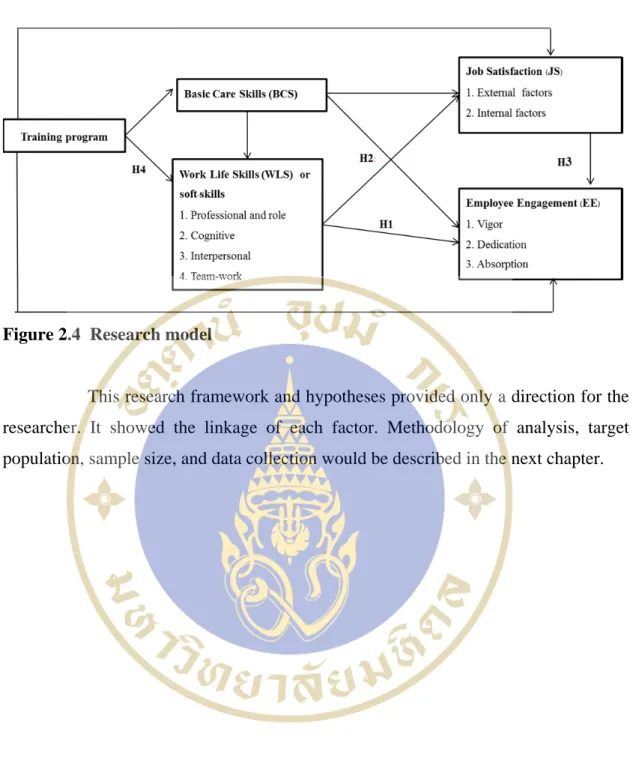
Nursing home caregivers who had higher work-life skills tend to have higher job satisfaction and higher employee engagement (Han et al., 2014). Assessment of self-confidence in both basic nursing and professional and private life skills of nursing home caregivers has not been investigated. The aim of this research was to examine the relationship between professional and private skills (soft-skills) and the engagement of employed caregivers in homes for the elderly.
This study provided feedback from care staff working in nursing homes regarding their basic care and work life skills. Job satisfaction and employee engagement were investigated to find the relationship between work life skills (soft skills) and employee engagement of care staff in nursing homes.
LITERATURE REVIEW
Definition of Terms
- Nursing home
- Caregivers in nursing homes
- Caregiver Training Program
- Basic-care knowledge and skills of caregivers
- Work-life skills (soft skills) for caregivers
- Job Satisfaction
- Employee Engagement
- Linkage between job satisfaction and employee engagement The conceptual model “factors affecting employee engagement” defined two
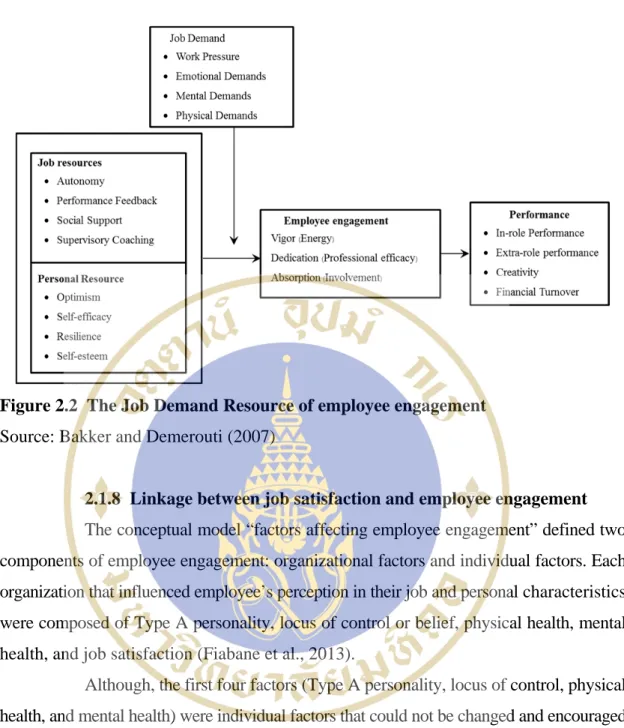
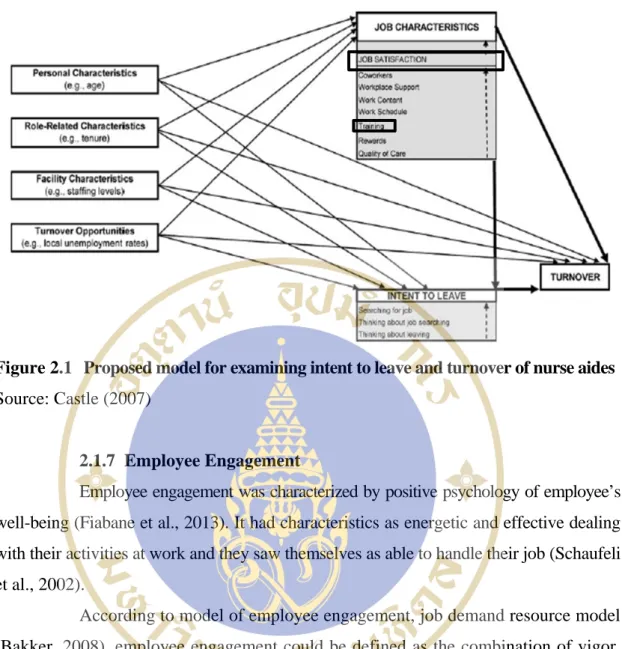
Individual and organizational factors related to job satisfaction among caregivers have been defined as intrinsic factors and extrinsic factors (Friedman et al., 1999). According to model of employee engagement, job demand resource model (Bakker, 2008), employee engagement can be defined as the combination of vitality, commitment and absorption. Employees who were motivated by responding to their job demand tended to have higher employee engagement.
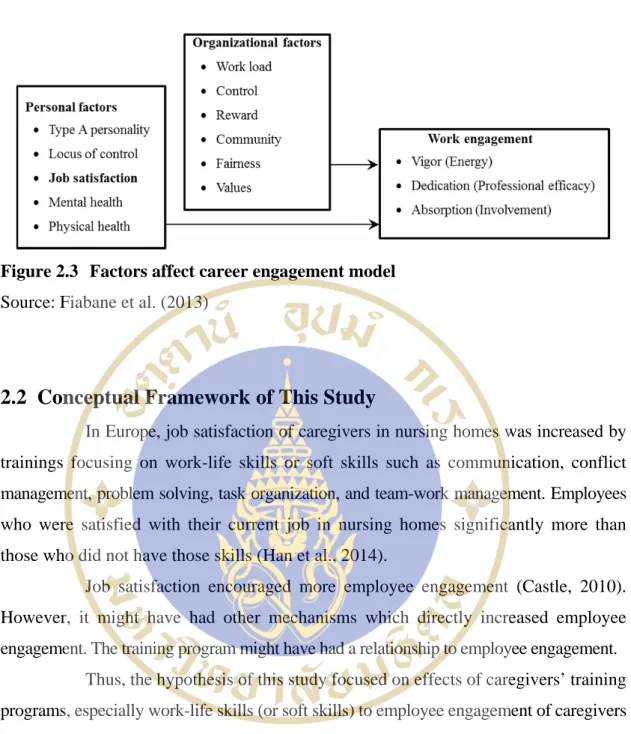
Each organization that influenced employees' perception of their work and personal characteristics consisted of type A personality, locus of control or trust, physical health, mental health and job satisfaction (Fiabane et al., 2013). Although, the first four factors (Type A personality, locus of control, physical health, and mental health) were individual factors that could not be changed and encouraged from outside, except for job satisfaction.
Conceptual Framework of This Study
RESEARCH METHODOLOGY
- Research Design
- Data Collection and Instrument
- Self-assessment questionnaire for caregivers
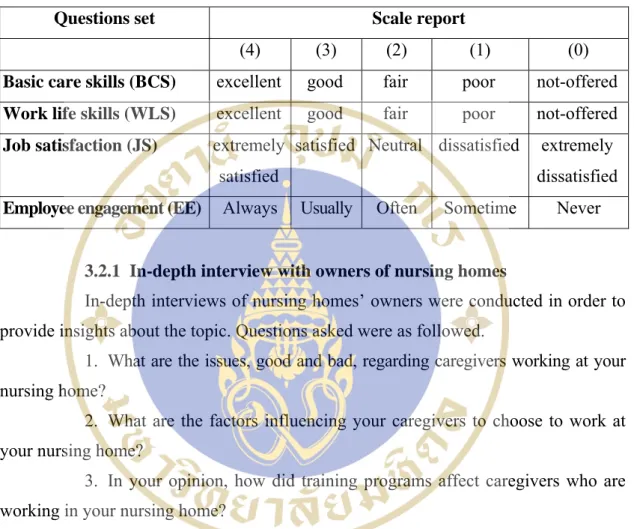
- In-depth interview with owners of nursing homes
- Validity and Reliabilty Assessment
- Data Collection
- Data Analysis and Statistical Analysis
- The Criteria for Meaning
In-depth interviews were conducted with nursing home owners to obtain additional data for analysis. To gain insight into the subject, in-depth interviews were conducted with nursing home owners. According to the Thai Elderly Promotion and Healthcare Association of Thailand (2016), there were 81 member nursing homes nationwide.
However, this study only focused on nursing homes in Bangkok with a total of 42 nursing homes. As some nursing home owners refused to participate in this study, only 13 nursing homes were studied.
FINDING AND ANALYSIS
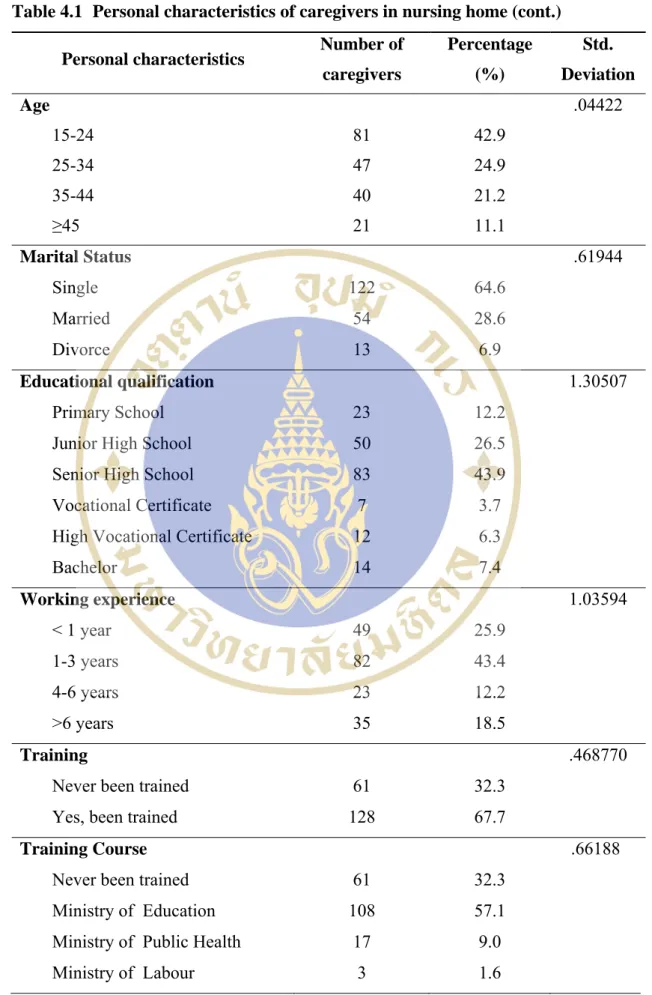
Demographics data of caregivers and characteristics of nursing home
Training Course Never trained Ministry of Education Ministry of Public Health Ministry of Labour. Only a small proportion of caregivers had other educational levels: elementary school (12.2%), bachelor (7.4%), higher vocational certificate (6.3%) and vocational certificate (3.7%). Regarding the years of service of nursing homes, the majority of nursing homes have been in operation for 6-10 years (46%).
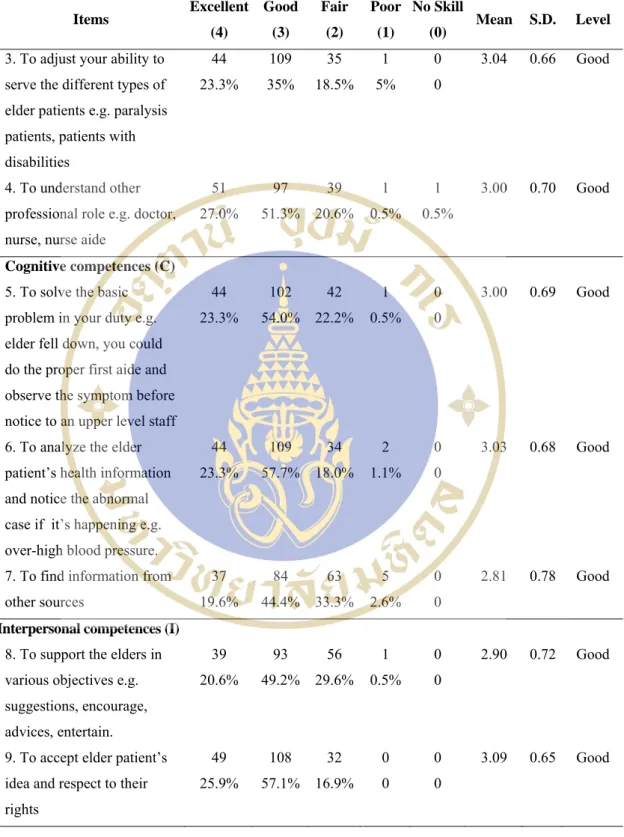
Self-Assessment on Basic-Care Skills
Work-Life Skills (Soft-Skills)
To analyze the health information of the elderly patient and notice the abnormal case if it occurs, e.g.
Job satisfaction
Employee Engagement
The Relationships Between Data Set
- Relationships between personal characteristics and basic-care skills According to Table 4.7, three variables of personal characteristics had positive
- Relationships between personal characteristics and job satisfaction According to Table 4.9, this study found that working experience has
- Relationships between personal characteristics and employee engagement
- Relationships between nursing-home characteristics and basic care skills
- Relationships between nursing-home characteristics and work- life skills
- Relationship between nursing-home characteristics and job satisfaction
- Relationship between nursing-home characteristics and employee engagement
- Relationships between basic-care skills and job satisfaction Table4.15 showed that basic-care skills had positive relationships with both
- Relationships between basic-care skills and employee engagement Per Table 4.15, basic-care skills had positive relationships with two
- Relationships between work-life skills and job satisfaction Per Table 4.16, work-life skills had some positive relationships with job
- Relationships between work-life skills and employee engagement Per Table 4.16, work-life skills had some positive relationships with employee
- H1: Work-life skills have positive relationship with employee engagement
- H2: Work-life skills have positive relationship to Job satisfaction
- H3: Job satisfaction has positive relationship to Employee engagement According to Table 18, components of job satisfaction had positive relationships
- H4: Training program has positive relationship to Work-life skills (WLS)
Pearson correlation = 0.206) However, training has a negative relationship with extrinsic factors and intrinsic factors for job satisfaction (Pearson correlation = -0.184 and -0.152 respectively). For the most part, work life skills had positive relationships with job satisfaction with one exception: interpersonal skills and external factors of job satisfaction did not have a statistically significant relationship. Specifically, the statistically significant relationships between components of work life skills and components of job satisfaction were summarized as follows.
Competencies associated with professional values and roles; and external factors of job satisfaction (Pearson's correlation = 0.219). Competencies associated with professional values and roles; and intrinsic factors of job satisfaction (Pearson's correlation = 0.363). Management and organizational skills associated with teamwork and extrinsic factors for job satisfaction (Pearson's correlation = 0.213).
Leadership and organizational competencies related to teamwork and intrinsic factors of job satisfaction (Pearson's correlation = 0.360). Specifically, the statistically significant relationships between job satisfaction components and employee engagement components were summarized as follows.
Additional Finding
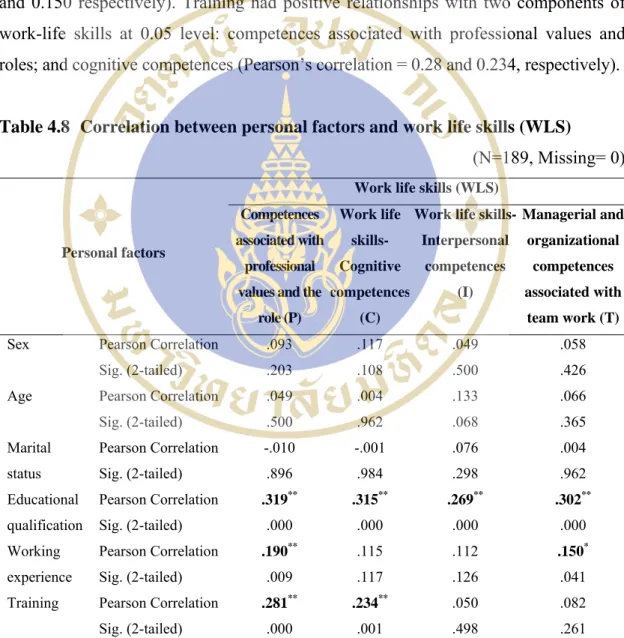
According to Table 4.18, training program had positive relationships with only two components of work-life skills. Specifically, the statistically significant relationships between training program and components of work-life skills were summarized as follows. Moreover, educational qualification was positively correlated with employee engagement's component, absorption (Pearson's correlation 0.173) (see Table 4.10).
It was correlated with two components of work-life skills: competencies related to professional values and roles (Pearson's correlation = 0.303) and cognitive competencies (Person's correlation = 0.190) (see Table 4.8). Work experience was also correlated with external factors of job satisfaction (Pearson's correlation = 0.206) (see Table 10). Finally, there was a positive relationship between the number of years of service in a nursing home and the component of work-life skills, and the management and organizational competencies related to teamwork (Pearson's correlation = 0.163) (see Table 4.12 ).
In-Depth Interviews of Nursing Home’s Owners
According to the criteria of the labor law, caregivers who were younger than 18 years old could not work. But in the real world, due to the lack of guardians, we had to hire new guardians. But the problem was that they were too young to deal with work problems and work under pressure.
The elderly were more involved in organizations and kept well informed than the younger relatives. The experienced caregivers had better basic care skills such as elder care and had better interpersonal skills with the elderly and families. Trained caregivers appeared to have more competence in basic caregiving skills than someone who was not trained.
Caregivers with higher education appeared to have more competence in basic caregiving skills and professional and personal life skills. This made our employees feel good in the working atmosphere, because we believed that if our employees were satisfied, they would take good care of the elderly. Caregiver education has shown me that caregivers have more competence in knowledge and skills with higher education, such as a higher vocational education and diploma.
I would prefer experienced caregivers who used to work in nursing homes or hospitals because they would know how to handle the elderly and their family members.
CONCLUSIONS, DISCUSSION AND RECOMMENDATIONS
Conclusion
- Characteristics of caregivers in nursing homes
- Characteristics of nursing homes
- The relationship between basic-care skills and work-life skills Basic-care skills had a positive relationship to work-life skills in all dimensions;
- Work-life skills have a positive relationship with employee engagement
- Work-life skills have a positive relationship with job satisfaction
- Job satisfaction has a positive relationship with employee engagement
- Training program has a positive relationship with work-life skills
- Theoretical Implications
- Managerial Implications
The results of this study showed that the component of work-life skills related to professional values and roles had a positive relationship with the component of employee engagement, namely strength (Pearson's correlation = 0.321) and dedication (Pearson's correlation = 0.241). The results of this study showed that the cognitive competencies component between work and life skills had a positive relationship with the employee engagement component. The component of internal competencies in work-life skills had a positive relationship with the absorption component of employee engagement (Pearson's correlation = 0.239).
Furthermore, the results of this study showed that the work-life skills component of managerial and organizational competencies related to teamwork had a positive relationship with the momentum component of employee engagement (Pearson's correlation = 0.336) and absorption (correlation of Pearson = 0.231). The work-life skills component of competencies related to professional values and roles had a positive relationship with the job satisfaction component of extrinsic factors (Pearson's correlation = 0.219). The work-life skills component of competencies related to professional values and roles had a positive relationship with the job satisfaction component of intrinsic factors (Pearson's correlation = 0.363).
The work life skills component of cognitive competencies had a positive relationship with the job satisfaction component of external factors (Pearson's correlation = 0.153); and with the job satisfaction component of internal factors (Pearson's correlation = 0.266). The work life skills component of interpersonal competencies had a positive relationship with the job satisfaction component of internal factors (Pearson's correlation = 0.303). Furthermore, Han et al., (2014) argued that basic care and work life skills could be trained and significantly correlated with job satisfaction.
The results of this study showed that the training program had a positive relationship with the work-life skills component of competencies related to professional values and roles (Pearson coefficient = 0.281) and cognitive competencies (Pearson coefficient = 0.234), but not with interpersonal competences; managerial and organizational competences related to teamwork. Work-life skills were crucial to creating job satisfaction and engaging carers in their careers. Therefore, carer training schools should emphasize the importance of professional and private life skills in their training programs.
Limitations of This Study
Work and life skills consisted of professional competence, cognitive competence, interpersonal competence and finally, management and organizational competence. They were important to create staff job satisfaction through understanding rules and regulations, job security, career development, working with others, incentives, sharing success, autonomy and job pride. Also, nursing home owners or managers should promote caregivers' work and life skills in order to create job satisfaction and engagement; and provide skills that caregivers need.
Finally, policy makers should put work-life skills into the regular curriculum of caregiver training program in Thailand.
Recommendations and Suggestions for Future Research
A comparison of job satisfaction among caregivers in nursing homes and a program of comprehensive care for the elderly (PACE). Associations between state regulations, length of training, perceived quality, and job satisfaction among certified nursing assistants: A cross-sectional analysis of secondary data. Quality of work life, personality, job satisfaction, competencies and job performance: A critical review of the literature.
Job satisfaction among caregivers in long-term home care: A systematic review of individual and organizational contributors.
APPENDICES
Appendix A: Statistical Output
The results of the relationship between personal factors and job satisfaction (JS) and employee engagement (EE) in caregivers. The results of the relationship between nursing home factors and basic care skills (BCS) and work life skills (WLS) of caregivers. The results of correlation between nursing home factors and job satisfaction (JS) and employee engagement (EE) in caregivers.
Correlation results between basic caregiving skills (BCS), work life skills (WLS) and job satisfaction (JS) and employee engagement (EE) of caregivers.
Appendix B: Questionnaire
General Information (12 questions)
Basic Care Skills of elderly care (BCS)
Work-life skills or Soft-skills
Job satisfactions with career
Employee engagement to organization
แบบสอบถามงานวิจัย
คําอธิบายประกอบแบบสอบถาม
ผูวิจั
3) □ มัธยมปลายหรือเทียบเทา
การดูแลผูสูงอายุ
ไมนับการเรียนหรือฝกอบรม
ป_____เดือน
1) □ ไมเคย กรุณาไปทําตอขอ 8
2) เคย กรุณาไปทําตอขอ 7
ปจจุบัน
คน
ตอบไดมากกวา 1ขอ)
ใชยา อยางถูกตองและเหมาะสม
เปนตน
สิ่งแวดลอมในการทํางาน
หนาที่อยางสุดความสามารถ