This organization provided generous funding for the research and production of the book. Second, party funding is important from the point of view of the current issue of political corruption.
Political Funding and the General Character of Democratic Systems
The constitutional preference of these systems is also reflected in the regulation of political finance. The difference between party-oriented and candidate-oriented models hinders the introduction of detailed, universally binding rules in the field of political finance regulation.
A General Issue: The Status of Political Parties in Democracies
On one side of the spectrum of possible solutions, there is no difference between the political parties and civil society associations such as e.g. Finally, a third area in which the dilemma between parties as civil bodies and parties as state organs is present is the regulation of the internal affairs of political parties.
The Specificity of ‘Transition’
Similarly, some problems with party finance and campaign finance may not simply be a corruption of democracy, but rather symptoms of the establishment of semi-authoritarian regimes. All the problems mentioned in this section of the text tend to hamper the development of universal models or rules for party and campaign financing.
Problems of Political Finance in Eastern Europe
In the rest of the region, seeking ever greater transparency of political finances would probably be in vain. In many countries in the region, these media were or still are under the political control of the parties in power.
Conclusion
One way to seriously consider this model would be in the context of the Council of Europe, which has already adopted normative principles that endorse the rationale of the voucher system. We hope that the detailed analysis of the experiences in some eastern parts of the continent that this book provides will help in developing such answers.
Description of the Campaign Finance Model
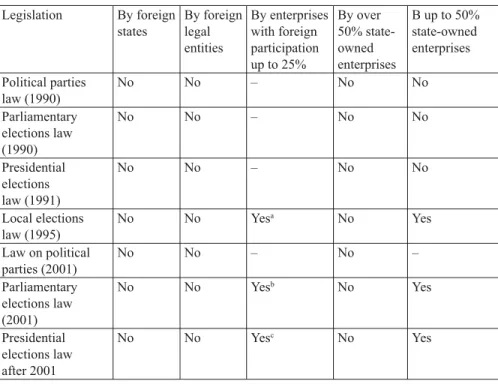
They received advances of up to 50 percent of the amount set aside for campaign financing in the state budget. The Act on Political Parties stipulates that the state audit supervises the control of political parties' finances.
Analysis of the Campaign Finance Model
Pure majority replaces consensus in the decision-making process; the rights of the opposition are subject to limitation. There is no risk of the 'nationalization' of political parties or excessive public funding that leads to the alienation of voters and citizens from politics.
Description of a Political Finance Model
Liberal-oriented parties are members of the global federation called Liberal International (they also have contacts with the Friedrich Neumann Stiftung). At the same time, the previous provision of Article 18 of the Law on Political Parties strictly defined political parties as non-profit entities. After the 1998 amendment, the wording of the law changed in that they were required to treat earned income in the same manner described for non-profit entities.
Law on Political Parties proposes a quota of 0.056 percent of the previous year's state budget. Act on the State Audit Office7 provides for the authority to review the financing of political parties and entrusts it in a very general way to the State Audit Office. In the period between 1990 and 2001, SAO never scrutinized the financial management of the political parties in the Republic of Croatia.8.
An Analysis of the Party Finance Model
There is no desire in the world stronger than the desire of the rich to gain power and titles, except the desire of the rich and powerful to become even richer. It is not an analytical step where we focus on politics, nor is it part of our desire to build the necessary institutions by promoting the democratic process regardless of obstacles in political culture, values, social limitations. The reform of party financing and the regulation of election campaigns have, in addition to clearly expressed goals, the effects and purposes of the development of a participatory political culture, changes in the operation of economic entities and administration.
The original argument that the budgetary compensation for the campaign costs and the financing of the minimum costs of the political parties helps democracy has gradually faded. The following conclusion is suggested: precise legislative regulation is a necessary but insufficient condition for achieving democratic and responsible behavior by political parties. The regulation of the financing of political parties and election campaigns is also a very economical process because it reduces the unnecessary operating costs, prevents the party resources from being directed to propaganda campaigns, advertising and even personal accounts.
Conclusions
Description of the Party-Funding Model
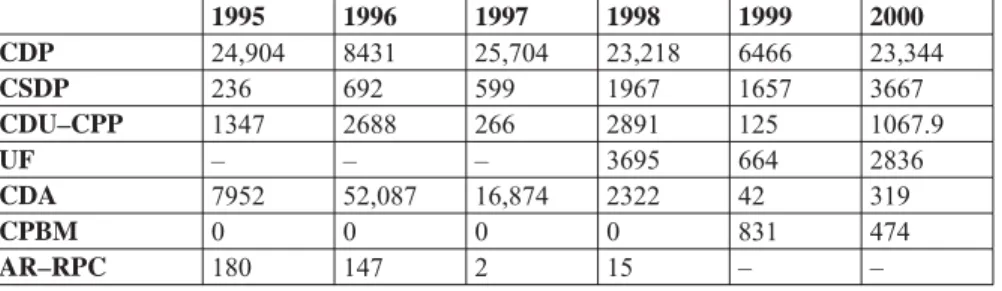
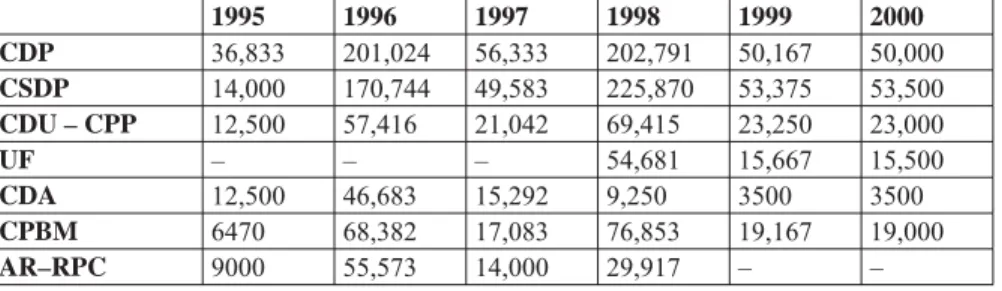
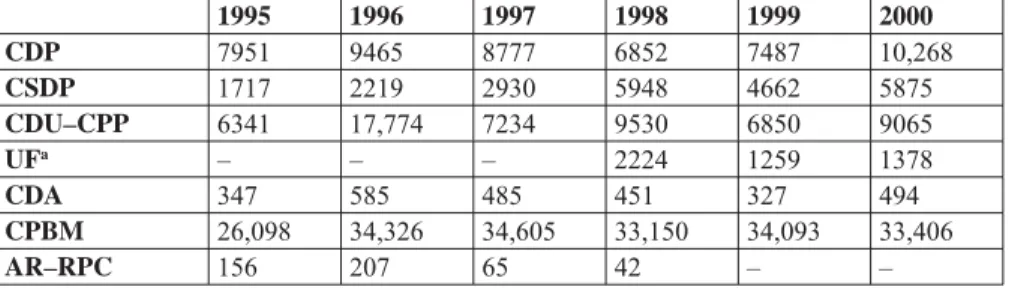
If the party's election results exceeded 5 percent of the total votes (the threshold set for achieving parliamentary representation), the subsidy was no longer increased. The structures dealing with party financing are defined in the statutes and relevant guidelines of the political parties. The ownership of the Communist Party of Bohemia and Moravia (CPBM) belongs to the party itself.
At the height of the party's power, donations accounted for more than 50 percent of its total income. friendly support is one of the challenges facing political finance regulation in the Czech Republic. Based on the evidence presented, it is possible to conclude that public funding of political parties is increasing in the Czech Republic.
Analysis of the Party-Funding Model
According to the president's reasoning, these parties have already managed to become established in the minds of a part of the electorate (this was proven by the share of votes they achieved in the elections). The deputies therefore responded to the court's verdict without being aware of the reasons for it. Only the State Audit Office is allowed to examine the accuracy of the financial reports.
MIÉP regularly transfers most of the money it receives from the state to the Hungarian Forum Foundation. In 1994, over a third of the Socialist Party's income came from real estate sales. The head of the State Audit Office is elected by parliament and is accountable to parliament.

Analyses of the Party-Funding Model
These parties – the first was in government and the second in opposition – collaborated to make the most of the law that gave parties office space. Here the spirit of the law was clearly violated, but no actual violation of the regulations was found. In 1993, the vice president of Fidesz said that the party's actions raised "only moral issues" and not legal ones.
By the end of the decade, this advantage over other parties had diminished, although it still existed. The leaders of the old parties joined the new party and retained the membership of the old party. Ironically, the politician most affected by this government maneuver was Mihály Kupa, then head of the Center.
Conclusion
Together with the Social (Public) Organizations and Citizens' Associations Act of 1983 (also amended in 1990), this measure formed the legal basis for the organization of political parties. In 1991, the first multiparty assembly adopted a new constitution, which declared political pluralism a basic element of the constitutional order. At the time of the 1998 parliamentary elections, there were 39 political parties in Macedonia, a country with 2 million inhabitants.
Some of them have just over 500 members; the largest political parties each have more than 50,000 members. This research focuses on the financing of two major political parties and main political rivals: the Social Democratic Union of Macedonia (SDSM) and the VMRO–Democratic Party for Macedonian National Unity (VMRO–DPMNE). The LDP is a medium-sized political party that ran a very professional election campaign in 1998, while the PDP is one of the Albanian political parties in Macedonia.
Description of the Political Finance Model
The 1998 Law on the Election of Representatives to the Assembly of the Republic of Macedonia contains more detailed provisions on election campaign financing. According to this law, a party's election campaign organizer must open a special account for the campaign 45 days before the day of the election. The Law on the Election of Representatives to the Assembly of the Republic of Macedonia gives those sources of financing prohibited during election campaigns.
According to the parties' official documents, special committees are in charge of financial matters. For example, according to VMRO-DPMNE's statutes, the party congress elects a supervisory committee for the party's financial operation. Also the Law on the Election of Representatives to the General Assembly of the Republic of Macedonia.

Analysis of the Party-Funding and Campaign Finance Models
To facilitate the work and existence of political parties, an increase in budget resources is necessary. The inadequacies of the initial political finance regime led to subsequent campaign finance reforms. First, in the case of presidential elections, contributions from legal entities, excluding political parties, may not exceed 60 percent of the spending limit (7.2 million zlotys).
This brought about an important modification in the creation of the Polish political financing system, namely. 24 The President of the Republic of Poland appoints the judges recommended to the National Election Commission. 25 Important examples of implementation practices can be seen after the 2001 parliamentary elections.

Analysis of the Political Finance Model
Laws and Regulations on Party Funding
There was no discussion about the ceilings for donations during the adoption of the law on political parties in the State Duma. In 1991, the Serbian Parliament adopted the Law on the Republic's Participation in the Financing of Political Organizations. Part of the support was channeled to DOS in the form of technical assistance (computers, cars, fax machines and mobile phones).
The Election Campaign Act contains some rules on the financing and reporting of the financial situation of political parties. The constitution must determine which party organ is responsible for the party's financial activities. The highest body in the party is usually the congress, which is akin to the party's parliament.
Prejšnja imena stranke so Socialdemokratska zveza Slovenije (SDZS), Socialdemokratska stranka Slovenije (SDSS) in Socialdemokratska stranka Slovenije (SDS). Donacije in povračila so v poročilu SDS predstavljena kot en znesek.