Such initiatives will contribute to raising the knowledge and practices of healthcare professionals regarding the handling of cytotoxic drugs. In addition, the KAP study is also the first in the UAE to assess the KAP of oncology healthcare professionals in handling cytotoxic drugs.
Introduction
Overview
Statement of the problem
Exposure can occur at any step of the medication circuit, where cytotoxic drugs are processed in shipping and receiving areas, prepared in pharmacies, administered in wards, and contacted through sanitation services such as laundry, cleaning, and waste disposal (Hon et al., 2013; WHSQ , 2017). In addition, no studies have been conducted on the knowledge, attitudes and practice (KAP) of healthcare professionals in Abu Dhabi regarding the handling of cytotoxic drugs in oncology healthcare settings.
Research questions
In the UAE, cytotoxic therapies are mainly prepared by pharmacists in the designated pharmacy, and administered to patients by nurses in the oncology wards. Therefore, it is essential to identify the extent of workplace contamination with cytotoxic agents and to evaluate oncology healthcare workers' knowledge, attitude and practices regarding the handling of these hazardous agents.
Aim and objectives
Significance of the study
Summary
Relevant literature
- Cytotoxic drugs definitions, classifications, and uses
- Environmental assessment
- Controlling exposure
- Biological monitoring
- Hazardous effects of cytotoxic drugs
- KAP regarding safe handling of cytotoxic drugs
A study in two Iranian hospitals by Azari et al. 2017) reported contamination of the workplace with cyclophosphamide. In other studies, it was also found that the oncology nurses have sufficient knowledge about the safe handling of cytotoxic drugs (Sheikh, 2016; . Callahan et al., 2016).

Methods
Introduction
- Data synthesis
- Synthesis of evidence: meta-analysis
The main outcome measure in the study will be the pooled prevalence of positive samples of cytotoxic drugs in the environmental samples tested, and the mean concentration of cytotoxic drugs in environmental samples collected from healthcare facilities. The full texts of the eligible and potentially eligible studies will be thoroughly reviewed for adequacy by at least two independent reviewers. If necessary, the authors of the studies are contacted to request missing or additional data for clarification.
RoB will be assessed in the following areas: (i) selection bias; (ii) performance biases; (iii) misclassification bias; (iv) conflict of interest; and (v) other biases. A quantitative synthesis approach will be provided to report the prevalence of cytotoxic drug contamination in environmental samples collected from healthcare settings. The metaprop command will be used to perform a meta-analysis of prevalence estimates (Nyaga et al., 2014).
To estimate the average concentration of cytotoxic drugs in the tested environmental samples in healthcare settings, a meta-analysis will be performed using a random effects model. The methane command will be used to perform meta-analysis of the concentration of cytotoxic drugs in the tested samples.
Study No. 2: Environmental assessment of cytotoxic drugs in
- Study area and study period
- Wipe sample collection
- Storage, transportation and analysis of samples
- Ethical considerations
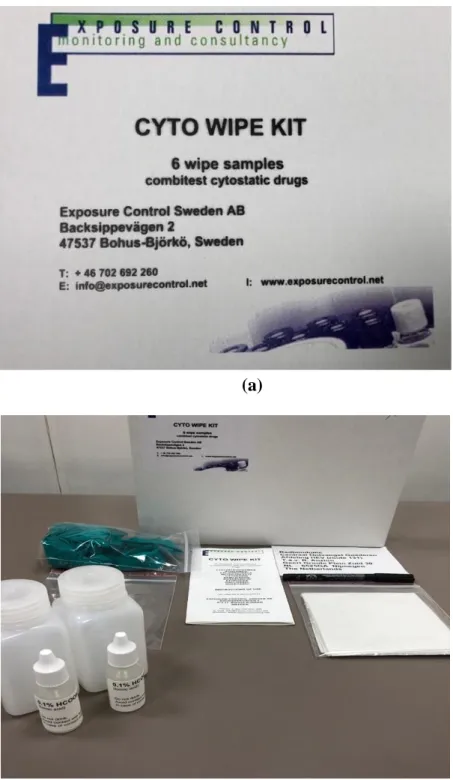
The selected 10 cytotoxic drugs were identified as drugs that are more often used in the treatment of cancer patients. This swab kit includes the materials needed to collect 6 swab samples, contains: 6 x 2 = 12 swabs, 6 droppers with 17 ml of 0.1% HCOOH (formic acid) solution, 6 containers including labels and plastic mini bags, 6 pairs of gloves, registration form, label with the address of the Exposure Control Sweden AB laboratory in the Netherlands, waterproof pen and instructions for use. Samples were obtained from all departments of the oncology centers (oncology pharmacy, outpatient clinic, and outpatient clinic).
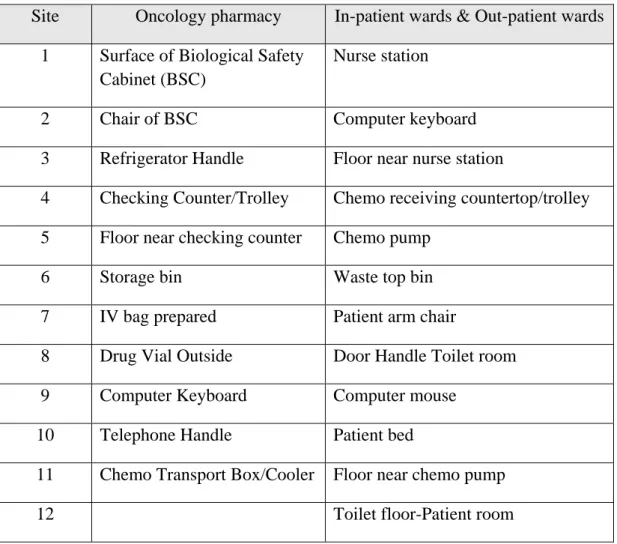
The selected sampling sites were assessed as the surfaces that are more potentially contaminated and at the same time more frequently touched by the health workers in the course of their daily duties. The surface wipe samples were collected by pouring the 0.1% HCOOH (formic acid) solution over the targeted sampling surface. Wipe samples were collected using a uniform sampling procedure by wiping thoroughly in various directions on the surfaces (Figure 2.2).
The tissues were then placed in designated containers that were pre-labeled with the date of collection and a coded number identifying the study site and sample location. All samples were sent to Exposure Control AB in the Netherlands, where analyzes were performed.
Study No. 3: Knowledge, attitudes and practices of oncology
- Study design, settings, population, and duration
- Sample size determination
- Inclusion and exclusion criteria
- Sampling strategy
- Data collection tool
- Validity and reliability of the research questionnaire
- Study variables
- Data analysis
- Ethical considerations
- Operational definitions
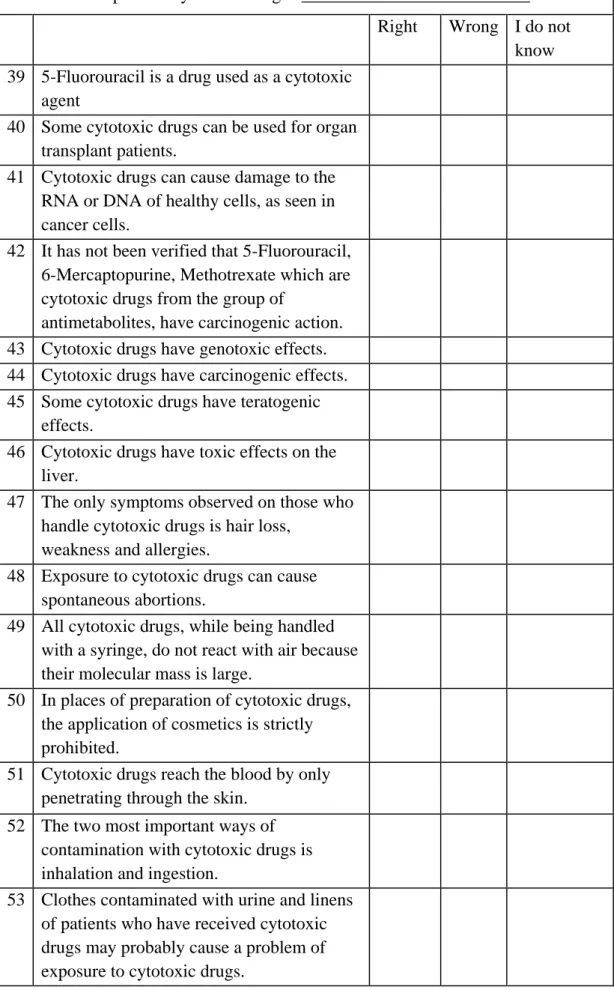
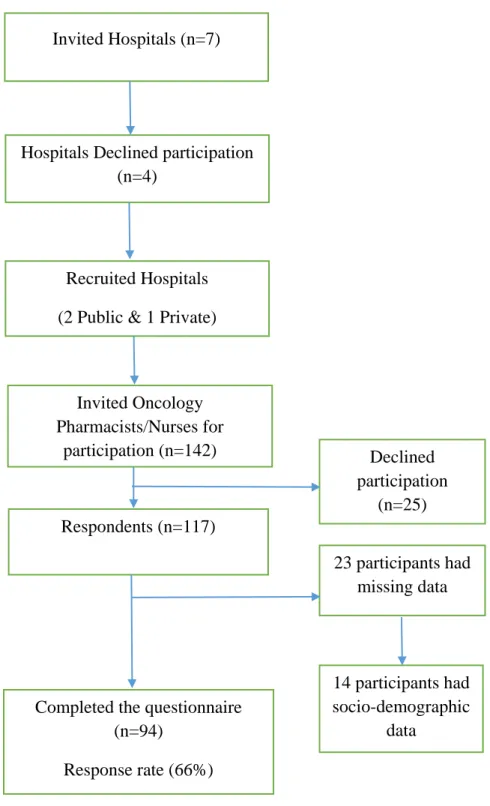
Nurses and pharmacists who were not involved in handling chemotherapy and those with work experience less than six months. All nurses and pharmacists who handled chemotherapy were invited to participate in the study. A previously validated questionnaire (Kyprianou et al., 2010) was used in this study to evaluate the KAP of oncology pharmacists and nurses in relation to handling cytotoxic drugs.
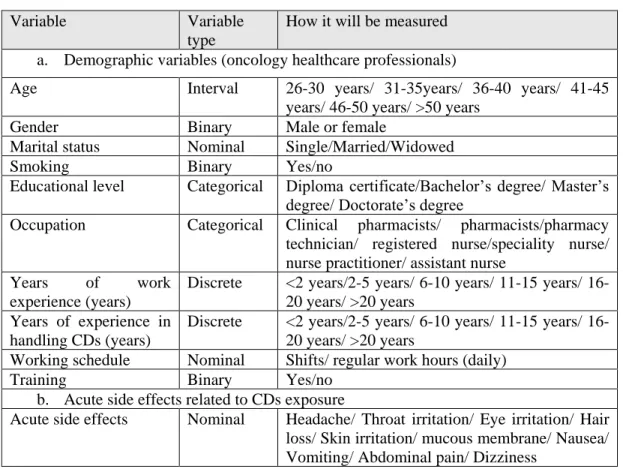
The questionnaire (Appendix D) used in this study was conducted in English and consisted of two parts: sociodemographic characteristics and KAP for managing chemotherapy. This section contained 8 questions that assessed the participants' practice of handling chemotherapy using multiple-choice questions and a Likert scale. Knowledge of oncology healthcare staff about safe handling of CDs knowledge Nominal Right/Wrong/Don't know.
Knowledge: is the information and concepts that oncology health care professionals have about cytotoxic drug treatment. Attitude: is the perception and inner feeling that oncology health care professionals have towards cytotoxic drug treatment, which can be positive or negative.
Results
Study No. 1: Environmental assessment of cytotoxic drugs in
Study No. 2: Environmental assessment of cytotoxic drugs in
- Surface contamination in Hospital A
- Surface contamination in Hospital B
A total of oncology pharmacy samples were positive for each of cytarabine and ifosfamide were positive for cyclophosphamide and 20%. A significant level of contamination was found in the Biosafety Cabinet (BSC) chair (cyclophosphamide 12 ng/cm2, gemcitabine 3.24 ng/cm2 and ifosfamide 8.53 ng/cm2) followed by one of the BSCs (5 -fluorouracilng4 /cm2 and ifosfamide 1.01 ng/cm2). The lowest contamination was measured on the surface of the other BSC (gemcitabine 0.13 ng/cm2 and ifosfamide 0.47 ng/cm2), on the control counter (ifosfamide 0.59 ng/cm2), on the floor (cyclophosphamide 0, 41 ng/cm2) and on the refrigerator handle (ifosfamide 0.16 ng/cm2).
None of the ten cytotoxic agents were found on any of the surfaces in the oncology inpatient department and the pediatric oncology outpatient department. There were a total of five positive samples with a percentage of contamination with some of the total oncology department samples tested. None of the ten cytotoxic agents were detected on the surfaces in the oncology inpatient department, the inpatient hematology department, the outpatient clinical department, and in the pediatric oncology inpatient and outpatient departments.
Significant contamination was found in the BSC (5-fluorouracil 50 ng/cm2, ifosfamide 23 ng/cm2, cyclophosphamide 4.83 ng/cm2 and cytarabine 1.25 ng/cm2) followed by the storage tank (ifosfamide 1.38 ng/cm2) . Lower contamination was observed on a prepared IV bag (cytarabine 0.51 ng/cm2), on the chair in front of the BSC (methotrexate 0.38 ng/cm2), and on the pharmacy storage container (cytarabine 0.13 ng/cm2).
Study No. 3: KAP of oncology healthcare professionals on the
- Demographic characteristics of study participants
- Acute side effects experienced by the oncology
- Frequency of handling cytotoxic drugs
- Attitudes of oncology healthcare professionals towards
- Challenges in safe handling of cytotoxic drugs
- Training on safe handling of cytotoxic drugs
- The level of knowledge among oncology healthcare
- Knowledge of oncology healthcare professionals towards
- Factors associated with knowledge score
- Regression analysis
Overall, the results showed that a high percentage of the respondents had a positive attitude towards the handling of cytotoxic drugs. Almost all oncology health care professionals (99.0%) reported a positive attitude regarding their involvement in safety and health issues related to the handling of cytotoxic agents. While (8.5%) of the study group reported negative attitudes regarding their employer's commitment to health and safety regarding the handling of cytotoxic agents.
In general, the results showed that a high percentage of respondents have good practices regarding the handling of cytotoxic drugs. Oncology pharmacists and nurses reported a range of challenges in the safe handling of cytotoxic drugs. Gloves used to prepare cytotoxic drugs should be changed every one to two hours.
For the preparation of cytotoxic drugs, it is better to use needles with a small lumen. However, age, gender, level of education, working period/years, duration/years of handling cytotoxic drugs and number of drugs treated per day were not related to the assessment of knowledge regarding the handling of cytotoxic drugs.
Discussion
- Introduction
- Study No. 1: Environmental assessment of cytotoxic drugs in
- Study No. 2: Environmental assessment of cytotoxic drugs in
- Strengths and limitations
- Study No. 3: KAP of oncology healthcare professionals on the
- Strengths and limitations
Several other studies have consistently shown contamination of such surfaces (Korczowska et al., 2020; Soteriades et al., 2020). Training healthcare workers in the safe handling of cytotoxic drugs is essential to increase their knowledge and use of workplace safety measures (Keat et al., 2013). Findings from other research involving oncology nurses were inconsistent with the current study regarding training in the handling of cytotoxic drugs (Kyprianou et al., 2010).
The use of PPE has been found to reduce occupational exposure to cytotoxic therapies (Connor, 2006; Crauste-Manciet et al., 2005). Another survey of oncology health care workers in the USA showed high use of protective chemotherapy gloves (85%) and low use percentages for overshoes (3%) and head coverings (4%) (Boiano et al., 2014). The result is consistent with that of a study conducted by Boiano et al. 2014), which investigated the level of practice regarding the cytotoxic agents' safe handling guidelines by oncology healthcare professionals.
In contrast, a study by He et al. 2017) argued that higher workloads were significantly associated with higher scores on the PPE use scale. The study also examined all symptoms reported in the scientific literature as possible adverse health effects associated with exposure to cytotoxic drugs (Ivanova & Avota, 2016; Shahrasbi et al., 2014).
Conclusion
Managerial implications
Research implications
Environmental assessment of cytotoxic drugs in healthcare facilities: protocol for a systematic review and meta-analysis. Impact of nurses' knowledge, attitudes and health beliefs on their safe behavior with cytotoxic drugs in Israel. Safety guidelines for cytotoxic drugs: their effect on awareness and safe practices of oncology nurses [online].
Knowledge and practice on safe handling of cytotoxic drugs among health care workers at Kenyatta National Hospital Master, The Nairobi University, Kenya. Occupational exposure to cytotoxic agents: the importance of surface cleaning to prevent or reduce exposure. Knowledge, Attitudes and Practices of Safe Handling of Cytotoxic Drugs Among Oncology Nurses in Tanta University Hospitals.
Do you know if there is ventilation (negative pressure) in the place of preparation of cytotoxic drugs. No, there is no ventilation c. Which of the following do you use during the preparation of cytotoxic agents. please tick all that apply) a. Have you had any training in handling cytotoxic drugs in the past year.
58 Gloves used in the preparation of cytotoxic drugs should be changed every one to two hours.