Leona Achtenhagen is currently Visiting Fellow at the Center for Creativity, Strategy and Change at Warwick Business School, UK. She was previously a research fellow at the Research Institute for International Management at the University of St Gallen, Switzerland, and is currently completing her PhD on 'coordinating new forms of organisation'. Johannes Rüegg-Stürm is currently an assistant professor at the Department of Management at the University of St. The gall.
Several articles reporting his research have won Best Paper awards at the Academy of Management and Strategic Management Society conferences. Mathias Wagner has worked as a project assistant at the Research Institute of International Management, University of St. Gallen.
Preface
We would also like to acknowledge the practical advice and support of Adrian Alsop of the ESRC and Dr Fiona Steele, the coordinator of the ESRC Innovation Programme. Important to the success of the program was PWC's willingness to act not only as co-funders, but also co-producers and co-distributors of knowledge. In Ove Arup we are particularly grateful for the help of the current Chairman Duncan Michael and also Stella Littlewood, the Human Resources Director.
Mr Egbert Appel, member of the Executive Committee and Mr Mathias Oertle, Head of Technical Projects. These are the risks and blessings of knowledge generation at the dawn of the twenty-first century.
Theoretical Perspectives on New Forms of Organizing
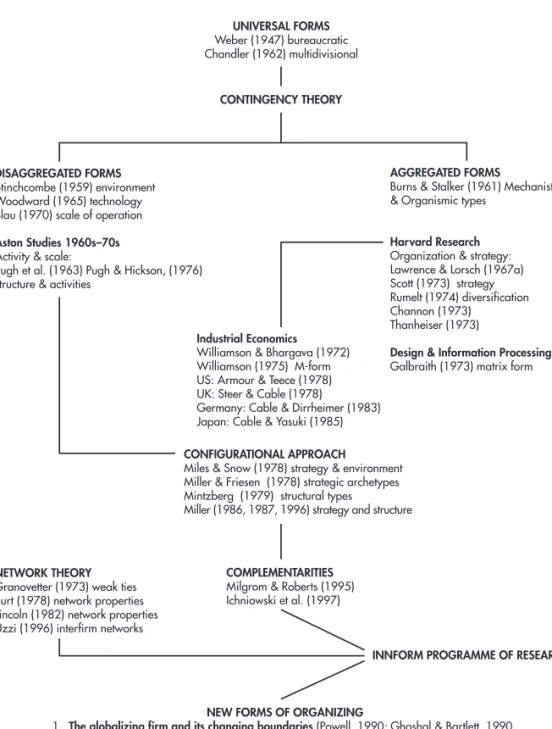
The literature on new forms has also blurred the boundaries of the firm in terms of scope and depth. This adoption of the multidivisional structure in turn 'institutionalised' the strategy of diversification. One of the main drivers for the new forms of organizing literature is the rapidly changing organizational context.
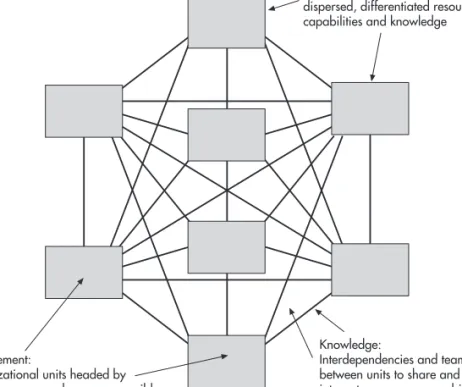
The organization of the future is considered to include a high-involvement workplace (eg self-managing teams), an emphasis on managing business processes rather than functional departments, and the development of information technology (Stewart, 1992). The principle of integration becomes an additional basis for organization, as discussed in the knowledge-based view of the company. Similarly, Grant's (1996b) knowledge-based view of the firm makes interdependence the focus of organizational design.
This is in the sense of the organization as an institution for knowledge and in the terminology of Collins (1993) knowledge would be described as cultivated (shared meaning), embedded (systemic routines) and encoded (conveyed by signs and symbols).
Integrating a Global Professional Services Organization: The Case
Initially, the reformation challenges the company's hitherto loose structure by creating divisions and an explicit hierarchy. As White and Poynter note: 'Vertical structures must not get in the way of the pursuit of advantage. We also sought to analyze the nature of the social controls that Jones et al.
Arups is considered one of the top three companies in the industry and has a reputation for professionalism, skill and innovation. There is thus no individual ownership of the company, and the legal structure makes the company completely independent. Despite the recession in the UK in the late 1980s, there was a much stronger international orientation of the partnership.
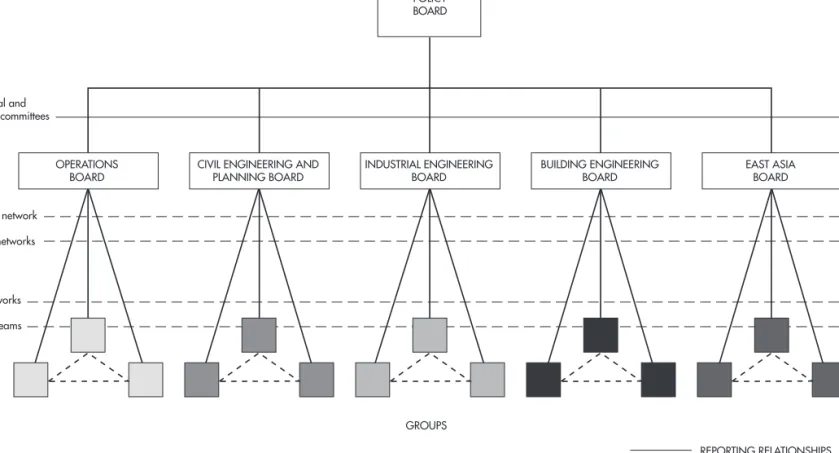
The second, dependence and interdependence, was broader in scope and focused on the structure of the organization. This arrangement allows the policy council to focus on policy matters and delegate activities to the corporate body. One of the first skills networks was that of geotechnical engineering, which emerged informally in the late 1970s.
During this phase, it is likely that they will flourish most in the operation of the board (see Figure 2.4). We were one of the first geotechnical groups of its kind to be established within a consulting firm. These contingencies include both external competitive factors and internal factors such as history, capabilities and network size.
The Role of Social Mechanisms in an Emerging Network: The Case
First, pharmaceuticals are a global industry because of the reach of client companies. The organization of the pharma network must be seen in the context of the MCS organization (see previous section). However, it is also necessary to consider the individual components of the pharma network in relation to its division into functional sub-networks.
National firms in the pharma network were independent profit centers that primarily employed consultants based on their perceived market needs. The success of the pharmaceutical industry program helped to strengthen and develop the culture in the network. Critically, this sub-network was responsible for the well-being, performance and reputation of the pharma network as a whole.
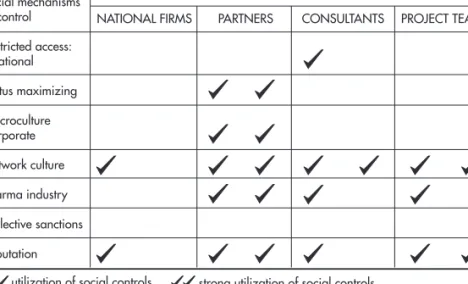
These people had the longest experience with networking; some have played an important role in setting up the pharmaceutical network. The social mechanisms used in different parts of the network varied, but there was also some consistency. The way national companies in the pharmaceutical network coordinated with each other raises questions about limiting access as the network grows.
Further, the financial consequences of governance must match the expectations of the network. The cognitive dimension is evident in the culture of the pharmacology network, which provided a mindset for consultants, governing their work expectations and behaviour. We have seen that in the pharmaceutical network goodwill and trust were born from 'social attraction'.

Multidivisional Organization
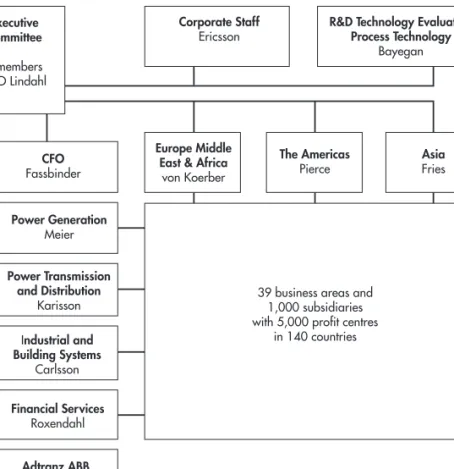
The next section describes the history of the ABB Group and the organizational structure that developed during the ten years following the merger. ASEA Holding (formerly ASEA) and BBC Holding (formerly BBC) each own 50 percent of ABB ASEA Brown Boveri Ltd. It took ABB only two months to develop the main functions of the new organization.
ABB Switzerland (ABB CH), where most interviews were conducted, is one of the 140 national holding organizations of the ABB group. A key element of the ABB matrix was to ensure that Business Area (BA) and Country Managers understood their complementary and different roles. CCT team members are general managers of various ABB CH companies.
An internal analysis showed that the horizontal differentiation of the four business segments was very ineffective. ABB's transfer pricing system – undoubtedly one of the most advanced in the world – required a lot of time and energy. This even led to a point where some frontline companies understood their role as owners of the business rather than as providers of business opportunities to the ABB Group.
A third fundamental problem was that the individual manager found it increasingly difficult to live up to the matrix's expectations. The three regional barons and the three segment heads had different views on the need to focus on the business dimension and equal weight in the executive committee. An underlying barrier to the development of the matrix may have been that ABB's corporate culture has been based rather one-sidedly on achieving customer focus.
The Emergence and
Development of Internal
Networks and their Impact on Knowledge Flows: The Case of
Local member banks are the second unit of analysis, at the start of the change process towards an internal network. In the following three sections, the case study results are reported at company level, at the level of the local member banks and the Spectrum business unit. The first question focuses on the drivers of change and the heterogeneity in the pace of change.
This means that we looked for (1) the involvement of the case in many levels of analysis, (2) temporal interconnections of events, (3) the interpretation of the action in its context, and (4) . Prior to the transition of local member banks, two change programs were implemented: FOCUS and EDLB. Therefore, the process of changing the local member banks, which began in 2018, was initiated in order to increase the position of local banks on both.
We focus particularly on the local banks' knowledge process characteristics to describe the extent to which they form an internal network. Furthermore, the interviews made it clear that the day-to-day managers of the local banks tend to perceive the central organization as. Advisors help local entities comply with the customer's wishes at the local location.
Almost all changes in Spectrum's transition process have been at the discretion of the BU manager and leadership team. At the time of the investigation, local member banks did not appear to function as an internal network. The failure of local banks to function as an internal network can be partly attributed to the fact that Rabobank is a cooperative.
Hilti AG: Shared Leadership and the Rise of the Communicating
This chapter answers three questions in the analysis of the case of Hilti AG, a company based in the Principality of Liechtenstein, and a world leader in its field, which supplies fastening and demolition systems to the construction industry. The interviews focused on the evolution of the Hilti organization and the logic of the various organizational and management innovations introduced into the company during the 1980s and 1990s. We then discuss the barriers to change in the Hilti organization, before considering the consequences of the changes described for both top management and other employees.
These periods constitute the formative years of the organization and form the framework for the changes in the 1980s and 1990s. This decision on in-house product innovation was to become the first leg of the organization. In 1958, Hilti began series production of its DX 100 in Schaan, and the tool became the star of the Hannover 1958 fair.
This led to the creation of the second link in the Hilti organization: the introduction of direct sales and marketing. The Hilti Management Model identified the interdependence of the different parts of the organization, especially between the two legs of production and marketing. Most importantly, the Hilti Management Model changed the decision-making process: top management decisions now required a form (Entscheidungantrag) stating not only the problem and the decision's goal, but also how the decision would affect other parts of the organization.
In 1980, an integrated cost and contribution margin calculation system was introduced to improve the financial transparency of the market organizations. With the establishment of this trust, all family members waived their inheritance rights to Hilti shares, ensuring the future of the company, independent of family involvement. Würth, a family business founded in 1945, presents itself as one of the success stories of post-war German history.