AFRICAN EAST-ASIAN AFFAIRS
THE CHINA MONITOR
2015 - Issue 3 and 4 | December
- Issue 3 -
Policies, achievements and problems of full-time higher vocational education teacher development in China:1983-2013
by Wang Qi and Zhang Juxia
China-Africa humanistic education co-operation: a road toward cultural diversity by Jian Junbo
China’s Engagement with Nigeria: Opportunity or Opportunist?
by Emeka Umejei - Issue 4 -
Tokunbo and Chinco economies in Nigeria: rethinking encounters and continuities in local economic transformations
by Kudus Adebayo - Forum -
The power of language: globalising the “Chinese Dream”
by Anny Boc
China’s growing security relationship with Africa: for whose benefit?
by David H. Shinn
Editorial Board of the African East-Asian Affairs
Chris ALDEN, London School of Politics and Economics/
South African Institute of International Affairs Adams BODOMO, Vienna University
Fantu CHERU, American University and Leiden University Scarlett CORNELISSEN, Stellenbosch University Stephen GELB, World Trade Institute, University of Bern
Karen HARRIS, University of Pretoria
Garth LE PERE, University of Pretoria and Gabriel and Associates LI Xiaoyun, China Agricultural University
LIU Haifang, Peking University MINE Yoichi, Doshisha University HUANG Meibo, Xiamen University
Kyu Deug HWANG, Hankuk University of Foreign Studies Yoon Jung PARK, Rhodes University (non-resident)/
Chinese in Africa/Africans in China Research Network Ian TAYLOR, University of St. Andrews Chen-shen YEN, National Chengchi University Taipei ZHANG Chun, Shanghai Institutes for International Studies
African East-Asian Affairs Issue 3 and Issue 4 | December 2015
The African East-Asian Affairs (AEAA) is an international, African based journal. It focuses on the developments and nuances of the relationship between Africa and East- Asian nations, including China, Japan, Korea and the ASEAN states. Topics covered include both the domestic developments and the international relations of these states, with a focus on their engagement with Africa. Articles published fall within the social sciences and related disciplines, such as politics, economics, environmental studies and law. The AEAA was formerly known as the China Monitor, a title that has now been reserved for special topical issues only. The journal has been in circulation since 2006.
The AEAA in its current form was re-launched in 2012.
Submissions to African East-Asian Affairs:
The CCS welcomes contributions for this publication. Please contact the editors using the details below if you would like to submit a piece, or would like guidelines on submis- sions to African East-Asian Affairs. The CCS reserves the right not to publish submitted manuscripts.
—0—
Editorial Team Dr Sven Grimm | Editor-in-Chief Harrie Esterhuyse | Deputy Editor
—0—
© Centre for Chinese Studies, Stellenbosch University, 2014. All Rights Reserved.
Centre for Chinese Studies
Stellenbosch University Tel: +27 (0) 21 808 2840
P.O. Box 3538 Matieland Fax: +27 (0) 21 808 2841
7602 Email: [email protected]
South Africa Website: aeaa.journals.ac.za
Contents
Issue 3 | December 2015 Wang Qi and Zhang Juxia………...……...…...06 Policies, achievements and problems of full-time higher vocational education teacher development in China:1983-2013
Jian Junbo ..……….………..……...…...30 China-Africa humanistic education co-operation: a road toward cultural diver- sity
Emeka Umejei ..……….…...……...…...54 China’s Engagement with Nigeria: Opportunity or Opportunist?
Issue 4 | December 2015 Kudus Adebayo ……..…….………...……...…...80 Tokunbo and Chinco economies in Nigeria: rethinking encounters and continui- ties in local economic transformations
Forum Anny Boc…….….………...……...……...…...102 The power of language: globalising the “Chinese Dream”
David H. Shinn……...……..……..………...……...…...124 China’s growing security relationship with Africa: for whose benefit?
* Research funds:Research Project in Humanities and Social Sciences Sponsored by MOE Special Fund for Young Scholars 2014, Occupational Adaptation of Newly Employed Vocational College Teachers: Difference Analysis and Improvement Strategies (project ID: 14YJC880078): Key Projects of Key Humanities and Social Sciences Research Bases of MOE 2014: Ideology, Connotation and Driving Force of University Teacher Development (project ID: 14JJD880003).
** Wang Qi is the Deputy Director of the Institute of Higher Education at Ningbo Polytechnic, and a research fellow of the Vocational Education Institute for Developing Countries.
*** Zhang Juxia is a Research Assistant of the Institute of Higher Education at Ningbo Polytechnic and a research fellow of the Vocational Education Institute for Developing Countries.
Policies, achievements and problems of full-time higher vocational education teacher development in China:1983-2013*
by Wang Qi**
Institute of Higher Education, Ningbo Polytechnic Ningbo, People’s Republic of China by Zhang Juxia***
Institute of Higher Education, Ningbo Polytechnic Ningbo, People’s Republic of China
Abstract
Through analysis of policies of China’s higher vocational education (HVE) from 1983 to 2013, we find that full-time teachers at vocational colleges have undergone
four stages of development: conceptual exploration of full-time teacher development, forming of the notion “dually-qualified teachers”, clarification of the notion “dually- qualified teachers”, and - development of formal training systems and platforms for
“dually qualified teachers”. This process has seen a rapid expansion in the number of full-time teachers in HVE institutions, as well as great improvement in the overall quality of these teachers. There are, however, several areas which require improvement. There still exists a lack of professional standards for these teachers’
performance, weakness of research ability of these teachers, and low efficiency of programs fostering “dually qualified teachers”. In the future more efforts should be made to accelerate composition of professional standards for full-time teachers in HVE institutions and to improve their practical skills and applied research abilities.
Introduction
As a new form of higher education, China’s higher vocational education (HVE) dates back to 1980. In the course of more than 30 years of development, from 1982 to 2013, China's higher vocational education has provided 28.1 million graduates, accounting for 43.51 per cent of higher education graduates (see Figure 1), which has greatly promoted the development of the economy and society.
China’s HVE has played an important role in promoting social class upward mobility. According to MyCOS survey figures, 88.1 per cent of the vocational college students who graduated in 2011 were the first college students in their families, a record that has been maintained for three consecutive years from 2009 to 2011. It has been reckoned that in those three years close to 8.5 million families had produced their first generation of college students (Shanghai Academy of Education Sciences & MyCOS Institute, 2012).
China’s HVE has also played an important role in training talents for underdeveloped regions. Of the total number of students who graduated in 2011 from vocational colleges, 12.7 per cent came from impoverished areas, 22.2 per cent from the western regions, and 16.2 per cent from minority-inhabited regions
(Shanghai Academy of Education Sciences & MyCOS Institute, 2012). In 2013, 67 per cent of the graduates from vocational colleges in middle and western regions were employed in local areas. In some ways, the HVE has met the needs of the underprivileged and the poor for higher education. (Shanghai Academy of Education Sciences & MyCOS Institute, 2014).
Figure1: Number of graduates from HVE institutions and all HE institutions in China: 1983-2013 (thousand people)
Source: data for 1983-1986,from China Education Yearbook 1982-1984 and China Education Yearbook 1985-1986;data for 1987-2013,from the annual China Education Statistics Yearbook of those years.
By the end of 2013, there were 1321 HVE colleges, in which 1108 specialties and 47,347 programs were being provided, and 9,736,373 students were being trained in China. The HVE system has gradually been improved. The HVE has become an important part of higher education, and played an increasingly important role in the whole education system (Figure 2). The tremendous achievement is inseparable from the teachers from HVE colleges, who have made a great contribution to the development of HVE. Meanwhile, the team of teachers in HVE has also improved a lot during the period.
Since HVE’s first appearance, China has been exploring ways to cultivate full-time teachers for it. After combing through all relevant policies over the past three decades, four stages were identified in its full-time teacher development: conceptual exploration of full-time teacher development, forming of the notion “dually-qualified teachers”, clarification of the notion “dually-qualified teachers”, and development of a formal training system and platforms for “dually qualified teachers”. The first Figure 2: A diagram of the Chinese vocational education system
Source: Mi.J. and Wu, A. (2009).China’s higher technical and vocational education:
Development and reform. In Maclean,R. and Wilson, D. (Eds.) International Handbook of Education for the Changing World of Work (pp. 649-657).
stage, conceptual exploration of full-time teachers’ development, happened from 1983 to 1990 when no national policies had stipulated specific requirements for full- time teachers in China’s vocational colleges, but some vocational colleges had emphasized the requirement of “being competent to guide students’ practical training” on their full-time teachers. Then, in the second stage from 1991 to 1999, the requirement of “dual qualification” had gradually been accepted by vocational colleges and included in national policies, in which employing a certain percent of
“dually-qualified teachers” was defined as a basic requirement for establishing and running a vocational college, but no clear definition or standards of “dually-qualified teachers” had been set up until the third stage from 2000 to 2004, clarification of the concept of "dually-qualified teachers." In 2004, Assessment Scheme for Students Training in Vocational Colleges (trial version) formulated by Ministry of Education (MOE) of the People’s Republic of China (PRC) codified the concept of “dually- qualified teachers” from perspectives of professional qualification, industrial experience, technical training, abilities to carry out applied research or R&D, and defined the concept and criteria for assessing “dually-qualified teachers” officially.
Since 2005, however, government policies turned to focus on how to train “dually- qualified teachers” in both practical competencies in the industry and practical training competencies in colleges, such as setting up a system for teachers’ going back to industries, establishing on-job training bases for teachers, and so on.
Coupled with policy evolution is the continuous expansion of China’s full-time teachers in HVE institutions, especially after the Great Expansion of China’ higher education in 1999. In 2013, the number of full-time teachers in China’s vocational colleges reached 436,561, accounting for 29.17 per cent of the total number of full- time teachers in all Chinese institutions of higher learning. Meanwhile, quality improvement was also seen among full-time teachers in HVE institutions, with the percentage of “dually-qualified teachers” reaching 57.2 per cent of the total of full- time teachers in HVE institutions. However, the teacher-student ratio in China’s vocational colleges has stayed above 120 since 2003,signifying a lack of teachers even after part-time teachers from industries are also included.
There are however several problems in development of full-time teachers in HVE institutions which are in an urgent need for improvement. These problems are a) a lack of national professional standards for employment and promotion; b) little attention on teachers’ research abilities by HVE policies and practices and consequently weak research abilities; c) weakness of practical competencies in a corporate environment though “dual qualification” has been remarkably advanced.
Therefore, entry requirements and promotion criteria should be formulated as soon as possible by the Chinese government together with industries and vocational colleges. Meanwhile, a system should be established to promote co-operation between colleges and industries where full-time teachers can advance their practical competencies by getting involved in industries’ practice. Finally, attention should be placed on strengthening full-time teachers’ research abilities. Full-time teachers should be encouraged to carry out applied research or R&D so that their research abilities can improve, thus improving the quality of the whole team.
Thirty years of policy evolution
During the 30 years from 1983 to 2013, there were four stages about the teachers’
development in HVE in China, namely stages of conceptual exploration of full-time teachers’ development, forming of the notion “dually-qualified teachers”, clarification of the notion “dually-qualified teachers” and the development of formal training system and platforms for “dually-qualified teachers”.
The first stage from 1983 to 1990: conceptual exploration of full-time teachers’ development
Following China’s first vocational college, Jinling Vocational College in City of Nanjing, Jiangsu Province, were establishment as part of the first batch of thirteen vocational colleges approved by the National Education Committee (former name of MOE) in 1980. Born out of practical needs, these vocational colleges followed a bottom-top development route. Consequently, no national guidelines were formulated for their development, let alone nationally standardised requirements for teachers in vocational colleges until 1982 when “Interim Regulations on Vocational
Colleges in Jiangsu Province” was published, calling for “fostering a contingent of vocational teachers with devotion to China’s educational cause as well as teaching competencies so as to maintain normal orders of teaching, to systematically summarise teaching experience, to continuously improve teaching practice and quality, “and suggesting employment of part-time teachers where necessary. The regulations also demanded full-time teachers in vocational colleges be assessed and conferred with academic titles or technical titles in line with relevant rules and requirements set up by MOE” (Ye Chunsheng, 2004) .
At that time, the differences between HVE and general higher education were identified in students training objectives, teaching processes and quality requirements on full-time teachers. For instance, Jianghan College, one in the first batch of vocational colleges founded in 1980, identified, in its college experience retrospect in 1986, two key competencies for teachers in HVE institutions:
competencies to transmit knowledge and to guide students’ practice (Chen Yingjie,2007). Unlike six years earlier, vocational colleges have since realised the importance of their teachers having competencies to guide students’ practice, though little theoretical research and very few state policies have touched upon what elements comprise the competencies and how to develop the competencies among teachers.
The second stage from 1991 to 1999-- forming of the notion “dually- qualified teachers”
The notion “dually-qualified teachers” was first defined as “engineers and teachers”
in an article published in 1991 featuring teacher development experience of Shanghai Metallurgy College. It pointed out:
The key factor for setting a tertiary technical college apart from universities is to foster a contingent of ‘dually-qualified teachers’ who master both knowledge and ability to put knowledge into practice. (Wang Yicheng,1991)
This article signified the commencement of research into the topic of “dually- qualified teachers” in China’s vocational education, followed by a gradually
increasing number of issues on the necessity of a contingent of “dually-qualified teachers” in vocational colleges (Zhou Mingxing, 2009). Then in 1994, Opinions of the State Council on Implementing the National Outline for Education Reform and Development mentioned that:
Entry criteria for vocational teachers should be formulated in line with characteristics of vocational education, and full-time technical teachers in vocational institutions could apply for both academic titles and technical titles. (The State Council, P.R.C.,1994)
One year later, the Circular Concerning Model Vocational Colleges Development Project, promulgated by the National Education Committee, set up a basic requirement for vocational colleges: they must have a team of teachers with an appropriate ratio between full-time teachers and part-time teachers, and with remarkable aptitude, of which over one third is “dually-qualified teachers” and in which both specialized course instructors and practical training instructors have ample practical competencies. It was the first time a national policy mentioned the concept of “dually-qualified teachers” and set it up as an objective for full-time teacher development in vocational colleges, and in the whole vocational education field. By then, though the concept of “dually-qualified teachers” had been put forward in government policies, apart from the emphasis on teachers’ “technological application” and “practical competencies”, no detailed statements had been made concerning clear definition or standards of “dually-qualified teachers.”
The third stage from 2000 to 2004--clarification of the notion “dually- qualified teachers”
Due to lack of clear definition, the term of "dually-qualified teachers" was only interpreted as teachers with both teaching qualification and other occupational qualifications (for example an engineering qualification). This misinterpretation was seen in such government policies as a) Decision on Deepening Educational Reform and Promoting Quality-Oriented Education promulgated by CPC Central Committee in 1999, which demanded excellent engineering and administrative professionals from industries be attracted into serving as teachers in vocational institutions while
the building of a contingent of "dually-qualified teachers" with both teaching qualification and other occupational qualifications be sped up; b) Opinions on Strengthening Teaching Staff Training in Vocational Colleges issued by MOE in January 2000, which defined "dually-qualified teachers" as “teachers who are also engineers, accountants, and so on” (the MOE, 2000).
Different criteria for "dually-qualified teachers" were put forward in MOE’s Circular on Carrying out Research into cultivation of Teachers in Higher Vocational Education Institutions and Junior Colleges issued in March, 2000:
“dually-qualified” full-time teachers of engineering disciplines must either a) have two years or more of engineering work experience and be able to guide practical trainings in their area of study, or b) have chaired (or participated as a key member) at least two engineering researches or development projects or at least two laboratory revamping projects, and have published two scientific and technological papers on college-level journals or above. These criteria can serve as a reference for other non-engineering disciplines.
It was the first national policy clarifying the meaning of "dually-qualified teachers"
though a slightly different term of “teachers with dual qualifications” was adopted by the Circular. These criteria pinpointed the connotation of “dually-qualified teachers" from the perspective of qualification mix and highlighted the importance of teachers’ practical competencies in a particular field. These criteria are more operable in that it focused on measuring teachers’ industrial experience and scientific -technological R&D abilities (SUN Cui-xiang & LU Shuang-ying, 2013).
A more detailed definition of “dually-qualified teachers” was given in 2004 by MOE’s Scheme for Assessing Students Training Quality in Vocational Colleges (trial version)
“dually-qualified teachers” are those teachers who have an academic title of lecture or above, and meet at least one of following requirements: a) having intermediate or above technical titles (or qualification certificates, titles of occupational certificate assessor or vocational skill assessor) in their field of study;
b) within the last five years having at least two cumulative years of working experience in industries relevant to their field of study, or having attended vocational skills training programs organized by MOE and received certificates signifying the abilities to guide students’ practical training of all kinds; c) having chaired (or participated as a key member) at least two applied researches within the last five years and the research results have been utilized by industries and have achieved great benefits; d) having chaired (or participated as a key member) at least two on-campus practical training facility construction projects or technological upgrading of on-campus practical training facilities, enabling those facilities to function better than those in other vocational colleges of this kind in province areas (the MOE,2004) .
This is the most detailed interpretation of “dually-qualified teachers” by government policies since its conception and is also the official guideline currently in effect for vocational college accreditation and full-time teacher development in these institutions.
The fourth stage since 2005--development of formal training system and platforms for “dually-qualified teachers”
The clarification of “dually-qualified teachers”(dual qualifications)served as a guidance for “dually-qualified teachers” training. Since 2004, the focus of governmental files and policies has been shifted to training of “dually-qualified teachers,” instead of its definition. Decision of the State Council on Vigorously Developing the Vocational Education, promulgated in 2005, and clearly stated that the country should:
Implement a teacher quality improvement scheme for HVE institutions while financial departments of local governments should provide financial support continuously to teacher training and training centre building. A system should be set up to encourage teachers to go back to the front line of production or service for at least two months every two years to get industrial practice.
It was the first requirement in national policy for teachers in HVE institutions to
obtain industrial practice and it was subsequently institutionalised. Following policies mostly focused on how to improve quality and practical competencies of teachers’ with “dual qualification” by establishing a college-industry co-operation and platforms for teachers’ industrial practice. For example, Several Opinions on Improving the Overall Educational and Instructional Qualities of Higher Vocational Education, issued by MOE in 2006, stated that “on-job practice in industries should be arranged for teachers with a view to gaining practical experience and hence improving practical training competencies” (the MOE, 2006), while the National Outline for Medium and Long-term Education Reform and Development (2010- 2020), Promulgated in 2010, called for:
a) Development of “dually-qualified teachers” and practical training centres for students, b) improvement of fundamental capabilities of vocational education, c) building of “dually-qualified teachers” training centre with the joint efforts of higher education institutions and both large and medium-sized enterprises, and d) perfection of the system for teachers’ regular industrial practice. (The State Council, 2010)
Opinion on Further Improvement of Training System for Vocational Education Teachers, promulgated by MOE in 2011, proposed a training system via college- industry co-operation, in particular by taking advantage of both large and medium- sized enterprises, provision of a group of “dually-qualified teachers” training centres and partner enterprises for vocational teachers’ industrial practice. It was stressed again in Decision of the State Council on Accelerating Development of Modern Vocational Education, issued in 2014,
Implementation of a system for teachers to obtain industrial practice and construction of teacher training centres by the joint efforts of top-quality vocational colleges and both large and medium-sized enterprises. (the State Council, 2014) Through retrospection of the above relevant policies, we can conclude that over the past three decades the objectives of teacher development in HVE institutions has been gradually clarified and teachers’ industrial/practical competencies increasingly
valued. Since its invention, the notion “dually-qualified teachers”, as a key topic for governmental policies, has been continuously highly valued by governmental policies and its interpretation also steadily improved, by governmental policies.
Along with this the policy focus shifted from what teachers vocational colleges need, to how to evaluate teachers’ “dual qualification”, and then how to help teachers advance their “dual qualification”. These policies covered not only the definition, standards, number, training of “dually-qualified teachers”, but also system for
“dually-qualified teachers” training (SUN Cui-xiang & LU Shuang-ying, 2013).
Nowadays cultivation of “dually-qualified teachers” with both practical competencies in industry and teaching competencies has become the core of all policies in the field.
Achievements both in quantity and quality
During the evolution over the last 30 years, there were also great achievements both in quantity and quality regarding the full-time teachers in HVE. The number of teacher teams was increasingly expanded and the quality was steadily improved.
Achievements in quantity: the continuously increasing total number of full-time teachers
In 1983, a small number of 54 vocational colleges (then named as short-cycle term vocational colleges)employed 2321 full-time teachers, only accounting for 0.77 per cent of the total number of teachers employed by all institutions of higher learning.
Since then, the number of vocational colleges has been continuously increasing while its teacher cohorts have been continuously expanding. Especially after the 1990s when the Chinese economy started to take off and industries began needing more skilled workers, increased importance was attached to vocational education. A decision (termed as “three revamping and one supplementing”) was endorsed in the early 1990s by the government, suggesting that:
HVE can be developed by reform, reorganization and transformation of existing occupation university, post-secondary junior colleges and universities for self-taught adults, and that if all these are not enough, the shortfalls be filled by
upgrading a small number of authorized key vocational high schools. (Li Lanqing , 2003)
Pushed by this decision, HVE as a whole witnessed a rapid expansion in the middle and late years of the 1990s. In 1998, Higher Vocational Education Division, also responsible for development planning and governance of post-secondary junior colleges, besides those of vocational colleges, was set up under the MOE, resulting in the reform of some post-secondary junior colleges towards vocation-oriented colleges and a sharp increase in the number of both vocational colleges and their full -time teachers. Moreover, a surge in the number of both vocational colleges and consequently of their full-time teachers was witnessed in 1999 when China started its great expansion in higher education, in which a majority of the enrolment quota Figure 3: Number of Full-time Teachers in HVE Institutions in China: 1983- 2013 (thousand people)
Source: data for 1983-1986,from China Education Yearbook 1982-1984 and China Education Yearbook 1985-1986;data for 1987-2013,from the annual China Education Statistics Yearbook of those years.
was given to vocational colleges. In 1999, the number of full-time teachers in HVE institutions reached 88,206, accounting for 20.72 per cent of the total (425,682) in all
Figure 4: Ratio between Students and full-time Teachers in China's HVE Institutions: 1983-2013
Source: data for 1983-1986,from China Education Yearbook 1982-1984 and China Education Yearbook 1985-1986;data for 1987-2013,from the annual China Education Statistics Yearbook of those years.
institutions of higher learning. The number increased steadily to 436,561 in 2013, accounting for 29.17 per cent of the total (see Figure 3).
Though noticeable, the surge in the number of full-time teachers lagged far behind the surge in student enrolment. As a result, teacher-student ratio reached 1:24 in 2003, but has been below 1:20 since then. It is alarmingly low even after taking into account of the number of part-time teachers (see Figure 4).
Steady improvement of quality
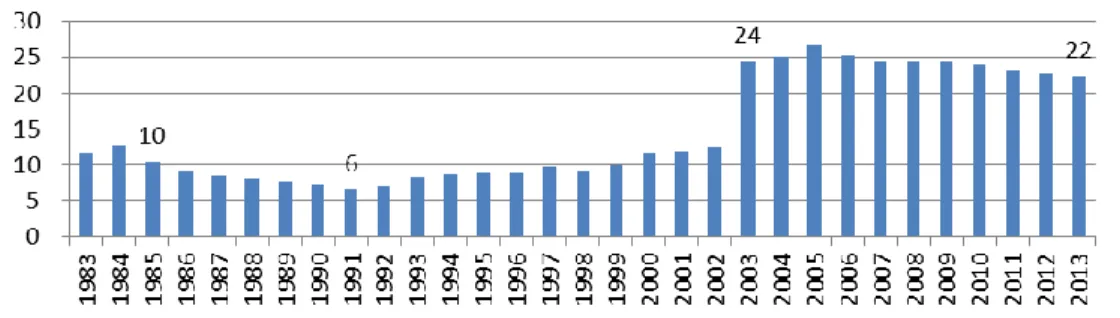
Along with growth in figure, the quality of full-time teachers in HVE institutions also went through a steady advance. A point in case is their academic titles, with the percentage of senior academic title (professors and equivalent level, and associate professors and equivalent level) holders elevated from 5.81 per cent in 1987 to 29.28 per cent in 2013 (see Figure 5).
A non-stop increase was also seen in the number of teachers with industrial practical experience. The percentage of “dually-qualified teachers” reached 28.4 per cent (Ma Shuchao, 2009) in 2007 and then 57.2 per cent in 2013, even over 70 per cent in
Figure 5: Percentage of full-time teachers with senior academic titles in China's HVE institutions: 1987-2013
Source: annual China Education Statistics Yearbook of those years.
some provinces like Jiangsu, Zhejiang, and so on (Shanghai Academy of Educational Sciences & MyCOS Institute, 2014).
Problems that need urgent solutions
There are also some problems regarding the teacher development in HVE, including no official standards for teacher development available, teachers’ research and practical abilities still remain weak and so on.
Lack of professional standards for teachers
According to Ren and Sun (2009):
Professional standards are detailed description of skills, knowledge and behaviours required for entry into a particular profession and yardsticks against which applicants for the profession will be measured. (Ren Bo & Sun Yvzhong, 2009)
In order to strengthen teachers’ professional development, teachers’ professional standards have been formulated in many developed countries, stipulating entry requirements in terms of knowledge, aptitude, skills, conduct codes and assessment criteria. Likewise, Professional Standards for Kindergarten Teachers (trial version), Professional Standards for Primary School Teachers (trial version), and Professional Standards for Secondary School Teachers (trial version) were promulgated by the MOE in China in 2012 to specify essential professional ideology, knowledge and competencies for teachers in kindergartens, primary schools, or secondary schools respectively. HVE, however, is a different level and type of education focusing on fostering students practical competencies. Therefore, teachers in HVE institutions are expected to have some special competencies for HVE, as well as general competencies required for all college teachers. Due to these differences, a unique set of professional standards should be established for teachers in HVE institutions. However, no sound professional standards are available in China for these teachers, and these teachers are still in the same track similar to those of other higher education institutions in terms of teacher certification, which have not yet taken HVE’s unique features and demands into consideration. Even worse, the current teacher certification system only examines applicants’ competencies before their entry into the profession, but no attention has been paid to ongoing assessment and upgrading along with teachers’ professional development.
Consequently, this lack of special professional standards for teachers in HVE institutions has disoriented those teachers along their professional development (Zhu Xuemei, 2010).
Negligence of teachers’ scientific and technological research abilities improvement
As one of three functions of higher education, scientific and technological research is a vital means for teachers in HVE institutions to improve their professional competencies. However, over the nearly thirty years of HVE development, and despite the advocacy of “production-teaching-research combination” in HVE, objection to knowledge-oriented and discipline-categorised courses have been the main theme in HVE’s educational and instructional reform and in its teacher development drive whereas academic themes have been marginalised, hence scientific and technological research among the teachers has been weakened (Cheng Yikang, 2012). The status of scientific and technological research by teachers in HVE institutions was further lowered by a government policy publicised in 2006, Several Opinions on Improving the Overall Educational and Instructional Qualities of Higher Vocational Education, in which “research” was removed out of the
“production-teaching-research combination” and another term “production-teaching combined approach” was proposed instead. Since then little efforts have been given to improve HVE teachers’ scientific and technological research, although “research”
was discussed again in following policies.
Applied technological invention and patents show teachers’ practical competencies,technological application and R&D abilities, and professional proficiency. We searched in the Patent Database under China National Knowledge Infrastructure (CNKI) by typing in key words such as “vocational and technical colleges” “vocational colleges”, and “technical colleges” for patents for invention, exterior design or new applied techniques owned by teachers from these colleges.
We found that 2,387 patents of the three kinds were conferred to full-time teachers from HVE institutions in 2011, which means 0.006 patents per full-time HVE teacher. Even if these patents were all from teachers of technological, engineering, agricultural, or medical subjects (accounting for about half of the total according to the China Education Statistics Yearbook 2011), subjects involving more technology which are more likely to contribute to technological advancement, the per capita
average is just 0.012, signifying huge room for improvement.
More efforts should be made to reinforce the effectiveness of “dual qualification” training
Involvement in industrial practice is the major approach for teachers in HVE institutions to improve their professional aptitude. In recent years, industrial working experience and practical competencies of some full-time teachers from HVE institutions have been improved via doing on-job industrial practicum. There are, however, some problems. First, no mature system has been established for teachers’
deep involvement in industrial practice, therefore the effects of industrial practice vary greatly from institution to institution, from program to program, from individual teacher to individual teacher; second, for some teachers, industrial practicum only means looking around the industries and gaining some industrial working experience while only very few teachers, with excellent technological applications and R&D abilities, can actively participate in enterprises’ technical innovation and upgrading.
A survey of "dually-qualified teachers" in vocational colleges in Jiangsu Province found that “32 per cent of all vocational college teachers in Jiangsu cannot learn or acquire new knowledge timely from production front lines, while 90 per cent or so of teachers are poor at operation and technique” (Cai Yi, Zhang Yiping & Sun Xianshan, 2011), which, to some extent, reveals the problems faced by "dual qualification" project in vocational colleges.
Unable to attract professionals from industry to teach in HVE colleges Professionals with high skills and rich experiences from industry are the best choice for higher vocational colleges to train their students to meet the need of industry. But just like in other countries around the world, professionals can earn more practicing their profession than they can teaching it. Salary of teachers in HVE colleges in China is just at medium level and less attractive to professionals than industry. So most the professionals with high skills are in the industry and there are few teachers in HVE colleges with skills meet the needs of industry. Therefore, the primary mission of the construction of “dual qualification” teachers’ team is to improve the practical ability of the full-time teachers. For example, a new item is listed in the
Modern Vocational Education Development Strategy 2014-2020 which requires the full-time professional teachers should practice their profession in industry no less than two months every two years. This is one of the reasons that account for the graduates from HVE colleges can’t meet the needs of industry.
Suggestions on teacher development in HVE institutions
Based on the analysis above, we try to put forward some suggestions on teacher development in HVE, according to some policies published recently.
Speed up the development of professional standards for teachers in HVE institutions
The development of professional standards for teachers in HVE institutions has been prioritised by the government and proposed in government files such as the National Outline for Medium and Long-term Education Reform and Development (2010- 2020)promulgated in 2010, asking for “the establishment of professional standards for teachers in HVE institutions correspondent to vocational education’s features,”
and Decision of the State Council on Accelerating the Development of Modern Vocational Education in 2014, demanding “perfection of teacher qualification criteria and the establishment of professional standards for teachers”. Policies also demanded that, in compliance with the characteristics and development orientation of HVE, the professional standards for HVE teachers are expected to emphasise
“dual qualification.” In terms of knowledge requirements, these professional standards should highlight teachers’ mastering of technical and industrial knowledge; as for research ability, these professional standards should focus on technological application and R&D abilities, abilities to apply their research results in enterprises’ production, technological renovation and products upgrading; and as for teaching competencies, teachers’ practical training competencies and their guidance in students’ practical training should be underscored to meet the mission of HVE: training skilled manpower.
To further college-industry co-operation to better enhance teachers’
practical competencies
Working experience in industries and knowing production technologies and operating procedures of a company is an important indicator of professional aptitude of teachers’ in HVE institutions. However, professional aptitude should not be defined only as having working experience in industries and obtaining certain technical expertise and practical skills, otherwise teachers would be directed towards becoming technicians (Song Qinglong, 2007), which is inconsistent with HVE’s orientation as tertiary education. The core of teachers’ practical competencies is the ability to serve industries and businesses, which in turn enable teachers to update their working experience, and then their teaching content, thus providing improved training quality. Serving industries and businesses, means that you get involved in enterprises’ technical renovation and R&D, to provide technical support and consultancy to enterprises, even to lead the enterprises’ technical development, as well as to master technical expertise in that industry. Therefore, HVE institutions should put more emphasis on teachers’ practical competencies and R&D abilities instead of their working experience in industries. Moreover college-industry co- operation mechanisms should be set up to guide teachers’ active involvement in production and R&D of enterprises and increase the effectiveness of the teachers’
practicum by means of deepening the teacher-enterprise co-operation in R&D as well as enhancing their practical expertise.
To guide teachers’ applied research
Teachers’ participation in industries’ applied research or R&D, as a symbol of the two natures of HVE (tertiary and vocational) and an essential goal of HVE development, is not only an effective way for teachers to enhance their practical skills and their ability to serve enterprise but also an effective way to improve the overall quality of HVE. It is beneficial to both HVE institutions and teachers. For HVE institutions, teachers’ participation in industry-demanded applied research or R&D can guarantee sustainable and deep college-enterprise co-operation, hence improved student training quality. On the teachers’ part, applied research or R&D
can greatly enhance their academic expertise, knowledge teaching, and confidence in academic research. Therefore under the circumstance where quality development is stressed, great efforts should be made in both governmental policy and college policy to guide teachers towards applied research and towards research abilities improvement. It should be noted, however, that applied research in HVE should focus on applied research driven by industrial needs, and on didactic research to improve actual instruction. Meanwhile, research and teaching should be well- balanced, instead of stressing research while neglecting teaching.
To construct motivation systems to attract professionals from industry to teach in HVE colleges
China needs to establish multi-sectorial promotion policies, such as policies established by the MOE, the Ministry of Human Resources and Social Security (MOHESS), and the National Development and Reform Commission (NDRC), to attract more professionals from business to teach in HVE colleges. Policies should set a series of salary standards to encourage professionals from industry to teach in HVE colleges, as well as to reward or provide promotion priorities to those whose teach in colleges part-time. Meanwhile, more authority should be delegated to colleges permitting them to employ professionals as full-time teachers at a high salary. It is also a good way to attract professionals to employ as part-time teachers.
With a principal of not-for-possession-but-for-using, colleges should employ some professionals with high skills from industry.
Conclusions
1. Conceptually, a principle has been shaped for full-time teacher development in HVE institutions, namely individual full-time teachers should have “dual qualifications” while “dually-qualified teachers” should account for the majority of a teacher cohort.
2. The number of full-time teachers in HVE institutions has greatly increased, now accounting for 29.17 per cent the total in all institutions of higher learning.
Compared with the percentage of HVE enrolment, 50 per cent of the total higher
education enrolment, there is a lack of teachers, even part-time teachers from industry.
3. Great progress has been made in faculty quality with sharp increases in the percentage of both senior academic title holders and “dually-qualified teachers”.
Nevertheless, more efforts should be made to further improve teachers’ practical competencies, and applied research abilities in particular so that they can participate actively in industrial production and technical research. Meanwhile, policies should be established by several sectors jointly, such as the MOE, the MOHESS, and the NDRC, to motivate professionals to teach in colleges.
4. No national professional standards for full-time HVE teacher development are available. Government is expected to work together with industries and HVE institutions to formulate criteria for entrance and promotion of teachers, and to regulate the development of full-time teachers in order to promote the quality of the team.
Bibliography
Cai, Y., Zhang, Y. and Sun, X. 2011. Problems Faced by "Dually-qualified Teacher"
Development in Vocational Colleges and Their solutions--from a Field Survey of Jiangsu. Journal of National Academy of Education
Administration, 21(6): 29–32.
Chen, Y. 2007. Development History of China’s Higher Vocational Education.
Zhongzhou: Zhongzhou Ancient Book Press.
Cheng, Y. 2012. HVE teachers’ Professional Development Based on Multidimensional Academic View. Journal of National Academy of Education Administration, 22(5): 22–26.
He, D. 2003. Important educational documents of P.R.C. (1998-2002). Haikou:
Hainan Press.
Li, L. 2003. An Interview with Li Lanqing on Education. Beijing: People's Education Press.
Ma, S. 2009. Historical Choices of China’s Higher Vocational Education. Beijing:
Higher Education Press
Mi, J. and Wu, A. 2009.China’s higher technical and vocational education:
Development and reform, in R. Maclean and D, Wilson (eds.). International Handbook of Education for the Changing World of Work. Berlin: Springer.
649–657.
Ren, B. and Sun, Y. 2009. Constructing Professional Standards for HVE teachers.
China Higher Education, 359(1): 49–50.
Shanghai Academy of Educational Sciences and MyCOS Institute. 2012. 2012 Annual Report on Technical and Vocational Higher Education in China.
Beijing: Foreign Language Teaching and Research Press.
Shanghai Academy of Educational Sciences and MyCOS Institute. 2014. 2014 Annual Report on Technical and Vocational Higher Education in China.
Beijing: Higher Education Press.
Song, Q. 2007. Several Problems Faced by HVE Teachers’ Professional Development. Wuhan: Central China Normal University.
Sun, C. and Lu, S. 2013. Changes of “Dual-qualification” Teacher Policy: Process, Characteristics and Future Trends. Vocational and Technical Education, 34 (28): 48–54.
The MOE, P.R.C. 2000. The MOE Circular on Carrying out Overall Students Training Quality Assessment in Vocational Colleges [Online]. Available:
http://www.moe.edu.cn/publicfiles/business/htmlfiles/moe/
moe_42/201010/110099.html [2015, November 20].
The MOE, P.R.C. 2006. Several Opinions on Improving the Overall Educational and Instructional Qualities of Higher Vocational Education [Online].
Available: http://www.moe.edu.cn/publicfiles/business/htmlfiles/moe/
moe_745/200612/19288.html [2015, November 20].
The MOE, P.R.C.2011. Opinion on Further Improvement of the Training System for Vocational Education Teachers. [Online]. Available: http://www.moe.edu.cn/
publicfiles/business/htmlfiles/moe/moe_960/201201/xxgk_129037.html html [2015, November 20].
The State Council, P.R.C. 2010. National Outline for Medium and Long-term Education Reform and Development (2010-2020) [Online]. Available: http://
www.moe.edu.cn/publicfiles/business/htmlfiles/moe/
moe_838/201008/93704.html [2015, November 20].
The State Council, P.R.C. 1994. Opinions of the State Council on Implementing the
“National Outline for Education Reform and Development” [Online].
Available: http://www.moe.edu.cn/publicfiles/business/htmlfiles/moe/
moe_177/200407/2483.html [2015, November 20].
Wang, Y. 1991. To Develop a Contingent of “Dually Qualified Teachers”.
Researches in Engineering Higher Education, 9(2): 49–50.
Ye, C. 2004. Twenty Years of Practice and Exploration-- Collection of Essays on Higher Vocational Education. Beijing: Higher Education Press.
Zhou, M. 2009. 30 Years of Development of China’s Vocational Education.
Shanghai: Eastern China Normal University Press.
Zhu, X. 2010. Connotation and Framework of Teachers Professional Abilities of Higher Vocational Education. Vocational and Technical Education, 31(1): 56 –58.
*This paper, as part of the research project titled “Emerging Powers in Africa: a New South-South Co-operation Possible?" (project number: 14FSSX03YB), is funded by the "African Research Fund 2014” of Zhejiang Normal University, China. The author will extend his appreciate to Professor Liu Yongtao whose suggestions and comments are very helpful for this paper’s writing.
** Dr. Jian Junbo is an Associate Professor at the Institute of International Studies at Fudan University.
China-Africa humanistic education co-operation: a road toward cultural diversity*
by Jian Junbo**
Institute of International Studies, Fudan University Shanghai, China
Abstract
For nearly six decades, China-Africa education co-operation has made great progress laying a stronger foundation for a better partnership between the partners and, to some extent, the promotion of African capacity-building. Nonetheless, considering the cultural domination of the West in the world and a cultural crisis that both China and African countries are encountering, technique-oriented Sino-African education co-operation should be accompanied with a stronger co-operation on humanistic education, so as to meet the needs of cultural diversification in a global age. This article argues that it is just the time for China and Africa to address the need of pursuing their closer humanistic education co-operation to counterbalance the Western cultural hegemony and promote diversification of cultures in the world, although in this bi-lateral co-operation Western culture should never be a targeted enemy.
Introduction
Sino-African educational co-operation has made great progress since the People’s Republic of China (PRC) was established in 1949. However, it does not mean this progress is much associated with or has significantly pushed the world’s cultural diversification. This is mainly due to the reality that technique-oriented educational co-operation between China and Africa has outnumbered their humanity-oriented co- operation.
This article will focus on the humanistic education co-operation between China and Africa over the past few decades, analysing its achievements and challenges and searching for feasible approaches to promote the humanistic education co-operation that can contribute to the diversity of cultures in the world. Taking this into account, the article is divided into three sections. The first section will discuss the theoretic role of humanistic education between China and Africa in its contribution to the cultural diversification in the world. In the second section, the social practices, achievements and limitations of China-African humanistic educational co-operation will be examined and analysed empirically. The road to cultural diversification in Africa and China through education co-operation in the humanistic field will be elaborated on in the third section.
Crisis of cultural diversification in China and Africa and their cultural independence
Crisis of national/local culture in China and Africa
The importance of cultural diversity for humankind is self-evident. The respect and protection of cultural diversity is not simply part of the road to economic prosperity and political stability at national, regional and global levels, but also arguably the precondition of the survival of humanity. The Universal Declaration on Cultural Diversity, issued by the United Nations Educational, Scientific, and Cultural Organisation (UNESCO) in 2001, highly values cultural diversity by stating that:
(A)s a source of exchange, innovation and creativity, cultural diversity is as necessary for humankind as biodiversity is for nature. In this sense, it is the common
heritage of humanity and should be recognised and affirmed for the benefit of present and future generations. (UNESCO, 2001)
It also stated that cultural diversity:
Widens the range of options open to everyone; it is one of the roots of development, understood not simply in terms of economic growth, but also as a means to achieve a more satisfactory intellectual, emotional, moral and spiritual existence. (UNESCO, 2001)
The implication of these words is that both the equality of different cultures and the maintenance of their distinctions should be respected. Cultural diversity is both desirable and achievable if local and national cultures in the same region are recognised by each other and treated equally by political systems1. That is, the cultural diversity can be empirically considered as a case if each culture can be independent from any heterogeneous cultures.
Nonetheless, the cultural diversity and many countries’ local and national cultures’
independence have long been undermined by colonialism and the spread of western culture embedded in the process of industrialisation, and especially challenged lately by a new wave of globalisation since the 1990s. As for China and Africa, their national/local cultures are particularly undermined by a series of historical episodes such as Westernisation, de-tradition movements, colonisation, and globalisation.
As for China, huge cultural crises emerged in the late 19th century when western powers entered this old empire and Japan defeated China in 1895 (Leung Kai Chiu, 1993)2. From then on the Chinese elite has never given up on their search for ways of generating wealth and saving a poor “central kingdom”, hoping to resume the glory of Chinese culture. Nonetheless, since the May 4th Movement in 1919, one alternative road to restore a rich and strong China- overall westernisation, defined as embracing “democracy and science”- was broadly accepted by Chinese elites, despite the early failure of a top-down “Westernisation Movement”3.
After the People’s Republic was founded, the Chinese Communist Party (CCP) as a ruling party partly took over the idea of overall Westernisation, in the sense that it set
Marxism and socialism as dominant ideologies. After the end of the Cultural Revolution (1966-1976) which led to immeasurable catastrophe for Chinese culture, the CCP declared that it is promoting the partial resumption of Chinese traditional culture in order to make Chinese people learn all “outstanding achievements of all civilisations in the world” to serve for “Four modernisations” and “Socialist Construction” (Hua Guofeng, 1978)4. Yet in reality all the “outstanding achievements of all civilisations” were mainly referred to as Western cultures in this context.
That is, from the late 19th century, Chinese traditional culture was in great jeopardy, under pressure of Westernisation. And now Chinese political ideology is Marxism, an ideology from Western culture, although at present Marx’s doctrine is not popular among Chinese in reality. It can be said that contemporary China’s culture is like a mixture, blending with Chinese and western, traditional and modern, capitalist and socialist cultures, and it is named as “modern Chinese culture”.
Apart from upper-mentioned voluntary Westernisation, Chinese traditional culture is also seriously challenged by globalisation and Western countries’ intended ideological war in the post-Cold War era. The impact of globalisation on China’s culture is more serious than imagined. Yet, China has never rejected globalisation and internationalisation from the beginning, partially because globalisation is related to internationalisation, which is positive for China as a developing country to become more modernised, industrialised, and developed, and partially because globalisation as a tendency is hard to reject and resist. Consequently, under the impacts of globalisation, China tends to be more westernised in terms of its culture.
Although theoretically Chinese culture can also “go abroad” and engage the West and other cultures, Chinese culture finds it hard to compete with American and Western culture in practice.
The implication is that Western countries (including the United States of America) have successfully “sold” their cultures to the rest of the world (including China) via globalisation, which is considered as (conscious or unconscious) Western cultural imperialism by some scholars (for example J. Schlesinger Arthur, 1974). Clearly, this
process of “selling” their cultures in globalisation is also a process of industrialisation, marketization and internationalisation of Western culture. That is, the spread of Western culture is fit for the capitalist way, it is an efficient business which not only profits those related Western companies but also spreads the Western cultures to the rest of the world at the same time. Furthermore, the West’s success is also due to it deftly taking advantage of the similarities between “Western culture”
and “modern culture”, and to its exercising great power of “international” media, a part of Western capitalist system’s great chains.
However, if compared with the West, China lacks the ability to internationalise its cultural industry, including its cultural resources and innovation, and influential
“international” media, so the Chinese culture is unable to compete with Western culture at present. In a word, in globalisation, Western, especially American culture, become “globalised culture”, yet other cultures in the world (including Chinese culture) do not.
In addition, another challenge to Chinese culture is that it faces the permeation and even attack of Western ideologies, especially after the end of the Cold War. Some Western countries’ governments often criticise and scold Chinese political and societal systems and some special policies, and this criticism is always grounded in some would-be universal moralities and values, such as respecting minorities, human rights, social freedom or election rights, and so on. This attack of Western countries has encouraged some Chinese dissents to criticise Chinese political ideologies and create value confusion among Chinese people. Together with the action of Western non-government organisations (NGOs) in China that financially support academic communications and cultural exchanges, Western ideologies’ permeation is somehow very successful among some Chinese elites, educated young persons, and even middle-aged women, the latter are not well educated but become the main Christian believers in China ( Wu Guihua, 2012)5.
As for Africa, its long history of being colonised by European colonists is also companied with a long history of under-development of the culture. The dark history is marked by the brutal cultural imperialism of European colonial powers in Africa
and the tragic fate of African culture.
By 1912, except for Ethiopia and Liberia, all other countries in Africa had been colonised by some European countries, namely Britain, France, Germany, Belgium, Portugal, Italy and Spain. In reality, the independence of Ethiopia and Liberia was only in name, the state of these two countries was sub-colonised. Under the colonial ruling, African countries became some Western powers’ backyards and a part of these colonial empires. For example, those colonised regions in Western Africa were incorporated by the suzerain state France into the “Federation of Western Africa” in 1904, and those equatorial regions into the “Federation of Equatorial Africa” in 1910. Other colonial powers took similar tactics to combine their colonies into one big political system which was mixed with different nations, cultures, identities, regions and customs. Hence there emerged German East Africa, Portuguese African Territory, Belgian Central Africa, and so on. As a result of this struggling for spheres of influence among colonial powers in Africa, on the one hand, African territories and peoples were arbitrarily divided and separated, although between the borders of these different colonies, some nations and ethnicities shared the same traditions and cultures. On the other hand, each colonised region was strengthened through economic, political and cultural linkages with Western suzerain states. Thus colonisation is also a process of African division and overall dependence on Western colonial powers. This process did not change substantially until the success of de- colonisation in the 1950s-1960s.
Due to the long history of being under the influence of colonial powers from the 15th century to more or less direct control until the mid-20th century and the continuous link with the pre-suzerain in many ways, African cultures have become deeply influenced and marked by European culture. This has generally resulted in negative impacts on African culture, although slightly sprouted the fledging modernization in African coast and hinterland.
First, because of colonisation and dependence on suzerains, African education is less developed. In the colonial period, African education was only limited to primary and middle school education, only a few higher education institutions in some big cities
were established after the end of the World War II. In reality, the number of primary schools was also insufficient, and was unable to meet the real demands of Africa countries. In the vast rural areas and most towns, schools for black African people were hard to find. The curriculums of schools were not reasonable either, since they were only copies of suzerain’s own systems, and did not match with the real condition and local tradition of Africa. Consequently, African education after de- colonialism cannot develop quickly with a lack of resources to be used for the building of national educational systems in Africa after independence.
Second, related to the colonial education mechanism, African elites could not grow to be national leaders, but only the assistants of Western colonists. Obviously, European colonial powers were unable to send their citizens to occupy all positions in African colonies. The colonists selected and appointed those who were educated in suzerains or in colonial schools, and thus likely loyal to suzerains, as the middle and low level rulers in their mother lands. Those educated Africans became a part of the colonial system, maintaining the system’s function and efficiency. And these elites in political and societal areas were also elites in culture. Influenced by these elites, African culture was transformed into a copy of Western culture, and the local cultures in Africa were unable to be inherited and carried forward. That made African people unable to shape their own cultural consciousness.
Thirdly, European suzerains’ institutions were introduced and duplicated in Africa.
Gradually, African people become familiar with and used to European institutional cultures. Even after their political independence, African countries almost accepted the overall coloniser’s institutions, especially administrative and judicial systems, and unavoidably those values and ideologies embedded in these institutions, although many African countries desired to reform these institutions. These institutions were less functional, if not flawed.
Fourthly, mainly due to the arbitrary creation of African countries by the colonial powers, the natural growth and evolution of traditional local cultures in Africa was brutally interrupted. Originally, local ethnic groups lived together and shared the same or similar languages, totems, religions, and customs, but were divided and
forced to live in different countries and meanwhile, in a new “homeland”, people in one ethnic group had to live with people in another ethnic group who were culturally and ethnically different. For instance, Haussa are living in Nigeria, Niger, Ghana, Chad, Cameroon, Cote d'Ivoire and Sudan. Conversely, many ethnics with different traditions and cultures were sectioned into one country, like in Tanzania where almost 120 ethnicities live together, and in Nigeria, about 250 ethnicities.
Consequently, in general the local cultures were ruptured because of the division of nations, ethnicities and tribes, and meanwhile, the national culture in a new country could not be formed easily due to big differences among different ethnic groups and tribes within a country that cannot be bridged in a short term. Furthermore, the local culture does not have the chance to be consciously classified, inherited, and developed in political, social and economic areas by African people.
Humanistic Education co-operation, cultural independence and significance of Sino-African humanistic education co-operation
Not like scientific and technological education, social sciences and humanistic education cannot get rid of the influence of ideology. In other words, social sciences and humanistic education “is never politically and ideologically neutral” (Samuel Kodjo, 1979). In this sense, the humanistic education can promote the cultural independence of a nation by cultivating citizens’ patriotism, self-consciousness on national culture and identity.
The humanistic education, especially on history, literature and language, and philosophy is necessary for developing countries to (re)shape the nationality and consciousness on national unity. That is also the reason that in the beginning of state- establishment, all developing countries that were independent from suzerains and always included different ethnicities, separated territories and heterogeneous cultures were inclined to construct special narrations on “national history”, integrate those different ethnics’ literatures and philosophies into official ideology. The newly- formed ideology reflects that the “new nation” shared the same histories, customs, philosophies, traditions, dreams and common future, namely, the shared national identity. Based on the intended humanistic education, a new nation is constructed