An Analysis of the Role of Non-Governmental Organizations Working with Refugees in Durban
By
Astrid Marthinsen
Submitted in partial fulfillment of the requirements for the degree of Masters in Development Studies.
School of Development Studies University of KwaZulu-Natal
Durban, South Africa
2007
Acknowledgements
The topic for this dissertation derived from a discussion I had with Dr Richard Ballard at the School of Development Studies. I want to thank him for putting me to the idea and for providing me with valuable literature for my research.
I would further like to give a special thanks to Mr Baruti Amisi. Mr Amisi both shared his own experiences and knowledge with me,and put me in contact with other
organizations working with refugees in Durban. The interview with the refugee
community leaders would not have been possible without Mr Amisi'sassistance. I highly appreciate his kindness and dedication to help me collect my research.
Thank you to all the NGOs and their staff who took time to meet and talk to me. Your experiences,thoughts and ideas have made it possible for me to write this dissertation. A special thanks to the refugee community leaders for finding time to talk to me.
Thank you to my superb supervisor,Ms Caroline Skinner. I am forever grateful for her continuous dedication and constructive feedback throughout this whole process.
Thank you to Kerry Kyd for her feedback during the proof-reading and final editing period.
Finally I would like to thank the Marthinsen and Naicker family for all their love, backing and support.
Declaration
This dissertation is original work by the author and has not been submitted in any other form to another university.Where use has been made of the work of other authors and sources,it has been accordingly acknowledged and referenced in the text.
Acronyms
ACA ACORD DHA DRC DSPN GRO INGO IRS KZNRC LHR MCC NCRA NEPAD NGO NNGO OAU PPASA RNGO RPC SADC SAMP SANZAF SARC SNGO UN UNCHS UNHCR URW
Aliens Control Act
Agencyfor Cooperation and Research in Development Department of Home Affairs
Democratic Republic of Congo Durban Service Provider Network Grassroots Organization
International Non-Governmental Organization International Refugee Service
Kwa-Zulu Natal Refugee Council Lawyers for Human Rights Mennonite Central Committee
National Consortium for Refugee Affairs New Partnership for Africa's Development Non-Governmental Organization
Northern Non-Governmental Organization Organization of African Unity
Planned Parenthood Association of South Africa Religious Non-Governmental Organization Refugee Pastoral Care
Southern African Development Community Southern African Migration Project
South African National Zakah Fund South African Red Cross
Southern Non-Governmental Organization United Nations
United Nations Conference on Human Settlements United Nations High Commissioner for Refugees Union of Refugee Women
Chapter 1. Introduction: The role of NGOs working with refugees 3 Chapter 2. Refugee Migration: Policies and Problems 6
The international refugee migration context 6
Why people migrate 7
International refugee policies 9
Refugee migration in Africa 12
The South African Context 12
Perceptions of migration in South Africa 16
South Africa's immigration policies 17
Contradicting policies 22
Refugees:Demographics and Experiences 23
Xenophobia 25
Problems with the Department of Home Affairs 26
Access to social services 27
Access to private services 29
Chapter 3. The World of Non-Governmental Organizations 30
The history and growth ofNGOs 30
The Diversity of the NGO scene 31
Assessing NGO Performance 36
Performance and Accountability 36
NGO Autonomy: The donor-NGO relationship 37
The need to 'scale-up' and collaborate 38
Main strategies to increase impact 39
Case studies on NGO collaboration and partnerships 40
Chapter 4. Methodology 42
Interviews 43
Observation 44
Analysis 45
Ethical concerns 45
Biases, limitations and problems experienced 46
Chapter 5. Research Findings 48
Presentation of the NGOs 48
Gaps and weaknesses in the refugee assistance 56
The NGOs' perceptions of their working environment... 58
The PolicyEnvironment 58
Migration Theory 60
The refugee environment and the problems theyface 64
The internal workings ofNGOs 69
Value-based legitimization 70
Localaccountabilityand the issue offavourit ism 71
Access to funding 74
The evaluation process 77
Available strategies to improve and increase impact 78
Collaboration and Partnerships 79
NGOs' Relationshipand Recommendationsto theState 82
Chapter 6. Conclusion and Recommendations 85
Recommendations to the service providers 87
Remaining gaps for future research 88
References 90
Appendix 98
Appendix A:Overviewof interviews 98
Appendix B: Interview scheme for NGOs 100
AppendixC: Interview scheme for refugee community leaders 103
Chapter 1. Introduction: The role of NGOs working with refugees
Arriving in South Africa as an asylum seeker or refugee today you might expect a certain level of support and assistance in order to settle in this new country.Unfortunately,it turns out that is nothing but wishful thinking. Ifyou arrive without having prior networks in the country,there is a great chance you will spend your first night sleeping on the street. When you stand in the queue at the Department of Home Affairs the nextday,you can do nothing but hope that youwill getyour identification document and be advisedof where to go for accommodation,food, and clothing. However,the refugee is in for another disappointment.
Due to an increasing backlog and bureaucratic inefficiencyat the Department of Home Affairs,a great number of asylumseekers are awaiting the document declaring their refugee status.Without this document they are by and large unable to access accommodation,jobs, banking and health care.With Durban being the second largest city in South Africa,it receives many of the asylum seekers coming to South Africa today. The issue of asylum seekers and refugees is not going to go away,hence it is an increasing need to manage the problems they experience in an appropriate way.
The objective of this research is to add to the previousliterature regarding refugees and the role of non-governmental organizations (NGOs).The research seeks to map out which organizations are available in Durban;what servicesare providedand how; and how the organizations' staff perceive the refugee situation. As these are people who have worked with a variety of refugees over an extended period of time,their experiences and practices
compliment previous research,which often focuses on a group of migrants at a specific time (Landau 2004a) or on a group with distinct demographics (Amisi 2005,Sabet-Shargi 2000, Jinnah 2006). The role NGOs play within the support agency structure for refugees is thus illustrated.
In Chapter 2 the international and national policy environment is analysed,with the research on refugees' demographics,experiences and problems faced being further reviewed. Although the definition and rights of asylum seekers and refugees are clearly stipulated in the policies, the refugees still face a number of challenges in South Africa. Thisis highlighted through issues such as xenophobia,dealings with the Department of Home Affairs and access to social and private services. In Chapter 3 the history,growth and diversity ofNGOs are further
demonstrated in order to illustrate how the different characteristics impact on the
organization'sperformance,accountability and autonomy. This will thus indicate how NGOs operate in multiple settings which affect upon their ability to manoeuvre. Lastly,the
organizations' role within the neoliberal development context is outlined showing the need for these agencies to scale up and collaborate if success is to be achieved on a macro level.
The work of refugee-assisting NGOs and their experiences with refugee issues has not been widely documented in previous research. With the aim of filling this gap,the researcher identified the main organizations available for refugees in Durban.The central themes discussed in Chapter 2 and 3 strongly informed the design ofthe interview scheme, with ten organizations being interviewed. In addition three refugee community leaders were
interviewed as well as the Lawyers for Human Rights' branches in Pretoria and Johannesburg.
The details of the research methods employed as well as ethical concerns and potential biases are discussed in Chapter 4.
Chapter 5 is divided into four sections presenting the main findings of the research. In the first section the organizations are presented - what and how services are provided is documented and gaps and weaknesses in the assistance are identified. The second section examines NGO staff perceptions of the context in which they work - especially the policy environment,the migration process and the refugees' situation. The third section focuses on the internal workings of the NGOs - their structure, access to funding,accountability and monitoring and evaluation processes. This section considers how these factors impact on the NGOs' work and room to manoeuvre. The fourth and last section evaluates the degree of collaboration and networking used by the organizations in the sample;how they describe their relationship to the state; and what recommendations the NGOs would give the state to improve refugees' living conditions.
The research suggests that refugee support organisations in the city can be divided into two distinct clusters. One group consists of recently formed and locally based organizations with a strong degree of downward accountability but less access to funding and weaker links to state institutions. The second group are well established national and/or international organizations which seem to be more distant from their clients,but have better access to funding and state institutions as well as a higher degree of professionalism.The respective characteristics further provided both benefits and disadvantages with regards to the organizations' room to
manoeuvre. Although the services provided are relevant,the assistance requirements, inadequate capacity,and the lack of inclusion of the clients are hampering the effects of the assistance provided.As a result,the NGOs are currently only scratching the surface of the needs in the migrant community.The policy environment was found challenging by the NGO staff. The refugee environment,within each community,was however described as very supportive. Collaboration through the Durban Service Provider Network provides the organizations with valuable information and the basis for referrals,yet internal workings and tension between the organizations are having negative effects on their work and reputation.
Collaboration across city and country borders was minimal.
In the final chapter the core findings from the research are reiterated concluding that the NGOs are playing a crucial role within the support agency structure for refugees in Durban.
However, ifthe organizations are to offer sustainable and viable assistance to the refugees a number of improvements are recommended. In short,services such as accommodation,skills training and micro credit should receive increased attention. Key people within the refugee community such as the refugee leaders should be better included in the NGOs' work. The NGOs should also have more knowledge ofthe refugee policies,and lobby for greater collaboration with government and other stakeholders involved in refugee issues. The chapter ends off identifying remaining gaps for future research.
Chapter 2. Refugee Migration: Policies and Problems
This chapter contextualises thisresearch by reflecting on key findings in both the international and South African literature on migration. Much of the international literature has focused on migration patterns,determinants and theories as well as the role of United Nations High Commissioner for Refugees (UNHCR). In the South African context, previous work can be grouped into two broad themes.There is much research reflecting on South Africa'spost- apartheid immigration policies,and how the concepts ofinclusion, exclusion and citizenship have affected the perceptions of local South Africans and refugees. A second body of research reflects the demographics,work activities and problems faced by refugees in the cities of Johannesburg, Pretoria,Cape Town and Durban. Each of these is looked at in turn.
The international refugee migration context
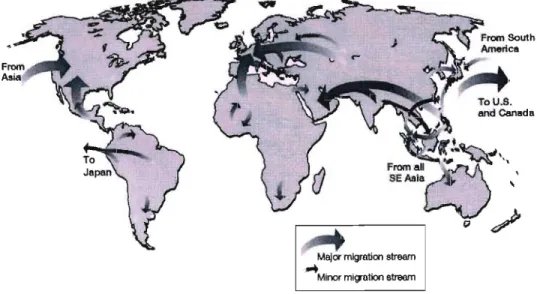
As Figure 1 illustrates,different flows of migration are to be observed around the world, with each region having its own migration patterns and challenges. According to Dodson (200 1:85) three trends can be identified in international migration - a growing feminization, an
increasing level oftemporary migration,and various forms oftransnationalism emphasizing how networks and household structures are maintaining links between two or more places. Further, it is likely that the emerging global economic and social system will continue to increase population movements thus, emphasising governments' and institutions' need to develop effective policies and accept cultural difference and diversity (Richmond 1994).
Although Figure 1 suggests that migration to South Africa only comes from Sub-Saharan Africa, the research done on demographics of refugees migrating to South Africa shows that, although constantly changing and difficult to measure,the majority of refugees who get their applications approved are from Angola, the Democratic Republic of Congo, Burundi, Rwanda, Sudan, Somaliaand Ethiopia. (Handmaker 200 I :94).This gives a more nuanced picture of migration to South Africa.
Figure 1. Illustrating the migration patterns in the early21stCentury
Minormigationetreern
Source: Martin and Widgren 2002:9
Why
people migrateAccording to Adepoju (1998) a number of different migration patterns and categories of migrants are created as a result of historical, demographic,political,ecological and ethnic factors working together in various ways. This,together with immigration rules and policies, forces the migrant into categories such as labour migrants,nomads,undocumented migrants, brain drain/skilled migrants,family reunion members,asylum seekers, refugees and internally displaced persons. Each of these groups has their own set of rights and entitlements further illustrating the migration complexity.
By presenting two different,but complementing,approaches to migration through the works
of~~rtinand Widgren (2002) and Stalker (2001),the understanding of refugee migration and how thisis seen within an international context will be outlined. This is relevant both for placing refugee migration within a broader theoretical context and for understanding the background and situation of refugees (see also Brettell and Hollifield 2000,Castles 2000, Siddique and Appleyard 200 I,Weiner 1999).
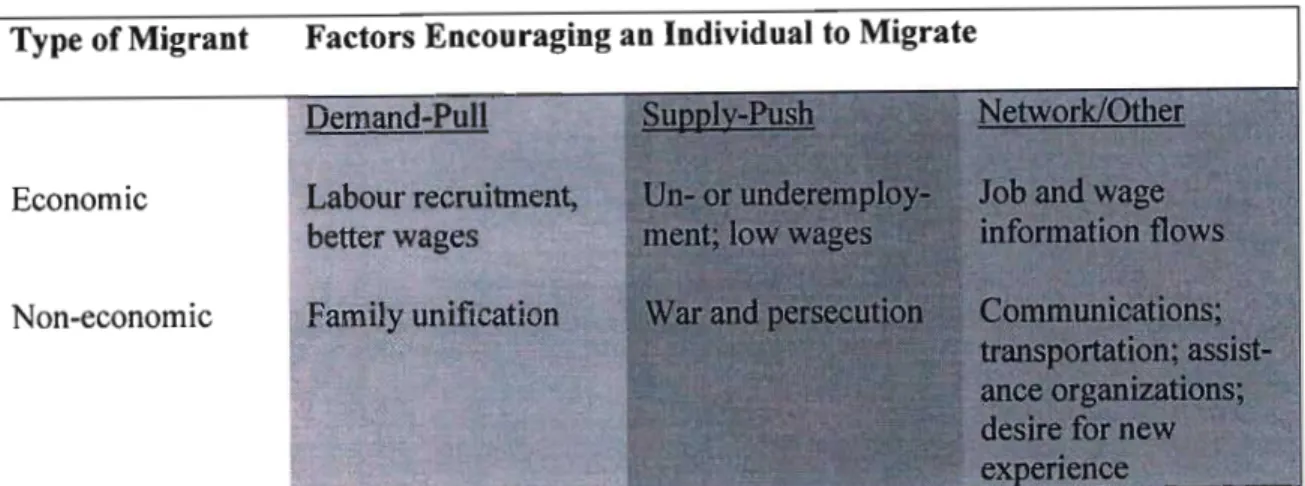
According to Martin and Widgren (2002) migrants can be divided into two broad categories;
those who migrate because of economic factors,and those who move mainly because of non-
economic factors. Further, they divide the factors which encourage migrants into three groups: demand-pull, supply-push and network factors, see Table 1.
Table 1.Determinants of Migration Type of Migrant
Economic
Non-economic
Factors Encouraging an Individual to Migrate
Note: The examples are illustrative. Individuals may be encouraged to move by all three factors. The importance of pull,push and network can change over time. Source: Martin and Widgren 2002:8
Ifwe are to see the migration of refugees with reference to Martin and Widgren's
determinants, refugees will be described as non-economic migrants mainly migrating due to push-factors such as war and persecutionI. Still, as argued by Adepoju (1998:22) the increasing nature of poverty is crucial for understanding linkages between poverty, conflict and refugee flows. Thus, even though economic factors might not be the main reason for why refugees migrate per se, they must be considered in relation to other migration determinants such as conflicts, loss of state capacities and statelessness. As emphasized by the UNHCR:
In an ever more interconnected world, migration has become more complex and the distinctions between categories of migrants blurred. Migrants seeking better economic opportunities and refugees fleeing conflict, and human rights abuses are increasingly using the same routes and intermediaries (UNHCR 2006a:4).
A different approach to the theories of migration is presented by Stalker (2001), although it can be seen in relation to the categories used by Martin and Widgren (2002). Stalker argues that different theories of migration essentially boil down to two main approaches; the individual and the structural. The individual approach sees the migrants as rational human beings who consider available options and destinations offering most jobs and highest wages. Yet,often the decision to migrate is part of a family strategy hence sometimes referred to as the 'new economics of migration' (Stalker 200 I :22). The individual approach is linked to the
IHowever, for wives arriving at a later stage family unification is also to play an important role in their migration process.
'push-and-pull' theory,which explains migration through push of poverty and pull of labor shortage.This complements Martin and Widgren's(2002) category of'economic migrants'.
The structuralist approach highlights how external economic,social and/or political forces push people out of some countries and into others. A variant of this approach is the theory of 'dual labor markets' which argues that capitalist development creates two distinct types of jobs - the secure,permanent,high-skilled and well paid tasks, and the hard, temporary and unpleasant tasks. The latter often carried out by immigrants (Stalker 2001:22-23). The structuralist approach has similarities with Martin and Widgren's(2002) category of 'non- economic' migrants.However, Stalker also underlines the complexity when explaining migration by pointing out that the two approaches can be difficult to keep separate as people's choices often are shaped by external forces but responded to in different ways.
Kofman (2004) points out that global migration patterns are gendered and that global
processes are drawing up new lines of selectiveinclusion and exclusion resulting in complex systems of stratification.This has resulted in a hierarchical mobility structure with a divide between skilled people on one side,and lesser skilled people,asylum seekers and refugees on another. She further argues that the dominant explanation of why people migrate is economic, thus as men tend to be associated with the economic and workplace, and women with the socio-cultural and family,migration has for some time mainly focused on men and their determinants for migration.
International refugee policies
Originally the objective of the United Nations High Commissioner for Refugees (UNHCR), created in 1950,was to help and support the nearly one million refugees still situated in Europe long after the end of the Second World War. Thus,in 1951 the Geneva Convention, the major legal foundation on which UNHCR'swork is based,was adopted (Achiron 2001:8).
However,the Convention was limited to protecting persons who became refugees as a result of events occurring before January 1, 1951. Hence,as time passed and new refugee situations emerged,the need increased for making the Convention applicable to new refugees. Thus in October 1967 the Protocol relating to the status of refugees entered into force giving the same protection to new refugees (UNHCR 1996:6).
Together, the Convention and the Protocol constitute the principal international instruments established for the protection of refugees and their basic character has been widely
recognized.Furthermore,
[B]oth instruments reflect a fundamental human value on which global consensus exits and are the first and only instruments at the global level which specifically regulate the treatment ofthose who are compelled to leave their home because of a rupture with their country of origin (Turk and Nicholson 2003:3).
In particular, the Convention sets out the basic principles on which international refugee protection is built - non-refoulement, emphasizing refugees' right not to be returned to any place where they could face persecution; and impartially, whereby all refugees are provided protection without discrimination (UNHCR 2006a:1).
In 1995 South Africa signed the Organization of African Unity (OAU) Convention Governing the Specific Aspects of Refugee Problems in Africa and in 1996 South Africa signed the United Nations Refugee Conventions.The OAU and UN Conventions are considered important documents establishing the rights of refugees and asylum seekers in South Africa, which is often explicitly stated to be the same as those of nationals. In the UN Convention, a refugee is defined as any person who:
Owing to a well-founded fear of being persecuted for reasons of race,religion,
nationality, membership of a particular social group or political opinion, is outside the country of his nationality and is unable or, owing to such fear, is unwilling to avail himself of the protection of that country; or who, not having a nationality and being outside the country of his former habitual residence as a result of such events,is unable or, owing to such fear,is unwilling to return to it (UNHCR 1996:16).
The OAU Convention includes this description, but further widens it by adding;
The term "refugee" shall also apply to every person who, owing to external
aggression, occupation, foreign domination or events seriously disturbing public order in either part or the whole of his country of origin or nationality, is compelled to leave his place of habitual residence in order to seek refuge in another place outside his country of origin or nationality (OAU 1969, Article 1(2)).
Further, according tol ThfHCRan asylum seeker is described as a person who has entered a country with or without the legally required documentation, is seekingrefugee status and whose status has not yet been determined.The asylum seekers should be considered to have the same rights as refugees until it has been fairly determined that they do not have refugee
status (Human Rights Watch 1998: 149). In short,the 1951 Convention (UNHCR 1996) states that refugees shall enjoy the same treatment as nationals in matters relating to access to the courts,labour protection,public assistance and elementary education.
Although the Convention has helped a large number of refugees since it entered into force,it has also been criticized for being outdated, unworkable, irrelevant and inflexible.Siddique and Appleyard (200 I: 12) make the following argument:
The Geneva Convention has been written in a way that allows signatory states to protect their interests, it asks for very little and leaves many responsibilities not well defined. While states are likely to continue to operate through UNHCR, NGOs are set to play an increasingly important role in the resolution of refugee-type problems.
It can thus be argued that this group of institutions is an increasingly important area of analysis.
During the last 10 to 15 years there has been a shift within governments' refugee policies.
States that used to have generous refugee policies now focus on the costs of asylum seekers to the state and how these outweigh their benefits to society. As pointed out by UNHCR
(2006a: I) "it was easier to welcome refugees who were culturally similar,fulfilled labour needs,arrived in manageable numbers and reinforced ideological or strategic objectives".
Thus, two emerging trends within asylum and refugee policies can be identified. First,due to an overly restrictive application of the Convention and its 1967 Protocol there has been an increase in detention, exclusion and lack of due process. Second, states are promoting alternative protection mechanisms which guarantee fewer rights than those contained in the Convention. Hence, more discretionary forms of refugee protection, such as notion of' safe country of origin', 'effective protection elsewhere' and 'safe third country',have replaced the broader approach based on human rights (UNHCR 2006a:2).
The number and types of migrants have increased faster than the capacity of national governments, regional bodies and international organizations and agreements to deal with them. Along with an upsurge in racism,discrimination, intolerance and xenophobia in Europe and North America,there is a worldwide trend towards stricter immigration controls
(Richmond 1994:212). Developed countries have made clear their unwillingness to resettle large numbers of refugees from the South within their borders. Thus, the expectation is that
refugees will stay in the South, in return for which the North will provide financial assistance (Weiner 1999:16).
Refugee migration in Africa
There are a number of different factors affecting migration patterns in Africa, especially in Sub-Saharan Africa. As pointed out by Whitwell (2002:9):
If there is any region in the world where the migration system could be said to be going through fundamental change it is Sub-SaharanAfrica, which displays complex and shifting migration patterns arising from wars and civil strife, social and economic restructuring withinindividual countries and closer economic cooperation between groups of African states.
In particular, violent ethnic conflicts in the Hom of Africa and the Great Lakes region of central Africa remain the most significant trigger of large-scale emigration and refugee flows in the region. The migration configurations in Somalia, Liberia, Sierra Leone, the Democratic Republic of Congo (DRC),Rwanda and Burundi have especially generated massive size and rates of refugee flows and forced population displacement. Thus Adepoju (1998:32) argues that the root of Africa's crisis lies at the political level.It is a political crisis with devastating economic consequences.
These regional migration trends highlight some important features. First, although figures from UNHCR (2005) show that the global refugee population has dropped four years in a row, from just over 12 millions in 2000 to 9,2 millions in 2004, Africa is still the region most affected by refugees providing for about one-third of the world's refugees (Martin and Widgren 2002:29). Secondly, the vast majority of international migration from Sub-Saharan countries remains within the continent. South Africa,which is seen to be a country doing much better compared to other African countries,has become a primary destination for migrants, including refugees, from the African continent (Landau 2004a: 10).
The South African Context
Human Rights Watch (1998) has identified three different migration trends in South Africa before 1990. First, South Africa has long been the center of an extensive system of labour migration in the southern African region with foreign mine workers traditionally making up
about 40 percent of the South African mine labour force. Secondly, economic migrants from the Southern African Development Community(SADC) have tended to migrate to South Africa because of economic disparity. And thirdly,Mozambican refugees fleeing civil war within their own country settled (illegally) in the former'homelands' of South Africa. In addition,many South Africans had to migrate to neighboring countries due to the apartheid- regime and their policies.
In 1991 UNHCR was finally allowed to establ ish their presence in South Africa,and in 1993 South Africa signed a Basic Agreement which among others required an individual
determination of refugee status (Handmaker 2001:94).Since 1994, South Africa has become a primary destination for migrants from the African continent. McDonaldet al argue:
Migration into South Africa is now truly a pan-African phenomenon and will become increasingly so. It is important that policy-makers are sensitive to the regional
differences in migration into the country, and that they acknowledge the new role that South Africa has begun to play with respect to the movement of people on the
continent as a whole (McDonaldet al1999,cited in Boaden 2002:7).
Further, three immigration amnesties were granted between 1996 and 2000. The first amnesty was given to contract mine workers from the SADC who had worked in South Africa for at least ten years and had voted in the 1994 elections.The second amnesty offered permanent residence to undocumented citizens from SADC who had lived for more than five years in South Africa. The third amnesty was for the Mozambican refugees,and although announced in 1997, it was only implemented in February 2000 (Peberdy 2001:20). As will be pointed out later, these amnesties signaled which migrants would and would not be included in the new South African nation.
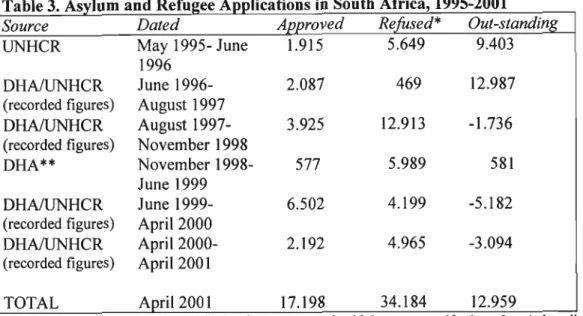
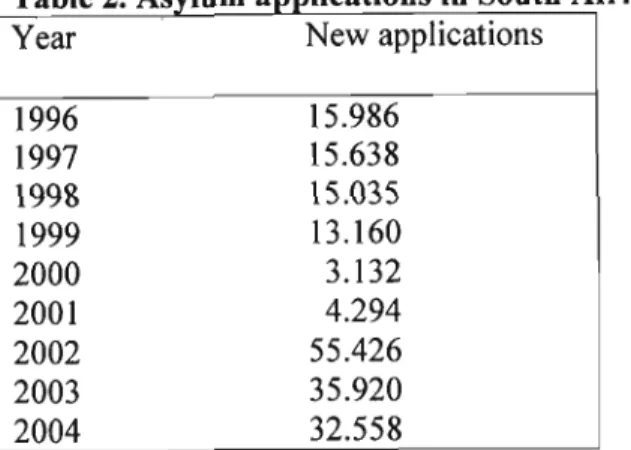
Table 2 illustrates the number of asylum applications received in South Africa between 1996 and 2004. The number of applications lodged from 1996-1999 were about 15 000 per year, then decreasing to 3-4 000;yet, recently there has been a large increase in people seeking asylum.Further,using numbers from UNHCR and Department of Home Affairs,Handmaker (2001: II 0) illustrates the number of applications approved,refused and out-standing between May 1995 and April 2001,see Table 3.Thus,by April 2001 South Africa had received about 65 000 applications of which 17 000 were approved,35 000 refused and 13 000 out-standing.
Table 2. Asylum applications in South Africa 1996-2004
Year New applications
1996 15.986
1997 15.638
1998 15.035
1999 13.160
2000 3.132
2001 4.294
2002 55.426
2003 35.920
2004 32.558
Source: UNHCR 2003:318,Redden 2005.
Table 3. Asylum and Refugee Applications in South Africa, 1995-2001
581 -5.182 -3.094 12.987 -1.736 469
4.965 4.199 5.989 12.913 577
3.925
2.192 6.502 2.087
DHAIUNHCR
(recorded figures)
DHAIUNHCR
(recorded figures)
DHAIUNHCR
(recorded figures)
DHAlUNHCR
(recorded figures)
DHA**
Source Dated Approved Refused* Out-standing
UNHCR May 1995- June 1.915 5.649 9.403
1996 June 1996- August 1997 August 1997- November 1998 November 1998- June 1999 June 1999- April 2000 April 2000- April 2001
TOTAL April 2001 17.198 34.184 12.959
*Refused includes: Rejected, cancelled, referred, extended,withdrawn or manifestly unfounded applications.
** Speech by Deputy Minister of Home Affairs to Parliament,S November 1998.
Source:Handmaker 2001: 110
However, it must be emphasized that asylum seekers and refugees constitute a very small part of the overall migration to South Africa. Further, there are an undisclosed number of migrants entering for humanitarian reasons who do not try to apply for refugee status due to fear of not being granted a fair determination. Hence the migration community as such is much larger than the numbers indicated above. UNHCR estimated that just over 28000 recognized refugees were living in South Africa by July 2005. Most of the refugees getting their
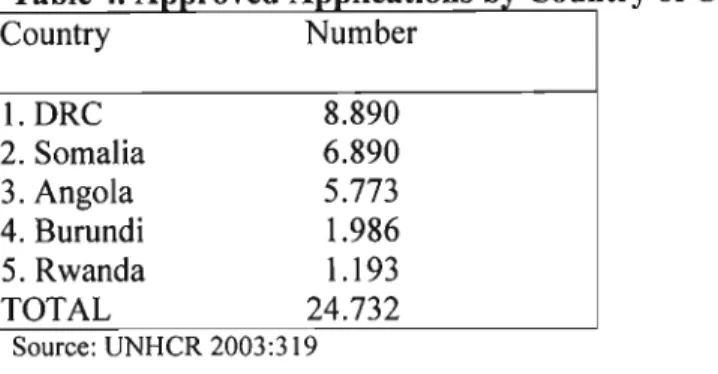
applications approved have come from Angola, the Democratic Republic of Congo, Burundi, Rwanda, Sudan, Somalia and Ethiopia, with a smaller number from Nigeria, Senegal, Cote d'Ivoire, Cameroon, as well as India and Pakistan. Yet,the three main 'refugee generating"
2One problem related to labeling some countries as'refugee-generating' has been a tendency among Home Affair officials to prioritize and approve people from these countries rather than following the individual determination process introduced in 1993 (Handmaker 2001:94).
countries have been DRC, Somalia and Angola, see Table 4. However, in Durban the majority of refugees are from the Great Lakes area (DRC, Burundi and Rwanda) illustrating potential regional variations and clusters (CASE 2003 :210). As the nature of conflicts changes so does the asylum community, pointed out by Mr Jeff Maqetuka director general of home affairs. He states that although the biggest number of asylum applications still comes from the DRC, the next countries currently following on their list are Zimbabwe, Ethiopia and Pakistan (Naidu 2006:5).
Table 4. Approved Applications by Country of Origin, 1994-2003
Country Number
1. DRC 8.890
2. Somalia 6.890
3. Angola 5.773
4.Burundi 1.986
5. Rwanda 1.193
TOTAL 24.732
Source: UNHCR 2003:319
With the current increase in asylum applications, the most recent numbers point toward a backlog of 117 000 pending asylum claims by July 20053(UNHCR 2006b:211). While the overall number of applications are relatively modest compared to the millions of refugees the African continent has witnessed during the last decade, the South African asylum authorities have been poorly prepared to deal with this amount of cases. Further, there is a tendency among government officials to express perceptions of a 'mass inflow' of refugees entering the country. Together with an increased profile of migration-related issues in the media, much which is uninformed, this has added to xenophobic feelings where foreigners are being blamed for exacerbating social problems such as rising crime, unemployment, or even spreading disease (UNHCR 2006b:211, Human Rights Watch 1998: 1, see also Danso and McDonald 2001).
Thus, asylum seekers and refugees have become victims of misguided perceptions presented by politicians and the media, and bureaucratic inefficiency at the Department of Home Affairs. UNHCR has been providing training, advice and materials to support the effort to raise the capacity both of the DHA staff and equipment. Still, it will take time to clear the backlog and raise the credibility of the overloaded asylum system which today represent the
3UNHCR's number is slightly higher then the number used by Mr Jeff Maqetuka to the Sunday Independent 14th May 2006 where he said they have a backlog of 103 410 asylum applications.
most substantial asylum-related challenge for South Africa (Redden 2005, UNHCR 2006b:211).
Perceptions of migration in South Africa
v
There is a perception among South Africans that legal immigrants are depriving locals ofjobs and services while "illegal immigrants" supposedly corrupt officials, cause crime and take scarce resources from South Africa's poor (Crush and McDonald, 2001 :7). These perceptions have led to a pervasively high and deepening level of hostility and intolerance towards outsiders, and particularly Africans from elsewhere. Dodson (2001 :80) notes with respect to migration from neighbouring countries particularly that this is being presented as a threat to the social and economic well-being of South Africa rather than seen as a means of reducing inequality through skills transfer and remittances. As many South Africans emphasize migrants taking scarce resources and jobs from local South Africans, they place themselves within the neo-Malthusian category of describing immigrants' impact on society. The neo- Malthusian view argues that every society has limited resources (ofland and jobs) thus a large immigration is not in the interests of society (Hollifield 2000).
According to The Human Rights Watch (1998:4) South African attitudes have in general become increasingly xenophobic. Politicians add to anti-foreigner feelings by making statements about the 'deluge' of migrants being responsible for crime, unemployment and spreading of disease. Further, since refugees often have linguistic, cultural and other differences making them more visible than other migrants, they are particularly targeted for abuse by South African citizens, the police, the army, and the Department of Home Affairs (Handmaker 2002:11,Rogerson 1997). Landau (2004b) points to three areas where anti- immigrant sentiments are having visible consequences in that they result in forms of exclusion. First, in terms of accessing work and studies, second when accessing public and private services such as education and health, and third when dealing with the police. The latter often resulting in repeated arrests with rough handling, verbal abuse and sometimes repatriation (Human Rights Watch 1998:5, Landau 2004b: 15-16). Thus, although asylum seekers and refugees have the right to be in South Africa, they continue to meet xenophobic attitudes, to be excluded from social benefits and to be unable to make long-term
commitments to business, people and/or the space they inhabit.
South Africa's immigration policies
Table 5 illustrates South Africa's different immigration policies. During the apartheid-era decisions about whowould be allowed accessto South Africa and onwhat terms were made based on racial and religiouscriteria. According to Crushand McDonald(2001:2) the
immigration policies developed under white minorityrule rested on four pillars - racist policy and legislation,the exploitation of migrant labour from neighboring countries,tough
enforcement legislation,and the repudiation of international refugee conventions. With the introduction of the Aliens Control Act (ACA) in 1991 emphasis was put on tougher penalties for illegal immigration and increased power to immigration officers and the police. Yet,the Minister of Home Affairs managed to convince the Parliament that the ACA actually was too soft,hence the Act was amended in 1995 and 1996 giving the Department of Home Affairs new powers and abilities to police in-migration (Peberdy2001: 17).
Table 5. Overview of South Africa's immigration policies and refugee obligations Year Name of Policy Document/Convention
1991 The Aliens Control Act
1995 Joined the OAU refugee Convention 1996 Joined the UN refugee Conventions
1997 The Draft Green paper on International Immigration 1998 The Refugees Act (implemented in 2000)
1999 The White Paper on International Migration 1999 The DHA Discussion Document
2000 Draft Immigration Bill (passed into law in 2002)
2001 The Refugee Amendment Bill and explanatory Memorandum
The Aliens Control Act established a system with the aimof identifying all persons in South Africa as either prohibited or non-prohibited. Prohibited persons is defined in Section 39 (a-i) as any person who"is likely to become a public charge by reason ofinfirmity of mind or body,or because he is not in possession of sufficientmeans to support himself and his
dependants", "is deemed by the Minister to be an undesirable inhabitant or visitor", "has lived on the earnings of prostitution", "has been convicted", "is mentally ill,or who is deaf and dumb,deaf and blind,or dumb and blind", "is afflicted with any such contagious,
communicable or other disease",or"has been removed from the Republic by warrant".The Act clearly indicates the expected behavior of citizens towards prohibited persons pointing out that no person shall employ, provide instruction or training,or issue or conduct business
licenses to any "alien"who is in the Republic in contravention of the provisions of this Act (Aliens Control Act 96 of 1991,32(a-d)).
Further,the ACA was premised on the assumption that prohibited individuals can be either excluded from South Africa at the border, or effectively identified and removed from within the country's borders:
An immigration officer may, if a person who is a prohibited person, enters or is found in the Republic,and is not in custody,arrest him or her, or cause him or her to be arrested, without a warrant, and shall, irrespective of whether such person is arrested or not, remove him or her from the Republic (... ) (Aliens Control Act 96 of 1991,44 (1)).
Until the promulgation of the 1998 Refugee Act (implemented in April 2000) refugees and asylum seekers were treated according to the Aliens Control Act, a heavily control-based model of legislation,which was never intended to offer protection to anyone (Handmaker 2002:1).
According to Crush and McDonald (2001:4-6) South Africanpost-apartheid immigration policies has made three important breaks with the past. First,it abandoned racist immigration policies. Yet, this has not led to more liberal policies. In fact, the government has shown little support for any type of immigration,and only since 2001 has the African National Congress acknowledged the role of immigration but then mainly with regards to the "brain drain" and skilled migrants.Second, the state offered once-off compensation to some of the victims of apartheid immigration policies, these were the three amnesties given to mine workers,citizens from the SADC living in South Africa for at least five years and Mozambican refugees. Third and finally,the government acknowledged the ideals and practices of international refugee protection by joining the GAU and UN refugee Conventions in 1995 and 1996 and by passing a new Refugee Act in 1998.
Also the South African Constitution (1996) guarantees rights applicable to asylum seekers and refugees. Section 7(1) of this legislation states:
The Bill of Rights is a cornerstone of democracy in South Africa. Itenshrines the rights.of all people in the country and affirms the democratic values of human dignity, equality and freedom (Republic of South Africa, 1996).
Among others, rights to adequate housing, health care services,food and water,and social security for all people in South Africa are included here. Only two sets of rights are explicitly reserved to citizens - political rights (section 19) including the right to vote,and the right to engage in freedom of trade,occupation and profession (section 22).
The 1997 Draft Green Paper on International Migration proposed for a new national skills- based immigration policy,regional sensibility,rights-regarding enforcement and separate refugee and immigration legislation as refugees were still falling under the Aliens Control Act. Further, recommendations on refugee policy were focusing on temporary protection, 'solution-orientation', and burden-sharing within the region (Handmaker 2002:6). Of all these proposals Crush and McDonald (2001: 10) argue there was only immediate progress on the refugee issue, particularly due to the combination of a growing number of asylum seekers and South Africa's obligations under the UN and OAU Conventions. The skills-based
immigration policy was on the other hand only to be passed into law in 2002.
In May 1998 the Department of Home Affairs appointed a task team to produce a White Paper on refugees. The team consisted of people from the Department,civil society and UNHCR. Based on this team's recommendations,the DHA presented a Refugees White Paper in June 1998. After some amendments made by the Parliamentary Portfolio Committee of Home Affairs the Refugees Act was passed in the National Assembly on 5thof November 1998 and turned into law the 2ndof December. However, the Act did not come into force until April 2000 (Handmaker 2001 :96).
Although the new Refugee Act was viewed at the time as broadly progressive, concerns have been raised about the implementation and refugee's rights. The Refugees Act states that refugees are entitled to a formal written recognition of refugee status,to full legal protection, to seek employment, and to access the same basic health and education services as South Africans (Section 28 (a,b,f,g)). Yet, as stated by Handmaker (2002:7) "the DHA has consistently failed to issue refugee documents and travel documents to recognized refugees who need it to access services, apply for jobs,open bank accounts and avoid being arrested and deported on suspicion of being illegal in the country".The legislation can only be effective if the government builds capacity,and if the procedures allow a fair opportunity for asylum applications to be granted a credible hearing.
The 1999 White Paper on International Migration ended up being inconsistent reflecting both on South Africa's "illegal alien" problem, and arguing for a more open skills-based
immigration policy (Crush and McDonald 2001: 11).As the White Paper also set out that illegal migration could be decreased by reducing pull factors, the DHA released a Discussion Document the same year proposing the establishment of "Reception Centres" where asylum seekers are to be kept while their applications are being processed". However, the Discussion Document has been strongly criticized for not being economically feasible, for threatening rights already obtained by asylum-seekers and for just being used in circumstances of a sudden 'mass influx' - which is obviously not the case in the present situation (Handmaker 2001:102).
The 1999 White Paper on International Migration was followed by a Draft Immigration Bill in 2000 which was passed into law in 2002.This Bill suggests facilitating the movement of skilled migrants into the country. Crush and McDonald (2001: 11) commented at the time "the new Immigration Act promises a long over-due new approach to immigration, with skills being the main criteria for immigrant selection". Yet, even though this document was not supposed to deal with the issue of refugees, Handmaker (2001) points out that refugees would be affected by the migration policy, particularly the provisions on border control. The
Immigration Bill asks the community to be responsible for helping with internal policing actions to ensure that illegal immigrants are not attracted to South Africa, thus suggesting that
"one would be a good citizen by reporting anyone suspected of being without legal residence to the authorities" (Handmaker 2001: 105). However, this approach will most likely contribute to increased xenophobia and discrimination, especially towards refugees who often are more visible due to linguistic and cultural differences, further splitting communities. Finally, the 2000 Bill states that it precedes the 1998 Refugees Act in the event of conflict.
In 2001 the Discussion Document was replaced by a Refugees Amendment Bill along with an explanatory Memorandum. According to Handmaker (2001: 104) the Bill set out to do two things:
[F]irst to provide a legislative framework for the introduction of government-run Reception Centres for asylum seekers in South Africa and, second, to introduce legal mechanisms for the purpose of restrictively interpreting the extension of refugee status in terms of the Refugees Act 1998.
4This is not to be mistaken for the Refugee Reception Centres operated by DHA today
One of the mechanisms suggested was to refuse asylumseekers passing through a so-called 'safe third country' entering South Africa. However,this was successfully challenged in a legal case taken up by Lawyers for Human Rights in May 200 1. Thus,as South Africa has not yet introduced the proposed Reception Centres,where refugees are to be kept while their application is processed,it can still learn from the terrible experience of compulsory detention of asylum-seekers in other countries and reject the idea altogether.
Dodson (200 1) points out that both the 1997 Green Paper and the 1999 White Paper have been "remarkably silent on questions of gender".This illustrates a gender blindness towards the links between gender and migration and on the migration policies' different outcomes for men and women. The 1997 Green Paper's 'migrant' category is suggested to mainly be governed by economic criteria of labour demand admitting individuals possessing desirable skills,expertise,resources,and entrepreneurial will. However,many women are denied access to these skills and resources hence theybecome disadvantaged by the application of such criteria. Further,there is no explanation why most of the refugees entering South Africa are men and whether they leave behind female partners, parents and/or children in their country of origin.Dodson (200 1:86) suggests that since all migration takes place within a social context where gender and family relations are among the key factors influencing migration behaviour,research on refugee migration should not just pay attention to the gender of the individual migrants, but also to their household position and family status using the household strategy approach.
Although the government,through the above mentioned policies,has tried to break with apartheid policies,Crush and McDonald (200 1) argue that some trends have yet been continued. First,a tough enforcement legislation is sustained and justified by using wrong numbers and statistics to describe'waves' and 'floods' of immigrants arriving South Africa.
Between 1994 and 2000, over 600 000 people were forcibly removed from the country by the police. Second, the mines continue to recruit labour unrestricted from outside the country;
mineworkers who still cannot acquire any rights of residence in South Africa. Third, the migration policies continue to define migrants in neutral terms illustrating how a gender dimension in the policies is yet to be present. Finally,although most of the migrants do not intend to stay in South Africa,and many of them are victims of crime,the vast majority perceives legal immigrants to take jobs from locals,and illegal immigrants to cause crime and
take resources from South Africa's poor. Crush and McDonald (2001) point out that this has resulted in increased hostility,especially towards Africans from elsewhere;an idea that can be traced back to apartheid ideologies describing Africa (in contrast to South Africa) as a place of'otherness', fear and threat. They (2001:8) state"Many of the same apartheid-era images and stereotypes have simplybeen displaced onto African migrants and refugees,known pejorativelyaskwerekwere".
Contradicting policies
Peberdy (2001 :29) describes citizenship as the basic legal marker of national identity. However,as many refugees often do not know the constitution and legislation,it makes it difficult for them to claim their rights. Hence most refugees are unable to draw on their
citizenship to make demands on the state nor have they organized as an aggregated group with common political interests. Previous research shows how grassroots mobilization and ethnic networks can substitute national citizenship,as established refugees are often the best placed to help newcomers with accommodation and job hunting.Not only is this a way of dealing with everyday life,but it is also a way for refugees to safeguard their culture and identity (Amisi and Ballard 2005,Amisi 2005,Sabet-Sharghi 2000,Jinnah 2006).
South Africa's history of racial oppression and human rights abuse can be said to stand in stark contrast to the construction of a new identity,built on principles of inclusion,democracy and human rights for all citizens.This divided,but shared history is used to identify 'true South Africans', thus,those standing outside are excluded from its unifying implications. As argued by Peberdy (2001 :23): "The South African state has quicklydeveloped a very clearly defined spatial identity and sense of territorial integrity,shaped by notions of nation building and national identity", further paying increased attention to controlling the nation's borders and implementing stronger regulations and restrictions for African migrants.A South African national identity based on citizenship seems to feed,not challenge,xenophobic tendencies, thus"South Africa's new national identity, while African,is still firmly South African"
(Peberdy 2001:29).
The South African concept of citizenship stands in stark contrast to the political rhetoric of 'The African Renaissance'. As stated by then Deputy President Thabo Mbeki:
The new African world which the African Renaissance seeks to build is one of democracy,peace and stability,sustainable development and a better life for the people, non-racism and non-sexism,equality among the nations and ajust and democratic system of international governance (Mbeki 1998).
The African Renaissance emphasizes unity among African countries and African people using the Organization of African Unity (OAU) and New Partnership for Africa'sDevelopment (NEPAD) as examples of how this can be achieved. South African immigration policies contradict Mbeki's notion of the African Renaissance. Through partnerships such as the AU and NEPAD it has become easier to move goods,services,capital, finance and technology across borders. While immigration laws and practices have made it far more difficult for people crossing the same borders (Nayyar 2000).Hence South Africa'simmigration policies are working against Mbeki's ambitions to create a better life for African people and equality among the nations.
In addition to the use and definition of citizenship two other reasons for South Africa's strong emphasis on immigration control and exclusion have been pointed out. First,the misleading notion ofa so-called'immigration-crises' s, and second the appointment of Mangosuthu Buthelezi from the conservative Inkatha Freedom Party,to the Minister of Home Affairs in 1994 and reappointment following the 1999 elections (Crush and McDonald 2001).As illustrated through the words of Buthelezi:
With whatever empathy and understanding one may judge the underlying reasons and motivation why people are compelled to leave their fatherland and to seek refugee here,the interests of the RSA and her citizens and legal residents must be our first and foremost consideration (Buthelezi 1995,cited in Peberdy 2001: 15).
Refugees: Demographics and Experiences
Most of previous research done on refugees" in South Africa has focused on demographics, work activities,the number of problems they face and the importance of social networks (Hunter and Skinner 2001,2003,Boaden 2002,Landau 2004a,2004b,Amisi 2005,Jinnah 2006). After briefly outlining what is known of the demographics of migrants, the findings of previous research are reviewed through four themes- migrants' experiences of xenophobia
5This was alreadyprevalent in Human Rights Watch' (1998:19)findingsfrom 1996-1997 noting that certain public officials used the highest estimates ofundocumented migrantsin orderto suggesta state ofcrisis with regard to the presence of migrants in South Africa
6The previousresearch has not necessarilyfocused exclusively on refugees,but refugees havebeen part of the researchsamplecategorizedas foreigners,Africanmigrants, and forced migrants.
and discrimination;their experiences with the Department of Home Affairsand problems with accessing social and private services.
The nationality of asylum seekers and refugees entering South Africa has been pointed out above. In the case of Durban,the majority have come from DRC,Rwanda and Burundi,and most of these are situated in Central Durban in the Point area.The demographic profile further indicates that most of the refugees are young, single men. Although many ofthem are well-educated,the majority still ends up working in the informal economy revealing distinct clusters of economic activity within each nationality'.For example 60 percent of street barbers in Durban are from the DRC and Burundi (Hunter and skinner 2003:7). This clustering of economic activities can be partly explained with regards to the strong ethnic networks developed among this group of migrants. As new refugees often tend to get help from more established refugees from the same country, this contributes to increased work specialization since the established refugees are more likely to transfer knowledge and skills and find job opportunities within their own field of work. The importance of the networks among Congolese and Pakistani migrants in Durban has formerly been pointed out by Amisi (2005) and Jinnah (2006).
Previously,asylum seekers in South Africa received a Section 41 permit which usually was a three-month permit to remain in the country(Human Rights Watch 1998: 11 0). However, according to Boaden (2002) there seems to have been a major change in official policy in 2000:
Because ofthe backlog many people come into the country and apply for asylum and are granted a section 41 permit which entitles them to work until their cases are processed. In terms of the new Home Affairs system,applicants will no longer be issued with Section 41 permits. Instead they will get a new Section 22 permit,which prohibits their working until their refugee status has been approved (Saturday Star 2000, cited in Boaden 2002:4).
These changes came in to effect with the 1998 Refugees Act made operational in April,2000.
The Minister of Home Affairs published a number of Refugee Regulations where Regulation 7 contained a prohibition on work and study for all holders of a section 22 permit (Baguley 2003:11). However,these conditions are to be removed,justified by Regulation No. 366 of the Refugees Act and a ruling from the Cape Town High Court in August 2002 holding that
7Previously pointed out by Rogerson (1997) and Boaden (2002).
the prohibition was unconstitutional and therefore invalid. Yet,until this happens in practice it is very difficult for asylum seekers and refugees to look for and accept jobs (Segale 2004:48). Hence Hunter and Skinner (2003:3) point out that:"In many cases asylum seekers have no choice but to work where barriers to entry are lower in the informal economy,often as street traders".
Xenophobia
The Human Rights Watch (1998:123) documented in 1998 an increasing level of xenophobia since 1994 which further encouraged abuse by the police and Home Affairs officials of both documented and undocumented migrants. This treatment of foreigners as a homogenous group is confirmed in more recent research stating that refugees,asylum seekers and
foreigners legally and illegally in the country tend to be dealt with in the same way. Surveys carried out by Southern African Migration Project (2001, 2004) illustrate that South African attitudes towards foreigners are currently very negative. South Africans gave strong support for policies that would place strict limits on or prohibit immigration altogether.Although almost 70 percent agreed that refugees warrant protection,only 47 percent thought that the South African government should give asylum and protection to refugees (Crush 2001,Crush and Pendleton 2004)). Palmary's (2004:66) study found that the Johannesburg Metropolitan Police Department tended to treat foreigners as criminals. Yet, foreigners in Johannesburg are in fact disproportionately victims of crime, particularly in robbery;among others resulting from refugees' lack of or improper documents to open bank accounts and access savings.
Segale (2004:50) argues that xenophobia is one of the single biggest obstructions to
integration facing refugees in South Africa. This has recently been illustrated by the number of attacks experienced by Somalis in South Africa. In August 2006,30 Somali shopkeepers were forced to flee the area ofMasiphumelele in Cape Town when a mob of between 200 to 300 locals attacked their shops. Although Tromp (2006:17) argues these attacks happen due to the Somalis being successful businessmen and not because of xenophobia, the counter
argument is that the Somalis are attacked because theyare successful Somali businessmen, hence the South African businessmen's jealousy has ethnic roots. Another example is the Zimbabwean refugee who sued her pastor for making discriminatory comments about her in church. She further said in her affidavit: "[The pastor] hated me and still hates me because I'm an immigrant,African and a refugee" (Olivier 2006:4). The xenophobic attitudes
experienced by refugees from officials, the police, in school, and in the community, must be understood in relation to the South African concept of citizenship and its view on immigration linking refugees to increased crime,unemployment, drug abuse and disease.
Problems with the Department of Home Affairs
During the Apartheid regime, the Department of Home Affairs was considered one of the most corrupt departments in South Africa. The Department continues to be characterized by administrative incompetence and arbitrary and uninformed decisions after 1994,under Home Affairs Minister Mangosuthu Buthulezi8(Landau 2004b:7). Clearly, this has caused huge problems for asylum seekers and refugees trying to access identity documents. The
importance of these documents is highlighted by Landau (2004b) arguing that identity papers can promote social integration by providing a sense of belonging as well as giving migrants the chance to contribute to their physical and social environment by living securely and exercising their skills.The research conducted by Human Rights Watch in 1996-1997 revealed high levels of corruption in the refugee determination process. However,recent research indicates few changes on this issue. Segale (2004:47) gives the following example:
"Asylum seekers and refugees consistently allege that they are not allowed into the offices of the Refugee Reception Centers unless they are willing to pay a bribe to the Security Guards at the doors to the building".
While the asylum seekers are waiting for their cases to be considered,they receive a section 22 permit which until recently put a prohibition on refugees studying and working. Although this was successfully challenged in court,the DHA in Johannesburg continued to insert the prohibition on permits and would only remove it at the request of the asylum seeker (Bhamjee and Klaaren 2004:60). Further, the Section 22 permit has to be renewed at least twice a year, and this must be done in the office where the asylum seeker originally applied effectively limiting their freedom of movement. The long backlog of applications at the Refugee Reception Centers has been used by migrants not eligible for refugee status as a way to legitimize their stay in the country. This in turn further increases the number of applications in the system. Because of this backlog many asylum seekers are living in an administrative 'limbo ' where their status is unclear and their rights to services ill defined (Gotz and Landau 2004: 17).
8Replaced in 2004
Findings from a study done on the Refugee Reception Office in Cape Town 2002 showed long queues,outdated and misleading signs,inconsistent intake procedures,and no facilitation for disabled and children (Sterken 2003). Further,refugees have complained that signs are in English,permits with adequate justification have not been renewed,refugee identity
documents are delayed, and xenophobia and discrimination is exercised by the DHA officials. Hence,refugees are facing both administrative and xenophobic problems at the Refugee Reception Centers (Segale 2004:49).The most striking finding from a survey carried out in 2004 by the Southern African Migration Project (SAMP) on the quality of migration services delivery in South Africa revealed a significant high level of officials being unfamiliar with the Refugees Act. Although some ofthese officials were employed as Administrators,Clerks and Maintenance staff,43 percent ofImmigration Officers stated that they were unfamiliar with the Act. This was also the case for officials working at border posts and airports. As these people often are the first point of contact for asylum seekers, Davids et al (2005:53) highlight the need for training programs and other measures to ensure that these staff have a more in- depth understanding and knowledge of the legislation.
Access to social services
Article 22 of the UN Refugee Convention states that refugees are entitled to the same
treatment as nationals with respect to elementaryeducation,and further that they shall accord as favourable treatment as possible,or at least not less favourable than that accorded to non- nationals generally with respect to education other than elementary education (UNHCR 1996:26). This is confirmed in article 27 of the Refugees Act (130 ofl998) declaring that:"A refugee is entitled to the same basic health services and basic primary education which the inhabitants of the Republic receive from time to time",The most evident barriers for refugees trying to access education are expenses such as school fees as well as the costs for transport, books and uniforms.Thus,this problem is rooted in the larger issue of poverty,something that affects both South Africans and refugees (Winterstein and Stone 2004:79,also see Sabet- Shargi 2000). Other problem areas are discrimination due to language and age,as well as teachers not being aware of the impact oftraumatic experiences thus dismissing refugee children as unruly or uncooperative. Education helps people to maintain a normal routine, increases their sense of security,and is a key factor in creating a skilled and creative
workforce. It is thus crucial that the government implement measures to eliminate the barriers to education faced by refugees and South African citizens.
In the case of health care the South African Constitution (1996) says that everyone has the right to health care services, including reproductive health care (Section 27 (1)). However, research shows that that refugees are often not able to exercise their full rights to public health services, and are sometimes even denied access or charged fees they are not supposed to pay (Landau 2004b: 11). Pursell (2004:95-97) identifies ignorance both among refugees and health care workers as other possible problems. Refugees may not know that the health system in South Africa requires you to make a claim at a clinic before being referred to a hospital, thus if refused service at a hospital they may assume they will not get it anywhere. Ignorance among health care personnel is illustrated through perceptions of all immigrants as illegal,or low awareness ofthe specific rights of refugees. Finally, the issue of xenophobia is
demonstrated through refugees being denied emergency health care,and/or when accepted into the clinic having to wait longer than South African clients.
Within a constitutional framework, Section 8.4 of the Bill of Rights grants the "Right to Housing" to all "juristic persons", with no distinction made between 'person' and 'citizen' (Republic of South Africa 1996). Further, the United Nations Conference on Human
Settlements' (UNCHS) Habitat Agenda document commits the Government of South Africa to find ways to ensure "equal access to affordable, adequate housing for all persons and their families" (UNCHS 1996, cited in McDonald 1998:8). According to McDonald (1998) South Africans are in general negative to non-citizens being eligible to buy a house or get a housing subsidy. Refugees need to move frequently because of lack of secure housing at affordable prices, lack of identity documents and exploitation by the landlord.As a result of this refugees, on average, pay more for rent than South Africans. Further, the subdividing of houses and flats into smaller and smaller units increases health risks, limits security and reduces the area in which to be productive. The latter especially affects women (Sadie and Borger 2004:86, Boaden 2002: 14). Hence, Sadie and Borger (2004:86) state that: "A lack of safe, short-term accommodation for newly arrived refugees and asylum seekers (...) is one of the most immediate issues that must be considered". Further they argue for the incorporation of refugee organizations into discussions on housing policy as this can both help to ensure that refugees are guaranteed housing, and facilitate improved infrastructure maintenance and a commitment to the city.
Access to private services
According to Landau (2004b) lack of accessto bank accounts or a safe place to keep the cash constrains refugees' economic activities and their ability to survive and contribute to the city as well as decreases their possibility of saving and investment. Further it makes it more difficultto start and/orexpand business which not only affects refugees' livelihood,but also their abilityto create jobs for others. Due to the lack of access to credit,some refugees have to rely on loan sharks and other forms of lendingcontributing to unregulated and potentially dangerous forms of monetary exchange. Refugees having no access to bank accounts are also at a greater risk of being targets for crime or police extortion,as many refugees are known to carry cash.He (2004b:12) further states that:"Although current banking legislation
technically prevents anyone except permanent residents and citizens from opening bank accounts,this policy may be waived on a discretionary level as often done with people in the country on temporary basis". While having a Refugee Identity Document does not guarantee access to bank services,South African banks usuallydo not allow refugees to open accounts without it. Hence refugees' inability to access these documents constitutes a major barrier for accessing financial services,while asylum seekers with Section 22 permits are not eligible to open bank accounts at all (Jacobsen and Bailey 2004: 100).
In Johannesburg,the Jesuit Refugee Services and UNHCR have implemented credit programs for small group of refugees. However,as pointed out by Ballard (2004:105) none of these facilities have yet been negotiated in Durban. Thus,this constitutes an area where Durban- based NOOs working with refugees should pay increased attention in their lobbying and advocacy.
This chapter has considered the international migration contextas well as the specific
experiences of South Africa. Relevant immigration policies have been analyzed together with South Africa's negative perception of refugees. It has been argued that South Africa's policy stance contradicts President Mbeki's notion of 'The African Renaissance'. It appears that migrants - documented and undocumented- are largely young and mostly men.There are common experiences of discrimination and xenophobia; problems with the Department of Home Affairs and other state institutions;as well as various difficulties in accessing social and private services. They are thus a particularlyvulnerable group. The role ofNOO support in this context thus becomes all the more important.