THE COMPETITIVE EFFECT OF VETIVER GRASS ON NATIVE
1
GRASSES AND IMPLICATIONS FOR GRASSLAND
2
REHABILITATION IN SOUTH AFRICA
3 4 5
By 6
7
LINDOKUHLE XOLANI DLAMINI 8
9 10 11
Submitted in fulfilment of the academic requirements for the degree of 12
13
MASTER OF SCIENCE 14
15 16
In the Discipline of Grassland Science 17
School of Life Sciences 18
College of Agriculture, Engineering and Science 19
University of KwaZulu-Natal 20
Pietermaritzburg 21
South Africa 22
23 24
MAY 2018 25
26
i PREFACE
27
The research contained in this thesis was completed by the candidate while based in the 28
Discipline of Grassland Science, School of Life Sciences of the College of Agriculture, 29
Engineering and Science, University of KwaZulu-Natal, Pietermaritzburg Campus, South 30
Africa. The research was financially supported by National Research Foundation (NRF) 31
and UKZN College bursary.
32 33
This thesis is the result of the author’s original work except where acknowledged or 34
specifically stated to the contrary in the text. It has not been submitted for any degree or 35
examination at any other university or academic institution.
36 37
Signed ………. Date ……/……/……
38
Lindokuhle Xolani Dlamini 39
40
Signed ………. Date ……/……/……
41
Dr. Michelle J Tedder (Supervisor) 42
43
Signed ………. Date ……/……/……
44
Prof. Kevin P Kirkman (Co-supervisor) 45
46 47
10 08 2018
ii DECLARATION: PLAGIARISM
48
I, Lindokuhle Xolani Dlamini, declare that:
49
(i) The research reported in this dissertation, except where otherwise indicated or 50
acknowledged, is my original work;
51
(ii) This dissertation has not been submitted in full or in part for any degree or 52
examination to any other university;
53
(iii) This dissertation does not contain other persons’ data, pictures, graphs or other 54
information, unless specifically acknowledged as being sourced from other persons;
55
(iv) This dissertation does not contain other persons’ writing, unless specifically 56
acknowledged as being sourced from other researchers. Where other written sources have been 57
quoted, then:
58
a) Their words have been re-written but the general information attributed to them 59
has been referenced;
60
b) Where their exact words have been used, their writing has been placed inside 61
quotation marks, and referenced;
62
(v) Where I have used material for which publications followed, I have indicated in detail 63
my role in the work;
64
(vi) This dissertation is primarily a collection of material, prepared by myself, published 65
as journal articles or presented as a poster and oral presentations at conferences. In some cases, 66
additional material has been included;
67
(vii) This dissertation does not contain text, graphics or tables copied and pasted from the 68
Internet, unless specifically acknowledged, and the source being detailed in the dissertation and 69
in the References sections.
70 71
__ ____________________
72
Signed: Lindokuhle Xolani Dlamini 73
Date: 25 May 2018 74
75
iii ABSTRACT
76
Vetiver grass (Chrysopogon zizanioides) is a perennial C4 grass that originates from central 77
India. This grass is used worldwide for soil (e.g. erosion control) and water conservation (e.g.
78
wetland and river rehabilitation) because it is a fast-growing tufted grass with a dense root 79
system that reaches 3 meters deep forming a wall-like structure that binds soil particles. Vetiver 80
is a very hardy grass, allowing it to withstand environmental hazards such as drought, frost, and 81
floods. The most commonly used cultivars produce infertile seeds or even no seeds, hence it 82
reproduces vegetatively. To date, no study has investigated the competitive ability of vetiver, 83
factors influencing its competitive ability, whether it inhibits germination and establishment of 84
native grasses, and its role in secondary succession of native grasses. The predicted global 85
increase in atmospheric nitrogen deposition and excessive use of agricultural fertilizers will 86
result in changes in soil nutrient status, hence altering the plant competitive trade-offs that drive 87
species coexistence. Introduced plants, for example, are often more adapted to environmental 88
changes and this may lead to invasion through competition with native plants. This study had 89
three aims; 1) to examine the behaviour of vetiver and its association with native grasses in the 90
field; 2) to investigate the effect of established vetiver tufts on native grasses (E. curvula and P.
91
maximum) seed germination and seedling establishment. Within this aim, the effect of different 92
sowing method on seed germination and establishment, and the effect of vetiver tufts when root 93
competition is excluded was also investigated. Lastly, to investigate the competitive effect of 94
established vetiver tufts and soil nutrient status on mature native grasses (Eragrostis curvula, 95
Digitaria eriantha, Panicum maximum, and Hyparrhenia hirta). The last two aims were 96
investigated using a pot trial. The most important results from the surveyed sites were the 97
marked increase in grass species richness with an increase in distance away from planted vetiver, 98
the abundance of bare ground around planted vetiver, and the presence of the recruited vetiver 99
away from planted vetiver. However, in the pot trial, presence of vetiver tufts facilitated seed 100
germination in both E. curvula and P. maximum, and seeds sown on the surface had a greater 101
germination percentage compared to other sowing methods. However, vetiver presence inhibited 102
seedling establishment of these grasses, even when the root competition was excluded. Vetiver 103
shade could be retaining soil moisture and hence, creating a favourable environment for the 104
seeds of native grasses to germinate. A combination of vetiver shade, direct root competition, 105
and allelopathy (possibly from oil produced by the roots) could be causing an inhibitory effect on 106
iv the establishment of these native grasses. Vetiver tufts exerted a weak competitive effect on all 107
native grass tufts, except for D. eriantha, under low nutrient status. Vetiver exerted a facilitative 108
effect on D. eriantha under low nutrient status. However, vetiver exerted a strong competitive 109
effect on all native grass species under high nutrient status, except for P. maximum, which 110
responded similarly under low and high nutrient conditions. Overall, narrow-leaved grasses (E.
111
curvula and H. hirta) had a weak competitive ability compared to broad-leaved grasses (P.
112
maximum and Digitaria eriantha). Therefore, morphological traits are important in competition 113
studies and can predict species that might coexist with vetiver. As soil nitrogen continues to 114
increase globally, this will affect coexistence between native grasses and vetiver, with vetiver 115
gaining competitive advantage over native grass. There is no doubt that vetiver is beneficial for 116
soil and water conservation; however, this study shows that vetiver persists for decades, native 117
grasses fail to successfully recruit in close proximity to vetiver, and vetiver is a strong competitor 118
under both low and high nutrient soils. Irrespective of the predicted increase in soil nutrient 119
status, vetiver is unlikely to be succeeded by the native grasses and therefore, should be used 120
only in heavily degraded sites (e.g. gully erosion) for cover (soil protection) and not for the 121
purpose of retaining or promoting species diversity.
122 123
v LIST OF CHAPTERS
124
CHAPTER ONE: THE ROLE AND DYNAMICS OF VETIVER GRASS IN 125
REHABILITATION OF GRASSLANDS IN SOUTH AFRICA: A REVIEW 126
127
CHAPTER TWO: WHICH NATIVE GRASSES GROW IN CLOSE PROXIMITY WITH 128
VETIVER GRASS?
129 130
CHAPTER THREE: DOES VETIVER ALLOW GERMINATION AND ESTABLISHMENT 131
OF NATIVE GRASSES?
132 133
CHAPTER FOUR: EFFECT OF VETIVER COMPETITION AND SOIL NUTRIENTS ON 134
NATIVE GRASSES.
135 136
CHAPTER FIVE: SYNTHESIS, IMPLICATIONS AND MANAGEMENT 137
RECOMMENDATIONS.
138 139
vi
1 Table of Contents
140
PREFACE ... i 141
DECLARATION: PLAGIARISM... ii 142
ABSTRACT ... iii 143
LIST OF CHAPTERS... v 144
LIST OF FIGURES ... x 145
LIST OF TABLES ... xiii 146
ACKNOWLEDGMENTS ... xiv 147
1 CHAPTER ONE: THE ROLE AND DYNAMICS OF VETIVER GRASS IN 148
REHABILITATION OF GRASSLANDS IN SOUTH AFRICA ... 1 149
1.1 INTRODUCTION ... 1 150
1.1.1 Grasslands in South Africa ... 1 151
1.1.2 Vetiver grass ... 3 152
1.2 VETIVER GRASS (CHRYSOPOGON ZIZANIOIDES (L.) ROBERTY) ... 4 153
1.2.1 Growth and behaviour of vetiver grass ... 4 154
1.2.2 Effect of disturbances on vetiver grass ... 7 155
1.2.3 Vetiver grass uses ... 8 156
1.2.4 Competition and nutrient addition ... 11 157
1.3 COMPETITION ... 12 158
1.3.1 Role of competition in grasslands ... 12 159
1.3.2 Competitive response and effect ... 28 160
1.3.3 Rehabilitation, restoration, and management of grasslands ... 30 161
1.4 LIST OF QUESTIONS PER CHAPTER ... 33 162
1.4.1 Chapter Two: which native grasses grow in close proximity with vetiver grass? .. 33 163
vii 1.4.2 Chapter Three: does vetiver allow germination and establishment of native grasses?
164
33 165
1.4.3 Chapter Four: effect of vetiver competition and soil nutrients on native grasses. .. 33 166
1.5 REFERENCES ... 34 167
2 CHAPTER TWO: WHICH NATIVE GRASSES GROW IN CLOSE PROXIMITY WITH 168
VETIVER GRASS? ... 47 169
2.1 ABSTRACT ... 47 170
2.2 INTRODUCTION ... 47 171
2.3 MATERIALS AND METHODS ... 49 172
2.3.1 Study site ... 49 173
2.3.2 Data collection ... 51 174
2.3.3 Statistical analysis ... 51 175
2.4 RESULTS... 52 176
2.5 DISCUSSION ... 56 177
2.6 REFERENCES ... 60 178
3 CHAPTER 3: DOES VETIVER ALLOW GERMINATION AND ESTABLISHMENT OF 179
NATIVE GRASSES? ... 63 180
3.1 ABSTRACT ... 63 181
3.2 INTRODUCTION ... 64 182
3.3 MATERIALS AND METHODS ... 66 183
3.3.1 Study area and species ... 66 184
3.3.2 Experimental design... 67 185
3.3.3 Statistical analysis ... 69 186
3.4 RESULTS... 71 187
3.4.1 Seed germination ... 71 188
3.4.2 Seedling survival ... 74 189
viii 3.4.3 Growth traits ... 75 190
3.4.4 Roots exclusion trial ... 78 191
3.4.5 Roots density analysis ... 81 192
3.5 DISCUSSION ... 82 193
3.6 REFERENCES ... 87 194
4 CHAPTER 4: EFFECT OF VETIVER COMPETITION AND SOIL NUTRIENT STATUS 195
ON NATIVE GRASSES ... 93 196
4.1 ABSTRACT ... 93 197
4.2 INTRODUCTION ... 94 198
4.3 MATERIALS AND METHODS ... 96 199
4.3.1 Study site and species ... 96 200
4.3.2 Experimental design... 97 201
4.3.3 Data collection ... 98 202
4.3.4 Data analysis ... 98 203
4.4 RESULTS... 99 204
4.4.1 Relative interaction index (RII) ... 99 205
4.4.2 Percentage change in yield (RY) ... 105 206
4.5 DISCUSSION ... 108 207
4.6 REFERENCES ... 114 208
5 CHAPTER 5: SYNTHESIS, IMPLICATIONS, AND RECOMMENDATIONS ... 120 209
5.1 REFERENCES ... 125 210
6 APPENDICES ... 128 211
6.1 APPENDICES A: Study species ... 128 212
6.2 APPENDIX 2.1: Grass species and sedge abbreviations used in the CA ordination plot.
213
136 214
ix 6.3 APPENDIX 4.1. Sumplimentaly growth traits results for chapter 3; effect of vetiver 215
competition and soil nutrients on native grasses ... 137 216
217 218
x LIST OF FIGURES
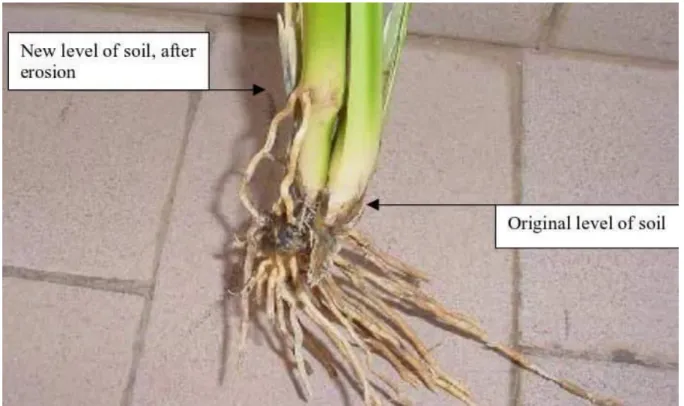
219
Figure 1.1: New root level formation on vetiver grass culm because of increased soil surface 220
level (The Vetiver Network International, 2017). ... 29 221
Figure 1.2: Tilman’s differentiation resource utilization model (R*) modified from Begon et al.
222
(1990), with A ZNGI and B ZNGI representing isoclines (ZNGI) of species A and B, R1 223
and R2 representing resources, and CA and CB representing consumption vectors of 224
species A and B. ... 33 225
Figure 2.1: The Okhombe Valley in KwaZulu-Natal showing the location and year of 226
rehabilitation of the six survey sites and the different forms of land use in the region 227
(Mansour et al., 2012). ... 76 228
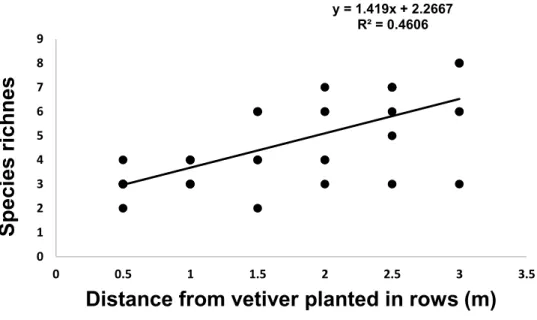
Figure 2.2: Relationship between species richness and distance from vetiver grass in areas 229
rehabilitated using vetiver grass between 1992 and 2015 in the Okhombe Valley, 230
Bergville, KwaZulu-Natal... 79 231
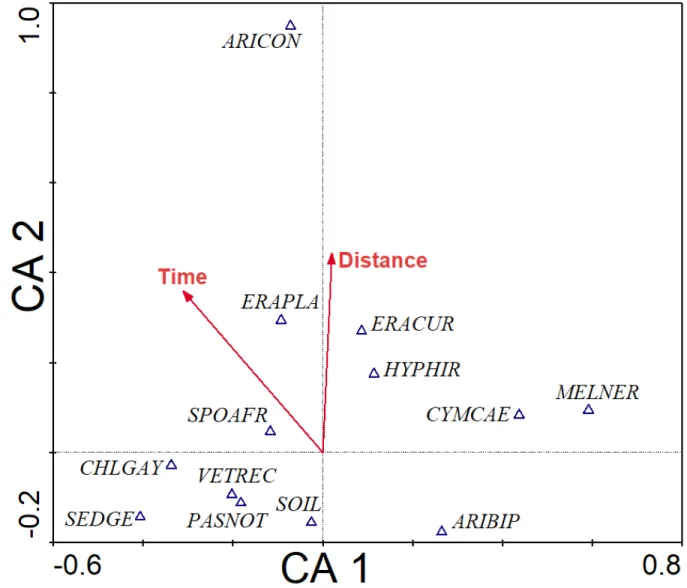
Figure 2.3: Correspondence analysis (CA) ordination of species composition and their basal 232
cover from sites rehabilitated using vetiver grass in different years (i.e. time) correlated 233
with distance from planted vetiver grass (i.e. distance), at Okhombe valley, Bergville, 234
KwaZulu-Natal, South Africa. The eigenvalues for species and species-environment 235
relation of the primary (CA1) and secondary axes (CA2) are 0.572 and 0.492, and 0.312 236
and 0.571, respectively. The primary and secondary axes accounted for 16% and 13% of 237
the variation in species data, and 19.5% and 56% of the variation in species and 238
environment relations, respectively. Full names of the abbreviations for species are 239
provided in Appendix 2.1. ... 80 240
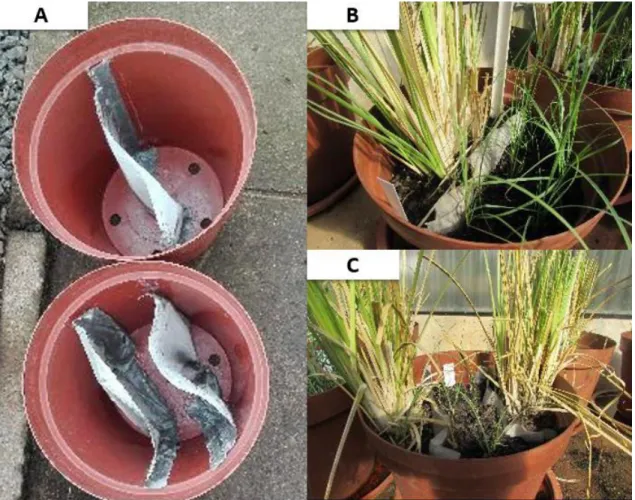
Figure 3.1: The pot design for the root exclusion trial showing how a 32-micron Nitex mesh was 241
pasted into the pots using a strong waterproof epoxy (A) and how E. curvula was planted 242
with one (B) and between two vetiver tufts (C). ... 95 243
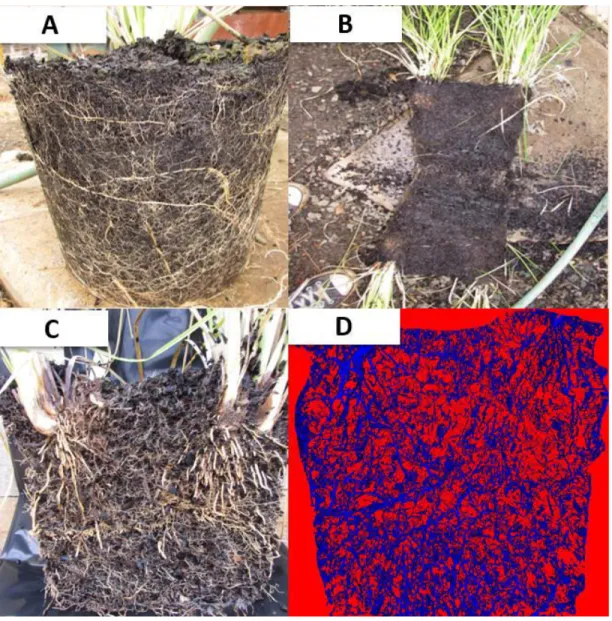
Figure 3.2: The root-soil profile used for analyzing root density and the illustration of the steps 244
involved from the careful removal of roots and soil from the pot (A), cutting of a soil 245
profile (B), Taking a picture (C), and root pixel analysis (D). ... 96 246
xi Figure 3.3: Main effect of vetiver on the mean germination percentage (± SE) of Eragrostis 247
curvula and Panicum maximum overall (A), and their effect on each species (B).
248
Different letters represent a significant difference between treatments (p<0.05). ... 98 249
Figure 3.4: Main effect of sowing method on mean germination percentage (± SE) of Eragrostis 250
curvula and Panicum maximum overall. Different letters represent a significant difference 251
between treatments (p<0.05). ... 99 252
Figure 3.5: Main effect of vetiver on the mean percentage seedling survival (± SE) of Eragrostis 253
curvula and Panicum maximum overall. Different letters represent a significant difference 254
between treatments (p<0.05). ... 100 255
Figure 3.6: Effect of vetiver (Full competition) on the mean seedling height (±SE) (A), mean 256
number of tillers per seedling (±SE) (B), and mean number of leaves per seedling (±SE) 257
(C) of both Eragrostis curvula and Panicum maximum overall. Different letters represent 258
a significant difference between treatments (p<0.05). ... 102 259
Figure 3.7: Effect of vetiver (full competition) on the mean seedling height (± SE) of the 260
interaction between Eragrostis curvula and Panicum maximum. Different letters 261
represent a significant difference between treatments (p<0.05). ... 103 262
Figure 3.8: Effect of vetiver with root interaction excluded on the mean aboveground biomass 263
(±SE) (A), mean seedling height (±SE) (B), mean number of tillers per seedling (±SE) 264
(C), and mean number of leaves per seedling (±SE) (D) of Eragrostis curvula. ... 105 265
Figure 3.9: Mean (± SE) soil space unoccupied by the roots of one and two vetiver grass tufts 266
compared to unoccupied space around Eragrostis curvula. Different letters represent a 267
significant difference between species (p<0.05). ... 106 268
Figure 4.1: Mean (± SE) relative interaction index (RII) based on the final aboveground biomass 269
for the main effects of species (A), vetiver competition level (B), nutrient level (C).
270
Different letters represent a significant difference between treatments (p<0.05). Species 271
(A) are as follows, D.e- Digitaria eriantha, E.c- Eragrostis curvula, H.h- Hyparrhenia 272
hirta, and P.m- Panicum maximum. ... 126 273
xii Figure 4.2: Mean (± SE) relative interaction index (RII) based on the final aboveground biomass 274
for interaction between species and the effect of competition level (A) and nutrient level 275
(B). Different letters represent a significant difference between treatments (p<0.05). . 127 276
Figure 4.3: Mean (± SE) relative interaction index (RII) based on the final aboveground biomass 277
for the interaction between competition level and nutrient level for each native species 278
response individually. Different letters represent a significant difference between 279
treatments (p<0.05). Species are as follows, D.e- Digitaria eriantha, E.c- Eragrostis 280
curvula, H.h- Hyparrhenia hirta, and P.m- Panicum maximum. ... 129 281
Figure 4.4: Mean (± SE) percentage change in yield (Ry) as a result of nutrient addition, based 282
on the final aboveground biomass for the main effects of competition level (A) and 283
species (B). Different letters represent a significant difference between treatments 284
(p<0.05). ... 131 285
Figure 4.5: Mean (± SE) percentage change in yield (Ry) as a result of nutrient addition, based 286
on the final aboveground biomass for interaction between the effect of competition level 287
and native species (B). Different letters represent a significant difference between 288
treatments (p<0.05). ... 132 289
290 291
xiii LIST OF TABLES
292
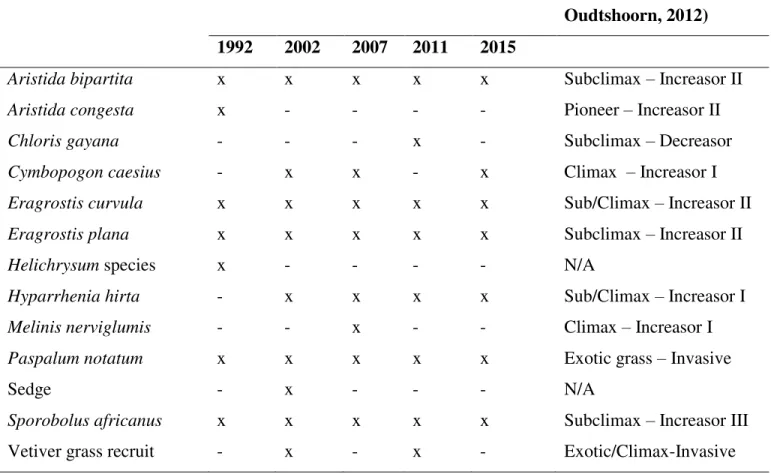
Table 2.1: Species found in areas rehabilitated using vetiver grass in different years, and their 293
successional and ecological status. Two sites were rehabilitated in 2002. In the table 294
below, (x) indicates that the species was present, and (-) indicate absent in that site ... 78 295
Table 2.2: Analysis of variance for a linear regression of species richness against distance from 296
planted vetiver grass rows (m) in all sites rehabilitated using vetiver grass in Okhombe 297
Valley, Bergville, KwaZulu-Natal ... 78 298
Table 3.1: The effect of the presence of vetiver (competition), sowing method, and their 299
interaction using a generalized linear model on seed germination (Poisson distribution) 300
and seedling survival (%) (Binary distribution, events by trials) of two native grass 301
species (Eragrostis curvula and Panicum maximum). Significant p-values (p< 0.05) are 302
in bold ... 97 303
Table 3.2: The effect of the presence of vetiver (competition), sowing method, and their 304
interaction on seedling height (cm), number of leaves per seedling, and number of tillers 305
per seedling of two native grass species (Eragrostis curvula and Panicum maximum) 306
using a generalized linear model with a gamma distribution and a log link. Significant p- 307
values (p< 0.05) are in bold ... 101 308
Table 4.1: Results of a generalized linear model, with a linear distribution and an identity link 309
function, showing the main effects and interactions of grass species, competition exerted 310
by vetiver, and nutrient level on the relative interaction index (RII) showing chi-square 311
likelihood ratio, degrees of freedom, and p-values. Significant p-values (p< 0.05) are in 312
bold ... 125 313
Table 4.2: Results of generalized linear model, a linear distribution with identity link function, 314
showing the main effect and interaction of species, and competition exerted by vetiver 315
tufts of the percentage change in yield (Ry), showing likelihood chi-square value, degrees 316
of freedom, and p-values. Significant p-values (p< 0.05) are in bold ... 130 317
318 319
xiv ACKNOWLEDGMENTS
320
The work presented here would not have been possible without the help of the following 321
institutions and numerous people. I would like to give my sincere thanks to everyone who 322
dedicated their time and/or money to make this project a success.
323
Firstly, I would like to thank both my supervisors, Dr. Michelle J Tedder and Prof. Kevin 324
P Kirkman for their numerous comments, critiques, and encouragement throughout the duration 325
of my masters. From the time we met to discuss the proposal for this study and the experimental 326
designs, I have been astonished by their vast knowledge and willingness to share such 327
knowledge with others. This project would not be possible without their invaluable efforts.
328
Secondly, I would like to thank National Research Foundation (NRF) and University of 329
KwaZulu-Natal (UKZN) for funding this project. Without their funding, this project would have 330
not even commenced.
331
Thanks to Mrs. Alison Young and her staff at the UKZN Botanical Gardens, 332
Pietermaritzburg, for providing space at the greenhouse and shade-cloth, ordering potting soil 333
and sand. In addition, I would like to thank specifically Mr. Welcome Ngcobo who was very 334
helpful even during the experimental setup. I thank Dr. Terry Everson for her input, providing 335
me with vetiver tufts, and allowing me to use her study sites at Okhombe Valley, Northern of 336
Bergville, and KwaZulu-Natal. I would like to thank Mrs. Mavundla who is part of the Okhombe 337
Monitoring group, for her help with sites identification and information on the year of vetiver 338
plantings.
339
I thank Prof. Steven Johnson for his help with statistical analysis, particularly for the 340
introductory workshop on generalized linear models. Additionally, I would like to thank the 341
Microscope and Microanalysis Unit PMB UKZN staff for teaching me how to use the NIS- 342
Elements Br software for root density pixel analysis. Without their help, this aspect of my thesis 343
would not have been possible.
344
Thanks to my colleagues, Naledi Zama, Nolwazi Hlongwane, Lindokuhle Ngcobo, Pretty 345
Zungu, and Kondwani N Shawula for help with data collection in the field, experimental setup, 346
and harvesting of my trials. A special thanks to Lindokuhle Ngcobo who worked tirelessly, 347
xv motivated me at times, and even dedicated two weeks just to help me finish harvesting my trials.
348
Thanks to Pumla Dlamini and Stuart Demmer for assisting with editorial work.
349
A special thanks to my mother Miss Thembile Myeza, and my two siblings Nomza 350
Gumede and Melizwe Gumede, for the supports, understanding, motivations, and love they 351
showed both to me and my research even when I was not there physically for them. This study 352
would not be possible without their unconditional support.
353
Lastly, my Lord and saviour Jesus Christ to whom I owe my existence.
354
1 1 CHAPTER ONE: THE ROLE AND DYNAMICS OF VETIVER GRASS IN 355
REHABILITATION OF GRASSLANDS IN SOUTH AFRICA 356
1.1 INTRODUCTION 357
1.1.1 Grasslands in South Africa 358
Importance and classification 359
Grasslands are economically and ecologically important ecosystems, and they cover a large 360
proportion of the earth’s surface. In South Africa, they constitute approximately 28.4% of the 361
land surface (Tainton, 1999; Fish et al. 2015). They contribute significantly to agriculture, 362
provide numerous ecosystem services (e.g. water), and are rich in biodiversity (Palmer and 363
Ainslie, 2005). Variability in grassland systems is driven mostly by environmental factors and 364
disturbance (i.e. grazing and fire) (Tainton, 1999). Grasslands are managed and maintained 365
through a top-down approach by means of grazing, fire or an interaction between the two 366
(Tainton, 1981a). Milchunas et al. (1988), defined grasslands by categorizing them as either 367
being climatically determined (climatic climax), successional, or agricultural. Climatic climax 368
grasslands have insufficient soil water to support a forest ecosystem but sufficient to maintain the 369
grass layer (Milchunas et al., 1988). Milchunas et al. (1988), suggested that savanna or shrub 370
steppe ecosystems (i.e. ecotone between grassland and forest) with an annual rainfall that is 371
between 250 - 1000mm, are also classified as climatic climax grasslands. Successional or 372
agricultural grasslands are those that result from clearing of forests, hence are maintained by 373
agronomic or other management practices (Acocks, 1988; Milchunas et al., 1988). However, not 374
all fire dependant grasslands are as a result of forests clearing. Some are naturally grasslands but 375
become encroached by woody plants when fire frequency decreases. These grasslands are not at 376
equilibrium with climate and Acocks (1988) termed them “false grasslands” as they require fire 377
to maintain the grassy layer. These grasslands are known as fire climax grasslands, similar to 378
what Milchunas et al. (1988) called successional or agricultural grasslands. The major focus of 379
grassland management is to maintain species diversity and good veld condition. In order to do 380
this, proper management of both fire and grazing is important in grasslands to avoid veld 381
degradation, mostly through soil erosion or species loss (Tainton, 1999).
382 383 384
2 Degradation
385
Grasslands are among the most degraded ecosystems globally, because of poor management and 386
a growing human population leading to increased demand for space for development and 387
agricultural practices. Grassland degradation can take many forms, from species shift (i.e.
388
dominance of one species, alien plant invasion, and woody-plant encroachment) to soil erosion.
389
One of the main drivers of such changes in grassland ecosystems is agricultural practices, such as 390
nutrient enrichment and overgrazing (Everson et al., 2007). Changes in soil nutrient status result 391
in changes in grassland species composition, through giving a competitive advantage to species 392
which thrive on nutrient-rich soils or that tolerate nutrient toxicity (Gough et al., 2000).
393
Furthermore, overgrazing, mostly in high altitude fire climax grasslands, results in degradation 394
as a result of soil erosion (Everson et al., 2007). This is because in high rainfall areas there are 395
mostly well-drained, dispersive soils, which are susceptible to erosion (Fey, 2010).
396
Rehabilitation or restoration is important for the maintenance of ecosystem function, provision of 397
ecosystems services, and biodiversity promotion.
398
Rehabilitation 399
Grassland rehabilitation aims to facilitate the reestablishment and recovery of ecosystem 400
functions that have been damaged, degraded, or destroyed (Zaloumis and Bond, 2011). Relying 401
on secondary succession processes to naturally rehabilitate rested degraded grasslands is 402
inadequate and does not always work (Zaloumis and Bond, 2011). Rehabilitation in grasslands 403
is slow, difficult, and time consuming, and is required mostly when nutrient-rich top soil has 404
been eroded as a result of soil erosion. The soil seedbank is also lost in the process of erosion, 405
reducing the chance of natural reestablishment of native grasses. This means, rehabilitation 406
efforts shift to the reintroduction of plant propagules (seeds through reseeding, or hydro-seeding, 407
and vegetative propagation-tillers or tufts). Native grasses usually fail to establish in the newly 408
exposed nutrient-poor soil, of which in turn leads to the introduction of fast-growing, soil 409
stabilizing and restoring plants, which are usually alien grasses e.g. Vetiver and Pampas grass 410
(Everson et al., 2007). However, these grasses, depending on their competitive ability and ability 411
to spread, could transform the natural grassland to a monospecific sward.
412 413
3 1.1.2 Vetiver grass
414
Coexistence with other species 415
Vetiver (Chrysopogon zizanioides (L.) Roberty) is a tufted perennial fast-growing grass 416
from central India with deep root systems that reach approximately 3m deep in a wall-like 417
formation and bind soil particles together (Chōmchalao, 2001; Adigun and Are, 2015). In its 418
native range it forms dense stands and competes strongly with other grasses, because of its 419
unique morphological and physiological features. It is also, an ecological climax, hardy grass 420
enabling it to withstand a variety of environmental conditions (drought, floods, and fires).
421
Information on its ecology is seldom available, particularly in terms of its coexistence with other 422
grasses and competitive strategies. However, its produces oil in its roots which could have 423
allelopathic properties and might inhibit recruitment of other grasses.
424
Competition 425
Competition is important in understanding plant coexistence. Competition refers to the 426
negative interference or effects caused by the presence of neighbouring plants, usually through 427
reducing the availability of resources (Eagles, 1972; Fowler, 1986; Casper and Jackson, 1997).
428
Competition plays an important role in structuring grassland and savanna ecosystems. Plants can 429
either compete aboveground for light or belowground for soil resources (water, nutrients, and 430
space), and/or above- and belowground for both, simultaneously (Goldberg, 1996). Numerous 431
studies show that introduced plants are more competitive than the native plants because they 432
acquire resources more efficiently, lack natural enemies, and some produce allelopathic 433
chemicals which inhibit growth of native plants (Alpert et al., 2000; Bakker and Wilson, 2001;
434
Milton, 2004). These attributes could promote the dominance of introduced plants, such as 435
Vetiver, over the native plants. This change in species composition will alter the overall diversity 436
of the grassland or savanna ecosystem. Understanding the ecology, mostly the competitive 437
ability of grasses used for rehabilitation of degraded grasslands is important for the formulation 438
and adaptation of better rehabilitation strategies.
439
Application 440
Irrespective of the limited knowledge of its ecology, vetiver’s unique morphological and 441
physiological features deem it usefull for soil and water conservation. This grass has been used 442
4 successfully for decades, for rehabilitation of eroded soils, phytoremediation (as it roots can 443
absorb toxic heavy metals/chemicals), wetland rehabilitation, slope stabilization, and soil 444
conservation, in India and worldwide. The oil from its roots is used in the cosmetic and 445
pharmaceutical industries as it has antifungal and anti-microbial properties. These applications 446
have popularized the use of this grass, but in South Africa, it is mainly used for soil erosion 447
control, rehabilitating mine waste, roadside slope stabilization, and waste water treatment 448
(George et al., 2001; Truong and Loch, 2004; Mulder and Brent, 2006).
449
This review aims to give a theoretical background to the problem statement and study 450
questions, by linking background information on vetiver grass to competition, seed germination, 451
seedling establishment, and grassland management.
452
1.2 VETIVER GRASS (CHRYSOPOGON ZIZANIOIDES (L.) ROBERTY) 453
1.2.1 Growth and behaviour of vetiver grass 454
Different grasses with different growth forms require different environmental and 455
climatic conditions for germination, establishment, and maturity. Growth form is of ecological 456
significance as it can provide important information about the life history of the grass. Vetiver 457
grass growth is highly dependent on its root system and vegetative reproduction because it 458
produces infertile seeds (Dalton et al., 1996). The reason for this infertility is unknown (Council, 459
1993). Most researchers have speculated that perhaps the plants are “sterile” or conditions for 460
germination are seldom present. However, there are two varieties of vetiver grass which have the 461
same botanical name (Council, 1993). The “colonizer” wild variety from North India, and the 462
“sunshine” commercially propagated variety from south or central India. The “colonizer” is an 463
aggressive grass capable of spreading, and Council (1993) stated that, if this variety is 464
mistakenly used for soil stabilization, it could become a weed. The sunshine variety was 465
believed to be seedless, with only vegetative reproduction but it has been observed to produce 466
infertile seeds. The question of why would it invest its resources producing infertile seeds, 467
remains unanswered. For this reason the ‘sunshine’ variety is said to not spread.
468
It is not easy to differentiate between these two varieties, particularly when there are no 469
flowers. Researchers have relied on morphological and physiological characteristics to 470
differentiate between these two varieties. The commercially propagated variety is said to have a 471
thicker stem, roots with less branching, and wider leaves (1.1cm on average) than the wild 472
5 variety but these characteristics may be too simple to be truly diagnostic (Council, 1993).
473
Furthermore, the commercially propagated variety produces more root biomass and hence more 474
oil (Council, 1993). Initially, vetiver was utilized for its oil and therefore, domestication could 475
have been aimed at producing greater oil yields, not at inhibiting sexual reproduction. This is 476
further evidenced by the fact that utilization of oil was initiated in India, the country of origin, so 477
negating the need for a sterile cultivar. Therefore, vetiver grass having infertile or sterile seeds 478
could have been a by-product of breeding for maximum oil production. Both the commercially 479
propagated, which have many cultivars, and the wild variety are dominant in the tropical and 480
subtropical plains throughout northern India. Both these grasses, particularly the wild variety, 481
prefer low-lying, damp (i.e. swamps and bogs) sites or even river margins (Council, 1993;
482
Dalton et al., 1996).
483
Adams et al. (2003) suggest that the origin of a non-seeding variety is unknown.
484
However, because there is still a wild vetiver (found in the northern part of India), researchers 485
have begun to use DNA fingerprinting to understand differences between wild vetiver and all 486
other known cultivars. Adams and Dafforn (1997) found that 86 % of 121 plants sampled 487
originated from a single clone (no variation in genetic material). Furthermore, Adams et al.
488
(1998) examined the vetiver wild variety, cultivars, and related genera (Sorghum and 489
Chrysopogon) using DNA fingerprinting, which led to Veldkamp (1999) combining DNA 490
fingerprinting and morphological data to show that species under Vetiveria actually fall under 491
Chrysopogon. Therefore, Vetiveria zizanioides (L.) Nash. was changed to Chrysopogon 492
zizanioides (L.) Roberty (Veldkamp, 1999; Adams and Center, 2000). An important finding of 493
this work was that the genetic material revealed no substantial differences between the wild and 494
commercially propagated vetiver. The only differences relate to reproduction, root biomass and 495
oil production (Adams and Dafforn, 1997; Adams et al., 1998; Adams et al., 2003).
496
Vetiver grass development is affected by daily temperature, soil moisture, and soil texture 497
(Wang, 2000; Nix et al., 2006). As it is a tropical grass it is adapted to high rainfall and 498
extremely warm conditions with deep soils, resulting in the extensive root systems that make it 499
useful for soil stabilization. Subfreezing conditions have been documented to significantly 500
reduce vetiver grass growth (Nix et al., 2006). For example, in China from Hainan Island (10oN 501
latitude) to Tianjing (39oN latitude)), when vetiver grass was grown in areas with a mean 502
6 temperature of -40C with the minimum temperature reaching -220C, the grass showed a slow 503
growth of about 0.5cm daily (Xu, 2002). Cheng et al. (1994) showed that vetiver started to grow 504
well when mean temperatures reached 10-15oC, the fast growth seen between 20 and 30oC or 505
higher with a daily growth of 2-3 cm in height. Many studies supported these findings, 506
suggesting that at higher temperatures, vetiver grass started tillering and flowering (Xia et al., 507
1998; Huang, 1999; Xu, 2002). However, when temperatures reach 40oC or above, the growth 508
slowed (0.5cm height increase daily) (Xia et al., 1998), suggesting that both very low and high 509
temperatures negatively affect the growth of this grass. Temperature fluctuations have not been 510
reported to cause mortality in vetiver.
511
Huang, (1999) noted that vetiver grass height and biomass is more dependent on soil 512
fertility rather than temperature. For example, vetiver grass grew up to 3 m in a fertile loam soil 513
in China compared to a white sandy soil where the grass only grew up to 1m over the growing 514
season with similar temperatures (Huang, 1999). Fertile soils do promote growth and survival of 515
vetiver grass. Studies have shown that vetiver grass growth and leaf quality is mostly influenced 516
by soil phosphorus availability (Huang, 1999; Xu, 2002; Wagner et al., 2003). Soils with limited 517
phosphorus availability result in a slow growth or sometimes mortality in vetiver grass. In 518
contrast, vetiver grass has shown enhanced growth under high levels of soil nitrogen and 519
phosphorus 520
Vetiver can grow in a variety of environmental conditions (e.g. arid to semi-arid to high 521
humid regions), however, even though it can tolerate drought and salinity, it prefers nutrient-rich 522
and high rainfall areas (Truong et al., 1999; Maffei, 2003). A study in China showed that vetiver 523
grows better than the well-known drought-tolerant grass, Paspalum notatum during drought (Xu, 524
2002). Edelstein et al. (2009) suggested that salinity levels between 3 and 6 deciSiemens per 525
metre (dS/m) do not cause significant reduction in growth and mortality in vetiver grass.
526
However, salinity levels above 6dS/m caused extensive reduction in yield, leaf and root quality 527
and even increased tuft mortality (Xu, 2002; Edelstein et al., 2009). This, therefore, is one of the 528
main reasons why vetiver performs poorly in arid regions. In contrast, vetiver grass grows well 529
in wetlands and swamp areas. The grass can even grow in soilless water, when only the leaves 530
are not covered by water (Xu, 1998, 2002). However, vetiver cannot stand long-term 531
7 waterlogging; for example, Xu (2002) showed that it does not survive when water levels are 532
higher than the base of the tillers during the growing season.
533
1.2.2 Effect of disturbances on vetiver grass 534
Grass behaviour cannot be extensively understood without considering the effect of 535
disturbance. Disturbance can be either natural or anthropogenic through grassland management.
536
The two main grassland disturbances utilized in management are fire and grazing. These two 537
disturbances are important in the understanding of grassland ecosystems as they are key factors 538
that influence grassland composition and maintain the dominant grass layer (Tainton, 1981a;
539
Tainton, 1981b, 1999). These two factors either promote or reduce plant diversity by means of 540
promoting the dominance of disturbance-tolerant, grazing resistant, and unpalatable grasses 541
(Tainton, 1981b). For these reasons, it is important to consider how vetiver responds to 542
management through fire and grazing.
543
Vetiver grass invests extensively in its root system and is said to be highly dependent on 544
roots for regrowth, survival and spreading (Council, 1993; Truong, 2000b; Xu, 2002). Fire does 545
not affect the root systems, therefore, vetiver grass is assumed to be tolerant to both hot and cool 546
fires (Council, 1993). Furthermore, vetiver stays green even in the dormant season which could 547
affect its flammability, and thus fire behaviour. However, no specific study has addressed how 548
vetiver responds to fire. The evidence that exists is anecdotal from small-scale farmers and 549
projects (Xu, 1998, 2002). As such, no scientific experiments, to the best of my knowledge, have 550
been done to evaluate the response and regrowth of vetiver after fire. Furthermore, not much is 551
known about how vetiver responds to fire intensity and frequency. However, considering vetiver 552
grass morphology and growth, it would be feasible to speculate that vetiver could withstand fires 553
because of its low flammability resulting from staying green even in the dormant season. Fire 554
also could result in the regrowth of those few tillers and leaves that were dormant in the time of 555
fire (Council, 1993).
556
Growth and survival of palatable plants are the two factors most frequently affected by 557
grazing, although trampling also influences germination and establishment through compacting 558
or breaking up compacted soil. However, the outcome of trampling is mostly dependent on the 559
soil physical properties. Vetiver grass has been observed being eaten by most livestock, which 560
suggests that it is relatively palatable when still young and not very fibrous (Council, 1993).
561
8 Testing the effect of grazing on a plant is usually done through simulated herbivory (e.g.
562
clipping). Experiments in Guangdong province in the 1950s showed that when vetiver with a 563
height of 150 cm was pruned to approximately 30 cm height, it produced on average 18.6 more 564
tillers in 40 days compared to the uncut plants (Xu, 2002). Xia (1995) suggested that clipping 565
twice annually, early in the year (February or March) and later (August or September) 566
accelerates tillering. However, because vetiver has strong fibrous leaves, it is safe to suggest that, 567
when mature, it is a highly unpalatable grass; hence, it is unlikely that grazing will affect the 568
growth and survival of vetiver.
569
Vetiver is more fibrous and has sharp edges in resource-poor regions or cold areas (Xu, 570
2002). Therefore, vetiver grass could only be eaten when it is young and when preferred grasses 571
are limited (Xu, 2002). This could result in its dominance in areas with unmanaged grazing 572
(selective grazed patches) or overgrazing. Integration of fire might increase the likelihood of 573
grazing as the regrowth might be palatable. However, to my knowledge, no studies have looked 574
closely at the palatability and digestibility of vetiver grass at different growth levels.
575
1.2.3 Vetiver grass uses 576
Environmental degradation has become a major problem worldwide, more specifically in 577
developing countries such as South Africa. Land degradation includes, but is not limited to, 578
species loss (decreasing diversity and richness), soil loss (erosion and pollution of arable soil), 579
water pollution and water reduction/loss (through changes in catchment vegetation - domination 580
of alien trees which uses more water e.g. eucalyptus species) (Bojö, 1996; Faria et al., 2015).
581
Drought, flooding and other environmental hazards which are as a result of climate change are 582
contributing extensively to land degradation (Bojö, 1996; Faria et al., 2015). These hazards or 583
climate change at large, are believed to be accelerated by changes in land use which are caused 584
by the human population growing exponentially (Faria et al., 2015). The growing demands for 585
food (hence, increase in industrial agriculture- extensive use of fertilizer) and energy (growing 586
demand for oil, coal and gas extraction, hence increase in carbon dioxide (CO2) in the 587
atmosphere) are a by-product of human population growth (Change, 2001; Guillebaud and 588
Hayes, 2008). The collective effect of changes in land use on soils are; 1) ecosystem 589
eutrophication through nitrogen deposition, and 2) soil contamination through heavy metals 590
9 deposition [e.g. Zinc (Zn), lead (Pb), and Cadmium (Cd)] from mines (O’Rourke et al., 2016).
591
This then affects the aboveground vegetation, soil microbes, and water health.
592
Soil contamination degrades ecosystem health, affecting human lives indirectly through 593
the loss of agricultural lands and water pollution, and directly through public health, as many 594
pollutants are linked or associated with cancer and neurological disorders (O’Rourke et al., 595
2016), and reduced agricultural productivity, through the loss of nutrient-rich topsoil and thus the 596
reduction in arable land (Fey, 2010). Therefore, the unique structure and tolerance of vetiver 597
grass to different disturbances, environmental catastrophes, and soil conditions, popularized its 598
use for environmental protection and rehabilitation (i.e. soil and water conservation). In 1956 599
John Greenfield used vetiver grass to plant contours on eroded hillsides in Fiji (Council, 1993).
600
This intervention slowed run-off, retained nutrient-rich topsoil, and enabled him to plant 601
sugarcane successfully between the vetiver contours. This initiated research into vetiver grass 602
application in erosion control, agriculture, wastewater treatment, and phytoremediation. The 603
widespread application of vetiver grass known as vetiver grass technology (VGT) was initiated 604
in India by the World Bank for soil and water conservation around the 1980s (Truong et al., 605
1999; Truong, 2000a; Greenfield, 2002).
606
This research funded by the World Bank and conducted for several decades has 607
demonstrated that vetiver grass technology is an effective, safe and low-cost natural method of 608
environmental protection (Council, 1993; Adigun and Are, 2015). For this reason, vetiver grass 609
has been used successfully for soil protection and rehabilitation of rill and gully erosion (Cao et 610
al., 2015). It has been shown to successfully reduce soil loss up to 100% through binding the soil 611
with roots and creating a new root level on a culm depending on the new soil level (see Figure.
612
1.1). In addition, it can increase water conservation up to 60% (Dalton et al., 1996; Xu, 2002;
613
Cao et al., 2015). The ability of vetiver to absorb toxic chemicals and heavy metals effectively 614
has also led to its use as a phytoremediation plant (Truong et al., 1999). Vetiver has been used 615
successfully all over the world for rehabilitating abandoned mine sites and it has proven effective 616
in restoring and maintaining soil health on those sites (Truong et al., 1999). Furthermore, vetiver 617
has recently been used as a floating island in contaminated or nutrient-rich dams to absorb excess 618
nutrients and contaminants, cleaning the water and restoring ecosystem function (Truong, 2000a;
619
10 Truong, 2000b; Truong et al., 2001). Vetiver also has been used successfully in wastewater 620
treatment (phytoremediation) and in rehabilitating landfill sites (Truong et al., 2001).
621
Recent studies have also shown that vetiver grass can be used as an anti-pest or insect 622
trap species to improve agricultural productivity, through drawing insect pests away from crops 623
(Shengluan and Jiayou, 1998). Vetiver grass has been reported to be eaten by most herbivorous 624
insects, mostly termites (Shengluan and Jiayou, 1998). However, most studies, both 625
observational and experimental, indicate that vetiver does not die as a result of herbivory 626
(Shengluan and Jiayou, 1998; Van den Berg et al., 2003). The highest recorded damage caused 627
by termites on the stem is 39% (Shangwen, 1999; Zhu et al., 2001). Van den Berg et al. (2003) 628
conducted a two-choice greenhouse and laboratory study to understand whether vetiver grass is 629
preferred by female Chilo partellus, a problematic moth in maize farming, and whether vetiver 630
can be used as a pest control plant. They used maize, vetiver, and napier grass (Pennisetum 631
purpureum), a grass that is widely used in Africa as a trap crop for stem borers. They showed 632
that vetiver grass was highly preferred for oviposition; however, larval survival on vetiver grass 633
was extremely low, significantly lower than on the napier grass (Van den Berg et al., 2003).
634
Therefore, their study supported the notion that vetiver grass could be used as a trap plant for 635
insect pest control, as it attracts the insects away from the crops and reduces their survival. For 636
this reason, vetiver has great application in agriculture and mostly in subsistence farming.
637
In windy areas, vetiver has been used as a windbreak for crops (e.g. maize) mostly by 638
small-scale farmers (Shengluan and Jiayou, 1998). This is done by planting vetiver in contours 639
and the crop plant between those contours. Under these circumstances not only does vetiver 640
reduce soil erosion but increases agricultural productivity by reducing wind damage (Shengluan 641
and Jiayou, 1998; Everson et al., 2007). The space between vetiver contours and the space 642
between vetiver tufts planted in rows is dependent on the topography and the purpose of planting 643
vetiver (Greenfield, 2002; Everson et al., 2007). Spaces between contours in the agricultural 644
fields are generally wider than those of slope stabilization (e.g. roadside) or soil erosion control 645
(i.e. sheet, rill or galleys) (Greenfield, 2002; Maffei, 2003). Generally, for soil erosion control, 646
tufts are planted 15cm to 30cm apart; however, between vetiver contours, the landscape, and the 647
purpose are usually the key determinants of spacing, with most scholars advocating two meters 648
(Council, 1993; Greenfield, 2002; Maffei, 2003; Everson et al., 2007).
649
11 Aside from rehabilitation, remediation, and agriculture, the commercial uses of vetiver 650
grass mainly pertain to the extraction of vetiver oil through distillation of the roots. Vetiver oil 651
has extensive applications in the cosmetic industry (e.g. soaps, deodorants and refreshing sprays) 652
and is also used as an anti-microbial and anti-fungal agent in the pharmaceutical industry 653
(Chomchalow, 2001). Furthermore, vetiver is also used in the manufacturing of handy-crafts, 654
thatching of houses, and organic compost production.
655
656
Figure 1.1: New root level formation on vetiver grass culm because of sedimentation (The 657
Vetiver Network International, 2017).
658 659
1.2.4 Competition and nutrient addition 660
Being an ecological climax species, vetiver can outlive its neighbours even other climax 661
species, mostly in relatively nutrient-poor soils (Council, 1993). The question as to whether 662
vetiver affects adjacent plants has not been addressed scientifically. The answers obtained 663
through observations by farmers and researchers show uncertainty and a lack of knowledge 664
about the ecology of this grass. For example, Council, (1993) stated that in theory, vetiver should 665
compete with adjacent plants for water and nutrients. However, no study has examined this.
666
12 Furthermore, an edge effect has been reported by farmers, where vetiver limits growth and 667
reduces the productivity of the nearest crop plants; however, not all crops have been reported to 668
experience this effect. This could mean that vetiver does not affect all crops or that farmers do 669
not report the effect but is apparent that there is some effect caused by vetiver grass on 670
neighbouring plants.
671
Vetiver grass does well in high rainfall areas and nutrient-rich soils. However, no study has 672
shown how vetiver competes with other grasses, and if competition differs under different 673
environmental conditions. Therefore, noting that phosphorus is a key limiting resource and that 674
the addition of phosphorus increases productivity, one could expect increased competitive ability 675
following fertilization.
676
1.3 COMPETITION 677
1.3.1 Role of competition in grasslands 678
Importance of competition 679
Grasslands are maintained mostly through a top-down effect where perturbations (outside 680
influence, i.e. disturbance such a fire and grazing) are of significance and control the ecosystem 681
stability. There is agreement among ecologists with regard to the importance of perturbations, 682
mostly because of their effect on plant interactions (Kirkman, 1988; Robinson and Rorison, 683
1988; Tainton, 1999). While ecologists agree that competition is important in structuring 684
grasslands there is uncertainty regarding whether competition promotes or reduces species 685
richness and diversity.
686
The definition of competition has been a subject of discussion among ecologists for 687
decades. However, because the experimental design used to study competition is fairly standard, 688
a general definition could be created. The basic experimental design involves a target species 689
growing in the presence or absence of neighbouring species, with the manipulation of limiting 690
resources (Goldberg, 1996; Cahill, 1999, 2002). Wall and Begon (1985) offered a simplified 691
definition of interspecific competition, suggesting that competition is “an interaction between 692
individuals, brought about by a shared requirement for a resource in limited supply, and leading 693
to a reduction in the survivorship, growth and/or reproduction of the competing individuals 694
concerned”. As this definition is fairly broad, one can extract a definition that suits the objectives 695
13 of the study. Hence, here we define competition as a negative interference, being either direct or 696
indirect suppression of one plant by another through resource utilization differences (Fowler, 697
1986). This is seen when one plants’ ability or utilization of resources decreases or influences the 698
growth, fecundity, and survival of a neighbouring plant (Casper and Jackson, 1997). Competition 699
is measured using functional traits such as plant height, shoot/leaf production, biomass, and 700
tillering. However, the most effective measure is biomass (both above and below ground) 701
because it has been shown to give conclusive results (Peltzer et al., 1998) that are useful in 702
explaining the effect of competition in structuring plant communities (Tedder et al., 2012).
703
Interspecific competition among ecologically similar species is suggested to be a major 704
driver of plant community structure (Wall and Begon, 1985). Studies have shown that 705
interspecific competition could drive certain species to local extinction or could promote 706
diversity (Hardin, 1960; Wall and Begon, 1985). For example, in a 12 year field trial, Fynn et al.
707
(2009) showed that grasses differ in their ability to resist invasion by other grasses, and that plant 708
functional traits can be used to predict species invasion and invasibility in restored grasslands.
709
Therefore, they suggested that restoration of diverse grasslands should use grasses with short 710
stature, low leaf mass, slow growth, few tillers, and high specific leaf area which may facilitate 711
succession by other native species, thereby increasing species richness (Fynn et al., 2009). This 712
is because such grasses had weak competitive effects as predicted by their traits. Interspecific 713
competition, therefore, can work to maintain species diversity in grasslands. However, the 714
grasses must be able to coexist spatially and temporally within the confines of limiting resources.
715
Competition theories 716
Plant species coexistence has been the subject of controversial debate among ecologists 717
for decades. Therefore, there have been many theories proposed to explain how different species 718
with similar ecological requirements could coexist (Grime, 1977; Tilman, 1980; Thompson, 719
1987; Craine, 2005). These theories differ in their objectives but all of them aim to further our 720
understanding of plant community structure. They each try to understand different topics, 721
ranging from the importance of competition and the role of competition in plant community 722
structure (i.e. Grime, 1977 and Tilman, 1980) to invasive plants (i.e. enemy escape theories and 723
novel weapons hypothesis) (Keane and Crawley, 2002; Wolfe, 2002; Colautti et al., 2004).
724
14 Grime and Tilman
725
Grime (1977) elucidating on his theory, suggested that there are two external factors 726
limiting plant biomass. The first one is stress, defined as ‘conditions that restrict production e.g.
727
shortages of light, water, or mineral nutrients and suboptimal temperatures” (Grime, 1977), 728
which relates directly to competition because competition is dependent on the availability of 729
resources. The second one is disturbance, defined as “the partial or total destruction of plant 730
biomass” (Grime, 1977), e.g. fire, herbivory, pathogens, wind damage, frost, desiccation, soil 731
erosion, and anthropogenic actives (i.e. mowing, ploughing, and trampling). Grime used the 732
interaction between these two external factors to suggest that there are three possible 733
combinations of stress and disturbance, which result in three plant strategies (Campbell et al., 734
1991b; Campbell and Grime, 1992). These strategies are 1) competitive plants, which dominate 735
in low stress, resource rich environments with low disturbance, 2) stress-tolerant plants, 736
dominant under high stress resource poor conditions with low disturbance, and 3) ruderal plants, 737
which thrive in low stress resource rich environments with high disturbance (Grime, 1977;
738
Grace, 1991). This theory will be referred in short as the CSR theory.
739
In short, Grime’s CSR theory suggests that species with the maximum capacity for 740
resource capture, thus having the highest growth rate will be superior competitors (Grime, 1977).
741
Therefore, competition is more apparent in resource-rich environments than in resource-poor 742
environments. For example, Mahmoud and Grime (1976) conducted a study focusing on the 743
competitive ability of three grasses under low nitrogen (resource-poor environment) and high 744
nitrogen (resource-rich environment) conditions. The grass species were Festuca ovina 745
(dominant in unproductive regions), Agrostis tenius (dominant in intermediate-fertility regions) 746
and Arrhenatherum elatius (dominant in productive regions). Overall, they showed that 747
competition decreases in importance as resources availability decreases (Mahmoud and Grime, 748
1976). This was shown through the complete elimination of one species in each pair and the 749
order of competitive ability (Arrhenatherum elatius> Agrostis tenuis> Festuca ovina) showing 750
that grasses adapted to productive regions are more competitive than the ones adapted to 751
resource-poor environments (Mahmoud and Grime, 1976). Many studies have shown that 752
fertilization causes decline in species diversity, which is in support of this theory (Campbell et 753
al., 1991b; Campbell and Grime, 1992; Rajaniemi, 2002).
754
15 In contrast to Grime’s CSR theory, David Tilman’s R* model of differential resource 755
utilisation suggests that species with a lower minimum resource requirement (R*), the point at 756
which population decline or loss equals population growth, will be superior competitors (Tilman, 757
1980, 1985; Tilman, 1987; Begon et al., 1990). This suggests that plant species with a low R*
758
are more competitive in resource poor-environments. To explain how coexistence in plants takes 759
place in his theory, the use of illustrations is required (see Fig. 1.2 below). The basis of this 760
model is the zero net growth isocline (ZNGI), which is defined in simple terms by Begon et al.
761
(1990) as “the boundary between the resource combinations which allow the species to survive 762
and reproduce, and the resource combinations which do not”. However, for this theory to predict 763
the outcome of two competing species, consumption vectors (CA and CB, in Fig.1.2) should be 764
included. Therefore, where resource 1 (R1) is limiting, species A dominates, but where resource 765
2 (R2) is limiting, species B dominates. Furthermore, above where the consumption vectors 766
cross, the two species coexist. The consumption vectors indicate resource consumption of each 767
species. If both species consume more of the resource that limits their own growth, the two will 768
exhibit a stable coexistence, but when these species consume more of the resource that limits the 769
other species, coexistence is not possible (i.e. if the consumption vectors are switched in Fig. 1.2) 770
(Tilman, 1985; Grace, 1991).
771
772