FACTORS INFLUENCING PARENTS’ DECISIONS WHEN CHOOSING A PRIVATE SCHOOL
Research report submitted in partial fulfilment of the requirements for the degree of
MASTER OF BUSINESS ADMINISTRATION in the
RHODES BUSINESS SCHOOL
by
DAVID ARENDSE
Student Number: 17A5515 November 2018
Supervised by: Mr Kevin Rafferty
DECLARATION
I, David Arendse, hereby honestly and truthfully declare that this is my original research work, it’s being submitted as partial completion of my Master of Business Administration studies at Rhodes Business School (Rhodes University). This work has never been submitted at any university or institution, all the work of others used in this research paper has been acknowledged.
__________________ 20 November 2018
DAVID ARENDSE DATE
ABSTRACT
Purpose: Consumers make decisions based on multiple factors that influence their decision-making process. These decisions can be influenced by deep personal reflection to the simple impulsive purchase done to fulfil a need or want.
This research study explored the relationship between the resource-based view and the factors considered by parents when selecting a school for their child/children. The Valuable, Rare, Imitable and Organized (VRIO) framework as developed by Barney, J. (1991) outlines the framework through which an organisations resources can be assessed in terms of their potential competitive advantage.
The research study was interested in understanding how an educational institution can identify and then leverage its resources to create a competitive advantage.
Methodology: Each family that has one or more child enrolled at St Stithians College, which is a private school in Gauteng, South Africa, was invited to participate in the study. This represented a potential population size of 1 700 families, however a sample of 334 was used. The educational institution caters to both boys and girls from Grade R to 12 (Matric). Each family was requested to participate in the study as they had already chosen to have at least one child enrolled.
A self-administered close-ended questionnaire was used as the instrument for data collection and the questionnaire was broken into two sections. Section A focused on building a profile of the respondent while section B assessed the level of influence the factors had on a parent’s decision. Section B’s questions were structured as Likert-Scale questions requiring a response between 1 and 5, with 5 being the highest influence, and 1 being the lowest. The responses to the questions were then grouped into the factors they spoke to and the average results per factor were assessed via an ANOVA table to test the null hypothesis that parents do not consider factors when choosing a school for their children.
Findings: As a paper, this study set out to discover what the competitive advantage was of a private education institution in South Africa. It did so by identifying what the key factors were when parents selected the school of their choice and then analysed these findings against the resources of the given institution.
The ANOVA table analysis of the responses identified that parents do consider factors and that the factor that they were most influenced by was convenience factor, represented by location of the institution and the distance to it. While there are multiple private education suppliers in South Africa, no other provider has the location that St Stithians College has, and as such, its location is its competitive advantage.
Significant: This research study will expand the existing but limited competitive advantage body of knowledge in the South African education sector. South African educational institutions will be able to develop similar studies which will then assist in identifying their own competitive advantages. This can better enable education providers to entice consumers to their education services.
Keywords: Competitive Advantage, Consumer Decision Making, Education Sector, Factors Influencing Parents, South African Education.
TABLE OF CONTENTS
DECLARATION ... i
ABSTRACT ... ii
TABLE OF CONTENTS ... iv
ACKNOWLEDGEMENTS ... viii
CHAPTER 1 : INTRODUCTION, STATEMENT OF THE PROBLEM, RESEARCH OBJECTIVES AND HYPOTHESES 9 1.1 Introduction ... 9
1.2 Background of the study ... 11
1.3 Statement of the problem ... 13
1.4 The objectives of the research study ... 13
1.4.1 Specific aims ... 13
1.4.2 The research question... 13
1.5 Hypotheses of the research study ... 14
1.6 Significance of the study ... 14
1.7 Research study outline ... 14
1.7.1 Chapter 2: Literature review ... 14
1.7.2 Chapter 3: Research methodology ... 15
1.7.3 Chapter 4: Results and discussion ... 15
1.7.4 Chapter 5: Recommendations, ethical considerations and conclusion ... 15
1.8 Conclusion ... 15
CHAPTER 2 : LITERATURE REVIEW ... 16
2.1 Introduction ... 16
2.2 Resource-based view ... 16
2.3 Education overview ... 17
2.4 Consumer decision making ... 19
2.5 Factors that influence a parent’s decision ... 21
2.5.1 Social Background or Status ... 22
2.5.2 Income Level ... 22
2.5.3 School Syllabus ... 22
2.5.4 School Environment or Facilities ... 23
2.5.5 School Performances or Results ... 23
2.5.6 Location ... 23
2.5.7 Teachers’ Qualification ... 24
2.5.8 Distance ... 24
2.6 Conclusion ... 24
CHAPTER 3 : RESEARCH METHODOLOGY ... 26
3.1 Introduction ... 26
3.2 Research paradigm ... 26
3.3 Data collection method ... 26
3.4 Questionnaire design ... 26
3.5 Data population and sampling ... 27
3.6 Statistical analysis ... 28
3.7 Conclusion ... 28
CHAPTER 4 : RESULTS AND DISCUSSION ... 29
4.1 Introduction ... 29
4.2 Respondents profile ... 29
4.3 Results of findings ... 29
4.3.1 Voluntary Consent. ... 31
4.3.2 Results from section A ... 31
4.3.3 Results from section B ... 37
4.3.4 Mean response rate per question ... 48
4.3.5 Table of grouped factors indicating mean ... 49
4.3.6 Frequency chart of grouped factors ... 50
4.3.7 Cronbach Alpha test ... 50
4.3.8 ANOVA table of factors ... 51
4.3.9 Inferential Statistical analysis ... 52
4.4 Descriptive analysis ... 55
4.4.1 Section A ... 55
4.4.2 Section B... 57
4.5 Discussion ... 57
4.6 Conclusion ... 59
CHAPTER 5 : RECOMMENDATIONS, ETHICAL CONSIDERATIONS AND CONCLUSION ... 60
5.1 Introduction ... 60
5.2 Recommendations for future research ... 60
5.3 Ethical considerations ... 61
5.4 Conclusion ... 61
BIBLIOGRAPHY ... 63
APPENDICES ... 71
1.1 Declaration ... 71
1.2 Institution Consent Form ... 72
1.3 Letter from the school ... 73
1.4 Ethics letter of approval ... 74
1.5 Figure 1 ... 75
1.6 Figure 2 ... 75
1.7 Questionnaire ... 76
ACKNOWLEDGEMENTS
There were many times where I wondered if I would ever manage to get this paper written, but it was through the incredible support that I have received from so many people that I am able to complete this paper today.
First most importantly I would like to thank God, without pouring out His blessings upon my life and opening the doors He did for me I would never have been able to get to where I am.
To my two parents, Mark and Jackie Arendse, thank you for supporting me, believing in me and pushing me to keep going. Your love and support have gotten me through the darkest of times.
To my brother, Gregory Arendse, thank you for your patience, love and support.
To my gran, Marion Kerby, thank you for your incredible generosity, without it I would never have been able to complete this journey. Your love and support have enabled me to achieve one of my life goals.
To my supervisor, Mr. Kevin Rafferty, thank you for walking this journey with me. There were countless times I honestly did not think I would ever be able to complete this project, but your patience and guidance has been invaluable and as I sit here writing this, I cannot believe I have neared completion of this project… thank you!
Then to my colleagues, and the St Stithians College community, thank you for your incredible support and engagement with this project.
To my class mates, who have been on this journey with me, thank you for the support, the laughs, the tears. We did it!
CHAPTER 1 : INTRODUCTION, STATEMENT OF THE PROBLEM, RESEARCH OBJECTIVES AND HYPOTHESES
1.1 Introduction
For as long as people have tried to sell their products and services, the ability to understand why consumers make their decisions has been central in allowing providers to gain an advantage. This has led to the understanding and accepted rationale that, while on rare occasions consumers do make impulsive decisions, there are factors that organizations can identify and leverage that will then lead to building their desirability among possible consumers. This is still true today where, even though consumers are presented with many options from organizations based all over the world, they must still make consumer decisions based on the same rationale as generations before.
By defining consumer behaviour and the decision-making process that follows, organizations have been able to better understand why a consumer chooses one service or product over another. This has become a key factor in enabling organizations to unlock the competitive potential of their product or service offering (Kim, Ferrin & Rao, 2008). This process is not an easy one as there are two obstacles that cause organizations to overlook its importance. The first is the sheer magnitude of work that an analyst must perform to complete an analysis, and secondly, many who are familiar with the technique still have difficulty translating the data into a coherent strategy (Reynolds & Olson, 2001). It is therefore perhaps understandable that there has not been a study such as this undertaken in the South African education sector. Yet, given the exponential growth of the private education sector, and the continuing growth that is expected over the next few years, it is vital that private education providers understand what their competitive advantages are to position themselves apart in the growing private education sector.
While parents want the best possible education, given by the best educators available and in the highest quality facilities (Glewwe, Suzanne & Harsha, 2013) they can find these needs fulfilled by most private institutions across South Africa (Spreen & Vally, 2006). Consumers, even in the education sector, must choose their preferred providers and the decision-making process that these consumers go through will ultimately define the outcome of this choice. What this means for educational institutions is that they, too, must be aware of the influence they can have over a consumer during the decision-making process and in the process be able to define their competitive advantage.
When it comes to identifying a competitive advantage there is a shift occurring. In 1983, Theodore Levitt first presented the idea of the ‘Globalization of Markets’ (Levitt, 1983) and, while controversial at the time, this idea has since permeated every organization across the world and influenced their strategies. From early in the 1980’s the concept of globalization influenced how organizations created, engaged, marketed and communicated with their consumers. Competitive advantage was built on the ability of an organization to operate in the ‘Globalized Market’ (Opara & Eboh, 2017). However, over the past few years, there has been a negative shift in consumer sentiment towards these globalised organizations and the generic products they offer in multiple markets. As such, global branding is losing its appeal and organizations are having to respond quickly (Holt, et al., 2004) to prevent their global brands from being perceived as irrelevant. Organizations are having to present products that appeal to a localised market and to do so, there is a renewed focus on finding their competitive advantages in these localised markets. The benefit of this shift in consumer sentiment is that localised
education providers could be able to leverage this shift and gain an advantage through the close ties they have with the communities that surround them.
With the continuing demise of the public education sector in South Africa there has been an increase in the number of parents seeking the services of the private education sector. This has led to further competition in the sector as more providers enter the market to supply a service to the growing consumer market. The business case for private education in South Africa is one of the most compelling, as is seen in the meteoric rise of listed companies such as AdvTech and Curro Holdings.
For example, Curro Holdings increased its annual revenue from R170 million in 2011 to almost R1.4 billion in the year ended December 2015 (Njobeni, 2017). This growth opportunity has led to a greater number of entrants to the market (Woodhead, Frost & James, 2013), while the increase in competition has led to traditional private education providers having to rethink their positions in the market and in doing so, ensuring that they maintain their competitive advantages (Al-Alak & Tarabieh, 2011).
While studies have been done in other regions of the world to highlight the reasons why parents elect to send their children to private over public education institutions (Beavis, 2004). The purpose of this study is to show the difference in the influences of factors when it comes to choosing St Stithians College and in doing so identify and define the competitive advantage presented by St Stithians College. St Stithians College is a private education institution situated in the northern suburbs of Johannesburg, South Africa. It offers private education to both boys and girls from Grade R to 12 (Matric).
Through a closed-ended questionnaire distributed to the parent body of the private institution, the factors that led parents to choosing a specific private education institution over other potential institutions will be tested and the differences in these factors identified. The identification of these factors will then begin to point towards the competitive advantage presented by the institution. The purpose of asking current parents was to indicate their motivation and therefore understand why they elected to send their child to this institution over other potential like-for-like suppliers of private education.
A previous study by Alyani, Osman & Bachock (2014) provided the factors that parents look for in an educational institution. These are the level of teacher quality, the academic results that the institution can produce as well as the access to facilities that the institution provides (Alyani, et al., 2014).
However, for the most part, private education institutions provide these, and therefore they are not in themselves differentiating factors that attract parents to one school over another.
This study indicated that ultimately convenience, as shown through the location of the institution’s campus as well as the distance a consumer resides from the campus, is a defining factor. The potential for this to continue to be a mitigating factor in South Africa is high as the country continues to see an increase in urbanisation consumers will potentially continue to make choices based on convenience.
1.2 Background of the study
When identifying a firm’s competitive advantage, the Resource-Based view, which was explored by Barney (1991) in his article “Firm Resources and Sustained Competitive Advantage” (Barney, 1991), presents a framework for analysing an organizations available resources as well as how these resources are then used to leverage the competitive advantage of the organization. While the literature presents different ideas around the concept of the resource-advantage perspective, which the Resource-Based view uses as its principles, at its core, the common theme is that the firm's resources are heterogeneous and imperfectly mobile, and that management's key task is to understand and organize the available resources for sustainable competitive advantage (Barney, 1991). For resources to hold potential as sources of sustainable competitive advantage, they should be valuable, rare, imperfectly imitable and not substitutable (generally known as the VRIO; Value, Rareness, Imitability, Organization, framework) (Barney & Zajac, 1994).
While the Resource-Base view has been widely explored in strategic management circles, its usage when identifying the competitive advantage of service providers, such as education providers, has not been as widely explored.
The education sector in South Africa is divided into two different areas (Fiske & Ladd, 2006). There is a public sector, which is funded by the government, with oversight and control by Department of Basic Education, and a private sector which is funded and managed independently from government. The public sector has the mandate to provide education to all citizens of the Republic of South Africa and as such the schools which are managed by the Department of Basic Education are not in competition with one another (Bolton, 2017). Instead, they are an apparatus of government intended to provide a basic service in accordance with the Bill of Rights (Bolton, 2017). As such, this sector’s management and organizational structures are not focused on gaining a competitive advantage but instead in ensuring sustained results across an entire system (Fiske & Ladd, 2006).
The private sector, on the other hand, is like that of any private service provider (Coleman, 1987) and, as such, the institutions which are set up to provide the service of education to the paying public rely on the fees these institutions can charge for the education they provide to their pupils as well as, in some instances, outside income. This may be in the form of donations and contributions from their alumni networks or income raised through listing on the Johannesburg Stock Exchange, as was done by Curro Holdings and the AdvTech Group. The service provided by the institution is education and they charge for these services accordingly. As a result, to increase their market share, these institutions need to set themselves apart by defining their competitive advantage and leveraging this advantage to increase their attractiveness to prospective parents in the highly competitive private education sector (Montenegro & Patrinos, 2013).
Research was conducted in Malaysia by Alyani, Osman & Bachock (2014), which focused on understanding what factors contributed to influencing prospective parents' decisions to enrol their children in certain private institutions over others. This research is relevant to the South African context, where there is a growing private education sector and as more and as more prospective parents begin to look for alternative options for their children's education (MacGregor, 2008). Private institutions in South Africa are in the unique position where they can take advantage of this shift (Jansen & Taylor, 2003). However, to do so, they will need to better understand how these factors influence the decision of prospective parents in the South African context; and by doing so, these private institutions can then better leverage their competitive advantage to set themselves apart in the market. Are they able to identify resources that are valuable, rare, costly to imitate, and is the
organization organized to capture value (Knott, 2015)? For education institutions these resources may be as obvious as the teaching faculty, while others may be less so, but either way every organization is presented with a unique set of capabilities, and it is the organization’s ability to identify which of their resources fit the VRIO framework that will enable it to gain a competitive advantage (Knott, 2015).
At present, the influence of the factors on a parent’s decision when selecting a private school for their child differs across various regions around the world. While, in some studies, parents seem to place greater importance on the reputation of the school, (Bosetti, 2004), while Beavis (2004) showed research which seemed to indicate that parents prefer schools that achieve greater academic results.
This then leads parents to elevate the importance of the school’s overall performances as a factor influencing their decision of choice (Beavis, 2004). In some occasions there even seems to be a greater influence based on the demographics of the parent or the level of education of the parents (Burgess, et al., 2015). This poses a unique opportunity for the South African context, because most of the South African population was historically prevented from receiving equal access to education (Spreen &
Vally, 2006). Further to this, is the level of trust that parents place in an educational institution to provide the best outcome for their child. This aspect is paramount and therefore the need to develop and nurture the trust placed in these institutions is vital (Cheng, et al., 2019).
These studies, as well as the study undertaken by Alyani, et al., (2014) in Malaysia, have helped to identify eight factors that together define what contributes to a parent’s choice of a private institution for their children. These are social background or status, income level, school syllabus, school environment or facilities, school performances, location, teaching quality and distance (Alyani, et al., 2014). Each of these factors impacts a prospective parent's choice differently; however, it is how a private institution presented their unique positioning against these eight factors that contributed to the respective institution's competitive advantage being identifiable and inter-alia, the institution's attractiveness to a prospective parent (Alyani, et al., 2014).
To conduct a similar study in a South African context, St Stithians College was chosen as a test case for the study. This College was selected because, while it is a private institution, St Stithians College offers a unique educational model. Based in Sandton, South Africa, the St Stithians College offers private education for both boys and girls from Grade R to 12. The College is structured in a style reflective of a village of schools in that there is are seven schools who together make up the St Stithians College brand. Each school is run in a similar manner to that of a department within a large organization, with oversight, central capabilities and services being provided on a campus level. The head of the College is the Rector whose role is like that of a Chief Executive Officer and reporting to him are the Heads of the respective schools, each of whom functions as a head of department, managing their respective departments with a certain level of autonomy. The seven schools that fall under the St Stithians College brand are the Junior Primary which is a co-educational school offering schooling from Grade R to 2, separate Girls’ and Boys’ Preparatory schools offering schooling from Grade 3 to 7 and separate Boys’ and Girls’ Colleges which offer education from Grade 8 to 12. The sixth school is Thandulwazi, a non-profit maths and science academy whose mandate is to provide free education through a Saturday school model for Grade 8 to 12 learners from around Johannesburg, as well as a teacher training program through which 43 intern teachers are provided to St Stithians College annually. The seventh school is the Kamoko Bush School, an outdoor education facility owned and managed by St Stithians College in the rural Modimolle region situated in the Limpopo Province of the Republic of South Africa. This facility provides a unique teaching environment for all St Stithians College learners as well as other institutions wishing to make use of it. St Stithians College was founded in 1953 as a boys’ college and has since expanded over the years, with the founding of the girls’ college in 1995.
Currently, there are 2600 students enrolled, made up from 1700 families, at St Stithians College over the different schools (St Stithians College, 2018).
1.3 Statement of the problem
With parents being faced with many options when it comes to the education of their child or children.
These decisions are influenced by many external factors that influence a parent’s decision, which for the most part cannot be controlled (Spreen & Vally, 2006). This is as a result of there being mitigating factors that each parent takes into consideration individually when electing to enrol their child or children at a given institution. For education institutions, identifying and understanding these factors is vital in determining their competitive advantage. In doing so, the ability to understand the why in a parent’s decision of choosing one education institution over a similar competitor in the market is key to identifying an institution’s differentiators.
Currently, many of these institutions assume and rely on their traditions and reputation (Jansen &
Taylor, 2003), and while this may have been a mitigating factor in the past, parents today are presented with multiple options to choose from (Nairaland, 2012). For an education institution to continue to be at the forefront of the consumer’s choice, they need to understand what their unique selling points are. This then presents the problem of understanding what sets one institution out from another. Why do parents choose certain institutions over others? For the purposes of this study, the focus will primarily be on St Stithians College. Given that there are so many options why do parents chose St Stithians College.
1.4 The objectives of the research study
The aim of this research is to examine the factors considered by parents when deciding to enrol their children in St Stithians College. This will provide evidence for identifying what sets the institution a part from its competitors and help present an argument for its competitive advantages.
1.4.1 Specific aims The aim of this study is:
- To assess and identify the influence of the eight factors; Social background, income level, school syllabus, school environment or facilities, school performances, location, teaching quality and distance.
- To explore, statistically, the strength and weaknesses of these factors in the decisions made by the parents
1.4.2 The research question
What are the factors that influence a parent’s decision when choosing St Stithians College, is there a significant difference between these factors and what is the relationship between the socio-economic background of a respondent and these factors?
1.5 Hypotheses of the research study
A hypothesis is a proposed statement about any two or more variables’ relationship that is then tested (Brugman, 1990). This is then designed through a strong research question as well as influenced by the accompanying literature review (Lawson, 2008). As such, the following hypotheses were derived from the research question presented in the above section, following an extensive review of the existing literature.
The null hypothesis is that there is no significant difference in the influence that factors have on a parent, from a certain socio-economic background, decision to send their child or children to a specific school.
Ha1: There is a significant difference in the level of influence that factors have on a parent’s decision to send their child or children to a specific private educational institution.
1.6 Significance of the study
The outcome of this research will be beneficial to the private education sector of South Africa as it can be replicated in any education institution wishing to understand why parents choose them as their preferred educational institution. It is primarily beneficial to St Stithians College as it provides a better understanding of why parents chose to send their child or children to St Stithians College. By considering the factors that influenced a parent’s decision, the institution can better use their unique capabilities. This will enable the College to better communicate its competitive advantage which can then contribute to growth strategies for the College.
The research was also able to advance the knowledge of the Resource-Based view in the growing private education sector of the South African economy. This is because the paper provides a practical way in which private institution can identify the resources at their disposal that could then be utilised to differentiate themselves in the market. This presents potentially significant practical implications for educational institutions in terms of maximizing their competitive advantages.
Such a study is important for education institutions as these institutions are service providers competing in a highly competitive sector of the market. As such, for these providers to be able to attract and sustain consumer engagement, there needs to be a greater level of understanding in how and why consumers choose them.
1.7 Research study outline
1.7.1 Chapter 2: Literature review
An extensive review of the literature is discussed, from the origins of the Resource-Based view, its evolution over the recent times and where several key theorist contributions were discussed. This has helped to construct. A large aspect that was discussed were the VRIO framework and the development
of where it is today. Similarly, Consumer Decision-Making was discussed in detail, with its adaptations over the years culminating in the current ‘five stage model’ which was utilised in this study.
1.7.2 Chapter 3: Research methodology
The design of this research study is discussed in detail, ranging from locating the study with in a paradigm of research (positivism), the type of study (quantitative), the sample size, research instruments, data collection technique and analysis.
1.7.3 Chapter 4: Results and discussion
The statistical output of the results is presented and discussed in detail. The Chapter discusses the response statistics, reliability statistics, frequency statistics, explains the variables and an ANOVA table tests the hypothesis presented.
1.7.4 Chapter 5: Recommendations, ethical considerations and conclusion
All the respondents who participated in the study were above the age of 18, and this was ensured by the fact that only the parent body of the institution received the request to participate. The confidentiality of the respondents was achieved by not requesting their names or personal details in any manner or form. This ensured that all responses were anonymous. All participants were required to indicate their consent to participate in the study, thereby acknowledging voluntary participation in the study. The organization where the research study was conducted signed granting permission to conduct the research. Ethical clearance was obtained from the University to conduct the research.
Ethical clearance number; 2018 08 80_Arendse, a copy of the letter can be found in Appendices (Ethics letter of approval, 74).
The recommendations presented are aimed at St Stithians College as this was the institution where the research was undertaken. The findings were discussed in brief and this allowed for the key findings to be unpacked.
1.8 Conclusion
This chapter briefly introduced theories and concepts that were adopted in the study without going into much detail. It also unpacked the location of the study.
In this chapter the problem that motivated the study was presented and this then fed into the objectives and specific aims being unpacked. The study outline was also presented together with an outline of each chapter.
The next chapter will begin to explore the current literature and theories that give this study its theoretical context.
CHAPTER 2 : LITERATURE REVIEW 2.1 Introduction
This chapter briefly defines The Resource-Based View, the four attributes of resource that can present a competitive advantage, namely those that are Valuable, Rare, Imitable, Organized (VRIO), an overview of the education climate of South Africa, the Consumer Decision making theory and the factors that parents consider when electing to send their child/children to a specific education institution.
Similar studies conducted globally are also discussed as they indicate factors influencing a parent’s decision as to which school to send their child or children.
2.2 Resource-based view
The Resource-Based View (RBV) of the firm is an organizational model in which individuals co-operate and leverage their differences, to produce the best possible business activity within their organization (Cooner & Prahalad, 1996). What this means is that the focus of the RBV is on the relationship between an organization’s resources and its ability to perform optimally, thereby creating a competitive advantage. It proposes that organizations must have resource heterogeneity, or that these resources must be unique for these resources to be able to contribute to an organization’s competitive advantage (Peteraf, 1993). The concept is that if all organizations in a market were to have the same stock of resources, no strategy would then be available to one organization that would not also be available to all other organizations in the market (Dierickx & Cool, 1989). In other words, what one organization would do, the others could simply follow (Barney, 1991).
When defining if a resource is heterogeneous the RBV proposes that a resource must fit into the VRIO framework. The VRIO framework was originally developed by Barney (1991) in his work ‘Firm Resources and Sustained Competitive Advantage’, where he named four attributes that firm’s resources must have to become a source of sustained competitive advantage (Barney, 1991).
According to Barney (1991), the resource must be valuable, rare, imperfectly imitable and non- substitutable. His original framework was called VRIN; however, in his later work Barney introduced the VRIO framework, which was an improvement of VRIN model (Barney & Zajac, 1994). VRIO analysis stands for four questions that ask if a resource is: 1. valuable? 2. rare? 3. costly to imitate? and 4. is a firm organized to capture the value of the resources? A resource or capability that meets all four requirements can bring sustained competitive advantage for the company (Chatzoglou, Chatzoudes, Sarigiannidis, & Theriou, 2017).
Through this framework, managers of organizations can assess the resources available to an organization and define if they can supply a competitive advantage (Chatzoglou, Chatzoudes, Sarigiannidis, & Theriou, 2017).
Gordon and Milne (1999) explain that if an organization’s current actions are incongruent with its accumulated assets, it is likely to be less effective than other organizations pursuing a similar strategy but with a good ‘‘fit’’ between current strategic investments and accumulated assets (Gordon & Milne,
1999). This means that if an organization has access to certain resources, its ability to use those resources to their fullest gives them a competitive advantage over their competitors.
This is not always easily implemented though, and scholars have started to explore the RBV’s implications for marketing and the role played by market-based resources in the development of the marketing strategy of an organization (Srivastava, Fahey & Christensen, 2001). Drawing on the RBV, further examination as to the extent to which organizations are then able to deploy their key resources has been carried out (Hulland & Wade, 2004). However, while there has been research into this, marketing scholars have so far devoted little attention to applying the RBV in a broader approach (Srivastava, Fahey & Christensen, 2001). This is a result of the fact that there are several unresolved problems in utilising an RBV approach (Ketchen, Hult & Slater, 2007). These criticisms, as highlighted by Gordon and Milne (1999), focus on aspects such as the unit of analysis which is used, the circularity of the RBV, the exogenous nature of value, the neglect of the environment around the organization, the condition of heterogeneity, and the behavioural assumption underlying the condition of non- imitability.
With that in mind, most studies utilising an RBV prefer to use the individual resource found as the relevant unit of analysis to study a possible competitive advantage. Gordon and Milne (1999), however, points out that this choice may only be useful if the resource is well-defined and free- standing. If, in contrast, there are strong relations of complementarity and specialization among the resources it is then advisable to group these resources together. This was presented by Priem and Butler (2001) who argue that the understanding of Barney’s (1991) statement “if a resource is valuable and rare, then it can be source of competitive advantage” is only true if the concepts ‘valuable’ and
‘competitive advantage’ are defined in the same terms. Peteraf and Barney (2003) answer this criticism by proposing a narrower definition of competitive advantage, with the focus shifting away from simple profitability and focusing attention on defining the competitive edge.
This was also explored by Priem and Butler (2001) who find a second important problem, namely that the value of resources often grows or originates outside of the actual organization. In his response to Priem and Butler (2001), Barney (2001) acknowledges that the determination of the value of an organization’s resources is exogenous in nature to the Resource-Based Theory presented in his 1991 paper. Because of this determination of value, Priem and Butler (2001) go on to conclude that the RBV has contributed very little to the explanation or prediction of competitive advantage and recommend that scholars address core connections between resources and the environment they must operate in because, while resources represent what can be done, the competitive environment represents what must be done to compete effectively in satisfying the needs of the consumer (Saá-Pérez & GarcÍa- FalcÓn, 2002).
2.3 Education overview
In South Africa, there is a need for quality education (Spreen & Vally, 2006). This need is fulfilled through the provision of education services as defined by two sectors. On one end of the spectrum is the public or state-run education system, and on the other is the private sector.
The state sector operates under the authority of the South African Schools Act (1996). Through this act the Government of the Republic of South Africa is mandated to provide quality education to all citizens of the Republic (Republic of South Africa, 1996). It is by far the largest provider of education services in South Africa (Department of Basic Education, 2018), responsible for 23 905 schools across South Africa. The independent sector is made up by 1 786 schools across South Africa (Department of Basic Education, 2018). The state sector has been criticised for its continued decline in terms of the
educational outcomes achieved (Spreen & Vally, 2006). While there are cases of some state schools achieving consistently strong results (Bhorat & Oosthuizen, 2009), this is unfortunately not the norm (Nicolaides, 2015), and because of this decline there is a growing number of parents seeking an alternative education provider for their child or children (Spreen & Vally, 2006).
Bridging the gap between the state sector and the private sector are the semi-private or former
‘Model C’ schools (South African Institute of Race Relations, 2011). Former ‘Model C’ schools are schools that were reserved for white pupils under apartheid. The term is not officially used by the Department of Basic Education but is widely used to refer to former whites-only schools. In 2009 the national matric pass rate in former ‘Model C’ schools were 94%, compared to an overall pass rate of 60% (South African Institute of Race Relations, 2011). The former ‘Model C’ schools are state run but are granted a level of autonomy that allows the governing body to make decisions about the direction of the institution, employ staff, and set strategic goals for the institution. Their fees are generally higher than the average state school and so they tend to resemble more of a private sector institution than the typical South African state-run schools. The future of these schools has been in the balance for some time, though, as the debate continues over whether they should be allowed to continue in their semi-autonomous manner (Christie & McKinney, 2017). Both these institutions as well as the fully state-run institutions are required to follow the Department of Basic Education’s (DBE) guidance in the implementation of their examinations and the National Senior Certificate (NSC) curriculum.
While each province provides its own leadership and oversight of their respective schooling districts, the schools are required to follow the national framework.
When looking into the private sector, not every private education institution is the same. Many of South Africa’s traditional top private institutions were started out as church or missionary schools (SA Schools, 2018). While these institutions are private entities, they do not operate for profit (ISASA, 2018). Instead they reallocate any surplus income generated back into the institutions themselves.
Due to the increase in demand across South Africa there is a growing number of newer entrants entering into the market and starting their own private institutions. Many of these institutions are run, owned, and managed by listed companies, who seek to derive value for their shareholders and as such run their institutions as for-profit organizations (AdvTech, 2018). Institutions that are operated privately can elect to be members of The Independent Schools Association of Southern Africa (ISASA) and this body provides accountability and accreditation services, thereby providing a benchmark to ensure that the quality of these institutions is maintained. As an ISASA institution there is the freedom to choose which syllabus is offered and many of these institutions implement the Independent Examinations Board (IEB) curriculum (ISASA, 2018).
Both the IEB and DBE are monitored by the Umalusi Council. This council sets and monitors standards for general and further education and training in South Africa in accordance with the National Qualifications Framework Act No 67 of 2008 and the General and Further Education and Training Quality Assurance Act No 58 of 2001 (Umalusi Council, 2018).
The Council is tasked with the development and management of a sub-framework of qualifications for general and further education and training and for the attendant quality assurance (Umalusi Council, 2018).
Umalusi is currently responsible for the certification of the following qualifications in schools:
- Senior Certificate (SC) - continues as a revised qualification for adults - National Senior Certificate (NSC) - replaced the SC in 2008
ISASA schools undergo a further level of quality testing through the bi-annual IQAA accreditation visits, these ensure that ISASA institutions meet the requirements and expectations of ISASA and ensure the credibility of the institutions associated to it (ISASA, 2018).
A further provider, albeit a much smaller player in the market, are the International Schools, who offer British, American or German curricula. Some of these institutions are ISASA members, while others operate purely independently from the rest of the education sector in South Africa (ISASA, 2018).
There is a growing trend towards the privatisation of education in South Africa (Spreen & Vally, 2006), and as this trend continues, the need for these private service providers to differentiate themselves will be key in unpacking and leveraging their competitive advantages (Cao, Berkeley & Finlay, 2014).
2.4 Consumer decision making
Consumer decision making, or consumer behaviour is the study of individuals, groups, or organizations and the processes used to select, secure, use, and dispose of products, services, experiences, or ideas to satisfy needs and the impacts that these processes have on the consumer and society (Dennis, Merrilees, Jayawardhena, & Wright, 2009). In other words, it is the process consumers undertake, consciously or sub-consciously, when they choose which product or service to purchase. This process considers certain factors which then influence a consumer's decision.
Most of the time, the products and services purchased are because of a long and detailed decision- making process (Etzioni, 2014). For organizations the success in influencing the purchase behaviour depends largely on how well the organization understands the consumer’s behaviour. As such, the organization needs to know the specific needs that consumers are trying to satisfy and how they can then turn their own unique capabilities into resources the consumer wants (Morton & Fasolo, 2009).
Organizations, therefore, must be able to understand how consumers go about gathering the information about the different alternatives as well as the influence that factors have on making a final decision among multiple competing brands (Macdonald & Sharp, 2000).
One of the most active areas of academic research in marketing over the past few decades has been looking into what is known as the behavioural decision theory (Kaa, 2010). Through behavioural decision theory researchers have been able to identify situations where consumers end up making irrational decisions (Morton & Fasolo, 2009). However, what is emphasized by these reports is that consumer behaviour becomes a very valuable area to understand for organizations as they can then understand the context in which decisions are made thereby gaining an advantage over competitors (Friedrichs & Opp, 2002).
As such, understanding how the consumer decides on which service to use has become crucial for organizations (Wang & Shukla, 2013). The work of these and other scholars have also challenged predictions from economic theory and assumptions about rationality, leading to the appearance of the field of behavioural economics.
The traditional model originally put forward by Simon (1960), of consumer decision-making process, involves the five steps that consumers move through when buying a product or service. As an organization it is imperative to understand these steps and what influences each step-in order to move the potential consumer from recognising a need or want to complete the purchase (Clark & Knutson, 1996).
The Five-stage model of the consumer buying process can be graphically depicted as follows:
Figure 1: Consumer Decision Making Five Stage Model (Clark & Knutson, 1996)
For each stage of the model it is important for organizations to both determine and identify when their target market develops a need or want. Organizations may also help to recognize the consumer’s need or problem, or circumstances that trigger a need or want, at times going so far as to create the circumstance or need themselves, thereby making the consumer feel insecure without a certain product (Kanagal, 2016).
After the consumer has developed a need or a want, they then enter an information search stage the different alternatives that can be purchased to satisfy their need or want. It is during this second stage, or the information search stage where the consumer will then look both internally and externally for information on the product or service (Kanagal, 2016). An internal information search consists of utilizing information from memory or past experiences with the organization. An external information search is asking friends and family about their experiences with the organization. In certain circumstances a consumer might even go further and research from public sources, such as reviews, blogs (Darling, Heller, & Tablada, 2009). One way in which an organization can influence the external research factor is through marketing-controlled sources, such as banners, television adverts, brochures, etc (Darling, Heller, & Tablada, 2009).
The amount of time dedicated to this step usually depends on the consumer’s experience when engaging the organization or service, the risk involved and the level of interest (Etgar, 2008). The process of looking for information is a choice defining moment for consumers and organizations must be able to attract a consumer during this process (Carsky, Dickinson & Smith, 1995).
However, it is not enough to simply decide on what product or service to choose and consumers often find themselves re-evaluating their choices, however, once a consumer decides on a service provider they then enter the buying process, or the fourth stage. It is in this stage where a consumer must then still implement the decision and make the actual purchase. In the beginning a consumer may make a purchase intention to use a certain service but will not follow through and complete the purchase and it is here that the consumer considers other decisions. Factors such as when to buy, where to buy, and how much money to spend all contribute to influencing the consumer as to when the purchase decision is completed. Often, there is a time delay between the formation of a purchase decision and the actual purchase (Carsky, Dickinson & Smith, 1995).
In the final, or fifth stage, otherwise known as the post-purchase or satisfaction stage, consumers evaluate and review the service they chose to purchase. Questions such as; was it right for the consumer or were their expectations met are often considered during this stage (Brunelle, 2009). A consumer will evaluate if the service has matched or exceeded the promises made during the decision process and whether they, as the consumer, will become an ambassador for the organization. Thereby becoming influences for the organization to other potential consumers who are themselves in stage two of their respective consumers decision making processes (Darling, Heller, & Tablada, 2009). The same can be said for negative feedback, which if emerging at stage two can negatively influence a potential consumer’s decision-making process and negatively impact their sentiment towards a given product or service.
Even with the model proposed, it is accepted that many of the purchase decisions people make as consumers are based on a habitual or routine choice process (Gensler, Verhoef, & Böhm, 2012). For the most part, the decision process consists of little more than recognizing the problem, engaging in a quick internal search, and making the purchase to fulfil their need. As such, in these instances, the consumer spends little or no effort engaging in an external search or alternative evaluation (Belch &
Belch, 2009). This is further continued by Hoyer (1984) who argues a view of decision-making based on the idea that consumers are not willing to engage in a large decision-making process. Consequently, consumers apply very quick and effortless choice tactics. This traditional model is criticised by saying that it is a rational perspective, while many people may behave irrationally when deciding it is argued that consumers do not go through this sequence whenever they buy something but instead simply act on impulse. This view was argued by McKinsey & Company (2009) who developed their own understanding of the traditional decision-making model and presented it as a circular process with four phases: initial consideration; active evaluation, or the process of researching potential purchases;
closure, when consumers buy brands; and post purchase, when consumers experience them (McKinsey & Company, 2009).
Research by Macdonald & Sharp (2000) investigated how an organization’s brand or reputation influences buyer behaviour, their study was a replication of the study originally undertaken by Hoyer and Brown (1990) which highlighted the brand awareness effects on consumer decision making for a common, repeat purchase product. These studies examined brand awareness in the consumer choice process. The results of this study support the idea that brand awareness or reputation is a dominant choice factor when looking at what influences consumer decision making. Their research showed that consumers will choose from different brands based on the consumers awareness of the brand and that this does not always consider the quality and price factors of the service or product being offered (Hoyer & Brown, 1990), and was replicated in a more recent study which further entrenched this finding (Macdonald & Sharp, 2000).
Similarly, Heilman, Bowman & Wright (2000) examined how brand preferences and marketing activities evolve for consumers who are new to a market. A theoretical framework was developed which begins with a consumer first purchasing in a category and shows the subsequent purchases in the next purchasing stages. The theory is based on the idea that choices made by new to the market consumers are driven by two forces. The first is an information collection stage. The second is a stage in which information collection is extended to brands not as well known. The results of the study show the importance of considering the experience with the brand or organization (Heilman, et al., 2000).
As private education institutions are service providers (Gollust & Jacobson, 2006), they are required to be able to identify the decision-making process of their potential consumers. In this case it would be a parent deciding on the educational institution for their child. As parents are required to make choices on behalf of their children these are often influenced by the parents own preferences and when it comes to selecting a school, these preferences can be based on the parents own experiences or knowledge of the schools and area (Van Pelt, et al., 2007) which then influences a parent’s choice when it comes to which school to send their child to and why.
2.5 Factors that influence a parent’s decision
As highlighted, when any consumer decides toward one product or service over another, they consciously or subconsciously consider several factors which influence their choices (Alyani, et al.,
2014). When parents go through the decision-making process of selecting a school, they consider several factors as part of the external information stage (Shiv & Fedorikhin, 1999).
Understanding these factors and how they can influence a parent’s decision in the decision-making process of what school to send their child to can allow private education institutions to better position themselves in the market and while it is important to appreciate that there is a level to which children do influence their parents’ decisions (Hall, Shaw, Johnson, & Oppenheim, 1995), ultimately it is the parent who are responsible for paying for the goods and services consumed by the household and making the final decision (Labrecque & Ricard, 2001).
The influences of these factors are therefore an important aspect to enable private educational institution to identify their potential competitive advantage.
2.5.1 Social Background
When profiling a child or family's socioeconomic background it is important to consider the parents’
education, occupation, income, the family’s assets as well as their race or ethnicity (Jackson & Bisset, 2005).
These factors including the employment status of the parents’ combine to provide a social background profile. Understanding the parent’s employment status speaks to the possible perceptions held by prospective parents. Parents who hold occupations with a perceived higher prestige than their peers will most likely choose an institution with a level of prestige or reputation as this contributes to the perceived social standing of the family and individuals (Rehman, Khan, Triq, & Tasleem, 2010). When looking at this factor alone, parents can elect one institution over another simply based on the perception or reputation of the institution within the community (Beavis, 2004).
2.5.2 Income Level
From an economic point of view the income of a parent or a household combined annual income becomes an important factor affecting parents’ choice. This is because of the need to pay higher fees for the privilege of attending private schools (Bosetti, 2004). Often middle-income parents sacrifice and make allowances for their children to be educated in the private schools of their choice. This can have long term economic implications as in some cases these families overextend themselves, thereby burdening themselves with debt which may cause internal strife within the family unit (Tatar &
Benyamini, 1992). What the family can afford and what they can get for the amount they pay can, therefore, play a role in influencing the parents’ decision as they must ensure they are getting the best value for money.
2.5.3 School Syllabus
It is argued that parents select a school based on the syllabus being offered by that school (Maddaus
& Marion, 1995). However, in South Africa, both public and private schools write matric exams that are accredited by Umalusi (Lepota & Murray, 2014). This is a governing institution that ensures that both the IEB and the DBE maintain a certain level in their examinations. As such the factor of choosing a school based on a school syllabus is not as much of a factor in South Africa as it is in other parts of the world (Lepota & Murray, 2014). The majority of ISASA schools are still committed to the IEB (IEB, 2018)
One aspect of the syllabus offered which may have an influence parents’ decisions in the South African context is the influence of religion in schools, as many private schools in South Africa were started as church schools (Methodist Church of Southern Africa, 2017). St Stithians College is also a Methodist school with close links to the Methodist Church of Southern Africa (St Stithians College, 2018). Parents who select private schools based on the religious affiliation of the school are often concerned with the morals, values, religion, family and character development that are then expected to be developed along with the academic program (Burgess, Greaves, Vignoles, & Wilson, 2015).
2.5.4 School Environment or Facilities
When looking at what a school is, Smith (2000) defines it as a facility, which consists of school buildings on a well-located site which include the facilities for students to concentrate and learn. It facilitates the job of directing people in their social perspective, school management, school organization and class allocation as well as providing facilities to increase and assist teachers’ quality and effectiveness.
However, a school is not only a place that focuses on academic outcomes but also highlights the aspects of personal or social development among its learners and community (Owoeye & Yara, 2011).
Hence, a school must include the elements of convenience, safety and desirability (Burgess, Greaves, Vignoles, & Wilson, 2015). Rehman, Khan, Triq, & Tasleem (2010) further highlights that the quality of education has a direct correlation to the environment of the educational institution itself and school facilities may also affect the students’ academic performance. (Bosetti, 2004).
2.5.5 School Performances or Results
There is a strong level of importance placed on a school’s overall performance and studies show that parents prefer schools that achieve greater results. These are not only academic, though, as parents want their children to attend schools that consistently outperform other schools (West, 1992). It is argued that parents are more likely to send their children to private schools who achieve higher than average academic results (Howley, 2000). Parents want to send their children to an institution that will give them best possible opportunities to achieve their best possible results (Alyani, Osman, &
Bachock, 2014).
By focusing on achieving such high results the school increases its prestige (Checchi & Jappelli, 2003) and by doing so, elevates the school’s standing amongst the South African community (Jackson &
Bisset, 2005). This then increases the desirability of the school to potential parents, increasing its reputation and appeal of sending a child to it (Checchi & Jappelli, 2003).
2.5.6 Location
Finding the ideal school location is often a gamble as the location is identified based on the anticipated change that might occur in that given area (Bosetti, 2004). Given the cost of purchasing and developing land in an already built up area, schools must possess the foresight to foresee which areas will grow and be able to sustain their schools. This can at times be a hit and miss situation with some schools having to change their make-up, i.e. become boarding schools to ensure that they remain financially viable.
However, the location that an education institution places itself can influence future parents based on the desirability of the area, the access to the area, as well as its overall growth potential. While a
parent can arguably find a top education at one of the many highly ranked educational institutions, across South Africa they may not be able to find one that is conveniently located for them.
2.5.7 Teachers’ Qualification
In South Africa, where the public sector is unable to compete with the pay structures of the private sector, private schools often attract the top academic staff to their institutions (Green, Machin, Murphy, & Zhu, 2008). As a result, parents send their children to these institutions expecting that the teachers teaching their children are of the highest possible quality and ability. It is argued that teacher quality can increase or decrease the learning efficiency of their pupils (Green, Machin, Murphy, & Zhu, 2008).
As teachers are on the front line of the educational services presented by schools, their ability to teach and provide the required outcomes is vital (Darling-Hammond, 2000). The link between a teachers’
experience, qualifications and general ability have a direct impact on their students’ achievements (Ballard & Bates, 2008). For this reason, having a faculty that has higher qualified educators than competitors create the image that the institution may supply a better education (Decorby, Halas, Dixon, Wintrup, & Janzen, 2005)
2.5.8 Distance
The need for convenience would appear to be a growing factor across the consumer decision making spectrum, from healthcare (Abraham, Anderson, Andrea, Dehmer, & Tufano, 2011), disaster management (Kapucu & Garayev, 2011), and to the way tourists plan their respective vacations (Smallman & Moore, 2010), convenience continues to be a factor that influences each of their decision-making processes.
The same could then be assumed for parents seeking out an education for their child or children. While a good education is one thing, the convenience of finding the best possible service provider that is not too far from home becomes a factor that then influences a parent. This is due to the accessibility of the location (Burgess, Greaves, Vignoles, & Wilson, 2015). Just as any other service provider sees an increase based on the location they situate themselves in, the same can be said for an educational service provider. While a location could offer outstanding facilities with world class teachers, but is out of the way for a parent, will not be as attractive as a provider that is conveniently located for these same parents (Hanrahan, 1998).
Distance can at times also plays a part in the ability of a prospective parent to be involved and a part of their child’s education. However, this may not always thecase and in some situations, parents may not consider the distance of the schools at all (Burgess, Greaves, Vignoles, & Wilson, 2015). This could be because of the socio-economic background of the family, or the desire for the child to be a boarder and experience life away from their family.
2.6 Conclusion
This chapter discussed the Resource-based view, unpacked the VRIO framework, discussed the current education climate in South Africa, gave an overview of the Consumer decision making as well as the factors influencing parents’ decisions on the choice of school. The evolution of the Resource-based
view was discussed as was the implementation of the five stages of consumer decision making. The connection between a Consumer decision making process and a parent electing one school over another is key to understanding why a parent makes the choices they make.
While the Resource-based view has been utilised in many industries to assist in identifying an organization’s competitive advantage (Ketchen, et al., 2007), the correlation between the identified competitive advantage and the process consumers go through when deciding to purchase from the organization is often overlooked (Alamgir, et al., 2010). For a private education institution, the need to not only find the respective competitive advantages, but to also be able to use the identified advantage, to influence the potential consumers in their decision-making process, is critical in attracting new potential consumers to their services.
In the next chapter the methodology and the way the study was conducted will be discussed.
CHAPTER 3 : RESEARCH METHODOLOGY 3.1 Introduction
This chapter discusses the methodology adopted when conducting this research study. The research paradigm, the research design, quantitative method of research, the research sample, data collection and data analysis are discussed as well as the steps the research study followed to ensure validity and reliability.
3.2 Research paradigm
The research was conducted from a post-positivist paradigm with an ontological view of a critical realist. This perspective is important for such a study as the data gathered may be influenced by the participant's bias, upbringing and their own personal values. However, the ontology of a critical realist describes a view in which the reality that exists can be described or defined by what is observed; rather than the view that it exists independently of observation. Consistent with such a post-positivist paradigm, quantitative statistical data techniques were used. The gathering of such data was done through primary sources. The primary sources originated fully from the direct collection of data from the parent body of a private education institution.
3.3 Data collection method
The primary data was collected via a structured self–administered closed-ended questionnaire. The responses information was stored in a data repository and then extracted and analysed with the following objectives in mind; to assess the factors parents take into account when choosing a private school for their children, to describe, statistically, the level of influence these factors have on a parents choice, to identify any factors that score higher or lower than the total score, to identify any significant differences in the mean scores across the eight factors and to test for the homogeneity of any variances.
The questionnaire was distributed, electronically to the families who have at least one child enrolled at St Stithians College. This represented a population of 1 700 families and each family was requested to submit one response. These responses were captured, anonymously, electronically via an online collection system (Google Forms). A total of 334 responses were received representing the sample size used.
3.4 Questionnaire design
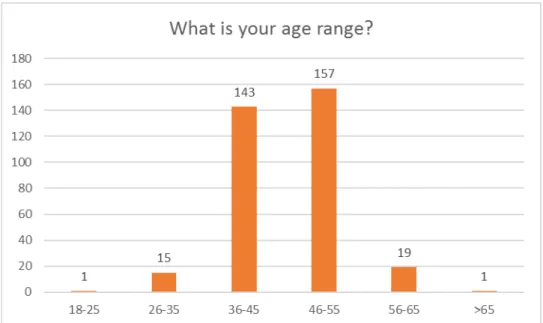
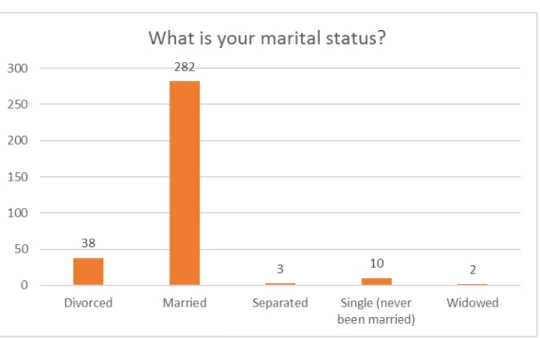
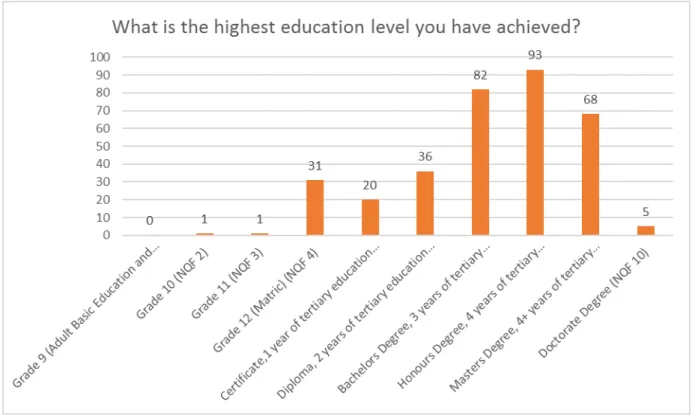
For reference, a sample questionnaire has been included in the Appendix (Questionnaire, 76). To keep the responses anonymous respondent’s personal details were not asked. However, to build a profile, the parent's age, education, and socio-economic background was asked in section A. This established
the respondent’s general profile. Encompassing but not limited to identifying their social background/status, income level, parent’s education level, distance from the school and parent’s connection to the school.
Section B then focused on understanding how the eight factors identified in the study undertaken by Alyani, et al. (2014) influenced the parents of St Stithians College when choosing to send their child to the institution. These questions were designed as Likert Scale questionsand required the respondents to indicate their level of agreement with a given statement on a scale of 1 to 5, with 1 being the least and 5 being the highest. This enabled the researcher to establish the level of influence of the school syllabus, school environment/facilities, location, school results, teacher education level, social background of the family, and distance to the campus.
While there were 31 questions, these questions were asked to identify the influence of the possible factors. The questions were grouped so that each question randomly linked to its corresponding factor. This was to attempt to stop respondents from influencing their answers unduly.
While factors such as location and distance only have two questions each that directly speak to them, both represent a similar factor in that they reveal the convenience factor that parents consider when selecting the desired school. As such each factor had a minimum of two questions asked which enabled a trend to be identified in each factor.
The questions themselves were developed in consultation with the Director of Marketing for St Stithians College, Mr Mfundo Ncube, who gave insight into some of the aspects that parents could consider when selecting education institutions. These were further analysed against studies into parent’s decision-making processes undertaken by Jackson & Bisset (2005), West (1992) and Bosetti (2004). While there could have been more questions asked, to keep the questionnaire an acceptable length the total number of questions was capped at 31 ensuring an even spread in representation across the different factors.
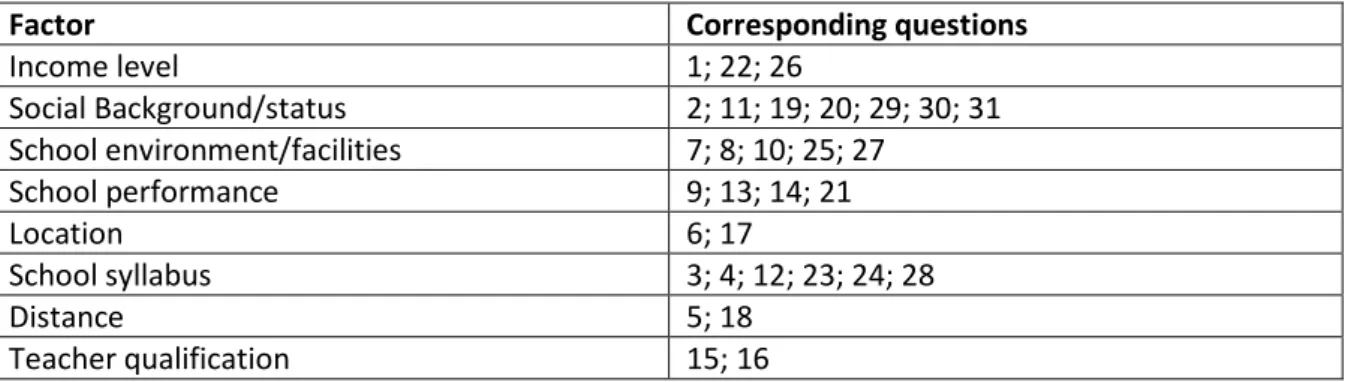
The questions correspond the relevant factors as follows:
Table 1: Table showing the link between questions asked and factors influenced
Factor Corresponding questions
Income level 1; 22; 26
Social Background/status 2; 11; 19; 20; 29; 30; 31 School environment/facilities 7; 8; 10; 25; 27
School performance 9; 13; 14; 21
Location 6; 17
School syllabus 3; 4; 12; 23; 24; 28
Distance 5; 18
Teacher qualification 15; 16
3.5 Data population and sampling
This research used quantitative techniques and the collection of primary data was done via the circulation of a structured self-administered closed-ended questionnaire. The research respondents were the current parent body of St Stithians College. Therefore, this group represents people who have already chosen St Stithians College over other potential schools.