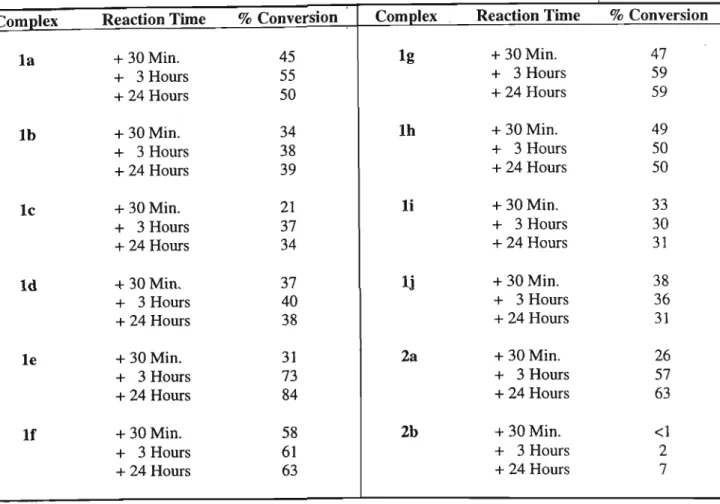
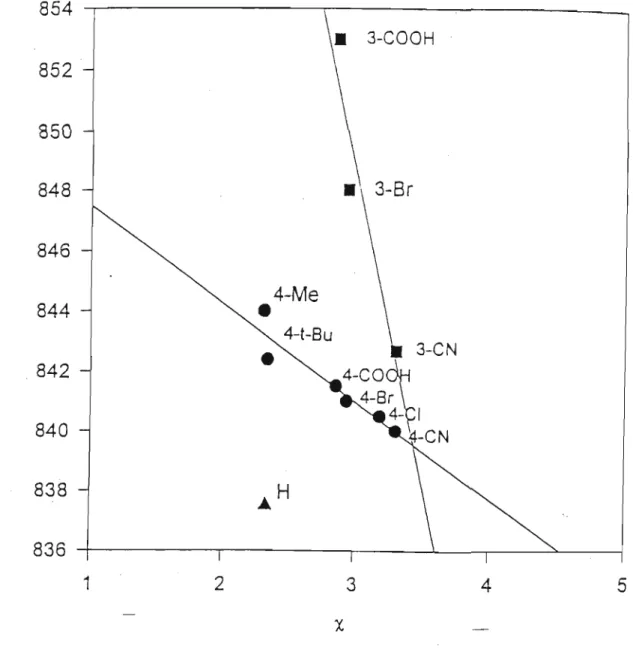
Where use has been made of the work of others, this is duly acknowledged in the text. Summary of the percentage conversions of the substrates to their corresponding products with compound c and the co-oxidants NMO and BU.
Oxidation Catalysis
Although the content of the introduction is limited to the oxidation of alcohols obtained by ruthenium oxo complexes, the value and importance of other ruthenium oxidants should not be overlooked. The combination of the catalyst [Ru(PPh3)3Chl and various derivatives of TEMPO (TEMPO tetramethylpiperidine N-oxyl) has an efficient catalytic system for the aerobic oxidation of primary alcohols to aldehydes and secondary alcohols to ketones, with.
![Figure 1.2.1. Aerobic triple catalytic system for the oxidation of alcohols [27,28].](https://thumb-ap.123doks.com/thumbv2/pubpdfnet/10629017.0/17.831.102.738.483.837/figure-aerobic-triple-catalytic-oxidation-alcohols-27-28.webp)
Ruthenium(VII)
TPAP was found to be tetrahedral like K[Ru04] by electron spm resonance [61] and infrared / Raman [64] studies. TPAP was found to be sterically demanding in oxidation reactions as primary alcohols reacted faster than secondary alcohols [66].
Ruthenium(VI)
Proposed mechanism for the activation of ruthenate by chloramine-T prior to the oxidation of 2-propanol [74]. When potassium ruthenate was used catalytically with the persulfate ion for the oxidation of organic substrates, primary alcohols were converted to carboxylic acids and secondary alcohols to ketones under mild conditions.
![Figure 1.5.2. Proposed mechanism for the activation of ruthenate by chloramine-T prior to the oxidation of 2-propanol [74].](https://thumb-ap.123doks.com/thumbv2/pubpdfnet/10629017.0/22.838.79.761.369.673/figure-proposed-mechanism-activation-ruthenate-chloramine-oxidation-propanol.webp)
Ruthenium(V)
Gross and Ini [108] synthesized a new chiral porphyrin trans-dioxoruthenium(VI) catalyst for the epoxidation of styrene. Low conversions were achieved for the epoxidation of norbonene, with cyclohexene epoxidation giving a mixture of products.
Ruthenium(IV)
Stoichiometric Oxidations
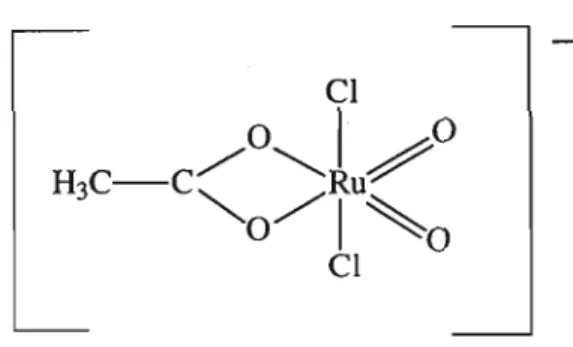
Due to the high cost of the starting material for the preparation of ruthenium tetroxide, RuCh.3H20, and some of the carboxylic acids, synthesis of the complexes [PPh4][Ru02(OCOR)ChJ (R = CF3 b, C6Hs c, C6Fsd, CsHII e) is very expensive. As such, it was not viable to investigate the stoichiometric oxidation reactions of all the synthesized complexes with alcohols. As before, the oxidation reactions were carried out in Schlenk tubes, under a nitrogen atmosphere (to prevent any possible oxidation with air) and in the dark (to prevent free radical oxidation reactions initiated by UV radiation).
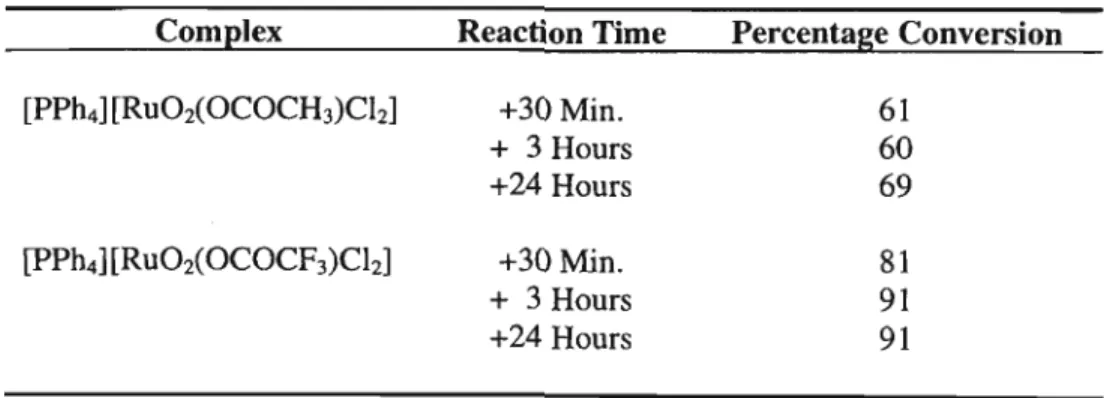
The reactions were monitored by gas chromatography (using a packed column) and isobutyl methacrylate or 2-ethoxyethyl acetate was used as an internal standard to obtain quantitative data (see Appendix One). It was previously shown that the complex [PPh4][RuO2(OCOCH3)Ch] functions as a stoichiometric oxidant when 1 mole equivalent of oxidant was used on 1 mole of substrate, converting primary alcohols to aldehydes, secondary alcohols to ketones, and triphenylphosphine to triphenylphosphine. oxide, and sulfides to sulfoxides [7]. These results showed that the complex functioned effectively as a two-electron oxidant, similar to other oxoruthenium(VI) complexes [10,12].
What is clear here is that the fluorinated complex [PPh4][RuO2(OCOCF3)Ch] is a better stoichiometric oxidant than the hydrogenated complex [PPh4][RuO2(OCOCH3)Ch]. The fluorinated complex oxidizes 1-hexanol at a faster rate at the start of the reaction, achieving a maximum conversion of 91% within three hours.
Catalytic Oxidations
Only the co-oxidant NMO also shows a 15% conversion of I-hexanol to hexanal after twenty-four hours of reaction. Compound [PPh4][RU02(OCOC6Hs)Ch] (c) affords an 81% conversion of I-hexanol to 1-hexanal (i.e. fourteen turns) with TMANO as co-oxidant. Iodosylbenzene showed a 100% conversion of l-hexanol to I-hexanal (i.e. seventeen turns) within three hours of starting the reaction with [PPh4][Ru02(OCOC6Hs)Ch].
Hydrogen peroxide is a poor co-oxidant for the oxidation of 2-hexanol to 2-hexanone (Table 3.2.5) by catalysts a-e. With this co-oxidant, [PPh4][RuO2(OCOC5HIl)Chl showed the highest conversion of 2-hexanol to 2-hexanone (i.e., iodosylbenzene as a co-oxidant for the oxidation of 2-hexanol to 2-hexanone was as effective as NMO) with all catalysts.
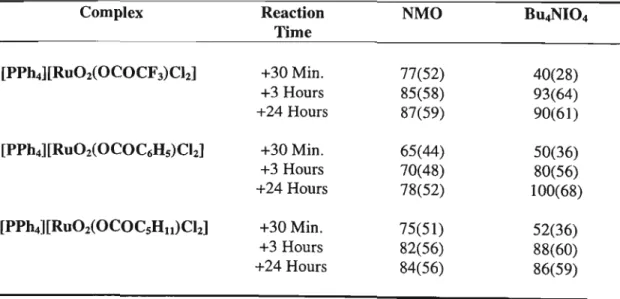
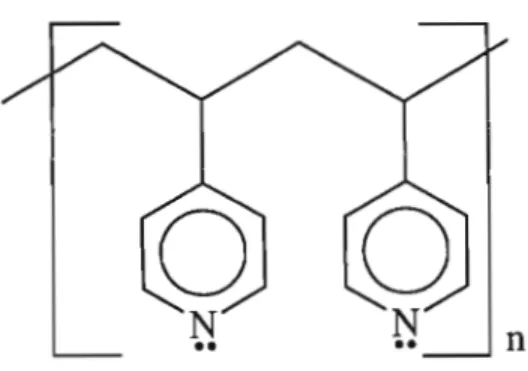
PPh4][RuO2(OCOCsH11)Ch] showed 88% conversion of 2-hexanol to 2-hexanone (i.e. fifteen turnovers) within thirty minutes of reaction and 100%. The 16% conversion of 2-hexanol to 2-hexanone obtained by Bu Complexes a (nine reactions) and d (ten reactions) and b (eight reactions) and c (eight reactions) showed comparable oxidation rates within thirty minutes of reaction initiation. After 24 h, [PPh4][RuO2(OCOC6Hs)Ch] achieved complete conversion of the alcohol to the aldehyde with 68 reactions of the catalyst. The catalyst [PPh4][Ru02(OCOC6Hs)Ch] with NMO reached forty-seven conversions within thirty minutes of the start of the reaction and achieved total conversion of 2-hexanol to 2-hexanone (i.e., sixty-eight conversions) within three hours. Summary of the percentage conversions of substrates to their corresponding products with [PPh4][RuO2(OCOC6Hs)Chl and the co-oxidants NMO and Bu~I04'. Summary of the percentage conversions of substrates to their corresponding products with [PPh4][RUO2(OCOC6Fs)Ch] and the co-oxidants NMO and Bu~I04'. Summary of the percentage conversions of substrates to their corresponding products by the co-oxidants NMO and Bu.NI04 alone. However, NMO alone showed a conversion of the alcohol to the aldehyde of 64% after twenty-four hours. Bu The components of the mixture (i.e., the substrate, products, and co-oxidants) dictated which of the two dissociation pathways was followed. All components of the reaction were scaled up proportionally and included gravimetric quantification of the cyclohexanol. The reaction was run over a period of 72 hours to allow as complete conversion of the substrate as possible. The reaction was monitored at twenty-four hour intervals by gas chromatography to determine the extent of the oxidation reaction. To further ensure complete elution of the catalyst-free reaction components, the column was rinsed with dichloromethane. The peaks of the poly(4-vinylpyridine) support overlap with other characteristic peaks of the ruthenium(VI) salts. However, the presence of the carboxylate and ruthenium-oxo vibrations mentioned above proves that the complexes [PPh4][Ru02(OCOC6Hs)Chl and [PPh4][Ru02(OCOC6Fs)Ch] are indeed bound to the poly(4-vinylpyridine) support. ). Both supported catalysts showed a slow conversion rate of cyclohexanol to cyclohexanone in toluene at the beginning of the reactions with both co-oxidants. The resulting solution was poured into a separating funnel and the CCl4 fraction (i.e. the lower fraction) was dropped into another separating funnel. A solution of sodium metaperiodate (1 g) in water (20 cm3) was applied over the combined RuO4-CCI4 fractions in a separatory funnel and the solution was stored in a fume hood. When the solution turned red (indicating the formation of sodium ruthenate), the solution was cooled to 0°C and the appropriate ligand (3.0 mmol for compounds 1, 1.5 mmol for compounds 2) dissolved in HClconc of min. All organic oxidation reactions were carried out in small (length 12 cm, diameter -1.5 cm) Schlenk tubes under a nitrogen atmosphere in nitrogen-saturated dichloromethane and monitored by gas chromatography (see Appendix 1). All oxidations were performed in the absence of light and repeated at least three times to ensure reproducibility. The standard solution was run daily before assays and again after 3 hours to ensure consistent results. The compound Y-py (Y =*H, 4-CN, 4-t-Bu) (1.0 mmol) was dissolved in N 2 (g) saturated CCl 4 (9 cm 3 ) before addition of nitrogen saturated deionized water (0.1 cm An oxygen-free environment was maintained throughout this solution by continuously bubbling N 2 (g) through the solution. A large (length 17 µm, diameter -2 cm) Schlenk tube was evacuated, filled with N2(g) and cooled in an ice bath. The microanalytical laboratory at the University of Natal, Pietermaritzburg performed the elemental analyses. The RU0 4 solution (10 cm 3 , 1.4 mmol) was carefully added to the cold mixture before sealing the flask and stirring overnight in the ice bath. Sodium hydroxide (19 cm 3 , 3 M) was added to iodobenzene diacetate (12.4 mmol) in a fume hood over 5 min with vigorous stirring. Water (13 cm 3 ) was added to the mixture and the mixture was stirred for 5 minutes before filtering off the crude iodosylbenzene. The dry yellow solid (decomp. 210°C) was stored in a Schlenk tube under nitrogen in the refrigerator. All organic oxidation reactions were carried out in Schlenk tubes under a nitrogen atmosphere in nitrogen-saturated solvents in the presence of an appropriate internal standard, followed by analysis on one of a number of gas chromatographs (see Appendix One) using a variety of columns and instruments. (see table 4.2.1). The standard solution was prepared by mixing a solvent of dichloromethane [or toluene for supported catalyst] (6 cm3), substrate (0.5 mmol), internal standard [iso-butyl methacrylate or 2-ethoxyethyl acetate or n-hexane] (0.5 mmol ) and the product [either the corresponding aldehyde, ketone, or epoxide] (0.5 mmol). Separation of Reaction Products The technique is based on the partitioning of the components of the mixture between the mobile (i.e. gas phase) and the stationary phase (i.e. usually a liquid immobilized on the surface of a solid support). An inert carrier gas (e.g., nitrogen) elutes the components of the mixture from the column, the rate of elution being determined by the partition ratio of the analyte between the gas and liquid phases. The more volatile components of the mixture elute faster through the column, as they spend more time in the mobile gas phase, with consequently lower retention times than the less volatile components [1]. The polarity of a column affects the rate of elution experienced by the components of a mixture. The retention time of the individual components of a mixture is determined before the mixture itself is analyzed on the gas chromatograph. A quantitative evaluation of the components of a mixture is obtained by using a standard solution and an internal standard. The peak area data obtained from such chromatographic analyzes are used to quantify the components of the reaction mixtures. Initially, the peak area data obtained from the analysis of the standard solution is used to obtain reference response factors (RRFs) (equation i).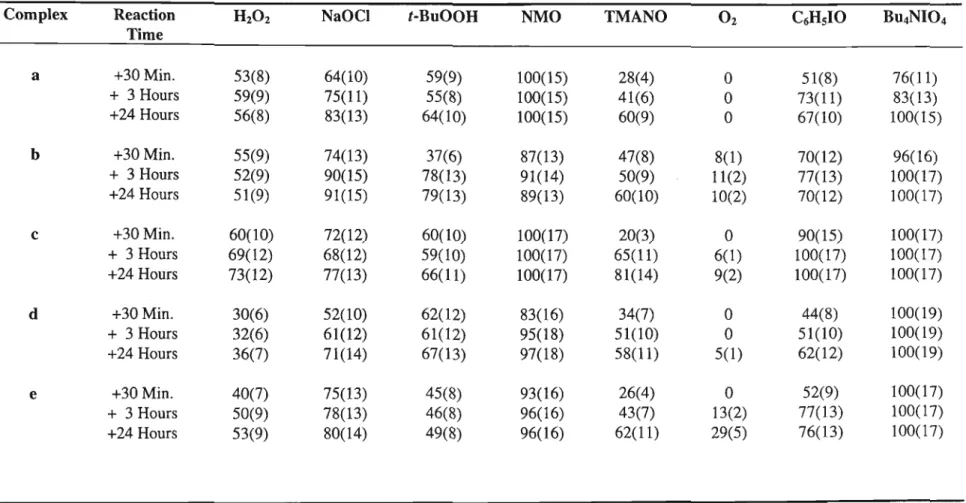
Determining Catalytic Turnover Limits
Separation of Reaction Components
Experimental Chapter Two
Experimental Chapter Three
Reagents Used
![Figure 1.5.1. Structure of the ruthenate anion trans-[Ru03(OH)2f [71].](https://thumb-ap.123doks.com/thumbv2/pubpdfnet/10629017.0/21.831.331.553.669.829/figure-structure-ruthenate-anion-trans-ru03-oh-2f.webp)
![Figure 1.5.4. Structure of [Ru02(pyM02CRhH101,102].](https://thumb-ap.123doks.com/thumbv2/pubpdfnet/10629017.0/27.831.308.566.308.526/figure-1-5-structure-of-ru02-pym02crhh101-102.webp)