Self-medication is a practice that can contribute significantly to reducing overall healthcare costs in South Africa. Pharmacists are in an ideal position to implement, monitor and contribute to the success of the self-medication concept in South Africa.
INTRODUCTION
INTRODUCTION
RESEARCH OBJECTIVES
CONTRIBUTION OF THE STUDY
The pharmacy profession has suffered significant encroachments by other health care professionals in recent decades (McCarthy, 1985). The pharmacy profession has responded with a move toward a patient-centered, clinical role for the pharmacist.
LITERATURE REVIEW
THE IMPACT OF ESCALATING HEALTHCARE COSTS
One of the national health goals in the national health policy is to promote self-care, including self-medication, for all people in South Africa.
THE VIEW OF GOVERNMENT
The government of South Africa has a limited capacity to meet the health needs of the population. The community pharmacist is a very underutilized health professional, and can make a significant contribution to meeting the health care needs of the population.
THE VIEW OF PHARMACEUTICAL ORGANISATIONS
According to the guidelines of the International Federation of Pharmacists (FIP), pharmacists are expected to promote and develop the concept of pharmaceutical care, including advice to the public (The Tokyo Declaration, 1993). The World Health Organization (WHO) recently endorsed the role of the pharmacist through the adoption of a resolution by the World Health Assembly (WHA) in Geneva, where member states were encouraged to make full use of the expertise of the pharmacist at all levels of the health care system (World Health . Organization, 1994).
THE PERCEPTIONS OF THE PHARMACIST
- The consumer's perception of the pharmacist
A positive consumer perception of the pharmacist is an important prerequisite for the successful adoption of self-medication. Most patients would use the .. pharmacy for over-the-counter medications for minor ailments.
THE RISKS ASSOCIATED WITH SELF-MEDICATION
The South African Pharmacy Council has started a public information campaign to inform the public about the possible dangers of taking medicines incorrectly, what information the doctor should be given and what information should be asked of him.
THE PHARMACIST'S ROLE
The increasing importance attached to self-medication in both developed and developing countries requires pharmacists to fulfill their role adequately.
THE EFFECT OF DEMOGRAPHIC VARIABLES ON SELF-MEDICATION
- The effect of gender
- The role of income on self-medication
- The effect of population group on self-medication
- The effect of language on self medication
As the percentage of the literate population increases, we can expect an increase in the practice of self-medication. These findings further emphasized the role of the pharmacist as information broker for responsible self-medication.
THE SITUATION INTERNATIONALLY
What is evident is the significant increase in the rate at which these changes have occurred.

THE SITUATION IN SOUTH AFRICA
Poor quality of healthcare would have a negative impact on the health status of the population, worsening the social and economic well-being of the population. This shortage of pharmacists poses another challenge to the success of self-medication in South Africa.
INEFFICIENCIES IN COMMUNITY PHARMACY
Health care inflation in South Africa for 2001 was approximately 15% compared to the consumer price index of six percent (6%). This reduction in long-term health care costs will also positively affect the country's economic situation.
OPPORTUNITY TO COMMUNITY PHARMACY
THE FUTURE ROLE OF THE PHARMACIST
ETHICAL CONCERNS FOR THE COMMUNITY PHARMACIST
RESEARCH METHODOLOGY
- INTRODUCTION
- HYPOTHESES STATEMENTS
- Hypothesis 1
- RESEARCH DESIGN
- SAMPLING DESIGN
- DATA ANALYSIS
- DATA PRESENTATION
- LIMITATIONS
Consumers have a more positive attitude towards self-medication for minor health ailments than for serious medical conditions. Community pharmacists play an important role in helping consumers make informed decisions about self-medication. Consumer perspectives and pharmacy perspectives provide an indication for a conceptual framework of self-medication for the most common ailments.
Although most of the sample population was fluent in English, in a few cases translators were needed. Data from both the consumer and phanacist questionnaires were analyzed using the computer software program, Statistical Package for the Social Sciences (SPSS). The computer analysis was used to extract frequency tables, one-sample chi-square tests and cross-tabulations for the data.
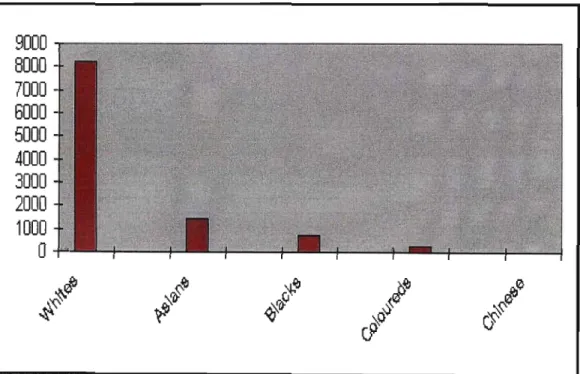
The data are presented in the form of frequency tables, chi-square test tables, and cross-tabulation. However, the sample population contains a mix of respondents that is representative of the composition of the South African population in terms of demographic, social and economic characteristics. The findings from the analysis of the primary data are discussed in the next chapter.
RESEARCH FINDINGS
INTRODUCTION
CONSUMER QUESTIONNAIRE
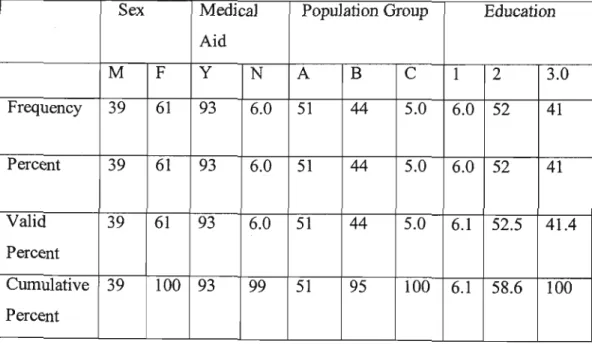
- DEMOGRAPHIC VARIABLE ANALYSIS
- OTHER VARIABLE ANALYSIS
- Table 15 One-sample Chi-Square Test for Consumer Questionnaire
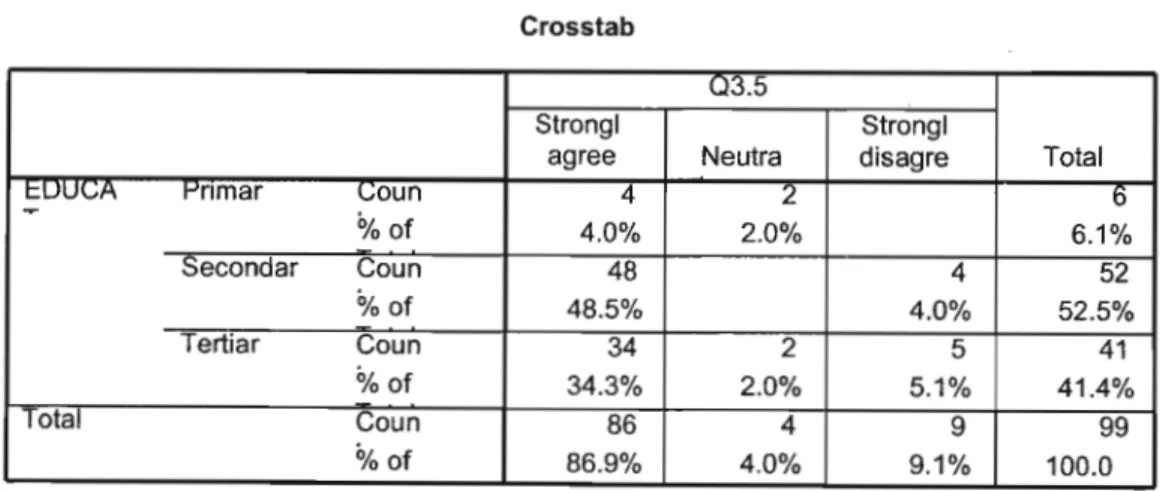
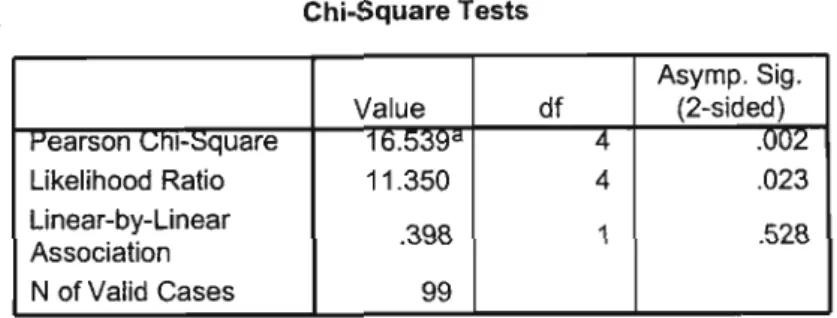
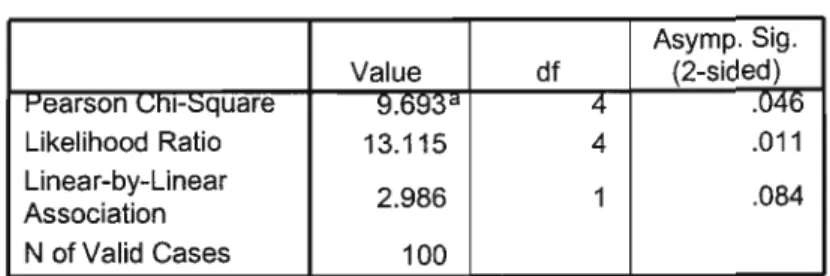
In addition to frequency tables, cross-tabulations and chi-square tables were compiled only for demographic data (education and population group) that were significant in their proportional representation in the various categories. Results of the cross-tabulation show that respondents from all levels of education agreed that self-medication is their first response to minor health problems. Asymptotic Significance values (p-values) of the chi-square table greater than 0.05 show that there is no relationship between the rows and the column categories.
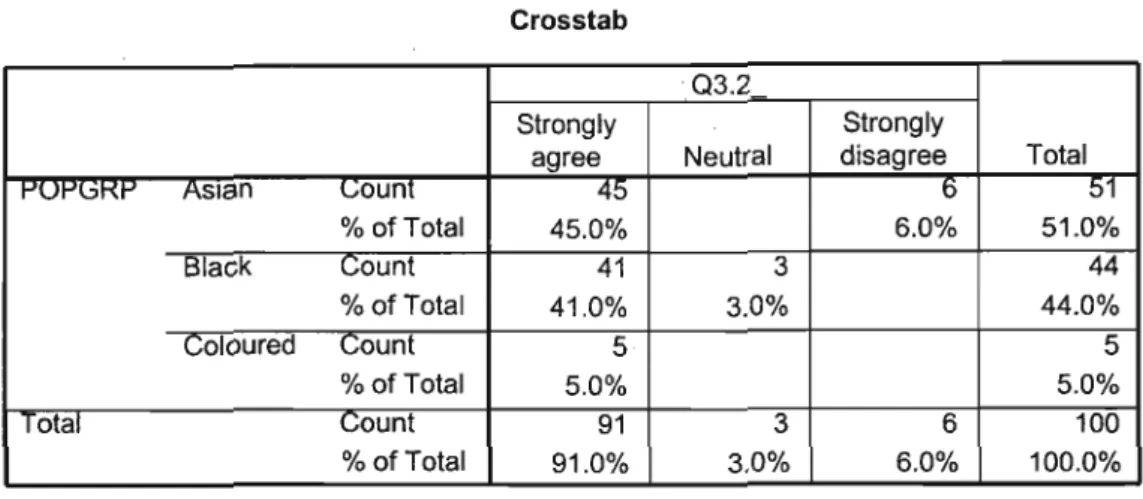
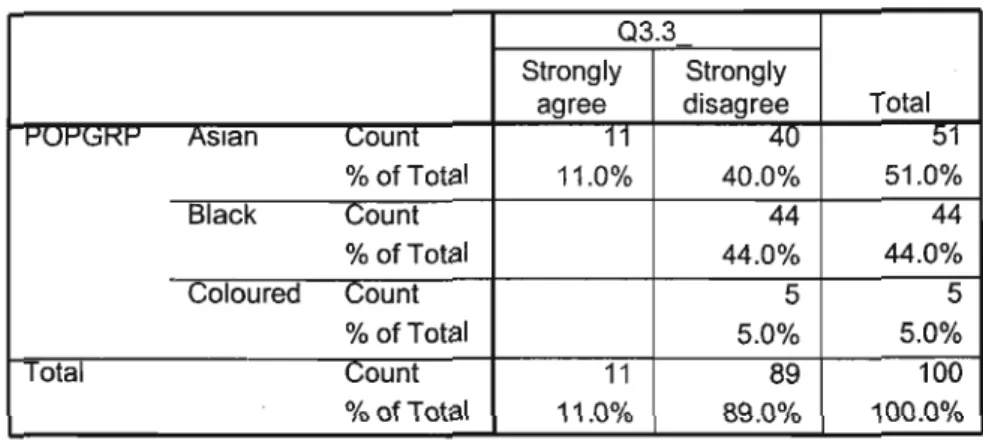
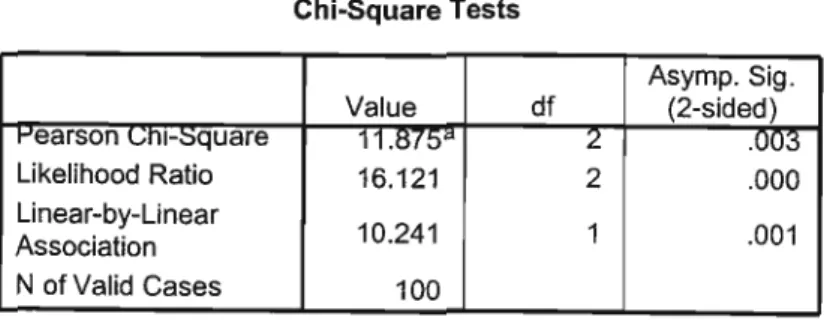
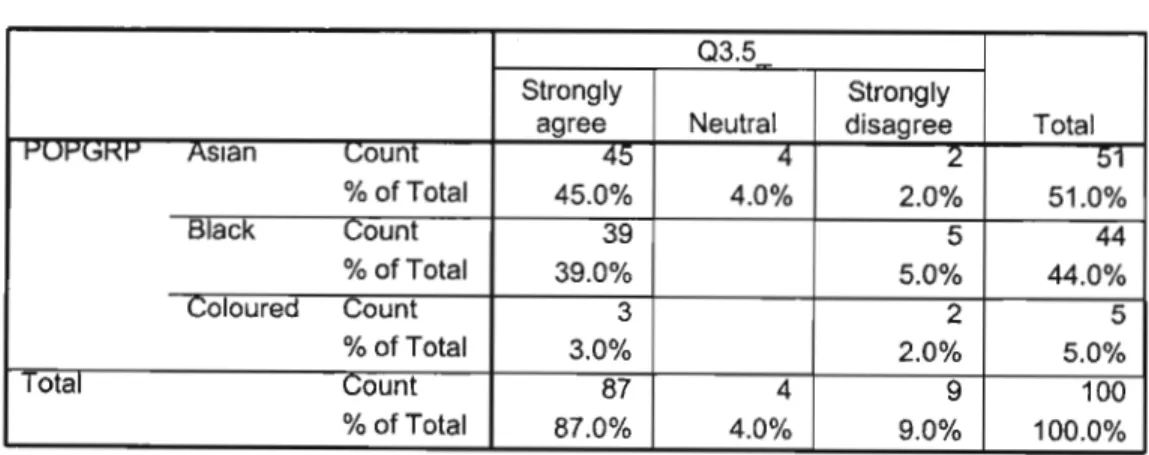
The results of the cross-tabulation (Table 7) show that all population groups, Asians, Blacks and People of Color, strongly disagree that pharmacists are not the most reliable source for information about self-medication. The cross-tabulation results show that all population groups, Asians, Blacks and People of Color, strongly agreed that self-medication would be their first response to minor health problems. Of the twenty percent (20%) of consumers who always or usually self-medicated for allergies (Appendix D), only twenty-four percent (24%) found the treatment very effective or effective (Appendix E).
Most consumers (89%) strongly agreed or agreed that the pharmacist provides valuable self-medication advice (Appendix F). The majority of the sample population (78%) indicated that pharmacists were the best source of self-medication information compared to doctors, nurses, herbalists and sangomas, and friends and family members (Appendix G). In addition to frequency tables and chi-square tests, a one-sample chi-square test was performed for the consumer questionnaire.
PHARMACIST QUESTIONNAIRE
- INTERPRETATION OF DEMOGRAPHIC DATA
- Education
- INTERPRETATION OF OTHER VARIABLES
They reinforce this view by their acceptance of the severity of the condition as the most important factor in the choice of self-medication. This finding agrees with the findings of the consumer questionnaire, where all cultural groups accepted the concept of self-medication. Ho: Consumers have an indifferent attitude towards self-medication for minor medical conditions than for serious medical conditions.
HA: Consumers have a more positive attitude toward self-medication for minor medical conditions than for serious medical conditions. Consumers have a more positive attitude towards self-medication for minor medical conditions than for serious medical conditions. The different population groups also indicated that they consider the pharmacist as the most reliable source of information about self-medication.
This shows the high demand for self-medication in South Africa, as well as the importance of the service offered by the pharmacist. This number represents a significant proportion of consumers who would not rationally self-medicate. Professional advice from a pharmacist is an important part of self-treatment.
PHARMACIST QUESTIONNAIRE
RECOMMENDATIONS
- CONSUMER QUESTIONNAIRE
- Hypotheses Statements
- Demographic Variables
- OTHER VARIABLES
- PHARMACIST QUESTIONNAIRE
Analysis of the consumer questionnaire confirmed that self-medication is the first response to minor medical conditions, regardless of level of education. The different population groups also indicated that the nurse is the most reliable source of information for self-medication. The majority of consumers, regardless of population group, indicated that self-medication is their first response to minor medical conditions.
The pharmacist must also supervise the self-medication treatment of the former group, as they would also have received prescribed medications. Pharmacists' views on self-medication for certain minor medical conditions differed from those of consumers. Pharmacists indicated that the severity of the condition was the most important factor contributing to the choice of self-medication as a treatment method.
Further research is needed to ensure that the goals of self-healing are realized and that all actors contribute to these goals. There is no doubt that the diverse South African conditions are conducive to actively pursuing the concept of self-healing. Differences in population groups, language, education and income do not hinder acceptance of the concept of self-medication.
THE CONCEPTUAL FRAMEWORK
INTRODUCTION
CONCEPTUAL FRAMEWORK FOR CONSUMERS
CONCEPTUAL FRAMEWORK FOR PHARMACISTS
This cross-sectional study provides a snapshot of consumer attitudes and pharmacists' beliefs about self-medication. Longitudinal studies are needed to ensure that positive outcomes from self-medication benefit all players involved. Rank in order of advice ability (1 being the most helpful and 5 being the least helpful) who could provide the best source of information about self-medication.
How important are the following services offered by a pharmacist? (1 is the most important, 5 the least important). How satisfied are you with the service at the pharmacy (1 is the least satisfied, 5 is the most satisfied). For which of the following conditions do you think self-medication is most effective/ineffective?
From the list of options presented below, rank in order of importance (1 being the least important and 5 being the most important) which factors contribute to the choice of self-medication. On a scale of 1 to 5, with 5 being the highest, indicate which factors have the greatest impact on self-medication. Rank in order of importance, with 5 being the least important and 1 being the most important.
COLDS AND FLU
GASTRIC / STOMACH PROBLEMS
ACHES AND PAIN
MINOR INJURIES
ALLERGIES
GASTRIC I STOMACH PROBLEMS
ACHES AND PAINS
MINOR INJURIES
ALLERGIES
CONSUMER QUESTIONNAIRE QUESTION 6 FREQUENCY TABLE
Anon (1993) Responsible self-medication, South African Pharmaceutical Journal, Vol. 1995) Observation and analysis of drug dispensing and advice requests in suburban community pharmacies on the Witwatersrand, MPhann (unpublished dissertation), University of Pretoria. 1996) GPs' views on OTC sales by community pharmacists, British Medical Journal, Vol. 1998) Pharmacist's Perception, The South African Pharmaceutical Journal, Vol. 1992). 1994) Consumer Preference and Willingness to Pay for Pharmaceutical Counseling for OTC Drugs, Journal of Clinical Pharmacy Therapy, Vol. 1996) Self-efficacy theory as a framework for community.
Pharmacy Based Diabetes Education Programs, The Diabetes Educator, Vol. 1978) Requests made in community pharmacies, American Journal of Public Health, Vol. 1978) Requests made in community pharmacies, American Journal of Public Health, Vol. 1978) Requests made in community pharmacies, American Journal of Public Health, Vol. 1992) PPAC Report, South African Pharmaceutical Journal, Vol. 1985). An assessment of response to symptoms in community pharmacies, Pharmaceutical Journal, Vol. 1983) What physicians think of pharmacists who treat minor ailments, The Pharmaceutical Journal, Vol. 1998). Interim Report on Pharmaceutical Services, Browne Report, Pretoria: Government Printer Confidence in the pharmacist and acceptance of the pharmacist's advice, Contemporary Pharmacy Practice, Vol. 2002) Obesity, South African Pharmacist's Assistant, Vol.
The advisory role of the community pharmacist in self-medication, New Zealand Medical Journal, Vol. The roles of the pharmacist in self-care and self-medication, South African Pharmaceutical Journal, Vol. The evolving role of the prescribing and diagnosing pharmacist in South Africa Pretoria: the South African Pharmacy Council.