i
UNIVERSITY OF KWAZULU-NATAL
Management Perceptions of Employment Equity at the Automotive Manufacturing Plant
By
Mpho Philemon Mabetoa 206510765
A dissertation submitted in partial fulfilment of the requirements for the degree of
Master of Business Administration
Graduate School of Business College of Law and Management Studies
Supervisor: Alec Bozas
Year of Submission 2012
ii
DECLARATION
I, Mpho Philemon Mabetoa declare that
(i) The research reported in this dissertation/thesis, except where otherwise indicated, is my original research.
(ii) This dissertation/thesis has not been submitted for any degree or examination at any other university.
(iii) This dissertation/thesis does not contain other persons’ data, pictures, graphs or other information, unless specifically acknowledged as being sourced from other persons.
(iv) This dissertation/thesis does not contain other persons’ writing, unless specifically acknowledged as being sourced from other researchers.
Where other written sources have been quoted, then:
a) their words have been re-written but the general information attributed to them has been referenced:
b) where their exact words have been used, their writing has been placed inside quotation marks, and referenced.
(v) This dissertation/thesis does not contain text, graphics or tables copied and pasted from the Internet, unless specifically acknowledged, and the source being detailed in the dissertation/thesis and in the References sections.
Signature:
iii
Acknowledgements
I extend my sincere gratitude and appreciation to the following persons for their assistance and support during the period of my study for this dissertation:
Mr. Alec Bozas, my supervisor, for his patience, encouragement and wealth of knowledge
Management for allowing me to conduct the research in their company All individuals who participated in this research through my questionnaire My wife Judy Mabetoa for her patience and tolerance during my long hours of
study and her invaluable emotional support My dearest children, Tumiso and Reabetswe
Ms. Tania Hughes for encouragement, total support and proofreading
My brothers and sisters in Mabopane (Pretoria), family friends in Durban, Johannesburg and Pretoria, my in-laws (Seageng family from Pretoria) for their unfailing support, without whom this study would be impossible,
My father Joseph Mabetoa and my mother Magdalene Mabetoa My colleagues at Automotive Plant
iv
Abstract
The implementation of the Employment Equity Act (EEA) No. 55 of 1998 is a crucial factor in promoting equal employment opportunities and the fair treatment of people in the workplace.
South Africa has an economically active population which is not sufficiently represented in the workplace due to the inequalities of the employment practices during the apartheid regime.
The purpose of the study was to test the management at a motor manufacturing plant’s perceptions of Employment Equity (EE) and the implementation thereof. A sample of convenience consisting of over 40 respondents at middle management level from various departments was sought. A 26-item Employment Equity Questionnaire using the five point Likert scale was used to explore the employment equity process. It was decided not to make reference to race and gender in terms of findings.
Respondents were unsure that the implementation of employment equity in the workplace was responsible for the “brain drain” in the country. Responses indicated that the majority agreed that the Employment Equity Act has provided many with the opportunity for promotion and development in the workplace. Furthermore, there is opportunity for development and sufficient programmes within the organisation to support the achievement of that development. Management felt that they were not equipped with sufficient knowledge to deal with the implementation of the equity laws. Research also showed that there is still a shortfall in the representation of females in the automotive industry.
The study makes various recommendations for improving the pace and status of the implementation of employment equity. The responsibility for Compliance with the
Employment Equity Act lies with the HR Department of the Company. It is within their realm of responsibility to ensure that all programmes within the organisation are linked to creating awareness of the Employment Equity Act and to ensure that its objectives are implemented within the organisation. In addition, particular scrutiny must be given to keeping an audit of progress of these programmes. As Human Resource is also the custodian of the recruitment process of the company, it needs to prioritise and drive the employment and promotion of females within the organisation.
v
Table of Contents
Description Page
Title Page i
Declaration ii
Acknowledgements iii
Abstract iv
Table of Contents v
List of Figures vii
List of Tables viii
CHAPTER ONE
Introduction and Background 1
1.1 Introduction 1
1.2 Focus of the Study 2
1.3 Problem Statement 2
1.4 Research Objectives 3
1.5 Significance of the Study 4
1.6 Limitation of the Study 5
1.7 Chapter Summary 5
CHAPTER TWO
Literature Review 7
2.1 Introduction 7
2.2 Characteristics of the Environment 7
2.3 General Trends of the Environment 12
2.4 Management Response to Employment Equity 16
2.5 Impact on Professionals Due to Implementation of Employment Equity 17 2.6 Is Employment Equity Making a Difference in the Industry? 19 2.7 Dealing with Management Perception and Diversity 20 2.8 Government Expectation and Employment Equity Strategy 25
2.9 Chapter Summary 26
vi CHAPTER THREE
Research Methodology 27
3.1 Introduction 27
3.2 Research Design 27
3.3 Sample of Respondents 28
3.4 Measuring Instrument 29
3.5 Questionnaire Construction 31
3.6 Research Procedure 35
3.7 Limitations of the Research 37
3.8 Chapter Summary 37
CHAPTER FOUR
Findings and Results 39
4.1 Introduction 39
4.2 Data Analysis 39
4.3 Respondents Feedback Analysis 45
4.4 Chapter Summary 50
CHAPTER FIVE
Conclusions and Recommendations 51
5.1 Introduction 51
5.2 Discussions 51
5.3 The Implications for Companies 55
5.4 Possible Limitations 56
5.5 Recommendations 57
5.6 Closing Comment and Conclusion 57
References 59
Appendices
Appendix 1 Informed Consent Letter 67
Appendix 2 Employment Equity Questionnaire 69
Appendix 3 Ethical Clearance Certificate 70
vii
List of Figures
No. Description Page
2.1 Employment Equity Life Cycle 8
2.2 Space Creation Model 15
3.1 Important factors to consider in research design 32 4.1 Q11 Employees are leaving the country (“brain drain”) due to EE 46 4.2 Promotion and development of equal opportunities through EEA 47
4.3 EE support previously disadvantaged employees 48
4.4 Gender bias 49
4.5 Management Responsibility 50
viii
List of Tables
No. Description Page
1.1 Industry sector workforce profile percentage population distribution at the senior management level for all employers by race & gender 4 2.1 Workforce profiles and workforce movements at the professional level 13 2.2 Workforce profiles and workforce movements at the skilled level 14 2.3 Promoting the effective management of diversity 23
3.1 Summary of reliability estimates 34
4.1 Age of respondents 39
4.2 Gender of respondents 40
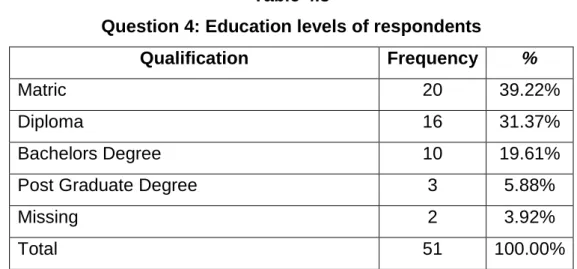
4.3 Education levels of respondents 40
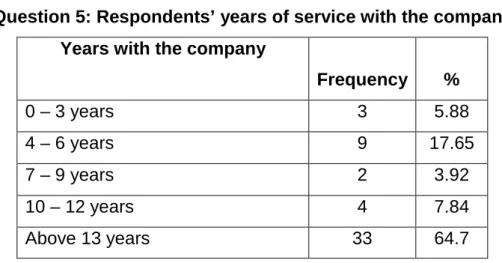
4.4 Main organisational function of respondents 41 4.5 Respondents' year of service with the company 41 4.6 KMO and Bartlett's test: First level factorisation 42 4.7 Coefficient of association between biographical variables 43 4.8 Reliability analysis on employment equity questionnaire 44 4.9 Matrix of correlation for age, highest qualification and years with company 45
1
Chapter 1
Introduction and Background Information 1.1. Introduction
The most pressing issue facing South Africa today is the employment inequalities in the private sector and finding ways to reduce gaps previously created by apartheid policies. The South African government has shown its commitment and intention to address discrimination by eliminating inequality in private companies and government institutions. The Employment Equity Act No. 55 of 1998 hereafter referred to as the ACT was promulgated to:
a) Promote and achieve equity that is equal opportunities in the workplace;
b) Foster an active environment for previously marginalised groups in the operational, professional and executive decision making process in their employing equities.
The purpose of the Employment Equity Act (South Africa EEA, 1998) is to achieve equity in the workplace by:
a) Promoting equal and fair treatment in employment through the elimination of unfair discrimination;
b) Implementing affirmative action measures to redress the disadvantages in employment experienced by Designated Groups or Previously Disadvantaged individuals.
It is not that individuals in the designated groups are inherently unable to achieve equality on their own, it is that the obstacles in their way are so formidable and self- perpetuating that they cannot be overcome without intervention (Abella, 1984).
As defined by the Act (South Africa EEA, 1998), designated groups refer to:
• Black people (African, Coloured and Indians),
• Women and
• People with disabilities.
2
It must be noted that South Africa’s situation on employment discrimination differs significantly from countries that founded the employment equity concept. In South Africa, historic employment policies prejudiced the majority of the population whereas countries such as Canada and the United States of America dealt with discrimination against the minority groups. Lessons about the implementation of employment equity can be learned from the experiences in such countries.
Assembly Two at the manufacturing plant under investigation developed an Employment Equity (EE) plan which aims to increase diversity at different occupational levels within the workforce. The employment equity plan improves the company’s profile as a corporate citizen and will contribute to labour market transformation in South Africa, which is one of the key requirements for sustainable economic growth.
1.2. Focus of the Study
It is vital to understand the underlying contributory factors and to eliminate them as barriers to the implementation of Employment Equity. As per the Employment Equity Act it is important to create an environment which is conducive for the achievement of employment equity goals and, as Management play a key role in creating that environment, it becomes important to understand how their perceptions impact upon it. Thomas and Jain (2004) indicate that employment equity programmes are more likely to succeed when line managers are an integral component of the planning and implementation of the programme and are held accountable for the outcomes.
Employers must take note of the impact of the Employment Equity Act on employment relationships, the consequences of non-adherence to it and the risks of facing unfair labour practice complaints (Nel, Swanepoel, Kirsten, Erasmus and Tsabadi, 2005).
1.3. Problem Statement
Since the implementation of the Employment Equity Act No. 55 of 1998, there has been a considerable change in the demographic profile of the South African workforce. The management of diversity within the workplace has become a key
3
issue (De Beer and Radley, 2000) for transformation. In order to manage a diverse workforce, it is necessary to address the perceptions of management in dealing with Employment Equity issues. The purpose of this research is to contribute to the employment equity debate by qualitatively identifying and exploring management attitudes towards and experiences of employment equity.
An internal investigation by the researcher suggested that there may be shortcomings in how management perceptions affect the implementation of employment equity to meet the organisation’s legislative obligations. Within the context of Assembly Division Two at the automotive firm, the associated research questions are as follows:
• Do companies lose expertise or experience as a result of employment equity implementation?
• Does the Employment Equity Act promote equal opportunity in the work place?
• Does the Employment Equity Act address promotion and development opportunities for employment equity candidates?
• Can the transfer of knowledge to employment equity candidates accelerate their progress and work experience?
1.4. Research Objectives
By answering the above research questions, the objectives of this study are to:
• Consider the loss of expertise or experience as a result of employment equity implementation and the effect on individual companies and South Africa if employees take up employment overseas;
• Consider the ability of the Employment Equity Act to provide career opportunities to address gap for employment equity candidates;
• Understand if the Employment Equity Act promotes equal opportunities in the work place; and
• Understand gender bias and transfer of knowledge to employment equity candidates.
4
1.5. Significance of the Study
This qualitative study will ensure a better understanding of the current challenges relating to the implementation of employment equity in the Manufacturing Sector. By analysing the outcomes, recommendations have been made that will facilitate change management elements which support the implementation of employment equity.
These elements are:
• Shared culture and values;
• Behaviours that support employment equity in the work place;
• Policies and practices which are consistent with employment equity
• Leadership development; and
• Skill retention.
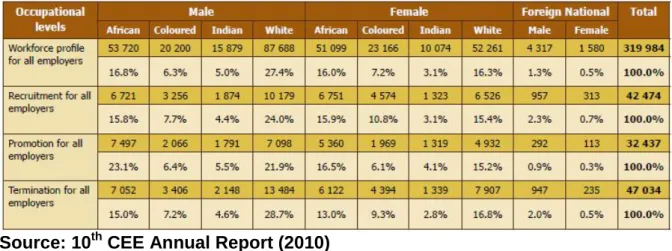
Table 1.1
Industry sector workforce profile percentage population distribution at the senior management level for all employers by race and gender
Source: 10th CEE Annual Report (2010)
5
Table 1.1 Reflects the industry sector workforce profile status at the senior management level for all racial groups. White males dominate at senior level in all sectors measured. The manufacturing sector has performed poorly in terms of progress towards meeting occupational representation at all levels (10th Commission of Employment Equity, 2010).
1.6. Limitations of the Study
This study was limited in certain ways therefore this research must be viewed in light of the following limitations:
1. The research is conducted solely on “Assembly Division Two Plant” so though the results may not be generalisable. The core issues are specific to Assembly Division Two on which this research is based.
2. The research is quantitative and as such lacks the depth of a qualitative study. Qualitative studies determine reasons why a problem really exists, whilst quantitative merely indicates the extent of the problem (Render, Stair and Hanna, 2006).
3. All respondents are salaried staff members of staff at the organisation i.e.
administration clerks, supervisors (group leaders and assistance managers), engineers, managers and senior managers. There is no input from blue collar workers.
4. Race is not an identifying factor of the respondents as the focus is on management as a group. The respondents were reluctant to be categorised according to race and felt it might give away their identity.
5. It is essential to acknowledge that, owing to its small sample size, this study is exploratory in nature and limited in its generalisability. The findings will be more meaningful if supplemented by those from a qualitative research design.
1.7.
Chapter Summary
This chapter has provided a summary of the intentions of the research. It has
unpacked key terms that make up the topic of the research. Background information has reflected the employment equity implementation in South Africa. The chapter explained key issues surrounding the principles of the research like the aim, objectives and research questions.
6
The narration of the chapters that follow provides a clear picture of how the research document is set out. The research methodology depicts how the research was planned and conducted.
7
Chapter 2 Literature Review 2.1. Introduction
Scholarly journals have published a number of articles that have focused on the content of employment equity policies or comprised of case studies that concentrated on individual public or private sector experiences. A review of this literature has revealed a number of employment relation practices that are commonly associated with employment equity. These policies, which have been implemented by governments worldwide, are a reaction to the worldwide historical discrimination against disadvantaged groups in the workplace (Sowell, 2004).
With the above background, this chapter reviews the literature on Employment Equity, research which has been conducted and conferences which have been held with designated groups in private companies and government. Employment Equity is not a new concept worldwide. The first traces of Employment Equity legislation were implemented in Canada. With South Africa’s previous political dispensation, only limited economic opportunity was afforded to non-white people, females and people with disabilities. They were restricted in their career options and had few opportunities for advancement in the employment arena. Denton and Vloeberghs (2003) stated that labour legislation requires companies to manage the implementation Employment Equity and compete globally whilst protecting local markets from international competitors.
2.2. Characteristics of the Environment
The employment equity plan contained herein was developed in line with the requirements of the Employment Equity Act.
The company’s approach to employment equity planning has been guided by the Employment Equity Cycle illustrated in Figure 2.1
8 Figure 2.1
Employment Equity Life Cycle
Source: Day (2010)
The employment equity life cycle is a concept borrowed from the theory of project management and helps organisations to introduce a formal business process which covers all aspects of employment equity management (Day, 2010).
Day (2010) notes that the purpose of the business case is to:
a) Determine the impact on company branding, market perception and stake holder relationships.;
b) Align the objectives of the plan (compliance) with the company’s vision, mission and business strategy;
c) Obtain a mandate which translates the company’s commitment to transformation into monetary and other resources required to develop and implement the employment equity plan;
d) Identifies and allocates the responsibility to the President and Chief Executive Officer (CEO), who are held accountable for the outcome;
9
e) Propose a Transformation Steering Committee;
f) Propose an employment equity team;
g) Identify organisational risks and how these may be mitigated; and
h) Learn lessons from previous experience of employment equity implementation and proposals for implementation.
Day (2010) continues to describe Employment Equity cycle as follows based on Figure 2.1:
STAGE 1: Enabling Environment
i. A strategy is developed on the basis of an approved business case and provides direction to all stakeholders. It contains the parameters for numerical goals to be set in the organisation.
ii. Provide employment equity policy for governance structure and formalise reporting lines for progress. The policy contains accountability for implementation and consequences for non-compliance.
iii. Formalise consultation structures, frequency and participation through employment equity forum constitution.
STAGE 2: Employment Equity Planning
The Employment Equity Act, Regulation and Code of Good Practice contain instructions and guidelines on the process of developing an employment equity plan.
The activity during this phase includes:
a) Analysis of policies, practices and staff profile;
b) Employment equity barriers;
c) Affirmative Action measures; and d) Numerical goals.
STAGE 3: Implementation
This phase involves the implementation activities, which includes:
a) Communication and training of all stakeholders;
b) Implementing affirmative action measures; and c) Change management.
10 STAGE 4: Monitoring
The company needs to monitor progress on:
a) Implementation of affirmative action measures;
b) Achievements of numerical goals;
c) The transformation maturity of the organisation; and d) Procedural and substantive compliance
STAGE 5: Review
The review is the final phase on the employment equity life cycle of the employment equity plan and also serves as the preparation for future developments. It covers the following:
a) Transformation strategy;
b) Employment equity compliance;
c) Director-General (DG) review;
d) Department of Labour (DoL) inspections;
e) Progress against employment equity plan; and f) Employment equity structures and resources.
The automotive industry, like most other industries today, is striving to become world-class and to compete globally. Automotive organisations also need to address the demands from South African government in relation to legislative compliance linked to employment. The management of the automotive companies is experiencing pressure to change.
One force of change, in the form of government legislation, is the Employment Equity Act No 55 of 1998 which was implemented with the purpose of promoting equal employment opportunities and the fair treatment of people (Republic of South Africa.
1998a. Employment Equity Act, No. 55, 1998). In his sixth volume, Abella (1984) stated that “employment equity is a strategy designed to obliterate the effects of discrimination and to open equitably the competition for employment opportunities to those arbitrarily excluded”.
The Employment Equity Act (1998) recognised that there are disparities in employment, occupation and income within the South African labour market due to
11
the history and policies of apartheid and other discriminatory laws and practices.
Therefore, it is important to promote the constitutional right of equality and eliminate unfair discrimination in employment in the “new” democratic South Africa.
The Department of Labour in 2009 released a report showing that slow progress was being made in implementing employment equity in both public and private organisations. It further predicted that at the current progress rate, it will take employers approximately one hundred years to achieve equitable representation in workplaces. The Department of Labour found that employers were not focusing on the workplace environment and the Economically Active Population (EAP) of certain designated groups when setting their numerical goals.
Seijts and Jackson (2001) support previous authors that “individuals perceive employment equity programmes to be unfair because these programmes consider people’s membership in particular social categories rather than traditional indexes of
“deservingness” when allocating desired outcomes”.
The aim of Employment Equity Legislation both internationally and nationally, has been to ensure an equitable representation of certain designated groups in all categories and at all levels in the workplace (Thomas, 2002). Despite these laws and regulations, inequality has continued to exist in many spheres. Mavin cited by van Zyl and Roodt (2006) argued that the working environment remained dominated by male career models and approaches, and that women’s careers suffered if they had family responsibilities to meet. Women were made to choose between their career prospects and their family stability, or even a family at all (van Zyl and Roodt, 2006).
This problem has existed in the international workplace since the sixties even though there was legislation to abolish it. It is for this reason that it is an issue deserving attention, especially for an emerging market such as South Africa.
After the 1994 elections, part of the transformation agenda for South Africa was to transform all organisations to make them demographically representative of all South African citizens (Denton and Vloeberghs, 2003). Op’t Hoog, Siebers and Linde (2010) explained that the introduction Employment Equity Act of 1998 was necessary to replace apartheid and other discriminatory laws and practices. South
12
Africa is still going through a process of change, in particular in terms of political and labour issues. Another important Act promulgated during 1998 was the Skills Development Act No. 97 of 1998. This Act set out to encourage business organisations to initiate training and development for employees and , in so doing, to address the country’s skills shortage.
The organisations in South Africa to which these Acts are applicable need to adapt their policies and procedures to accommodate the new prerequisites (Linde, Schalk and Linde, 2008). The introduction of employment equity legislation has met with opposing views from beneficiaries and non-beneficiaries of Employment Equity. In general the following concerns have been raised:
a) According to Oosthuizen and Naidoo (2010), White men are especially aware that they have limited opportunities to move up the ranks in their organisations and know the risk of entering into a labour market which does not favour them.
b) Jongens (2006) suggests that, for many organisations, complying with legislative demands to avoid the financial penalties for not doing so, has overshadowed the true need to transform.
c) The cost of change is no longer only about the Rands and cents spent on making working environments physically more accessible to people with disabilities. It is about the time and effort spent trying to change attitudes towards people with disabilities, and training managers and colleagues how to deal with people with disabilities (Gida and Ortlep, 2007).
d) Jordaan cited by van Rensburg and Roodt (2005) notes that white males are experiencing reverse discrimination because black workers are now being given preference over them in the job market.
2.3. General Trends in Work Force Movement
Each year The Commission for Employment Equity (CEE), submits a report to the Minister of Labour regarding the progress of Employment Equity. The functions of the Commission of Employment Equity include (EEA, 1998):
1. The commission advises the Minister on –
a) Code of practice issued by the Minister in terms of section 54;
b) Regulations made by the Minister in terms of section 55; and
13
c) Policy and any other matter concerning this Act.
2. The commission may –
a) Make awards recognising achievements of employers in furthering the purpose of this Act; and
b) Research and report to the Minister on any matter relating to the application of the Act.
The workforce distribution supplies information on the total population and the Economically Active Population (EAP) of the country’s four major population groupings in terms of their race and gender. This information is crucial for the setting of employment equity numerical goals (10th Commission of Employment Equity, 2010).
As the following tables indicate, based on the actual organisational data for the period 2009-2010, transformation in management positions is still very slow. Tables 2.1 and 2.2 contain comparative employment equity statistics for large employers.
Table 2.1
Workforce profiles and workforce movements at the professionally qualified level
2009)
Source: 10th CEE Annual Report (2010)
Table 2.1 reflects workforce profiles and movements at the professionally qualified level. Whites still dominate in all occupational levels at the professionally qualified level and White males dominate in all categories: Representation (27.4 per cent),
14
Recruitment (24.0 per cent), Promotion (21.9 per cent) and Termination (28.7 per cent). Slow progress is noticeable in the other race groups in comparison with data from previous years. This is disturbing in terms of employment equity progress, since the professional and middle management level is considered a “feeder” to senior and top management positions (10th Commission of Employment Equity, 2010). It is noted that promotion for African males promotion is higher than any other race group.
Table 2.2
Workforce profiles and workforce movements at the skilled level
Source: 10th CEE Annual Report (2010)
Table 2.2 reflects workforce profiles and movements at the skilled level. Positive trends are noticeable and it is evident that organisations are preparing their employees through recruitment and promotions to endeavour to meet equitable representation for all groups. The Commission of Employment Equity confirms that ten years after enacting the Employment Equity Act, “White males still dominate the top echelons of the workplace, yet they are in the minority” (10th Commission of Employment Equity, 2010).
Booysen (2007) states that management is still predominantly white and the soft positions, like Human Resources, Employment Equity and Marketing, are filled by blacks. Given the need for organisations to attract and retain talented employees to remain competitive in global market, it is suggested that every effort be made to deal openly with the potential feelings of violation that white managers may be experiencing (Maharaj, Ortlepp and Stacey, 2008). Booysen (2007) cites “a white
15
male dominant organisational culture that continues to exclude black recruits” and a lack of cultural sensitivity and cultural awareness programmes as contributors to the falling retention rate of black recruits.
Selby and Sutherland cited by Schoeman (2010) provide a model called Space Creation which is defined as “any course of action which persuades senior white managers to leave the organisation to create opportunities for black managers to assume their roles”. This model, illustrated in Figure 2.2 proposes job shadowing, expatriate assignments and retaining as a medium-term strategy with low risk (natural attrition, normal retirement, resignation and promotion) and high reward.
Figure 2.2 Space creation model
I. Job shadowing, expatriate assignments, retraining – medium-term strategy Rewards: improved BEE score?
Sustainability, maintenance of organisational memory, psychological contract, leadership skills and morale; pay used as fair exchange for Work.
Risks: requires intellectual and emotional buy-in; requires leaders with diversity competencies; requires alignment of HR practices
II. Incentives for early retirement – short-term strategy unless linked to skills and knowledge transfer Rewards: Accelerated achievement of EE targets
Risks: Breakdown of psychological contract with existing white employees and low morale; loss of organisational memory; loss of leadership skills; distrust and increased racial tensions; high financial burden.
III. Natural attrition, normal retirement, resignations and promotions – long term strategy
Rewards: Limited
Risks: Not fast enough if labour turnover is slow. White incumbents become career blockers
IV. Voluntary severance – once-off intervention
Rewards: Accelerated achievement of EE targets
Risks: Breakdown of psychological contract;
loss of organisational memory and capacity (impacts of business sustainability); high financial burden; loss of skills (not just leadership); distrust and increased racial tensions
Source: Managing Diverse Employees in a Multicultural Environment (2006)
Risks
Rewards
Low High Low
High
16
Incentives for early retirement and voluntary severance are ranked on the high risk end of the scale, with the former offering high rewards through accelerated
achievement of employment equity targets (Schoeman, 2010) but this comes with a financial price.
2.4. Management Response to Employment Equity
Leiter and Harvie (1997) noted that “front-line supervisors provide leadership during times of major organisational change by articulating the relevance of organisational values to issues confronting their workgroups”. Sagie and Koslowsky, cited by Leiter and Harvie (1997) stated that “it is during times of change that staff needs confidence in the ability of management to make sound decisions about the necessity of change along with encouragement from supervisors to be involved in the change process”. Munnik (2008) asserted that: “Your management of employment equity, or lack thereof, could put your business at risk.” With the representation at top 3 levels still dominated by Whites, the management of employment equity rests with them. It becomes important to build a business case for the implementation of employment equity.
Employment equity policies should represent positive developments in the employment domain because they should address past discrimination, promote social justice, and broaden the pool of qualified job candidates. However, Kravitz (2008) argued that these policies can be highly controversial and are often viewed negatively by employees. In particular, research suggests that these policies are viewed particularly negatively by individuals who do not benefit from them, in North America (USA) this would be men and Whites (Tougas and Veilleux, 1988). These findings are troubling because the support of both beneficiaries and non- beneficiaries of these policies is needed for such policies to be effective (Hitt and Keats, 1984).
The negative reactions of non-beneficiaries may have important implications for organisations, such as limiting the pool of potentially highly qualified applicants, wasting resources on developing employment equity policies, and, if negative reactions force an organisation not to use these policies, potential fines for not complying with the laws (Jain, Sloane and Horwitz, 2003). Further, non-beneficiaries’
17
negative reactions to these policies may lead to de-motivation, alienation, and hostility within the organisation (Heilman, McCullogh and Gilbert, 1996). Finding a way to overcome the resistance of non-beneficiaries of employment equity policies is therefore of utmost importance. Woolnough (2010) supported the previous authors’
statements on one of the shortcomings of affirmative action, namely tokenism. This may take place as a way to simply fill quotas which is sometimes perceived to be encouraged by Employment Equity (EE) and Black Economic Empowerment (BEE) policies. If those benefiting from equity policies are viewed as simply being “tokens”
or “quota-fillers”, they may be excluded from the cultural practices within the organisation by other employees (Woolnough, 2010). Organisations must therefore make every effort to communicate with all affected employees about the organisational culture and perception. This may eliminate some of the negative stereotypes associated with designated groups.
With Government putting ever increasing pressure on business to comply with legislation such as the Employment Equity Act and the Skills Development Act, businesses now need to review the risks associated with non-compliance and therefore need to manage the implementation of the legislation. It is important for management to manage the change of employment equity, not only through the employment of designated groups, but also by reviewing and managing related policy, procedures and employment practices.
However, management themselves now have to deal with their own perception of employment equity and how this impacts on them within the workplace. Many see employment equity as reverse discrimination and therefore battle with the implementation thereof. Employees within designated groups who now find themselves in managerial positions may not feel that they possess the positional authority and, as a result, may feel disempowered even at this level.
18
2.5. Impact on Professionals Due to Implementation of Employment Equity
According to Mitchell, Holtom and Lee (2001), managers face a constant challenge to develop and retain talent. Retaining key performers and keeping staff turnover low brings success to all organisations. Nel, Swanepoel, Kirsten, Erasmus and Tsabadi (2005) provided guidelines for the retention of key employees:
a) The key to retaining the best employees very often lies in the relationship employees have with their supervisor or manager. Therefore, training managers to enhance their relationship with their subordinates is important.
b) Improving supervisor-employee relationships should be viewed as an ongoing process rather than a one-off event.
c) Employee support will be gained if a strategic approach is adopted to retention d) Retention bonuses are often used to reward employees for staying with an
organisation for a defined period of time.
Human (2000) indicated that South African organisations were often guilty of playing with numbers in the employment strategies. They need to realise that affirmative action is the process of creating equal employment opportunities for all and that for it to succeed, will require certain important changes to the human resource culture.
Statistics South Africa (2005) reported that emigration by South Africans to countries such as the United Kingdom, New Zealand and Australia has increased in the past decade thereby supporting employment equity strategies of promoting designated groups.
There have been two distinct waves of emigration since the “new” South Africa emerged. The first occurred between 1994 and 2000 when the newly democratic government of the African National Congress (ANC) lead by President Nelson Mandela came into power. The second wave was in the period 2005–2006 when the new government strongly focused on transformation in South Africa. The Employment Equity Act was promulgated and implemented in the workplace and most of the people who left the country at the time were white South Africans (Statistics South Africa, 2005).
19
Thomas and Jain (2004) agreed that South African company executives have had to acquire new skills to manage the post-apartheid organisational culture and business dynamics. They need to be able to deal effectively with their more diverse employee pool. Prime (1999) stressed that South African business leaders are now “required to develop skills to effectively manage a multicultural and ethnic workplace, historically dominated by Eurocentric, autocratic and hierarchical conglomerates.”
Thomas conducted a study in South Africa in 2002 and found that the perceived “job hopping” of Black managers cannot only be ascribed to higher salaries or better perks, but also issues relating to the fact that they felt they did not fit into historically established (White) corporate cultures.
In managing this diversity, leaders face the challenge of creating organisational cultures in which the diversity of individuals is harnessed for competitive advantage (Thomas and Jain, 2004). South African organisations must include all organisational cultures and must encourage the full participation of all the diverse employees who now comprise the workforce (Thomas and Doak, 2000). Mullins (2005) suggested that organisations need to consider ways in which they can establish a broader gendered view of careers, one that takes into account the ebbs and flows of individual needs at different stages of their work cycle.
2.6. Is Employment Equity Making a Difference in the Industry?
Considerable research suggests that employment equity initiatives can produce a backlash or negative response, with many employees failing to support and promote such initiatives (Kidder, Lankau, Chrobot-Mason, Mollica and Friedman, 2004).
Employment equity has also sometimes been perceived as racism, unfair treatment and reverse discrimination (Denton and Vloeberghs, 2003). The objectives of the Employment Equity Act include the promotion of previously disadvantaged sectors of the workforce based on race and/or gender. This may be seen as a common element of dissatisfaction with Employment Equity for those who stand to benefit from Employment Equity and those who do not. This can be because the impact of employment equity depends on each individuals’ substantive reasoning.
20
Woolnough (2010) found that Africans give a significantly higher rating to the importance of employment equity than Whites, Indians and Coloureds. This is expected, as Whites do not exclusively benefit from employment equity (only White women do) but the other racial groups do.
Underlying discontent can occur because employees have hostile feelings about employment equity or anger about slow progress. An earlier South African study of the progress of employment equity in South African companies by Thomas (2003) noted the tensions between black and white employees and the opposing views and expectations held. Uys (2003) highlighted the effects of affirmative action on White employees, viz. low productivity, resignations, depression, emigration and even suicide.
Over time, employees will, by means of evaluation, mentoring and the assignment of greater responsibility, develop higher levels of human capital (Wocke and Sutherland, 2008). Lepak and Snell cited by Wocke and Sutherland (2008) found that although it is generally believed that development is the responsibility of the individual, most organisations support the process to retain the best employees. In the context of employment equity programmes training is not only supported by the organisation but, in the case of designated groups, this is the core of the programme and serves to support and reinforce the existence of the three dominant social identities (Wocke and Sutherland, 2008).
2.7. Dealing with Management Perception and Diversity
2.7.1. Management of Perception
The impact of the implementation of the Employment Equity Act on any organisation will depend in part on how individuals or groups of employees perceive the process.
Mullins (2005) defines perception as, “the mental function of giving significance to stimuli such as shapes, colours, movement, taste, sounds, touch, smells, pain, pressures and feelings giving rise to individual behavioural responses to particular situations”.
21
According to Inman cited by Banerjee (2006), perception of workplace discrimination may be driven by two factors. The first of these is the actual existence of inequality.
Employees who are disadvantaged or treated unfairly are usually most likely to feel discrimination. The second factor is whether the perception of discrimination is driven by the employees’ awareness of their rights and their sensitivity to unfair treatment. Thus, individuals’ expectations for equity also plays a role in their perception of discrimination.
Banerjee (2006) continues to cite Inman (2001) to further propose that discrimination is perceived when an event or incident does not conform to expectations .Those who strongly identify with a historically stigmatised ethnic or social subgroup, have been found to perceive greater workplace discrimination than those who do not identify with such a subgroup (Johnson and Lecci cited by Banerjee, 2006). These racial fault lines result in the reinforcement of in-group/out- group dynamics, an increase in the homogeneity of different subgroups and possibilities for conflict (Booysen, 2007).
2.7.2. Managing Diversity
Beginning in the mid-1980s in the United States of America and the late 1980s in Canada, a human resource management intervention known as managing diversity or valuing diversity was adopted in a growing number of workplaces (Agocs and Burr, 1996). Mullins (1999) believed that managing diversity means being aware of the characteristics which are common to a particular culture, race, gender, age or sexual preference. However, this does not mean that every individual with those characteristics should be treated exactly the same: they still need to be managed as individuals. Ajani (2005) noted that South African society is diverse and organisations are multi-cultural in their workforce composition. Managing such diversity requires skilfully informed and extensive managerial training in interpersonal skills, appropriate systems and an understanding of both ethnic and corporate cultures (Ajani, 2005).
One of the aims of the Employment Equity Act of 1998 is the creation of a diverse workforce within South African organisations. One definition of diversity provided by Ivancevich and Matteson (1996) is “the vast array of physical and culture differences
22
that constitute the spectrum of human differences. Six core dimensions of diversity exist: age, ethnicity, gender, physical attributes, race and sexual or affectional orientation”. According to Noe, Hollenbeck, Gerhart and Wright (2006), managing diversity involves creating an environment that allows all employees to contribute to organisational goals and experience personal growth. Managing diversity also refers to the establishment of an organisational culture that allows all members, including minorities, women and the disabled, to reach their full potential (Thomas, 1991).
Agocs and Burr (1996) developed an argument which proposed that in deciding whether or not to invest in diversity programmes, human resource managers, employers and other stakeholders need to be clear about their own goals and be honest in recognising who would benefit from such programmes.
Diversity sensitisation and a conscious focus employees’ on abilities, talents and competencies will enable managers to understand and appreciate relationships and approach interactions with confidence and objectivity (Sing and Govender, 2006).
According to George and Jones (2006), there are several reasons why diversity is such a pressing concern and issue, both in popular press and for managers and organisations:
a) There is a strong ethical imperative in many societies that diverse people receive equal opportunities and be treated fairly and justly.
b) Effective management of diversity can improve organisational effectiveness.
c) There is substantial evidence that diverse individuals continue to experience unfair treatment in the workforce as a result of biases, stereotypes, and overt discrimination.
George and Jones (2006) summed it all up by providing managers with a series of steps that could be taken to change attitudes and values. Table 2.3 lists the issues that promote effective management of diversity.
23 Table 2.3
Promoting the Effective Management of Diversity
a) Secure top management commitment – top management need to develop the correct ethical values and performance or business-oriented attitudes that allow them to make appropriate use of their human resources.
b) Increase the accuracy of perceptions – managers should consciously attempt to be open to other points of view and perspectives, must actively seek them out, and encourage their subordinates to do the same.
c) Increase diversity awareness.
d) Increase diversity skills – focus on improving the way people interact with each other and on improving their ability to work with different kinds of people e) Encourage flexibility - managers and their subordinates must learn how to be
open to different approaches and ways of doing things.
f) Pay close attention to how employees are evaluated.
g) Consider the numbers – if members of certain groups are very under-
represented in particular kinds of jobs or units, managers need to understand why this is the case and resolve any problems they might uncover.
h) Empower employees to challenge discriminatory behaviours, actions and remarks.
i) Reward employees for effectively managing diversity.
j) Provide training utilising a multipronged, ongoing approach.
k) Encourage the mentoring of diverse employees.
Source: Mullins (1999)
The EEA makes it clear that unfair discrimination in any employment policy or practice must be eliminated and that no person may be directly or indirectly discriminated against on one or more grounds, including race, gender and disability in any employment policy or practice, (South Africa EEA, 1998). However, it is not considered to be 'unfair discrimination' when an organisation takes affirmative action measures which are consistent with the purpose of the Act. Therefore, given the provisions of the Employment Equity Act in terms of affirmative action, the
24
Employment Equity Act is clear in its aim to redress past inequalities by giving preference to designated groups when it comes to employment opportunities.
Whether these types of policies are perceived as being fair or unfair may largely be determined by individual perceptions (South Africa EEA, 1998).
Human cited by Smith and Roodt (2003) pointed out that the Employment Equity Act (1998) requires a fundamental change in the way managers think about and perceive people and if this does not take place, the implementation of an Employment Equity strategy will remain problematic. Swanepoel, Erasmus, Van Wyk and Schenk (2000) highlighted the fact that laws can require organisations to hire and promote historically disadvantaged individuals but the law cannot remove societal barriers arising from people’s attitudes. According to Human cited by and Roodt (2003), good employment equity is part and parcel of good people management and “good people management leads to increased productivity.”
Seijts and Jackson (2001) quoted researchers who supported the notion that individuals perceive employment equity programmes to be unfair because these programmes consider people’s membership to particular social categories rather than traditional indices of “deservingness” when allocating desired outcomes including, but not limited to, jobs, promotion, and access to training programmes.
It follows from a transactional model of stress that members of organisations which are undergoing major change, assess their social environment for cues that will help them to predict outcomes for themselves personally, their workgroup and for the organisation as a whole (Leiter andHarvie, 1997). Saha, O’Donnell, Patel and Heneghan (2008) suggested that a good place for human resource professionals to begin might be in business schools themselves as the values and beliefs of business students are often the values of future manager and it is worth noting that values are exceedingly difficult to change.
Esterhuizen and Martins (2008) stressed that organisations that can effectively provide a pro-business justification for a diverse workforce may be able to reduce unfavourable attitudes towards employment equity and affirmative action programmes amongst their employees.
25
Kotter cited by Schoeman (2010) confirmed that the success of corporate change efforts tilt toward the “utter failures” end of scale. He attributes transformation failures to eight errors namely:
a) Not establishing a great enough sense of urgency;
b) Not creating a powerful enough guiding coalition;
c) Lacking a vision;
d) Under-communication the vision by a factor ten;
e) Not removing obstacles to the new vision;
f) Not systematically planning for and creating short-term wins;
g) Declaring victory too soon; and
h) Not anchoring changes in the corporation’s culture.
He communicates the opposite of each of these errors as a model to guide successful transformation and refer to it as “Eight steps to transformating your organisation (Kotter, cited by Schoeman, 2010).
2.8. Government Expectation and Employment Equity Strategy
It seems that the corporate culture is resistant to the changes which are necessary to effect employment equity (Booysen, 2007). The Department of Labour plays a significant role in the transformation of South African’s workforce. Automotive manufacturing industries are also expected to comply with the employment equity legislation. The Employment Equity Act has two main objectives, namely to eliminate unfair discrimination and to implement affirmative action (AA) measures (South Africa EEA, 1998).
All employers are required to promote equal opportunities in the workplace. For affirmative action designated employers who employ 50 or more employees or an employer who employs fewer than 50 employees, but has a total annual turnover that is equal to or above the applicable annual turnover of a small business in terms of Schedule 4 to this Act (South Africa EEA, 1998) compliance is compulsory. For non-designated employers it is voluntary. Affirmative action measures are designed to ensure that suitably qualified people from designated groups have equal employment opportunities and are equitably represented across all occupational
26
categories and levels in the workforce of a designated employer (South Africa EEA, 1998).
South Africa Employment Equity Act (1998) expects a designated employer to consult with representative trade unions or other representatives nominated by employees. Furthermore, employers are also required to provide information on their equity plan to all employees. Compliance and monitoring is mandated and labour inspectors from the Department of Labour are empowered to conduct employer audits.
Managers should focus on applying human resource practices and managerial and team skills to build an organisational environment that capitalises on diversity (Noe et al., 2006).
2.9. Chapter Summary
The South African workforce profile has changed considerably since the implementation of the Employment Equity Act resulting in improved diversity within the workplace. There is now a stronger emphasis on management of diversity within the workplace (De Beer and Radley, 2000). Employment equity policies cannot be changed to erased or diluted to favour one (disadvantaged) group over another without abandoning the very aims of the policy.
Denton and Vloeberghs (2003) stated that “in order to manage a diverse work force, it is necessary to address the attitudes of employees.” Therefore it is important that the perceptions of management ensure the effective implementation of employment equity in the workplace. In so doing, it is important to create perceptions which are based on realistic expectations and fair employment practices.
The next chapter will deal with the research methodology employed in the study and will discuss the framework and practical elements of the research used. It will explore the research methodology and design in depth and will discuss methods of data collection and outline the reasons for choosing particular methods over others.
27
Chapter 3
Research Methodology
3.1. Introduction
This chapter presents the methodology used to collect information from respondents.
The chapter starts by explaining the research design and includes an explanation for the choice of “Assembly Two Plant” for this research. In this chapter an explanation of the population and how the sample size was chosen and the importance of the sample is given. Data analysis and how data was recorded and analysed is also discussed. The issue of feedback that needs to be followed once the research is completed is also covered. The limitations of the research are stated.
3.2. Research Methodology and Design
The methodology and design of this study were based on three approaches: the review of relevant literature, collection of data from respondents and the data analysis. The literature review has covered issues related to employment equity in South Africa and other countries which had experienced employment equity.
Statistical Package for Social Science (SPSS) package will be used for all statistical analysis to obtain means and standard deviations on the data. Analyses of variance (ANOVAs) were used to measure the statistical significant between variables.
A qualitative research design was adopted in which a Likert scale questionnaire was used to collect data. Qualitative research is usually much less rigorously structured than quantitative research and, consequently, the researcher is more likely to miss some information (Blumberg, Cooper and Schindler, 2005).The case study design focused on employment equity perceptions. This resulted in a detailed description and analysis of processes as voiced by respondents.
“It was assumed that the respondents’ subjective attitudes and experiences were real and worthy of in-depth study and that engaging their perspectives was critical to answering the relevant research questions”, (Terre Blanche and Durrheim, 2002).
28
3.3. Sample of Respondents
3.3.1. Sample
Blumberg, Cooper and Schindler (2005) provided types of sampling designs and explained the difference between probability and non-probability sampling as follows:
a) Probability sampling is based on the concept of random selection that ensures that each population element is given a know non-zero chance of selection
I. Simple random sampling: it is the simplest form of probability samples and the population element has a known and equal chance of selection. It is often impractical as it requires the whole population list (sampling frame) that is often not available and may be expensive to implement.
II. Systematic sampling: this sample is taken by using a predetermined sequence. The major advantage of systematic sampling is its simplicity and flexibility.
III. Stratified sampling: it divides the whole population into sub-populations or strata and uses simple random selection on each strata. Results may be weighted and combined
IV. Cluster sampling: the population is divided into groups of elements with some groups randomly selected for study
V. Double sampling: the process includes collecting data from a sample using a previously defined technique. Based on the information found, a sub-sample is then selected for further study.
b) Non-probability sampling is arbitrary and subjective. Each member does not have a known non-zero chance of being included. There is no guarantee that the sample would be representative of each element in the population.
I. Convenience sampling: the people taken for the sample are readily available. Furthermore, this type of sampling is convenient with respect to time and expense.
II. Purposive sampling: there are two major types – judgement and quota sampling
Judgement sampling: this occurs when a researcher selects respondents who conform to a certain criterion.
29
Quota sampling: it is used to improve representativeness.
Certain relevant characteristics describe the dimensions of the population.
III. Snowball sampling: respondents are difficult to identify and are found through referral networks.
Convenience sampling was adopted as it makes no pretence that the sample is representative of the population. This is a sample based on the relevant employees who were available at the time.
3.3.2. Population
The population for this study comprised 65 employees made up of engineers, group leaders, artisans, managers and senior managers of Assembly Division Two. The size of the population usually makes it impractical and uneconomical to involve all the members of the research project (Statistics South Africa, 2001). This was certainly the case in this research.
A sample of convenience consisting of a sample of over 40 respondents from various departments across the division (from Production, Quality Control, Maintenance, Logistics and Engineering) was sought. All respondents had worked at the automotive organisation for at least one year and all performed different functions at middle management level. In total, 65 questionnaires were distributed to respondents, of which fifty-one (51) questionnaires were returned, indicating a 78.5%
response rate.
3.4. Measuring Instrument
A 26-item Employment Equity Questionnaire was used based on the employment equity process. The questionnaire called for respondents’ background information such as age, gender, qualification, main organisation function and years of service before getting into research specific issues. The variables will be compared with one another and the different levels of the variables will be compared within one another.
30
Respondents were asked to mark their responses to the questions with a cross (X) on a rating scale. The scaling procedure used was the Likert scaling, which is a popular approach to the creation of multiple-item measures. Bryman and Cramer (2006) noted that with Likert scaling, individuals are presented with a number of statements which appear to relate to a common theme. They then indicate their degree of agreement or disagreement on five- or seven point range. The scale consisted of five categories, and they are:
1 = Strongly Disagree 2 = Disagree
3 = Unsure 4 = Agree
5 = Strongly Agree
Brayfield and Rothe, cited by Bryman and Cramer (2006) noted that multiple-item scales are popular for various reasons. Firstly, a number of items are more likely to capture the totality of a broad concept like job satisfaction than a single question.
Secondly, it allows the researcher to draw finer distinctions between people.
The respondents were asked to mark all the questions and to choose only one answer per question. The questionnaire assessed the managers' beliefs regarding the influence of employment equity practices on their relationship with their employer. This study’s 'employment equity practices' are those practices and principles related to:
a) Access to training and development opportunities, b) Performance recognition,
c) Relationships with colleagues, and d) Honesty of senior management.
The questionnaire was scrutinised and approved by the Humanities and Sciences Research Ethics Committee at the University of Kwazulu-Natal before it was administered.
31
3.5. Questionnaire Construction
Leedy and Ormrod (2001) suggested a list of 12 guidelines for developing a questionnaire. These are:
a) Keep the questionnaire short;
b) Use simple, clear and unambiguous language;
c) Check for unwarranted assumptions implicit in questions;
d) Word questions carefully without giving clues about the desirable responses;
e) Check for consistency;
f) Determine in advance how the responses will be encoded;
g) Keep the respondent’s task simple in answering the questions;
h) Provide clear instructions;
i) Give a rationale for any item whose purpose may be unclear j) Make the questionnaire attractive and professional;
k) Conduct a pilot test; and
l) Scrutinise the final product and ensure that it meets the desired requirements.
According to Wisniewski and Stead (1996), it is essential to undertake a pilot or trial or survey before committing the organisation to the trouble and expense of the main survey. They add that such a pilot study will allow the researcher to determine whether there are any unforeseen problems in any of the previous stages, particularly relating to the data being collected and the selection of the sample members.
The questionnaire items consisted of the background information of the respondent.
It then probed further on issues such as discrimination, Employment Equity Act, emigration of skilled people, training, promotions, affirmative action, general management and leadership issues. Only 20 items were adopted and included in this study, as those items were generic across different industries.
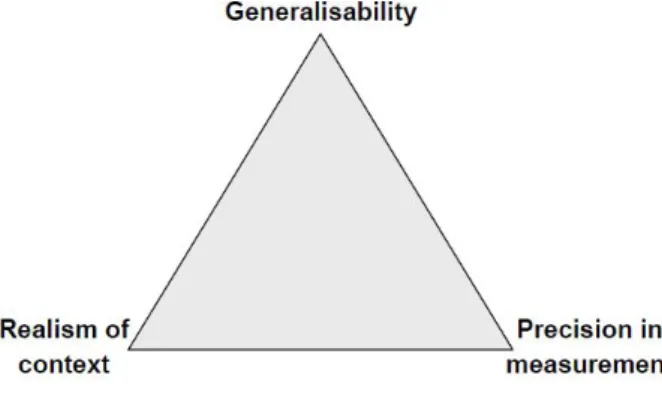
McGrath cited by Brent (2009) emphasised that the important factors that needed to be taken into account in research design are (see Figure 3.1):
a) Generalisability to the population that supports external validity;