i
UNIVERSITY OF KWAZULU-NATAL
A SYSTEMATIC STUDY OF THE GENUS RHOICISSUS Planch. (VITACEAE) IN KWAZULU-
NATAL
Sinethemba Faith Kunene
ii
A SYSTEMATIC STUDY OF THE GENUS RHOICISSUS Planch. (VITACEAE) IN KWAZULU-
NATAL
by
SINETHEMBA FAITH KUNENE
Submitted in fulfilment of the academic requirements for the degree of Master of Science
In the
School of Life Sciences
College of Agriculture, Engineering and Science
University of KwaZulu-Natal, Durban
DECEMEBER 2015
iii
PREFACE
The experimental work described in this thesis was carried out in the School of Life Sciences, University of KwaZulu-Natal, Durban from January 2013 to December 2015, under the supervision of Prof Ashley Nicholas, Dr Yougasphree Naidoo and Mr. Richard Boon.
The study represents original work by the author and has not been submitted in any form for any degree or diploma to any tertiary institution. Where use has been made of the work of others it is duly acknowledged in the text
NOTE
The proposed new names and new combinations are not to be considered scientifically available for use as they have not yet been validly or effectively published under the
Melbourne Code of International Nomenclature for Algae, Fungi and Plants
iv
DECLARATION BY SUPERVISORS
We hereby declare that we acted as Supervisors for this MSc student:
Students Full Name: SINETHEMBA FAITH KUNENE Student Number: 208 500 435
Thesis Title: A SYSTEMATIC STUDY OF THE GENUS RHOICISSUS Planch. (VITACEAE) IN KWAZULU-NATAL
Regular consultation took place between the student and ourselves throughout the investigation.
We advised the student to the best of our ability and approved the final documentation for submission to the College of Agriculture, Engineering and Science Higher Degrees Office for examination by the University appointed Examiners.
As the candidate’s supervisors we have approved this thesis/dissertation for submission
SUPERVISOR: --- PROFESSOR YOUGASPHREE NAIDOO
CO-SUPERVISOR: --- PROFESSOR ASHLEY NICHOLAS
CO-SUPERVISOR: --- MR RICHARD BOON
v
Plagiarism Declaration
I ……….Student no………
1. Know that plagiarism is wrong. Plagiarism is to use another’s work and to pretend that it is one’s own.
2. Will use a recognised convention for citation and referencing. Each significant contribution to, and quotation in, my report/ project from the work, or works, of other people has been acknowledged through citation and reference.
3. This report / project is the original work completed by myself, It has not been in use in any submissions to the university or collage.
4. I have not allowed anyone to copy my work with the intention of passing it off as his or her own work.
________________________ __________________
Signature of student: Date
vi
Abstract
The family Vitaceae, sometimes referred to as the grape family, comprises about 700 to 800 species and 13 to 14 genera, which includes Rhoicissus Planch. Rhoicissus contains 12 species all of which are described as climbing shrubs with tendrils that are without adhesive discs. This study was aimed at updating the taxonomy of the genus Rhoicissus in KwaZulu-Natal such that the names and number of species contained within the genus reflect the current findings. This dissertation looks primarily at the taxonomy of the leaves of the Rhocissus species of KwaZulu- Natal. The reason for this is that this work is meant to help conservationists, environmental managers, rangers, amateur botanists and others who will usually only encounters these species in their vegetative state. It is at this audience that this dissertation is aimed.
Rhoicissus tridentata was found to be a complex that is made up of three subspecies: R.
tridentata subsp. cuneifolia; R. tridentata subsp. diplonervia and R. tridentata subsp. tridentata.
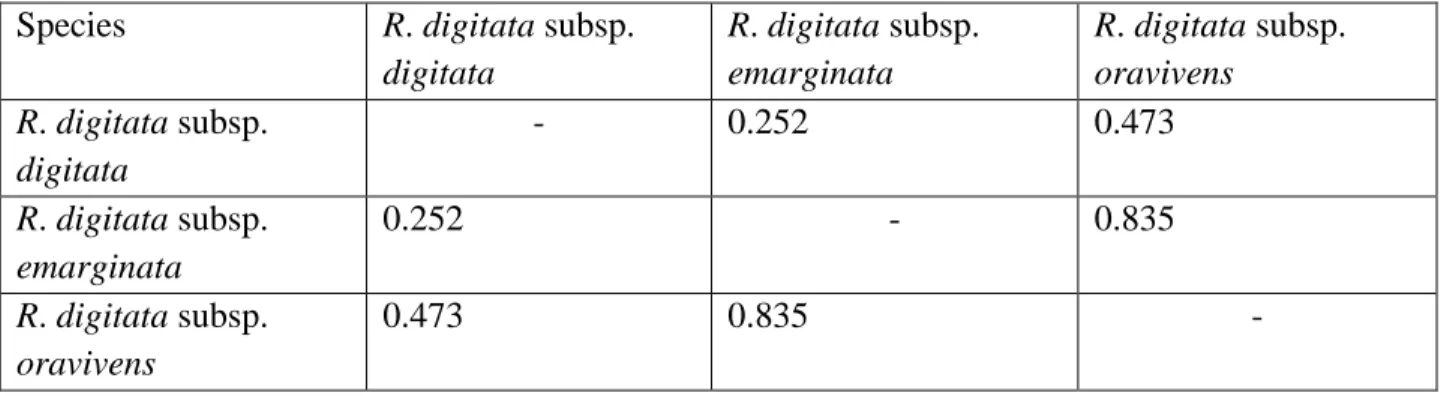
Phenetic results, scatter plots and polygonal graphs did not all support the division of R. digitata into three subspecies. Morphological results, however, did show the slight differences between the subspecies of R. digitata which are R. digitata subsp. digitata; R. digitata subsp. oravivens and R. digitata subsp. emarginata. The other species of Rhoicissus (R. revoilii; R. rhomboidea;
R. sessilifolia and R. tomentosa) were all found to be distinct species.
vii
Dedication
This thesis is dedicated to my late grandmother who was always supportive of me. She was the true pillar of my strength. It is also in part dedicated to my family, who also has been supportive of my dreams.
viii
Acknowledgements
I would like to thank and acknowledge Professor A. Nicholas for his continuous insight in regards to this study. For his patience, understanding and great knowledge when it came to the completion of this project. Dr. Y. Naidoo is thanked for her continuous and supportive role in bringing this project to fruition. Also thanks to Richard Boon for giving his time and knowledge at the beginning of this study. This made the identification and the grouping of the species in this study possible. Thanks to Dr. Elizabeth Retief for her dedication to the genus (Rhoicissus).
Her dedication to this genus made the research of this study easier. I would also like to say thank you to Nhlanhla E. Khathi for his technical and practical guidance which enabled the
documentation of specimens that would serve as evidence for field work. All this contributed immensely towards the completion of this study. Also, thanks to all my friends who helped me with all the field work that was conducted for this study.
ix
TABLE OF CONTENTS
Chapter 1 Introduction………..1 − 4 Chapter 2 Literature Review……….5
2.1 Species of Rhoicissus in KwaZulu-Natal………..………..6 2.1.1 Rhoicissus digitata………6 − 7 2.1.2 Rhoicissus revoilii………..7 − 8 2.1.3 Rhoicissus rhomboidea……….8 2.1.4 Rhoicissus schlechteri………...8 − 9 2.1.5 Rhoicissus sessilifolia………9 − 10 2.1.6 Rhoicissus tomentosa………..……….10 − 11 2.1.7 Rhoicissus tridentata……….………...11 − 13 2.1.8 General Observations……….13 − 14 Chapter 3 The Leaves of the Species of Rhoicissus…………..………………15 − 16 3.1 Types of Leaves……….16 − 18
3.1.1 Terminating and Lateral Leaflets………..………...18 − 19 3.2 Petiolate and sessile Leaves………..………19 − 20 3.3 Types of Margins on the Leaflets……….………21 − 22 3.4 Leaf Venation……….………..23 − 24 3.5 The Shapes of the Leaves of Rhoicissus……….………...24 − 28 3.6 Types of Apices on the Terminating Leaflets………28 − 29
x
3.7 Types of Apices on the Lateral Leaflets………30
3.8 Types of Leaf Bases on the Terminating Leaflets……….30 − 31 3.9 The Leaf Bases of the Lateral Leaflets………..31 − 33 3.10 The Presence and Absence of Hairs on the Leaves…………...33 − 36 Chapter 4 Distribution and Ecology………..39 − 43 Chapter 5 Materals and Methods………...44 − 45 5.1 Field Studies……….……….46
5.2 Phenetics ………...………46
5.3 Two Way ANOVA………...47
5.4 Scatter Diagrams………...47
5.5 Polygonal Graphs………..……….47
Chapter 6 Results……….………..48
6.1 Result Analyses………..………49 − 56 6.2 Phenetic Result……….………..57 − 60 6.3 Statistical Results for the subspecies of Rhoicissus digitata……….61 − 62 6.4 Scatter Plots………...……63 – 68 6.5 Polygonal graphs………..…...69 – 76 Chapter 7 Discussion………...77 − 85 Chapter 8 Taxonomy………...86
8.1 Key to the Species of Rhoicissus in KwaZulu-Natal………..……..87 − 88 8.2 RHOICISSUS Planch. ………..……....88
xi 8.3 The Taxonomy of the Species of Rhoicissus………..89
8.3.1 The Rhoicissus digitata group………..89 8.3.1a Rhoicissus digitata subsp. digitata……….89 − 92 8.3.1b Rhoicissus digitata subsp. oravivens Kunene, Nicholas & Boon Subsp. Nov.
………..……...…..92 − 94 8.3.1c Rhoicissus digitata subsp. emarginata Kunene, Nicholas & Boon Subsp. Nov.
………...…..…94 − 96 8.3.2 Rhoicissus revoilii………...97 − 100 8.3.3 Rhoicissus rhomboidea………..101 − 104 8.3.4 Rhoicissus schlechteri………...104 − 106 8.3.5 Rhoicissus sessilifolia………....………....107 − 110 8.3.6 Rhoicissus tomentosa………...………..110 – 113 8.3.7 The Species of the Rhoicissus tridentata Complex………113 – 115
8.3.7a Rhoicissus tridentata subsp. tridentata ……….115 − 117 8.3.7b Rhoicissus tridentata subsp. cuneifolia………..116 −120 8.3.7c Rhoicissus tridentata subsp. diplonerva ………...120 − 122 Chapter 9 Conclusion………...124 − 126 References……….……….127 − 132 Appendix………...133 − 146
1
Chapter 1
Introduction
2
Introduction
The family Vitaceae, sometimes referred to as the grape family, comprises of 700 to 800 species in 13 to 14 genera including Rhoicissus Planch. (Rossetto et al., 2007). These are spread
throughout the tropical and temperate regions of both hemispheres (Boon, 2010), distributed from Africa to Asia as well as in the Pacific islands (Rossetto et al., 2007; Siebert et al., 2001).
The majority of these genera are said to be predominantly distributed in the tropical and
subtropical regions (Rossetto et al., 2007). Studies show that the Vitaceae is most closely related to the monogeneric Leeaceae. This is based on the two families sharing the synapomorphies of the presence of raphides as well as pearl glands (Wen et al., 2007). Of the 14 genera worldwide, southern Africa harbours five of the genera and has a total of 53 known species (Boon, 2010).
According to Siebert et al. (2001), Vitaceae is among the most prolific families with regard to endemism in Sekhukhuneland (South Africa), along with Araceae and Euphorbiaceae.
This family contains a group of genera which are perennial woody climbers with leaf-opposed tendrils which are sometimes modified to form inflorescences (Rossetto et al., 2001). Tendrils of this family, like the leaves, are always lateral organs of the stem and are usually the ones bearing flowers (Shah and Dave, 1970). These tendrils then undergo modification to form inflorescences (Rossetto et al., 2001). They then usually branch during this process so as to hold multiple inflorescences at a time (Rossetto et al., 2001).
Although, with more than ten genera, this family is not genetically varied as only three major clades were supported within the family (Wen et al., 2007).
The first of the three clades contains Ampelopsis Michx, Rhoicissus Planch., the South American Cissus strista complex, Parthenocissus Planch., Yua C.L. Li, Vitis L., Ampeloissus Planch., as well as Pterisanthers Blume (Wen et al., 2007)
The second clade consists of the core of the genus Cissus L.
The third clade contains Cayratia Jussieu, Tetrastigma (Miquel) Planchon and Cyphostemma (Planchon) Alston.
3 Cissus is the largest of the 14 genera with approximately 350 species, distributed in the tropics worldwide (Ingrouille et al., 2002). Vitis with about 70-80 species, is by far the most
economically important genus in this family due to the inclusion of the species Vitis vinifera L.;
the grape which is commercially valuable (Ingrouille et al., 2002). Vitis vinifera is used to make wine and according to Gerrath and Posluszny (2007) is important economically worldwide and socially to western society (Ingrouille et al., 2002). It is also used as a table fruit and when dried produces raisins (red grapes) and sultanas (white grapes).
Although a relatively small genus, Rhoicissus adds to the ecological importance of the grape family (Gerrath and Posluszny, 2007). Rhoicissus is native to eastern Africa, extending from the Arab regions in the northeast to as far south as South Africa (Gerrath et al., 2004). Traditionally it has been considered to contain 12 species all of which are described as climbing shrubs with tendrils that are without adhesive discs (Gerrath et al., 2004). The flowers in this genus usually lack tendrils and are crowded into shortly pedunculate cymes (Gerrath et al., 2004).
Species within the genus are often used in traditional herbal remedies. These species are used all over southern Africa especially as the expense of Western medicines and medical care makes the trade of traditional medicinal plants essential in this region (Hutchings and van Staden, 1994).
Numerous surveys carried out in South Africa revealed that most of these remedies are used extensively to treat both human and animal diseases (Naidoo et al., 2006). Crude extracts from the leaves of Rhoicissus digitata (L.f.) Gilg & M. Brandt, roots of Rhoicissus rhomboidea (E.
Mey. Ex Harv.) Planch. and Rhoicissus tridentata (L.f.) Wild & R.B. Drumm., as well as the leaves and stem of Rhoicissus tomentosa (Lam.) Wild & R.B. Drumm. have been shown to have significant inhibitory activity against cyclooxygenase, an inflammation inducing enzyme (Lin et al., 1999). Even though 29 crude extracts from different species were tested for the inhibitory activity of cyclooxygenase, only extracts from R. rhomboidea and R. digitata exhibited the greatest inhibitory activity (Lin et al., 1999). Extracts of Rhoicissus tridentata subsp. cuneifolia (Eckl. & Zeyh.) Urton on the other hand had the highest anti-proliferation percentage (96.27%) against HepG2 cancer cells (Opoku et al., 2000). Other species of Rhoicissus (R. rhomboidea, R.
digitata as well as R. tridentata) were also found to have the ability of inhibiting the proliferation of these cancer cells when the crude extracts generated from their dried material were assayed (Opoku et al., 2000).
4 Extracts of R. tridentata have been found to have several compounds which are known for their health benefits, some of which support traditional healer’s claims that extracts generated from this species promotes good health during pregnancy (Brookes and Katsoulis, 2006). Also, herbal concoctions generated from R. tridentata are fed to children in cases where their mothers are away from home for a long time (Lin et al., 1999). Leaves and root tubers of the species of Rhoicissus are eaten by game animals; bush pigs and porcupines (Pooley, 1994). Birds and humans only eat the fruits of these species (Pooley, 1994).
Rhoicissus needs to be systematically studied because it has many valuable medicinal and ecological benefits that make this genus important. Knowing the correct name of each species would make the utilisation of their properties, both medicinal and ecological, more efficient and successful. Urgency in systematically analysing this genus should also be applied due to the potential cancer combating properties some species within the genus contain. This is particularly important as new and yet unnamed species of Rhoicissus has been proposed by Boon (2010).
These unnamed species need to be confirmed and if valid need to be named and described before they can be properly investigated for medicinal properties on a scientific basis. The application of names for these new species are also required if we are to establish their conservation status.
This study thus aims to update the taxonomy of the genus Rhoicissus in southern Africa such that the names and number of species contained within the genus reflect current knowledge i.e.
features and characteristics of the genus.
5
Chapter 2
Literature Review
6
2.1 Species of Rhoicissus in KwaZulu-Natal
2.1.1 Rhoicissus digitata (L.f) Gilg &M. Brandt
Taxonomically, Rhoicissus digitata (L.f) Gilg and Brandt (1911) (Wild and Drummond, 1963) has been described under six synonyms: Rhus cirrhiflora Gilg & Brandt; Cissus thunbergii Eckl. and Zeyh.; Rhoicissus thunbergii Planch.; Rhoicissus cirrhiflora (L.f) Gilg and Brandt as well as Rhus cirrhiflorum together with Cissus cirrhiflora (Wild and
Drummond, 1963). The basionym is Rhus digitata L.f.
Rhoicissus digitata, is among the species in Rhoicissus that has looping lateral veins. The species name, digitata, was given to this species because of the arrangement of its leaflets around the base of the petiole, which resembles that of an open hand (Pooley, 1994; Boon, 2010). Rhoicissus digitata has compound leaves of 3 and 5 leaflets (Wild and Drummond, 1963; Pooley, 1994; Retief, 2000; Retief et al., 2001; Boon, 2010). These different forms of compound leaves can occur on separate plants and sometimes on one plant there are more trifoliate than pentafoliate leaves. According to Boon (2010), the trifoliate leaves are often found on old growth while the pentafoliate leaves are mostly found on young growth of individual R. digitata plants. Terminating leaves of this species are oblanceolate to obovate in shape (Wild and Drummond, 1963; Retief et al., 2001; Boon, 2010) with some being emarginated. The leaflets are also smooth with entire margins, dark green on the adaxial surface and covered with fine russet hairs on the abaxial surface (Wild and Drummond, 1963; Pooley, 1994; Retief, 2000; Retief et al., 2001; Boon, 2010).
This species can grow and reach 15m in length and is usually a woody climber or a
scrambling vine in the riverine fringing vegetation, forest, forest margins, grasslands as well as valley bushveld (Wild and Drummond, 1963; Pooley, 1994; Retief, 2000; Retief et al., 2001; Boon, 2010). Besides South Africa this species can be found in Swaziland and Mozambique (Wild and Drummond, 1963; Pooley, 1994; Retief, 2000; Boon, 2010). In South Africa this species commonly occurs on the coastal dunes of both KwaZulu-Natal and the Eastern Cape (Wild and Drummond, 1963; Pooley, 1994; Boon, 2010). It also occurs in the Western Cape, Mpumalanga as well as the northern parts of South Africa (Wild and Drummond, 1963; Pooley, 1994; Boon, 2010).
7 This species is commonly known as Bobbejaandruif and vyfvingerdruif in Afrikaans (A);
baboon grape or the five-finger grape in English (E); isaqoni and isaQoni esincinci in iSiXhosa (X) and as isisnwazi, umthwazi, umnangwana, and umphambane in isiZulu (Z) (Pooley, 1994; Boon, 2010).
2.1.2 Rhoicissus revoilii Planch.
Rhoicissus sessilifolia was often mistakenly identified as R. revoilii and historically this species has been described with three synonyms. These are Rhoicissus erythrodes (Fresen) Planch. var. ferruginea sensu Eyles; Rhoicissus schlechteri Gilg & M. Brandt and Rhoicissus sansibarensis Gilg before it reverted to the oldest name: R. revoilii by Planchon (1887) (Wild and Drummond, 1963). In the past, it was believed that R. schlechteri was a form of R.
revoilii which represented R. revoilii in the northern parts of South Africa, parts of
Mozambique (which include Maputo) and parts of Zimbabwe (Wild and Drummond, 1963).
Rhoicissus revoilii on the other hand is mostly represented or found in areas north of Zimbabwe (Wild and Drummond, 1963).
Rhoicissus revoilii is either a shrub, robust woody climber, a small tree or a creeper in mid to high altitude forests; forest margins; bushveld; riverine shrubs or woodlands (Wild and Drummond, 1963; Retief and Herman, 1997; Retief, et al., 2001; Boon, 2010). At higher altitudes it is often found in Brachystegia woodlands especially those found occurring on rocky hills (Wild and Drummond, 1963). Rhoicissus revoilii has trifoliate leaves with entire margins, looping lateral veins, domatia on lateral vein axils of the abaxial surface as well as being dark to dark green in colour (Wild and Drummond, 1963; Retief and Herman, 1997;
Retief et al., 2001; Boon, 2010). The lateral leaflets of this species are asymmetrical and it also produces edible fruits (Boon, 2010).
Rhoicissus revoilii is widely distributed not only, within the bounds of South Africa (KwaZulu-Natal and possibly the Eastern Cape Province) but Africa as a whole (Boon, 2010). This species can even be found in areas such as the Comoros, Saudi Arabia,
Mozambique, Zimbabwe, Ghana, Congo as well as East Africa (Wild and Drummond, 1963;
Boon, 2010).
8 Rhoicissus revoilii is commonly known as bosdruif (A); forest grape (E); umbovu in si Swati (S); isaqoni and ingximba (X) and isinwasi (Z).
2.1.3 Rhoicissus rhomboidea (E. Mey. ex Harv.) Planch.
The leaves of this species are so unique and well defined in the genus (Rhoicissus) in that they are always made up of rhomboid leaflets (assymetrical rhomboid for lateral leaflets) and almost always with six dentitions along the margin (Wild and Drummond, 1963; Pooley, 1994; Retief and Herman, 1997; Boon, 2010). Like most species in the genus, this species has trifoliate leaves and russet hairs on both surfaces of the leaflets (Wild and Drummond, 1963; Pooley, 1994; Retief and Herman, 1997; Boon, 2010). In texture, the leaves are leathery, glossy, dark green on the adaxial surface and without hair when fully grown (Wild and Drummond, 1963; Pooley, 1994; Boon, 2010).
Rhoicissus rhomboidea is a canopy climber that can grow and reach a length of 20m (Wild and Drummond, 1963; Pooley, 1994; Boon, 2010). In terms of habitat, this species is found in forests, forest margins and thickets of areas such as KwaZulu-Natal, Eastern Cape as well as the north-west regions of South Africa (Wild and Drummond, 1963; Pooley, 1994; Boon, 2010). Other areas where it is found besides South Africa include Swaziland, Mozambique and Zimbabwe (Wild and Drummond, 1963; Pooley, 1994; Boon, 2010).
In more common terms this species is usually referred to as blinkblaarbosdruif (A); umbovu (S); umnxele, aqondi, umthwazi (X); isinwazi (Z) and the glossy forest grape (E) (Pooley, 1994; Boon, 2010). The fruits of R. rhomboidea are eaten by both people and birds while its stem is used to make ropes (Pooley, 1994; Boon, 2010).
2.1.4 Rhoicissus schlechteri Gilg & M. Brandt.
Based on its morphology and ecology, in this thesis, R. schlechteri Gilg & M. Brand is treated as a distinct species separate from R. revolii. Unlike R. revoilii, R. schlechteri can be found climbing low altitude sand and coastal forests as well as bushvelds all of which have
9 been often found to occur in sandy areas (Boon, 2010). Rhoicissus schlechteri can also grow and reach lengths of 5m (Boon, 2010). Not only was this species misidentified as R. revoilii in the past (but sometimes in the present too), it is also often misclassified as R. digitata, another Rhoicissus species with looping lateral veins (Boon, 2010). Around St. Lucia as well as coastal Maputaland, R. schlechteri apparently grades into R. digitata (Boon, 2010). The trifoliate leaves of R. schlechteri have a lanceolate terminating leaflet and relatively sickle- shaped lateral leaflets with an asymmetrical base (Boon, 2010). Intermediate plants between R. schlechteri and R. digitata are however being mapped with R. schlechteri even though they have much broader, obovate leaflets with rounded apices (Boon, 2010). The overall narrow leaflets of R. schlechteri have a pale, to mid green, to slightly blue-green colour according to Boon (2010). On the abaxial surface, they are usually grey and have grey-brown hairs which are normally seen on young leaves (Boon, 2010). Commonly this species is referred to as laevelddruif in Afrikaans and as the lowveld grape in English (Boon, 2010).
2.1.5 Rhoicissus sessilifolia Retief
Rhoicissus rhomboidea has in the past, been mistaken for R. sessilifolia (Retief, 1980). The first record of R. sessilifolia in the National Herbarium is that of a specimen collected by Guy and Ward (62) at the Umlalazi Nature Reserve (Retief, 1980). Material of this species had been collected for 20 years, however, they were either identified as R. rhomboidea or R.
revoilii or placed among the unnamed species (Retief, 1980). This occurred before the
species was correctly identified and described by Retief (1980). Rhoicissus sessilifolia differs from the other species in the genus by being the only species with sessile trifoliate compound leaves that do not have hair on them (Retief, 1980; Boon, 2010). Also, the lateral and
terminating leaflets have different shapes and sizes. The terminating leaflets have a lamina that is obovate to elliptic in shape while the lateral ones have a lamina that is ovate in shape (Retief, 1980). The number of dentition along the margin also differs between the lateral and terminating leaflets. Terminating leaflets are usually without dentitions along the margin but can sometimes have up to six dentitions, while the lateral leaflets usually have 1-3 dentitions along the margin (Retief, 1980; Boon, 2010). The branching stem of this species has very large lenticels that make the stem appear extensively corky and warty (Retief, 1980; Boon
10 2010). Rhoicissus sessilifolia is a climber in the dune and coastal forests of KwaZulu-Natal (Retief, 1980; Boon, 2010). This species occurs in a restricted area of the coastal dune forests of KwaZulu-Natal making it endemic to this area (Retief, 1980). This species can be found distributed from Mtunzini and Kosi Bay, and possibly extending into southern Mozambique.
It is commonly known as kusbosdruif (A) and the coastal grape (E) (Retief, 1980; Boon, 2010).
2.1.6 Rhoicissus tomentosa (Lam.) Wild & R.B. Drumm.
The leaves of this of species are unique in the genus as these leaves are the only ones with lobes along the margin, simple in form and 3-nerved at the base (Wild and Drummond, 1963;
Pooley, 1994; Retief and Herman, 1997; Boon, 2010). Some leaves of the same species can be extremely lobed to the extent that they appear 3-partite, i.e. one leaf having three lobes, with one for each nerve (Wild and Drummond, 1963). The leaves are also dark green on the adaxial surface, covered with rusty velvet hairs on the abaxial surface. Lobes can sometimes be kidney-shaped (reniform) (Wild and Drummond, 1963; Pooley, 1994; Retief and Herman, 1997; Retief, 2000; Boon, 2010). The rusty velvety hairs are also found covering young stems and tendrils, but are later lost on stems as they mature and are replaced by raised dots known as lenticels (Pooley, 1994; Boon, 2010). Unlike the young stems, the main stem of this species has a rough bark, and is broad and woody (Wild and Drummond, 1963; Pooley, 1994; Boon, 2010). In terms of habit, R. tomentosa can either be a scrambling shrub or a canopy climber that can reach up to 20m in length (Wild and Drummond, 1963; Pooley, 1994; Retief, 2000; Boon, 2010). This high climbing liana is found in forests (fringing forests or in gaps in closed forests) as well as on riverine bushes (Pooley, 1994; Retief and Jaarsveld, 1997; Boon, 2010). Specifically in South Africa it can be found from the Western Cape to Mpumalanga Province including KwaZulu-Natal and the Eastern Cape (Wild and
Drummond, 1963; Pooley, 1994; Retief, 2000; Boon, 2010).
Ecologically this species is significant as its swollen tubers are eaten by porcupines, baboons and bush pigs, while its leaves are browsed by game animals such as black rhino (Pooley, 1994; Boon, 2010). The swollen tubers have red outer flesh (Pooley, 1994; Boon, 2010). The
11 fruits of R. tomentosa are eaten by birds, mammals and people, and grown as an attractive vigorous climber as a result it makes a good screen patio cover (Pooley, 1994; Boon, 2010).
Compared to the other species of the genus, R. tomentosa is the most common woody climber in coastal and dune forests of KwaZulu-Natal. Rhoicissus tomentosa is almost always present in forests suitable for the species of Rhoicissus, either alone; with another or multiple other species of Rhoicissus. The other species found distributed among the
individuals of R. tomentosa in these forests depends on the geographical location of the forest.
Rhoicissus tomentosa (Lam.) Wild & Drummond is generally known as the common wild grape in English; umbovu in isiSwati; isaqoni and uchithibhunga in isiXhosa; umthwazi and isinwazi in isiZulu and gewone bosdruif in Afrikaans (Boon, 2010).
2.1.7 Rhoicissus tridentata (L.f) Wild & Drummond
Rhoicissus tridentata, like R. tomentosa, also tolerates an extensive range of climatic
conditions which include annual rainfall ranging from 380-1 500 mm (Wild and Drummond, 1963). The wide tolerance of both climatic conditions and altitude by this species might explain its varied distribution in a variety of habitats including habitats such as grasslands.
This species can be found distributed in dune forests, forest margins and grassy hillsides, thickets as well as in woodlands (Wild and Drummond, 1963; Pooley, 1994; Boon, 2010).
Rhoicissus tridentata can be seen in all these habitats particularly here in South African provinces such as KwaZulu-Natal; Eastern Cape; Western Cape; Free State; Northern Cape as well as the North West Province (Wild and Drummond, 1963; Pooley, 1994; Boon, 2010).
In these habitats, this species flowers are visited by sunbirds and its fruits are eaten by both birds and people (Pooley, 1994; Boon, 2010). This species can be found distributed as far north as Arabia and is also found all across central Africa to Ethiopia (Wild and Drummond, 1963). In upland northern Nigeria, R. tridentata grows as a trailer in the rocky areas of savannas (Wild and Drummond, 1963). This species can also be found in Angola, Mozambique; Lesotho; Swaziland and South Africa (Wild and Drummond, 1963).
12 Medicinally this species is extensively used by healers in the traditional medicine trade.
Concoctions generated from its plant material can be found in most vending stores around Johannesburg (Katsoulis et al., 2002). Reports of R. tridentata (L.f) Wild and Drumm. subsp.
cuneifolia (Eckl. and Zehr.) N.R. Urton (1963) is that it is used as a herbal oxytocics by nearly 80% of the South African Zulu and Xhosa populations, and it is among the six most frequently used species in such herbal remedies (Brookes and Katsoulis, 2006). In general, R.
tridentata and its subspecies are used to treat various ailments, and these include kidney and bladder complications, stomach ailments, colds, infertility as well as to facilitate childbirth (Boon, 2010). Rhoicissus tridentata subsp. cuneifolia was also found to have higher
antineoplastic activity against the HepG2 cell line, which are cancer cells, than the other nine traditional Zulu medicinal plants species in which the crude extract were also prepared from and their antineoplastic activity tested against these cells (Opoku et al., 2000). All these findings have crucial implications for cancer treatment in the future. While it is the roots and tubers that are mainly used by traditional healers to prepare concoctions, which are then used by their patients, to treat various ailments, the structure of the leaves of R. tridentata as a whole remain the most interesting taxonomic aspect about this species.
Firstly, the leaves of R. tridentata are trifoliate with a wedge-shaped terminating leaflet and a few to multiple dentations along the margin (Pooley, 1994; Boon, 2010). The size of the leaflets as well as the number and depth of toothing along the leaflet margin is highly variable (Wild and Drummond, 1963; Pooley, 1994; Boon, 2010). Rhoicissus tridentata subsp. tridentata has extremely small leaves and has entire or 3-4 dentations on the margin of each leaflet (Wild and Drummond, 1963; Urton et al., 1986; Pooley, 1994; Boon, 2010).
According to Urton et al. (1986), the reduction in leaf size, depth and degree of dentition as well as the increased density of indumentum observed in this subspecies are all ecological adaptations as it usually occupies the most arid regions. Rhoicissus tridenatata subsp.
tridentata chiefly grows in sandy soils of permanent coastal dune bushes (Urton et al., 1986).
It even extends inland to the southern Eastern Cape and into the Karoo, where it forms part of the dry Valley Bushveld vegetation (Urton et al., 1986). The leaves of R. tridentata subsp.
cuneifolia on the other hand are often large, with 10-12 dentations along the margin of the terminating leaflets (Wild and Drummond, 1963; Pooley, 1994; Boon, 2010). This
subspecies also has a wider distribution range than R. tridentata subsp. tridentata as it
13 extends from the Eastern Cape right through to the northern limits of South Africa (Urton et al., 1986). This might explain why R. tridentata subsp. cuneifolia is the most common form in South Africa (Wild and Drummond, 1963). In these areas it is found scrambling freely over the vegetation along forest margins or in high bushes (Urton et al., 1986). Generally, the leaf size and the density of indumentum decrease from the north to the south throughout the distribution range and as a result, the southern forms are usually without hair i.e.glabrescent (Urton et al., 1986). A wide variation in this character can be seen as the species of R.
tridentata have been reported to have tolarence of a wide range of altitudes ranging from 0 to 2000m (Wild and Drummond, 1963; Boon, 2010).
Also, the general trend is that R. tridentata subsp. tridentata represents the southern group while R. tridentata subsp. cuneifolia represents the northern group (Urton et al., 1986). The two groups are, however, sympatric and where this occurs (e.g. Grahamstown), the greatest diversity of form is observed, and intermediates of the two subspecies are encountered which, indicates hybridisation (Urton et al., 1986). The high level of hybridisation shown by the Rhoicissus tridentata complex might explain why there has been six different names given to R. tridentata before the nomenclature was corrected and stabalised by Wild and Drummond (1963). Rhoicissus tridentata has the following synonymy: Cissus cuneifolia Eckl. & Zeyh; Vitis erythrodes Fresen; Rhoicissus cuneifolia (Eckl. & Zeyh.) Planch.;
Rhoicissus erythrodes (Fresen) Planch. as well as Rhoicissus cirrhiflora (L.f.) Gilg & M.
Brandt.
2.1.8 General Observations
Based on the specimens used for analysing the complex relations of Rhoicissus species, it became clear that the northern areas of KwaZulu-Natal (i.e. the Zululand area), might have ideal conditions for both the existence and growth of most of the species within this genus.
Almost all the species within Rhoicissus have been collected from this area, although some species were collected in greater numbers in this area than others. Such is R. sessilifolia, with all the specimens (18 in total) collected from Zululand as well as its surrounding areas.
Another is R. tomentosa, where a total of 8 out of the 12 specimens analysed were collected
14 from Zululand. Rhoicissus tridentata has shown an interesting observation, from the
collection records as well as upon observationin the coastal forests explored during the course of this study. Rhoicissus tridentata has shown, in KwaZulu-Natal, a pattern of primarily being distributed along the Zululand area as well as its surrounding areas. Further, the shape of the leaflets of this species differ from different parts of KwaZulu-Natal in that specimens collected from the Drakensberg area differ from those collected around
Mtubatuba.
15
Chapter 3
The Leaves of the Species of Rhoicissus
16 Generally leaves are important in plants as they help to keep the plants alive through
photosynthesis. For the species of Rhoicissus, the leaves are especially important because they are used in identifying and classifying these species. The flowers of the species of Rhoicissus are microscopically small to be used for identification purposes unlike those of most species in other genera. Usually flowers are used for the identification and classification of most plants, however, leaf characters are used to identify and classify the species of Rhoicissus. Besides being too small and uniform, the fact that petals and sepals fall off early often results in the use of flowers to identify specimens, being difficult (Pers. comm. Richard Boon). Also, the flowers are reportedly similar between the species of Rhoicissus and can hardly be used for separating the different species of this genus. More luck may be had with fruit if it is present.
The use of leaves for these purposes is not difficult because they are highly diagnostic i.e.
extremely definitive as well as unique. Although some species in this genus share a few characteristics on the actual leaves, they are, however, still found to be uniquely different for each species. Different forms of leaves are observed in these species.
3.1 Types of leaves
Primarily there are two types of leaves, simple as well as compound leaves. Simple leaves (Figure 1) have only one blade that is not divided into leaflets. In this type of leaf form, the midrib is not divided to form a rachis. Rhoicissus tomentosa is the only species which has simple leaves. The rest of the species have compound leaves, most of which are trifoliate. Compound leaves (Figure 2) are those that have their single leaf blades divided into several leaflets. This type of leaf has the midrib as the main stalk that supports and connects the leaflets to the petiole.
The leaflets can either be two or more, extremely tiny or larger in size. The majority of Rhoicissus species have three leaflets i.e. trifoliate leaflets. These species are R. digitata (L.f.) Gilg & Brandt subsp. digitata; R. digitata subsp. nov. a; R. digitata subsp. nov. b; R. revoilii; R.
rhomboidea; R. schlechteri; R. sessilifolia; R. tridentata subsp.nov. c; R. tridentata subsp.
cuneifolia and R. tridentata subsp. tridentata. Rhoicissus digitata subsp. digitata can sometimes have five leaflets in which case the leaves are referred to as being pentafoliate. In addition, the
17 leaflets originate from the single point like the fingers around the palm of a hand, which is why it is said to be digitate.
Figure 1: An example of simple leaves observed on the species of Rhoicissus tomentosa. Note the leaves opposite the inflorescences are very compact and not tendril-like (x 0.73).
18 Figure 2: An example of a compound leaf from R. tridentata subsp. cuneifolia. Note the large
leaf opposite, to the more or less globose fruit (x 0.93).
3.1.1 Terminating and lateral leaflets
When the leaves are compound, they become divided into lateral and terminating leaflets.
This classification of the leaflets is based on their position on the actual leaves. Lateral leaflets are positioned on either sides of the terminating leaflet (Figure 3 a), while
terminating leaflets are found at the end of the actual leaves (Figure 3b). All the species of Rhoicissus mentioned above, with compound leaves, have both these leaflet types.
19 Figure 3: An example of lateral (a) and terminating (b) leaflets in R. digitata subsp. digitata (x
1.35).
3.2 Petiolate and sessile leaves
Leaves can be supported and connected to the rest of the plant by means of a petiole. When such an organ is present the leaf is said to be petiolate (Figure 4). When a leaf is directly connected to the stem and the rest of the plant without a petiole, it is then said to be sessile (Figure 5). Almost all the leaves of Rhoicissus species are petiolate. Rhoicissus sessilifolia is the only species with sessile leaves (Figure 5). The leaflets of R. sessilifolia do have petiolules. The leaves of R.
rhomboidea have the longest petioles of all the species of Rhoicissus.
a b a
20 Figure 4: Rhoicissus rhomboidea with a petiolate leaf (x 0.98).
Figure 5: Sessile leaves of in R. sessilifolia. The terminal leaflets in this species have long petiolules (x 0.64).
21
3.3 Types of margins on the leaflets
The margins of the leaves of Rhoicissus are diverse in that both entire and dentate margins are observed on the leaves. Entire margins (Figure 6) are those which are without lobes and/ or teeth.
Entire margins can be observed on R. digitata subsp. digitata; R. digitata subsp. nov. a; R.
digitata subsp. nov. b; R. revoilii as well as R. schlechteri.
Rhoicissus tomentosa is the only species not only with simple leaves but also with lobes (Figure 7) around the margin. The remaining species: R. rhomboidea; R. sessilifolia; R. tridentata subsp.
nov. c; R. tridentata subsp. cuneifolia and R. tridentata subsp. tridentata, have toothed margins (Figure 8). There are, however, differences between the margins of these species in that they are not the same. This type of margin (toothed margin) is even different between the species of the R. tridentata complex. Rhoicissus tridentata subsp. nov. c has the deepest dentitions in
comparison to the species of the complex. The teeth on the leaflets of R. tridentata subsp.
tridentata are the shallowest and sometimes absent. The leaves of R. tridentata subsp. cuneifolia have medium sized teeth. For R. rhomboidea, the teeth are usually six, but can be eight at times when the leaflets are large. The teeth when present are found at the end of the lateral veins that originates from the midrib.
Figure 6: The leaflet of R. digitata subsp. digitata with entire margins (x 1.08).
22 Figure 7: The simple leaf of R. tomentosa with lobes around the margin (x 1.01).
Figure 8: A leaf with toothed margins on its leaflets. In this figure though, the toothed margins are extensively deep in the leaflets of R. tridentata subsp. nov. c (x 0.85).
23
3.4 Leaf venation
There are two distinct groups when it comes to the leaf venation in the species of Rhoicissus.
There are those species with looping lateral veins, and those without. Looping lateral veins are those which branch out from the midrib, do not reach the leaf margin but instead connect to one another about 1mm away from the margin (Figure 9). Those without them reach the leaf margin without being connected to one another, other than at the midrib (Figure 10). The leaves without the looping veins terminate with dentitions while those with looping veins have entire margins.
Those species with looping veins are R. digitata subsp. digitata; R. digitata subsp. nov. a; R.
digitata subsp. nov. b; R. revoilii as well as R. schlechteri. Those without looping veins include R. rhomboidea; R. sessilifolia; R. tridentata subsp. c; R. tridentata subsp. cuneifolia as well as R.
tridentata subsp. tridentata. Of the species of Rhoicissus without looping lateral veins, R.
tomentosa is the only species with lobes and not dentitions on the margin.
Figure 9: A leaflet with looping veins which belongs to R. digitata subsp. digitata (with trifoliate leaves) (x 1.88).
24 Figure 10: A leaflet of R. tridentata subsp. cuneifolia with veins that terminate in a tooth (x
1.61).
3.5 The shapes of the leaves of Rhoicissus
For all the species of Rhoicissus with compound leaves (except R. digitata subsp. digitata with pentamerous leaflets) the lateral and terminating leaflets have the same shape. The lateral leaflets, however, have an asymmetrical shape of the terminating leaflets, except those of R.
sessilifolia which have a totally different shape to those of the terminating leaflets of the same species. As the result of the lateral leaflets being asymmetrical, the shapes of the leaves of Rhoicissus will be obtained from the terminating leaflets.
The subspecies of R. digitata have leaflets that are similarly shaped; the major difference can be seen on the apices of these leaflets. The leaflets of R. digitata subsp. digitata (those with
trifoliate leaflets); R. digitata subsp. a and R. digitata subsp.nov. b all have an oblong-shape (Figure 11). Those individuals of R. digitata subsp. digitata which are pentafoliate as well as those of R. revoilii have elliptic-shaped leaves (Figure 12). The leaflets of R. rhomboidea are rhomboid (Figure 13). A lanceolate to falcate-shape can be seen in leaflets of R. schlechteri (Figure 12). The terminating leaflets of R. sessilifolia have an elliptic-shape (Figure 14a), while an orbicular-shape can be seen on (Figure 14b) the lateral leaflets of this species. The leaves of
25 R. tomentosa have a deltoid-shape (Figure 15). The leaflets of the species of the R. tridentata complex have an overall wedge-shape (Figure 16). The terminating leaflets of R. tridentata subsp. nov. c are have an averall obovate-shape, as do those of R. tridentata subsp. cuneifolia and R. tridentata subsp. tridentata.
Figure 11: The leaves with the leaflets that are oblong in shape. These leaflets belong to R.
digitata subsp. nov. a, a new subspecies of Rhoicissus (x 1.33).
26 Figure 12: The leaves of R. schlechteri with a lanceolate terminating leaflet (x 0.82).
Figure 13: The leaves of R. rhomboidea with rhomboid terminating leaves (x 0.92).
27 Figure 14: The leaves of R. sessilifolia with elliptic terminating leaflets (a) and orbicular lateral
leaflets (b) (x 0.55).
Figure 15: The leaves of R. tomentosa with a deltoid-shape (x 0.73).
a
b
28 Figure 16: The wedge-shaped leaf found in species of the R. tridentata complex (R. tridentata
subsp. cuneifolia) (x 1.14).
3.6 Types of apices on the terminating leaflets
The apices of the leaves and leaflets of the species of Rhoicissus are extremely diverse, as much as five types are observed. Firstly, the general type observed on the terminating leaflets of R.
digitata subsp. digitata is rounded (for the species with trifoliate leaves), and tapering (for the species with pentafoliate leaves) (Figures 17 and 18, respectively). The type of apex observed on most of the terminating leaflets of R. digitata subsp. nov. a, is rounded (Figure 17). The apices on the leaflets of R. digitata subsp. nov. a are, however, wider than those observed on the leaflets of R. digitata subsp. digitata (the one with trifoliate leaflets). Most of the terminating leaflets observed on the leaves of R. digitata subsp. nov. b are emarginated (Figure 19). The apices on the terminating leaflets of both R. revoilii and R. schlechteri are tapering (Figure 18) with no teeth at the end. The apices on the leaflets of R. sessilifolia are rounded while the simple leaves
29 of R. tomentosa have tapering apices. The apices observed on the species of the R. tridentata complex are tapering; slightly tapering, as well as truncate for R. tridentata subsp. nov. c; R.
tridentata subsp. cuneifolia and R. tridentata subsp. tridentata, respectively.
Figure 17: The leaflet of R. digitata subsp. digitata with a rounded apex (x 1.46).
Figure 18: The leaflet of R. schlechteri with a tapering apex (x 1.40).
Figure19: Terminal leaflet of R.digitata subsp. nov. b with with an emarginated apex (x 1.20).
30
3.7 Types of apices on the lateral leaflets
The apices that occur on the lateral leaflets are also varied as much as those that occur on the terminating leaflets of this genus. The lateral leaflets of R. digitata subsp. digitata (individuals with trifoliate leaves) have rounded apices (Figure 17) while tapering apices (Figure 18) can be seen on leaflets of the individuals with pentafoliate leaves. The lateral leaflets of the new subspecies of R. digitata have rounded apices (Figure 17) for both subspecies. Those of R.
revoilii; R. rhomboidea and R. schlechteri have tapering (Figure 18) apices while the lateral leaflets of R. rhomboidea have a single dentition. Rhoicissus sessilifolia have rounded apices.
The subspecies of the R. tridentata complex (R. tridentata subsp. nov. c; R. tridentata subsp.
cuneifolia and R. tridentata subsp. tridentata) have tapering apices (Figure 18) all of which terminate with teeth.
3.8 Types of leaf bases on the terminating leaflets
When it comes to the bases of the terminating leaflets of Rhoicissus, all but two species have tapering bases (Figure 20). These two species are R. sessilifolia as well as R. tomentosa with rounded (Figure 21) and broadly truncate-shaped bases (Figure 22), respectively. The bases for R. tomentosa can, however, vary as truncate, cordate and rounded bases are found.
Figure 20: A leaflet with a tapering base of R. schlechteri (x 2).
31 Figure 21: The rounded bases of the leaflets of R. sessilifolia (x 0.88).
Figure 22: The leaf of R. tomentosa with a broad truncate-shaped base (x 1.56).
3.9 The leaf bases of the lateral leaflets
The bases of the lateral leaflets are so varied for the species of Rhoicissus such that, even the two sides of the same lateral leaflet exhibit two types of bases. The majority of the species were found to have lateral leaflets that were rounded on one side and tapering on the other (Figure 23).
Generally, the rounded side of the base of the lateral or side leaflet is found on the side that is away from the terminating leaflet, while the tapering side of the lateral or side leaflet is found on the side that is toward the terminating leaflet. Species in which both the rounded and tapering bases are observed are R. digitata subsp. digitata (trifoliate leaves); R. digitata subsp. nov a; R.
digitata subsp. nov. b as well as R. revoilii.
Another combination of the bases that was observed on the lateral leaflets was a tapering base on one side of the leaflet and a truncate-shaped base on the other side of the same leaflet (Figure
32 24). Again, the tapering side of the base of the side leaflet was found towards the terminating leaflet while the truncate-shaped side of the side leaflet was away from it. This combination was observed to have occurred on only two species namely R. rhomboidea as well as R. tridentata subsp. nov c.
The lateral leaflets of R. tridentata subsp. cuneifolia showed an even greater diversity when it came to the bases of these leaflets. Some lateral leaflets of this subspecies were observed to be tapering on one side and rounded (Figure 23) on the other, and others to be tapering on one side and truncate-shaped on the other (Figure 24).
Rhoicissus digitata subsp. digitata (pentafoliate leaves); R. schlechteri as well as R. tridentata subsp. tridentata all had tapering lateral leaflets at the base (Figure 20). The lateral leaves of R.
schlechteri were still, however, observed to be extremely asymmetrical at the base despite having only one leaf base type. Rhoicissus sessilifolia is the only species in this genus with lateral leaflets with rounded bases (Figure 21).
This high variation in the lateral leaflets of the species of Rhoicissus might be due to these leaflets being asymmetrical.
Figure 23: The base of a leaflet of R. digitata subsp. emarginata with an asymmetrical base rounded on ones side and tapering on the other (x 2.4).
33 Figure 24: Leaflets of R. rhomboidea with a tapering and truncated base on either side of the
leaflets (x 1.56).
3.10 The presence and absence of hairs on the leaves
The presence of hair on the leaves of the species of Rhoicissus is a common occurrence. There are, however, differences that might be observed among the hairs on the leaves of the different species. Leaves without hairs have also been observed in some species, such as those of the two new subspecies of R. digitata (R. digitata subsp. nov a and R. digitata subsp. nov. b) as well as R.
digitata subsp. digitata (Figure 26) which are without rustic, hirsute hairs on their leaves but rather have a very thick layer of wax (cuticle) on their epidermis. The thickness of the wax depends on the type of habitat the subspecies is growing in, as well as where it is located within that habitat. For these subspecies, the waxy layer thickens as they are exposed to dry conditions such as the sun, wind and sandy soil. The waxy layer is not as thick for the individuals of the subspecies which are found growing in moist and shady areas, especially where the soil can retain water. All these leaves are, however, glossy wherever these subspecies are growing.
Rhoicissus revoilii has tiny hairs on the surface of its leaves that are whitish in colour. Rhoicissus rhomboidea has hair on its leaves but its density varies based on the habitat it is growing in, as well as on how old the leaves are. Generally, the leaves of this species have white to brownish hairs on their surfaces. Short white hairs are often seen on the old leaves of the species growing
34 on the borders of forests (Figure 25). The young leaves of these species have long brownish and white hairs that are numerous and have leaves that are clustered together. Rhoicissus rhomboidea that grow within forests have extensively reduced hairs on their surfaces and longer internodes.
These species are also highly branched unlike their counterparts that grow in sun rich habitats.
Rhoicissus schlechteri and R. sessilifolia have leaves with short, white hairs.
The leaves of R. tomentosa have rustic hairs on their surfaces regardless of the habitat
individuals are found growing in (Figure 27). The difference between the species found growing in dry habitats and those found growing in moist habitats is in the size of the leaves. The leaves of the species found growing within forests are large, and may become semi divided into three
“subleaflets”, each one with its own nerve from the base. Some of the leaves of the species found growing in the borders of forests are smaller, sometimes with shorter whitish hair and are not divided. The hairs on the leaves of R. tomentosa like those observed on the leaves of R.
rhomboidea also start from the petioles and extend to the leaves or leaflets. The internodes on the species found growing within forests are also longer than their counterparts found growing on the borders of forests.
The Rhoicissus tridentata complex exhibits varying degrees of hairs on the surface of their leaves. Firstly, they all have hairs on their leaves. Secondly, R. tridentata subsp. tridentata has a high density of hair on its surface and this might be due to this subspecies being mainly found in grasslands. This might occur as a result of the excessive heat experienced at this environment.
The excessive hair on the leaflet surfaces might be there to deflect sunlight thus preventing water loss (transpiration). Rhoicissus tridentata subsp. nov. c has tiny whitish hairs on its leaves
especially those found growing within forests. The leaflets of this subspecies also grow to great lengths like the leaves of R. tomentosa; despite being trifoliate. The leaves of Rhoicissus
tridentata subsp. nov c when found growing in dry habitats are much smaller and have a high density of white hair. This might be a mechanism by which these subspecies deflect the sun in order to prevent water loss. Rhoicissus tridentata subsp. cuneifolia has short white hairs on the adaxial surface.
35 Figure 25: White hairs on the young leaves and stem of R. rhomboidea, while the mature leaves
are without hair on their surface.
Figure 26: The glossy leaves of R. digitata subsp. digitata growing on the floor of the Mkhomazi Forest.
36 Figure 27: Leaves of R. tomentosa with rustic red hairs on its surface as well as on its stem.
37
38
39
Chapter 4
Distribution and Ecology
40 The species of Rhoicissus are mostly found distributed in coastal dune forests; forest margins;
shrublands; grasslands as well as coastal forests of southern Africa (Wild and Drummond, 1963;
Pooley, 1994 and Boon, 2010). All the species of Rhoicissus have been reported to have been found along the coastal regions of KwaZulu-Natal (Wild and Drummond, 1963; Pooley, 1994 and Boon, 2010). Other areas of southern Africa, namely Zimbabwe; Mozambique and the North West Province; Western Cape and Eastern Cape of South Africa have only a few species of this genus found in their forests and grasslands. Rhoicissus revoilii can be found in the forests of Zimbabwe and the North West Province of South Africa. Rhoicissus tridentata subsp. tridentata has been collected in the forests and shrublands of the Eastern Cape Province. In all these
habitats and locations, these species are mainly climbers, but can sometimes be shrubs as well as small trees (especially the subspecies of the R. tridentata complex) (Wild and Drummond, 1963;
Pooley, 1994 and Boon, 2010).
Species occuring elsewhere in the South Africa include: Rhocissus sekhukhuniensis Retief, Siebert & A.E. van Wyk; Rhoicissus laetans Retief; and Rhoicissus kougabergensis Retief & van Jaars. these are all narrow endemics that occur outside the province of KwaZulu-Natal and will not be dealt with here.
As primary climbers, many species of Rhoicissus need trees (tall and short) to survive in the different types of habitats that they are found in. The environments in which they are found are currently under threats for various reasons which will be discussed below. In South Africa in this century alone, there has been an extensive loss of biodiversity of some habitats through their degradation (Neumann et al., 2010). Due to this, the life history characters, like reproductive traits, have fallen under strong selection pressure in order to maximise the fitness of the species for survival in particular habitats, while distinct sets of reproductive traits have changed as a result of the changing environmental conditions, altered pollinators and dispersers (Griffiths and Lawes, 2006). The changing environmental conditions can be caused by increased agricultural activities as well as urban development while climate change poses an even greater threat to the environment (Neumann et al., 2010). The change in the environment is a global issue as the attainment of natural resources for human-use has caused various damages to the environment such as its fragmentation, degradation as well as habitat loss (Grainger, 2011). As for cultivation, as a result of an increase in the human population, it now takes up the grazing lands from the
41 livestock which are in turn left to graze on marginal land (Mpanza et al., 2009). Livestock
grazing has resulted in the disturbance of the understory which greatly influences the plant diversity in these forests (Mpanza et al., 2009). Livestock grazing in these forests affects the species diversity through changing the vegetation structure, species composition, species abundance as well as plant nitrogen cycling and plant productivity (Mpanza et al., 2009). The balance between the shade-tolerant and intolerant species which occur within forests have obviously been affected due to fragmentation as a result of deforestation (West et al., 2000).
Deforestation is a division of a continuous forest into small patches which end up leaving islands of natural habitats with small interior areas still functioning (Weiermans and van Aarde, 2003).
Afforestation (artificial forests) poses an even greater threat to the South African grasslands as the most suitable areas for timber plantations overlap with the country’s regions which have the highest grassland biodiversity (Lipsey and Hockey, 2010). Approximately 3.3% (which is about 11, 500 km2) have been cleared for the plantation of exotic trees since 2004 (Lipsey and Hockey, 2010).
This increase in the degradation of natural resources due to human-induced disturbances has resulted in numerous efforts directed at determining the consequences of these disturbances which reflect high environmental awareness (Ferreira and van Aarde, 2000). All surface vegetation is removed during the mining of coastal sand dunes which then leads to the
disappearance of the associated animal life of the dunes and thus can be considered as a discrete disturbance event (van Aarde et al., 1996). The explicit aim of improving ecosystem structure and function after a modulation change in an ecosystem, due to a discrete disturbance event is known as rehabilitation (van Aarde et al., 1996). In the mining business (dune mining especially) ecological restoration is often a legally binding requirement of the mining permission as it is viewed to be integral in the conservation of biological diversity and sustainable development (Grainger, 2011). Ecological restoration involves the transformation of the disturbed habitat in a predetermined direction which is done through rehabilitation and restoration efforts (van Aarde et al., 1996). The rehabilitation of coastal dune is of great importance to Rhoicissus as the majority of Rhoicissus species grow in this coastal zone.
Thus change in the vegetation type in an environment can occur, such as in mesic savannas (such as those in the Hluhluwe-Umfolozi Park in KwaZulu-Natal) where the vegetation can shift from