WATER CONSERVATION AND WATER DEMAND MANAGEMENT IN BUFFALO CITY METROPOLITAN MUNICIPALITY
A thesis submitted in partial fulfilment of the requirements for the degree of
MASTER OF BUSINESS ADMINISTRATION in the
RHODES BUSINESS SCHOOL
by
KWANELE MLOMZALE
Student Number: 17M8538
Supervised by: Ms. Leticia Greyling
Submission date: 07 December 2020
DECLARATION
I, Kwanele Mlomzale hereby declare that the work contained within this research study is my original work, all sources are acknowledged and reported, and the work, in full or in part, has not been previously submitted to any other academic institution for obtaining an academic qualification.
07 December 2020
Signature Date
ACKNOWLEDGEMENT
I would like to thank all those who have contributed directly or indirectly to this study.
Thanking, also my God for the strength and inner encouraging Words through Jesus Christ, my Saviour.
A special appreciation to the following:
− My supervisor, Ms Greyling, for her support, wise advice, inspiring and encouraging words - even when I wanted to give up. I would not have done this without her guidance.
− Rhodes Business School, for the opportunity you have granted me.
− Buffalo City Metropolitan Municipality, for allowing me access to conduct this research.
− My colleagues and those who voluntarily participated in the interviews.
− My family.
ABSTRACT
Water is one of the scarce and constrained natural resource globally, and a necessity to every living creature, organism and the natural environment – it is the existence of life. Water, as an irreplaceable natural resource, plays a vital role in every country's development and prosperity, integrating socio-economic needs of both the present and future generation. Therefore, sustainable strategies and approaches or concepts are significant in ensuring that such a unique resource is preserved and conserved sustainably.
Municipal environment or local government sphere creates a pivotal role in governing the use of water, through the provision of legislation, regulations and establishment of water conservation and water demand management strategies and plans. However, it has been established that there is a lack of integrated water resource management approach and planning in municipalities, creating concerns with regards to controlling the overutilisation of water and protection of water sources in general.
The aim and goals of the study are to review Buffalo City Metropolitan Municipality's (BCMM) water conservation and water demand management (BCMM WC/WDM) development and implementation by, assessing the existing strategy related to water conservation and water demand management; constraints and opportunity identification; and provision of recommendations in improving the practices in the municipality.
The study presents core theories and empirical studies relevant to the water conservation and water demand management, and also deals with theoretical framework found under the Natural Resource-Based View and its application to water conservation and water demand management concepts. A qualitative research design approach was used for the research, which is underpinned by a post-positivism paradigm. In terms of data collection, two methods were used in the study: (i) document study and secondary analysis; and (ii) semi-structured interviews with BCMM relevant officials.
The study identified gaps and inconsistencies in the development and implementation of BCMM WC/WDM strategy, although the municipality has taken some step towards its implementation. However, the strives taken by BCMM in implementing water conservation and water demand management initiatives are acknowledged.
The study provides recommendations related to the findings identified upon the data collection and fieldwork. The recommendation proposed by the study includes proper communicating the BCMM WC/WDM strategy to all relevant stakeholders, focus on reducing the non-revenue water, implementation of various project related to pressure management, encourage culture of
using water efficiently through educational and community awareness campaigns, capacitation of BCMM including seeking financial support, continuous review of the strategy and exploring other water supply sources to relax the already constrained existing water sources.
The limitations of the study compared to the broader scope of water conservation and water demand management aspects are highlighted and acknowledged. Thus, in the conclusion of this study, further future studies are suggested to explore other related aspects of water conservation and water demand management in BCMM.
TABLE OF CONTENTS
DECLARATION... ii
ACKNOWLEDGEMENT ... iii
ABSTRACT ... iv
TABLE OF CONTENTS ... vi
LIST OF FIGURES ... ix
LIST OF TABLES ... ix
Glossary ... xii
CHAPTER 1: INTRODUCTION ... 1
1.1 BACKGROUND ... 1
1.2 LEGISLATIVE FRAMEWORK AND CONTEXTUAL OVERVIEW ... 2
1.3 OVERVIEW OF SOUTH AFRICAN WATER SUPPLY ... 3
1.4 DEMARCATION OF THE STUDY ... 3
1.5 PROBLEM STATEMENT ... 4
1.6 RESEARCH OBJECTIVES ... 6
1.7 CONCLUSION ... 7
CHAPTER 2: LITERATURE REVIEW... 8
2.1 INTRODUCTION ... 8
2.2 WATER CONSERVATION AND WATER DEMAND MANAGEMENT REVIEW 8 2.2.1 Background ... 8
2.2.2 Water Conservation and Water Demand Management Conceptualisation ... 8
i. Water Resource Management ... 16
ii. Distribution Management ... 17
iii. Consumer Demand Management ... 17
iv. Return Flow Management... 17
2.2.3 Need for Water Conservation and Water Demand Management in BCMM ... 18
2.3 NATURAL RESOURCE-BASED VIEW OUTLINED ... 19
2.3.1 Introduction ... 19
2.3.2 Theoretical Rationale ... 19
2.4 CONCLUSION ... 22
CHAPTER 3: RESEARCH METHODOLOGY ... 23
3.1 INTRODUCTION ... 23
3.2 RESEARCH METHODOLOGY AND PARADIGM ... 23
3.3 DATA COLLECTION TECHNIQUES ... 25
3.3.1 Interviewing ... 25
3.3.2 Document study and Secondary Analysis ... 25
3.4 POPULATION AND SAMPLING ... 26
3.5 VALIDATION OF QUALITATIVE RESEARCH ... 27
3.6 ETHICAL CONSIDERATIONS ... 27
3.7 STUDY LIMITATIONS ... 28
3.8 CONCLUSION ... 28
CHAPTER 4: RESULTS, FINDINGS AND DISCUSSIONS... 29
4.1 INTRODUCTION ... 29
4.2 RESEARCH OBJECTIVE 1: ... 30
Alignment of BCMM WC/WDM Strategy (BCMM, 2013) with the National WC/WDM Strategy (DWAF, 2004d) ... 30
4.2.1 Findings and Discussions with regards to Alignment of BCMM WC/WDM Strategy (BCMM, 2013) with the National WC/WDM strategy (DWAF, 2004d) ... 30
4.3 RESEARCH OBJECTIVE 2: ... 34
Assessment of the current BCMM WC/WDM strategy (BCMM, 2013) and evaluation of the progress and challenges encountered during the implementation of the strategy to date. ... 34
4.3.1 Findings and Discussion for Research Objective 2 ... 35
4.4 RESEARCH OBJECTIVE 3 ... 44
Identification of constraints and/or opportunities with regards to WC/WDM and make recommendations for improved practices at BCMM ... 44
4.4.1 Findings and discussions for Research Objective 3 ... 44
4.5 CONSOLIDATION OF SOME KEY ALIGNMENT CONCERNS AND CHALLENGES EMERGED FROM THE FINDINGS ... 46
4.5.1 Stakeholder engagement ... 46
4.5.2 Communication ... 46
4.5.3 Escalating non-revenue water and water balance ... 47
4.5.4 Billed meter consumption ... 48
4.5.5 Pressure management ... 49
4.5.6 Promotion of water efficiency programmes ... 49
4.5.7 Institutional capacitation ... 50
4.5.8 Financial support ... 51
4.6 CONCLUSION ... 52
CHAPTER 5: RECOMMENDATIONS AND CONCLUSION ... 53
Recommendation 1: Stakeholder engagement ... 53
Recommendation 2: Communication ... 54
Recommendation 3: Reduction of non-revenue water and detailed water balance ... 54
Recommendation 4: Billed meter consumption ... 55
Recommendation 5: Pressure Management ... 56
Recommendation 6: Promotion of water efficiency programmes ... 56
Recommendation 7: Enhancement of Institutional Capacity... 57
Recommendation 8: Financial Support ... 58
Recommendation 9: Review of the WC/WDM Strategy ... 59
Recommendation 10: Explore other alternative water supply sources ... 59
PROPOSED FURTHER RESEARCH ... 59
CONCLUSION ... 60
REFERENCES ... 62
APPENDICES ... 71
Appendix A – Interview Questions ... 71
Appendix B – Ethics Forms ... 74
Appendix C – Water Supply Scheme Schematic Layout ... 77
Appendix D – BCMM historical Raw and Potable Water Requirements ... 78
Appendix E – BCMM Water Balance ... 80
Appendix F – BCMM Water Supply Services Organogram ... 81
LIST OF FIGURES Figure 1: Water Conservation and Water Demand Management Concept ... 16
Figure 2: Stakeholder engagement process ... 53
LIST OF TABLES Table 1: Regional water supply schemes and dams supplying BCMM ... 4
Table 2: Comparative advantages of territories ... 20
Table 3: Comparison of BCMM non-revenue water goals and recorded progress ... 36
Table 4: Increased billed meter consumption ... 37
Table 5: BCMM water balance targets ... 38
Table 6: Pressure management progress ... 39
Table 7: BCMM promotion of water use efficiency ... 40 Table 8: BCMM Institutional capacitation progress ... 41
List of Acronyms
BCMM Buffalo City Metropolitan Municipality CSIR Council for Scientific and Industrial Research DWA Department of Water Affairs
DWAF Department of Water Affairs and Forestry DWS Department of Water and Sanitation
IDP Integrated Development Plan
IWRM Integrated Water Resource Management Ml/day Mega Litres per day
NWA National Water Act 36 of 1998
RBT Resource-Based Theory
RWSS Regional Water Supply System
The Constitution Constitution of the Republic of South Africa, Act 108 of 1996
WC Water Conservation
WD Water Demand
WC/WDM Water Conservation and Water Demand Management
WEF World Economic Forum
WSA Water Service Authority
WSDP Water Services Development Plan WSI Water Services Institutions
WWF World Wildlife Fund
Glossary
Business Plan
Evaporation
Integrated Water Resources Management
Non-revenue Water
It should incorporate vision, mission and strategy details and ought to address water supply and water demand, finances, funding, cash-flows, cost-benefits, roles and responsibilities, risks and address various regulatory and legislative requirements (Wegelin and Jacobs, 2013)
Air and water vapour pressures affect the evaporation rate, depending on the temperature (for both water and air), atmospheric pressure, wind water quality and surface's shape and nature (Department of Water and Sanitation, 2014).
It is a process that promotes the co-ordinated water resources development and management as to maximise economic and social welfare, sustainably and equitably without compromising the ecosystems to sustain itself (Department of Water and Sanitation, 2014).
Incorporates water System Inputs that are not revenue-producing and is equal to Apparent Losses plus Unbilled Authorised Consumption (Bement, 2014).
Real Losses Water that transported through a pipeline, but unable to reach the end-user as it is lost through the water system or network (Rabe, et al., 2012).
Revenue Water Contrary to non-revenue, it incorporates System Input components that produce revenue, and is equal to Billed Unmetered Consumption plus Billed Metered Consumption (Rabe, et al., 2012).
Unbilled Authorised Consumption
Authorised Consumption components that do not produce revenue (Department of Water Affairs and Forestry, 2004b).
Water Losses It is the Authorised Consumption and System Input difference, which can also be a total volume of the whole water system (Department of Water Affairs and Forestry, 2004f).
CHAPTER 1: INTRODUCTION 1.1 BACKGROUND
"We never know the worth of water 'till the well runs dry" – Thomas Fuller (Fowowe, 2016) Water is an essential environmental resource as it plays an unconditionally irreplaceable and necessary role in almost all the ecological services, such as hydrological cycle, creation of habitat, climatic regulation, and nutrient cycling (Smith, McDonald and Trinh, 2009).About 70% of our planet earth is covered by water, and we might think that is abundant; however, freshwater is extremely rare as only 3% is available for human usage or consumption (World Wildlife Fund [WWF], 2020). Thus, according to WWF (2020), about 1.1 billion people around the world has no access to water, with approximately 2.7 billion experience water scarcity at least a month per year.
As a result of an ever-increasing population, many natural water systems that keep the ecosystems flourishing and feeding the human population have become stressed (WWF, 2020).
There are droughts and floods in some areas due to altered weather patterns all over the world caused by climate change, and the increasing current consumption rate is worsening the situation. Maggioni (2015) also stated that in many parts of the world, there is a problem of freshwater scarcity and due to lack of infrastructure and climate change, many poor countries are experiencing such. Meanwhile, well developed and highly industrialised countries are experiencing droughts, degradation of water quality, and conflicts amongst different consumers or users (Maggioni, 2015).
It is of a great concern that although water is a very scarce globally, South Africa is over- exploiting its freshwater resources, creating major limitation in ensuring that the country implements its development plans of accelerating its investments, transformation and economic growth (Hedden and Cilliers, 2014). Consequently, water and wastewater are essential services in any business or industry and effective delivery of such services would assist in poverty eradication and promote economic growth and development of a country.
According to King, Mitchell and Pienaar (2011), awareness of risks such as climate change, drought, floods and deteriorating water quality are emphasised, specifically in the awakening evidence of degrading water sources or catchments. Hence, efficient and effective management of water resources in South Africa is crucial to ensure that the needs of the future generation are met, as water scarcity creates constraints to the development of any country. Water management and water conservation responsibilities and accountability are very significant at
local government level, as local government is the governance sphere that gives opportunity or grounds for the implementation of every national policy, legislation or strategy.
1.2 LEGISLATIVE FRAMEWORK AND CONTEXTUAL OVERVIEW
South Africa has a ground-breaking legislative framework with regards to recognition of natural water cycle importance in human lives and the environment at large, including their basic rights to it (Colvin, Muruven, Lindley, Gordon and Schachtschneider, 2016). The Department of Water and Sanitation is governed by the National Water Act (1998) and Water Services Act (1997), and the regulator and leader of the South African water sector. Through the development of national water resources strategy, the National Water Act (NWA) set out core principles relating and in support of water conservation and water demand management (WC/WDM) by establishing management practices, general international requirements and practical measures. It is to be noted that the Department of Water Affairs and Forestry (DWAF) was divided in 2009, and the Department of Water and Sanitation (DWS) was established in 2014 (hence the different naming within this document).As Biswas (2004) argued, water problem solutions do not only depend on the water availability, but also to many other factors such as integrated water management processes, existing legal framework appropriateness, water planning and practices, socio-political and environmental conditions, regional and international governance. Therefore, a holistic approach in managing water-related issues has been a requirement; thus, DWAF developed the Integrated Water Resources Management (IWRM) on a national level, incorporating WC/WDM components to be implemented on local government or municipal environment (Department of Water Affairs and Forestry, 2004d). This, in relevance to the study, links the IWRM with the WC/WDM concepts, and they are implemented in BCMM.
Savenije and Van der Zaag (2008) has highlighted that a country has to continuously review its policies related to water, as to ensure water management is an integrated and holistic management system and that it also meets the basic objectives and needs of socio-economic development and sustainability. Bement (2014) defines water management as the process of ensuring that the use of water resources is maximised in reducing negative impact to the environment and also balancing the consumer needs, through the development, management and distribution of water resources.
The water demand and water conservation management are incorporated under the integrated water resource management concept, with the adoption of WC/WDM active policies as key components to the IWRM plan (Department of Water Affairs and Forestry, 2003). The
would enable incorporation of institutional roles, enabling environment and management instruments as the three framework components. Biswas (2004) gives a statement on the concept of IWRM that the integrated water resources management provide that certain feeling of using an approach that is holistic and comprehensive, of which most people will theoretically assume that will probably produce required best results, even irrespective of certain inconsistencies and its shortcomings.
Savenije and Van der Zaag (2008:290) stated that “due to nature of water, integrated water resource management needs to be considered, based on water's natural dimension, i.e. taking the whole hydrological cycle into account; the water users (human dimension with all economic interest and stakeholders); the spatial distribution of water resources and uses; and taking into account the temporal variation in availability and demand of water resources.”
1.3 OVERVIEW OF SOUTH AFRICAN WATER SUPPLY
Colvin, et al. (2016) stated the following facts with regards to freshwater in South Africa:
− South Africa's main water source (rainfall) of 490mm per annum is the half of the world's average, of which 9% goes to surface water and rivers, and 4% recharges the groundwater.
− Half of freshwater is produced by 8% of the land area in this country.
− The biggest direct consumers are farmers, who use about 66% of all water.
− The national water demand will increase to 17.7 billion cubic metres (m3) by 2030.
− When invasive alien vegetation is removed, 2076 kilolitres of water is gained.
− South African municipalities have about 37% of portable water losses in their system.
South Africa's water resources are one of the important natural capitals of the country, thus need to be protected, preserved and used in a sustainable way, and Colvin, et al. (2016) agree that it is imperative that these water resources should be restored, conserved, monitored, maintained, controlled and managed carefully.
1.4 DEMARCATION OF THE STUDY
The context for this research is BCMM, which is within the Eastern Cape Province. BCMM consist of East London, King Williams Town, Dimbaza and Bisho towns, including townships such as Mdantsane, Zwelitsha, and Ginsberg within the rural area corridors (BCMM, 2017).
According to BCMM (2017), the towns and townships use an average water consumption of 60 to 320 litres/day per person; meanwhile, rural areas use 30 litres/day per person based on communal standpipes design (CSIR, 2005).
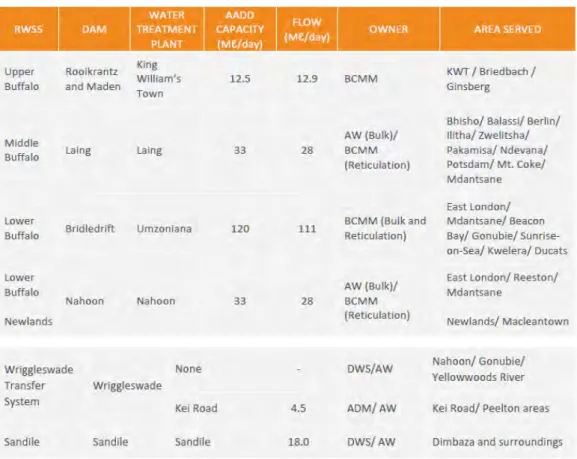
BCMM falls within the Mzimvubu-Keiskamma WMA, encompassing Gqunube, Buffalo, Kwelera, Gxulu, Tsholomnqa, Keiskamma and Nahoon River catchments (Future Works Sustainability Consulting, 2014). Thus, contained within these river catchments, there are eight main water sources (dams) supplying the entire BCMM population of approximately 834 997 (Lobanga, Crous, Brinkley, Griffioen and Ellis, 2019). A water supply schematic layout on Appendix C illustrates the water distribution of the mentioned water sources throughout BCMM. Appendix D also shows raw and potable water required for both domestic and industrial consumption in BCMM (BCMM, 2013). Table 1 below shows the Regional Water Supply Schemes, including dams, ownership and areas of supply for water conservation and water demand management information purposes.
Table 1: Regional water supply schemes and dams supplying BCMM
Source: Lobanga, et al. (2019:21)
1.5 PROBLEM STATEMENT
Water is crucial for the growth and prosperity of a country, especially a developing country like South Africa, which is faced with challenges related to water supply (Rabe, Maree, Ramano and Price, 2012). According to Botha and Chetty (2012), South Africa is considered as the driest countries globally, with drought and floods that are extreme, in various places.
BCMM is currently facing similar challenges with regards to droughts, as the municipality has
District Municipality has already been declared as a disaster area (BCMM Communications Department, 2020).
The major limiting factor to development and prosperity of the country is water scarcity, as water is the main source of life to both humankind, plants and animals. The growing human population is the major cause of increasing water resources contamination and water shortages (Bement, 2014). This needs creative strategies and approaches to the provision of water and effective solutions to water conservation and water demand management (WC/WDM).
Considering that South Africa is currently a developing country with a growing population requiring water as a basic need, expanded access to water supplies and our increasing environmental obligations presupposes a need for more water (Dzikus, 2001). Water is one of the over-utilised and constrained natural resources, which is also becoming increasingly scarce.
South Africa has been categorised as one of the countries that is water-stressed, and it is predicted to experience physical scarcity of water by 2025, with less than 1 000 m3 of freshwater available per person annually (Ochieng and Otieno, 2004). Hedden and Cilliers (2014) reported that the reason why South Africa is water-constrained is due to volatile and low water supply, coupled with poor existing resources usage and high-water demand.
According to Lobanga, et al. (2019), due to the persistent drought, BCMM is experiencing low levels of water in all the dams. Water scarcity and water crisis is a major concern worldwide, as it is listed as one of the many major risks that can cause severe impact, according to the World Economic Forum (WEF) Global Risk report, which was released in 2020.
There is a prediction that freshwater resources within South Africa will be fully utilised if the present water demand growth is not changed (Department of Water Affairs and Forestry, 2004a). Although South Africa has a supply of water infrastructure resources, there is a lack of infrastructure assets condition information resulting from a decentralised and dispersed municipality water services nature (Masindi and Duncker, 2016). The country is also facing water management challenges, lack of governance, poor infrastructure, climate change, poor water quality and lesser provision of alternative supply, to mention a few. Wegelin and Jacobs (2013) also highlighted that even though there have been many publications of numerous manuals, books and over the years, there has been continuous software packages production including presentations as to assist water supply managers in developing strategies in dealing with issues of WC/WDM, many municipalities in South Africa do not have proper WC/WDM Strategy. According to Athapaththu (2016), strategic planning can be a roadmap that provides an organisation's direction and guidance based on its present situation, how and where to get to its future goals. Furthermore, a strategy, directed by a vision, is concerned with a long-term trend and a sustainable accomplishment of goals (Louw and Venter, 2013). BCMM has
existing and developing industrial areas such as Industrial Development Zone (IDZ) that need a huge amount of water for production; therefore, water conservation and water demand management interventions are required to avoid water shortages in the near future (BCMM, 2017). Thus, successful implementation is needed in order to secure an efficient supply for residents together with businesses without draining the existing water sources.
It has also been reported that the information in many existing strategies is incomplete and vague (DWAF, 2011). Although South Africa is amongst the countries facing severe droughts in the world, it has not implemented its WC/WDM effectively. One of the critical problems experienced at a local government level with regards to the implementation of WC/WDM is caused by the lack of proper planning, coordination, and proper way of communication and sharing of information, amongst other things, and being unable to be fully aware of potential benefits and consequences of water restrictions (Wegelin and Jacobs, 2013). There is also lack of WD/WDM measures, adequate knowledge and expertise within the water industry with water services institution lacking knowledge on what drives the growth in water demand (Department of Water Affairs and Forestry, 2004d).
It is a constitutional right for everyone in South Africa to have access to water (Department of Justice, 1996), and every municipality has the mandate to give priority in providing a basic level of services such as water to its local communities in a well-structured and sustainable manner.
As a requirement from the national Department of Water and Sanitation (DWS, 2014), every municipality which acts as a Water Service Authority (including authorised municipalities) is required to prioritise the planning, development and implementation of water conservation and water demand management strategy (WC/WDMS). Therefore, according to Wegelin and Jacobs (2013), it is the responsibility of municipalities to obtain funds, appoint professional services providers such as consultants and contractors, provide budget and quality control, and ensure that timelines are achieved.
1.6 RESEARCH OBJECTIVES
The aim of this research is to review the current BCMM WC/WDM strategy developed and implemented in BCMM, aligned with the WC/WDM national strategy, through the following objectives:
− Assess the current BCMM WC/WDM strategy and evaluate the progress and challenges encountered during the implementation of the strategy to date.
− Identify constraints and/or opportunities with regards to WC/WDM and make recommendations for improved practices at BCMM.
This research hopes to highlight the importance of managing water as a scarce natural resource and providing effective water services to people including the business industry, and thus focuses on the planning, development and implementation of Buffalo City Metropolitan Water Conservation and Water Demand Management (BCMM WC/WDM) strategy within the sphere of local government.
1.7 CONCLUSION
The main focus in this chapter was to outline the study background, legislative framework supporting the WC/WDM, and also to give oversight of the study in terms of providing overview of water supply in South Africa, location of the study, problem statement and the actual research objectives.
The importance of conserving water (as a scarce resource) is highlighted in this chapter and it can be confirmed that South Africa is facing challenges due to water scarcity. Thus, there is a clear indication that legislation and strategies with regard to WC/WDM should be prioritize and put in place, to ensure sustainable use of water. Local government (municipalities such as BCMM) play an important role in ensuring that such legislation and strategies are effectively implemented and monitored. Thus, the focus of the study is WC/WDM in BCMM.
CHAPTER 2: LITERATURE REVIEW 2.1 INTRODUCTION
This chapter present core theories and empirical studies relevant to the research as it relates to the problem statement discussed in Chapter 1, and also deals with the theory and its application to WC/WDM concepts.
2.2 WATER CONSERVATION AND WATER DEMAND MANAGEMENT REVIEW
2.2.1 Background
According to DWAF (1999), WC/WDM conceptual perspective is the topic that has been continuously incorporated and stated in the South African water resource management literature. However, lately, it has been identified and argued that there had been no full recognition and appreciation of the WC/WDM principles' values and need (DWAF, 1999).
Reasonably, there has been evidence throughout the South African water institutes (Van Zyl and Leiman, 2002) that water is used in an unsustainable way, and its value seemed unimportant or not acknowledged by many water consumers. Viljoen and Van der Walt (2018) stated that South Africa is not only experiencing conditions of extreme drought, but its water conservation approaches, and associated records, are also poor and deficient.
2.2.2 Water Conservation and Water Demand Management Conceptualisation
According to the South African Department of Water Affairs and Forestry, water demand management (WDM) is a concept where consumers or water institutions adopt and implement a strategy as to affect the way water is used, in order to meet ideals around social equity, economic efficiency and protection of the environment (DWAF, 2004b). According to Stavenhagen, Buurman, Tortajada (2017) WDM literature review highlights policies that fall in these categories: non-tariff measures such as water awareness campaigns, operational improvements, water restrictions and regulations, and innovation in technology (such as smart- meters), meanwhile tariff measures are tariff reforms and water price increase. WDM should be regarded as a broader strategy with regards to the implementation of measures and systems related to the overall water usage and also should be linked with tariff increases and campaigns of communication (DWAF, 2004d). Consequently, water distribution and demand management from the consumer's side should be both included in the WDM. In order to ensure that future water requirements met for future development and growth, there are several possible and practical scenarios of the WDM role that can be used (Sandstrom and Singh,
opportunity, about 40% of existing water can be reduced without any negative impact on economic activities – making practical assumptions that there is feasibility of a full WDM potential in the water services sector.
On the other hand, Water Conservation (WC) includes environmental protection, effective and efficient water usage, and reduction of water loss or water use (DWAF, 2004a).
Thus, the concept of WC encompasses all water resources protection and effective management and should also be a strategy or an objective to water services institutions and water resources management. In acknowledging that South Africa is a water-scarce and stressed country, there is a need to establish long-term objectives of water conservation irrespective of objectives from water demand management. Van Zyl and Leiman (2002) emphasised that WC should be detached or incorporated and should be the key objective of the water services management, water resources management and as well as the national WC/WDM strategy (DWAF, 2004d).
On the other hand, WDM should be viewed as an objective instead of being a strategy, as the full WDM potential cannot be understood or recognised under a context that is limited (Van Zyl and Leiman, 2002).
a) WC/WDM as a Key Sustainable Concept
Water conservation and water demand management play a significant role in outlining the sustainability concept in this research proposal. Emas (2015:1) defines sustainability as
“development that meets the present generation's needs without compromising the future generation's ability to meeting their needs”. In addition to this, Pellicer-Martínez Jose and Martínez-Paz (2016) mentioned that one of the main challenges in water management is to establish how the present usage of water can be managed in order to ensure its availability to future generations and therefore, its sustainability. Wegelin and Jacobs (2013) have stated that there has been very poor implementation of WC/WDM at a municipal level, due to lack of proper planning and underestimation of the potential benefits or consequences of water restrictions. It has been estimated that 23% of water consumption in South Africa (including industrial and domestic use), occurs within the water services sector or local government, meaning that proper planning and implementation of water resource management within this sector is essential in order to balance water supply and demand (DWS, 2014).
b) Governance Arrangements concerning WC/WDM Development and Implementation
The DWAF, which is the responsible body under the National Water Act (No36 of 1998), developed a national Water Conservation and Water Demand Management Strategy (WC/WDMS) for Water Service Sectors in 2004 (DWAF, 2004c). The main aim of this
WC/WDM strategy is to establish long-term stability between water demand and available water resources, as to delay the need of large and expensive projects for infrastructure and to reduce wastage of water (DWAF, 2004d). This research will focus on the sustainable management of water through the development and implementation of WC/WDM strategies.
According to the National Water Act (No 36 of 1998), the National Water Resources (NWR) strategy should be able to set out and establish principles and guidelines related to WC/WDM (DWAF, 1998). Although the NWR strategy is simple, there was a need to develop manuals or guidelines to ensure that the planning, design and implementation of water conservation and water demand measures are clearly established (DWAF, 2004c).
According to Wegelin and Jacobs (2013), it is a government mandate to provide equitable, efficient and sustainable ways of providing water to communities. Furthermore, as stipulated in the Water Services Act (No 36 of 1998), each municipality that has been authorised to be a Water Service Provider (WSP) to its communities is required to develop and present practical measures that will promote water demand and water conservation management (Wegelin and Jacobs, 2013). Municipalities are required to develop, amongst others, their own WC/WDM strategies, where these WC/WDM strategies should also incorporate some WC/WDM guidelines and measures (Wegelin and Jacobs, 2013). According to DWAF (2004c), there are five strategies that have been developed by DWAF, and WC/WDM national strategy for the service sector is one of them. The fundamentals of the overall strategy form part of the NWR strategy, which then should be promulgated in the National Water Act (No. 36 of 1998).
The WC/WDM national strategy objectives are to ensure the role of WC/WDM is achieved efficiently by instilling the culture of saving water to the consumers/users and water service institution; to promote adequate allocation of capacity and resources by water institutions; to ensure integrated planning by water management institution; and to protect the environment, ecology and water resources (DWAF, 2004d). The WC/WDM national strategy further states that within the water services sector, there should be a provision of drought contingencies, such as enforcing water restrictions, installing proper water metering control, and appropriate revenue collection and billing structure (DWS, 2014). This will raise awareness and preparedness amongst water consumers, allowing them to place contingencies in place to improve their water conservation methods and reduce their consumption effectively.
Additionally, other areas of focus within the WC/WDM national strategy include the reduction of evaporation in existing water storage facilities such as dams, the reduction of water losses in existing infrastructure through pressure management application and the reduction of the amount of unaccounted water and non-revenue through the provision of water re-use strategies
approximately 1580 million m3 per annum of municipal non-revenue water, representing a staggering 36.8% of total municipal water supplied, has been estimated. Thus, at a R4.50/m3 nominal production cost, this represents an estimate of R7.2billions per annum municipal revenue loss (McKenzie, et al., 2012).
c) National Water Conservation and Water Demand Management Strategy Objectives and Review
A national water conservation and water demand management strategy was established by the then DWAF (2004d) to promote and motivated the necessity for water services and resources strategies at the beginning of planning processes, design phases up to the operation, maintenances and decommissioning of water-related projects and schemes. Thus, the national strategy promotes the sustainable use of water resources by focusing on social equity, economic efficiency and a sustainable environment. According to DWAF (2004d), the national WC/WDM strategy in South Africa focuses on three major water use sectors: water services, agriculture and industry (including power generation and mines). However, this study only focuses on water services as the main objectives and location of the study are pinned under the water services sector. The following are eight objectives determined by the national WC/WDM strategy as per DWAF (2004d):
1. To provide facilitation in ensuring WC/WDM role in sustainably achieved, affordable and efficient management of water services and water resources;
2. Create a WC/WDM culture for various water users and consumers;
3. To support the implementation of WC/WDM by water services and water management institutions;
4. Promote allocation and establishment of sufficient resources and capacity by water services institutions to the WC/WDM implementation;
5. To ensure water services and management institutions adopt integrated water planning;
6. Ensure water resources, ecology and environmental protection;
7. To create WC/WDM culture within all water services and water management institutions;
8. To endorse the development of joint WC/WDM strategies by water basin sharing countries and also ensure participation and international cooperation with other countries in the Southern Africa.
DWAF (2004d) also highlighted and emphasised that the broader strategy needs to incorporate international cooperation, communication, education, public awareness programme about the WC/WDM and also establishment of alien eradication programme under the Working For Water Programmes (WfW).
Financial support is the key component in implementing the WC/WDM strategy successfully.
According to Wegelin and Jacobs (2013), to implement the WC/WDM strategy effectively, financial capacity is needed, although most municipalities do not have the institutional capacity and financial support for such a strategy. Also, the current state of the South African economy is worsening the negative financial impact. On the contrary, it is an irony that municipalities in South Africa are complaining about lack of funds for their strategies (Wegelin and Jacobs, 2013). On the other hand, most financial or funding institutions are complaining that due to poor applications and strategy quality, they cannot find proper bankable projects (Wegelin and Jacobs, 2013).
There are important and basic principles that have been used in the development of WC/WDM strategies in order to attain a practical balance amongst economic efficiency, sustainable environment and social equity (DWAF, 2004d):
There is a need for water institution to develop a plan in supplying water to users in a way that is effectively and efficiently managed, i.e. through the promoting of WC/WDM objectives and minimisation of water losses in their water supply system. This can be done by ensuring that there is a reduction in water leakages at the waterworks or water supply systems up to an ideal or optimum required level. The measures implementation exercise should be continuous until the WC/WDM objectives or goals are achieved.
Water users or consumers should strive in using water sparingly or in an efficient way.
Minimisation in water wastage is vital as South Africa is a water-stressed and water-scarce country. DWAF (2004) defines water wastage as the water used without any benefits which they were intended for. Water used non-efficiently is water that is used without any benefit or is used over its intended benchmark for a particular purpose (DWAF, 2004).
When planning for water supply, water resources, water services processes take place, WC/WDM should be considered and incorporated in the planning. Hence development and implementation of WC/WDM measure is vital, as it promotes suitable solutions and cost- effective ways to reconcile the ever-growing water demand on very scarce and deteriorating water resources. The integrated planning process is substantial as to provide a relevant scope of work and resources allocation for the WC/WDM activities prioritisation. WC/WDM also
can limit the capital infrastructure (such as bulk water supply, water treatment works and dams) need where water is used insufficiently.
Intervention measures under WC/WDM should be inclusive but not limited to the improved billing system, metering, leak detection and repairs, awareness campaigns, pressure management and pipeline mains replacement (DWS, 2014). Improving billing systems would result in people being conservative in their water usage, as wasteful usage results in monetary consequences. Efficient leak detection systems can result in leaks being identified immediately, therefore conserving water in the pipeline system (that is a reduction in water wastage created by burst and leaking pipelines).
Using economic efficiency, the WC/WDM paradigm shift focuses on the consumer by ensuring that there are sustainable and affordable services for water usage (Water Services Regulatory Board, 2009). WDM, therefore, requires an all-inclusive approach which identifies the inter- relationship complexity of all factors affecting water demand (Thivet and Fernandez, 2012);
thus, calling for the establishment of an enabling environment grounded on suitable supportive policies and a proper legal framework with comprehensive regulatory measures in support of those policies (Thivet and Fernandez, 2012). This also highlights the importance of communicating the strategy through stakeholder engagement (Wegelin and Jacobs, 2013).
The fundamental principle for effective water conservation and water demand management is the proper application of practical and feasible WC/WDM interventions. According to Bryx and Bromberg (2009), there are a variety of the best practices initiatives being implemented to achieve the water demand management, such as educational and public awarenesses, water restrictions and water-wise building designs (featuring wastewater recycling).
On the other hand, pressure management and retrofitting can also be used in calculating the estimated savings (Wegelin and Jacobs, 2013; McKenzie, et al., 2012). They are also best practices to manage water conversation such as metering, water balance, and leak management or leak detection (Environmental Protection Agency, 2016). These are not only applicable locally but also are practised on an international level.
Communication breakdown amongst various stakeholders and institutions within the water supply environment, resulting in lack of cooperation, coordination and integration of WC/WDM information. According to Wegelin and Jacobs (2013), there is complexity in institutional arrangements particular with the urban area water supply, thus making it difficult to integrate the whole water supply chain planning. Gondal and Shahbaz (2012) further stated that breakdown in interdepartmental communication could impact the organisation efficiency and intensify stress level on employees, which can ultimately result in poor performance.
WC/WDM measures are often perceived as drought-relief tools, and the low payment of water services by the consumers even worsen the situation (McKenzie, 2014).
According to Wegelin and Jacobs (2013), approximately 44% of municipalities are unable to provide a proper water balance; thus, there is no baseline volume as a key water management information. One of the major issue when it comes to water balance in South Africa is that water is metered and billed to consumers, but there will be no recovery of payment due to high internal plumbing leaks (Mckenzie and Wegelin, 2006). However, Mckenzie and Wegelin (2006) stated that in other countries, this is not tolerated, as they have strict water bylaws.
DWAF (2004b) emphasise that there is visible lack of WC/WDM strategic tools such as planning tools, appropriate information and information systems, understanding of underpinning principles, and proper guidelines in the South African context.
Although water scarcity is caused by its physical or natural scarcity, in some cases, the majority is caused by managerial or human-made factors (Mutamba, 2014). Mutamba (2014) further argues that there is a struggle with water services providers in balancing the limited water resources and ever-growing water demand. BCMM's water balance has been reported on a city- wide level (GLS Consulting, 2019), and due to poor bulk meter data, present data is estimated in calculating the water balance, thus, in reality, targets pertaining water balance are not achieved (Lobanga, et al., 2019). However, in some part of the country, there is unbilled authorised consumption existing limited information, which impacts the unaccounted water component when comparing both the input and output volumes in the water balance (McKenzie, et al., 2012). McKenzie, et al. (2012) also stated that a major problem that requires attention is the inaccurate metering, billing and cost recovery, which are the key finance function in municipalities.
As WC/WDM strategies are often associated with a massive budget, there is also a challenge with financial constraints as most municipalities are unable to obtain external funding, resulting in detailed and important WC/WDM studies remaining dormant and undeveloped (Wegelin and Jacobs, 2013). According to DWAF (2004b), Water Services Institutions do not have financial muscle and resources to support the implementation of WC/WDM measures or activities, although the outcomes are a financial benefit. This is due to bottleneck and limiting regulations imposed on local authorities or government on increasing capital expenditure. It is important to calculate financial benefits on each WC/WDM measures as this will assist in further motivating for funding of any WC/WDM relevant programmes (Conward Consulting, 2007).
Another issue to development and implementation of WC/WDM is lack of political support, which is still a stumbling block in most municipalities (Wegelin and Jacobs, 2013). No interest and commitment to the WC/WDM is shown by political institution and management (lack of political will) (DWAF, 2004b). According to Conward Consulting (2007:11), a sustainable WC/WDM programme is a “relatively new function within most municipalities within South Africa, and senior management and Councillors do often not appreciate it”. However, Mckenzie and Wegelin (2006) concluded that it has been found in most cases that politicians in local level do not support WC/WDM interventions although they are enforced upon them by the Department of Water and Sanitation. Wegelin and Jacobs, (2013) emphasised the lack of proper presentation of Water Integrated Management (WIM) to the politicians on the basis of figures, facts and discussions done on a monthly basis.
d) Water Conservation and Water Demand Management Guidelines
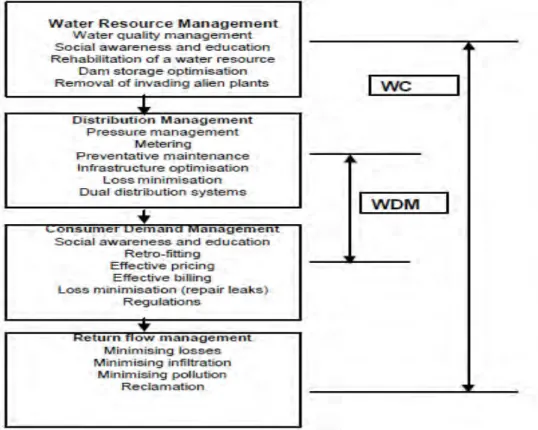
DWAF (2004f) established guidelines with the aim of assisting the water services authorities (BCMM included) in implementing WC/WDM and any related water-efficiency measures, in a sustainable way. The guidelines provide measures to be undertaken under the following WD/WDM concept – which is further discussed henceforward in the study (DWAF, 2004f):
− Water Resources Management: The various practical measures include water quality management for both surface and groundwater; and removal of alien vegetation.
− Distribution Management: Measures includes consumer meter management, pressure management, asset management, leak reduction and flow measurement.
− Consumer Demand Management: Dealing with habits in conserving water such as social awareness and education; and financial management through billing.
− Return Flow Management: Minimising infiltration; wastewater or water re-use and tariff management, are the measures applicable.
− Management and Institutional Aspects: Incorporates human resources development;
institutional strengthening and capacitation; and drought management.
e) Water Conservation and Water Demand Management Linkage
In broad terms, WDM is considered as a WC component, whereby the WC concept focuses more on efficient use of water resources, while the WDM concept is centred around obtaining solutions that are beneficial to water services based on different perspectives as well as financial and social aspects (City of Cape Town, 2007). Although differences between WDM and WC are shown, it is impossible to separate these two concepts from a management perspective; thus, these concepts are frequently used as synonymous terms (DWAF, 1999).
While the WDM strategy under the Water Services Act (No 108 of 1997) focuses on non- revenue consumption reduction measures; the WC perspective, however, requires water users to adapt to conservation culture and ethics (DWAF, 2004c). According to DWAF (2004d), even though there might be different objectives between WC and WDM, it is impractical to separate their interconnected components, therefore, the WC/WDM strategy includes both concepts combined. Figure 3 below show the WC/WDM concept through the water supply chain or linkage:
Source: Department of Water and Forestry (2004c:13)
Figure 1: Water Conservation and Water Demand Management Concept
i. Water Resource Management
The DWS (2014) addresses the issue of managing water quality by giving responsibility to Water Services Institutions (which include municipalities such as BCMM) as key stakeholders in ensuring that water resources are well managed, monitored and protected. Monitoring, management, control and protection of water resources is significant as poor water quality in a catchment is unsuitable for human consumption and any other economic use which requires water pre-treatment processes (DWAF, 2004f). Although water resource management is placed under the control of DWS, it is important that BCMM, as a key stakeholder, is engaged in relations to status quo and future developments of water sources within its boundaries/catchment. As DWS owns most water storages dams that supply BCMM, therefore, also support BCMM through its functions as a water services provider (Lobanga, et al., 2019).
ii. Distribution Management
It is the responsibility of a Water Services Institution or Authority to ensure that distribution of water to consumers is well controlled, monitored and well managed as it is one of the IWRM objectives (DWAF, 2004b). This can be done through WC/WDM activities such as flow measurements, sectorisation or zone meter, water leakage reduction, pressure management, consumer-meter management and asset management (DWAF, 2004b; McKenzie, et al., 2012).
According to Mckenzie and Wegelin (2006), in other countries, water bylaws and policies are strict on controlling internal plumbing leaks for consumer, and this is done by applying of payment recovery from the water users with high internal leaks. BCMM's main responsibility, as a Water Service Authority, is to manage water distribution system within the municipality;
thus, the WC/WDM interventions related to distribution management are duties of the municipality (BCMM, 2013a). The study evaluates whether this has been incorporated in the BCMM WC/WDM strategy.
iii. Consumer Demand Management
According to Bryx and Bromberg (2009), consumer demand management awareness such as education and public awareness has been considered as one of the WC/WDM best intervention practices. This water services phase deals or focuses on domestic, commercial and industrial water usage, but the WC/WDM measure deals more specifically on household water use.
Consumer demand management is a phase were social awareness, and education campaigns play a vital role as it targets the individual consumer level (DWAF, 2004f). BCMM sees the necessity to expertise a very specific action plan through communication, education and awareness programmes to drive behavioural change and achieve consumer commitment (BCMM Communications Department, 2020).
iv. Return Flow Management
Wastewater reclamation, including water re-use strategies, is incorporated under the return flow management, to minimise losses and infiltration (DWAF, 2004b). According to Rabe, et al. (2012), less water will be disposed, and lesser water will be abstracted from existing water resources when effluent from wastewater treatment works is re-used. Thus, based on environmental benefits, augmented stream flow containing recycled or used water has the ability to recover or improve habitats within the stream, meanwhile providing increase on potable water supply (Plumlee, Gurr and Reinhard, 2012). Milne (1979) also stated that residential water consumption could be reduced by partial re-use system and also reduce the load on municipal sewer systems. Thus, incorporation of water re-use or recycling intervention is one of the WC/WDM invention practices (Rabe, et al., 2012). The BCMM Water re-use
strategy should incorporate the possible re-use of effluent (return flow) from the wastewater treatment works (Lobanga, et al., 2019).
2.2.3 Need for Water Conservation and Water Demand Management in BCMM According to Rabe, et al. (2012), there is a need to implement WC/WDM interventions on the water-demand side as to effectively reduce artificial demand and physical water losses. The implementation of WC/WDM measure has a holistic, sustainable benefit to both the customer, organisation and the natural environment. According to Conward Consulting (2007), WC/WDM provides the most efficient and effective measures that require no huge investments necessary for bulky water resource schemes; thus, there is a postponement of water supply capital infrastructure. Dziegielewski and Baumann (1992) alluded that water demand management initiatives and measures may reduce short-term water supply and wastewater disposal costs.
According to Maddaus (2011), key quantitative benefits with regards to water conservation are reduction in operation and maintenance due to pumping energy efficiency and lesser chemical acquisition, including treatment and disposal; reduction in water purchase from water providers; and lowering water demand can also postpone infrastructure upgrades and construction cost.
The programs associated with WC/WDM are in general, cost-effective, faster and easier to implement than the traditional programs related to water supply (Rabe, et al., 2012). Financial risks caused by misjudged or miscalculated future water demand can be reduced, as predictions of such future demands can be complex and uncertain due to drought, economic or pandemic impacts (Conward Consulting, 2007).
WC/WDM measures can also reduce the effluent volume that needs to be treated, which results in environmental benefit as treated return flow volumes to natural water sources are decreased (DWAF, 2004f). Therefore, overall, base and peak water demands can be reduced through water use efficiency.
According to DWAF (2004f) and Conward Consulting (2007), WC/WDM ensures sustainable, basic and necessary service delivery specifically to low-income households, in an effective and efficient manner; thus, WC/WDM programmes are the catalysts in reducing non-revenue water, reduce leakage and reduce water accounts to acceptable and affordable levels for individuals. Some WC/WDM activities and programs such as retrofitting are labour intensive, thus creating jobs opportunities to the communities such as plumbing or any other semi-skilled work (DWAF, 2004f; Maddaus, 2011). Provision of equity through reasonable or fair tariffs.
Financial savings or benefits from the WC/WDM can be redirected to other community-needs services (DWAF, 2004f). While there is a possible increase in water tariffs, the overall to utility costs would automatically reduce as influenced by lower-cost providing water services.
2.3 NATURAL RESOURCE-BASED VIEW OUTLINED 2.3.1 Introduction
Although the relevant literature is outlined, the underpinning theoretical framework for this research is found in the Natural Resource-Based View (NRBV). The hypothesis is in discovering the linkage between the organisational effectiveness and its pollution preventing.
In consideration, the use of NRBV highlights on how the organisation can adjust competences or capabilities in the ever-changing markets.
2.3.2 Theoretical Rationale
NRBV is one of the theories founded upon the organisation's relationships to the natural environment, and in ensuring this, the Resource-Based Theory (RBT) has key elements such as a resource and a capability which focus on the organisation’s internal factors that contributes to a sustained competitive benefit. According to Hart (1995), the emphasis in the RBT is that;
for an organisation to have a continuous competitive advantage, a resource should be rare, valuable, unique, and be supported by complex processes within the organisation. The value created in the resource allows stakeholders to have a willingness toward sustaining it and its rareness provides an organisation to command quality and avoid competition in the market.
However, there is an omission in the RBT (Hart, 1995), where it ignores the interaction between an organisation and the natural environment. Thus, this can create a serious constraint towards the organisation's sustainability developments. NRBV contrast, however, that sustainable development, product stewardship and pollution prevention are important capability strategies.
On the other hand, Madhok, Li and Priem (2010) specified that the NRBV views organisations as collections of evolving capabilities and resources managed for the purpose of earning.
Therefore, firms or organisations deploy strategies for the purpose of making, enhancing and capturing economic rents (Madhok, et al., 2010).
According to Hart and Dowell (2011), it is suggested that sustainable development research should be done in a more case-comparative and qualitative approach; however, it is also argued that in the mid-90s it was rare to find large manufacturing firms which were committed to this sustainable development vision. Gupta (2015) further argues that there is a significant controversy with regards to the comparative advantage and its application, as either the competitive advantage framework/model interprets it inaccurately or regards it as useless.
Comparative advantage can be defined as that special ability of a country or organisation to provide service or product fairly more economically than other services (Madhok, et al., 2010).
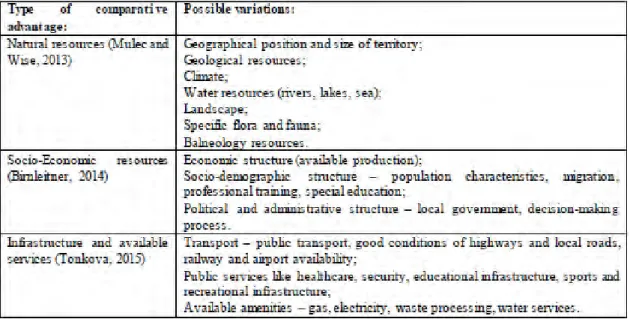
Technological superiority and resource endowment (such a human skills) are considered dynamic elements supporting comparative advantage (Gupta, 2015). Porter (1990) defines comparative advantages as so-called production factors such as labour, natural resources, land and financial capital. Balashova-Kostadinova (2017) clearly illustrate the comparative advantages of territories related to a municipality in Table 2 below:
Table 2: Comparative advantages of territories
Source: Balashova-Kostadinova (2017:42)
As per Table 2, BCMM can utilise comparative advantages such as its natural water resources, social-economic resources (including professional training, political and administrative structures), infrastructure and available services related to water in enhancing its WC/WDM strategy. Thus, the availability of resources does provide a source of comparative advantage (Gupta, 2015). According to the natural resource-based view, competitive advantage can only be sustained when resources creating organisation capabilities are available and used in a proper manner (Hart, 1995). Physical assets such as infrastructure, financial assets, human capital (i.e. employees' capabilities and skills) and social or organisational processes are the basic "resources" described in the natural resource-based view concept. According to Wegelin and Jacobs (2013), municipalities need financial capacity to implement WC/WDM strategy successfully; meanwhile, Masindi and Duncker (2016) stated that infrastructure assets conditions are one of the key concerns when it comes to water services issues in municipalities.
Also, BCMM has to prioritise the capacitation of its employees dealing with WC/WDM strategy, to ensure that the strategy is developed and implemented successfully.
The hypothesis-testing is suggested to be done on pollution prevention constructed strategies, as they are strategies adopted by a wide range of existing firms/organisations. This shows that mostly the application of NRBV focused on pollution-prevention and lesser on sustainable development and products stewardship strategies imperial research. NRBV assists in providing a theoretical technique whereby linkage between actions towards the environment and profitability can be established; as a key question to this research are whether there is a benefit or loss in improving environmental performance based on short-term performance financially (Hart and Dowell, 2011). Therefore, NRBV has been developed with the linkage with the operational resources of the firm/organisation and the challenges of the natural environment.
However, these impose a significant impact on the natural environment, as Hart (1995) stated that there is also a multiplication of environmental impacts associated with such activities.
Furthermore, Hart and Dowell (2011) argue that the natural environment could seriously create constraints for organisations trying to establish such sustainable advantages. As per the BCMM Integrated Development Plan (BCMM, 2017) there is a challenge in balancing the people's need when it comes to water usage (water demand) and conserving the already scarce water resources, thus highlighting the important need for WC/WDM interventions in BCMM (Lobanga, et al., 2019). Thus, BCMM effectively utilises its comparative advantage of territories in developing and implementing key WC/WDM strategy to ensure that it maximises the already constrained water resource in a sustainable manner and, on the other hand, creating effective revenue collection to sustain itself as the organisation (BCMM, 2013). This will ensure a proper balance between the already scarce natural water usage and meeting the socio- economic needs of the present and future generation.
As much as it is important to focus on sustainable use of water as a scarce resource, the national WC/WDM strategy also emphasises the protection of water sources from pollution, and that responsibility has been given to Catchment Management Agents such as Water Boards to authorise water use for water service sectors, such as BCMM (DWAF, 2004d). This supports the NRBV's stewardship aspect in terms of key strategies to consider for improved comparative advantage, which can be translated as improved service delivery and operational efficiency from a municipal perspective. Protection of water resources from pollution is one of the key functions of CMA (DWAF, 2004), further linking the underpinning NRBV concept to improved water management within a municipal area.
2.4 CONCLUSION
The chapter presented core theories and empirical study relevant to the research as is relates to the problem statement discussed in the previous chapter, and also deals with theoretical framework and its application to water conservation and demand management concepts.
Literature shows that WC/WDM can be used as a sustainable concept with regards to water saving, and also, there are various ways in which it can be developed and implemented through the use of numerous interventions within the municipal environment. Practical guidelines in implementing the WC/WDM concept through various phases of the water supply chain are also highlighted. Also, the literature framework highlights that NBRV supports comparative advantage of an organisation (municipality in this case) in improving water related service delivery and ensuring efficient and effectiveness of WC/WDM strategy.
CHAPTER 3: RESEARCH METHODOLOGY 3.1 INTRODUCTION
This chapter encompasses research paradigm which underpins the study, thus providing a viewpoint of understanding reality of the research, and also it provides a critical view on the selection of research techniques undertaken, data collection, sampling method, data analysis, research validation, ethics consideration and the study's limitations. It provides a detailed methodology structure on how the study commenced.
3.2 RESEARCH METHODOLOGY AND PARADIGM
Igwenagu (2016) defined research methodology as systematic techniques set that provides a guide to the research on how it has to be conducted, and furthermore, it provides methods description and analysis, highlighting on their resources and limitations, bringing clarity to their consequences and presuppositions, and relating to their potentialities at the knowledge frontiers. Furthermore, Huysamen (1996) clearly states that any applied research methodology in any case for any purpose should create conclusions that are justifiable and accountable, as it is imperative to increase knowledge in a reasonable and responsible manner.
In this study, a qualitative research design approach is used in the form of a case study evaluation or assessment approach (De Vos, Strydom, Fouche and Delport, 2011). Creswell (2003) describes the case study approach as a systematic strategy associated with qualitative research, where it incorporates an investigation of individual or activities, events and processes.
As per Robson (2002:178) case study definition, empirical investigation is established for the current BCMM WC/WDM strategy implementation, using multiple collected sources of evidence. Case study is relevant in this research, as multiple sources of evidence such as interviews, visual documents, questionnaires, participant recordings and observations can be used (Bryman and Bell, 2011). Rather than a comprehensive statistical survey, a case study is an in-depth or a detailed research problem study (Mouton, 1996).
According to De Vos, et al. (2011), the main purpose of qualitative research is to produce findings, as data is then transformed into findings by qualitative analysis (Patton, 2002:432).
Then De Vos et al. (2011) further states that this involves raw material volume reduction, scrutinising significance from trivia, identifying important patterns and creating a framework for communicating the essence of what is revealed by the data. Thus, this chapter outlines data collected and consolidated for the purposes of evaluating the content and the context of WC/WDM in BCMM. As previously discussed in the previous chapter, thematic analysis was used to analyse the data collected through interviewing of selected participants; meanwhile,
documentary study and secondary analysis were dealt through the application of content analysis.
Yin (2011) describes features contained in qualitative research, which are also much relevant to this study, as follows:
− Representing people's views and perspective in a study and meaning of people's lives under real and practical conditions;
− Covering of contextual conditions of communities or where people live and contributing understanding into emerging or existing concepts which might explain the social behaviour of a human being; and
− Motivates to use various sources of evidence rather than relying on a single source.
Thus, qualitative enable data collection, integration, data presentation and analysis from a source variety as part of this study. This study is also underpinned by a post-positivism paradigm (Guba and Lincoln, 1994). Barker (2003:312) defines a paradigm as a “pattern containing a set of assumptions” assumed to be legitimate and design system of collected and interpreted data. Thus, it is a framework of assumptions and philosophies about the knowledge nature and social world, and how the researcher views and interprets the gathered material about reality, in order to guide action to be taken (De Vos, et al., 2011:513). Also, Kivunja and Kuyini (2017) simplify a paradigm as a way of telling how meaning and reasoning can be constructed or created from a collected data, based on an experience of an individual's background.
In post-positivism research paradigm, there is critical realism as reality is assumed to exist but is not perfectly apprehendable due to the flawed mechanism of human intellectual and difficult phenomena nature (Guba and Lincoln, 1994). The research methodology selected for this study provides an integrated approach in evaluating the WC/WDM measures and possible interventions within BCMM.
Thematic analysis is a data pattern classifying, analysing and reporting method (Vaismoradi, Turunen and Bondas, 2013) and was used for document analysis. This is also a method to identify, analyse and report theme or a pattern within data (Braun and Clarke, 2006). Content analysis was also used for interviews as this allows a researcher to make a repeatable and valid conclusion reached on the basis of evidence and reasoning. Content analysis is a common term for different strategies used in text analysis, and it is also used for categorising and coding methods used to explore large quantities of textual information as to determine the frequency, patterns, structures, trends of words used including the discourse of communication (Powers
3.3 DATA COLLECTION TECHNIQUES
Data collection methods in the research include collecting and examining documents (document study and secondary analysis) and conducting interviews (Yin, 2011). A qualitative inter